×
Become a Partner call Contact Us
19-12-2025
BySneha Singh

How AI-Driven Analytics Improve Learning Outcomes


Summary

  • AI-driven learning analytics transform learning data into actionable insights, enabling institutions to move beyond basic tracking toward personalized, outcome-focused education using the best learning management software.

  • Artificial intelligence in education enables real-time personalization, helping learning management systems adapt content, pace, and assessments based on individual learner behavior and performance.

  • Learning analytics help identify learning gaps and disengagement early, allowing proactive interventions that improve completion rates, retention, and learner success across LMS platforms.

  • AI in digital education supports data-driven teaching and curriculum design, ensuring instructional strategies align with measurable learning outcomes and evolving learner needs.

  • Advanced AI tools—such as predictive dashboards, adaptive assessments, and content recommendation engines—enhance engagement and motivation, making learning more effective and measurable.

  • Platforms like ZYNO Upskill and ZYNO Eduvibe integrate AI-driven analytics into corporate learning and ERP software for school, enabling ethical, secure, and scalable learning intelligence for continuous improvement.
     

Measuring Learning Outcomes Has Become Critical

Education and training have entered a new phase. Learners today are no longer confined to physical classrooms or fixed schedules. Schools use LMS platforms and ERP software for school to manage academics, corporations rely on online learning for workforce upskilling, and learners expect flexible, personalized experiences. Choosing the best learning management software is now essential to deliver these experiences effectively. However, this digital shift has created a fundamental challenge. While learning management systems generate enormous amounts of data, many institutions still struggle to answer basic questions: Are learners truly understanding the content? Why do some learners disengage? Which training programs actually deliver results?
 

Traditional evaluation methods—periodic exams, completion certificates, or attendance—offer only surface-level answers. They fail to capture how learners interact with content, where they struggle, and what support they need at the right time. This gap has made AI in education and learning analytics essential. By applying artificial intelligence in education to learning data, organizations can move from assumptions to evidence, from reactive decisions to proactive interventions, and from generic instruction to personalized learning journeys. The importance of AI in education is becoming increasingly evident in driving engagement, retention, and measurable learning outcomes.
 

What Is AI-Driven Learning Analytics?

AI-driven learning analytics refers to the use of artificial intelligence, machine learning, and advanced data analysis techniques to understand, predict, and improve learning behavior and outcomes in AI in digital education.

Unlike traditional analytics that focus on static reports, learning analytics continuously analyze learner interactions such as time spent on lessons, assessment attempts, engagement frequency, content preferences, and performance trends. AI models identify hidden patterns within this data and translate them into actionable insights.

For example, instead of simply reporting that a learner scored poorly, AI in education can explain why it happened, what concepts were misunderstood, and how the learning path should be adjusted to improve results. 

Platforms like ZYNO by Elite Mindz embed AI-driven analytics directly into learning management systems, allowing insights to be generated in real time rather than after learning has already failed.
 

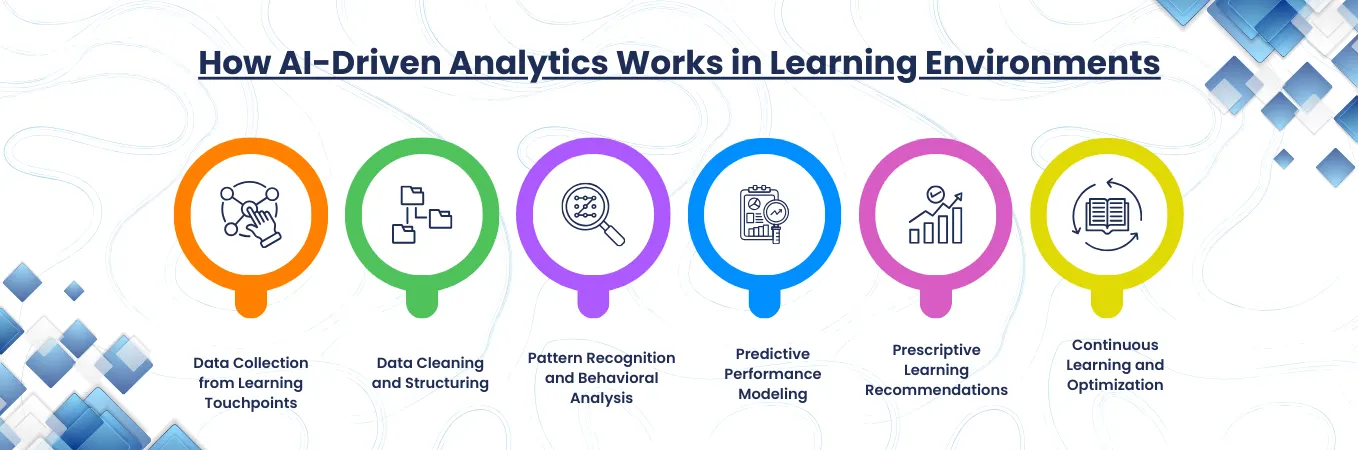
How AI-Driven Analytics Works in Learning Environments

AI-driven learning analytics follows a structured process:

  1. Data Collection from Learning Touchpoints
    LMS platforms and ERP software for school capture learner data from assessments, mobile apps, attendance records, and interaction logs to build a complete view of learning behavior and performance.

  2. Data Cleaning and Structuring
    Raw learning data is filtered, standardized, and organized so AI models can accurately analyze patterns, eliminate inconsistencies, and ensure reliable insights for decision-making.

  3. Pattern Recognition and Behavioral Analysis
    Machine learning algorithms study engagement trends, assessment attempts, and learning habits to uncover hidden patterns that indicate strengths, challenges, and learning preferences.

  4. Predictive Performance Modeling
    Artificial Intelligence uses historical and real-time data to predict learner outcomes such as skill mastery, disengagement risk, or completion probability before performance issues become visible.

  5. Prescriptive Learning Recommendations
    Based on predictions, AI suggests personalized learning paths, additional resources, remedial content, or instructor intervention to improve learner progress and outcomes.

  6. Continuous Learning and Optimization
    As learners interact further, AI models refine insights continuously, ensuring analytics remain accurate, adaptive, and aligned with evolving learning needs and behaviors.


Key Ways AI-Driven Analytics Improve Learning Outcomes

Various ways AI in digital education and learning analytics improve learning outcomes are:-

  1. Personalized Learning Experiences
    AI-driven analytics analyzes individual learner behavior, performance, and preferences to deliver customized learning paths via learning management systems. Personalization ensures learners receive relevant content at the right pace, improving comprehension, engagement, and long-term knowledge retention.

  2. Early Identification of Learning Gaps
    By continuously monitoring progress and engagement patterns, AI analytics detects learning gaps and performance risks early. Educators and trainers can intervene proactively, preventing learners from falling behind and improving overall completion and success rates.

  3. Real-Time Feedback and Adaptive Support
    AI in education and AI-powered analytics enables immediate feedback on assessments and learning activities. Learners can correct mistakes instantly, while adaptive support adjusts content difficulty and format to reinforce understanding and accelerate skill development.

  4. Improved Learner Engagement and Motivation
    Learning analytics identifies content preferences and engagement triggers, enabling dynamic learning experiences. By aligning content with learner interests and abilities, it sustains motivation, reduces dropout rates, and encourages consistent participation.

  5. Data-Driven Instruction and Curriculum Design
    Educators use artificial intelligence in education insights to evaluate content effectiveness, refine curriculum structure, and optimize instructional strategies. This data-driven approach ensures teaching methods align with learner needs and measurable learning outcomes.

  6. Measurable Learning Impact and Continuous Improvement
    AI in digital education tracks learning outcomes over time, enabling institutions to measure effectiveness, optimize programs continuously, and align learning initiatives with academic or business objectives for sustained improvement.


Essential AI Tools and Features for Learning Analytics

  1. Predictive Performance Dashboards
    AI dashboards in learning management systems track learner engagement, assessment scores, and progress in real time. They can predict skill gaps, dropout risks, and mastery levels, enabling timely interventions.

  2. Personalized Learning Path Generators
    AI tools analyze learner behavior and performance to recommend customized learning paths, resources, and practice exercises, ensuring each learner progresses at the right pace.

  3. Engagement and Interaction Trackers
    These tools monitor how learners interact with content—time spent on lessons, video completions, quiz attempts—and identify patterns that drive engagement or reveal areas of struggle.

  4. Adaptive Assessment Tools
    Artificial intelligence in education adjusts assessment difficulty and question types based on learner responses. This ensures accurate measurement of comprehension while providing real-time feedback.

  5. Content Recommendation Engines
    AI recommends additional resources, remedial lessons, or advanced topics based on learner performance and preferences, helping learners stay on track and motivated.
     

Challenges of AI-Driven Learning Analytics

  1. Data Quality and Integration Issues
    AI-driven learning analytics relies heavily on accurate and consistent data. Incomplete, fragmented, or poorly integrated data from multiple LMS platforms can reduce insight quality and lead to unreliable learning predictions.

  2. Data Privacy, Security, and Compliance
    Handling sensitive learner data raises concerns around privacy, consent, and regulatory compliance. Institutions must ensure secure data storage, ethical usage, and adherence to data protection regulations to maintain trust.

  3. Bias and Transparency in AI Models
    AI algorithms may unintentionally reflect biases present in training data. Without transparency and regular evaluation, analytics insights can become unfair or misleading, impacting learner support and decision-making.

  4. Adoption and Change Management
    Educators and organizations may resist analytics-driven approaches due to skill gaps or cultural barriers. Successful implementation requires training, clear communication, and trust in AI-supported insights.


ZYNO Upskill: AI-Driven Analytics for Corporate Learning Management

ZYNO Upskill, developed by Elite Mindz, is best learning management software designed specifically for corporate training and workforce development. It uses AI-driven analytics to help organizations understand employee learning behavior, skill gaps, and training effectiveness.

ZYNO Upskill tracks learner progress across courses, certifications, and skill pathways. AI Learning analytics identify areas where employees need support and recommend targeted learning interventions. This enables faster onboarding, continuous upskilling, and improved workforce readiness.

For learning and development teams, ZYNO Upskill provides dashboards that connect learning outcomes with business objectives, making training measurable and strategic rather than administrative.
 

ZYNO Eduvibe: AI-Enabled Insights for School ERP Systems

ZYNO Eduvibe extends AI-driven analytics into school and academic management. As a comprehensive ERP software for, it integrates academic performance, attendance, assessments, and behavioral data into a unified system.

AI in digital education provides insights to monitor student progress, identify learning gaps early, and support teachers with actionable data. Administrators gain visibility into academic trends, helping them make informed decisions about curriculum planning and student support programs.

ZYNO Eduvibe ensures that data does not remain isolated across departments but works together to improve student outcomes holistically.
 

Implementation Roadmap: Getting Started with AI Analytics

  1. Assess Digital Learning Readiness
    Begin by evaluating your current LMS platforms, ERP software for schools and data infrastructure. This helps determine whether systems can support AI-driven analytics and identifies gaps that need to be addressed.

  2. Establish Data Governance and Integration
    Integrate learning data from multiple sources into a unified system. Define policies for privacy, security, and ethical artificial intelligence in education usage.

  3. Start with Pilot Programs
    Implement AI analytics in small, focused use cases such as learner engagement tracking or early risk detection. Pilots help validate insights, fine-tune models, and demonstrate value before large-scale rollout.

  4. Enable Educators and Stakeholders
    Train educators, trainers, and administrators to interpret learning analytics dashboards and apply insights effectively. Adoption improves when users understand how data supports better learning decisions.

  5. Monitor, Optimize, and Scale
    Continuously review analytics outcomes, model accuracy, and learning impact. Use these insights to refine strategies, expand AI analytics across programs, and embed data-driven decision-making into learning operations.


Ethical, Privacy, and Governance Considerations

Implementing AI-driven learning analytics comes with significant responsibility. Organizations must ensure that data is used ethically, securely, and transparently to maintain trust and comply with legal requirements. Here’s a detailed explanation of the key considerations:

  1. Data Privacy and Learner Consent
    Learner data is sensitive and must be handled carefully. Institutions need to obtain clear consent from learners for data collection, storage, and use. Personal information, performance records, and behavioral data must be securely stored and accessible only to authorized personnel to protect privacy.

  2. Algorithm Transparency
    AI models can be complex and opaque, making it hard for educators and learners to understand how recommendations are generated. Ensuring transparency in AI algorithms allows stakeholders to trust insights, understand the basis for predictions, and make informed decisions.

  3. Bias Detection and Mitigation
    The historical data can be biased, which the AI models may inevitably transmit, which could disadvantage some learners or groups. Biases have to be constantly monitored, tested and corrected so as to have a fair and equitable learning process among the participants.

  4. Compliance with Regulations
    Organizations also have to comply with local and international laws, e.g., GDPR, FERPA, or other laws on data protection. Compliance would guarantee that the handling, storing and processing of data complies with the legal requirements and prevents the possible ethical or legal problems.
     

ZYNO by Elite Mindz incorporates these principles into its design. It provides secure data storage, transparent AI-driven insights, and governance frameworks, ensuring ethical adoption of artificial intelligence in education while protecting learner privacy and supporting responsible decision-making.
 

The Future of AI-Driven Learning Analytics

AI-driven learning analytics is set to transform the learning landscape further, moving from tracking performance to actively guiding learning and career development. Here’s a detailed look at the future directions:

  1. AI Learning Copilots
    AI will function as a personalized learning assistant for each learner, providing real-time guidance, answering questions, recommending content, and adjusting learning paths dynamically. These copilots will make learning more interactive, adaptive, and responsive to individual needs, effectively supporting both students and employees throughout their learning journey.

  2. Career and Skill Prediction Engines
    AI analytics will increasingly predict future skill requirements and career pathways by analyzing learner progress, performance trends, and industry demands. This allows organizations to proactively align training programs with workforce needs and helps learners plan for future roles, bridging skill gaps before they become a challenge.

  3. Lifelong Learning Intelligence Systems
    Learning analytics will extend beyond formal education or single training programs, supporting continuous, lifelong learning. Systems will track skill development over time, suggest learning opportunities for career growth, and adapt learning strategies to evolving personal and professional goals, ensuring ongoing competency development.

Those organizations that embrace these advanced AI-driven capabilities early on will have a competitive edge that is substantially high and enhances learner performance, workforce preparedness, and decision-making in the education and corporate sectors.
 

To Conclude

The use of AI in learning analytics is changing the nature of learning success in measuring and attaining. Organizations are able to provide personalized, engaging and outcome oriented learning experiences by transforming learning data into meaningful insights.

With solutions like ZYNO Upskill for corporate learning and ZYNO Eduvibe for academic management, ZYNO by Elite Mindz enables institutions to move from fragmented data to intelligent learning ecosystems.

If you are ready to improve learning outcomes with data-driven intelligence, ZYNO by Elite Mindz can help you implement AI-powered analytics tailored to your learning environment. Connect with us to build smarter learning systems today.
 

Checklist: Are You Ready for AI-Driven Learning Analytics?

  • Digital learning infrastructure in place

  • Access to learner engagement and performance data

  • Clear learning outcome goals

  • Faculty or trainer readiness

  • Data privacy and governance policies

  • Analytics-driven decision culture


FAQs

What is AI-driven learning analytics?
It uses AI and machine learning to analyze learner data and provide predictive and prescriptive insights.

How does AI analytics improve learning outcomes?
By personalizing learning, predicting risks, enabling early intervention, and optimizing instruction.

Is AI analytics suitable for corporate training?
Yes, it helps identify skill gaps, measure ROI, and improve workforce readiness.

Are learner data and privacy protected?
When implemented correctly, AI analytics platforms follow strict data governance and compliance standards.

How does ZYNO by Elite Mindz support AI-driven analytics?
ZYNO integrates AI-powered dashboards, adaptive learning paths, and predictive insights to improve learning effectiveness.

Are you looking for a professional advisor for your business?

Get in Touch with Our IT Consultants

Complete the form and discuss implementation strategies with our IT expertise.

Get a Quote in Minutes

next
next
next

Related Blogs

AI Enablement in the Age of Generative AI: ZYNO by Elite Mindz Leading the Charge

AI Enablement in the Age of Generative AI: ZYNO by Elite Mindz Leading the Charge

Read More →

Top 10 Trends Shaping the Future of AI Agents in 2025

Top 10 Trends Shaping the Future of AI Agents in 2025

Read More →
Top 5 AI Chatbot Features Transforming Customer Engagement in 2025

Top 5 AI Chatbot Features Transforming Customer Engagement in 2025

Read More →
Top 10 AI Integration Strategies for Seamless ERP and CRM Upgrades in 2025

Top 10 AI Integration Strategies for Seamless ERP and CRM Upgrades in 2025

Read More →
Best GAI Consulting Approaches for Ethical Business Transformation in 2025

Best GAI Consulting Approaches for Ethical Business Transformation in 2025

Read More →
From Vision to Value: The Ultimate Guide to Enterprise GenAI Platforms

From Vision to Value: The Ultimate Guide to Enterprise GenAI Platforms

Read More →
Top 10 GAI Development Trends Shaping Autonomous Agents in 2025

Top 10 GAI Development Trends Shaping Autonomous Agents in 2025

Read More →
The Future of Computer Vision: Trends to Watch in 2025

The Future of Computer Vision: Trends to Watch in 2025

Read More →
Generative AI in 2025: How ZYNO BY Elite Mindz is Transforming Enterprise Workflows

Generative AI in 2025: How ZYNO BY Elite Mindz is Transforming Enterprise Workflows

Read More →
10 Real-World Applications of Computer Vision in 2025

10 Real-World Applications of Computer Vision in 2025

Read More →
Integrating Computer Vision with IoT and AI: Driving the Next Wave of Intelligent Systems in 2025

Integrating Computer Vision with IoT and AI: Driving the Next Wave of Intelligent Systems in 2025

Read More →
Agentic AI Explained: How AI Agents Are Transforming Business in 2025

Agentic AI Explained: How AI Agents Are Transforming Business in 2025

Read More →
From Chatbots to Autonomous Agents: The Evolution of Agentic AI

From Chatbots to Autonomous Agents: The Evolution of Agentic AI

Read More →
The Rise of Multi-Agent Systems: How Agentic AI Teams Will Run Enterprises of the Future

The Rise of Multi-Agent Systems: How Agentic AI Teams Will Run Enterprises of the Future

Read More →
Agentic AI vs Generative AI: What Business Leaders Need to Know

Agentic AI vs Generative AI: What Business Leaders Need to Know

Read More →
The Power of Autonomous Agents: Understanding Agentic AI for Enterprises

The Power of Autonomous Agents: Understanding Agentic AI for Enterprises

Read More →
The Role of Agentic AI in Enhancing Enterprise Agility and Responsiveness

The Role of Agentic AI in Enhancing Enterprise Agility and Responsiveness

Read More →
Agentic AI as a Competitive Advantage: Why Businesses Can’t Ignore It

Agentic AI as a Competitive Advantage: Why Businesses Can’t Ignore It

Read More →
The Shift from Automation to Autonomy: How Agentic AI is Redefining Enterprise Operations

The Shift from Automation to Autonomy: How Agentic AI is Redefining Enterprise Operations

Read More →
From Reactive to Proactive: How Agentic AI Changes Enterprise Decision-Making

From Reactive to Proactive: How Agentic AI Changes Enterprise Decision-Making

Read More →
Why Every Business Will Hire an AI Agent Soon

Why Every Business Will Hire an AI Agent Soon

Read More →
Agentic AI for Startups: Leveling the Playing Field

Agentic AI for Startups: Leveling the Playing Field

Read More →
Agentic AI: The New Digital Workforce

Agentic AI: The New Digital Workforce

Read More →
The Future of Business: Autonomous Teams of AI Agents

The Future of Business: Autonomous Teams of AI Agents

Read More →
From Insights to Action: How AI Agents Close the Gap

From Insights to Action: How AI Agents Close the Gap

Read More →
Agentic AI in 2025: From Hype to Enterprise-Ready Transformation

Agentic AI in 2025: From Hype to Enterprise-Ready Transformation

Read More →
The Competitive Edge: Why Early Adopters of Agentic AI Are Winning Markets

The Competitive Edge: Why Early Adopters of Agentic AI Are Winning Markets

Read More →
Beyond Automation: Why Agentic AI is the Key to Enterprise Agility in 2025

Beyond Automation: Why Agentic AI is the Key to Enterprise Agility in 2025

Read More →
The Human-AI Partnership: Building Smarter Teams with Agentic AI

The Human-AI Partnership: Building Smarter Teams with Agentic AI

Read More →
The Rise of Autonomous Teams: Why Agentic AI is the New Digital Workforce

The Rise of Autonomous Teams: Why Agentic AI is the New Digital Workforce

Read More →
Top ML Use Cases You Didn’t Know About

Top ML Use Cases You Didn’t Know About

Read More →
What Is Low Code/No Code and Why It Matters in 2025

What Is Low Code/No Code and Why It Matters in 2025

Read More →
Top Use Cases of Generative AI in 2025

Top Use Cases of Generative AI in 2025

Read More →
The Future of Generative AI in Enterprises

The Future of Generative AI in Enterprises

Read More →
How Generative AI Is Reshaping Enterprise Operations in 2025

How Generative AI Is Reshaping Enterprise Operations in 2025

Read More →
Top AI Features Every Modern Taxi App Must Include in 2026

Top AI Features Every Modern Taxi App Must Include in 2026

Read More →
The Future of Events: How Artificial Intelligence Is Changing the Industry

The Future of Events: How Artificial Intelligence Is Changing the Industry

Read More →
Why Are AI Agents the Next Big Shift in Banking and Finance

Why Are AI Agents the Next Big Shift in Banking and Finance

Read More →
How AI-Driven Analytics Improve Learning Outcomes

How AI-Driven Analytics Improve Learning Outcomes

Read More →