×
A business expense tracker is a system — software, app, or platform — that records, categorizes, and monitors all financial spending within an organization. It's the operational backbone that transforms chaotic receipts, ad-hoc reimbursement requests, and scattered corporate card statements into clean, auditable financial data.
But here's what most articles won't tell you: a good Business Expense Tracker isn't just about recording what was spent. It's about controlling what gets spent — before, during, and after the transaction.
Modern expense tracking platforms function at three levels:
Whether you're a startup with 5 employees submitting expense claims via WhatsApp, or an enterprise running global teams with multi-currency corporate cards, the right expense management system changes everything.
Book a Free Demo of ZYNO’s Business Expense Tracker and Simplify Corporate Expense ManagementBook a free demo of ZYNO’s Business Expense Tracker to automate approvals, reimbursements, and reporting while gaining complete control over corporate spending.
Let's be blunt. If you're still managing employee expenses with spreadsheets, email chains, or paper receipts, you are losing money every single month — and you probably don't know exactly how much.
Here's what the data shows:
The average company overspends 19% on T&E expenses because of lack of visibility and poor policy enforcement. For a business spending ₹50 lakhs annually on travel and entertainment, that's almost ₹10 lakhs in preventable waste.
Receipt fraud is real. Studies show nearly 19% of expense reports contain some form of policy violation, ranging from inflated amounts to outright fake receipts.
Finance teams waste 2-3 hours per expense report in follow-ups, corrections, and approvals when processes are manual. Multiply this by hundreds of reports per month.
Reimbursement delays hurt employee satisfaction. When employees wait 3–4 weeks to get reimbursed for out-of-pocket business expenses, it affects morale, especially for field staff and frequent travelers.
The solution isn't just software — it's the right software. Here's how to find it.
Not all expense tracking software is built the same. Here are the features that actually matter — ranked by what separates average tools from excellent ones.
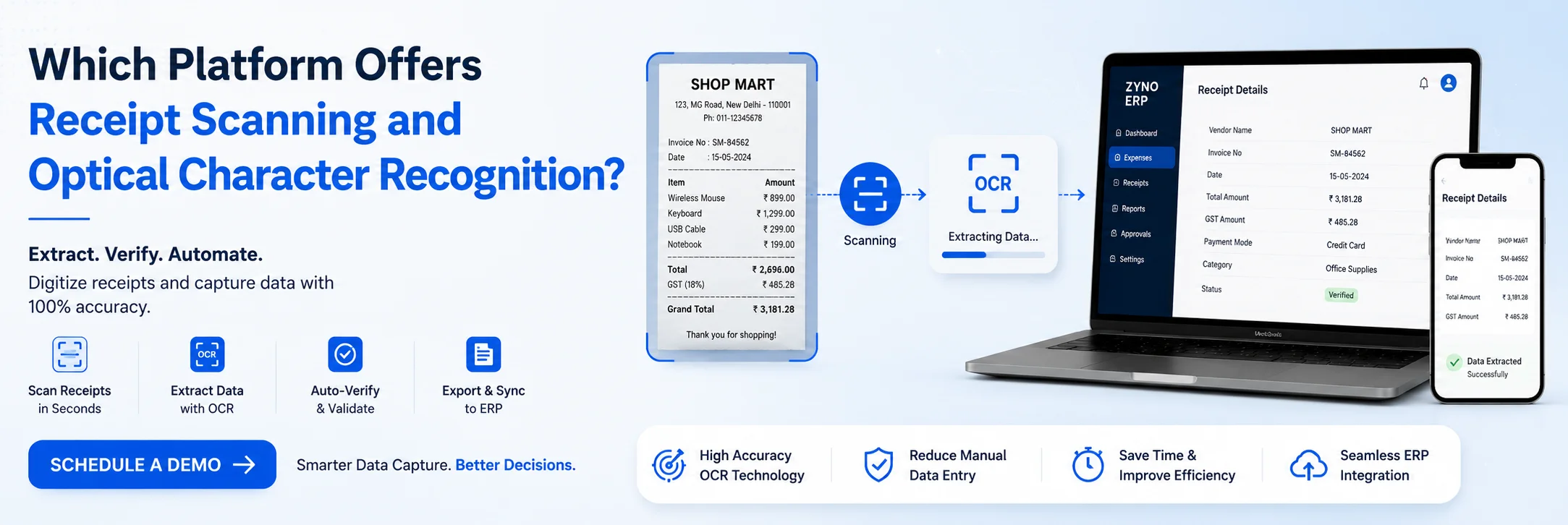
The best tools let employees photograph receipts with their phone, and the software automatically reads the merchant, amount, date, and category using OCR and AI. Zero manual entry. Zero lost receipts.
When your expense tracker is connected to your Corporate Cards, every transaction is automatically logged. No more collecting receipts at month-end. The card swipe is the expense entry.
Set multi-level approval rules based on expense type, department, amount, or employee level. A ₹500 team lunch shouldn't need the CFO's sign-off. A ₹5,00,000 equipment purchase should.
Your expense data should flow automatically into QuickBooks, Tally, Xero, NetSuite, SAP, or whatever system your finance team uses. Manual data transfer between systems is where errors happen.
A business expense tracker should enforce your expense policy at the point of submission — flagging out-of-policy items, blocking certain merchant categories, and requiring justification for exceptions.
For companies with global teams or international travel, the tracker must handle currency conversion, exchange rate capture at time of transaction, and accurate local tax reporting.
From submission to payment, the system should handle the full reimbursement lifecycle — with direct bank transfer capabilities and clear employee communication at each stage.
The difference between basic tracking and strategic Expense Management is data. Can you see spend by department, project, vendor, or employee? Can you spot trends and anomalies before they become problems?
Finance managers work in offices. Sales teams and field employees work everywhere else. A mobile app that's clunky, slow, or missing key features will result in employees avoiding it — defeating the purpose entirely.
The tool that works for 10 employees must still work when you have 500. Check whether pricing scales reasonably and whether the system can handle your growth without requiring a platform migration.
Compare top spend and expense management tools for modern businesses.
| Tool | Best for | Key strengths | Limitation |
|---|---|---|---|
|
Ramp
USA |
US SMBs & mid-market | AI receipts, duplicate detection, 60+ integrations | Limited India & Asia support |
|
Zoho Expense
India |
Zoho ecosystem users | GST compliance, 150+ currencies, offline receipts | Busy UI; analytics needs Premium |
|
Expensify
Global |
Frequent travelers | SmartScan, travel integrations, one-click reports | Expensive at scale; complex pricing |
|
SAP Concur
Global |
Large global enterprises | Multi-entity, SAP ERP integration, strong compliance | Dated UI; costly for SMBs |
|
Rippling
Global |
HR + expense + IT teams | Unified HR-payroll-expense, auto onboarding/offboarding | Costly with multiple modules |
|
Fyle
India |
Indian startups & SMBs | GST & TDS, Gmail/Outlook integration, Tally support | Weak for multinational use |
|
Happay
India |
Large Indian enterprises | Corporate cards, petty cash, Indian compliance | Best for 100+ employees only |
|
FreshBooks
Global |
Freelancers & micro teams | Simple UI, invoice billing, mileage tracking | No approval workflows |
|
Webexpenses
UK/EU |
UK & European mid-market | VAT reclaim, HMRC compliance, mileage auto-calc | Less competitive outside UK/EU |
|
Pleo
Europe |
European startups | Smart cards, auto-categorization, real-time alerts | Europe-focused only |
Here's an honest, use-case-driven comparison of the leading expense management platforms available today. Note that pricing can change — always verify on the vendor's website.
Use Ramp (US) or Fyle (India). Both offer generous free or low-cost tiers with enough functionality to scale with you through Series A and beyond.
Use Expensify or SAP Concur. Both are built around T&E (travel and entertainment) use cases and have the deepest integrations with travel booking platforms.
Use Rippling. When expense management is part of the same platform as your HRIS, you get automation that standalone tools simply can't match.
Healthcare expense management has unique requirements: grant tracking, insurance reimbursements, equipment categorization, and compliance documentation. SAP Concur and Ramp both have healthcare-specific configurations. Indian hospitals often prefer Happay or custom ERP integrations.
Use SAP Concur or Rippling. Both handle multi-entity, multi-currency, multi-country operations with appropriate local tax compliance.
Technology is only half the equation. The Best Expense Management Software in the world fails if the process around it is broken. Here's a step-by-step framework used by finance teams at well-run companies.
Before choosing software, document your expense policy. Answer these questions:
Your software should enforce this policy — but first, the policy must exist.
Most modern businesses operate with one of three models:
Corporate card model: Employees use company-issued cards. All spending is automatically tracked. Best for high-volume expense environments.
Reimbursement model: Employees pay out of pocket and get reimbursed. Best for occasional, low-volume expenses.
Mixed model: Corporate cards for regular business categories (SaaS, travel, client entertainment); reimbursements for incidental or irregular expenses.
Set up:
The biggest reason expense systems fail is user adoption. Run a 30-minute training session. Create a one-page cheat sheet showing how to submit expenses on mobile. Make it easy, and employees will use it.
Schedule a monthly finance review that includes:
Your expense policy should be a living document. Review it annually, or whenever business needs change significantly (new markets, remote work expansion, headcount growth).
One of the most common pain points in expense management is the data transfer between your expense tracker and your accounting system. Doing this manually is not just time-consuming — it's where most errors happen.
A proper accounting integration should:
| Accounting Software | Best Expense Trackers |
|---|---|
| QuickBooks Online | Ramp, Zoho Expense, Expensify, Fyle |
| Tally ERP | Happay, Fyle, Zoho Expense |
| Xero | Ramp, Expensify, Webexpenses |
| NetSuite | SAP Concur, Ramp, Rippling |
| SAP S/4HANA | SAP Concur |
| Zoho Books | Zoho Expense (native) |
After analyzing how hundreds of well-run companies manage expenses, these practices consistently separate high-performing finance teams from those constantly fighting fires.
Top companies require receipts to be submitted within 48 hours of a transaction. This prevents the month-end receipt avalanche and ensures data is accurate while the context is fresh.
For expenses below a certain threshold (typically ₹10,000 or $500), direct manager approval is sufficient. Finance should only review exceptions and high-value items. This removes bottlenecks without sacrificing control.
Rather than a single monthly limit, leading companies set category-specific limits: ₹3,000 for team meals, ₹8,000 for hotel per night, ₹2,500 for client entertainment per person. This gives employees clear guidance and prevents creative categorization.
For expenses above a defined threshold (e.g., ₹25,000), require pre-approval rather than after-the-fact submission. This prevents awkward denials and keeps spending predictable.
Best-in-class finance teams review their expense policies quarterly — not just annually. Market rates change, business models evolve, and policies that made sense 18 months ago may be unnecessarily restrictive or dangerously loose today.
Share monthly spend dashboards with department heads, not just the CFO. When managers can see how their team is spending — broken down by employee, category, and project — they make better decisions without Finance having to police everything.
Here's a breakdown of what manual expense reporting actually costs compared to an automated system. These numbers are based on typical mid-sized companies (100–500 employees).
| Cost Factor | Annual Impact |
|---|---|
| Finance staff time (processing, follow-up, data entry) | 40–80 hours/month |
| Employee time submitting manual reports | 1.5–3 hours per employee per month |
| Errors and duplicate payments | 1–2% of total expense spend |
| Out-of-policy spending (no real-time enforcement) | 8–15% of total expense spend |
| Reimbursement delays (employee dissatisfaction) | Indirect but real attrition risk |
For a company spending ₹1 crore annually on business expenses, automated expense management typically delivers:
Total annual savings: ₹13–24 lakhs — far exceeding the cost of even enterprise-grade software.
Read more: Best Financial Reporting Software in 2026: Top Tools CFOs Actually Use
Ramp offers a genuinely capable free tier for US businesses, covering expense tracking, reporting, and reimbursements. For Indian businesses, Fyle and Zoho Expense both offer limited free plans. For solo freelancers, Wave (free accounting software) handles basic expense tracking at no cost.
An expense management system is the combination of software, policies, and processes that a company uses to control, track, approve, and reimburse employee business expenses. Modern systems are software-driven and automate most of the administrative work.
Employees submit expenses through a mobile app or web portal, attaching receipts and specifying the category and purpose. The system routes the submission through the configured approval workflow. Once approved, the finance team processes reimbursements directly to the employee's bank account — all tracked within the same platform.
Most leading tools offer accounting integrations. Ramp, Zoho Expense, and Fyle integrate with QuickBooks; Fyle and Happay connect with Tally; Expensify and Ramp sync with Xero; SAP Concur integrates with SAP ERP. Always verify the specific version of your accounting software is supported.
Expense tracking records what was spent after the fact. Spend management is broader — it includes budgeting, pre-approval workflows, vendor management, contract tracking, and proactive spend optimization. Tools like Ramp and Rippling are moving toward full spend management; traditional expense tools focus primarily on tracking and reimbursement.
Yes — especially once you have more than 5 employees submitting expenses regularly. The time saved on manual processing, combined with the reduction in errors and out-of-policy spending, typically delivers a positive ROI within the first few months. Many tools offer free or very affordable tiers for small teams.
For US businesses, Ramp consistently receives the highest user ratings (4.8+ on G2 and Capterra) for its combination of features, usability, and value. For enterprise customers, SAP Concur remains the most widely deployed solution globally. In India, Happay and Fyle are the strongest domestic players.
Startups prioritize speed, simplicity, and cost. Ramp (US) and Fyle (India) are top choices. Both offer easy onboarding, mobile-first experiences, and pricing that scales affordably from seed stage through growth.
Book a Free Demo of ZYNO’s Business Expense Tracker and Simplify Corporate Expense ManagementBook a free demo of ZYNO’s Business Expense Tracker to automate approvals, reimbursements, and reporting while gaining complete control over corporate spending.
The right business expense tracker for your company depends on your size, geography, existing software stack, and how complex your expense workflows are.
Here's the practical summary:
Whatever tool you choose, the most important step is to also get your expense policy right. Software enforces your rules — but first, you need clear rules to enforce.
A well-configured business expense tracker doesn't just save money. It gives your finance team their time back, gives leadership real visibility into how the company's money moves, and removes the friction that makes employees avoid submitting expenses on time.
The companies that take expense management seriously consistently have tighter budgets, cleaner books, and fewer financial surprises. That's not a coincidence.
Sneha Singh
Content Writer
Sneha Singh is a B2B tech content strategist with 4+ years of experience. She specializes in SEO-driven SaaS content, whitepapers, and platform-native social media campaigns that simplify complex technology and drive business growth. Sneha's core exp
Smart IT Powering U.S. Fintech Success
Read More →

From Booking to Reimbursement: AI-Driven Travel and Expense Management
Read More →
A New Era Begins: ZYNO Expenz Brings Smarter Corporate Travel to the Middle East
Read More →
5 Hidden Pharmacy Cost Leakages ZYNO Expenz Can Eliminate
Read More →
Top AI-Powered Expense Management Systems Transforming GCC Businesses
Read More →
Technology Expense Management in 2026: A Complete Guide to Trends and Optimization
Read More →
Step by Step Guide to Build Expense Management Software
Read More →
Best Expense Management Software in the Middle East 2026
Read More →
How AI and Machine Learning Are Transforming Expense Management Software in 2026
Read More →
Top Financial Reporting Software for Accurate Business Insights
Read More →Travel Expense Management: Complete Guide for Businesses & Teams
Read More →
How Does AI Automate Expense Auditing?
Read More →Manual vs Automated Expense Management: Why Automation is the Future
Read More →Corporate Travel Booking Software: The Smart Way to Manage Business Travel
Read More →
ZYNO Expenz vs Expensify: Which One Actually Saves Your Business Money in 2026?
Read More →
Best Expense Management Software a Complete Guide in 2026
Read More →
Expense Management vs Spend Management: What's the Real Difference?
Read More →
Best Financial Reporting Software in 2026: Top Tools CFOs Actually Use
Read More →
What Is Spend Management? Definition, Process, Strategies & Best Practices
Read More →
Business Expense Tracker: The Complete Guide to Managing Corporate Expenses in 2026
Read More →Partner with ZYNO by Elite Mindz to revolutionize how your business works. Fill out the form, and we’ll reach out with AI-powered solutions made just for you.
We use browser cookies to ensure you get the best experience on our website. Learn more
The form was submitted successfully!
ZYNO Digital
Fueling Smarter Digital Growth
ZYNO Digital fuels smarter digital growth through data-driven marketing, creative storytelling, and performance strategies that boost visibility, engagement, and measurable business outcomes across global platforms.
ZYNO Tech
Engineering the Future of IT
ZYNO Tech delivers cutting-edge IT solutions — including web, mobile, and digital transformation services — helping businesses scale efficiently, innovate faster, and stay ahead in a connected world.
ZYNO AI
AI Built for Business Growth
ZYNO AI harnesses the power of artificial intelligence to automate processes, enhance decision-making, and deliver predictive insights — driving innovation, agility, and measurable business growth.
ZYNO by Elite Mindz
Your Partner in the AI-Powered Future
ZYNO by Elite Mindz offers AI-powered products and services that unify operations, boost productivity, and drive digital transformation — helping businesses scale smarter and innovate faster.
* In just 2 mins you'll get a response
* Your idea is 100% protected by our Non-Disclosure Agreement