×
One Platform for All Your Expense Management Needs.
Most business owners use expense management and spend management as if they mean the same thing. They don't. Mixing them up costs companies real money every year.
Here's a simple way to think about it. Expense management is like managing your own wallet. Spend management is like running the budget for your entire home — groceries, rent, utilities, savings, everything.
In 2026, getting this right matters more than ever. AI tools and real-time dashboards have changed how finance teams work. The companies that understand this difference save more, plan better, and catch fraud earlier.

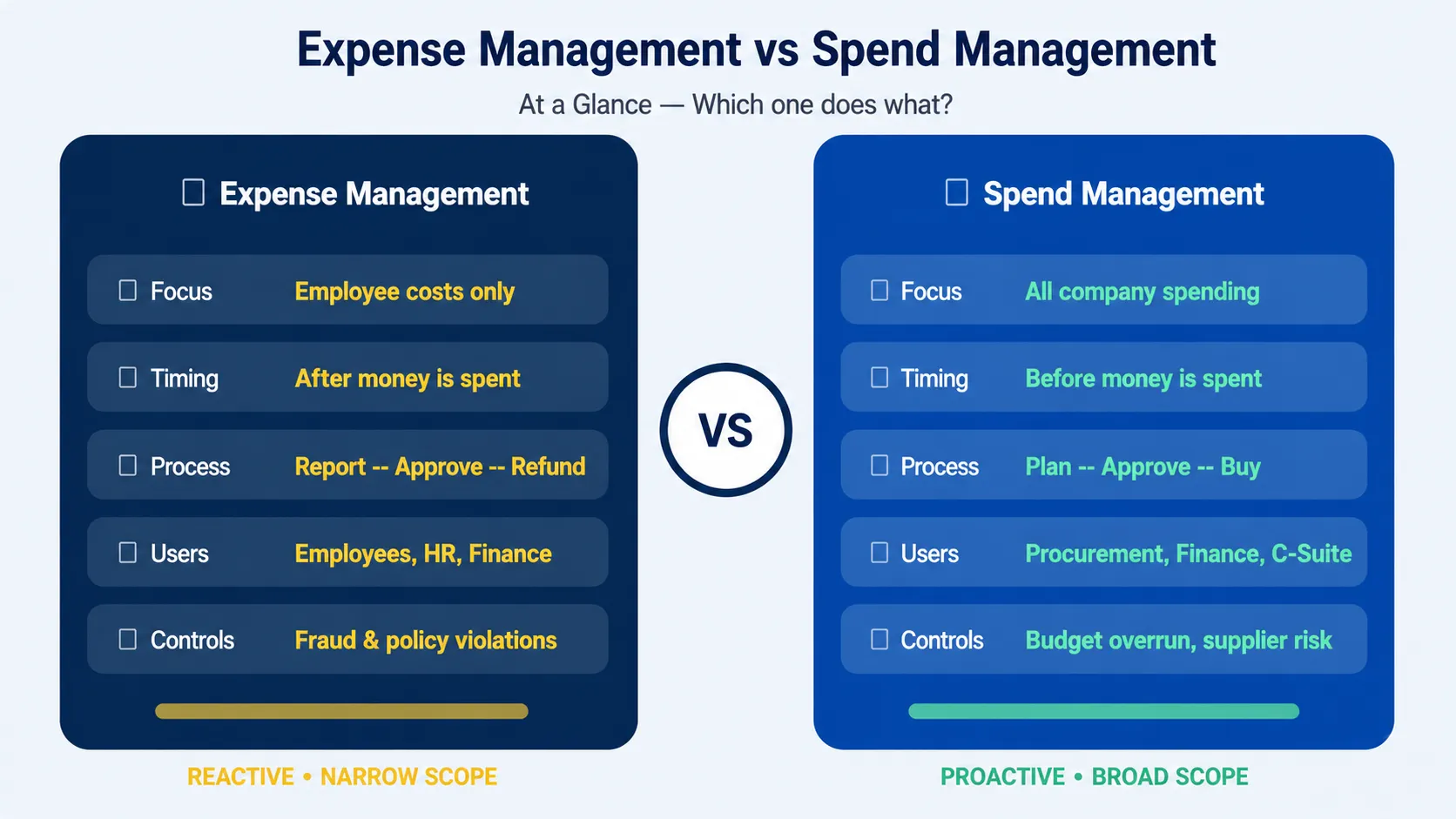
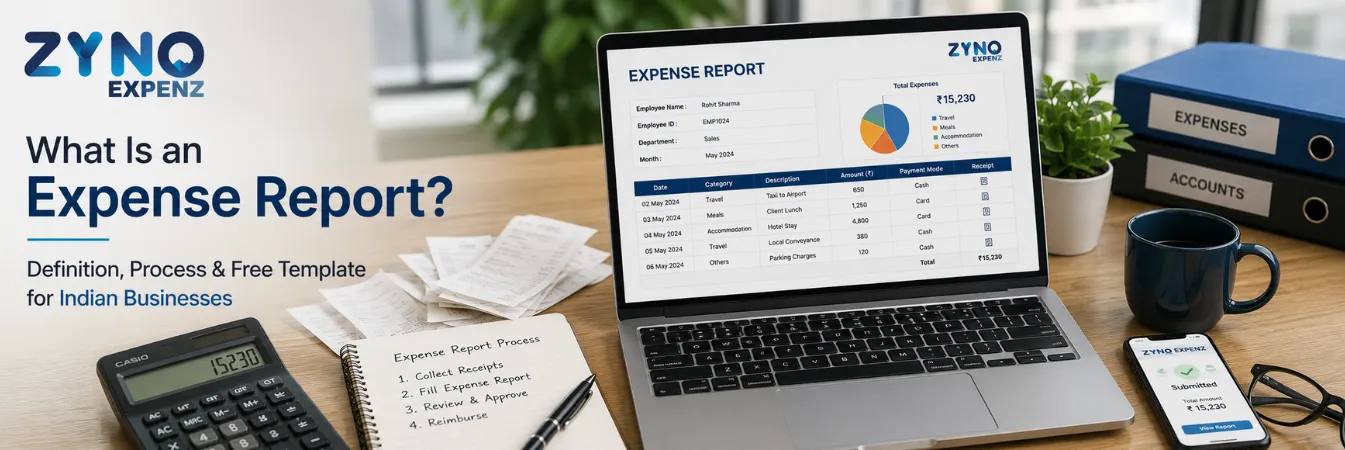
Expense management is how a company handles money that employees spend for work. It covers tracking that spending, getting it approved, and paying the employee back.
Here's a quick example. A sales rep flies to meet a client. She pays for her flight and hotel from her own pocket. After the trip, she fills out an expense report with her receipts. Her manager approves it. Finance checks it against company policy. She gets her money back. That whole process — that's expense management.
The key thing to know: expense management happens after the money is already spent. An employee pays first. Then they report it. This makes it a reactive process by nature.
Spend management is much bigger. It covers every rupee a company spends — not just what employees claim back.
Think about it this way. Expense management handles the end of the spending story. Spend management starts at the beginning. It asks the right questions upfront: Who are we buying from? Are we getting the best price? Are our supplier contracts working for us?
Spend management is proactive. Money doesn't leave the company until the right checks are in place.
This is a strategic function. It's not about one employee's hotel bill. It's about how the whole company spends its money.
| Feature | Expense Management | Spend Management |
|---|---|---|
| Focus Area | Employee costs | All company spending |
| Timing | After spending (reactive) | Before spending (proactive) |
| Scope | Narrow — reimbursable costs only | Broad — all procurement and spend |
| Who Uses It | Employees, HR, Finance team | Procurement, Finance, Leadership |
| Main Goal | Reimburse staff accurately | Optimize and control all spend |
| Tools Used | Expense apps, receipt scanners | ERP, procurement platforms |
| Decision Level | Day-to-day operational | Strategic and company-wide |
| Risk Managed | Fraud, policy violations | Budget overrun, supplier risk |
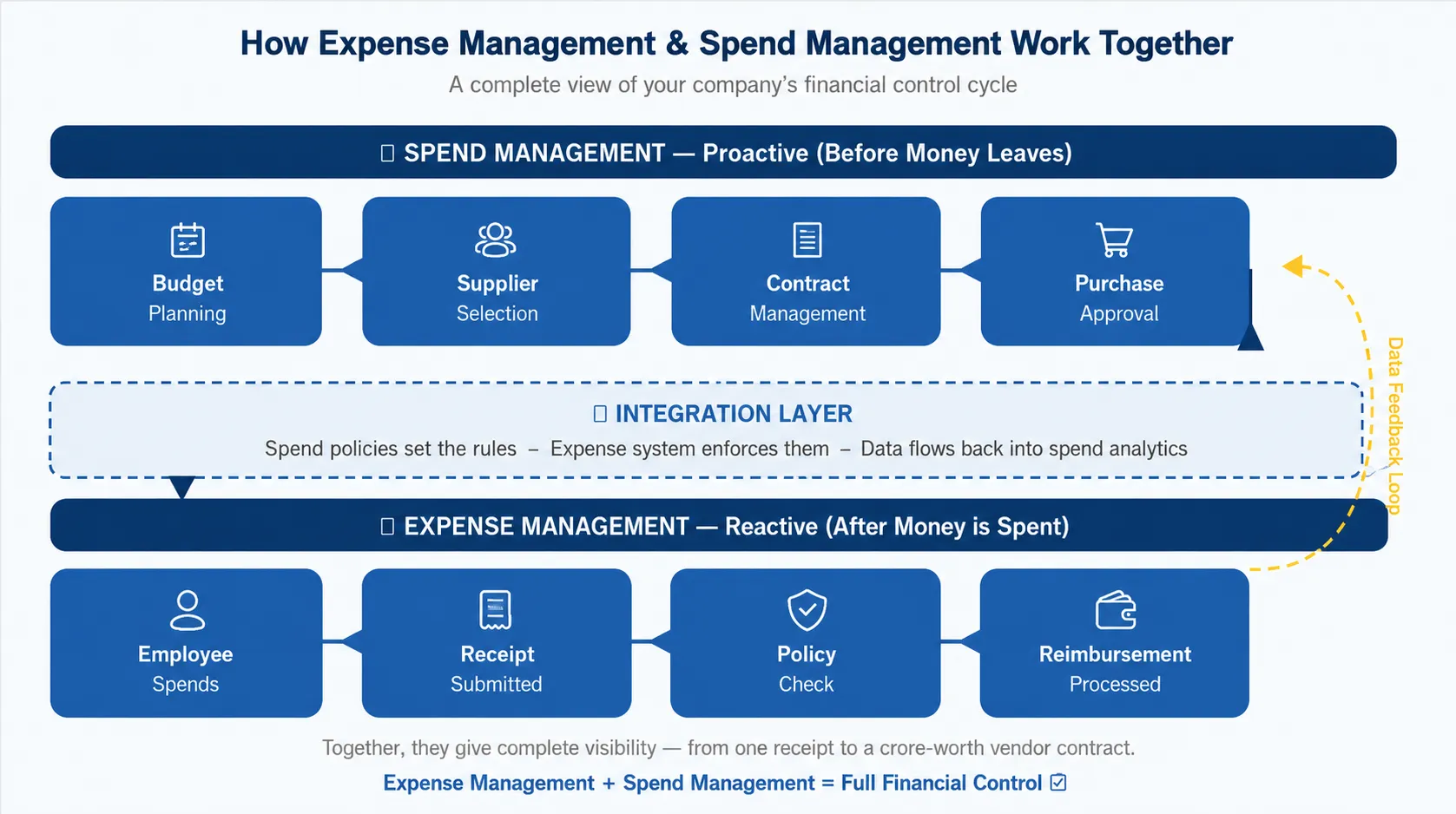
These two are not rivals. They work best together. One keeps employee costs clean. The other keeps the whole company's spending sharp.
Here's how they connect in practice:
Picture a mid-sized IT company with 200 staff. The procurement team signs a deal with a cloud software vendor. They set a rule: any software subscription under Rs. 10,000 per month can be approved at the department level.
Now an employee buys a new tool that costs Rs. 15,000 per month — without going through procurement. The expense management system catches this when she submits her receipt. It flags a policy violation. Finance steps in.
That's expense management and spend management working as a team. One caught what the other set up to catch.

Most businesses need both. But where you start depends on your company's size and stage.
Start with expense management. Your team is small. The biggest pain is probably lost receipts, slow approvals, or delayed reimbursements. Fix that first. A basic expense tool pays for itself quickly.
You need both now. Employee expenses are growing. But so are your vendor deals, procurement decisions, and budgets. This is the time to build a proper spend management process alongside your expense workflows.
Spend management becomes critical here. At this scale, even a 2% cut in procurement costs can save crores every year. You need dedicated systems, clear supplier policies, and full spend visibility across every department.
Using one generic tool for both jobs is like using a fork to cut steak. It sort of works — but not well. You need the right tool for each job, or a platform built to handle both properly.
Without a clear policy, employees guess what's allowed. This leads to disputes, rejected claims, and hours of manual review. Write your policy down. Share it with every team member. Review it once a year.
Maverick spend is when teams buy from vendors outside your approved list. This breaks your negotiated contracts and drives costs up. Spend management exists specifically to stop this. Without visibility, you lose the value of every deal your procurement team worked to win.
If your team still handles paper receipts or uses Excel for expense tracking, you're wasting time and money. Affordable automation tools exist for even small businesses. Manual processes cost 3 to 5 times more in staff hours than a basic software subscription.
| Benefit | Expense Management | Spend Management |
|---|---|---|
| Cost Savings | Cuts fraudulent claims | Optimises supplier deals |
| Time Saved | Faster reimbursements | Streamlined procurement |
| Compliance | Per-claim policy checks | Contract compliance tracking |
| Visibility | Per-employee spend data | Company-wide financial view |
| Employee Experience | Quick, hassle-free refunds | Clear approved vendor list |
| Audit Readiness | Digital receipts and trails | Documented procurement history |
AI has moved from a buzzword to a real tool in finance operations. Here's what it actually does today:
Companies using these tools in 2026 don't just save money. They build finance systems that are faster, cleaner, and harder to game.
Read more: Best Expense Management Software a Complete Guide in 2026
These are the real questions people search for — answered clearly and directly.
Expense management only tracks what employees spend — like travel, meals, or client meetings — and reimburses them. Spend management covers all company spending, including vendor contracts, procurement, budgets, and purchasing controls. Expense management is just one part of overall spend management. They are related, but not the same thing.
No. They are connected but different. Expense management is a smaller, focused process that handles employee reimbursements and receipts. Spend management is the broader strategy that includes procurement, supplier negotiations, contract tracking, and budget planning. Many companies confuse the two and end up managing neither effectively.
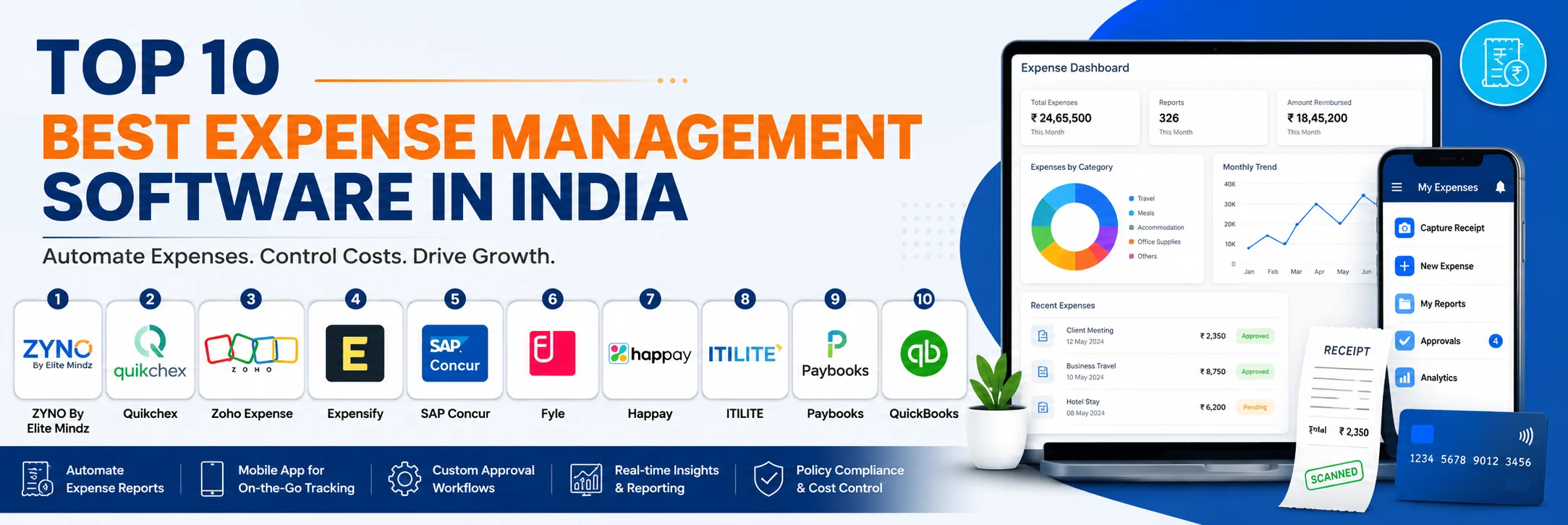
For Indian businesses, Zoho Expense is a strong first choice. It works with Tally, Zoho Books, and handles GST automatically. Fyle is great if you want real-time card reconciliation — no waiting until month-end. Both are affordable and mobile-friendly. Start with Zoho Expense if you're on Indian accounting tools.
Step 1 — Employee spends money for work. Step 2 — They save the receipt. Step 3 — They submit an expense report in the system or app. Step 4 — Their manager reviews and approves or rejects it. Step 5 — Finance checks it against company policy. Step 6 — Approved amount is transferred to the employee's account. Tools like Zoho Expense automate most of these steps — receipts are scanned, approvals are routed, and payments are tracked automatically.
Start by writing a clear expense policy. State what is allowed, what the limits are (like hotel max Rs. 4,000 per night), and which receipts are required. Then use an expense tool that flags out-of-policy claims automatically. Use corporate cards instead of personal ones where possible — spending shows up in real time. Run a monthly review to catch patterns before they become problems.
Companies with proper spend management typically cut costs by 5% to 15%. For a company spending Rs. 20 lakh per month, that's Rs. 1 to 3 lakh saved every month — just from better vendor control and fewer maverick purchases. Processing a single expense report manually takes about 20 minutes on average. Automation cuts that by up to 80%. Less time wasted, fewer errors, and more savings.
Excel works when your team is tiny and expenses are few. But once you cross 5 employees or 30+ expenses per month, it gets messy fast. Receipts go missing. Categories get mixed up. Reimbursements get delayed. Basic expense tools start at Rs. 500 per user per month. That's far cheaper than the time and fraud risk that manual tracking creates.
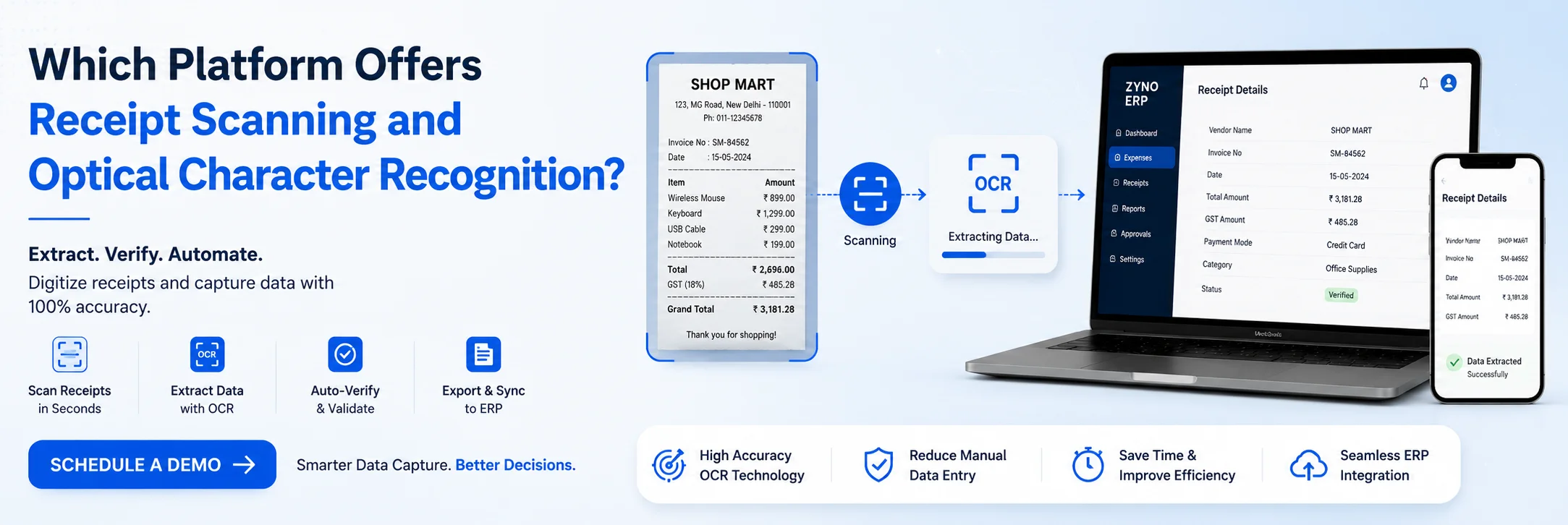
Modern AI tools do three things well. First, they read receipts automatically using OCR — no typing needed. Second, they catch duplicate claims or out-of-policy expenses before payment happens. Third, they analyse past spending to forecast future budgets. These features used to be premium add-ons. In 2026, they come standard with most good expense tools.
Yes — and this matters a lot for Indian businesses. Zoho Expense, for example, splits GST automatically on every expense, identifies which costs are eligible for Input Tax Credit (ITC), and pushes journal entries directly into Tally or Zoho Books. At audit time, everything is already sorted — receipts, GST breakdowns, category reports. Month-end close drops from 2 to 3 days to just a few hours.
Start with expense management if your team doesn't have a clean reimbursement process yet. Fix the basics first — receipts, approvals, payments. Once that runs smoothly, add spend management on top — vendor controls, procurement workflows, budget planning. Build the ground floor before you add the upper floors.
One Platform for All Your Expense Management Needs.
Expense management and spend management are not the same. But they're not rivals either. Think of them as two parts of the same financial engine.
Expense management keeps the day-to-day clean. Employees get paid back on time. Receipts don't get lost. Policy gets followed.
Spend management keeps the big picture sharp. Vendors are chosen well. Contracts are tracked. Budgets are planned with real data.
Together, they give your business full financial control — from a single employee's lunch to a company-wide procurement deal.
Start simple. Get expense management right. Then zoom out and build your spend management strategy. The businesses that master both spend smarter, waste less, and grow faster.
Sneha Singh
Content Writer
Sneha Singh is a B2B tech content strategist with 4+ years of experience. She specializes in SEO-driven SaaS content, whitepapers, and platform-native social media campaigns that simplify complex technology and drive business growth. Sneha's core exp
Smart IT Powering U.S. Fintech Success
Read More →

From Booking to Reimbursement: AI-Driven Travel and Expense Management
Read More →
A New Era Begins: ZYNO Expenz Brings Smarter Corporate Travel to the Middle East
Read More →
5 Hidden Pharmacy Cost Leakages ZYNO Expenz Can Eliminate
Read More →
Top AI-Powered Expense Management Systems Transforming GCC Businesses
Read More →
Technology Expense Management in 2026: A Complete Guide to Trends and Optimization
Read More →
Step by Step Guide to Build Expense Management Software
Read More →
Best Expense Management Software in the Middle East 2026
Read More →
How AI and Machine Learning Are Transforming Expense Management Software in 2026
Read More →
Top Financial Reporting Software for Accurate Business Insights
Read More →Travel Expense Management: Complete Guide for Businesses & Teams
Read More →
How Does AI Automate Expense Auditing?
Read More →Manual vs Automated Expense Management: Why Automation is the Future
Read More →Corporate Travel Booking Software: The Smart Way to Manage Business Travel
Read More →
ZYNO Expenz vs Expensify: Which One Actually Saves Your Business Money in 2026?
Read More →
Best Expense Management Software a Complete Guide in 2026
Read More →
What is Spend Management? Explained with Examples & Benefits
Read More →
Expense Management vs Spend Management: What's the Real Difference?
Read More →Partner with ZYNO by Elite Mindz to revolutionize how your business works. Fill out the form, and we’ll reach out with AI-powered solutions made just for you.
We use browser cookies to ensure you get the best experience on our website. Learn more
The form was submitted successfully!
ZYNO Digital
Fueling Smarter Digital Growth
ZYNO Digital fuels smarter digital growth through data-driven marketing, creative storytelling, and performance strategies that boost visibility, engagement, and measurable business outcomes across global platforms.
ZYNO Tech
Engineering the Future of IT
ZYNO Tech delivers cutting-edge IT solutions — including web, mobile, and digital transformation services — helping businesses scale efficiently, innovate faster, and stay ahead in a connected world.
ZYNO AI
AI Built for Business Growth
ZYNO AI harnesses the power of artificial intelligence to automate processes, enhance decision-making, and deliver predictive insights — driving innovation, agility, and measurable business growth.
ZYNO by Elite Mindz
Your Partner in the AI-Powered Future
ZYNO by Elite Mindz offers AI-powered products and services that unify operations, boost productivity, and drive digital transformation — helping businesses scale smarter and innovate faster.
* In just 2 mins you'll get a response
* Your idea is 100% protected by our Non-Disclosure Agreement