Procurement is no longer limited to raising purchase requests, collecting quotations, and processing invoices manually. As businesses grow, procurement teams often find themselves managing hundreds of emails, spreadsheets, supplier documents, approval requests, purchase orders, goods receipt notes, and invoices every month. This fragmented approach creates delays, increases manual errors, and makes it difficult for organizations to maintain complete visibility over spending.
This is where AI Procurement Automation is changing the way modern businesses manage purchasing and supplier operations.
With AI-powered procurement systems, organizations can automate the complete journey from an initial email or purchase request to supplier sourcing, quotation comparison, purchase order creation, goods receipt tracking, invoice processing, and payment initiation. Instead of relying on disconnected tools, businesses can use intelligent AI agents that understand natural language, extract information from documents, make workflow-based decisions, and execute repetitive procurement activities automatically.
ZYNO AI Procurement is designed around this next generation of procurement automation. It helps organizations move beyond traditional Procurement Software by connecting the entire procurement lifecycle through intelligent automation.
What Is AI Procurement Automation?
AI Procurement Automation uses artificial intelligence, machine learning, natural language processing, document intelligence, and workflow automation to simplify and automate procurement activities.
Traditional procurement processes often require employees to manually:
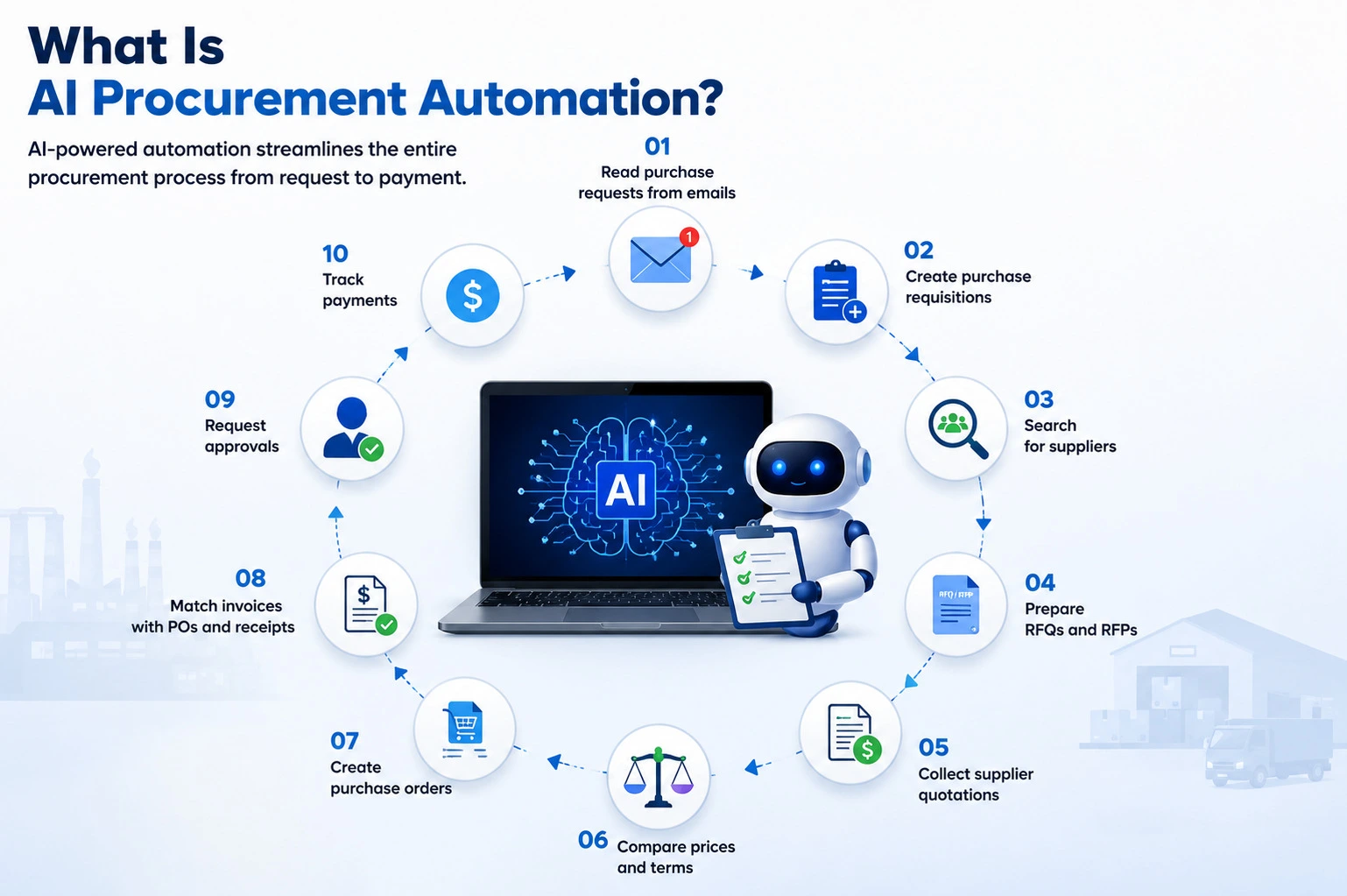
- Read purchase requests from emails
- Create purchase requisitions
- Search for suppliers
- Prepare RFQs and RFPs
- Collect supplier quotations
- Compare prices and terms
- Create purchase orders
- Match invoices with POs and receipts
- Request approvals
- Track payments
AI agents can assist with or automate many of these tasks. They can understand an employee's request in natural language, extract relevant information from emails and documents, identify the required procurement workflow, and trigger the next step automatically.
For example, an employee may send an email saying:
"We need 50 laptops with 16GB RAM and 512GB storage for the new sales team."
An AI procurement agent can identify the product category, quantity, specifications, and business requirement. It can then initiate a purchase requisition, route it for approval, launch a quotation request, compare supplier responses, and move the selected purchase through the purchase-to-payment process.
This makes procurement faster, more structured, and significantly less dependent on manual data entry.
Automate Your Entire Procurement Process with ZYNO AI
Transform procurement from email to payment with AI-powered automation. Streamline purchase requests, automate invoice verification, accelerate approvals, and gain complete visibility across every procurement stage with ZYNO AI Procurement Automation.
Why Traditional Procurement Processes Are No Longer Enough
Many organizations still manage procurement using a combination of email, Excel spreadsheets, ERP systems, and separate accounting tools. While these tools may work individually, they often create gaps between procurement activities.
A typical process may look like this:
- An employee sends a purchase request through email.
- A procurement executive manually creates a requisition.
- The team searches for suppliers.
- RFQs are sent manually.
- Supplier quotations arrive in different formats.
- Procurement teams compare quotations in spreadsheets.
- The selected supplier is approved.
- A purchase order is created manually.
- The receiving team confirms delivery.
- The supplier sends an invoice.
- Finance manually matches the invoice with the PO.
- The invoice is approved for payment.
Every manual handoff creates the possibility of delays, duplicate data entry, errors, and communication gaps.
With End-to-End Procurement Automation, businesses can connect these steps into a single digital workflow. AI agents can help manage repetitive activities while keeping humans involved in approvals, exceptions, negotiations, and strategic decisions.
How AI Agents Automate Procurement from Email to Payment
The biggest advantage of AI-powered procurement is that automation does not have to begin with a structured form. It can begin with an email, chat message, document, or natural-language request.
Here's how an AI-enabled procurement workflow can operate.
AI Reads Emails and Identifies Purchase Requirements
The procurement process often begins with an email.
An employee may send:
"Please arrange 100 office chairs for the new branch. The required delivery date is next month."
Instead of asking the employee to complete multiple forms, an AI agent can analyze the email and identify:
- Product or service required
- Quantity
- Delivery timeline
- Department
- Location
- Budget information
- Business purpose
The AI agent can then convert this unstructured request into a structured procurement workflow.
This is one of the most important capabilities of AI Procurement Software because it allows businesses to automate procurement without forcing every employee to learn complex systems.
Automatic Purchase Requisition Creation
Once the requirement is identified, the AI agent can create a purchase requisition automatically.
Purchase Requisition Software helps businesses formally capture purchasing requirements before a purchase order is issued.
A purchase requisition may include:
- Item description
- Quantity
- Required date
- Department
- Cost center
- Estimated budget
- Supplier preference
- Supporting documents
AI can automatically populate these fields based on the original email or uploaded document.
The requisition can then be routed through the appropriate approval workflow based on:
- Purchase value
- Department
- Category
- Budget availability
- Approval hierarchy
This eliminates repetitive data entry and reduces the risk of incorrect requisition information.
AI-Powered RFQ Automation
Once a purchase requisition is approved, the next step is often supplier sourcing.
RFQ Automation Software can help procurement teams create and distribute requests for quotations automatically.
AI can:
- Identify the required product or service
- Select relevant suppliers
- Prepare RFQ documents
- Send RFQs through email or supplier portals
- Track supplier responses
- Send automated reminders
- Extract quotation information
Instead of manually preparing every RFQ, procurement teams can use AI to automate the process.
For example, if a company needs office equipment, the AI system can identify relevant suppliers based on approved vendor records, category, location, historical performance, and pricing history.
RFP Management with AI
For complex procurement projects, organizations may need to issue detailed requests for proposals.
RFP Management Software helps companies manage the complete RFP lifecycle, from preparing requirements to evaluating supplier proposals.
AI can assist with:
- RFP creation
- Requirement analysis
- Supplier communication
- Proposal document extraction
- Response comparison
- Evaluation scoring
- Compliance checks
AI agents can also identify whether supplier responses meet predefined requirements.
For example, an RFP may require:
- ISO certification
- Specific delivery timelines
- Minimum service-level commitments
- Security standards
- Industry experience
The AI system can analyze supplier responses and highlight which requirements are met, missing, or unclear.
This allows procurement teams to focus on supplier strategy instead of manually reviewing every document line by line.
Transform Your RFP Management Process with AI
Eliminate manual RFP processes with AI-powered automation. Create RFPs faster, collaborate with stakeholders, evaluate vendor proposals intelligently, automate approvals, and make data-driven sourcing decisions with ZYNO AI Procurement.
AI Automatically Compares Supplier Quotations
Supplier quotation comparison is one of the most time-consuming procurement activities.
Suppliers may submit quotations in different formats, including:
- PDF files
- Excel spreadsheets
- Email messages
- Word documents
- Supplier portals
A traditional process requires procurement teams to manually extract and compare information.
AI can automate this process by identifying:
- Product or service price
- Quantity
- Taxes
- Discounts
- Delivery charges
- Delivery timelines
- Payment terms
- Warranty conditions
- Additional costs
The system can then create a standardized comparison.
For example:
|
Supplier
|
Total Price
|
Delivery Time
|
Payment Terms
|
Warranty
|
|
Supplier A
|
₹10,00,000
|
7 Days
|
30 Days
|
2 Years
|
|
Supplier B
|
₹9,75,000
|
14 Days
|
45 Days
|
1 Year
|
|
Supplier C
|
₹10,25,000
|
5 Days
|
30 Days
|
3 Years
|
AI can help identify the best option based on the organization's procurement policies and evaluation criteria.
Importantly, AI does not necessarily replace procurement professionals. Instead, it provides better insights so that procurement teams can make faster and more informed decisions.
Purchase Order Automation Software: From Approval to PO
After a supplier is selected and approved, the next step is creating a purchase order.
Purchase Order Automation Software can automatically generate POs using approved requisition and quotation data.
The system can populate:
- Supplier information
- Product details
- Quantities
- Prices
- Taxes
- Delivery terms
- Payment terms
- Purchase order number
This eliminates the need to manually re-enter information from a quotation into a purchase order.
AI agents can also check for inconsistencies before the PO is issued.
For example, the system may flag:
- Price differences between the quotation and PO
- Incorrect quantities
- Missing approvals
- Supplier contract mismatches
- Budget violations
This helps improve procurement compliance and reduces costly mistakes.
AI-Enabled Goods Receipt and GRN Tracking
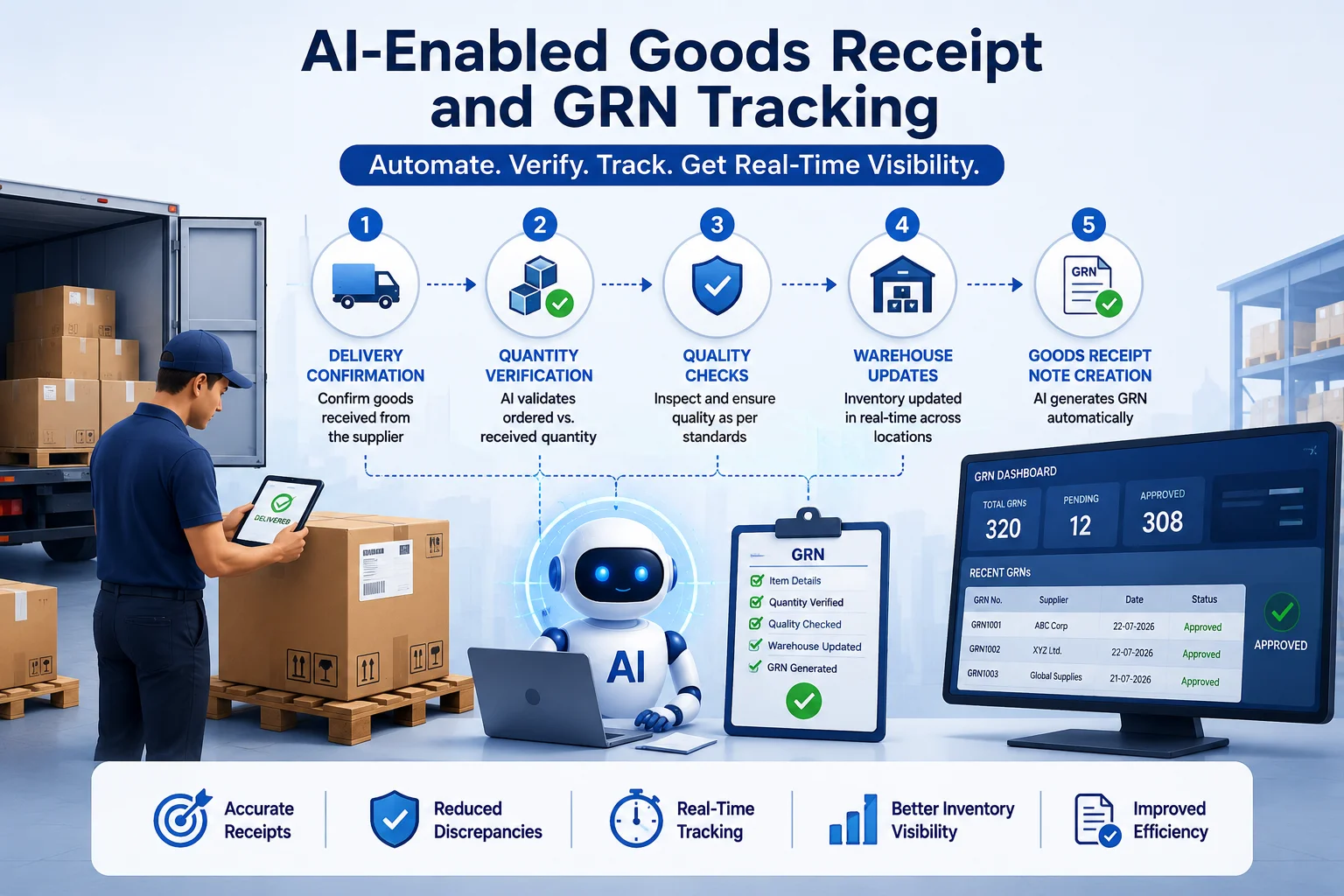
Procurement does not end when a purchase order is created.
Organizations also need to confirm whether the goods or services were received correctly.
The goods receipt process can involve:
AI can help compare the purchase order with delivery documents and receiving information.
For example:
Purchase Order: 100 units
Delivered: 95 units
The system can identify the mismatch and automatically flag the transaction for review.
This is important for preventing incorrect payments and improving inventory accuracy.
AI Invoice Processing Software for Faster Accounts Payable
Invoice processing is another area where businesses lose significant time.
Invoices may arrive through:
- Email
- Supplier portals
- PDF uploads
- Scanned documents
- Paper-based processes
AI Invoice Processing Software can automatically extract important invoice information using OCR and document intelligence.
The system can identify:
- Supplier name
- Invoice number
- Invoice date
- Purchase order number
- Line items
- Tax details
- Total amount
- Payment terms
The system can then match the invoice against the purchase order and goods receipt.
This process is commonly known as three-way matching.
Three-Way Matching
The system compares:
- Purchase Order
- Goods Receipt
- Supplier Invoice
For example:
PO: 100 units at ₹500 each
GRN: 100 units received
Invoice: 100 units at ₹500 each
If all information matches, the invoice can move automatically through the approval workflow.
If the invoice includes unexpected pricing or quantity differences, the AI agent can identify the exception and route it to the appropriate person.
This significantly improves the efficiency of accounts payable teams.
Email to Payment Automation: The Complete Procurement Journey
The true potential of AI procurement automation becomes visible when the complete process is connected.
A typical Email to Payment Automation workflow can look like this:
Step 1: Email Request
An employee sends a natural-language purchase request.
Step 2: AI Understands the Requirement
The AI agent extracts the product, quantity, specifications, department, and delivery requirements.
Step 3: Purchase Requisition
The system automatically creates a purchase requisition.
Step 4: Approval
The requisition is routed to the correct approver.
Step 5: Supplier Sourcing
The AI agent identifies suitable suppliers and initiates the RFQ process.
Step 6: Quotation Comparison
Supplier quotations are automatically extracted, standardized, and compared.
Step 7: Supplier Selection
The procurement team selects the preferred supplier based on price, quality, delivery, and other factors.
Step 8: Purchase Order
A purchase order is automatically generated and issued.
Step 9: Goods Receipt
The delivery is recorded and matched with the purchase order.
Step 10: Invoice Processing
The invoice is automatically captured and processed.
Step 11: Three-Way Matching
The system compares the PO, receipt, and invoice.
Step 12: Payment Initiation
Once the invoice is approved, the payment workflow is initiated.
This is what makes End-to-End Procurement Automation possible.
How ZYNO AI Procurement Supports Intelligent Procurement Automation
ZYNO AI Procurement brings AI-powered automation into the complete procurement lifecycle.
Instead of using separate systems for requisitions, supplier sourcing, purchase orders, invoices, and approvals, businesses can connect these processes into a unified procurement environment.
The platform can help organizations automate key procurement activities, including:
- Purchase requisition management
- Supplier sourcing
- RFQ automation
- RFP management
- Quotation comparison
- Purchase order creation
- Approval workflows
- Goods receipt tracking
- Invoice processing
- Three-way matching
- Supplier management
- Spend visibility
- Procurement analytics
With AI agents supporting repetitive activities, procurement teams can spend less time managing paperwork and more time focusing on strategic activities such as:
- Supplier negotiations
- Cost reduction
- Strategic sourcing
- Supplier relationships
- Risk management
- Category management
AI Procurement Automation vs Traditional Procurement
|
Traditional Procurement
|
AI-Powered Procurement
|
|
Manual email processing
|
AI-powered email understanding
|
|
Manual requisition creation
|
Automated purchase requisitions
|
|
Manual RFQ preparation
|
AI-powered RFQ automation
|
|
Spreadsheet-based quotation comparison
|
Automated supplier comparison
|
|
Manual PO creation
|
Purchase order automation
|
|
Manual invoice data entry
|
AI invoice data extraction
|
|
Manual invoice matching
|
Automated three-way matching
|
|
Limited visibility
|
Real-time procurement insights
|
|
Reactive exception handling
|
AI-powered exception detection
|
The goal is not simply to digitize existing processes. The goal is to create intelligent workflows that can understand business requirements and automate the next step.
Key Benefits of AI Procurement Software
1. Reduced Manual Work
AI automates repetitive tasks such as data entry, document processing, quotation comparison, and invoice capture.
2. Faster Procurement Cycles
Automated workflows reduce delays between requisitions, approvals, supplier sourcing, POs, receipts, and invoices.
3. Fewer Errors
AI reduces the risk of manual data entry mistakes and inconsistencies across procurement documents.
4. Better Compliance
Automated workflows help ensure that purchases follow approval rules, budgets, contracts, and company policies.
5. Improved Spend Visibility
Organizations can gain better visibility into purchasing activity, supplier spending, categories, and approval workflows.
6. Better Supplier Management
AI can help organizations evaluate supplier performance based on pricing, delivery, quality, and historical data.
7. Faster Invoice Processing
AI-powered document processing and automated matching can reduce the time required to process supplier invoices.
8. More Strategic Procurement Teams
When repetitive administrative tasks are automated, procurement professionals can focus on business value and strategic decision-making.
What Is the Difference Between Source-to-Pay and Procure-to-Pay?
Businesses often use the terms Source-to-Pay Software and Procure to Pay Software interchangeably, but they cover different parts of the procurement lifecycle.
Procure-to-Pay Software
Procure-to-Pay Software generally focuses on the purchasing process after a business identifies a need.
It typically includes:
- Purchase requisitions
- Approvals
- Purchase orders
- Goods receipts
- Invoice processing
- Payments
Source-to-Pay Software
Source-to-Pay Software covers a broader procurement lifecycle, including supplier sourcing and strategic procurement.
It may include:
- Supplier discovery
- RFQ and RFP management
- Supplier evaluation
- Contract management
- Purchase requisitions
- Purchase orders
- Invoice processing
- Payments
AI agents can support both processes by connecting sourcing activities with purchasing and payment workflows.
This creates a more complete procurement automation strategy.
The Future of AI Procurement Automation
The future of procurement is moving toward autonomous, intelligent, and conversational workflows.
Instead of employees navigating complex systems, they may simply interact with an AI procurement assistant.
For example:
"Find the best supplier for 500 units of packaging material under our approved budget."
The AI agent may:
- Understand the requirement.
- Check existing supplier contracts.
- Identify approved suppliers.
- Request updated quotations.
- Compare supplier responses.
- Identify the best options.
- Recommend a supplier.
- Create a purchase requisition.
- Route the request for approval.
- Generate a purchase order after approval.
Similarly, an employee may ask:
"Show me all delayed purchase orders above ₹5 lakh."
The AI procurement system can analyze procurement data and provide an immediate answer.
This is the direction in which AI Procurement Software is evolving: from simple workflow automation to intelligent procurement assistance.
Transform Your Purchase Process with AI Automation
Streamline every stage of purchasing with AI-powered automation. Manage purchase requests, automate approvals, improve supplier collaboration, track purchase orders, and gain complete visibility into your procurement process with ZYNO Procurement.
Final Thoughts
Procurement automation is no longer limited to digitizing purchase orders or replacing spreadsheets with software.
The next generation of procurement technology is about connecting the entire process through AI.
AI Procurement Automation allows businesses to move from email-based requests to automated requisitions, intelligent supplier sourcing, quotation analysis, purchase order creation, goods receipt tracking, invoice processing, and payment workflows.
By understanding natural language, extracting information from emails and documents, and executing workflows in real time, AI procurement agents can reduce manual work, accelerate approvals, improve compliance, minimize errors, and give procurement teams better control over spending.
For organizations looking to automate the complete journey from sourcing to payment, ZYNO AI Procurement provides a smarter approach to modern procurement management.
The future of procurement is not just digital.
It is intelligent, connected, automated, and increasingly powered by AI agents.
Frequently Asked Questions
What is AI Procurement Automation?
AI Procurement Automation uses artificial intelligence to automate procurement activities such as purchase requisitions, supplier sourcing, RFQs, quotation comparison, purchase orders, invoice processing, approvals, and payments.
How do AI agents automate procurement?
AI agents can understand natural-language requests, extract information from emails and documents, create purchase requisitions, initiate RFQs, compare quotations, generate purchase orders, process invoices, and trigger approval workflows.
What is the difference between Procurement Software and AI Procurement Software?
Traditional Procurement Software primarily digitizes procurement workflows. AI Procurement Software adds artificial intelligence to understand documents, automate decisions, analyze data, and execute repetitive procurement activities.
What is Email to Payment Automation?
Email to Payment Automation connects the complete procurement process, starting with a purchase request received through email and continuing through requisition, sourcing, purchase order, goods receipt, invoice processing, approval, and payment initiation.
Can AI automate purchase requisitions?
Yes. AI can extract purchasing requirements from emails, documents, or natural-language requests and automatically create structured purchase requisitions for approval.
What is AI Invoice Processing Software?
AI Invoice Processing Software uses OCR, artificial intelligence, and document intelligence to extract invoice data, validate information, match invoices with purchase orders and receipts, and automate invoice workflows.
What is Procure-to-Pay Software?
Procure-to-Pay Software manages the purchasing lifecycle from purchase requisition and approval to purchase order, goods receipt, invoice processing, and payment.
What is Source-to-Pay Software?
Source-to-Pay Software manages the broader procurement lifecycle, including supplier sourcing, RFQs, RFPs, supplier evaluation, purchasing, invoicing, and payments.
How does ZYNO AI Procurement help businesses?
ZYNO AI Procurement helps businesses automate procurement processes using AI-powered workflows for requisitions, supplier sourcing, RFQs, quotation comparison, purchase orders, invoice processing, approvals, and payment workflows.
Can AI Procurement Software integrate with existing ERP systems?
AI Procurement Software can be designed to work with existing business systems and ERP environments through integrations and connected workflows, helping organizations automate procurement without completely replacing their existing technology infrastructure.
 ×
×
 Contact Us

.webp)
.webp)
.webp)