
 Contact Us

AI Agent Development Company Building AI That Doesn’t Just Respond. It Acts.
Build intelligent AI agents that understand business intent, reason through complex tasks, connect with enterprise systems, and execute actions with controlled autonomy. ZYNO helps businesses move beyond traditional chatbots and assistants with AI Agent D
From AI Assistants to Agentic AI: From Answers to Actions
AI has moved beyond simply generating responses. Traditional chatbots answer predefined questions. AI assistants can help employees find information or generate content. AI copilots provide contextual support inside business applications. AI agents take the next step. They can interpret an objective, reason through the task, access relevant information, use connected tools, execute approved actions, verify outcomes, and escalate when human intervention is needed.
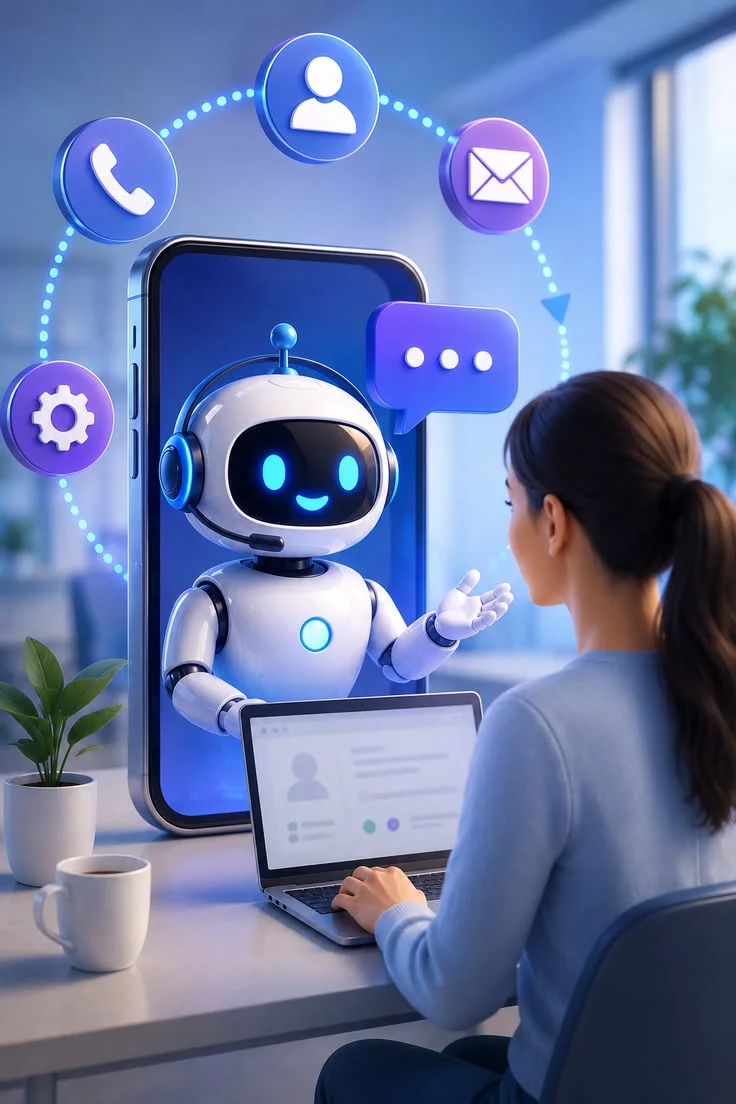
Chatbot
Answers predefined questions.
AI Assistant
Helps users find information and complete tasks.
AI Copilot
Works alongside employees to provide contextual recommendations and assistance.
AI Agent
Understands an objective and performs a sequence of actions using tools and business systems.
Multi-Agent System
Coordinates multiple specialized agents to complete complex business processes.
With ZYNO, this shift means businesses can move from AI-generated information to AI-driven execution.
What Is AI Agent Development?
AI Agent Development is the process of designing and building intelligent software agents that can understand goals, reason over context, access information, use tools, perform actions, and adapt their next steps based on the results. Unlike a conventional automation workflow that follows a fixed sequence, an AI agent can evaluate the situation and determine what should happen next within defined business rules and permissions.
LLMs
For natural-language understanding and generation.
AI reasoning
For evaluating context and determining next steps.
Context
For understanding the current business situation.
AI memory
For retaining relevant information across interactions.
Tools and APIs
For taking actions in connected systems.
Enterprise data
For grounding decisions in business information.
AI workflows
For coordinating multi-step processes
AI guardrails
For controlling what an agent can and cannot do
Human-in-the-loop
Controls for approvals and exceptions
AI Agent Development Services Built Around Business Outcomes
Custom AI Agent Development Services
Build Custom AI Agent Development solutions tailored to your workflows, business rules, data, and goals, enabling intelligent automation across sales, finance, HR, procurement, and operations.
Enterprise AI Agent Development
Our Enterprise AI Agent Development solutions connect AI agents with enterprise systems, data, APIs, and workflows while supporting security, scalability, governance, permissions, and observability.
Autonomous AI Agent Development
Develop Autonomous AI Agents that reason through multi-step tasks, use approved tools, execute workflows, evaluate outcomes, and escalate decisions requiring human intervention or approval.
AI Copilot Development
Enhance employee productivity with AI copilots that retrieve information, summarize records, generate reports, recommend actions, answer questions, and support everyday business decisions.
Multi-Agent System Development
Build Multi-Agent AI Systems where specialized agents collaborate through AI orchestration to manage complex workflows, delegate tasks, exchange information, and deliver coordinated outcomes.
Conversational & Voice AI Agents
Develop conversational and voice AI agents that understand natural language, retrieve information, trigger workflows, update systems, execute actions, and escalate complex requests when needed.
AI Agent Integration
Enable seamless AI Agent Integration with ERP, CRM, HRMS, databases, APIs, cloud applications, and enterprise platforms, connecting intelligent agents directly with your business workflows.
AI Agent Modernization
Modernize legacy chatbots, rule-based automation, and workflows through Agentic AI Development, introducing intelligent reasoning, AI tool calling, contextual understanding, automation, and adaptive execution.
What Can AI Agents Do for Your Business?
The real value of AI agents isn't simply that they can "chat." It's that they can move through a business process.
This is the difference between an AI chatbot and an AI worker: a chatbot gives you an answer. An AI agent can help move the process forward.
AI Automation Across Enterprise Business Functions
AI agents become most valuable when they're connected to the functions where repetitive decisions, information gathering, coordination, and execution happen every day.
Sales & CRM Agents
Help sales teams qualify leads, summarize customer interactions, recommend follow-ups, update CRM records, identify opportunities, and coordinate next steps.
Finance Agents
Automate invoice-related workflows, validate expenses, retrieve financial information, support payment follow-ups, and assist with financial analysis.
HR Agents
Support employee self-service, recruitment workflows, onboarding, HR queries, document processing, and employee information requests.
Procurement Agents
Assist with supplier discovery, RFQ analysis, vendor comparison, purchase recommendations, purchase requests, and approval workflows.
Customer Service Agents
Resolve customer queries, retrieve account information, create or update tickets, recommend resolutions, handle routine requests, and escalate complex issues.
Operations Agents
Coordinate workflows, monitor exceptions, generate reports, retrieve operational information, and trigger appropriate business actions.
IT Agents
Assist with incident management, troubleshooting, knowledge retrieval, ticket resolution, system checks, and escalation.
Single AI Agents vs Multi-Agent AI Systems
Not every business problem needs a network of agents. A focused workflow can often be handled by a single intelligent agent with access to multiple tools.
| Key Point | Single AI Agent | Multi-Agent AI System |
|---|---|---|
| Structure | One agent handles the workflow | Multiple specialized agents collaborate |
| Best For | Focused, specific tasks | Complex, cross-functional processes |
| Workflow | One goal → Agent → Outcome | Goal → Agents → Coordinated outcome |
| Specialization | Handles multiple related tasks | Each agent has a specific role |
| Scalability | Best for simpler workflows | Ideal for enterprise-scale workflows |
ZYNO AI Agent Architecture for Enterprise Execution
Effective agents require more than a powerful language model. They need the right architecture around intelligence, context, actions, systems, and governance.
 LAYER 06
The intelligence layer interprets requests, analyzes information, generates plans, and supports decision-making.
Agents can retrieve relevant business information and maintain the context required for multi-step interactions and workflows.
The orchestration layer determines which agent or capability should handle each part of a task.
Agents need access to tools that allow them to perform actions instead of simply generating text.
This is where agent intelligence connects to the systems that run your organization.
Governance ensures agents operate within clearly defined boundaries and that important actions remain visible, traceable, and controllable.
Your AI Agents Shouldn't Work in Isolation
An AI agent becomes significantly more useful when it can work with the systems your business already depends on. ZYNO enables AI Agent Integration across your existing technology ecosystem.
ERP
— access business operations, inventory, orders, workflows, and reportsCRM
— work with leads, customers, opportunities, activities, and sales workflowsHRMS
— support employees, HR teams, recruitment, attendance, payroll, and HR processesProcurement
— work with suppliers, purchase requests, RFQs, approvals, and procurementFinance
— connect with invoices, expenses, accounting information, and financial workflowsPOS
— access sales and transaction-related informationDatabases
— retrieve and process structured enterprise informationAPIs & Cloud Applications
— connect agents with third-party systems and specialized business toolsAutonomous Doesn't Mean Uncontrolled
Autonomy without governance can create operational risk. That's why responsible AI Agent Development Solutions need clear boundaries around what agents can access, decide, and execute. ZYNO designs agent workflows with governance and human control built into the architecture.
Agent Identity
Define which agent is performing an action and under what identity or role.
Role-Based Access
Give agents access only to the information and systems required for their assigned responsibilities.
Permission Controls
Define which actions an agent can perform independently and which require approval.
Data Privacy
Protect sensitive business information through appropriate access, data handling, and security controls.
AI Guardrails
Establish boundaries around agent behavior, responses, tool usage, and actions.
Human-in-the-Loop
Route sensitive, high-value, uncertain, or exceptional decisions to authorized employees.
Approval Workflows
Require human approval before defined actions are executed.
Audit Trails
Maintain visibility into relevant agent interactions, decisions, and actions.
Action Limits
Control what agents can execute and under which conditions.
AI Observability
Monitor agent behavior, workflow performance, tool usage, failures, and outcomes
Compliance & AI Governance
Build governance into the lifecycle so agent deployment can scale responsibly.
Our AI Agent Development Process
A successful agent starts with the business problem, not the technology.
Discover
Identify the workflow, business objective, pain points, decision points, data sources, and opportunities for agent-based automation.
Design
Define the agent's responsibilities, tools, knowledge sources, permissions, escalation rules, and success criteria.
Connect
Integrate the agent with relevant enterprise data, APIs, applications, databases, and communication channels.
Develop
Build the agent, tools, prompts, workflows, orchestration logic, and required interfaces.
Test & Govern
Evaluate accuracy, reliability, security, edge cases, permissions, failure scenarios, and human approval requirements.
Technologies Powering Agentic AI Development
Modern agents require an ecosystem of models, frameworks, connectivity standards, knowledge systems, infrastructure, and monitoring.
AI Models
Leading foundation models and ecosystems — OpenAI, Anthropic, Google Gemini, and open-source models, based on the use case.
Agent Frameworks
Modern SDKs such as OpenAI Agents SDK, LangGraph, CrewAI, and AutoGen where appropriate.
Agent Connectivity
MCP, A2A, APIs, and Function Calling for tools and agent-to-agent communication.
Knowledge & Context
RAG, Vector Databases, Enterprise Knowledge, and Knowledge Graphs.
Infrastructure
Cloud Infrastructure, Containers, and Secure Execution Environments.
The technology stack should follow the business requirement — not the other way around.
AI Agents Across Industries
Agentic AI can be adapted to industry-specific processes, data environments, workflows, and compliance requirements.

Manufacturing
Production coordination, maintenance workflows, quality processes, supply chain operations, and exception management.
Banking & Finance
Customer support, financial operations, compliance assistance.
Retail & E-commerce
Customer engagement, order management, inventory support, product assistance.
Logistics
Shipment management, exception handling, status updates.
Education
Student support, admissions workflows, information retrieval.
IT & SaaS
Technical support, incident management, ticket workflows, knowledge management.
Healthcare
Patient support, administrative workflows, information retrieval, appointment processes, and healthcare operations.
Business Benefits of AI Agent Development
The strongest AI deployments aren't measured by how impressive the demo looks. They're measured by what changes in the business.
Why Choose ZYNO for AI Agent Development?
Choosing an AI Agent Development Company isn't only about finding someone who can connect an LLM to an application. Enterprise agents need business context, integration capabilities, governance, workflow expertise, and a clear path from experimentation to production.
Enterprise-First
ZYNO approaches AI agents around real business processes, enterprise systems, operational requirements, and measurable outcomes.
Prompt-to-Action
Move from asking AI questions to giving AI the ability to perform approved actions.
Connected Intelligence
Connect agent capabilities across ERP, CRM, HRMS, Procurement, Finance, POS, APIs, databases, and other business systems.
Controlled Autonomy
Define what agents can access, what they can execute, and when a human must approve an action.
Multi-Agent Ready
Start with a focused agent and expand toward coordinated Multi-Agent AI Systems as business requirements grow.
From One AI Agent to an AI-Powered Enterprise
AI transformation doesn't have to start with hundreds of agents. Start with one meaningful workflow.
One Workflow
Identify a process where employees spend significant time gathering information, making repetitive decisions, coordinating tasks, or performing routine actions.
One AI Agent
Build an agent capable of understanding and executing that workflow within defined boundaries.
Department-Level Agents
Expand AI capabilities across sales, finance, HR, procurement, operations, customer service, and IT.
Multi-Agent Workflows
Connect specialized agents to coordinate complex processes across departments.
The future isn't about adding an AI chatbot to every department. It's about creating an enterprise where intelligent agents can work alongside people and systems.
Frequently Asked Questions
AI agent development is the process of designing and building software agents that can understand goals, reason through context, access information, use tools, execute actions, verify outcomes, and escalate tasks when human intervention is required.
Traditional chatbots primarily respond to user queries. AI agents can go further by understanding an objective, planning a sequence of actions, using connected tools, interacting with business systems, and executing approved tasks.
An AI copilot generally works alongside a human by providing information, recommendations, summaries, or assistance. An AI agent can be designed to independently execute defined tasks and workflows within controlled permissions.
Yes. AI agents can be connected to ERP, CRM, HRMS, procurement platforms, databases, APIs, and other enterprise applications. The specific integration approach depends on the system architecture, APIs, permissions, and workflow requirements.
Yes. AI agents can be connected to ERP, CRM, HRMS, procurement platforms, databases, APIs, and other enterprise applications. The specific integration approach depends on the system architecture, APIs, permissions, and workflow requirements.
A multi-agent AI system consists of multiple specialized agents that collaborate to achieve a larger objective. Each agent can have its own role, tools, knowledge, and responsibilities while an orchestration layer coordinates the overall workflow.
Security depends on how the agent is designed and deployed. Enterprise implementations should include identity management, access controls, permissions, data protection, guardrails, monitoring, auditability, and human approval mechanisms where required.
Yes, within defined boundaries. Agents can independently perform approved tasks, but sensitive actions can be configured to require human approval. The right level of autonomy depends on the workflow, risk, permissions, and business requirements.
MCP, or Model Context Protocol, is a protocol designed to standardize how AI applications and agents interact with external tools and data sources. It can help create more structured connections between agents and the capabilities they need to perform tasks.
The timeline depends on the agent's complexity, integrations, data requirements, workflow scope, security requirements, testing needs, and whether you're building a single agent or a multi-agent system. A focused proof of concept can generally be delivered faster than a production-grade enterprise implementation.
Yes. ZYNO can design AI agent use cases around industry-specific workflows and enterprise requirements, including functions across healthcare, manufacturing, finance, retail, logistics, education, IT, and other sectors.
Don't Just Add AI. Give Your Business an AI Workforce.
Build intelligent agents that understand your business, connect with your systems, and turn intent into action. Whether you're starting with one workflow or planning a broader Agentic AI Development strategy, ZYNO can help you design the architecture, integrations, workflows, governance, and AI capabilities required to move from experimentation to execution.
ZYNO — From AI That Answers to AI That Acts.