Emergency Operations Management System- Know What's Happening Across Your ED, Right Now
Real-time visibility matters most exactly when an emergency department is at its busiest — this is the operational core of ZYNO's Emergency Room Management Software.
- Real-time bed availability & allocation. Know exactly what is free before the next patient is wheeled in, and assign beds without manual back-and-forth.
- Ambulance & intake coordination. Track incoming ambulance cases and pre-arrival details so teams can prepare before the patient arrives.
- Emergency patient flow tracking. Every movement from registration through assessment, treatment, and disposition reflected instantly.
- Real-time staff availability. As part of ZYNO's Emergency Medical Management System, the next case gets assigned the moment a clinician is free.
- One connected view. No phone calls to the next ward, no walking the corridor to check.
- Built for leadership to catch bottlenecks. Flagged as they form, not after they've cost time.
- No stale dashboards. The view updates as fast as the department actually moves.
Emergency Workflow Management — From the Ambulance to the ICU, Nothing Gets Lost in Handoff
Fragmented records at handoff points are where emergency care usually breaks down. ZYNO connects every department so that doesn't happen.
- Connected departmental workflows. Emergency care links directly with laboratory, radiology, pharmacy, and billing, so services are requested and tracked without leaving the workflow.
- One record moves with the patient. No re-entry at any handoff, no fax, no paper chit.
- Regulatory reporting built in. Structured to support state Clinical Establishments Act requirements without manual assembly.
- One continuous, traceable record. No separate department logs left to reconcile later.
- Lab and pharmacy move the moment the ED does, with no waiting on a paper request.
- Billing built from the actual visit. Nothing reconstructed afterward from scattered notes.
- No conflicting versions of the same case. Every department reads from the same live record.
Emergency-to-Admission Continuity — Every Record Becomes Part of the Patient's History
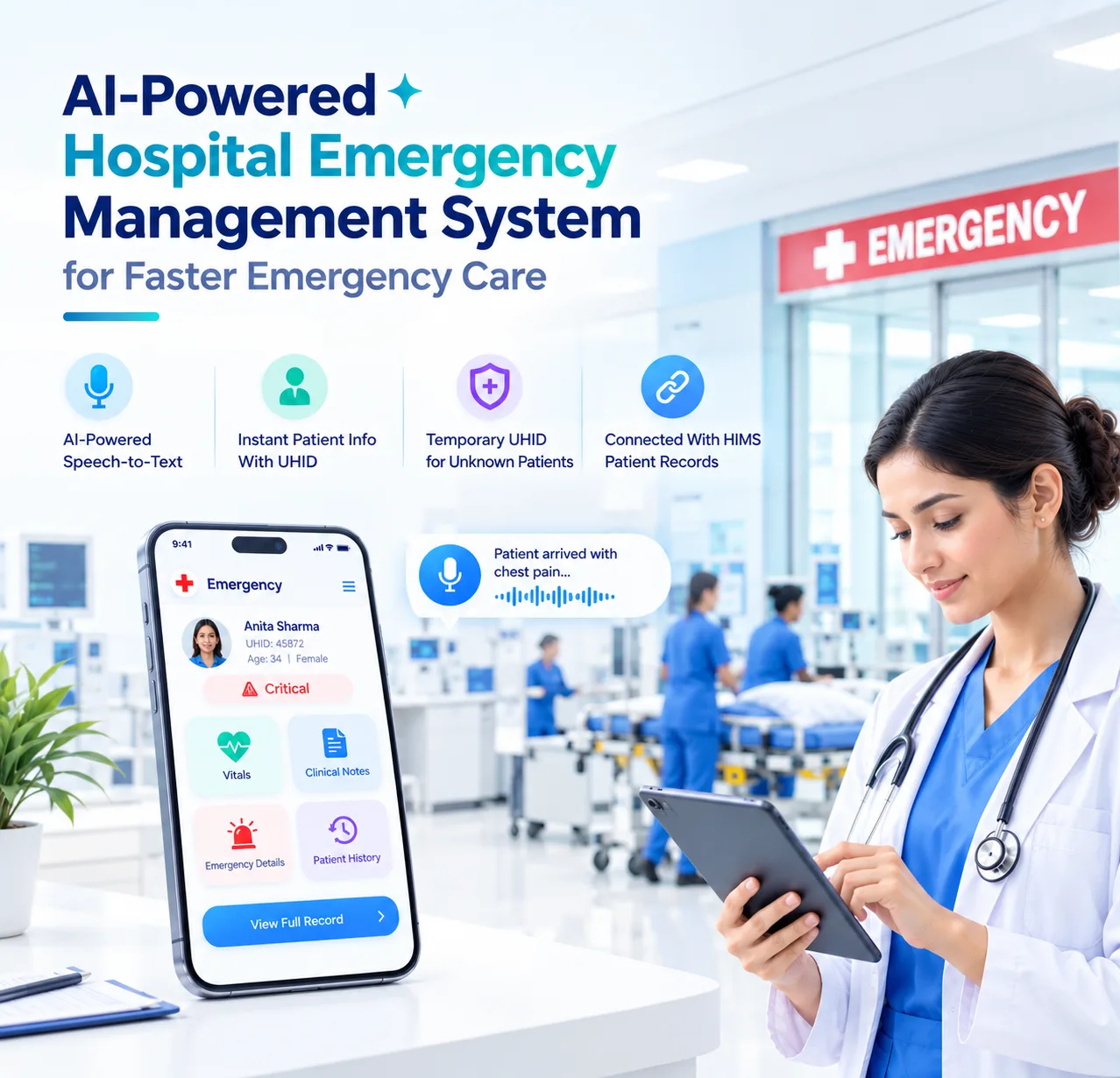
- Automatic merge. Temporary UHID records merge into the permanent history once identity is confirmed.
- Nothing re-entered, nothing duplicated. Every note from the first minutes carries forward automatically.
- Seamless continuity. The record flows from the emergency visit into inpatient admission and beyond.
- Evidence that holds up. Usable for physician review, accreditation review, or legal review, months later.
- No gap at handoff. The admitting team sees exactly what happened in the ED, in full.
- One patient, one history. Not an ED file and a hospital file that never quite match up.
Compliance Isn't an Add-On It's the Standard our Hospital Emergency Software Is Built To
- ABHA. Patient identity and records align with India's Ayushman Bharat Health Account framework from registration.
- Digital Personal Data Protection Act, 2023. Every piece of patient data collected, stored, accessed, and shared under this standard.
- NABH and NABL. Documentation and record-keeping built to support accreditation, not reconstructed for it later.
- Clinical Establishments Act. Reporting structured to meet applicable state-level obligations without a separate manual process.
- HIPAA and HITECH Act. Data handling aligned with these standards for hospital groups with international operations.
- No parallel compliance process. The records staff create for care are the same ones used for audits.
- Access controlled and logged. Every view and edit of a patient's data is tracked, never assumed.
HOW IT WORKS
Emergency Patient Management Workflow
Patient/Ambulance Arrival → Identify Patient (UHID) / Create Temporary UHID → Digital Registration & Bed Allocation → Capture Notes via Speech-to-Text → Connected Record Maintained Throughout
Who this is Built for
- Emergency departments handling high patient volumes with limited registration staff
- Multi-specialty hospitals needing one connected record across ED, IPD, ICU, and diagnostics
- Hospital groups operating across multiple states with different Clinical Establishments Act obligations
- Hospitals preparing for or maintaining NABH or NABL accreditation
- Healthcare organizations with cross-border operations that also need HIPAA-aligned data handling
- Individual clinics and nursing homes, as well as large multi-specialty hospital networks built to scale either way
- Any hospital where every second at the door genuinely affects patient outcomes
 ×
×
 Contact Us


 AI-Powered Speech-to-Text