 Contact Us

Corporate Learning Management System vs Traditional LMS: Which Is Better?
Learn the difference between a Corporate Learning Management System and a Traditional LMS. Compare features, benefits, and choose the right solution for 2026.

Share This Blog :


Stop Losing Money to VAT Penalties & Manual Errors
Businesses using ZYNO Books cut accounting time by 70% and stay 100% ZATCA-compliant — automatically.


In today's competitive business environment, employee learning is no longer a one-time activity. Organizations must continuously upskill their workforce to keep pace with technological advancements, changing customer expectations, and evolving industry regulations. This shift has made learning management systems an essential part of every company's training strategy. However, businesses often face one important question: Should they choose a Corporate Learning Management System or continue using a Traditional LMS?
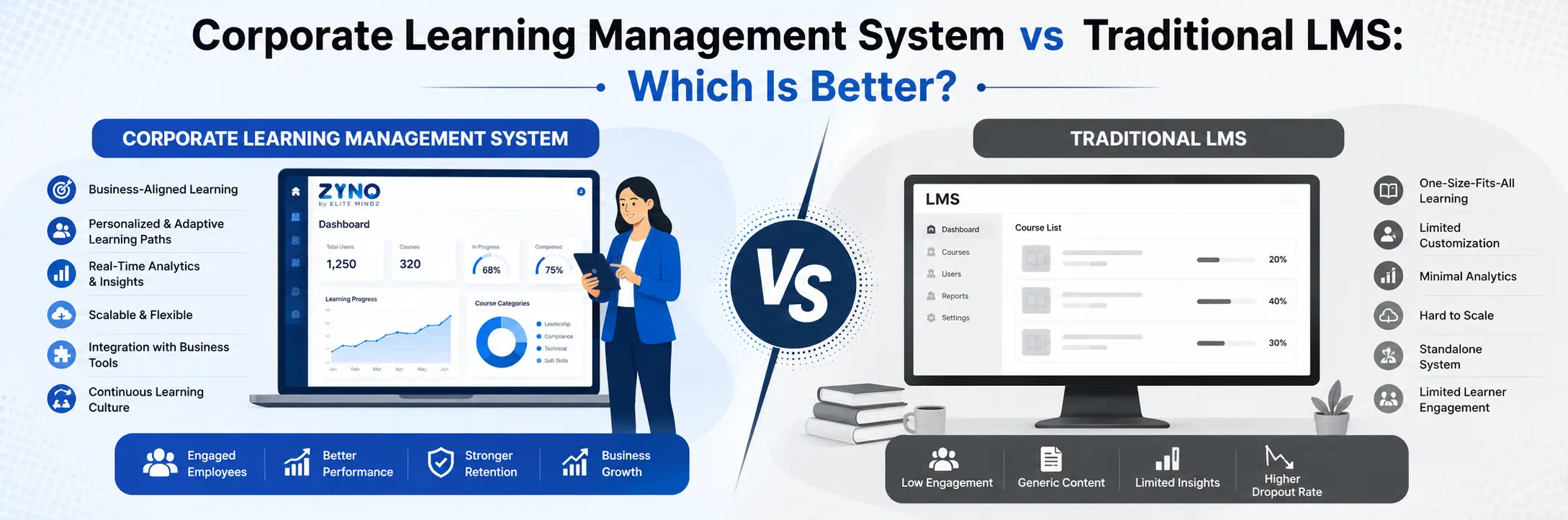
While both platforms help organizations deliver and manage learning programs, they are designed for different purposes. A traditional LMS primarily focuses on course delivery and completion, whereas a Corporate Learning Management System is built to support employee onboarding, compliance training, performance improvement, leadership development, and continuous learning across the organization.
As companies adopt remote and hybrid work models, the demand for a Cloud-Based Corporate Learning Management System has increased significantly. Businesses now require flexible learning platforms that allow employees to access training anytime, anywhere while giving HR teams complete visibility into employee progress and skill development.
This guide explains the differences between a Corporate Learning Management System and a Traditional LMS, compares their features, highlights their advantages, and helps you determine which solution is the best fit for your organization.
What Is a Corporate Learning Management System?
A Corporate Learning Management System is a digital platform specifically designed to manage employee training and professional development within an organization. Unlike education-focused LMS platforms, it supports business objectives by helping companies improve workforce productivity, maintain regulatory compliance, and develop employee skills.
Organizations use a Corporate Learning Management System to create, assign, monitor, and evaluate training programs across departments. It centralizes learning content and provides managers with detailed insights into employee performance, certifications, and learning progress.
Key Features of a Corporate Learning Management System
- Employee onboarding and orientation
- Compliance and regulatory training
- Role-based learning paths
- Certification management
- Mobile learning support
- Learning analytics and reporting
- AI-powered course recommendations
- Gamification and rewards
- Performance tracking
- HRMS and ERP integration
- Multi-location training management
- Content library management
These capabilities make it an ideal solution for organizations looking to build a skilled, productive, and future-ready workforce.
What Is a Traditional LMS?
A Traditional Learning Management System (LMS) is primarily designed to deliver educational content, manage online courses, and track learner completion. Educational institutions, coaching centers, universities, and training providers commonly use these platforms.
Traditional LMS platforms generally focus on:
- Course creation
- Student enrollment
- Assignment submission
- Online assessments
- Instructor management
- Attendance tracking
- Course completion reports
Although some businesses still use traditional LMS platforms for employee training, they often lack the advanced capabilities required for corporate learning and development.
Looking for a modern Corporate Learning Management System? ZYNO Upskill helps organizations deliver engaging employee training, skill development, compliance learning, certifications, and performance tracking—all through one secure, cloud-based platform designed for today's workforce.
Understanding the Key Differences
Both platforms help organizations deliver digital learning, but their goals are entirely different.
A Traditional LMS focuses on teaching learners through structured courses, whereas a Corporate Learning Management System emphasizes improving employee performance and supporting business growth.
The biggest difference lies in personalization. Corporate LMS platforms deliver customized learning paths based on employee roles, departments, experience levels, and career goals. Traditional LMS platforms generally offer the same learning experience to everyone.
Corporate Learning Management System vs Traditional LMS
|
Feature |
Corporate Learning Management System |
Traditional LMS |
|
Purpose |
Employee development |
Educational learning |
|
User Type |
Employees and organizations |
Students and institutions |
|
Learning Paths |
Personalized |
Standardized |
|
Employee Onboarding |
Yes |
Limited |
|
Compliance Training |
Advanced |
Basic |
|
Certification Tracking |
Automated |
Manual |
|
Performance Analytics |
Detailed dashboards |
Basic reports |
|
Mobile Learning |
Fully supported |
Limited |
|
HRMS Integration |
Yes |
Rare |
|
ERP Integration |
Yes |
Rare |
|
AI-Based Recommendations |
Available |
Usually unavailable |
|
Skill Gap Analysis |
Yes |
No |
|
Career Development |
Supported |
Limited |
Why Modern Businesses Prefer a Corporate Learning Management System
Organizations today require more than course management. They need learning platforms that contribute directly to business performance.
A Corporate Learning Management System helps companies create a culture of continuous learning by providing personalized training, automated workflows, and measurable outcomes.
Some major benefits include:
Faster Employee Onboarding
New employees can complete onboarding programs digitally before joining their teams. This reduces training time and improves productivity from the first day.
Better Compliance Management
Many industries require employees to complete mandatory compliance training regularly.
A Corporate Learning Management System automatically:
- Assigns compliance courses
- Sends reminders
- Tracks certifications
- Generates audit-ready reports
This reduces compliance risks and administrative effort.
Personalized Learning Experience
Instead of assigning identical courses to every employee, organizations can create customized learning journeys based on:
- Department
- Job role
- Experience
- Skills
- Career goals
This improves engagement and learning outcomes.
Increased Employee Engagement
Modern learning platforms include:
- Gamification
- Leaderboards
- Badges
- Certificates
- Interactive quizzes
- Video learning
- Discussion forums
These features motivate employees to complete training programs successfully.
Improved Decision-Making Through Analytics
Managers can access detailed reports showing:
- Course completion rates
- Employee progress
- Assessment scores
- Learning hours
- Skill development
- Department-wise performance
These insights help organizations optimize training strategies.
Benefits of a Cloud-Based Corporate Learning Management System
A Cloud-Based Corporate Learning Management System has become the preferred choice for businesses because it offers flexibility, scalability, and cost efficiency.
Learn Anytime, Anywhere
Employees can access courses using:
- Desktop computers
- Laptops
- Tablets
- Smartphones
This supports remote work and hybrid workplaces.
Reduced Infrastructure Costs
Cloud deployment eliminates the need for:
- Dedicated servers
- Expensive maintenance
- Manual software updates
Businesses pay only for what they use.
Faster Implementation
Unlike traditional software installations, cloud platforms can be deployed within days.
Organizations can quickly:
- Upload learning content
- Add employees
- Launch training programs
- Track learning progress
Automatic Software Updates
Cloud providers continuously improve the platform without disrupting users.
Organizations always have access to:
- New features
- Security updates
- Performance improvements
- Bug fixes
Enhanced Security
Leading cloud platforms provide:
- Data encryption
- User authentication
- Role-based access
- Secure backups
- Disaster recovery
This ensures sensitive employee information remains protected.
Easy Scalability
Whether your organization has 100 employees or 50,000 employees, a Cloud-Based Corporate Learning Management System can easily scale without major infrastructure changes.
Empower your workforce with a powerful Corporate Learning Management System. ZYNO Upskill simplifies employee onboarding, skill development, compliance training, certifications, and performance tracking through one intelligent cloud-based learning platform.
The Growing Importance of Corporate Learning & Development
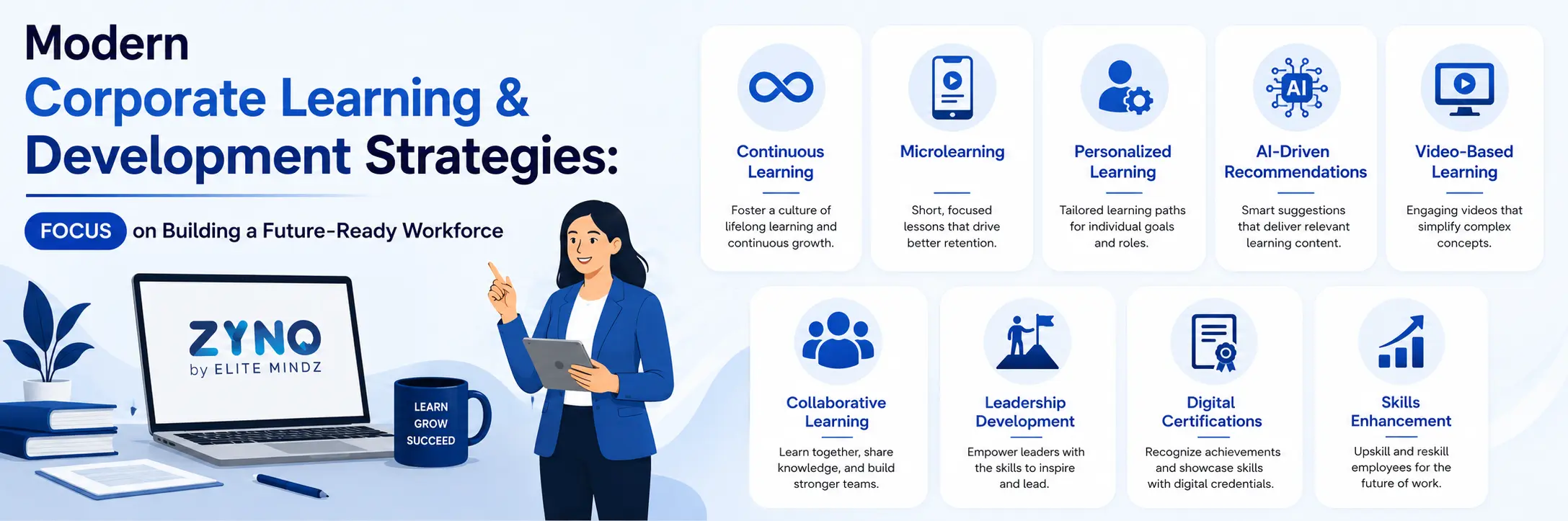
Employee learning has evolved dramatically over the last decade.
Earlier, organizations relied on classroom training conducted once or twice a year. Today, businesses recognize that learning should be continuous.
Modern Corporate Learning & Development strategies focus on:
- Continuous learning
- Microlearning
- Personalized learning
- AI-driven recommendations
- Video-based learning
- Collaborative learning
- Leadership development
- Digital certifications
- Skills enhancement
Organizations that invest in Corporate Learning & Development experience higher employee engagement, better retention, and improved business performance.
How a Learning & Skill Management System Supports Workforce Growth
A Learning & Skill Management System is an advanced component of corporate learning that focuses on employee competencies rather than course completion alone.
It enables organizations to:
- Identify existing skills
- Detect skill gaps
- Create personalized development plans
- Track certifications
- Measure competency improvements
- Prepare employees for leadership roles
Managers can also align employee learning with organizational goals, ensuring that workforce capabilities grow alongside business requirements.
Limitations of a Traditional LMS
Although Traditional LMS platforms work well for schools and universities, they often fall short in corporate environments.
Limited Personalization
Employees receive generic training that may not be relevant to their specific roles.
Basic Reporting
Traditional LMS platforms generally track only:
- Course completion
- Attendance
- Test scores
They rarely provide deeper workforce insights.
Lack of Automation
Many administrative tasks require manual effort, including:
- User enrollment
- Certification renewals
- Training reminders
- Reporting
Limited Integrations
Corporate businesses often require integration with:
- HRMS
- ERP
- Payroll
- CRM
- Performance Management Systems
Traditional LMS platforms may not support these integrations effectively.
Which Industries Benefit Most from a Corporate Learning Management System?
A Corporate Learning Management System is valuable across almost every industry.
It is particularly beneficial for:
- Manufacturing
- Healthcare
- Retail
- Banking and Financial Services
- Insurance
- Information Technology
- Logistics
- Construction
- Hospitality
- Education
- Government Organizations
- Pharmaceuticals
- Telecommunications
Each industry can customize learning programs according to compliance requirements, operational processes, and employee roles.
When Should You Choose a Traditional LMS?
A Traditional LMS may still be suitable if:
- You operate a school or university.
- You only need basic course management.
- Compliance tracking is not required.
- Employee skill mapping is unnecessary.
- HR integration is not important.
- Your learner base is relatively small.
For organizations with simple learning requirements, a traditional LMS can be a cost-effective solution.
How to Choose the Right Corporate Learning Management System
Before investing in a learning platform, evaluate the following factors:
User-Friendly Interface
Employees should be able to navigate the platform easily without extensive training.
Mobile Accessibility
Learning should be available on any device to support remote and field employees.
Custom Learning Paths
The platform should allow administrators to assign personalized learning journeys.
Reporting and Analytics
Look for real-time dashboards that provide actionable learning insights.
Integration Capabilities
Ensure compatibility with existing HRMS, ERP, payroll, CRM, and communication tools.
Scalability
Choose software that can grow with your organization.
Security
Verify that the platform offers strong security measures, including encryption, access controls, and regular backups.
AI and Automation
Modern systems should automate routine tasks such as enrollments, reminders, certifications, and reporting.
Why Businesses Are Switching to Cloud-Based Corporate Learning Management Systems
As organizations embrace digital transformation, cloud technology has become the preferred deployment model for enterprise software.
A Cloud-Based Corporate Learning Management System enables businesses to:
- Reduce IT infrastructure costs
- Improve accessibility
- Launch training faster
- Scale effortlessly
- Deliver consistent learning experiences worldwide
- Support hybrid work environments
- Continuously update learning content
These advantages make cloud-based solutions significantly more flexible than traditional on-premise systems.
Why Choose ZYNO Corporate Learning Management System?
ZYNO Corporate Learning Management System is designed to help organizations streamline employee training, onboarding, compliance, and professional development through a centralized, intelligent learning platform.
Built as a Cloud-Based Corporate Learning Management System, ZYNO empowers businesses to deliver engaging learning experiences while reducing administrative effort and improving workforce performance.
With ZYNO, organizations can:
- Automate employee onboarding programs
- Create role-based learning paths
- Manage compliance training and certifications
- Monitor employee progress with real-time analytics
- Deliver learning across desktop and mobile devices
- Support continuous Corporate Learning & Development
- Identify skill gaps using a powerful Learning & Skill Management System
- Integrate seamlessly with HRMS and ERP solutions
- Enhance employee engagement with interactive learning experiences
- Scale training programs across multiple departments and locations
Whether you are a growing enterprise or a large organization, ZYNO provides a flexible and scalable learning platform that helps build a knowledgeable, compliant, and future-ready workforce.
Replace outdated training methods with a modern Cloud-Based Corporate Learning Management System. ZYNO Upskill helps organizations deliver engaging learning experiences, track employee progress, manage certifications, and accelerate Corporate Learning & Development through one powerful platform.
Conclusion
Both Traditional LMS platforms and Corporate Learning Management Systems help organizations deliver digital learning, but they serve different purposes. A Traditional LMS is ideal for educational institutions and businesses with basic training needs, while a Corporate Learning Management System offers advanced capabilities that align learning with organizational goals.
With personalized learning paths, compliance management, performance analytics, HR integration, and mobile accessibility, a Cloud-Based Corporate Learning Management System provides everything modern organizations need to support continuous Corporate Learning & Development. When combined with a robust Learning & Skill Management System, businesses can identify skill gaps, nurture employee growth, and create a high-performing workforce prepared for future challenges.
For organizations looking to improve employee engagement, streamline training processes, and maximize the return on their learning investments, adopting a modern Corporate Learning Management System is the smarter long-term choice.
FAQs:
1. What is a Corporate Learning Management System?
A Corporate Learning Management System is a software platform designed to manage employee training, onboarding, compliance, certifications, and continuous learning. It helps organizations improve workforce skills and track employee development.
2. What is the difference between a Corporate Learning Management System and a Traditional LMS?
A Corporate Learning Management System focuses on employee training, skill development, and business performance, while a Traditional LMS is primarily designed for educational institutions to manage courses, assignments, and student learning.
3. Why should businesses choose a Cloud-Based Corporate Learning Management System?
A Cloud-Based Corporate Learning Management System offers anytime, anywhere access to training, automatic software updates, lower infrastructure costs, better scalability, and support for remote and hybrid work environments.
4. How does a Corporate Learning Management System support Corporate Learning & Development?
A Corporate Learning Management System enables organizations to create personalized learning paths, deliver continuous training, monitor employee progress, and improve overall Corporate Learning & Development initiatives.
5. What is a Learning & Skill Management System?
A Learning & Skill Management System helps organizations identify employee skill gaps, track competencies, assign relevant training, and support career development through personalized learning plans.
6. What features should I look for in Corporate Learning Management Software?
The best Corporate Learning Management Software should include employee onboarding, compliance training, mobile learning, certification tracking, learning analytics, AI-powered recommendations, role-based learning paths, and integration with HRMS and ERP systems.
7. Which industries benefit the most from a Corporate Learning Management System?
Industries such as manufacturing, healthcare, IT, retail, banking, logistics, education, and government organizations benefit from a Corporate Learning Management System by improving employee training, compliance, and workforce productivity.
8. Can a Corporate Learning Management System integrate with HRMS and ERP software?
Yes. Most modern Corporate Learning Management Software integrates seamlessly with HRMS, ERP, payroll, CRM, and other enterprise applications to streamline employee training and data management.
9. Is a Traditional LMS suitable for corporate employee training?
A Traditional LMS can handle basic training requirements, but it often lacks advanced features like skill management, compliance automation, personalized learning, and detailed analytics that businesses need for effective employee development.
10. How do I choose the best Corporate Learning Management System for my business?
When selecting a Corporate Learning Management System, consider factors such as ease of use, cloud deployment, scalability, mobile accessibility, reporting capabilities, integration options, security, customization, and support for Corporate Learning & Development initiatives.
Related Blogs
Let’s Build the Future Together
Partner with ZYNO by Elite Mindz to revolutionize how your business works. Fill out the form, and we’ll reach out with AI-powered solutions made just for you.