AI Software Development in the Middle East: Innovation, Impact & Opportunity
Read More →
×
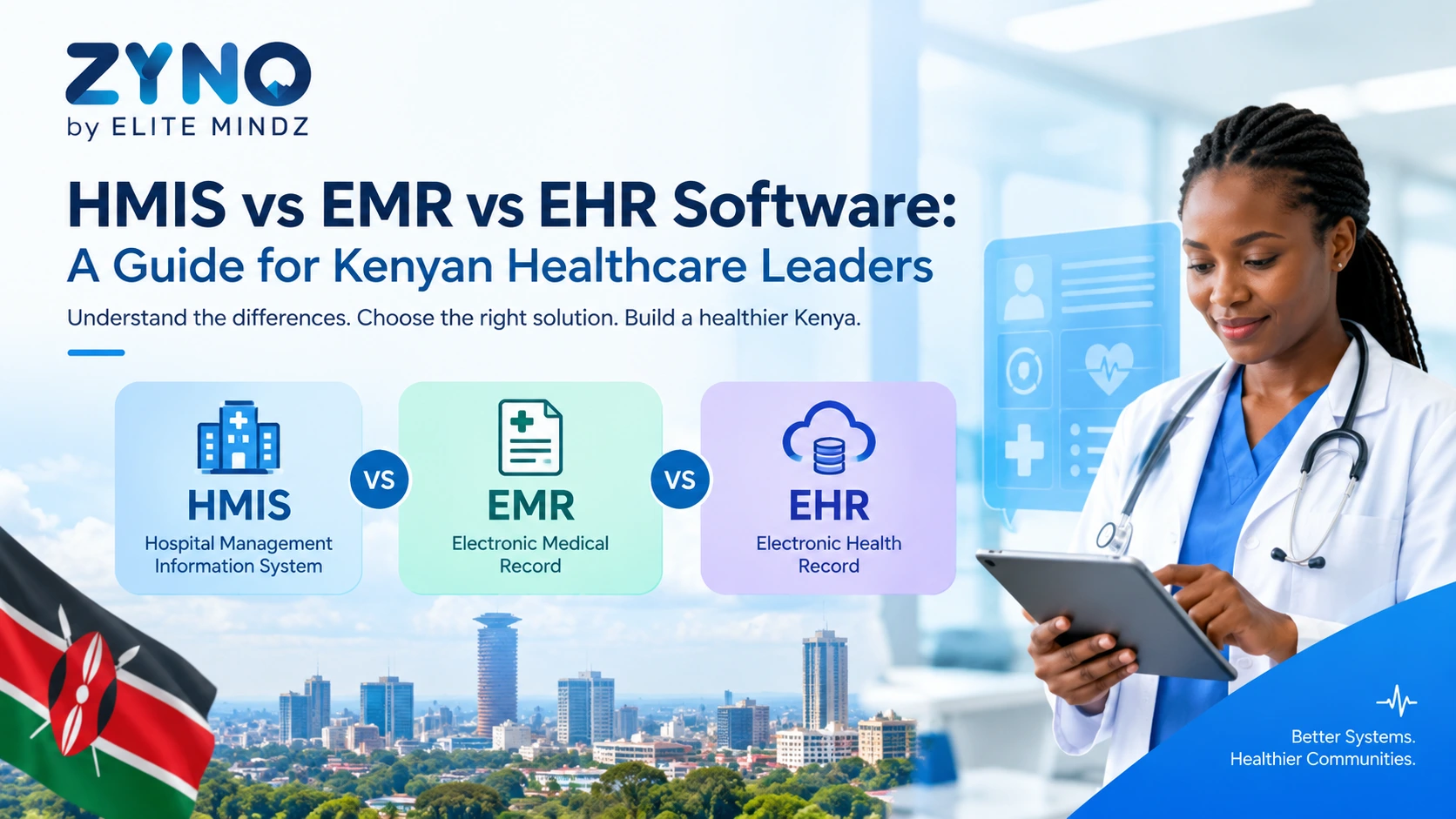
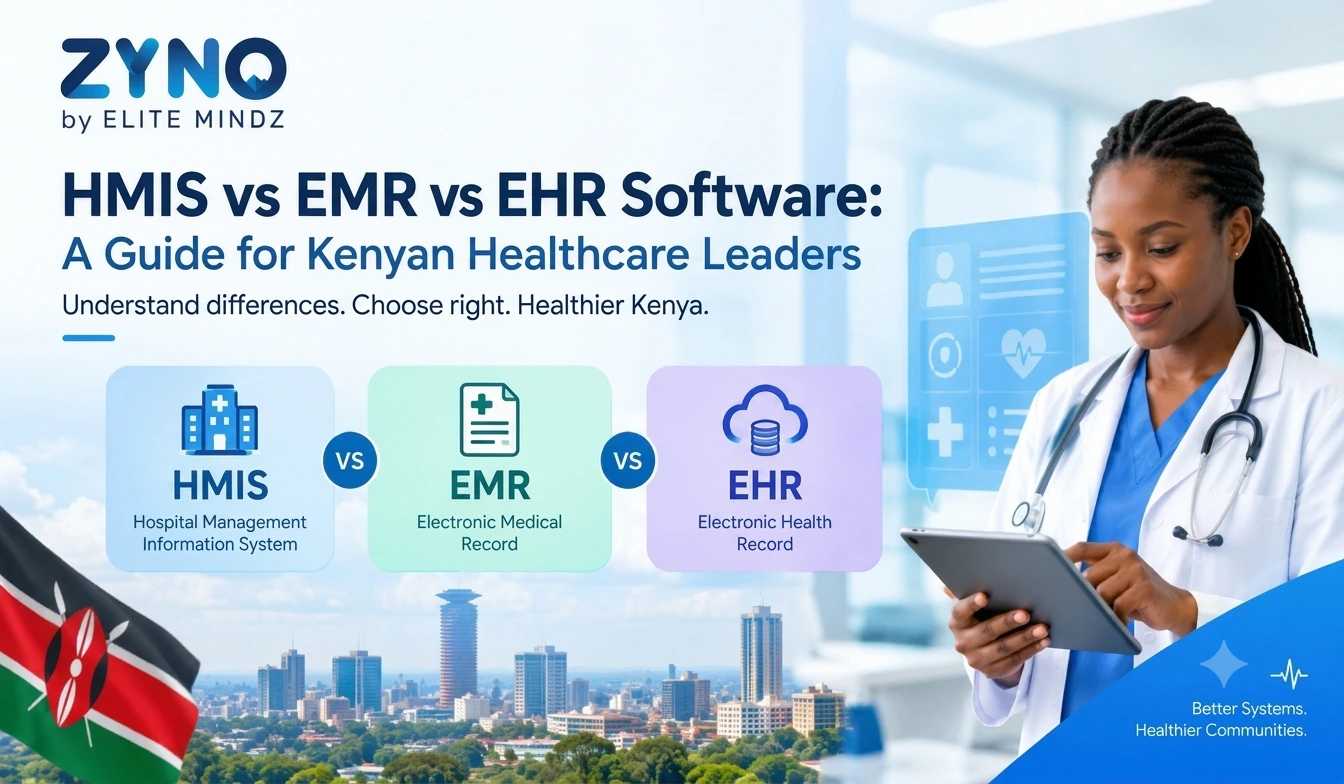
HMIS, EMR, and EHR software serve different healthcare needs. Learn how these systems support hospital administration, electronic medical records, and patient information sharing. Explore their benefits, compare important features, and find useful tips for selecting healthcare software in Kenya. Make a more informed decision with this guide from ZYNO BY Elitemindz.
Businesses using ZYNO Books cut accounting time by 70% and stay 100% ZATCA-compliant — automatically.
Healthcare is changing, and many hospitals and clinics in Kenya are moving from paper records to digital systems. These systems help healthcare teams manage patient information, improve daily work, and provide better care.
However, when choosing healthcare software, hospital owners and managers often come across three terms: HMIS, EMR, and EHR. They may sound similar, but each system has a different purpose.
Understanding the difference can help healthcare leaders choose the right solution for their facility. In this guide, ZYNO BY Elitemindz explains HMIS vs EMR vs EHR in simple words and shows how to choose the right option for your hospital or clinic in Kenya.
HMIS stands for Hospital Management Information System. It helps a hospital or clinic manage its daily activities in one place.
Instead of using separate registers, spreadsheets, and paper files, staff can use HMIS software to manage patient details, appointments, billing, pharmacy stock, laboratory services, and reports.
For example, when a patient visits a hospital, the system can help staff register the patient, schedule a consultation, record service details, and prepare a bill.
Hospitals looking for HIMS Software in Kenya should check which features are included, because different vendors may use HMIS, HIMS, or hospital management system to describe products with different capabilities.
EMR stands for Electronic Medical Record. It is the digital version of a patient's medical file within a healthcare facility.
An EMR allows authorised healthcare professionals to record and review information such as medical history, symptoms, diagnoses, prescriptions, allergies, and test results.
For example, a doctor can review a patient's previous visit and treatment notes before starting a new consultation. This can help the doctor make more informed decisions.
EMR software is useful for clinics and hospitals that want to improve the way they record, access, and manage clinical information.
EHR stands for Electronic Health Record. It contains a patient's health information and is designed to support access to that information across different healthcare professionals or care settings, where systems are connected and sharing is authorised.
An EHR may include medical history, diagnoses, medications, allergies, laboratory results, and other important health information collected over time.
For example, if a patient is referred from a local clinic to a specialist hospital, a connected EHR arrangement can help authorised providers access relevant information instead of asking the patient to repeat their entire medical history.
However, this sharing depends on system interoperability, data-sharing arrangements, patient privacy safeguards, and the permissions available. Simply calling software an EHR does not guarantee that it can exchange records with every hospital.
Improve Healthcare Management with ZYNO BY Elitemindz
Looking for better ways to manage patient records and hospital operations? Explore healthcare software solutions that help organise patient information, streamline daily workflows, and support efficient hospital management. Choose the right digital solution for your healthcare facility in Kenya with ZYNO BY Elitemindz.
Contact Our Team Explore Our SolutionsThe main difference is what each system is designed to manage. Some healthcare platforms include more than one of these functions, so it is important to compare actual features rather than only the product name.
|
Feature |
HMIS |
EMR |
EHR |
|
Main purpose |
Manages hospital operations |
Manages clinical records within a facility |
Supports a broader patient health record |
|
Patient registration |
Usually included |
May be limited or integrated |
May be included or connected |
|
Doctor's notes |
May be included |
Core feature |
Core feature |
|
Appointments |
Usually supported |
May be integrated |
May be integrated |
|
Billing and payments |
Commonly included |
Usually needs integration |
|
Pharmacy and inventory |
May be included |
Usually needs integration |
|
Sharing across facilities |
Depends on integrations |
Usually facility-focused |
Designed to support sharing across connected providers |
|
Best suited for |
Clinics and hospitals managing daily operations |
Facilities digitising medical records |
Connected care across providers and settings |
The right system depends on your facility's size, budget, daily challenges, and future plans.
If your hospital needs to manage patient registration, appointments, billing, pharmacy, laboratory services, and administrative work, an HMIS may be a suitable starting point.
It can help different departments work with more organised information. Before selecting a system, confirm which modules are included and whether they work together properly.
If your main goal is to replace paper medical files, an EMR may meet your needs. It can help doctors and nurses record consultations, diagnoses, prescriptions, and test results.
Clinics should also check whether the EMR can connect to billing, appointments, laboratory services, and pharmacy systems as their needs grow.
If patients receive treatment from several healthcare providers, broader record-sharing capabilities may be valuable. An EHR approach can support better access to relevant medical information when participating systems are connected.
Ask software providers to demonstrate how information is shared, how access is controlled, and how patient privacy is protected.
Healthcare facilities also need to manage staff, finance, procurement, supplies, and inventory. ERP Software in Kenya can help connect these business activities.
A healthcare ERP may integrate with hospital or clinical software, but not every ERP includes specialised medical records or clinical workflows. Check whether the platform supports your facility's actual requirements.
Before choosing HMIS, EMR, EHR, or another healthcare solution, consider the following:
Healthcare facilities in Kenya should also verify any applicable requirements for data protection, digital health systems, reporting, and payer-related workflows with the relevant authorities and service providers.
Choose Smarter Healthcare Software with ZYNO BY Elitemindz
Make hospital management easier with digital healthcare solutions. Improve patient record management, organise daily hospital activities, and help your team work more efficiently. Discover software solutions designed to support better healthcare operations and meet the changing needs of hospitals and clinics in Kenya.
Talk to Our Team Explore Our SolutionsPatient Management Software helps healthcare teams organise the patient journey, from registration and appointment booking to consultation and follow-up.
When patient information is easy to find, staff can spend less time searching for records and more time assisting patients. Automated reminders and better appointment planning may also help reduce missed visits and improve patient communication.
For a clinic or hospital, patient management features can be part of an HMIS, EMR, EHR, or a separate connected application. The best option is one that fits the facility's workflow and avoids unnecessary repeated data entry.
HMIS, EMR, and EHR serve related but different purposes. HMIS focuses on managing hospital operations, EMR focuses on clinical records within a facility, and EHR is designed to support a broader patient health record across connected care settings.
For Kenyan healthcare leaders, the best choice depends on the services you provide, how your departments work, and whether you need to share information with other providers. Compare the actual features, security measures, support, and integration options before making a decision.
With the right planning, digital healthcare systems can help facilities organise information, improve daily workflows, and support better patient care.
HMIS manages hospital activities such as registration, appointments, billing, and administration. EMR stores clinical records within a facility. EHR is designed to support a broader health record that can be shared across connected healthcare providers when authorised.
An EMR may be suitable if the clinic mainly needs digital medical records. An HMIS may be better if the clinic also needs appointment management, billing, pharmacy, and other operational features. The right choice depends on the clinic's needs.
HIMS Software in Kenya generally refers to Hospital Information Management System or Hospital Management Information System software. The term is used for solutions that help healthcare facilities manage patient information and operational activities. Features differ by provider.
Yes. An HMIS may include an EMR module or connect to a separate EMR. Before purchasing, confirm how patient details, consultation notes, laboratory results, and billing information move between the systems.
EHR software is designed to support broader health information sharing, but sharing is possible only when the relevant systems are connected and appropriate permissions, privacy safeguards, and data-sharing arrangements are in place.
Patient Management Software can organise registration, appointments, patient details, and follow-ups. Depending on its features, it may reduce paperwork, help staff find information faster, and improve communication with patients.
It can help by improving registration, appointment scheduling, queue management, and access to patient information. The results depend on how well the software is implemented and how consistently staff use it.
Yes. ERP Software in Kenya can help hospitals manage finance, procurement, staff, inventory, and other business operations. Facilities should confirm whether clinical features are included or whether integration with an HMIS or EMR is required.
Hospitals should review usability, data security, reporting, integration, training, technical support, costs, and scalability. They should also verify relevant Kenyan legal and regulatory requirements before implementation.
ZYNO BY Elitemindz offers technology and software solutions. Organisations considering a software project should first identify their requirements, then review available features, implementation plans, integration needs, and ongoing support before choosing a provider.
Sneha Singh
Senior Content Marketing Specialist | 8+ Years of Experience
Senior Content Marketing Specialist | 8+ Years of Experience Sneha Singh has over 8 years of experience creating B2B SaaS and enterprise software content. She specializes in CRM, HRMS, POS, HIMS, ERP, and AI-powered business solutions.
AI Software Development in the Middle East: Innovation, Impact & Opportunity
Read More →

How to Choose the Right Procurement Software in Dubai, UAE
Read More →
Top 10 Cloud-Based Manufacturing ERP Software Solutions in Middle East
Read More →
Procurement Management Software for Trading Companies in UAE
Read More →
Top B2B Procurement Platform Solutions in the UAE for 2026
Read More →
Top 12 ERP Software Providers in Kenya: A Complete Comparison Guide
Read More →
Top 17 Procurement Software Companies in Kenya (2026)
Read More →
How Hospital Management Software Reduces Patient Waiting Time in Kenya
Read More →
HMIS vs EMR vs EHR Software: A Guide for Kenyan Healthcare Leaders
Read More →
10 Questions to Ask Before Choosing Hospital Management Software in the Middle East
Read More →Partner with ZYNO by Elite Mindz to revolutionize how your business works. Fill out the form, and we’ll reach out with AI-powered solutions made just for you.
We use browser cookies to ensure you get the best experience on our website. Learn more
The form was submitted successfully!