
 Contact Us

Best Textile Manufacturing ERP Software in UAE
Discover the best textile manufacturing ERP software in UAE to streamline production planning, fabric inventory, procurement, quality control, garment manufacturing and financial operations. Compare leading textile ERP solutions for Dubai and the Middle East to improve efficiency, reduce manual work and manage your textile business with greater control.

Share This Blog :


Stop Losing Money to VAT Penalties & Manual Errors
Businesses using ZYNO Books cut accounting time by 70% and stay 100% ZATCA-compliant — automatically.




The textile and garment industry in the UAE includes fabric manufacturers, clothing companies, textile traders, weaving units, dyeing businesses and apparel suppliers. Managing all these operations can become difficult when businesses depend on separate systems for production, inventory, purchasing, sales and accounting.
ZYNO BY Elitemindz is one ERP provider businesses can consider when looking for an integrated platform to manage manufacturing and business operations. A suitable ERP system helps textile companies connect different departments, track materials, manage customer orders and make better business decisions.
Choosing the right software is important because textile businesses work with different fabric types, colours, sizes, designs, production stages and customer requirements. The right system can reduce manual work, improve stock accuracy and provide better control over daily operations.
In this guide, we explore some of the best textile manufacturing ERP software in UAE, their important features and how textile and garment businesses can select a suitable solution.
Why Do Textile Businesses in UAE Need ERP Software?
Textile manufacturing involves several connected activities. A company may purchase raw materials, manufacture fabric, process it through different stages, check quality, store finished products and deliver orders to customers.
Managing these activities manually can create problems such as incorrect stock records, delayed production, material wastage and poor communication between departments.
ERP software brings these operations together through a central system.
Some important benefits include:
- Better production planning: Monitor production orders, schedules and material requirements.
- Inventory control: Track yarn, fabric, accessories, chemicals and finished products.
- Cost management: Understand material costs, labour expenses and production costs.
- Order tracking: Monitor customer orders from quotation to final delivery.
- Quality management: Record inspection results and identify product defects.
- Purchasing management: Manage suppliers, purchase orders and material receipts.
- Business reporting: View sales, production, inventory and financial performance.
For companies searching for Textile ERP Software in Dubai, an integrated platform can help improve coordination between warehouses, production teams, suppliers and customers.
8 Best Textile Manufacturing ERP Software in UAE
Here are eight ERP solutions that textile manufacturers, garment companies and textile trading businesses in the UAE can consider.
1. ZYNO BY Elitemindz
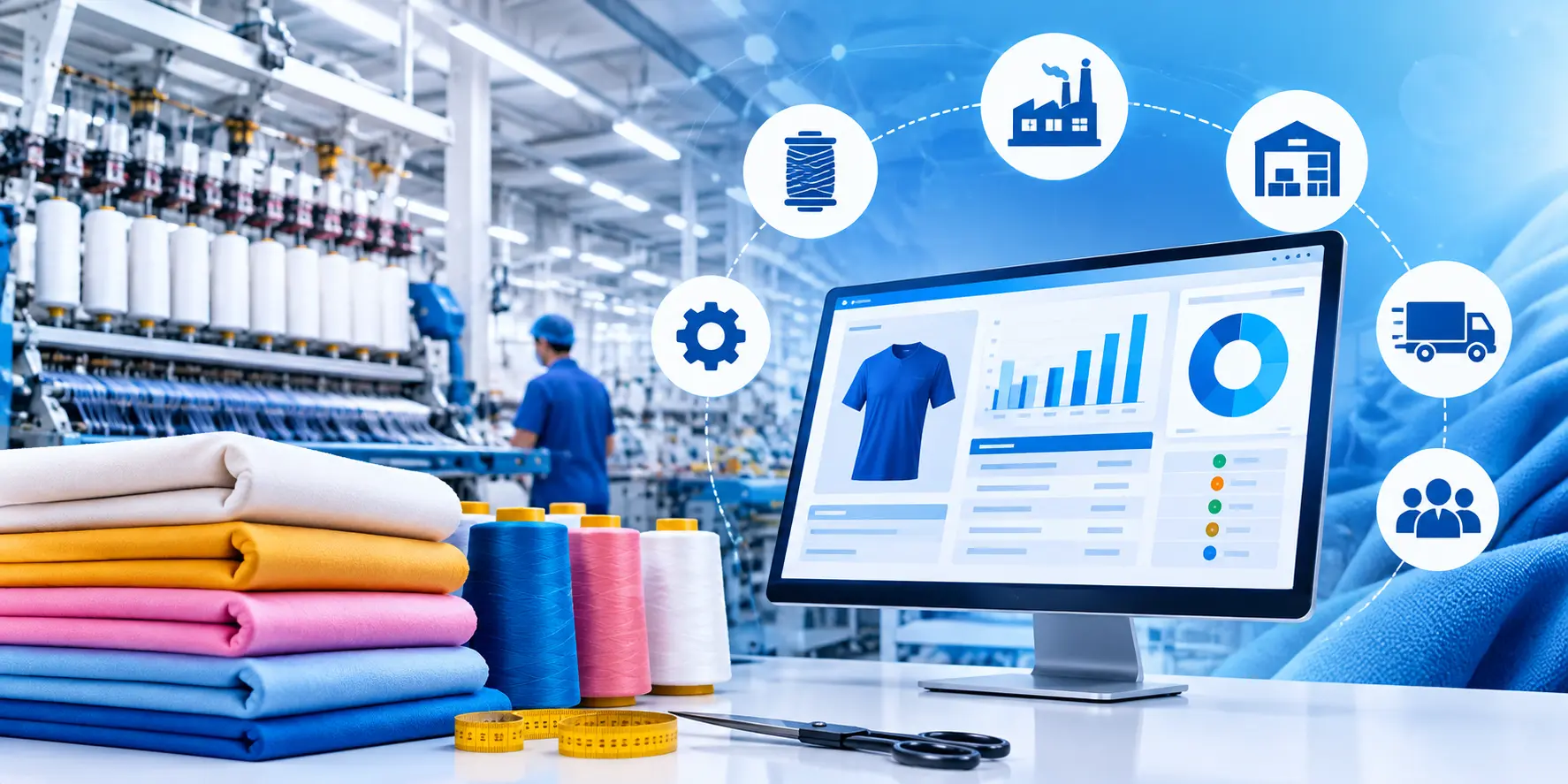
ZYNO BY Elitemindz provides ERP and business management software solutions for companies looking to connect their major business activities through one platform.
For textile and garment businesses, an ERP system needs to support production planning, inventory management, purchasing, sales, finance and reporting. ZYNO's manufacturing ERP offering is worth evaluating for businesses looking for an integrated solution that can be configured around their operational requirements.
Key features to evaluate:
- Manufacturing and production management
- Inventory and warehouse management
- Purchase and supplier management
- Sales and order management
- Financial management and reporting
- Business process automation
- Customised workflows and integrations
Textile companies should discuss their specific requirements, such as fabric roll tracking, colour and size variations, production stages, batch management and material consumption, during the product demonstration.
Website:https://elitemindz.co/
2. VERTEX ERP by Brainsphere IT Solutions
VERTEX ERP is presented by Brainsphere IT Solutions as a solution for textile trading businesses in Dubai and the UAE. It focuses on the requirements of textile companies dealing with woven fabrics, knitted garments, home textiles, readymade clothing and related products.
The platform covers important business activities such as finance, purchasing, inventory, sales orders, HR and reporting. Its inventory functions include product attributes such as size and colour, barcode tracking, stock transfers and batch control.
For textile traders, these functions can help manage different product varieties and customer orders more efficiently.
Key features:
- Finance and accounting management
- Purchase and supplier management
- Inventory and warehouse control
- Sales order processing
- Barcode and batch tracking
- HR and payroll management
- Business intelligence reports
3. FACTS Textile ERP
FACTS ERP offers textile-focused software for businesses in Dubai and across the UAE. Its features address common textile inventory and trading requirements, including fabric roll tracking, lot management and piece-wise stock control.
Textile businesses often need to track fabric in different units and quantities. A roll may have a particular length, colour, design and batch number. Accurate tracking is important when handling multiple customer orders and warehouse locations.
FACTS provides functions such as barcode scanning, inventory management, production scheduling and customised reporting.
Key features:
- Fabric roll and lot tracking
- Piece-wise inventory management
- Barcode scanning
- Production planning
- Vendor and customer management
- Warehouse stock control
- Business reporting
Website:https://www.facts.ae/textile-erp-software-dubai/
4. Odoo ERP for Textile and Apparel Businesses
Odoo is a modular ERP platform that offers manufacturing, inventory, purchase, sales and accounting applications. Businesses can select the modules they need and expand the system as their operations grow.
For textile manufacturers, Odoo can be configured to manage production orders, bills of materials, raw materials, finished products and inventory movements.
It can also support product variations such as different colours, sizes and styles. However, textile-specific processes may require additional configuration or custom development.
Key features:
- Manufacturing and production orders
- Bill of Materials (BOM)
- Inventory management
- Purchase and sales management
- Product variants
- Quality management
- Accounting and reporting
5. Focus Softnet Garment Manufacturing ERP
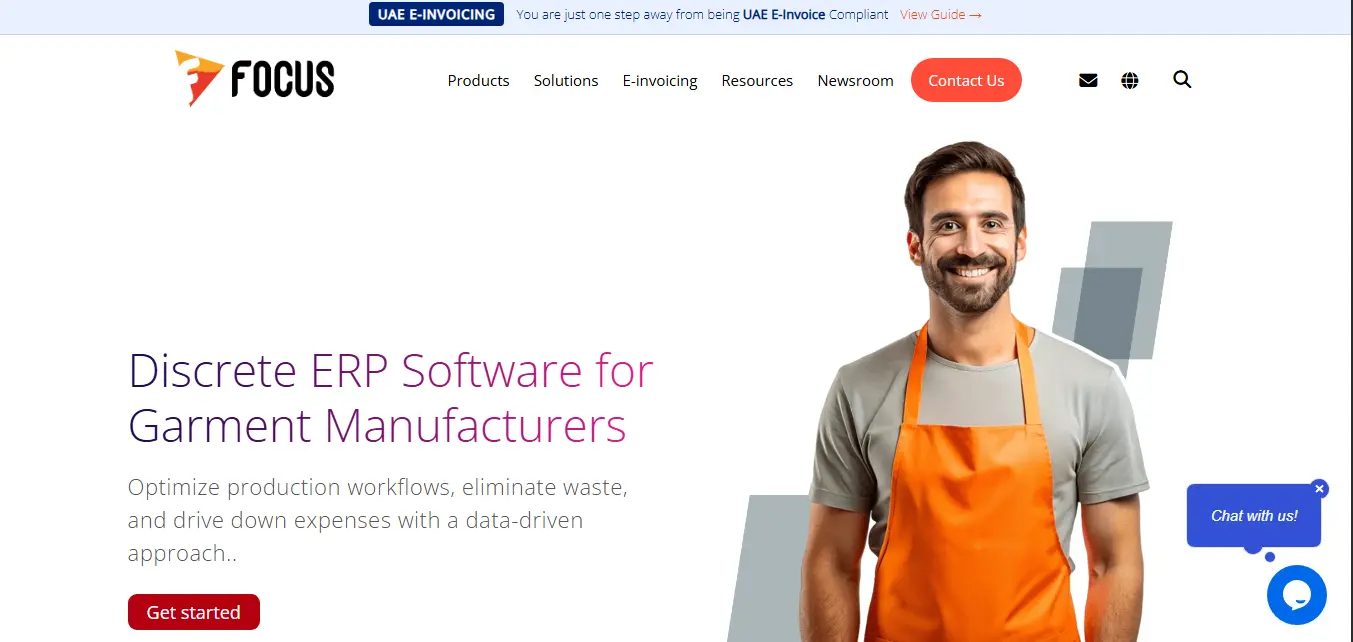
Focus Softnet provides ERP solutions for different industries, including garment manufacturing. Its garment ERP offering focuses on connecting production, inventory, purchasing, sales and other business activities.
Garment manufacturers need to manage several production stages, including cutting, stitching, finishing, inspection and packing. Software that provides visibility into these stages can help businesses monitor production progress and delivery schedules.
Focus Softnet is an option for garment businesses that want to improve coordination between their production and business departments.
Key features:
- Production planning and monitoring
- Inventory management
- Quality control
- Supplier and distributor management
- Sales and order processing
- Business reporting
- Operational performance tracking
Website:https://www.focussoftnet.com/ae/garment-manufacturing-erp-software
6. Datatex NOW ERP
Datatex NOW ERP is an industry-specific ERP platform developed for textile and apparel manufacturers. Unlike general-purpose business software, it focuses on the processes involved in the textile value chain.
The platform supports operations from raw material handling to finished garments. It is designed for businesses involved in spinning, weaving, knitting, dyeing, finishing and apparel production.
Datatex can be useful for manufacturers that require detailed production planning, shop-floor monitoring and supply chain visibility.
Key features:
- Textile production management
- Production planning and scheduling
- Manufacturing execution support
- Quality management
- Product costing
- Inventory and supply chain management
- Process tracking and reporting
Website:https://datatex.com/
7. ERPNext
ERPNext is an open-source ERP platform that provides manufacturing, inventory, accounting, purchasing and sales applications.
Textile and garment businesses can use its manufacturing features to manage production orders, bills of materials, material requirements and stock movements.
It can also be configured to manage different product sizes, colours and material specifications. Businesses with more specialised textile requirements may need customisation or support from an implementation partner.
Key features:
- Manufacturing management
- Bill of Materials
- Inventory and warehouse management
- Purchase and sales management
- Accounting and financial reports
- Work orders
- Stock tracking
Website:https://erpnext.com/
8. SAP and Oracle NetSuite
SAP and Oracle NetSuite are established enterprise ERP platforms used by businesses across different industries. They offer capabilities for finance, procurement, inventory, supply chain and manufacturing management.
For textile companies operating multiple factories, warehouses or business locations, these platforms can provide a connected view of business operations.
However, textile-specific requirements such as fabric roll tracking, dyeing batches, garment size variations and production processes should be checked during implementation planning. Some requirements may need industry-specific extensions or integrations.
Key features:
- Financial management
- Procurement and supplier management
- Inventory and warehouse management
- Manufacturing operations
- Supply chain visibility
- Multi-location business management
- Analytics and reporting
Websites:https://www.sap.com/ andhttps://www.netsuite.com/
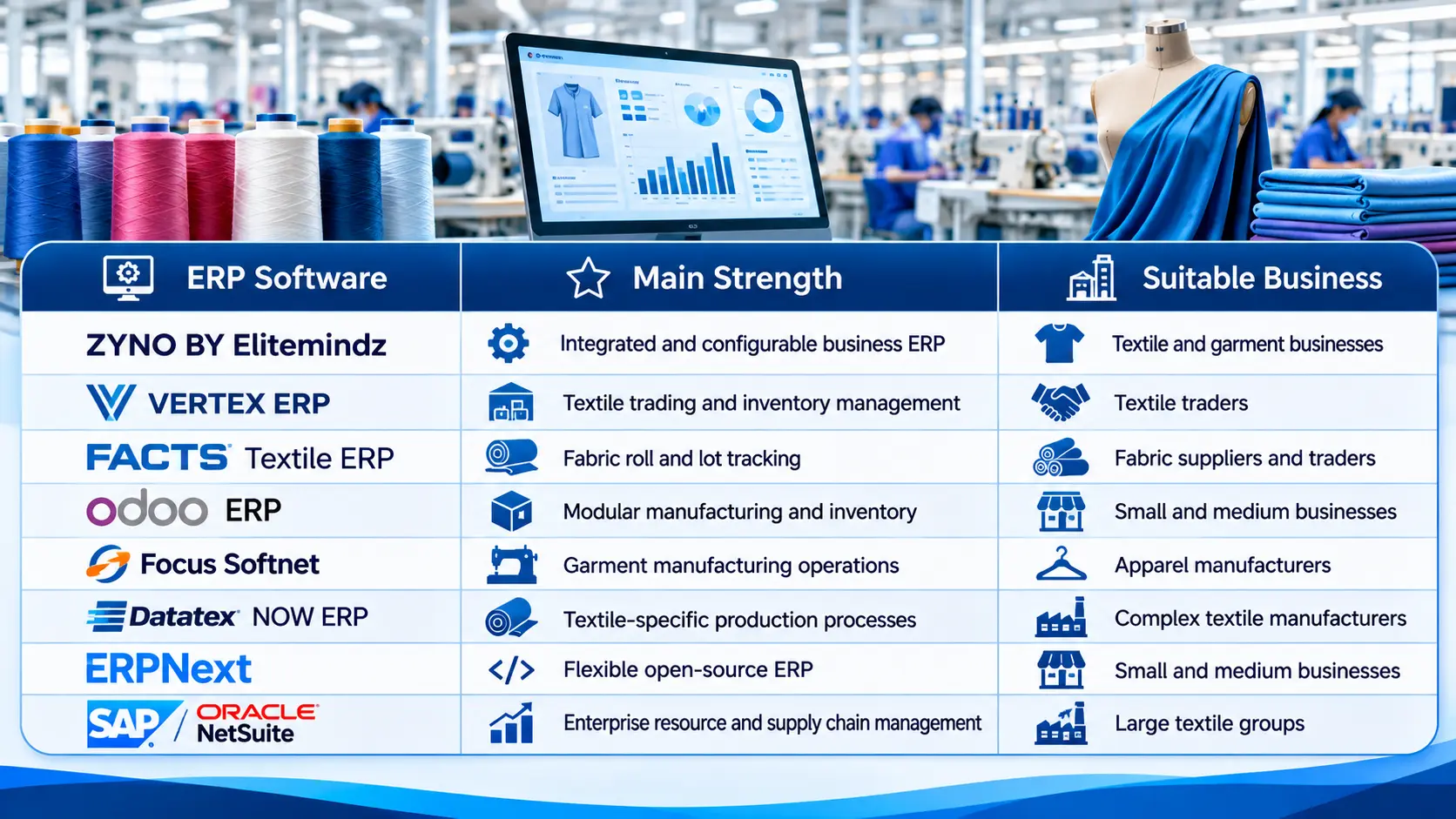
Comparison of Textile ERP Software in UAE
Before selecting an ERP platform, businesses should compare its features with their actual production and trading requirements.
Important Features to Look for in Textile Manufacturing ERP Software
Choosing an ERP system is not only about comparing software names. Textile businesses should check whether the platform can manage their complete operational process.
1. Production Planning and Scheduling
The system should help manufacturers create production orders, allocate materials, plan machine usage and monitor production progress. It should support the processes relevant to the business, such as weaving, knitting, dyeing, cutting and stitching.
2. Fabric and Raw Material Inventory
Inventory management is one of the most important parts of textile operations. The software should track fabric, yarn, accessories, dyes and finished products.
It should also support different units of measurement, product specifications, colours, sizes and warehouse locations.
3. Quality Management
Textile manufacturers need to maintain consistent product quality. ERP software should help record inspection results, identify defects and monitor quality at different production stages.
4. Procurement Management
The procurement module should help businesses manage suppliers, purchase orders, material requirements, goods receipts and supplier payments.
5. Financial Management
An integrated financial module helps companies track expenses, production costs, sales revenue, payments and profitability.
6. Reporting and Business Analytics
Reports and dashboards help managers understand production performance, stock levels, pending orders and financial results.
Transform Textile Operations with ZYNO ERP
Simplify textile production, fabric inventory, procurement, quality control, and order management with ZYNO ERP. Connect your business processes, improve operational efficiency, reduce manual tasks, and manage your textile manufacturing operations more effectively.
Request a Free Demo Explore Manufacturing ERPHow to Choose the Right ERP Software for Textile Industry in Dubai, UAE
The right ERP depends on the size of the business, production model and operational requirements.
Here are some points to consider before making a decision:
- Understand your business requirements: Identify whether you manufacture fabric, produce garments, process textiles or mainly trade textile products.
- Check industry-specific features: Ask whether the software supports fabric rolls, batch tracking, colour variations, size management and production stages.
- Review customisation options: Make sure the platform can handle your existing workflows without unnecessary complexity.
- Check integration capabilities: Confirm that it can connect with accounting systems, barcode devices, e-commerce platforms and other business applications where required.
- Evaluate reporting: Review whether managers can access useful production, inventory, sales and financial reports.
- Consider implementation and support: Ask about training, data migration, technical support and future upgrades.
- Request a product demo: Test the software using your actual business processes before making a final decision.
Companies searching for ERP Software Solutions for Textile Trading Business in Dubai, UAE should give special attention to purchasing, sales orders, warehouse operations, supplier management and fabric stock tracking.
On the other hand, manufacturers should focus more on production planning, material consumption, quality control and shop-floor visibility.
Power Smarter Textile Manufacturing with ZYNO ERP
Bring your textile business operations together with ZYNO ERP. Manage fabric inventory, production planning, raw material purchases, quality checks, customer orders, and financial activities through an integrated ERP platform. Improve workflow visibility and support business growth with smarter management.
Request a Free Demo Explore ZYNO ERPConclusion
The textile industry in the UAE needs reliable systems to manage production, inventory, purchasing, sales and financial operations. The right ERP platform can help businesses reduce manual work, improve stock accuracy and manage customer orders more effectively.
Solutions such as ZYNO BY Elitemindz, VERTEX ERP, FACTS Textile ERP, Odoo, Focus Softnet, Datatex NOW ERP, ERPNext, SAP and Oracle NetSuite offer different capabilities for textile and garment businesses.
Before choosing a platform, compare its features, flexibility, implementation support and ability to handle your specific textile processes. A suitable ERP system should not only solve current business challenges but also support future growth.
Learn More:
Top 10 Cloud-Based Manufacturing ERP Software Solutions in Middle East
Best Chemical Manufacturing ERP Software in the Middle East
Best ERP System for Logistics and Transport Industry in Middle East
Top 15 Manufacturing ERP Software in Saudi Arabia
Top Warehouse Management ERP Software in the Middle East
12 Best POS Software for Supermarkets in UAE
Frequently Asked Questions (FAQs)
1. What is textile manufacturing ERP software?
Textile manufacturing ERP software is a business management system that helps textile companies manage production, inventory, purchasing, sales, quality control, finance and reporting through one integrated platform.
2. Which is the best textile manufacturing ERP software in UAE?
The best option depends on business requirements. ZYNO BY Elitemindz, FACTS Textile ERP, VERTEX ERP, Odoo, Focus Softnet, Datatex NOW ERP and ERPNext are options businesses can evaluate based on their manufacturing and trading needs.
3. What are the benefits of Textile ERP Software in Dubai?
Textile ERP software helps businesses manage fabric inventory, production planning, purchase orders, sales, supplier information and financial operations. It can improve operational visibility and reduce manual errors.
4. Is ERP software useful for garment manufacturers in UAE?
Yes. ERP software helps garment manufacturers manage cutting, stitching, finishing, packing, raw material inventory, production schedules and customer orders.
5. What features should ERP software for garment manufacturers include?
Important features include production planning, BOM management, size and colour variations, inventory control, quality inspection, order tracking, costing and financial management.
6. Can ERP software manage textile trading businesses in Dubai?
Yes. ERP systems can manage textile purchasing, sales orders, fabric inventory, supplier details, customer information, warehouse operations and financial transactions.
7. What is the difference between textile ERP and general manufacturing ERP?
General manufacturing ERP supports common production and business processes. Textile ERP may include specialised features for fabric rolls, colours, sizes, batches, textile processing, dyeing, weaving and garment production.
8. Is cloud-based textile ERP software suitable for UAE companies?
Cloud-based ERP can be suitable for UAE businesses that want to access business information across different locations. Companies should check data security, backup policies, access controls, integrations and support before selecting a cloud solution.
9. How much does textile ERP software cost in UAE?
The cost depends on the number of users, selected modules, customisation, integrations, implementation and support requirements. Businesses should request a quotation based on their specific needs.
10. Why should textile businesses consider ZYNO BY Elitemindz?
Textile businesses can consider ZYNO BY Elitemindz when evaluating integrated ERP and manufacturing software solutions. They should request a demonstration to check how the platform can address their requirements for production, inventory, procurement, sales and financial management.
Related Blogs





















Let’s Build the Future Together
Partner with ZYNO by Elite Mindz to revolutionize how your business works. Fill out the form, and we’ll reach out with AI-powered solutions made just for you.