How E-Commerce Is Transforming Businesses and Driving Digital Growth
Read More →

×
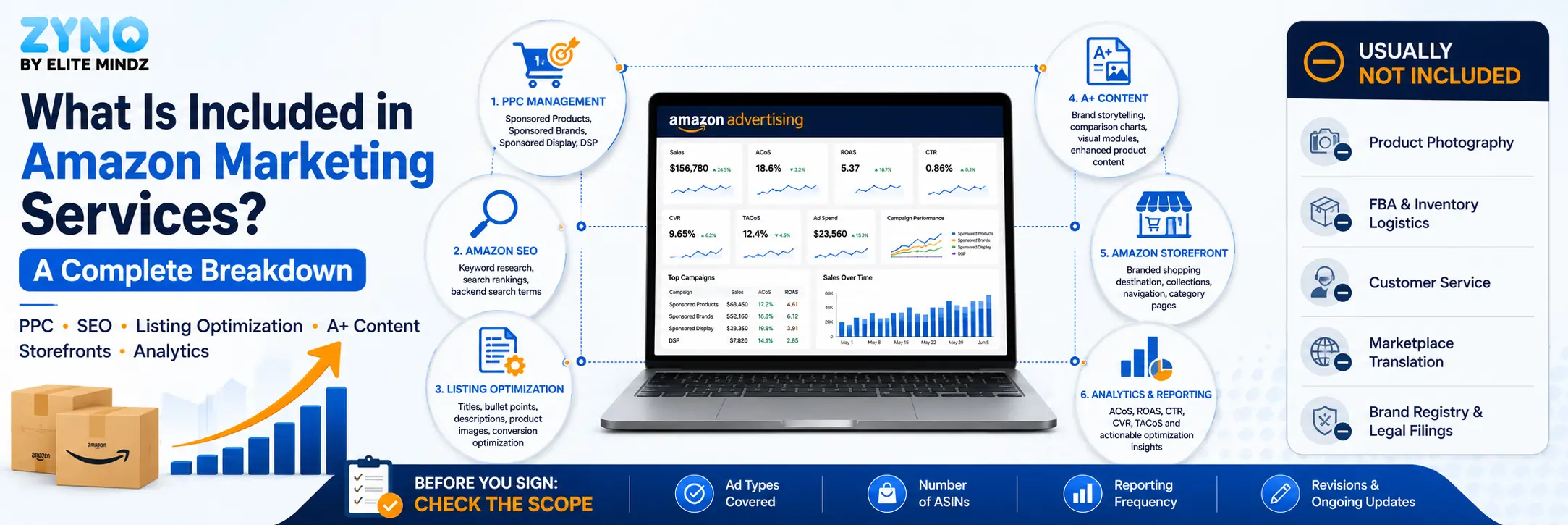
Amazon Marketing Services (AMS) covers everything from PPC and SEO to A+ Content and Storefront design - the full toolkit brands use to grow visibility and sales on Amazon. Not sure where to start or how to make it all work together? Explore Elite Mindz's Amazon Marketing Services to see how a coordinated strategy can move the needle for your brand.
Businesses using ZYNO Books cut accounting time by 70% and stay 100% ZATCA-compliant — automatically.

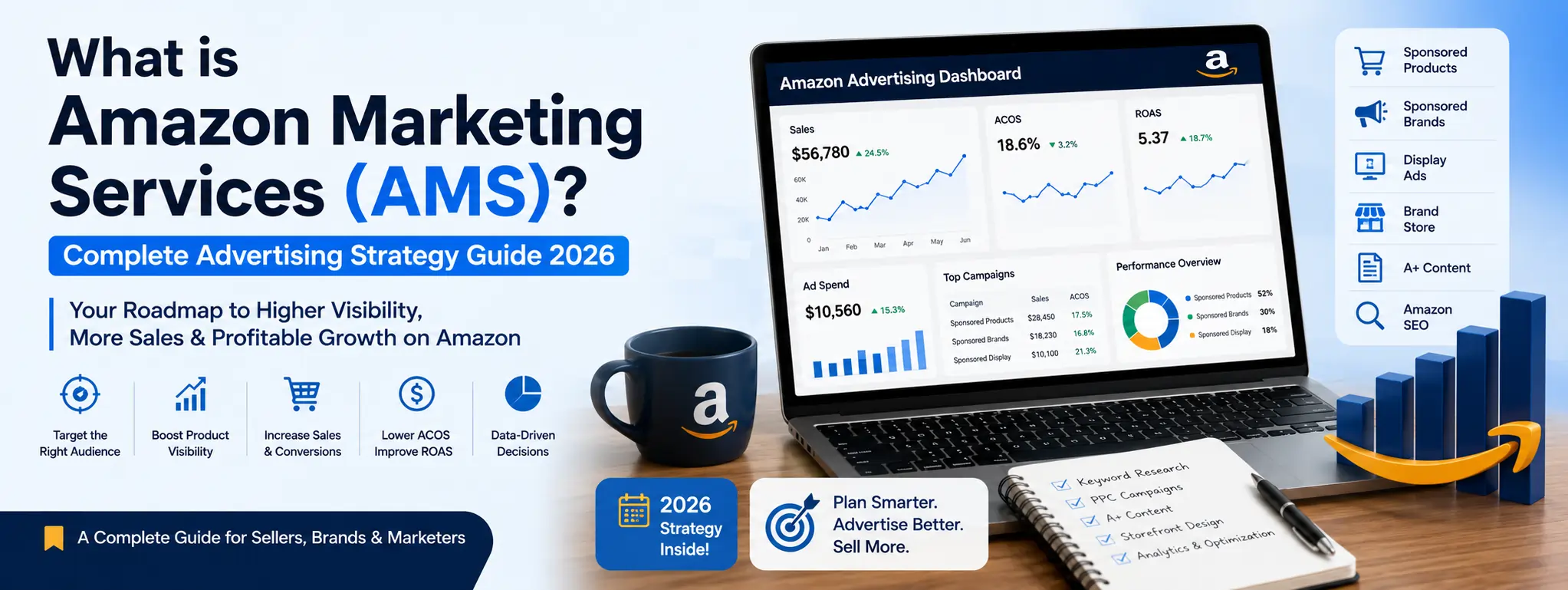
Amazon Marketing Services, commonly shortened to AMS, refers to the full range of advertising and optimization tools brands use to sell on Amazon, including Sponsored Products, Sponsored Brands, Sponsored Display, A+ Content, Storefronts and Amazon SEO. While Amazon officially rebranded its advertising platform as Amazon Ads several years ago, "AMS" remains a widely used shorthand in the marketing world for the broader discipline of growing sales on Amazon through paid and organic strategies combined.
This guide breaks down every piece of the puzzle for sellers, brand owners and marketers: PPC campaigns, keyword research, listing optimization, content, analytics and the strategy that ties it all together.
AMS originally referred to a specific self-service advertising console Amazon launched for vendors. Over time, Amazon consolidated its advertising products under the Amazon Ads umbrella, which now includes Sponsored Products, Sponsored Brands, Sponsored Display and Amazon DSP. Despite this shift, "Amazon Marketing Services" stuck around as an informal, catch-all term that agencies and marketers use to describe everything involved in marketing a product on Amazon.
In practical terms, when someone asks about Amazon Marketing Services Agency today, they're usually asking about:
None of these work well in isolation. A well-optimized listing with no advertising sits invisible in search results. A heavily advertised listing with weak content burns budget without converting. The modern approach treats Amazon marketing as one connected system, and that's the lens this guide uses throughout.
Amazon marketing follows a funnel similar to other digital channels, but shaped by Amazon's own search and purchase behavior. Shoppers arrive with strong purchase intent already, which changes how each stage should be approached.
1. Discovery - Shoppers find your product through Amazon search results, Sponsored Products placements, category browsing or external traffic. This is where keyword targeting and SEO visibility matter most.
2. Consideration - Once a shopper clicks through, they evaluate your listing: images, title, bullet points, pricing, reviews and A+ Content. This stage determines whether a click turns into a serious look or a bounce.
3. Conversion - The shopper decides to buy. Conversion is influenced by price competitiveness, review quality, Prime eligibility, listing clarity and trust signals like brand content and Storefront presence.
4. Retention and brand growth - Repeat purchases, brand searches and Storefront visits build long-term equity. This stage is often overlooked but it's where advertising costs start to drop as organic and branded demand increases.
Each stage feeds the next. Weak discovery limits everything downstream, while weak conversion wastes traffic you've already paid to acquire.
A complete Amazon marketing approach touches several interconnected areas.
Places products in front of shoppers actively searching or browsing on Amazon. Campaigns are built around keyword and product targeting, and success depends on continuous bid and budget management rather than a "set it and forget it" launch.
The practice of optimizing titles, bullet points, backend search terms, images and content so products rank higher in organic search results without paid placement. Amazon's search algorithm (informally called A9/A10, though Amazon doesn't publish exact mechanics) weighs relevance and sales performance signals, so SEO and conversion rate are closely linked.
Allows brand-registered sellers to replace plain text descriptions with enhanced visual modules - comparison charts, lifestyle imagery and brand storytelling. It's one of the more direct ways to influence how shoppers perceive product quality once they've clicked through.
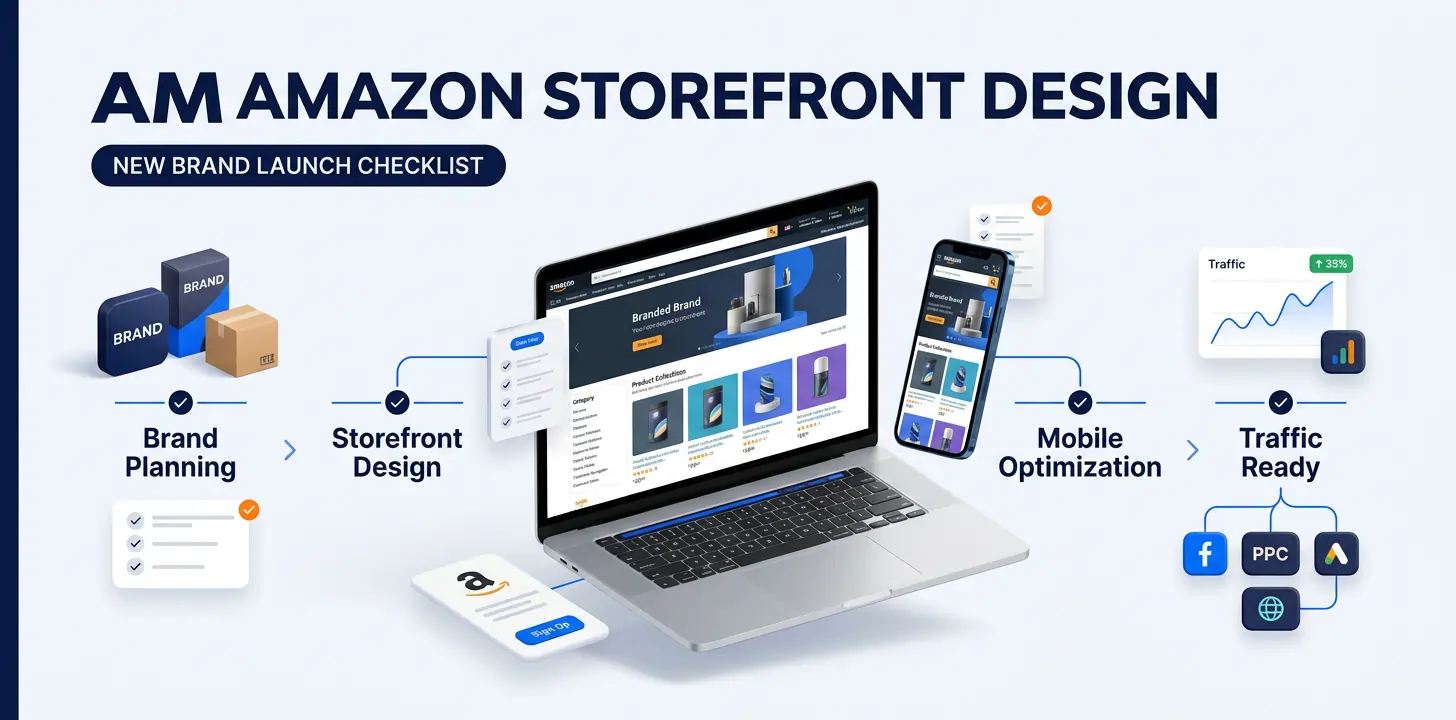
A free, multi-page branded shopping destination on Amazon. Particularly useful for brands driving external traffic (social, influencer, email), since it gives that traffic a dedicated landing experience instead of a single product page.
Identifies the exact terms shoppers use to search for products like yours, including branded, non-branded, long-tail and competitor-related terms. This informs both PPC targeting and SEO content, which is why it sits at the center of most Amazon marketing decisions.
Covers titles, bullet points, descriptions, backend keywords and images, structured to satisfy both search relevance and shopper decision-making. A listing built for SEO but ignoring conversion (or vice versa) will underperform regardless of traffic volume.
Ongoing analysis of ACOS, ROAS, CTR and CVR determines which keywords and campaigns deserve more budget and which need to be paused or restructured. This is continuous, not a one-time setup task.
Brands looking to combine these elements under one coordinated strategy often work with a specialized team offering Amazon Marketing Services rather than managing each piece separately in-house.
Improve your Amazon visibility, attract targeted traffic, increase conversions, and build a more profitable advertising strategy with expert Amazon Marketing Services.
Amazon PPC • Amazon SEO • A+ Content • Storefront Design • Campaign Optimization
What is the best way to structure Amazon PPC campaigns? Most effective PPC strategies combine automatic and manual campaigns, layered with match-type control and consistent negative keyword management.
Automatic campaigns let Amazon match ads to relevant search terms based on listing content, useful for discovering new keyword opportunities early on. Manual campaigns give direct control over which keywords or products to target, using three match types:
A mature PPC strategy also separates branded keywords (your own brand/products, usually cheap and high-converting), non-branded keywords (generic category terms, where most new customer acquisition happens), competitor targeting (bidding on competitor ASINs or brand names, higher risk but can capture comparison shoppers), and product targeting (placing ads on specific product pages or categories rather than search keywords).
Negative keywords exclude irrelevant search terms from triggering ads, protecting budget from wasted clicks. Bid optimization and budget optimization mean regularly adjusting cost-per-click bids and budget allocation based on performance data rather than guesswork.
| Metric | What It Measures | Formula |
|---|---|---|
| ACOS (Advertising Cost of Sale) | Ad spend as a percentage of ad-attributed sales | Ad Spend ÷ Ad Sales × 100 |
| ROAS (Return on Ad Spend) | Revenue generated per dollar of ad spend | Ad Sales ÷ Ad Spend |
| CTR (Click-Through Rate) | How often impressions turn into clicks | Clicks ÷ Impressions × 100 |
| CPC (Cost Per Click) | Average cost paid per click | Ad Spend ÷ Clicks |
| CVR (Conversion Rate) | Percentage of clicks that result in a sale | Orders ÷ Clicks × 100 |
| TACOS (Total Advertising Cost of Sale) | Ad spend as a percentage of total sales (paid + organic) | Ad Spend ÷ Total Sales × 100 |
TACOS is particularly useful for tracking whether advertising is genuinely driving business growth, rather than just cannibalizing organic sales you'd have gotten anyway.
Sellers who want hands-on campaign structuring and ongoing optimization often turn to dedicated Amazon PPC services rather than managing complex campaign portfolios manually.
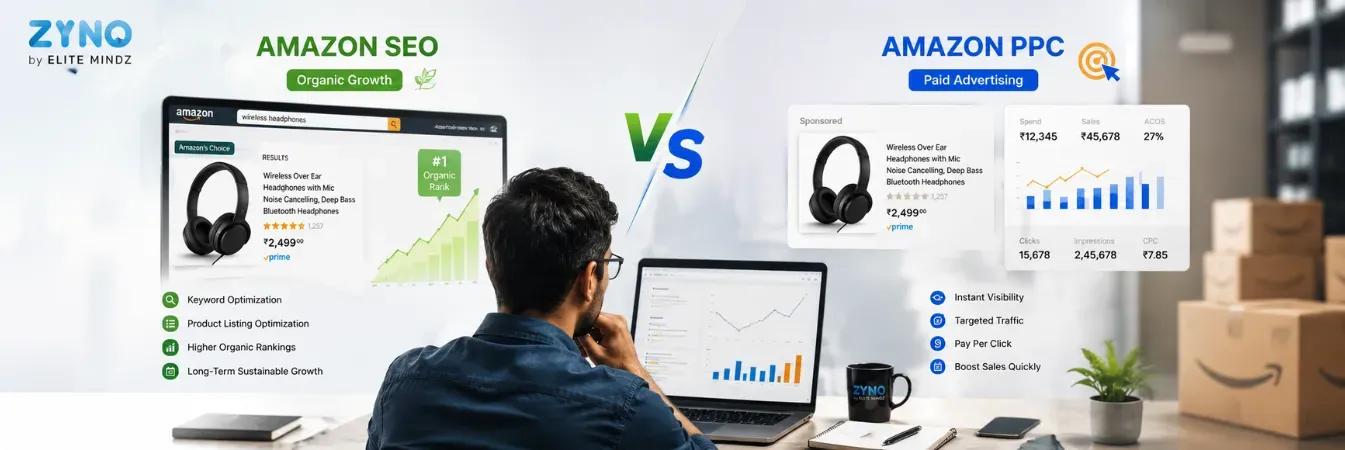
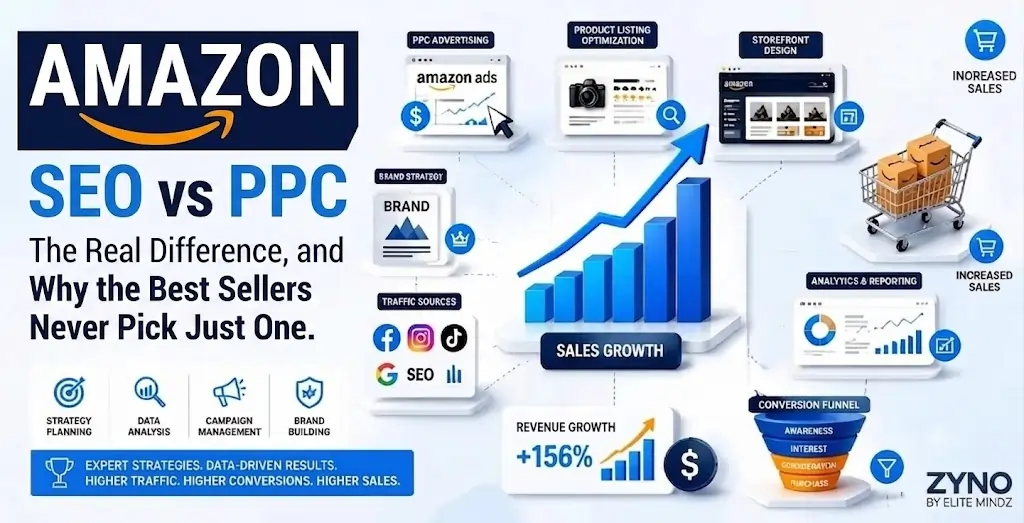
Should you focus on Amazon SEO or Amazon PPC? In most cases, the answer is both - they serve different purposes and reinforce each other rather than competing for the same job.
| Factor | Amazon SEO | Amazon PPC |
|---|---|---|
| Cost | No direct cost per click | Pay per click |
| Speed of Results | Gradual, builds over time | Immediate visibility |
| Sustainability | Long-term, compounding | Stops when spend stops |
| Best For | Long-term ranking and organic traffic | New launches, testing, and fast visibility |
| Data Value | Relies on existing sales and relevance signals | Generates keyword and conversion data |
New product launches lean more heavily on PPC since there's no sales history to support organic ranking yet. As a listing accumulates reviews and sales velocity, organic visibility typically improves, and PPC data (which keywords convert, which don't) informs ongoing SEO refinement. Brands with strong organic rankings generally spend less on PPC over time, though dropping it entirely on a winning product usually means giving up premium placements to competitors.
Teams wanting expert-led listing and keyword strategy alongside advertising can pair PPC management with dedicated Amazon SEO services so both channels work from the same keyword data.
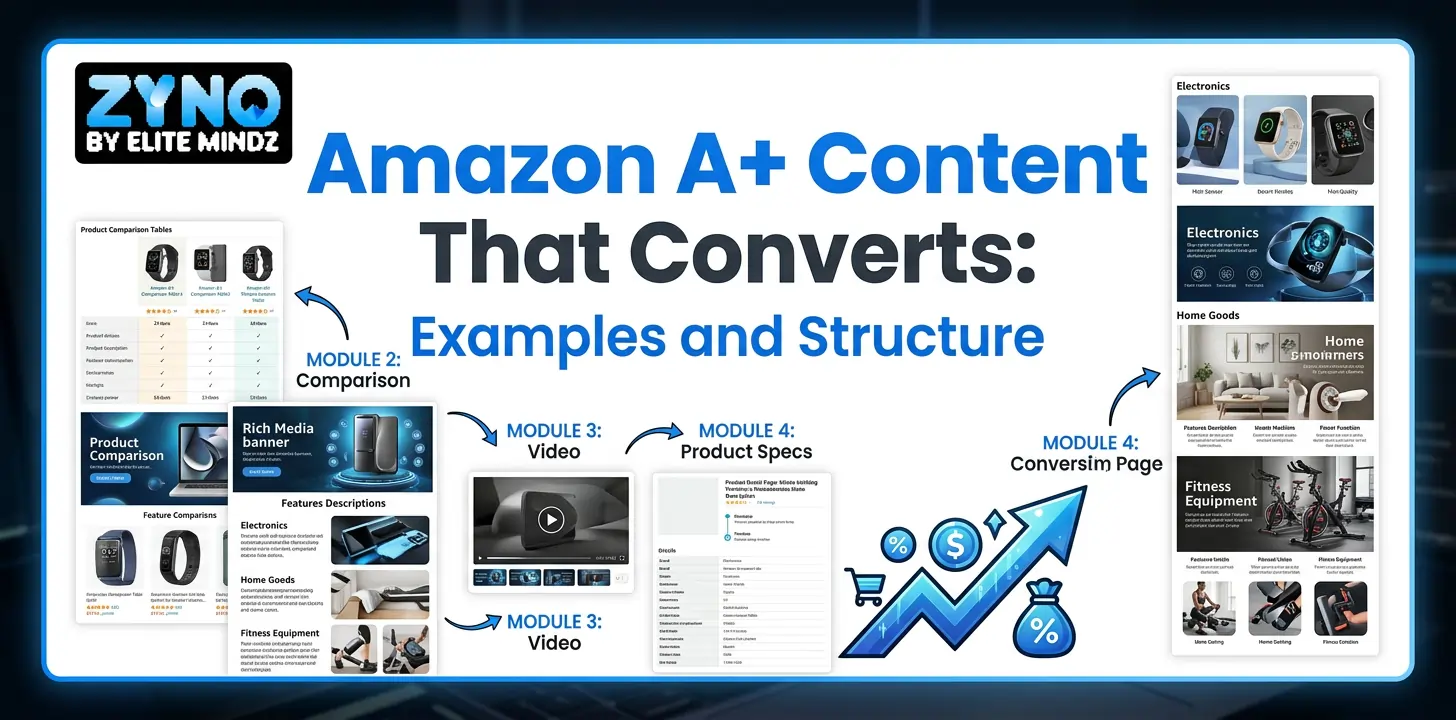
How does A+ Content improve Amazon sales? A+ Content replaces plain, text-only descriptions with visual modules - comparison tables, lifestyle photography and feature callouts - that help shoppers understand a product faster and trust the brand behind it.
Shoppers scanning search results move quickly and compare multiple similar listings before deciding. Content that clearly communicates benefits and visually differentiates a brand tends to reduce hesitation at the point of decision. A Storefront extends this by giving a brand a dedicated, multi-page shopping destination - especially valuable when driving traffic from outside Amazon, since it gives visitors a cohesive landing experience instead of a single, isolated product page.
Together, A+ Content optimization and Amazon Storefront design work as the "trust layer" of an Amazon marketing strategy, supporting conversion after advertising and SEO have already earned the click.
Beyond the core PPC metrics covered earlier, a few additional figures matter for overall account health: impressions (how often an ad or listing appeared in search or browse results), attributed sales (sales credited to a specific ad or campaign within Amazon's attribution window), and TACOS (total ad spend relative to total sales, useful for tracking overall marketing efficiency rather than just ad-level performance). ACOS and ROAS, covered above, remain the primary profitability indicators at the campaign and keyword level.
Tracking these metrics in isolation rarely tells the full story. A campaign with high ACOS on one keyword might still be worth running if it drives high-value repeat customers or supports a deliberate launch push. Context and business goals should shape how the numbers get interpreted.
What are the steps to building an Amazon marketing strategy? A structured approach generally follows eight stages:
This isn't a linear, one-time process. Steps 5 through 8 repeat in cycles as new data comes in, seasonality shifts and competitors adjust.
From Amazon PPC and SEO to A+ Content and Storefront optimization, build a complete Amazon marketing strategy that helps your products reach the right customers.
Improve Visibility • Increase Conversions • Scale Amazon Sales
Several recurring mistakes tend to hold back otherwise promising Amazon marketing efforts:
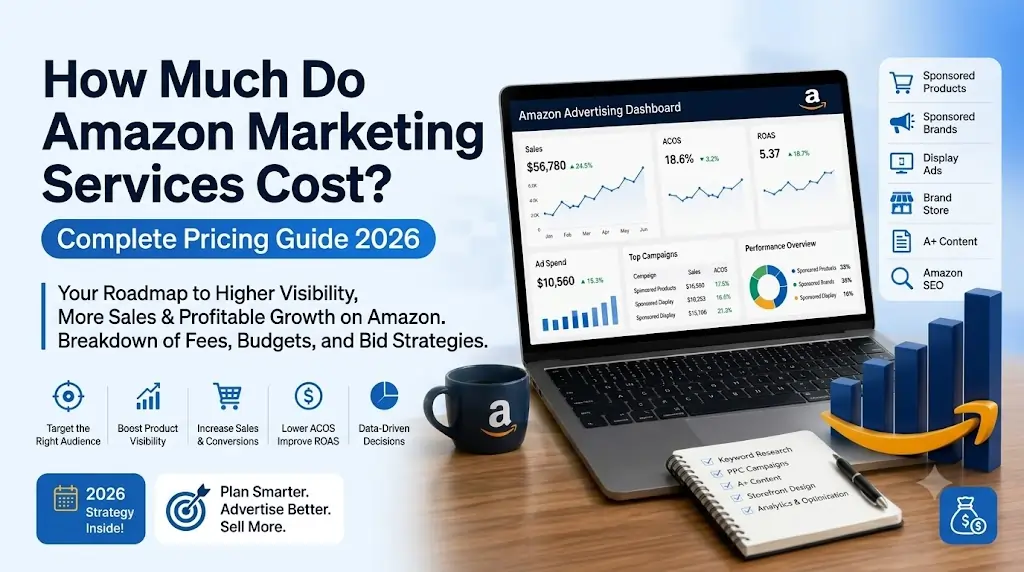
There's no single fixed price for Amazon Marketing Services, and any source quoting one number without knowing your product count, marketplace and goals should be treated with some skepticism. Cost depends on several factors:
| Factor | Why It Affects Cost |
|---|---|
| Number of Products/ASINs | More listings mean more content, campaigns, and optimization work. |
| Marketplace(s) | Managing multiple Amazon marketplaces increases the overall scope of work. |
| Competition Level | Highly competitive categories often require more active bid management and optimization. |
| Campaign Complexity | More campaign types, including Sponsored Products, Sponsored Brands, Display Ads, and DSP, increase management time. |
| Advertising Budget | Ad spend itself is separate from service fees and scales independently. |
| Service Scope | Full-service Amazon marketing, including PPC, SEO, content, and Storefront optimization, costs more than PPC-only management. |
Agencies typically use a flat monthly retainer, a percentage of ad spend, or project-based pricing for one-time work like A+ Content design or a Storefront build. None of these models is universally "best" - the right fit depends on your budget predictability needs and whether you want ongoing management or discrete projects.
Professional Amazon Marketing Services tend to make the most sense for brands managing too many moving parts to handle in-house, or that lack the time to stay on top of ongoing optimization. Search-term analysis, negative keyword management, bid optimization and ACOS/ROAS analysis aren't one-time setup tasks - they need continuous attention as competition and platform features shift.
That said, hiring an agency isn't the right call for everyone. Smaller sellers with a handful of SKUs and the bandwidth to learn the platform may reasonably manage campaigns themselves, at least initially. The clearest signal it's time for expert support is when ad spend is growing but results aren't scaling proportionally, or when listing content, Storefront design and analytics all need attention at once and internal resources are stretched too thin.
Considering professional support? A team that manages product listing quality, conversion optimization, A+ Content, Storefronts and campaign scaling together - rather than treating each as a separate task - tends to produce more consistent results than piecing together freelancers for each individual piece.
A widely used term for the combined practice of Amazon advertising, SEO, A+ Content, Storefront design and performance analytics used to grow visibility and sales on Amazon.
Not exactly. Amazon Ads is Amazon's official advertising platform (Sponsored Products, Sponsored Brands, Sponsored Display, DSP). "Amazon Marketing Services" is a broader, informal term that includes Amazon Ads plus organic SEO, content and Storefront work.
Typically PPC management, SEO and keyword research, listing optimization, A+ Content design, Storefront development and performance analytics.
For most brands, yes, particularly for new launches and competitive categories where organic visibility alone isn't enough. Results vary by product and execution, so PPC should be evaluated against clear ACOS, ROAS and TACOS goals rather than assumed to work uniformly.
SEO earns organic search visibility through listing optimization and relevance signals, while PPC pays for placement in search results and product pages. They complement rather than replace one another.
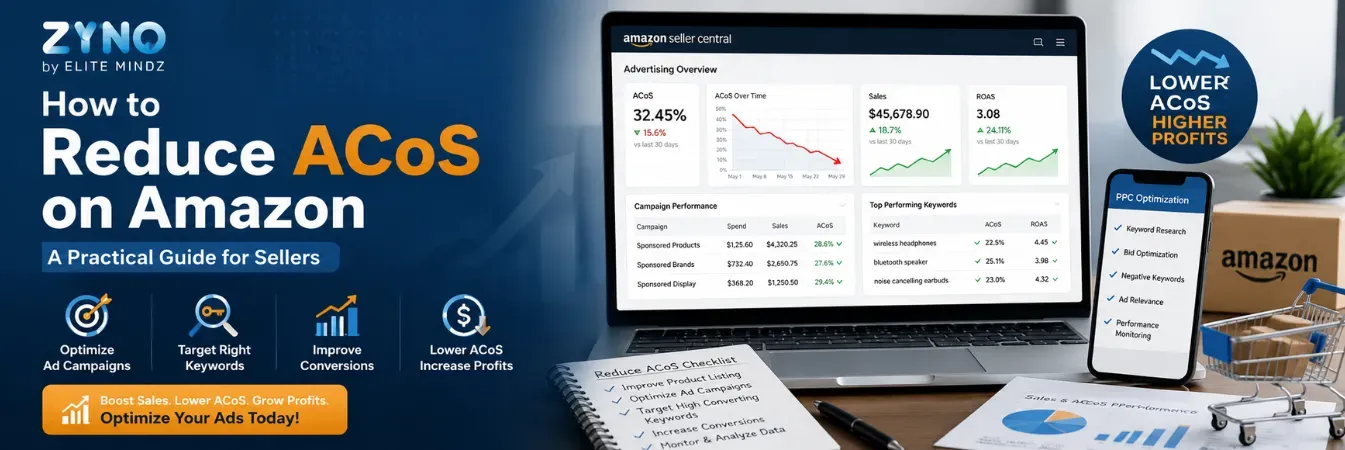
Refine keyword targeting, add negative keywords consistently, improve listing conversion rate, and reallocate budget away from underperforming keywords toward proven ones.
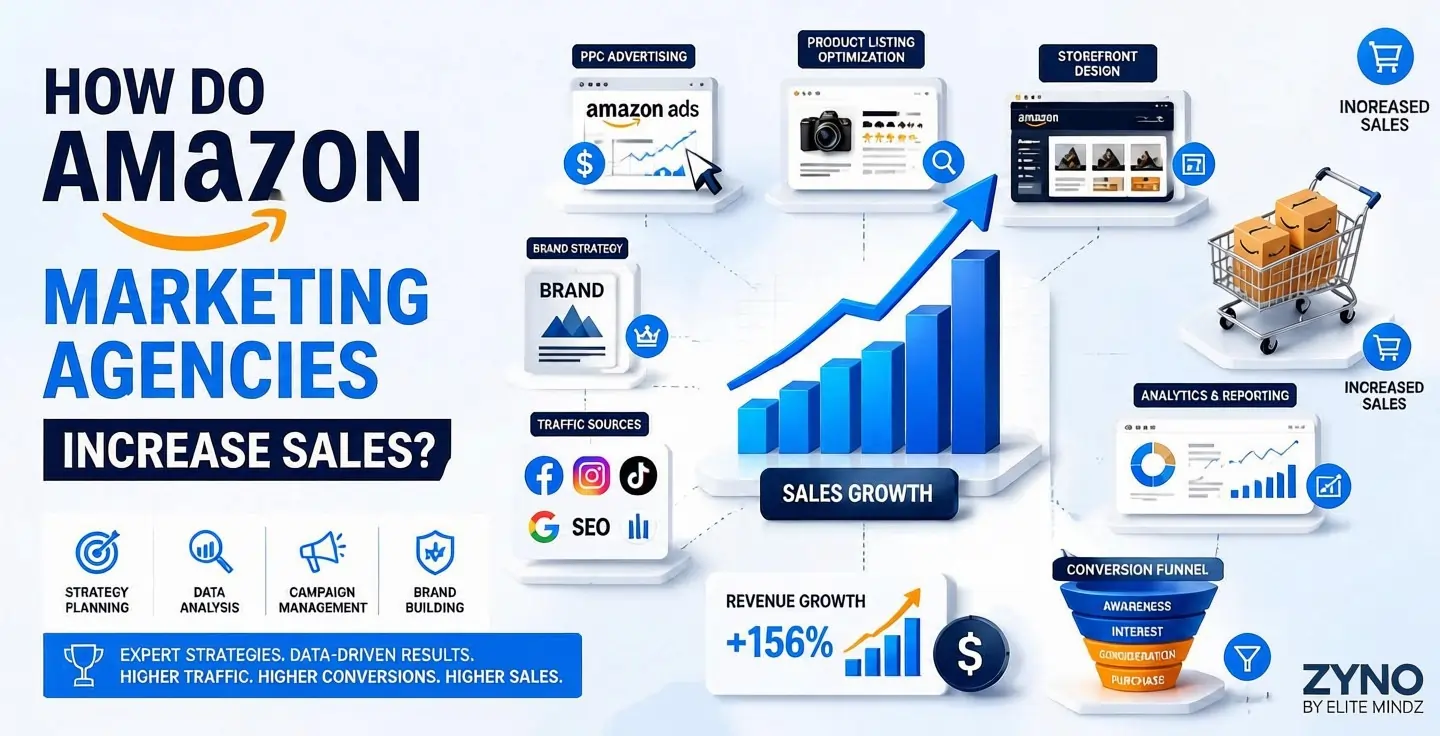
By combining paid visibility, organic visibility, trust-building content and continuous data-driven optimization, so more of the right shoppers see a listing and convert once they arrive.
Amazon Marketing Services isn't one single tool - it's the combination of Amazon PPC, Amazon SEO, keyword research, listing optimization, A+ Content, Storefront design and ongoing analytics working together. Brands that treat these as separate, disconnected tasks tend to leave performance on the table, while brands that align paid advertising with organic optimization and strong content generally see steadier growth.
Whether you're launching a new product or scaling an existing catalog, the fundamentals stay the same: understand your funnel, invest in both discovery and conversion, and let performance data guide where budget goes next. If managing that strategy internally feels like more than your team has bandwidth for, exploring dedicated Amazon Marketing Services is a reasonable next step toward getting PPC, SEO, content and analytics working as one coordinated system.
Discover opportunities to improve your Amazon visibility, optimize your advertising campaigns, and build a stronger strategy for sustainable sales growth.
Free Consultation • Amazon PPC • Amazon SEO • A+ Content • Storefront Optimization
How E-Commerce Is Transforming Businesses and Driving Digital Growth
Read More →
Top 10 Software Development Companies in India
Read More →
Local SEO Strategies That Actually Generate Leads for US Businesses in 2026
Read More →
How to Choose the Right Digital Marketing Agency in the USA
Read More →
Top SEO Mistakes Costing US Companies Thousands of Dollars And How to Fix Them
Read More →
How to Choose an Indian Digital Marketing Agency for Projects
Read More →
Choosing a Partner for High-Intent Growth: What to Look For in a Digital Marketing Agency
Read More →
What Role Does Leadership and Change Management Play in Driving Digital Transformation in Mid-Sized Indian Companies?
Read More →
How Do Mid-Market Companies in India Measure the Success of Their Digital Transformation Initiatives?
Read More →
What Are the Common Challenges Mid-Market Businesses in India Face When Implementing Digital Transformation?
Read More →
How Should a Mid-Sized Indian Company Prioritize Technology Investments During Digital Transformation?
Read More →
How to Choose the Best Amazon Storefront Design Agency in 2026
Read More →
Amazon Storefront Design Agency vs. DIY: What Actually Drives Sales?
Read More →
What Is Amazon Marketing Services (AMS)? Complete Advertising Strategy Guide 2026
Read More →
How Much Do Amazon Marketing Services Cost? Complete Pricing Guide 2026
Read More →Partner with ZYNO by Elite Mindz to revolutionize how your business works. Fill out the form, and we’ll reach out with AI-powered solutions made just for you.
We use browser cookies to ensure you get the best experience on our website. Learn more
The form was submitted successfully!
ZYNO Digital
Fueling Smarter Digital Growth
ZYNO Digital fuels smarter digital growth through data-driven marketing, creative storytelling, and performance strategies that boost visibility, engagement, and measurable business outcomes across global platforms.
ZYNO Tech
Engineering the Future of IT
ZYNO Tech delivers cutting-edge IT solutions — including web, mobile, and digital transformation services — helping businesses scale efficiently, innovate faster, and stay ahead in a connected world.
ZYNO AI
AI Built for Business Growth
ZYNO AI harnesses the power of artificial intelligence to automate processes, enhance decision-making, and deliver predictive insights — driving innovation, agility, and measurable business growth.
ZYNO by Elite Mindz
Your Partner in the AI-Powered Future
ZYNO by Elite Mindz offers AI-powered products and services that unify operations, boost productivity, and drive digital transformation — helping businesses scale smarter and innovate faster.
* In just 2 mins you'll get a response
* Your idea is 100% protected by our Non-Disclosure Agreement