
 Contact Us

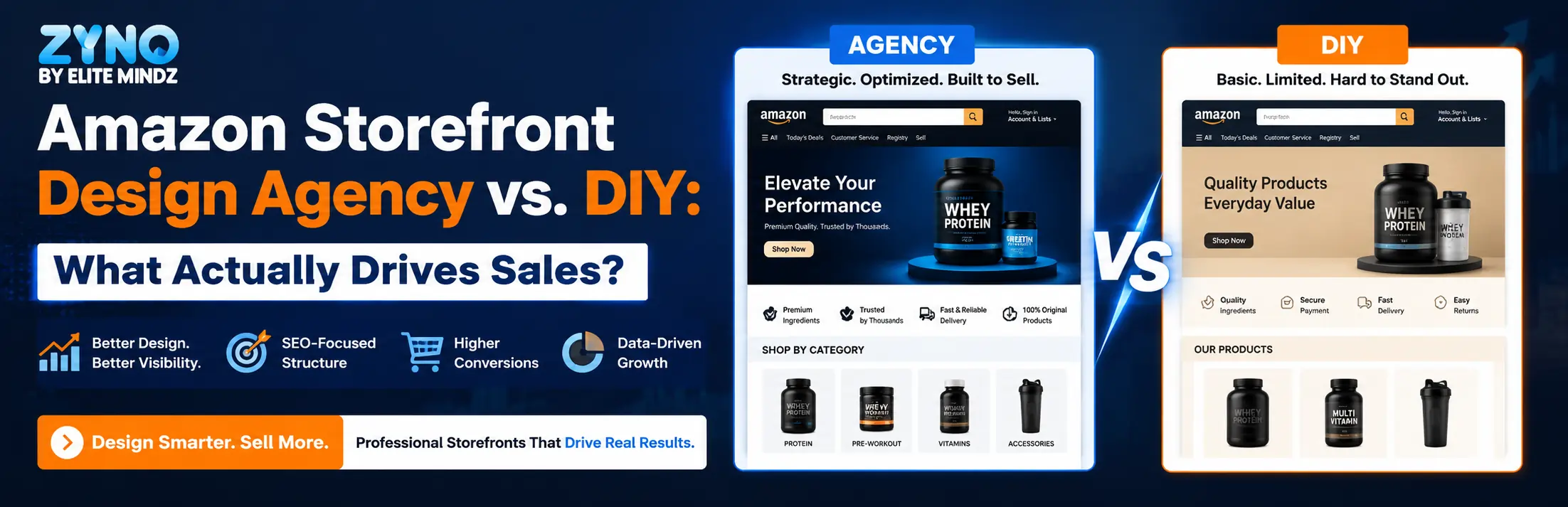
Amazon Storefront Design Agency vs. DIY: What Actually Drives Sales?
Stuck between DIY and hiring an agency for your Amazon storefront? See the real signs, hidden costs, and sales drivers - then get a free store audit to know exactly where you stand.

Share This Blog :


Stop Losing Money to VAT Penalties & Manual Errors
Businesses using ZYNO Books cut accounting time by 70% and stay 100% ZATCA-compliant — automatically.




Late night. Third cup of coffee. You're dragging tiles around Amazon's Store Builder, trying to make your brand look as good as the competitor whose store you just bookmarked. You hit publish, feel proud for about ten minutes… and then the numbers come in. Same traffic. Same conversion rate. Nothing moved.
If that sounds familiar, you're not alone - and you're not doing anything "wrong." You're just running into a question every growing Amazon seller eventually asks: should I keep building my storefront myself, or is it finally time to bring in a storefront design agency?
This isn't a "DIY is bad" or "agencies are always right" kind of article. It's an honest, no-fluff breakdown of what actually moves the needle on an Amazon Storefront - so you can decide with facts, not guesswork.
The Real Question Isn't "Agency or DIY" - It's "What's Actually Driving Sales?"
Most articles on Amazon Storefront Design frame this topic as a binary choice and stop there. But that misses the real point. A storefront isn't a trophy - it's a sales tool. So the better question is: what elements of a storefront genuinely influence whether a visitor buys, and can you realistically build those yourself?
Once you know what actually drives sales, the DIY-vs-agency decision becomes much easier - because you're comparing against a real yardstick, not a vague feeling that "it should look better."
What DIY Amazon Storefront Design Really Looks Like
Let's be fair to DIY first, because it genuinely works for some sellers.
Amazon's free Store Builder is drag-and-drop, template-based, and doesn't need any coding. If you're just starting out, have a handful of ASINs, and want a basic branded page instead of the default listing grid, DIY can absolutely get you there in an afternoon.
But here's what DIY quietly struggles with as your catalog and ambitions grow:
- No strategic structure. Most self-built stores are organized the way the seller thinks about their products, not the way a shopper searches for them. That mismatch quietly kills conversions.
- Keyword blind spots. Category names, page titles, and tile copy get filled in with whatever sounds nice - not what your customers are actually searching for.
- Mobile is an afterthought. DIY builders let you preview mobile, but few sellers actually test and rework the layout for it. And most of your shoppers are on their phones.
- No one is measuring it. Once it's live, DIY stores are rarely revisited unless something looks broken. There's no one tracking bounce rate or click-through rate and asking "why."
None of this means you did a bad job. It means design and data-analysis skills are a full-time craft, and most sellers are already stretched thin managing inventory, ads, and customer service.
What a Storefront Design Agency Actually Brings to the Table
This is the part most comparison blogs skip - they talk about agencies in vague terms like "expertise" and "professional design." Here's what that actually translates to in practice:
- Store architecture built around buyer intent - grouping products the way customers shop (by use case, bestseller, bundle) instead of by internal SKU logic.
- Keyword-informed navigation and copy - using real Amazon search data to decide what your category tabs and headlines say.
- A tested, mobile-first layout - not just "it looks fine on my phone," but actually checked across screen sizes before launch.
- Integration with A+ Content and ad campaigns - so your Sponsored Brands traffic lands on a page that matches the promise made in the ad.
- Ongoing optimization - using Amazon Brand Analytics to see what's working and quietly fixing what isn't, month after month.
In short: a good agency isn't selling you a prettier store. It's selling you a system that keeps improving after launch - something DIY, by its nature, rarely does.
Ready to Build an Amazon Storefront That Sells More?
A high-converting Amazon Storefront can strengthen your brand, improve product discovery, and increase customer trust. Whether you're launching a new storefront or optimizing an existing one, ZYNO Digital helps you create a shopping experience designed to drive more sales.
Explore Our Amazon Storefront Services Get a Free ConsultationDIY vs. Storefront Design Agency: A Straight Comparison
| What Matters | DIY Store Builder | Storefront Design Agency |
|---|---|---|
| Setup Cost | Free | Investment, scoped by pages/complexity |
| Time to Launch | Fast, but time-intensive for you | Fast, and it's not your time |
| Keyword Strategy | Usually missing | Built into the structure |
| Mobile Optimization | Inconsistent | Standard practice |
| A+ Content Integration | Often disconnected | Designed together |
| Post-launch Tracking | Rarely happens | Ongoing, data-driven |
| Best For | Very small catalogs, early testing | Growing brands, competitive categories |
The Real Signs Your DIY Store Is Quietly Costing You Sales
You don't need to overhaul everything the moment you launch a store. But watch for these honest red flags:
- Ad traffic from Sponsored Brands is going up, but your store's conversion rate isn't moving
- Your bounce rate on mobile is noticeably higher than desktop
- You haven't touched your store's layout in months, even as you've added new products
- A competitor's store visibly looks more premium, more organized, and easier to shop
- You genuinely don't know which of your store pages perform best - because no one's checking
If two or more of these feel true, it's not a failure - it's just a sign you've outgrown what DIY can realistically give you.
What Actually Drives Sales on an Amazon Storefront (The Part Most Guides Skip)
This is the piece missing from most "agency vs DIY" articles - they debate who should build the store, but rarely explain what inside that store actually converts a browser into a buyer. Here's what the data consistently shows matters most:
- Clarity within the first 3 seconds. Shoppers decide almost instantly whether a store feels trustworthy. Cluttered layouts and generic stock photos quietly push people back to search results.
- Product grouping that matches intent. "Shop by problem" or "Shop by collection" consistently outperforms a flat, alphabetical product grid.
- Mobile speed and thumb-friendly navigation. Since most Amazon browsing happens on phones, a store that's slow or fiddly to scroll loses buyers before they even see your bestseller.
- Consistent message match with your ads. If your Sponsored Brands ad promises "eco-friendly kitchenware" but your storefront homepage doesn't reinforce that instantly, you lose the emotional momentum that got the click.
- Social proof and lifestyle context. Reviews, ratings, and real-use imagery reassure hesitant buyers far more than polished product-only shots.
- A clear, singular next step. Every store page should nudge the visitor toward one obvious action - not five competing CTAs.
Whether you build this yourself or hire an agency, these six elements are what actually move sales. The tool (DIY vs. agency) just determines how well and how consistently you can execute them.
The Hidden Cost of DIY Mistakes Nobody Talks About
Here's something most comparison articles gloss over: DIY isn't risk-free just because it's free.
- Broken mobile layouts silently cost you conversions for weeks before anyone notices.
- Mismatched ad-to-store messaging wastes real ad spend - you're paying for clicks that land on a page that doesn't follow through.
- Untouched, stale stores slowly fall behind as competitors refresh theirs, and Amazon's algorithm quietly favors better engagement signals.
The real cost of DIY isn't the time you spend building it - it's the sales you don't realize you're losing because nobody's watching the numbers.
When DIY Genuinely Makes Sense
To be fair and balanced: DIY is a smart choice, not a compromise, in a few real situations -
- You're a brand-new seller with 1–5 ASINs, still validating product-market fit
- Your budget genuinely can't stretch beyond ad spend and inventory right now
- You (or someone on your team) has real design and Amazon SEO instincts and the time to maintain it
There's no shame in starting here. The mistake isn't choosing DIY - it's staying on DIY long after your catalog, ad spend, and competition have outgrown it.
When It's Time to Bring in a Storefront Design Agency
On the flip side, hiring specialists starts paying for itself when:
- You're running paid traffic (Sponsored Brands, DSP, social) into your store and want it to convert, not just look nice
- Your catalog has grown enough that a flat layout no longer makes sense
- You've noticed the red flags above and don't have the bandwidth to fix them yourself
- You're entering a competitive category where a generic store puts you at a visible disadvantage
The honest math: if a poorly performing store is quietly costing you even a few conversion points a month, that gap often adds up to more than an agency's fee - especially once you factor in the ad spend already going to waste.
Build an Amazon Storefront That Converts Visitors into Buyers
A professionally designed Amazon Storefront does more than look good—it improves product discovery, strengthens your brand identity, and encourages shoppers to explore more of your catalog. See how ZYNO Digital creates high-performing storefronts designed for growth.
Explore Amazon Storefront Design →A Simple Stage-Based Framework for This Decision
Competitor blogs on "agency vs DIY" often give revenue-based rules of thumb - but those are built for general Amazon management (ads, listings, account health), not for storefront design specifically. Here's a version built just for your storefront:
- Just launched, under 10 ASINs: Stick with DIY. Use Amazon's free Store Builder, keep it simple, and focus your energy on getting your first reviews and sales.
- Growing catalog, running paid ads: This is the tipping point. Once you're spending real money on Sponsored Brands or DSP, a weak storefront starts wasting that spend. A one-time professional redesign usually pays for itself here.
- Established brand, multiple categories or sub-brands: A DIY store simply can't keep pace with this complexity. You need ongoing storefront strategy, not a one-off design - this is where a dedicated agency relationship earns its keep.
- Seasonal or promotional sellers: Consider a hybrid - a professionally built base structure that your in-house team refreshes for sales events, holidays, or new launches.
Use this as a starting compass, not a rigid rule. The honest indicator is always your own data: conversion rate, bounce rate, and whether your store is keeping up with your ad spend.
The Hybrid Approach: You Don't Have to Pick Just One
Here's something rarely mentioned in these debates - you don't need to choose DIY or agency forever. A blended model works well for a lot of growing brands:
- Agency-led launch, in-house maintenance - have professionals build the architecture and design, then handle small day-to-day updates yourself.
- Periodic audits - keep managing your store, but bring in an agency once or twice a year to review performance and refresh what's underperforming.
- Design once, optimize continuously - pair a one-time professional redesign with ongoing internal tracking of Brand Analytics data.
This way, you get expert structure without handing over full-time control if you're not ready to.
How ZYNO Digital Approaches This Decision With You
At ZYNO Digital, the technology and digital growth arm of Elite Mindz, storefront work isn't sold as a one-size-fits-all package. The team starts by understanding where your brand genuinely is - catalog size, ad spend, and growth goals - before recommending a full rebuild, a targeted redesign, or simply a few fixes to your existing DIY store.
For sellers ready for a dedicated, keyword-driven, mobile-first storefront, the Amazon Storefront Design team builds around a documented process - audit, architecture, design, and post-launch tracking - so the store keeps improving instead of sitting static after launch. It's often paired with Amazon SEO, Amazon PPC, and A+ Content optimization, so every part of your Amazon presence tells the same brand story. Sellers who aren't ready for a full agency engagement can still start with a free store audit to see, in plain terms, what's realistically holding their current DIY store back.
Get a Free Amazon Storefront Audit
Not sure which side of this decision you're on? A quick, honest audit usually makes it obvious. Get a FREE Amazon Storefront Audit from ZYNO Digital and discover what's helping your storefront grow—and what's quietly holding back your sales.
Book Your Free Audit →Frequently Asked Questions
Is DIY Amazon storefront design good enough for a small brand?
Yes, for very small catalogs or brand-new sellers, Amazon's free Store Builder is a reasonable starting point. It becomes limiting once your product range, ad spend, or competition grows beyond what a simple template can support.
What's the biggest difference between a DIY store and an agency-built one?
The biggest difference isn't visual polish - it's strategy. Agency-built stores are structured around keyword research and buyer intent, tested for mobile, and tracked after launch. DIY stores are usually built once and rarely revisited.
Does a better-looking Amazon storefront actually increase sales?
Design alone doesn't guarantee sales, but a store built around clear navigation, mobile-first layout, and consistent messaging with your ads directly improves conversion rate, time-on-store, and click-through - all of which support stronger sales over time.
How do I know if my Amazon storefront is underperforming?
Watch for a high bounce rate on mobile, ad traffic that isn't converting well once it lands on your store, or a layout that hasn't changed even as your product catalog has grown. These are strong signs it's time for a review.
Can I switch from DIY to an agency later without starting over?
Yes. Most agencies audit your existing store first and rebuild strategically around what's already working, rather than starting from a blank page. You don't lose your existing branding or product data in the process.
Is a hybrid approach (partly DIY, partly agency) realistic?
Very much so. Many growing brands have an agency handle the initial architecture and design, then manage smaller day-to-day updates in-house - checking in with a professional periodically for a refresh or audit.

Related blogs:
1. How to Choose the Best Amazon Storefront Design Agency in 2026
2. How to Choose an Indian Digital Marketing Agency for Projects
3. Local SEO Strategies That Actually Generate Leads for US Businesses in 2026
Related Blogs









Let’s Build the Future Together
Partner with ZYNO by Elite Mindz to revolutionize how your business works. Fill out the form, and we’ll reach out with AI-powered solutions made just for you.