How E-Commerce Is Transforming Businesses and Driving Digital Growth
Read More →

×
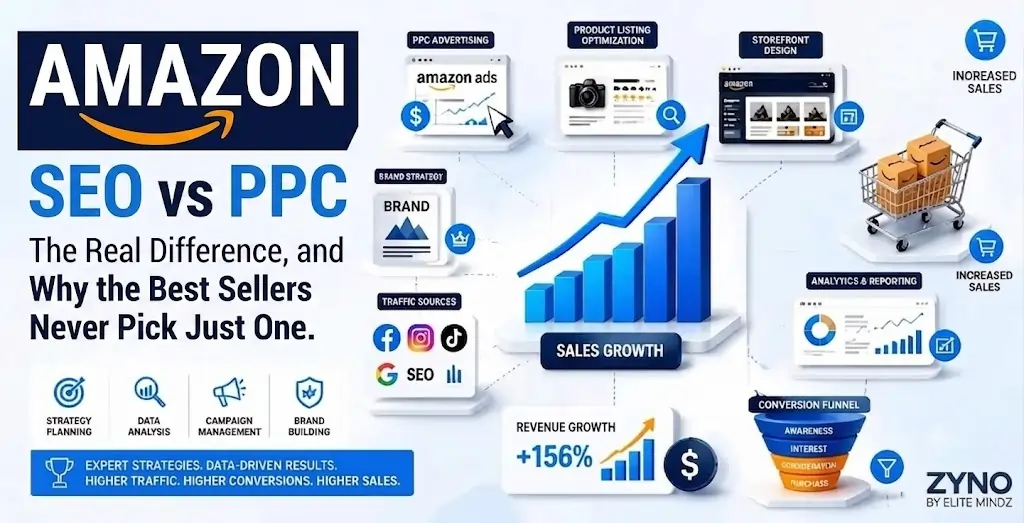
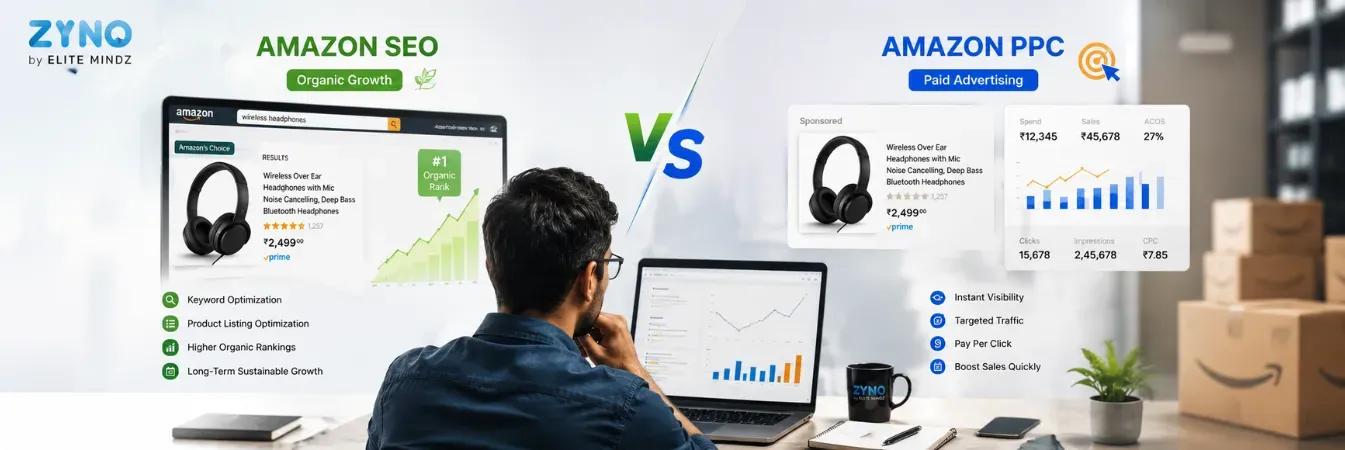
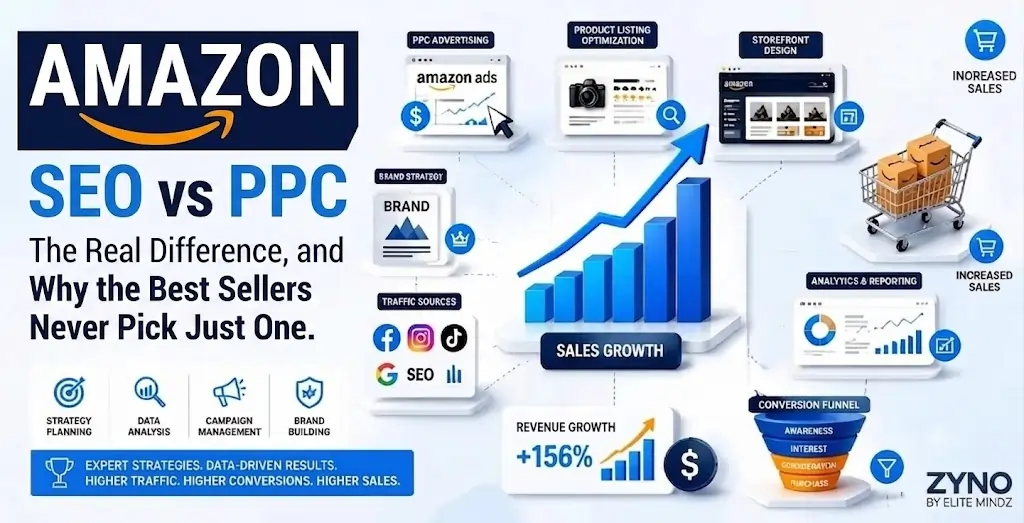
Amazon SEO earns visibility, Amazon PPC buys it, and the sellers who win use both together instead of picking sides. From listing optimization to AEO and E-E-A-T signals, your Amazon growth strategy needs every layer working in sync. Ready to grow your Amazon business? Explore Amazon Marketing Services by ZYNO Digital today.
Businesses using ZYNO Books cut accounting time by 70% and stay 100% ZATCA-compliant — automatically.
Every seller runs into this question eventually: should I put my budget into Amazon SEO, or into Amazon PPC? It sounds like a simple either-or decision, and most articles on this topic treat it that way. It isn't. The two work through completely different mechanisms, they're measured differently, they carry different risks, and increasingly, they're both being reshaped by things that didn't matter three years ago, like Amazon's Rufus AI assistant and how generative tools like ChatGPT summarize products before a shopper ever opens the Amazon app.
So here's the honest version. Amazon SEO is visibility you earn, built from relevance, sales history, and listing quality, with no cost per click. Amazon PPC is visibility you buy, through Sponsored Products, Sponsored Brands, Sponsored Display, and Amazon DSP, with cost every time a shopper clicks. That much is straightforward. What actually matters for sellers is what happens underneath that surface-level distinction: whether PPC spend genuinely helps organic rank (it doesn't, not directly), what skills each channel demands, what silently goes wrong when either one is left unmanaged, and how both now feed into AEO, GEO, and E-E-A-T signals that Amazon's own AI systems increasingly rely on.
This guide walks through all of it, definitions, cost structure, ranking mechanics, and the newer AI-driven layer, so you're working from a complete picture instead of a basic side-by-side comparison.
Find Out What Is Holding Your Website Back
Get a free SEO audit to uncover technical issues, ranking opportunities, content gaps, and areas that may be limiting your organic visibility and growth.
Most comparisons stop at "organic vs paid." That was enough a few years ago. It isn't anymore. Amazon's own AI shopping assistant (Rufus), its backend recommendation engine (Cosmo), and external generative tools that shoppers now research products on before they even land on Amazon, all read listings differently than a traditional keyword-matching algorithm does. The table below breaks down how Amazon SEO and Amazon PPC each play into five distinct optimization layers: classic SEO, AEO (Answer Engine Optimization), GEO (Generative Engine Optimization), AIO (AI Optimization, i.e. Amazon's internal AI systems), and E-E-A-T (Experience, Expertise, Authoritativeness, Trust).
| Optimization Layer | What It's Actually Optimizing For | Where Amazon SEO Fits In | Where Amazon PPC Fits In | Why Sellers Should Care |
|---|---|---|---|---|
| SEO (Search Engine Optimization) | Organic ranking position inside Amazon's own search results | Keyword-optimized titles, bullets, backend search terms, and consistent sales velocity | Doesn't directly affect rank, but reveals which keywords convert, which then feed SEO | Still the foundation, this is the visibility that keeps working after ad budgets are cut |
| AEO (Answer Engine Optimization) | Getting pulled into direct answers, voice search, and Amazon's Rufus assistant | FAQ-style A+ Content and benefit-first bullets that directly answer common buyer questions | Search term reports surface the exact phrases and questions real shoppers type, which sharpens AEO content | Shoppers are increasingly asking Rufus questions instead of scrolling search results themselves |
| GEO (Generative Engine Optimization) | Being cited or recommended by generative AI tools like ChatGPT, Gemini, and Perplexity during product research | Factual, comparison-ready descriptions and specs that generative engines can summarize accurately without distortion | Reviews and sales volume generated through PPC build the credibility data these engines lean on | A growing share of purchase research now happens before a shopper ever opens Amazon |
| AIO (AI Optimization, Amazon's internal AI) | How Amazon's own AI systems (Rufus, Cosmo) read, summarize, and recommend listings inside the app | Consistent, non-contradictory claims across title, bullets, and A+ Content that Amazon's AI can summarize cleanly | Sponsored placements can appear next to AI-generated answers, so listing clarity affects paid performance too | A listing with mismatched or vague claims risks being quietly skipped by Amazon's own AI summaries |
| E-E-A-T (Experience, Expertise, Authoritativeness, Trust) | The underlying credibility signals that every ranking and recommendation system, human or AI, ultimately relies on | Verified reviews, Brand Registry status, transparent seller information, detailed and accurate specs | Sponsored Brand storefronts and verified badges reinforce the same trust signals for paid traffic | Trust now quietly shapes organic rank, AI-generated answers, and even ad quality scores at once |
The takeaway from this table isn't that you need to chase five separate strategies. It's that Amazon SEO and Amazon PPC were never just competing for the same organic-vs-paid space to begin with, they're both, together, building the trust and clarity signals that every layer above depends on. A listing that's clean, factual, and well-reviewed performs better in classic search, gets summarized more accurately by Rufus, and shows up more reliably when ChatGPT is asked to compare products. None of that happens by accident.
Amazon SEO is the process of optimizing a product listing, titles, bullet points, backend search terms, images, and A+ Content, so it ranks higher organically, without paying for placement. Unlike Google SEO, Amazon's ranking system (informally called A9/A10, though Amazon has never published its exact mechanics) exists to serve one goal above all: getting shoppers to a product they'll actually buy.
| Ranking Factor | What It Actually Reflects |
|---|---|
| Relevance | How closely listing content matches real shopper search terms |
| Sales velocity | How fast a product sells relative to category competitors |
| Conversion rate | Percentage of listing visitors who go on to purchase |
| Click-through rate | How often the listing gets clicked when it does show up |
| Reviews and ratings | Volume and quality, both feeding trust and relevance together |
| Pricing competitiveness | How the price compares to similar listings in the category |
| Listing completeness | Whether backend fields, images, and content are fully filled out |
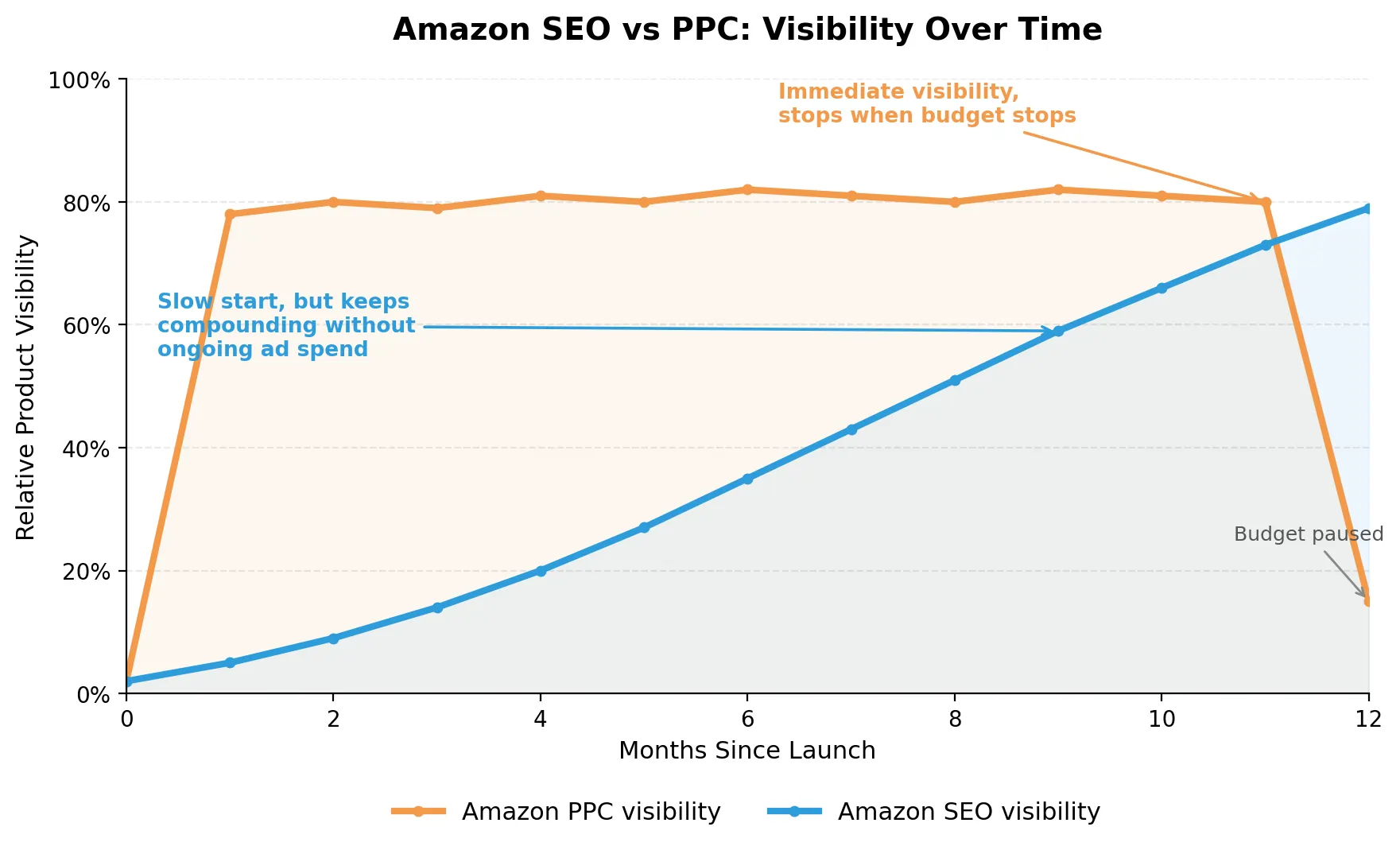
Here's the catch most first-time sellers don't see coming: several of these factors need a product to already have sales history before they kick in. A brand-new listing, no matter how well it's written, usually starts with limited organic visibility, simply because Amazon has no sales data yet to reward. That's the real reason Amazon SEO alone rarely works as a launch strategy, it's not that the optimization is wrong, it's that the algorithm has nothing to go on yet.
Want a listing built around these exact signals? Amazon SEO services start with a review of relevance, content completeness, and keyword alignment before a single line gets rewritten.
Is Your Amazon Listing Getting the Visibility It Deserves?
Improve your Amazon search visibility with data-driven keyword research, listing optimization, and SEO strategies designed to help your products reach more relevant shoppers.
Amazon PPC is a paid advertising model where sellers pay only when a shopper clicks their ad, placing products directly in front of buyers regardless of organic rank.
| Ad Type | Where It Appears | Typical Use Case |
|---|---|---|
| Sponsored Products | Search results, product pages | Individual listing visibility, the usual starting point |
| Sponsored Brands | Top of search results | Brand awareness across multiple products at once |
| Sponsored Display | On and off Amazon | Retargeting shoppers who viewed but didn't buy |
| Amazon DSP | Amazon-owned and third-party sites | Larger-scale programmatic reach and upper-funnel awareness |
Campaigns run either automatic (Amazon selects matching search terms based on listing content, useful for keyword discovery on new products) or manual, where sellers pick specific keywords and match types themselves:
Unlike SEO, PPC hands sellers direct control. Bids, budgets, and targeting are set manually, not left to an algorithm to reward over time.
Not sure which ad types your launch actually needs? Amazon PPC services typically start with Sponsored Products alone and expand into Sponsored Brands or Display only once there's enough data to justify it.
Stop Wasting Ad Spend on Campaigns That Don't Convert
Build smarter Amazon PPC campaigns with data-driven targeting, strategic bid management, and continuous optimization designed to improve visibility while protecting your advertising budget.
This is the question nearly every seller asks eventually: "If I spend more on PPC, will Amazon rank my product higher organically?"
The honest answer is no, not directly. Amazon doesn't reward a listing simply because money is being spent on ads pointing to it. What actually happens is more indirect, and it's worth walking through step by step instead of glossing over it:
PPC Advertising → More Visibility → More Clicks → More Sales → Higher Sales Velocity → Improved Organic Ranking Potential
The factor that matters isn't the ad spend itself, it's whether that spend produces real, profitable sales. A campaign generating plenty of clicks but few conversions won't meaningfully help organic rank, because it's the sales outcome Amazon's algorithm responds to, not the advertising activity. Sellers who conflate "running ads" with "improving SEO" tend to expect ranking gains from campaigns that are really just burning budget on unprofitable clicks.
A common assumption is that SEO is free and PPC is expensive. That's not quite right either.
Amazon SEO carries no per-click cost, but it does require real investment, keyword research, listing optimization, content creation, image work, and competitor analysis all take time or service fees. Amazon PPC requires an advertising budget plus ongoing campaign management, bid optimization, and search term analysis, but its upside is that performance is directly measurable.
| Cost Type | Amazon SEO | Amazon PPC |
|---|---|---|
| Direct, per-transaction cost | None | Cost per click |
| Where the real cost hides | Time, content creation, service fees | Ad spend plus management fees |
| Cost visibility | Harder to track as a single number | Highly visible, tracked to the click |
| Cost trend over time | Can decrease as content matures and ranks | Fluctuates with competition and seasonality |
This visibility gap is exactly why PPC often feels more expensive, even when SEO's less obvious costs (time, content creation, the slower path to visibility) are just as real. The more useful comparison isn't "which one costs money," it's the total cost of reaching a given sales outcome through each path.
| Metric | Meaning | Why It Matters |
|---|---|---|
| ACoS | Advertising Cost of Sales | Measures whether a campaign is actually profitable |
| TACoS | Total Advertising Cost of Sales | Shows advertising's impact across the whole business, not just the campaign |
| ROAS | Return on Advertising Spend | Measures overall advertising efficiency |
| CTR | Click Through Rate | Signals whether the ad itself is relevant to searchers |
| CVR | Conversion Rate | Reflects how well the listing itself converts once clicked |
Both channels need ongoing attention, but the type of work is genuinely different. Amazon SEO work is front-loaded and periodic: keyword research, content creation, then refreshes as competition shifts, it doesn't need daily monitoring. Amazon PPC, on the other hand, rewards frequent, often weekly, attention: reviewing search term reports, adding negative keywords, adjusting bids, and reallocating budget based on what's actually converting.
| Resource | Amazon SEO | Amazon PPC |
|---|---|---|
| Time cadence | Periodic, builds then refreshes | Ongoing, often weekly |
| Core skill set | Copywriting, keyword research, content structure | Bid strategy, data analysis, campaign structure |
| Tools typically used | Keyword research tools, Brand Analytics | Campaign Manager, search term reports |
| Risk of neglect | Content goes stale, competitors overtake relevance | Budget waste compounds quickly if left unmonitored |
A team without bandwidth for that ongoing PPC rhythm often watches efficiency quietly decline over time, even if the original campaign setup was solid. That's part of why Amazon PPC services tend to exist as an ongoing management function rather than a one-time setup job.
| Channel | What Typically Goes Wrong | How It Shows Up |
|---|---|---|
| Amazon SEO | Content, reviews, or pricing quietly weaken over time | Gradual ranking decline that's slow to rebuild |
| Amazon PPC | Poor targeting, ignored negative keywords, weak listing content | Budget waste, rising ACoS, little to show for the spend |
Neither risk is a reason to abandon a channel, it's a reason to actively manage both instead of setting either on autopilot. SEO risk tends to move slowly and go unnoticed until rank has already slipped. PPC risk moves fast and can compound within days if reports go unreviewed.
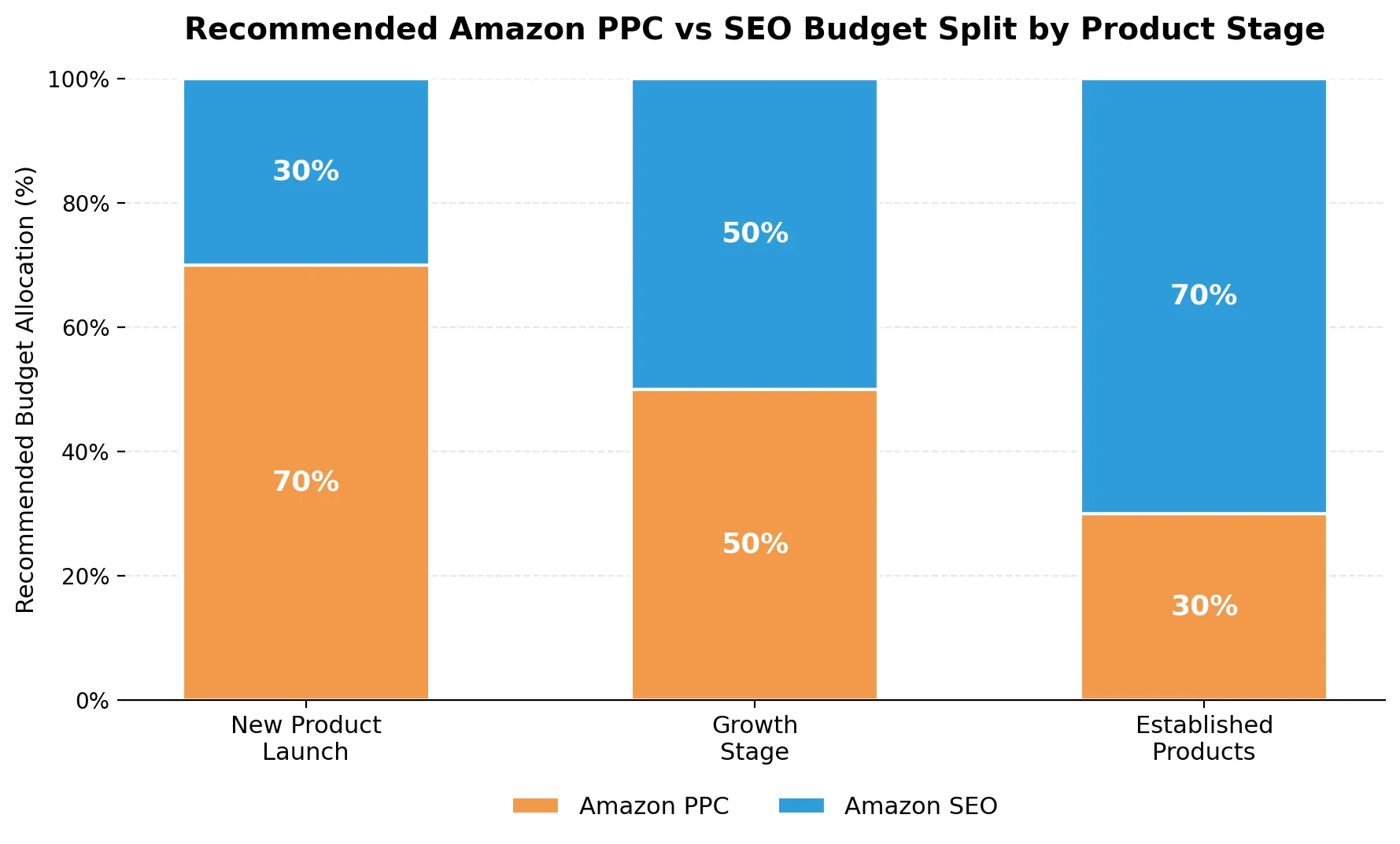
| Product Stage | Recommended Split | Focus |
|---|---|---|
| New Product Launch | 70% PPC + 30% SEO | Generate initial sales, discover keywords, build sales history |
| Growth Stage | 50% PPC + 50% SEO | Improve rankings, reduce advertising dependency, boost profitability |
| Established Products | 70% SEO + 30% PPC | Protect rankings, defend key keywords, maintain market position |
The biggest mistake sellers make is managing these two channels in separate silos, when the data each one generates directly strengthens the other.
| Direction | What Flows | What It Improves |
|---|---|---|
| PPC → SEO | Search term reports showing which keywords actually convert | Which terms get prioritized in titles, bullets, and backend fields |
| SEO → PPC | Stronger listing content and A+ Content | Higher conversion rate on the same paid traffic, which lowers ACoS |
PPC search term data is far more reliable than keyword tools alone, since it reflects real purchase behavior rather than estimated volume. And in the other direction, stronger SEO content improves conversion on the same PPC traffic, lowering ACoS without touching a single campaign setting.
Amazon success today needs more than ads running in the background. It needs a strategy that ties SEO, PPC, content, and the newer AI-driven layers (AEO, GEO, and AIO) together instead of treating them as separate line items.
ZYNO Digital by EliteMindz builds Amazon marketing strategies around exactly that connection, aligning PPC targeting with SEO-optimized content so paid traffic lands on pages that are already built from the same keyword data, and treating listing quality as a prerequisite rather than an afterthought.
| Key Feature | Business Benefit |
|---|---|
| Amazon SEO Optimization | Improves organic keyword rankings |
| Advanced Keyword Research | Finds high-converting search opportunities |
| Amazon PPC Management | Improves advertising efficiency |
| Sponsored Ads Optimization | Reduces wasted ad spend |
| Product Listing Optimization | Improves conversion rates |
| A+ Content Strategy | Builds customer trust and AEO-readiness |
| Competitor Analysis | Identifies market opportunities |
| Search Term Analysis | Converts PPC insights into SEO improvements |
| Amazon Storefront Optimization | Creates a stronger brand experience |
| Performance Reporting | Delivers measurable growth insights |
✔ SEO + PPC managed as one connected strategy ✔ Data-driven decisions, not guesswork ✔ Conversion-focused optimization at every step ✔ Transparent, weekly reporting ✔ Scalable framework built for long-term profitability
Explore Amazon Marketing Services, including A+ Content optimization and Amazon Storefront design, built around how listings should actually perform together, not as disconnected efforts.
From Amazon SEO and PPC to listing optimization and brand growth, ZYNO Digital brings the strategy, expertise, and performance focus your Amazon business needs to grow with confidence.
Neither is inherently better. SEO builds long-term organic growth, PPC delivers immediate visibility. The strongest sellers run both together rather than choosing one.
No. PPC generates paid traffic on demand, but SEO builds the sustainable, cost-free visibility that keeps working after ad budgets are cut.
No. Amazon's ranking system doesn't factor in ad spend itself. PPC helps indirectly, by generating sales, and sales velocity is one of several organic ranking signals.
Not entirely. There's no per-click cost, but keyword research, content creation, and ongoing optimization all require real time or service investment.
Yes. PPC helps new products generate initial traffic, gather keyword data, and build the sales history that organic ranking depends on.
Yes, but growth is usually slower, since there's no paid boost generating the early sales and click data that support organic momentum.
PPC generally needs more frequent, often weekly, attention: bids, negative keywords, budget shifts. SEO work is more periodic, built around content creation and refreshes rather than daily monitoring.
They should. PPC search term data reveals which keywords actually convert, which is far more reliable input for deciding what to prioritize in organic listing content.
By improving listing quality, removing irrelevant keywords, optimizing bids, and doubling down on search terms that are already converting.
Amazon SEO and Amazon PPC were never really competing strategies, they solve different problems entirely. PPC buys immediate visibility and generates the real-world data that makes SEO sharper. SEO builds the organic, cost-free visibility that keeps a listing found long after an ad budget runs out. And underneath both of them now sits a newer layer, AEO, GEO, AIO, and E-E-A-T, that's quietly deciding whether Rufus, Cosmo, or ChatGPT ever surface a product to a shopper who hasn't opened Amazon's search bar yet.
The real strategic question was never "SEO or PPC." It's how to sequence and connect both so the data from one keeps making the other sharper, while building the kind of trust signals that every ranking system, human-built or AI-driven, ultimately rewards.
Ready to grow your Amazon business? Explore Amazon Marketing Services by ZYNO Digital and build a growth strategy designed around how SEO, PPC, and AI-era discovery actually work together.
Stop Choosing Between Amazon SEO and PPC. Build a Strategy That Uses Both.
ZYNO Digital helps brands combine Amazon SEO, PPC, listing optimization, keyword intelligence, and performance data into one connected growth strategy designed to improve visibility, conversions, and long-term profitability.
How E-Commerce Is Transforming Businesses and Driving Digital Growth
Read More →
Top 10 Software Development Companies in India
Read More →
Local SEO Strategies That Actually Generate Leads for US Businesses in 2026
Read More →
How to Choose the Right Digital Marketing Agency in the USA
Read More →
Top SEO Mistakes Costing US Companies Thousands of Dollars And How to Fix Them
Read More →
How to Choose an Indian Digital Marketing Agency for Projects
Read More →
Choosing a Partner for High-Intent Growth: What to Look For in a Digital Marketing Agency
Read More →
What Role Does Leadership and Change Management Play in Driving Digital Transformation in Mid-Sized Indian Companies?
Read More →
How Do Mid-Market Companies in India Measure the Success of Their Digital Transformation Initiatives?
Read More →
What Are the Common Challenges Mid-Market Businesses in India Face When Implementing Digital Transformation?
Read More →
How Should a Mid-Sized Indian Company Prioritize Technology Investments During Digital Transformation?
Read More →
How to Choose the Best Amazon Storefront Design Agency in 2026
Read More →
Amazon Storefront Design Agency vs. DIY: What Actually Drives Sales?
Read More →
What Is Amazon Marketing Services (AMS)? Complete Advertising Strategy Guide 2026
Read More →
How Much Do Amazon Marketing Services Cost? Complete Pricing Guide 2026
Read More →
Amazon SEO vs Amazon PPC: Which One Should You Invest in First?
Read More →
How to Reduce ACoS on Amazon: A Practical Guide for Sellers
Read More →
Amazon A+ Content That Converts: Examples and Structure
Read More →
What Is Included in Amazon Marketing Services? A Complete Breakdown
Read More →
Amazon Storefront Design Checklist for New Brand Launches
Read More →
How Do Amazon Marketing Agencies Increase Sales?
Read More →
Amazon SEO vs PPC: The Real Difference, and Why the Best Sellers Never Pick Just One
Read More →Partner with ZYNO by Elite Mindz to revolutionize how your business works. Fill out the form, and we’ll reach out with AI-powered solutions made just for you.
We use browser cookies to ensure you get the best experience on our website. Learn more
The form was submitted successfully!
ZYNO Digital
Fueling Smarter Digital Growth
ZYNO Digital fuels smarter digital growth through data-driven marketing, creative storytelling, and performance strategies that boost visibility, engagement, and measurable business outcomes across global platforms.
ZYNO Tech
Engineering the Future of IT
ZYNO Tech delivers cutting-edge IT solutions — including web, mobile, and digital transformation services — helping businesses scale efficiently, innovate faster, and stay ahead in a connected world.
ZYNO AI
AI Built for Business Growth
ZYNO AI harnesses the power of artificial intelligence to automate processes, enhance decision-making, and deliver predictive insights — driving innovation, agility, and measurable business growth.
ZYNO by Elite Mindz
Your Partner in the AI-Powered Future
ZYNO by Elite Mindz offers AI-powered products and services that unify operations, boost productivity, and drive digital transformation — helping businesses scale smarter and innovate faster.
* In just 2 mins you'll get a response
* Your idea is 100% protected by our Non-Disclosure Agreement