How E-Commerce Is Transforming Businesses and Driving Digital Growth
Read More →

×
From quick PPC wins to long-term organic rankings, every Amazon marketing strategy follows a different timeline. Discover when to expect results and how ZYNO Digital Amazon Marketing Services can help accelerate your marketplace growth.
Businesses using ZYNO Books cut accounting time by 70% and stay 100% ZATCA-compliant — automatically.
This is usually the first question sellers ask right after signing off on a budget, and it's a fair one. You've just committed to Amazon SEO, PPC, a storefront refresh, maybe new A+ Content, and now you want to know when it actually starts paying off.
The honest answer is: it depends on which part of the strategy you're asking about, because each piece moves on its own timeline. PPC can show something within days. SEO takes months. A+ Content and storefront changes sit somewhere in between. Most articles on this topic only answer half the question, they'll tell you PPC stabilizes in a few weeks and leave it there, without touching how category competition, catalog size, account history, or plain impatience change that number in either direction. That's the gap this guide is meant to close.
Amazon Marketing Results Timeline
| Channel | When You Start Seeing Movement | When Results Fully Mature | What's Actually Happening Behind the Scenes |
|---|---|---|---|
| Amazon PPC | 24 to 72 hours after launch | 6 to 12 weeks | Amazon needs weeks of click and conversion data before bids and targeting stabilize. |
| Amazon SEO | 4 to 8 weeks | 3 to 6 months | Ranking depends on accumulated sales velocity, reviews, and relevance signals, none of which build overnight. |
| A+ Content | 1 to 2 weeks | 4 to 6 weeks | Conversion rate improves almost immediately once live, but it takes a few weeks of traffic to see the shift reliably in the data. |
| Storefront Design | 2 to 4 weeks | 2 to 3 months | Impact shows up gradually as branded traffic and repeat visits grow. It's a trust play more than an instant-conversion one. |
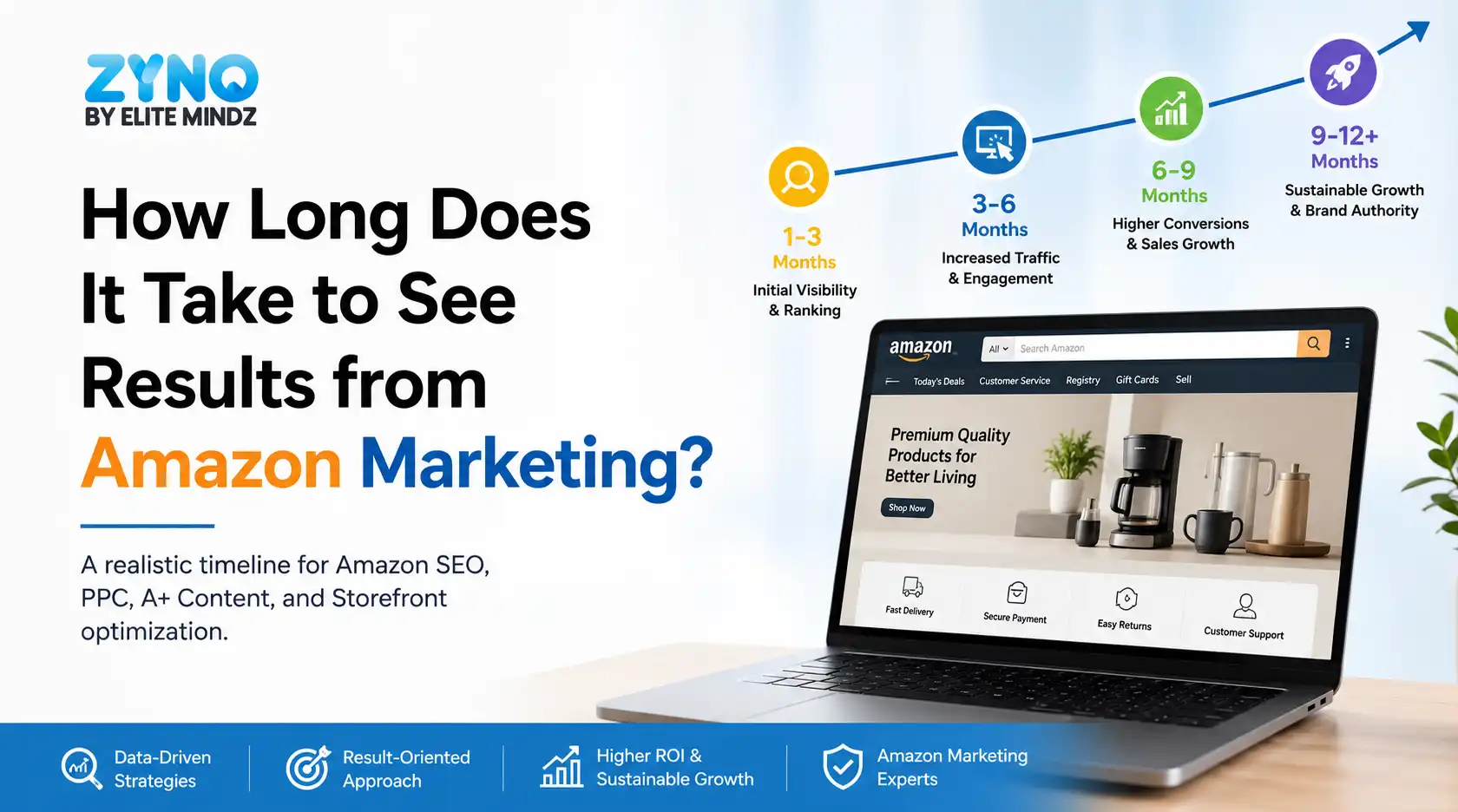
| Full Combined Strategy | 2 to 4 weeks (early signals) | 4 to 6 months (compounding results) | Each channel starts feeding the others. PPC data sharpens SEO, better content lifts PPC conversion, and the whole system starts compounding. |
The pattern across every row is the same: something paid shows up fast, something organic takes longer, and the two are always more powerful once they're actually working off the same data.
Ready to Grow Your Amazon Brand Faster?
From Amazon SEO and PPC to listing optimization and Storefront strategy, ZYNO Digital helps brands build stronger visibility and turn marketplace traffic into measurable growth.
Sellers hear the phrase "learning phase" a lot and rarely get told what it actually means. When a PPC campaign goes live, Amazon doesn't immediately know which keywords, placements, and audiences will convert for your specific listing. It runs your ads against a spread of relevant search terms, watches what happens, click-through rate, conversion rate, time-of-day performance, and gradually narrows in on what's actually working.
This is why ACoS often looks rough in week one and improves by week four or five, it's not that the campaign got worse and recovered, it's that it finally has enough data to target well. The practical implication is simple: judging a campaign's performance in the first two weeks is judging it before it's finished learning. If your ACoS is still climbing well past that point instead of settling down, that's usually a sign something specific needs fixing rather than more patience, and our guide on how to reduce ACoS on Amazon walks through the exact audit steps for that.
Here's a mistake that quietly extends timelines more than almost anything else: making major changes to a campaign before it's finished its learning phase. Changing bids, keywords, or budgets frequently in the first two to three weeks doesn't speed things up, it restarts the data collection Amazon needs to optimize placement. Every reset effectively pushes your "results by week 4" back to "results by week 6 or 8."
This doesn't mean sit on your hands and do nothing. It means distinguishing between small, informed tweaks (pausing an obviously irrelevant search term, nudging a bid slightly) and wholesale restructuring (rebuilding ad groups, changing match types across the board) during a period when the algorithm hasn't finished forming a picture of your listing yet. Sellers who panic-reset in week one are often the same ones asking, three months later, why results still haven't shown up.
Turn Your Amazon Store Into a Growth Engine
Your products deserve more than visibility. With the right strategy, optimization, and data-driven marketing, you can attract more shoppers and improve your Amazon performance.
Not every product plays by the same clock, and this is a piece most timeline guides skip entirely. A niche kitchen gadget with a handful of competitors behaves very differently from a phone case in a category with thousands of nearly identical listings.
Amazon PPC vs Organic Ranking Timeline
| Category Type | Typical PPC Stabilization | Typical Organic Ranking Timeline | Why the Difference |
|---|---|---|---|
| Low competition, niche product | 3 to 5 weeks | 6 to 10 weeks | Fewer competing listings mean less bidding pressure and faster relevance matching. |
| Moderate competition | 5 to 8 weeks | 2 to 4 months | This is the standard timeline most sellers should plan around. |
| Highly competitive (phone accessories, supplements, kitchenware) | 8 to 12 weeks | 4 to 6+ months | More established competitors have deeper review counts and stronger sales histories to outrank. |
| New-to-Amazon category with limited search volume | 6 to 10 weeks | 3 to 5 months | Slower data accumulation occurs simply because fewer people are searching for the term. |
If you're selling into a crowded category, a 6 to 8 week PPC stabilization estimate is optimistic, plan closer to 8 to 12. This is also exactly why category research matters before setting expectations, not after a campaign underperforms them.
Two factors that rarely get mentioned but genuinely affect timeline: how established your seller account already is, and how many SKUs you're managing at once.
A brand-new seller account with no sales history anywhere on Amazon typically takes slightly longer to gain traction than an established account launching a new product, existing account trust, prior review velocity, and historical performance data all give Amazon more to work with from day one. It's not a massive gap, but it's real, expect an extra two to three weeks of runway if you're brand new to the platform entirely.
Catalog size cuts the other way. A single-SKU seller sees a cleaner, faster read on results simply because there's only one data set to interpret. A seller managing 40 SKUs across several categories will see faster portfolio-level learning (more total ad spend generating data faster) but a slower, noisier read on any individual product's timeline, because attention and budget are naturally split. Neither is better, it's just important to know which situation you're in before comparing your timeline to someone else's.
Launch timing changes results speed more than most sellers expect. Launching in the run-up to Q4 (October through early December) tends to compress timelines, higher search volume and shopping intent mean more data accumulates faster, so PPC learning phases can shorten and SEO signals build quicker simply because more transactions are happening across the board.
The trade-off is that competition intensifies at the same time, so while your data builds faster, so does everyone else's, and post-holiday sales cliffs can also distort what "stable" performance actually looks like. Launching in a slower season (January through March, for many categories) means a longer runway to steady results, but a cleaner, less noisy read on what's actually working, without a holiday spike masking the real baseline.
Neither timing is wrong. It's simply worth adjusting your expectations, and your patience, based on when you're actually launching rather than applying a single generic timeline regardless of the calendar.
Not Getting the Results You Want on Amazon?
The right Amazon marketing strategy can improve your rankings, increase product visibility, and help you reach more high-intent shoppers. Let ZYNO Digital help you build a smarter path to growth.
This is the piece most timeline articles leave out entirely, they'll tell you when to expect results, but not how to tell the difference between "still early" and "actually broken." Here's a practical checkpoint list.
Amazon Marketing Performance Checkpoints
| Timeframe | Signs You're On Track | Signs Something Needs Fixing |
|---|---|---|
| Week 1-2 | Impressions and clicks are appearing, with ACoS fluctuating but not reaching extreme levels. | Zero impressions after 72 hours, or ACoS above 100% with no conversions at all. |
| Week 3-4 | ACoS starts trending downward, and some keywords clearly convert better than others. | ACoS continues climbing with no clear pattern, or CTR remains far below the category average. |
| Month 2 | Small organic ranking movement appears for at least a few target keywords. | No organic movement at all despite steady sales velocity. |
| Month 3-4 | PPC reliance decreases while maintaining the same sales volume, with TACoS trending downward. | PPC dependency stays flat or increases despite steady advertising spend. |
| Month 6 | Organic sales carry a meaningful share of total revenue. | The business remains almost entirely dependent on paid traffic with little to no organic lift. |
If you're consistently landing in the right-hand column past the point where you should have moved on, that's rarely a "just wait longer" situation, it usually points to a specific fixable issue: weak listing content, mistargeted keywords, an uncompetitive price point, or a review count too thin to build trust.
Most delays aren't actually about the channel being slow, they're about pieces of the strategy running in isolation instead of together. PPC without a decent listing wastes spend on traffic that won't convert. SEO without any paid traffic to build early sales history takes far longer than it needs to. A storefront that's never linked from ads or content just sits there unseen. And a campaign reset every few days never gets far enough into its learning phase to tell you anything useful at all.
This is really what a full Amazon marketing services engagement is meant to solve, not doing more of any one thing, but making sure SEO, PPC, content, and storefront are all pointed at the same data and the same goal at the same time. If you're also trying to figure out what that kind of engagement should reasonably cost given the timeline involved, Amazon marketing services cost breaks that down as well.
If you're still deciding how to split attention between the two core channels while you wait for results to build, Amazon SEO vs PPC, which to prioritize first is worth reading, and our broader breakdown on the difference between Amazon SEO and PPC is useful if the two are still blurring together conceptually.
Amazon Marketing Growth Timeline
| Timeframe | What You Should Realistically Expect |
|---|---|
| Week 1-2 | PPC goes live and begins gathering data. A+ Content and listing optimization are published, while the storefront build gets underway. |
| Month 1 | Early PPC performance begins stabilizing, ACoS starts to settle, and the first small movement in organic rankings may appear. |
| Month 2-3 | Noticeable organic ranking improvement develops. PPC data actively shapes keyword strategy, while the storefront begins driving early branded traffic. |
| Month 4-6 | Organic sales share increases, dependency on ad spend decreases for the same sales volume, and results begin compounding across channels. |
| Month 6+ | SEO carries a meaningful share of sales, PPC runs more efficiently on proven keywords, and overall growth becomes steadier and more predictable. |
This isn't a guarantee, competition level, category, catalog size, and starting point all shift these numbers, sometimes by weeks, sometimes by months. But it's a far more realistic picture than "results in 30 days," which is the kind of claim worth being skeptical of whenever you hear it.
Ready to Build a More Successful Amazon Business?
From optimizing your listings to managing PPC campaigns and strengthening your overall Amazon presence, ZYNO Digital provides data-driven strategies designed to support sustainable marketplace growth.
Impressions and clicks appear within a day or two, but campaigns typically need 6 to 12 weeks of data before performance stabilizes and ACoS settles into an efficient range, longer in highly competitive categories.
Most listings start showing measurable ranking movement in 4 to 8 weeks, with fuller results building over 3 to 6 months as sales history and reviews accumulate.
Yes, conversion rate can improve within days of publishing, though it takes a few weeks of consistent traffic to confirm the shift is real and not just short-term variance.
Category competition, existing review count, pricing, account age, catalog size, and whether SEO and PPC are being run together rather than separately all affect how fast results show up.
Yes. Month one is largely a data-gathering phase across every channel. The real inflection point for most sellers shows up between month two and month four.
No, the opposite. Frequent bid, keyword, or budget changes during the learning phase restart Amazon's data collection, which typically pushes results further out rather than bringing them forward.
Yes. Higher search volume and shopping activity during Q4 tends to speed up data accumulation for both PPC and SEO, though heavier competition during the same window can offset some of that advantage.
There's no single honest answer to "how long will this take," because Amazon marketing isn't one thing, it's several channels moving at different speeds, shaped by category competition, account history, catalog size, and even the time of year you launch, that only compound into real growth once they're working together. PPC gives you speed. SEO gives you staying power. A+ Content and storefront design give both of those a better shot at converting. Expect small signals within weeks, and real, compounding results within four to six months, if the strategy is actually built to connect all of it, and if it's given room to run its course instead of being reset every time a number looks slightly off.
Want a clearer sense of what your specific timeline would look like? Explore Amazon Marketing Services by ZYNO Digital and get a realistic, catalog-specific growth plan instead of a generic estimate.
1. How to Choose the Best Amazon Storefront Design Agency in 2026
2. How to Choose an Indian Digital Marketing Agency for Projects
3. Local SEO Strategies That Actually Generate Leads for US Businesses in 2026
How E-Commerce Is Transforming Businesses and Driving Digital Growth
Read More →
Top 10 Software Development Companies in India
Read More →
Local SEO Strategies That Actually Generate Leads for US Businesses in 2026
Read More →
How to Choose the Right Digital Marketing Agency in the USA
Read More →
Top SEO Mistakes Costing US Companies Thousands of Dollars And How to Fix Them
Read More →
How to Choose an Indian Digital Marketing Agency for Projects
Read More →
Choosing a Partner for High-Intent Growth: What to Look For in a Digital Marketing Agency
Read More →
What Role Does Leadership and Change Management Play in Driving Digital Transformation in Mid-Sized Indian Companies?
Read More →
How Do Mid-Market Companies in India Measure the Success of Their Digital Transformation Initiatives?
Read More →
What Are the Common Challenges Mid-Market Businesses in India Face When Implementing Digital Transformation?
Read More →
How Should a Mid-Sized Indian Company Prioritize Technology Investments During Digital Transformation?
Read More →
How to Choose the Best Amazon Storefront Design Agency in 2026
Read More →
Amazon Storefront Design Agency vs. DIY: What Actually Drives Sales?
Read More →
What Is Amazon Marketing Services (AMS)? Complete Advertising Strategy Guide 2026
Read More →
How Much Do Amazon Marketing Services Cost? Complete Pricing Guide 2026
Read More →
Amazon SEO vs Amazon PPC: Which One Should You Invest in First?
Read More →
How to Reduce ACoS on Amazon: A Practical Guide for Sellers
Read More →
Amazon A+ Content That Converts: Examples and Structure
Read More →
What Is Included in Amazon Marketing Services? A Complete Breakdown
Read More →
Amazon Storefront Design Checklist for New Brand Launches
Read More →
How Do Amazon Marketing Agencies Increase Sales?
Read More →
Amazon SEO vs PPC: The Real Difference, and Why the Best Sellers Never Pick Just One
Read More →
How Long Does It Take to See Results from Amazon Marketing?
Read More →Partner with ZYNO by Elite Mindz to revolutionize how your business works. Fill out the form, and we’ll reach out with AI-powered solutions made just for you.
We use browser cookies to ensure you get the best experience on our website. Learn more
The form was submitted successfully!
ZYNO Digital
Fueling Smarter Digital Growth
ZYNO Digital fuels smarter digital growth through data-driven marketing, creative storytelling, and performance strategies that boost visibility, engagement, and measurable business outcomes across global platforms.
ZYNO Tech
Engineering the Future of IT
ZYNO Tech delivers cutting-edge IT solutions — including web, mobile, and digital transformation services — helping businesses scale efficiently, innovate faster, and stay ahead in a connected world.
ZYNO AI
AI Built for Business Growth
ZYNO AI harnesses the power of artificial intelligence to automate processes, enhance decision-making, and deliver predictive insights — driving innovation, agility, and measurable business growth.
ZYNO by Elite Mindz
Your Partner in the AI-Powered Future
ZYNO by Elite Mindz offers AI-powered products and services that unify operations, boost productivity, and drive digital transformation — helping businesses scale smarter and innovate faster.
* In just 2 mins you'll get a response
* Your idea is 100% protected by our Non-Disclosure Agreement