How HRMS Systems Streamline Payroll and HR Processes
Read More →

×
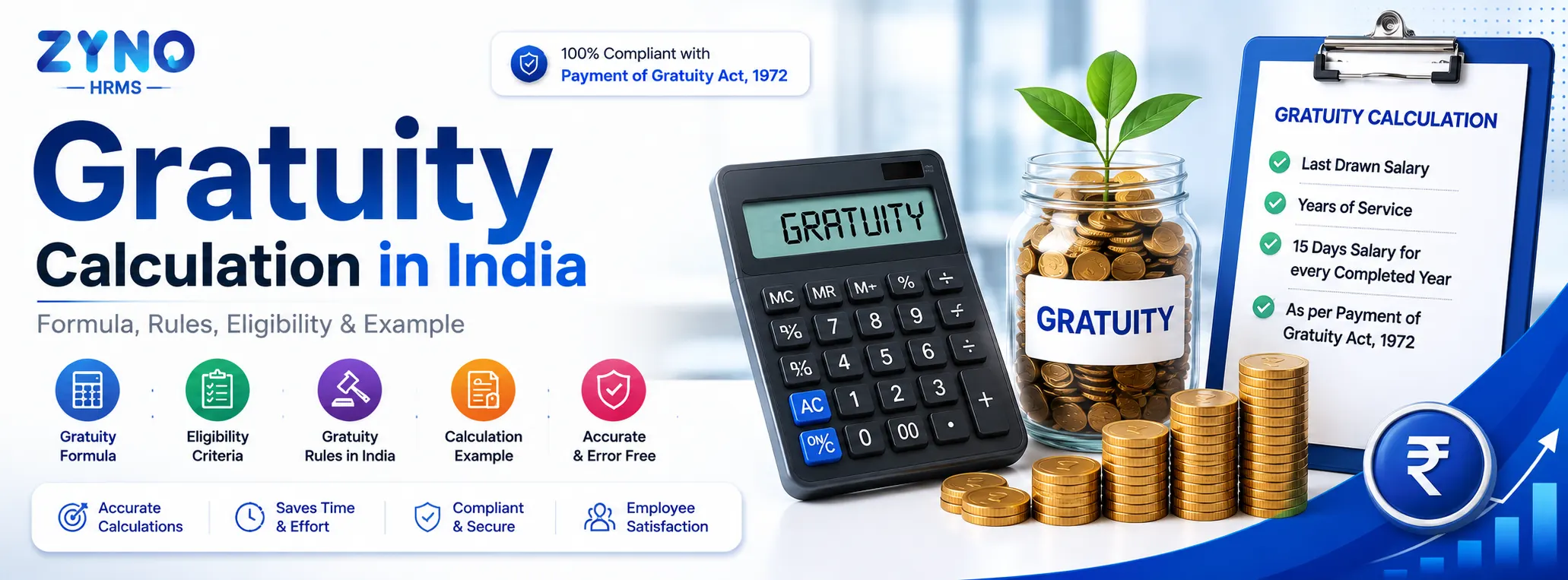
Gratuity in India is calculated using the formula: (Last Drawn Salary × 15 × Years of Service) ÷ 26. Employees generally become eligible after completing five years of continuous service. The last drawn salary includes Basic Salary and Dearness Allowance (DA), as per the Payment of Gratuity Act, 1972.
Businesses using ZYNO Books cut accounting time by 70% and stay 100% ZATCA-compliant — automatically.

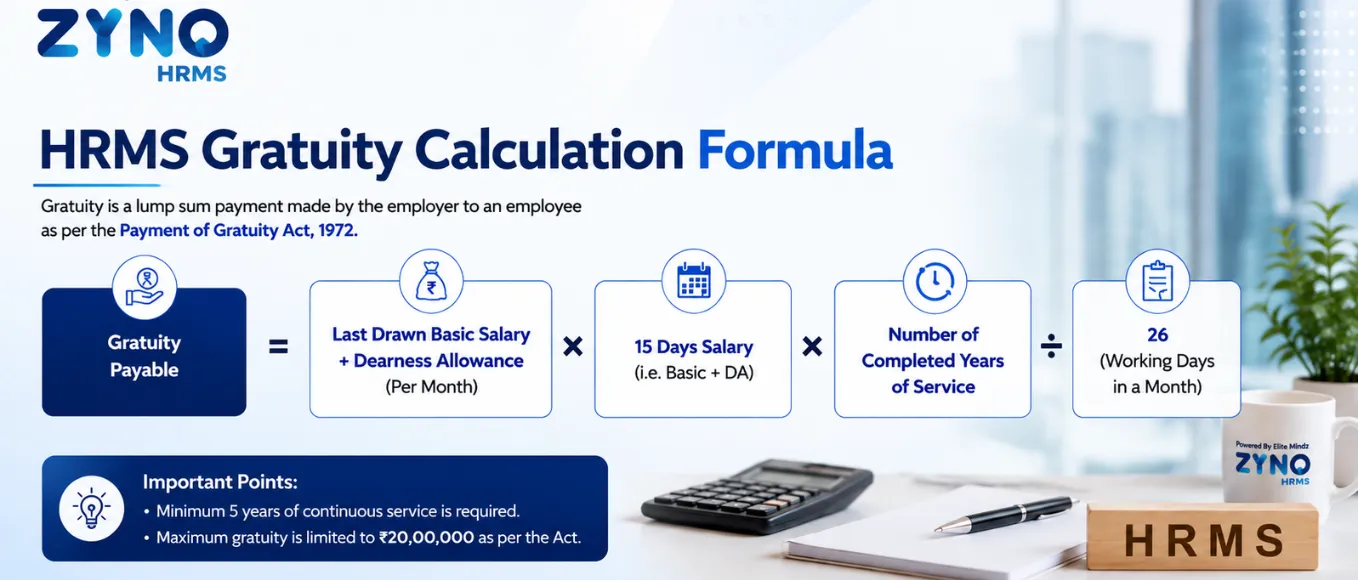
How is gratuity calculated in India? Gratuity is calculated using the formula (Last Drawn Salary × 15 × Number of Completed Years of Service) ÷ 26. To be eligible, an employee generally must complete at least five years of continuous service with the same employer, although exceptions apply in cases such as death or permanent disability. The last drawn salary includes Basic Salary + Dearness Allowance (DA). Employees covered under the Payment of Gratuity Act, 1972 can use this formula to estimate the gratuity amount they will receive when leaving their job.
Gratuity is one of the most important retirement benefits provided to employees in India. It acts as a financial reward for the long-term service an employee provides to an organization. Whether you are working in a private company, MNC, government organization, or any covered establishment, understanding gratuity calculation, eligibility criteria, tax rules, and recent changes is essential for financial planning.
In 2026, gratuity rules have gained more attention because of changes introduced under India’s new labour law framework, especially regarding wage definitions and fixed-term employees. However, many employees are still confused about how gratuity is calculated and whether the rules have changed completely.
This detailed guide explains everything about gratuity calculation in India, including the formula, eligibility requirements, examples, online calculator method, tax exemption, and latest updates.
Gratuity is a lump-sum amount paid by an employer to an employee as a token of appreciation for completing a significant period of continuous service with an organization. It is governed by the Payment of Gratuity Act, 1972, which applies to eligible establishments such as factories, companies, shops, and other organizations meeting the prescribed employee count criteria. Modern HR systems help organizations calculate gratuity accurately, track employee tenure, and simplify payroll compliance.
Unlike salary, gratuity is not paid every month. It becomes payable when an employee leaves the organization due to:
The main purpose of gratuity is to provide financial support after an employee ends their employment journey.
Stop relying on spreadsheets for gratuity calculations. ZYNO HRMS helps you automate gratuity, payroll, leave, attendance, and employee lifecycle management while ensuring compliance with the latest labor laws and regulations.
The exact method for gratuity calculation in India depends on whether an employee’s organization is covered under the Payment of Gratuity Act, 1972 or not. Most medium and large organizations fall under this Act, while some small establishments may follow different calculation methods.
Let us understand both categories with formulas and practical examples.
Most private companies, factories, and establishments with 10 or more employees come under the Payment of Gratuity Act. For employees covered under this Act, the standard gratuity calculation formula is:
15:
This represents 15 days’ wages for every completed year of service. The law considers half a month’s salary as the gratuity benefit for each year worked.
26:
This represents the number of working days considered in a month. A month is calculated as 26 working days after excluding weekly holidays (generally Sundays).
Last Drawn Salary:
For gratuity calculation, salary does not mean the total salary or CTC. It includes only:
Components such as:
are not included while calculating gratuity.
Completed Years of Service:
For employees covered under the Act, the service period is calculated by rounding the additional months according to gratuity rules.
For example:
Suppose Ravi works in a manufacturing company that is covered under the Payment of Gratuity Act.
His details are:
Since Ravi has completed 10 years and 8 months, his service period will be rounded up to 11 years.
Now applying the formula:
= (15 / 26) × ₹40,000 × 11
= ₹6,00,000 ÷ 26 × 11
= ₹2,53,846 approximately
Therefore, Ravi will receive approximately ₹2,53,846 as gratuity.
Some small organizations or establishments may not fall under the Payment of Gratuity Act. However, employers can still voluntarily provide gratuity benefits to their employees.
For employees not covered under the Act, the calculation method is slightly different.
The formula used is:
15:
Represents 15 days’ wages for every completed year of employment.
30:
Unlike covered employees, this calculation considers a full month of 30 days instead of 26 working days.
Last Drawn Salary:
The salary considered includes:
Other allowances are generally excluded.
Completed Years of Service:
For employees not covered under the Act, only completed years are considered. There is no rounding benefit.
For example:
Only fully completed years are counted.
Suppose Sunita works in a small startup that is not covered under the Payment of Gratuity Act.
Her details are:
Since the organization is not covered under the Act, only completed years are considered.
Therefore:
Service period = 6 years
Now applying the formula:
= (15 / 30) × ₹40,000 × 6
= 0.5 × ₹40,000 × 6
= ₹1,20,000
Therefore, Sunita will receive ₹1,20,000 as gratuity.
|
Criteria |
Covered Under Gratuity Act |
Not Covered Under Gratuity Act |
|
Formula |
(15/26) × Salary × Years |
(15/30) × Salary × Years |
|
Monthly Days Considered |
26 days |
30 days |
|
Service Rounding |
More than 6 months rounded up |
No rounding |
|
Applicable To |
Most medium and large organizations |
Certain small establishments |
|
Salary Considered |
Basic + DA |
Basic + DA |
Understanding which category applies to you is important because it directly affects your final gratuity amount. Before calculating gratuity, employees should confirm whether their organization comes under the Payment of Gratuity Act and check their salary structure carefully.
To receive gratuity in India, employees need to meet certain eligibility conditions under the Payment of Gratuity Act, 1972 and updated labour law provisions. The eligibility rules vary depending on whether the employee is regular or working on a fixed-term contract.
Under normal circumstances, regular employees must complete 5 years of continuous service with the same employer to become eligible for gratuity.
This applies when gratuity is claimed due to:
The organization should generally be covered under the Payment of Gratuity Act, which applies to establishments having 10 or more employees.
A major change was introduced through the Code on Social Security, 2020, which provides gratuity benefits to fixed-term employees after completing 1 year of continuous service.
Earlier, fixed-term employees were generally required to complete 5 years of service like regular employees to claim gratuity. The new provision was introduced to provide better social security benefits to employees hired on fixed-term contracts.
Under this rule:
The 5-year service requirement is not mandatory if employment ends due to:
In such cases, gratuity is paid to the nominee or legal heirs of the employee.
One of the most common employee questions is:
"Can I get gratuity after working for 4 years and 8 months?"
In many cases, courts and organizations consider service exceeding 4 years and 6 months as completion of 5 years, depending on applicable rules and interpretations.
However, employees should check their organization's gratuity policy and applicable legal interpretation before making a claim.

Several discussions around gratuity changes have emerged due to implementation of labour law reforms.
The major areas of change include:
The new labour framework focuses on a broader definition of wages. This can impact salary structures because gratuity calculations may consider revised wage components instead of only traditional basic salary structures.
This means employees with higher statutory wage components may see changes in their gratuity calculation.
One major development is related to fixed-term employees.
Under the updated framework, fixed-term employees may become eligible for gratuity on a proportionate basis after completing one year of service, unlike permanent employees who generally continue under the five-year requirement.
This change mainly benefits contractual employees who earlier had difficulty qualifying for gratuity due to shorter employment periods.
Despite discussions about labour law changes, the basic gratuity formula:
(Salary × 15 × Years of Service) ÷ 26
continues to remain the standard calculation method.
Gratuity taxation depends on whether the employee belongs to:
Generally:
Gratuity received by government employees is fully exempt subject to applicable rules.
Tax exemption is available up to the specified limit.
Tax exemption depends on Income Tax Act provisions.
Employees should check current tax rules before filing returns.
Employees usually need:
The employer is responsible for processing the gratuity payment after it becomes due.
An employer must pay gratuity within 30 days from the date it becomes payable, as required under the Payment of Gratuity Act, 1972. If the employer delays payment without a valid reason, they may be liable to pay interest on the gratuity amount for the period of delay.
After gratuity becomes payable, employers are required to process and pay the amount within the prescribed timeline as part of the employee's full and final settlement. Employees should ensure all exit formalities are completed and maintain copies of resignation letters, acceptance emails, relieving letters, and other relevant documents to avoid unnecessary delays.
utomate gratuity calculations, payroll, and employee records with ZYNO HRMS while ensuring accuracy, compliance, and faster HR operations.
Many employees confuse gratuity with PF, but both are different benefits.
|
Feature |
Gratuity |
PF |
|
Purpose |
Reward for long-term service |
Retirement savings |
|
Contribution |
Mainly employer responsibility |
Employer + employee contribution |
|
Payment Time |
Usually after leaving job |
Can be withdrawn according to rules |
|
Calculation |
Based on salary and service years |
Based on monthly contributions |
Gratuity is generally calculated on basic salary and DA, not total CTC.
Employees leaving before eligibility requirements may lose gratuity benefits.
A higher basic salary component can affect future gratuity benefits.
Employees should keep nomination records updated to avoid issues for family members.
Gratuity is an important employee benefit that provides financial security after years of dedicated service. Understanding the gratuity calculation formula, eligibility rules, tax treatment, and latest labour law updates helps employees make better career and retirement decisions.
While 2026 has brought discussions around wage definitions and fixed-term employee benefits, the core gratuity calculation method remains unchanged for most employees. Keeping track of salary structure, service period, and updated labour regulations ensures that employees receive the benefits they are entitled to.
Whether you are planning a job change, retirement, or simply calculating your future benefits, using a gratuity calculator and understanding the applicable rules can help you estimate your financial security accurately.
Generally, employees need 5 years of continuous service. Exceptions apply in cases of death and permanent disability.
The formula is:
(Last Drawn Basic Salary + DA × 15 × Years of Service) ÷ 26
Yes, many companies include an estimated gratuity component in CTC, but it is paid only when eligibility conditions are fulfilled.
The current tax-exempt gratuity limit is ₹20 lakh for eligible private sector employees.
Yes, if you meet the required eligibility conditions.
Gratuity tax rules depend on the type of employee. Government employees generally receive tax exemption, while private employees get exemption up to the applicable limit under income tax rules.
Yes, gratuity can be received before 5 years in cases of death or permanent disablement. Fixed-term employees may also become eligible after 1 year of service under updated rules.
Gratuity is calculated on the basis of Basic Salary + Dearness Allowance (DA). Other components like HRA, bonus, and incentives are generally not included.
There has been no universally applicable new formula for gratuity calculation. Under the Payment of Gratuity Act, 1972, gratuity is generally calculated using the formula:
Gratuity = (Last Drawn Salary × 15 × Years of Service) ÷ 26
Here, the last drawn salary includes Basic Salary + Dearness Allowance (DA). Employees covered under the Act are generally eligible after completing at least five years of continuous service, subject to applicable legal provisions and exceptions.
If your last drawn Basic Salary + DA is ₹20,000 and you have completed 5 years of eligible service, the gratuity would be:
Gratuity = (20,000 × 15 × 5) ÷ 26 = ₹57,692 (approx.)
The actual gratuity amount depends on:
As of 2026, there is no major nationwide amendment that changes the standard gratuity calculation formula under the Payment of Gratuity Act, 1972. The eligibility criteria and calculation method continue to remain the same unless notified otherwise by the Government. Employees should always refer to the latest official government notifications or consult their employer's HR department for any organization-specific policies.
Under the Payment of Gratuity Act, 1972, employees generally become eligible for gratuity after completing 5 years of continuous service. However, in some cases, courts have interpreted 4 years and 240 days (approximately 4.8 years) as meeting the continuous service requirement for employees working in establishments operating six days a week. This interpretation is based on certain judicial decisions and may not apply in every case, so eligibility can depend on the applicable law, court rulings, and employer policies.
The maximum gratuity amount eligible for tax exemption in India is ₹20 lakh under the current provisions. Employees receiving gratuity within this limit may qualify for tax benefits, subject to applicable income tax rules.
How HRMS Systems Streamline Payroll and HR Processes
Read More →
Top HRMS Software Providers in USA
Read More →
Best Service Providers for Cloud-Based HRMS in Singapore
Read More →
Top 10 HR Software Systems in Belgium for Employee Engagement
Read More →
ZYNO HRMS: Setting the Standard for HRMS Payroll Software Trends in 2026
Read More →
A New Era of HR Excellence Begins with ZYNO HRMS- Best HRMS Software
Read More →Revolutionize HR Management With Powerful SaaS HR Solutions
Read More →Why Businesses Are Switching to Cloud-Based Payroll Software
Read More →
Essential HR Tech Tools for Businesses in Kenya
Read More →
21 Must-Have HRMS Software Features in 2025 (Complete Checklist)
Read More →
Top People Analytics Trends in Uganda (2026): AI, HR Data & Workforce Insights
Read More →
12 Must Have HRMS Features for Every Business
Read More →Top 10 Payroll Software Companies in India 2026 Updated List
Read More →
Why Your Business Needs HR Management Software to Scale Faster
Read More →
Top 10 HR Software in India for Smart HR Automation
Read More →
Best HRMS Software in Kenya for Modern Businesses (2026 Guide)
Read More →
Buy Affordable HRMS Software in Middle East for Smart HR Management
Read More →
Buy HR Management Software in Ethiopia for Business Growth
Read More →
ZYNO HRMS vs Zoho People: Which HR Software Is Better for You?
Read More →
Top 10 Zoho People Alternatives Compared: Features, Pricing & Reviews
Read More →
Top Keka Alternatives: Choosing the Right HRMS for Your Business
Read More →
Which HR Software Do Most Small Businesses Use in India? Guide
Read More →
What is Cloud Based Payroll? A Complete Guide to Cloud Based Payroll Software
Read More →
How Does HR Software Streamline Payroll Processing?
Read More →
What is the Use of HR Management Software?
Read More →
What Is Streamline Payroll? A Complete Guide for Modern Businesses
Read More →
Best Employee Management Software Every HR Should Check
Read More →
10 Best Employee Management Software for Small Business
Read More →
Employee Monitoring Software for All Businesses | Complete Guide
Read More →
Best Software for Payroll in India: A Full Comparison for 2026
Read More →
Why Payroll Management in India Is More Complex Than You Think
Read More →
How to Reduce Payroll Processing Time Using HRMS Software
Read More →
What HRMS Features Matter Most for Growing Companies?
Read More →
What Is HRMS and Why Does Your Growing Business Need One?
Read More →
GreytHR vs Keka vs ZYNO HRMS: Which HR Software Should You Choose?
Read More →
How to Manage Attendance, Leave and Payroll from a Single Platform
Read More →
ZYNO HRMS: The Smarter AI-Powered HR and Payroll Solution for Kenyan Businesses
Read More →
HROne vs ZYNO HRMS: Which HR Software is Best for Your Business in 2026?
Read More →
Gratuity Calculation in India: Formula, Eligibility, Calculator & Latest Rules (2026)
Read More →
BambooHR vs ZYNO HRMS: Features, Pricing, Pros & Cons Compared (2026)
Read More →Partner with ZYNO by Elite Mindz to revolutionize how your business works. Fill out the form, and we’ll reach out with AI-powered solutions made just for you.
We use browser cookies to ensure you get the best experience on our website. Learn more
The form was submitted successfully!
ZYNO Digital
Fueling Smarter Digital Growth
ZYNO Digital fuels smarter digital growth through data-driven marketing, creative storytelling, and performance strategies that boost visibility, engagement, and measurable business outcomes across global platforms.
ZYNO Tech
Engineering the Future of IT
ZYNO Tech delivers cutting-edge IT solutions — including web, mobile, and digital transformation services — helping businesses scale efficiently, innovate faster, and stay ahead in a connected world.
ZYNO AI
AI Built for Business Growth
ZYNO AI harnesses the power of artificial intelligence to automate processes, enhance decision-making, and deliver predictive insights — driving innovation, agility, and measurable business growth.
ZYNO by Elite Mindz
Your Partner in the AI-Powered Future
ZYNO by Elite Mindz offers AI-powered products and services that unify operations, boost productivity, and drive digital transformation — helping businesses scale smarter and innovate faster.
* In just 2 mins you'll get a response
* Your idea is 100% protected by our Non-Disclosure Agreement