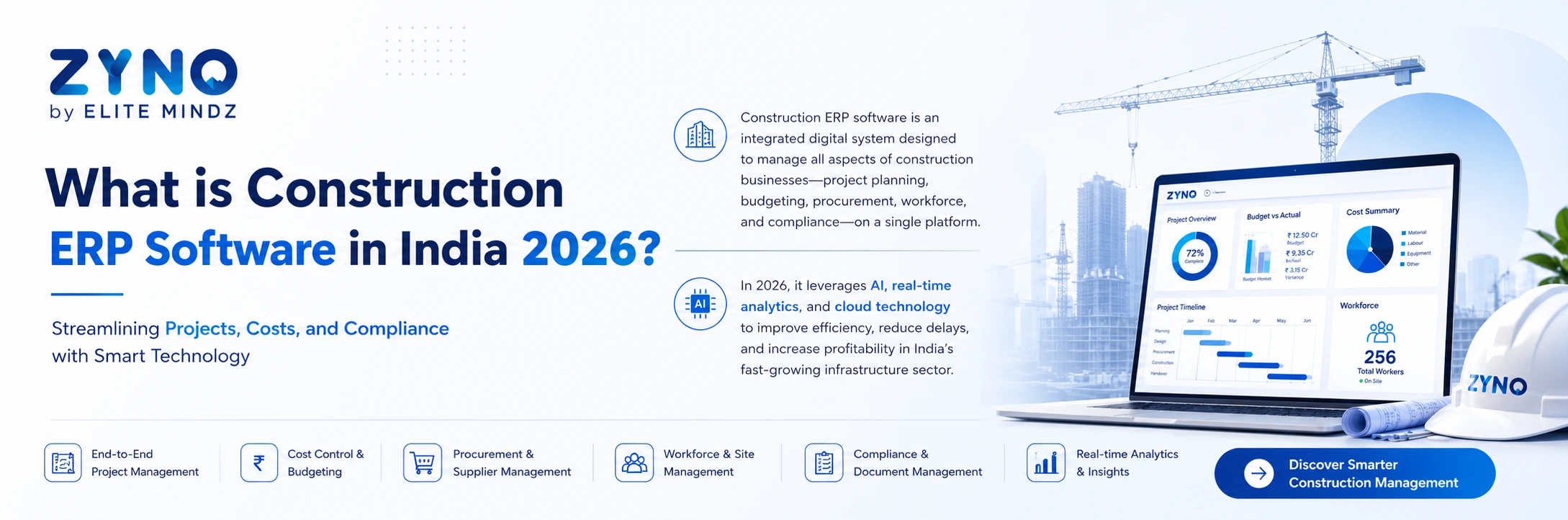
What is Construction ERP Software in India 2026?
Read More →

×
Discover the best tender management software to streamline tender creation, supplier communication, bid collection, proposal evaluation, approvals, and procurement workflows. Compare top tender management tools, explore key features, benefits, automation capabilities, and learn how the right solution can improve transparency, reduce manual work, accelerate procurement decisions, and strengthen supplier collaboration.
Businesses using ZYNO Books cut accounting time by 70% and stay 100% ZATCA-compliant — automatically.
Tendering is one of the most important stages in the construction industry. From identifying suitable projects and preparing tender documents to estimating costs, optimizing bid prices, submitting bids, and tracking outcomes, every stage requires accuracy and timely decision-making.
However, managing tenders manually can quickly become complicated. Construction companies often deal with spreadsheets, emails, multiple documents, changing requirements, subcontractor quotations, material costs, and tight submission deadlines. Even a small error in estimation or documentation can affect the profitability of an entire project.
This is where tender management software can make a significant difference.
Modern construction tendering software helps construction businesses organize tender opportunities, automate estimation workflows, manage documents, coordinate teams, optimize pricing, and improve bidding accuracy from a centralized system.
For contractors and builders, construction tender & bid management software can connect tender discovery, estimation, pricing, approvals, bid responses, and submission tracking in one streamlined workflow.
In this guide, we will explore what tender management software is, its key features, benefits, top tools to consider in 2026, and how construction companies can choose the right solution.
Tender management software is a digital solution designed to help construction companies manage the complete tendering and bidding process.
Instead of handling tender information across spreadsheets, emails, documents, and disconnected applications, businesses can manage critical tender activities through a centralized platform.
Modern construction tender management software can support the complete lifecycle, from identifying a potential opportunity to preparing an estimate, finalizing pricing, obtaining approvals, submitting the tender, and tracking the outcome.
Depending on the solution, tender management software can help teams:
For construction organizations, tendering software construction workflows can also become part of a broader construction management software ecosystem, connecting pre-construction activities with project execution, procurement, finance, billing, and reporting.
Streamline tender estimation, improve bid accuracy, manage project costs, and make smarter bidding decisions with ZYNO Construction's intelligent tender estimation solution.
The construction bidding process is becoming increasingly data-driven. Companies need to evaluate opportunities quickly while maintaining accurate estimates and competitive pricing.
Modern tendering software for construction helps businesses replace disconnected spreadsheets and manual processes with structured digital workflows.
Manual tender processes can create several challenges:
Teams may spend hours entering quantities, rates, supplier information, and project details into spreadsheets.
Repeated data entry can increase administrative work and create opportunities for calculation and data-entry errors.
Incorrect quantities, outdated material rates, or missed cost components can result in inaccurate project estimates.
A structured construction tender software solution can help standardize estimation processes and provide better visibility into project costs.
Tender documents can be scattered across emails, folders, and individual systems, making it difficult to find the latest version.
Centralized document management helps teams access the right tender information when preparing bids.
Construction tenders often have strict submission timelines. Without centralized deadline tracking, important opportunities can be missed.
Tender tracking software can help teams monitor submission dates, internal deadlines, clarification dates, and tender status.
Estimators, project managers, procurement teams, finance professionals, and management may need to work together before a bid is submitted.
A centralized platform provides a common workspace for these stakeholders.
Without historical data, companies may struggle to understand which tenders are profitable, competitive, or worth pursuing.
With tender analysis software, organizations can evaluate historical bids, win rates, tender values, clients, project categories, and other important performance indicators.
A centralized tender management system helps address these challenges by bringing important tender activities into one digital workflow.
Before choosing a platform, construction companies should understand the features that can directly improve the tendering process.
The software should provide a centralized location for managing tender opportunities.
Teams can record information such as:
This gives management a clear overview of active and upcoming opportunities.
A good construction tender software platform should also allow users to categorize and prioritize opportunities based on project value, location, client, deadline, and expected profitability.
Accurate estimation is at the heart of successful construction bidding.
A modern tender estimation solution can help teams calculate project costs based on materials, labor, equipment, subcontractors, overheads, and other expenses.
A digital tender estimator can help standardize calculations and reduce the time required to prepare detailed project estimates.
This allows estimators to build reliable project estimates before submitting a bid.
Bill of Quantities management is another important part of construction tendering.
The system should allow teams to manage:
Centralized BOQ management reduces repetitive data entry and improves estimation accuracy.
It also gives estimators better visibility into the cost structure of each tender.
Construction tenders often require quotations from multiple suppliers and subcontractors.
Tender software can help teams collect, organize, and compare quotations so they can make better cost decisions.
This can be particularly useful when preparing competitive bids without compromising expected project margins.
For trade contractors, this capability becomes even more important because project profitability can depend heavily on supplier and subcontractor rates.
A tender solution should make it easier to calculate direct and indirect project costs.
Teams can consider:
Accurate cost calculations help companies avoid underpricing and protect project profitability.
Winning a tender is not simply about offering the lowest price. Contractors need to balance competitive pricing with expected project margins.
Tender pricing optimization software can help teams evaluate material costs, labor rates, subcontractor quotations, overheads, markups, and expected profitability before finalizing the bid.
This allows businesses to make more informed pricing decisions rather than relying entirely on manual calculations.
Tendering involves large volumes of documents.
A centralized system can help teams organize drawings, specifications, BOQs, contracts, client documents, quotations, and other tender-related files.
This reduces the risk of using outdated documents during bid preparation.
Before submitting a tender, estimates and pricing may need approval from senior management.
Approval workflows allow organizations to establish structured review processes and reduce unnecessary email communication.
Businesses can create approval stages based on tender value, project type, or internal policies.
Tender deadlines are critical.
A tender management system can help teams track:
Automated reminders can help reduce the possibility of missing important dates.
This makes tender tracking software an important component of an efficient digital bidding workflow.
Teams should be able to monitor every opportunity through stages such as:
New → Under Evaluation → Estimation → Pricing → Approval → Submitted → Won/Lost
This provides management with better visibility into the overall tender pipeline.
Tender analytics can help businesses understand:
Modern tender analysis software can turn historical tender data into useful insights for future bidding decisions.
Simplify tender estimation, track bidding activities, manage project costs, and improve your construction bidding process with ZYNO Construction.
The right platform depends on the size, workflow, industry, and requirements of your construction business.
Some organizations may need dedicated estimating tools, while others may prefer integrated construction ERP software that connects tendering with project execution, procurement, finance, and billing.
Here are some solutions worth evaluating in 2026:
Best for: Construction companies looking for integrated tender estimation and construction management capabilities.
ZYNO Construction provides a digital platform for managing construction workflows, including tender estimation and other project-related processes.
Its tender estimation capabilities can help businesses organize project estimates, manage cost components, and improve visibility during the pre-construction stage.
The platform can be particularly useful for companies looking to connect tendering with broader construction operations instead of maintaining separate systems for every process.
By connecting tender estimation with other construction workflows, businesses can work toward a more centralized construction software solution.
Best for: Construction companies looking for connected construction workflows.
Autodesk Construction Cloud brings together tools for project management, document management, collaboration, and construction workflows.
It can be considered by organizations that require a broader digital construction ecosystem.
Best for: Medium and large construction organizations.
Procore is a widely used construction management platform offering capabilities across project management, financial management, quality, safety, and collaboration.
Companies should evaluate its available estimating and preconstruction capabilities according to their specific tendering requirements.
Best for: Residential builders, remodelers, and specialty contractors.
Buildertrend offers construction management capabilities covering project planning, communication, financial processes, and customer management.
It may be suitable for smaller and mid-sized construction businesses that want to centralize multiple operational processes.
Best for: Construction businesses requiring structured financial and project management workflows.
Sage provides construction-focused business management solutions that can support estimating, project management, accounting, and other construction processes.
It can be evaluated by businesses that want stronger connections between financial and operational activities.
Note: Features, pricing, integrations, and availability can change over time. Construction companies should evaluate current capabilities against their specific tendering workflow before selecting a platform.
| Factor | Manual Tendering | Tender Management Software |
|---|---|---|
| Data Management | Spreadsheets and files | Centralized platform |
| Cost Estimation | Mostly manual | Structured workflows |
| Document Management | Multiple folders/emails | Centralized documents |
| Collaboration | Email and meetings | Shared workflows |
| Deadline Tracking | Manual reminders | Automated tracking |
| Quotation Comparison | Spreadsheet-based | Centralized comparison |
| Approvals | Email-based | Workflow-based |
| Reporting | Manual reports | Digital dashboards |
| Historical Analysis | Difficult | Easier with stored data |
| Tender Tracking | Manual updates | Centralized tracking |
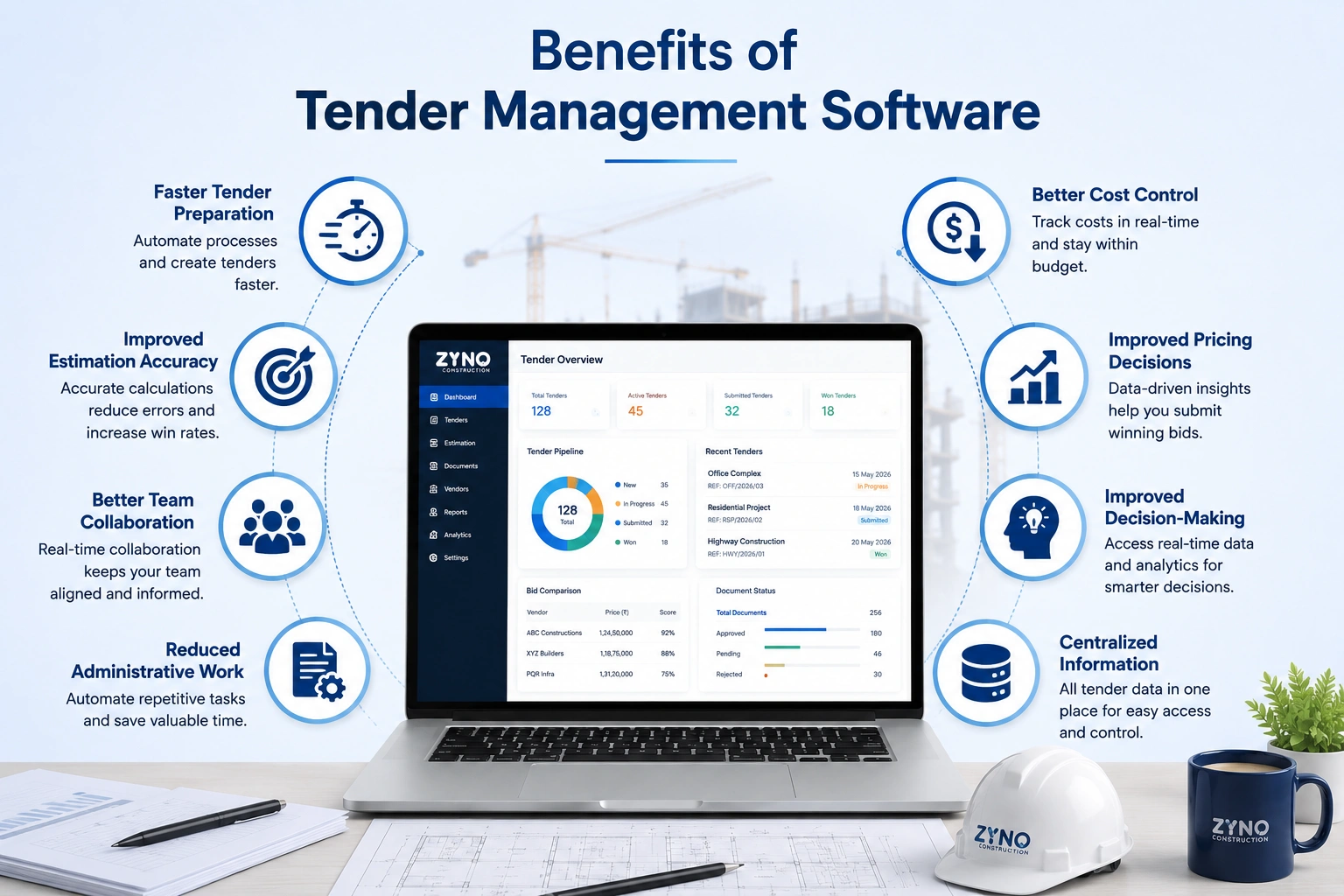
The main advantage of software is not simply automation. It is the ability to create a standardized and connected tender workflow.

Automated calculations, reusable templates, and centralized data can reduce the time required to prepare bids.
Structured estimation processes help reduce calculation errors and improve cost visibility.
Estimators, procurement teams, project managers, finance teams, and management can work from the same information.
Automating repetitive activities allows teams to focus more on evaluating projects and improving bid strategies.
Detailed cost visibility can help companies identify potential margin risks before submitting a tender.
By evaluating costs, markups, supplier rates, and expected margins, businesses can make more informed bidding decisions.
Management can compare opportunities using historical data, estimated profitability, client information, and other business parameters.
Instead of searching through multiple spreadsheets and emails, teams can access important tender information from a centralized system.
Selecting the right software requires more than comparing feature lists. Construction companies should evaluate how well the platform fits their existing workflow.
Map your current process from tender discovery to bid submission.
Identify where your team spends the most time and where errors commonly occur.
If estimation is your primary requirement, pay close attention to BOQ management, costing, labor calculations, material rates, overheads, markups, and profitability analysis.
A strong tender estimator should make calculations easier without forcing teams to completely change their existing estimation workflow.
Check whether the software provides centralized tender tracking, deadline alerts, bid status management, follow-ups, and historical tender information.
This is particularly important for businesses managing multiple opportunities simultaneously.
The ideal system should work with other business processes.
For example, tendering may eventually connect with:
This is where an integrated construction ERP software platform can provide an advantage.
Software should simplify the tendering process rather than make it more complicated.
Request a product demonstration and test common workflows before making a purchase.
Your tendering requirements may increase as your company grows.
Choose a system that can support additional users, projects, locations, workflows, and integrations.
Check whether the software provides useful dashboards and reports for tender performance, project costs, bid outcomes, pricing, and profitability.
Tender documents and project estimates can contain sensitive commercial information.
Look for appropriate access controls, permissions, data security, and document management capabilities.
Tender management should not always operate as an isolated function.
For many growing construction companies, tendering is the first stage of a much larger project lifecycle.
A connected construction ERP system can link:
Tender → Estimation → Procurement → Project Execution → Billing → Finance
This creates better information flow between departments.
For example, once a tender is converted into a project, relevant cost and project information can potentially move into downstream workflows instead of being recreated manually.
This makes tender management an important component of a broader ERP for construction industry strategy.
For businesses looking for tendering software construction solutions, integration with broader construction operations can therefore be an important selection factor.
Contractors have unique requirements when preparing bids.
They may need to manage subcontractor quotations, labor costs, equipment costs, material prices, client requirements, and project-specific margins.
For these organizations, contractor management software combined with tender and estimation capabilities can provide greater operational visibility.
Tendering software for trade contractors is particularly useful for electrical, mechanical, HVAC, plumbing, civil, and other specialist contractors that regularly respond to multiple project opportunities.
Such software can help trade contractors:
A centralized platform can help contractors manage opportunities while keeping important commercial information organized.
Engineering companies often deal with complex technical specifications, drawings, BOQs, compliance documents, commercial requirements, and client instructions during the bidding process.
Tender response software for engineering can help teams organize technical and commercial information, coordinate contributors, manage document versions, and prepare consistent bid responses.
For engineering businesses handling multiple complex tenders, centralized response management can reduce duplication and improve collaboration between technical, commercial, procurement, and management teams.
Renewable energy projects such as solar farms, wind projects, battery storage systems, and EPC installations often involve complex specifications, equipment costs, subcontractor pricing, technical documentation, and long project timelines.
Renewable energy project bid software can help organizations organize project requirements, calculate costs, compare vendor quotations, manage tender documentation, and evaluate potential margins before submitting bids.
As renewable energy projects continue to involve multiple stakeholders and complex commercial requirements, structured tender workflows can help businesses manage bidding activities more efficiently.
Companies operating across Germany, Austria, and Switzerland may have specific requirements when managing tenders and bids.
Businesses searching for tender software DACH should evaluate factors such as regional workflows, language requirements, documentation, user permissions, integrations, data security, and applicable business requirements.
The right solution should be selected based on the organization's actual tendering process and regional operating requirements rather than keyword relevance alone.
Tendering does not end when a bid is submitted.
Once a tender is won, project information needs to transition into execution.
This is why companies evaluating construction project management software should consider how pre-construction information connects with project execution.
A connected construction project management system can help organizations maintain continuity from initial estimation through project delivery.
For example:
Tender → Estimate → Award → Project Setup → Procurement → Execution → Billing
This connected approach can reduce duplicate data entry and improve visibility across the project lifecycle.
ZYNO Construction is designed to help construction businesses move toward a more connected digital workflow.
Its tender estimation capabilities can help organizations structure project estimates, improve cost visibility, and support better decision-making during the pre-construction phase.
For companies already using or planning to adopt a broader construction software solution, connecting tender estimation with project, resource, procurement, inventory, and financial processes can help reduce information silos.
ZYNO Construction can therefore be considered by organizations looking for a more structured approach to construction tender estimation and pre-construction management.
Explore ZYNO Construction Tender Estimation Software to bring tender-related workflows into a more organized digital environment and improve visibility across your pre-construction process.
Track materials, reduce inventory waste, improve stock visibility, and manage construction resources efficiently with ZYNO Construction.
Construction tendering requires speed, accuracy, and strong cost control. As project complexity increases, relying entirely on spreadsheets, emails, and manual calculations can make the bidding process inefficient and difficult to scale.
Tender management software provides construction companies with a structured way to manage opportunities, estimates, documents, quotations, pricing, approvals, and submissions from a centralized platform.
Modern construction tender & bid management software can go beyond basic tender tracking by connecting estimation, pricing, document management, bid responses, approvals, and analysis into a single workflow.
However, the best solution is not necessarily the one with the longest feature list. Construction companies should select software based on their actual workflow, estimation requirements, project size, integration needs, industry requirements, and long-term digital strategy.
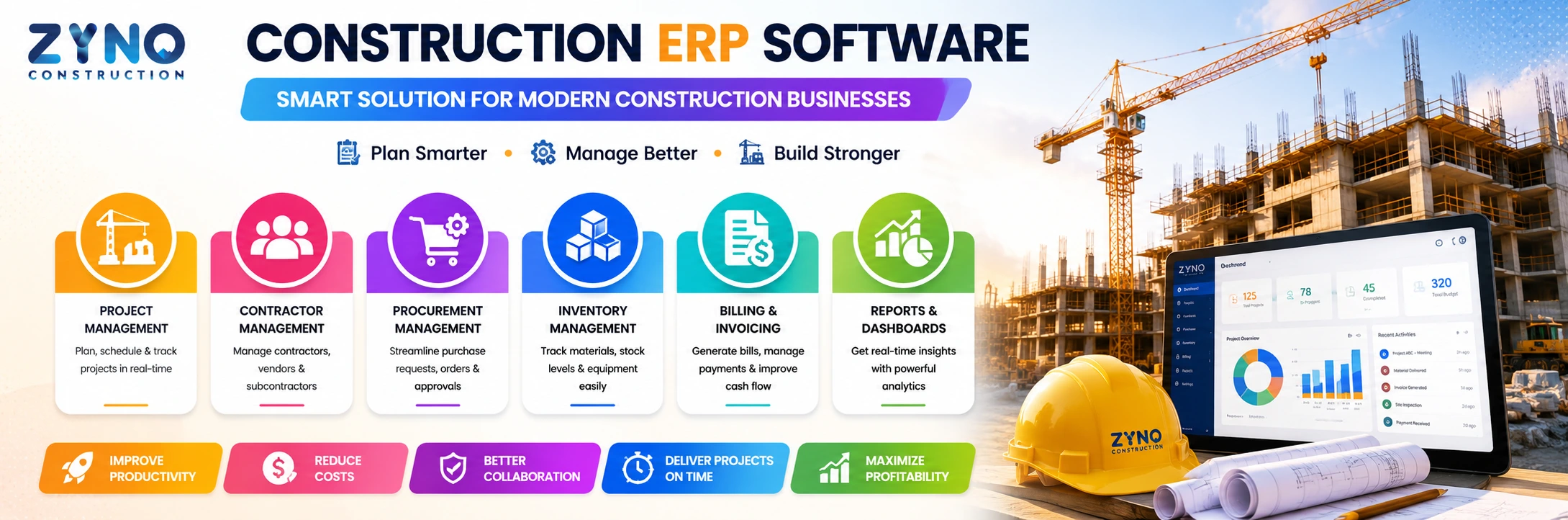
For organizations looking beyond standalone tender tools, an integrated construction ERP system can provide an even broader approach by connecting tendering with procurement, project management, inventory, billing, finance, and other construction operations.
In 2026, moving from fragmented tender processes to a connected digital workflow can help construction businesses prepare bids faster, make better cost decisions, improve tender visibility, and build a stronger foundation for profitable project execution.
Tender management software is a digital solution that helps construction companies manage tender opportunities, estimation, BOQs, quotations, documents, approvals, deadlines, submissions, and tender performance.
Construction tendering software helps builders, contractors, and construction businesses manage the bidding process, including tender opportunities, estimates, pricing, documentation, approvals, and bid submissions.
Tender management covers the broader tender lifecycle, while tender estimation software primarily focuses on calculating project costs, quantities, rates, markups, and expected profitability.
Tender tracking software helps contractors monitor tender opportunities, submission deadlines, bid status, follow-ups, approvals, and won or lost opportunities from a centralized system.
Important features include tender opportunity management, BOQ management, estimation, quotation comparison, pricing, document management, approval workflows, deadline tracking, reporting, and tender analysis.
Tender pricing optimization software helps businesses evaluate project costs, supplier rates, labor expenses, overheads, markups, and expected margins to develop competitive and profitable bid prices.
Yes. Tendering software for trade contractors can help electrical, mechanical, HVAC, plumbing, civil, and other specialist contractors manage tender invitations, estimates, quotations, pricing, documents, and bid submissions.
Yes. Depending on the platform, tender management software can connect with procurement, project management, inventory, finance, billing, vendor management, and other construction ERP workflows.
Yes. Renewable energy project bid software can support bidding activities for solar, wind, EPC, and other energy projects by organizing estimates, technical requirements, quotations, documentation, and pricing.
Consider your company's tendering workflow, estimation requirements, BOQ capabilities, tender tracking, pricing features, integrations, reporting, user experience, security, scalability, and compatibility with your existing construction management software.
What is Construction ERP Software in India 2026?
Read More →
Construction ERP Software – Features, Benefits & Complete Guide
Read More →
Complete Guide to the Best Construction ERP Software in Dubai, UAE
Read More →
What is Construction ERP Software?
Read More →
AI-Powered Construction ERP Software: Complete Guide to Features, Benefits, and Business Growth
Read More →
How to Choose the Best Construction ERP Software for Your Business
Read More →
Which Construction Software Helps Interior and Fit-Out Contractors Control Vendor Exposure, Invoices, and Cash Flow with Integrated ERP Connections?
Read More →
Construction Inventory Management Software: The Smart Way to Reduce Costs and Prevent Stockouts
Read More →
Best AI Construction ERP Software Comparison: Which Solution Is Right in 2026?
Read More →
Labor Management System: Features, Benefits & Complete Guide for 2026
Read More →
What is Maintenance Management Software? Types, Features & Benefits
Read More →
Construction Project Management Software for Real Estate Companies in Kenya: Complete Guide
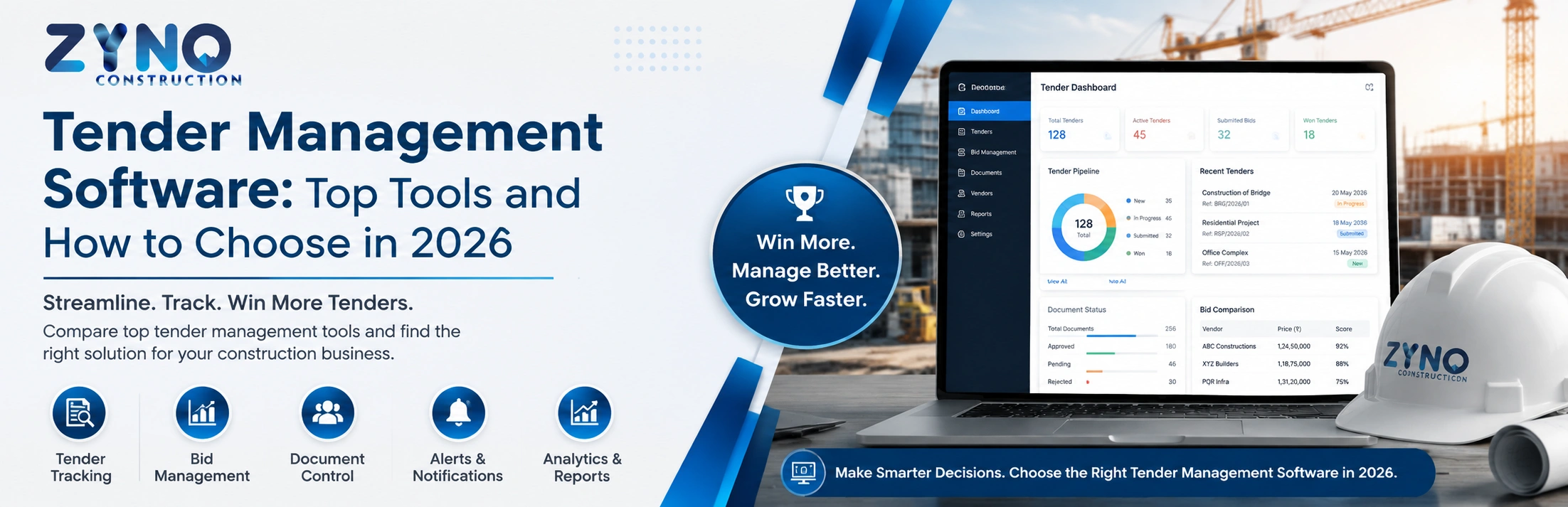
Read More →Tender Management Software: Top Tools and How to Choose in 2026
Read More →Partner with ZYNO by Elite Mindz to revolutionize how your business works. Fill out the form, and we’ll reach out with AI-powered solutions made just for you.
We use browser cookies to ensure you get the best experience on our website. Learn more
The form was submitted successfully!