×
Discover how AI-powered Construction ERP software streamlines projects, automates workflows, improves cost control, and drives business growth with intelligent insights.
Businesses using ZYNO Books cut accounting time by 70% and stay 100% ZATCA-compliant — automatically.

The construction industry is one of the most complex and fast-moving sectors in the world. Every project involves multiple teams, strict deadlines, shifting budgets, material planning, vendor coordination, site execution, documentation, and compliance requirements. Managing all of this manually can quickly become difficult, expensive, and error-prone.
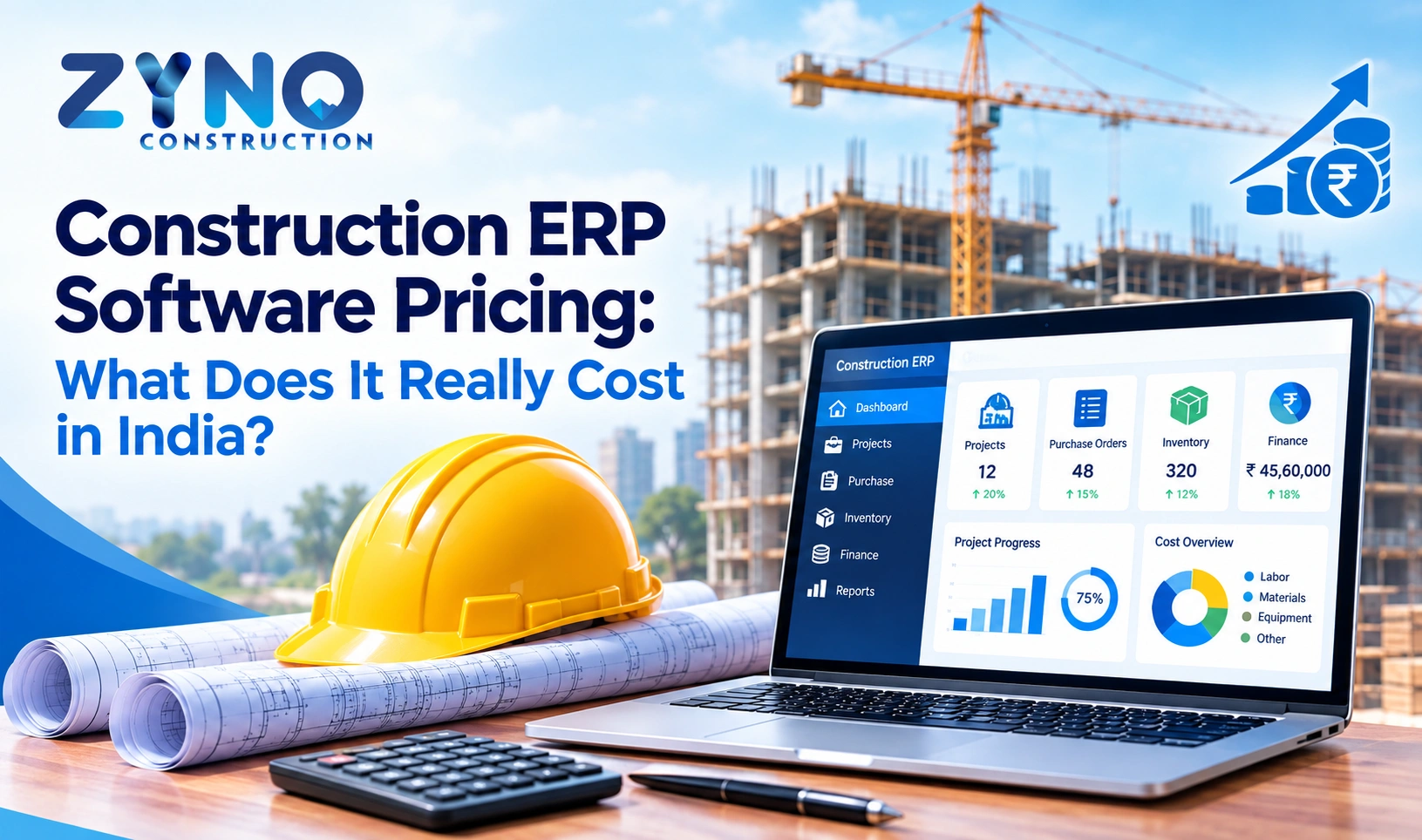
This is why construction ERP software has become an essential tool for modern construction companies. It helps organizations manage operations from a single platform, bringing together project management, finance, procurement, inventory, workforce, and reporting. Instead of working in disconnected spreadsheets and systems, businesses can operate with better visibility and control.
Today, with the addition of AI and automation, construction ERP software is becoming even more powerful. It not only centralizes data but also helps businesses forecast risks, improve planning, automate repetitive tasks, and make smarter decisions.
In this blog, we’ll explore what construction ERP software is, its key features, benefits, business use cases, and why it is becoming a must-have solution for construction firms of all sizes.
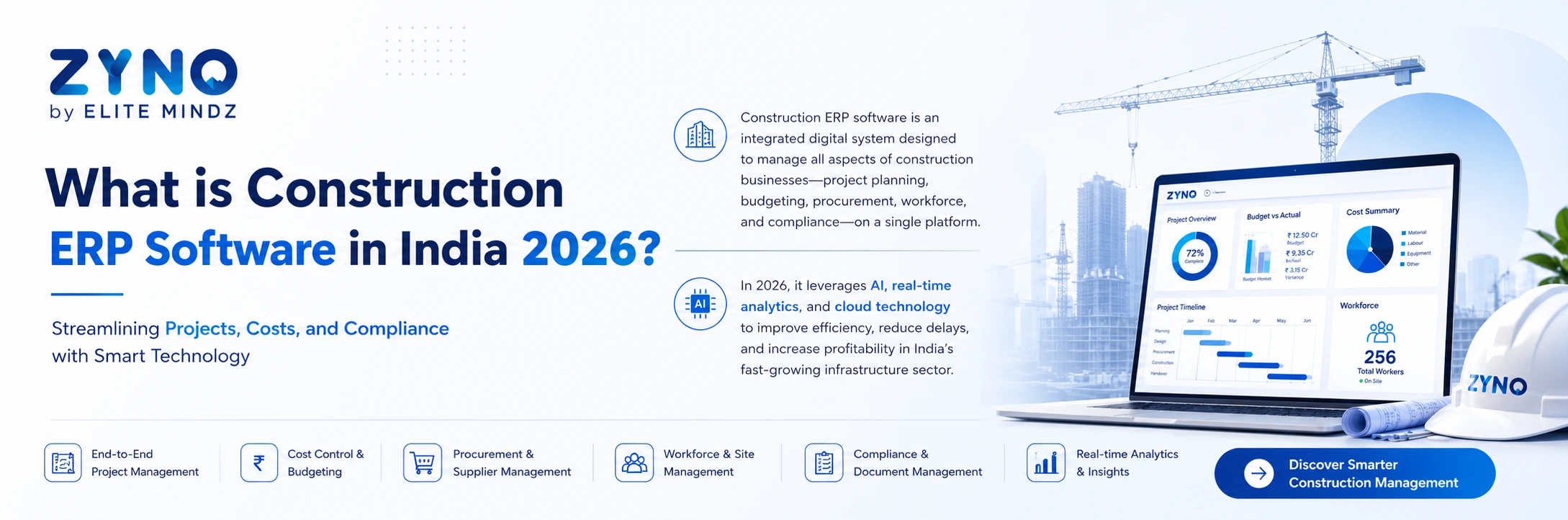
Construction ERP software is an enterprise resource planning solution built specifically for the construction sector. It connects different departments and processes into one centralized system so that project teams, office staff, finance teams, and field workers can work in sync.
A construction ERP solution usually covers:
By integrating these functions, construction companies gain better control over daily operations and long-term business performance.
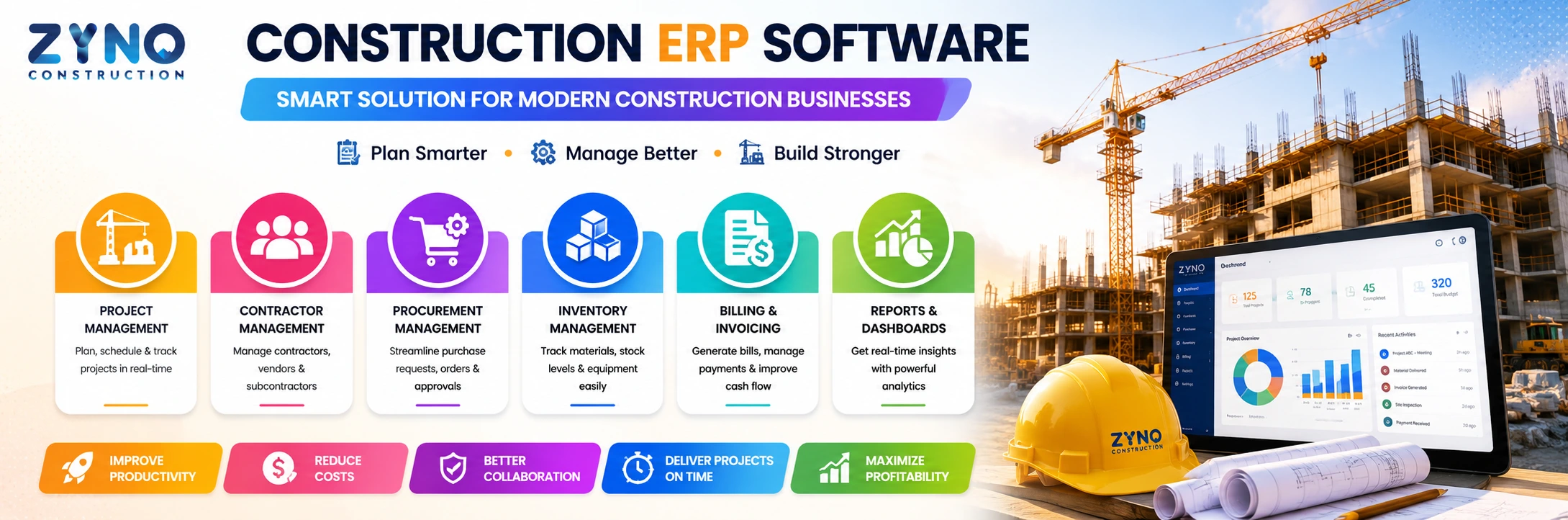
Transform your construction business with AI-powered ERP software that streamlines project management, automates procurement, controls costs, manages inventory, and delivers real-time insights for faster, smarter decision-making.
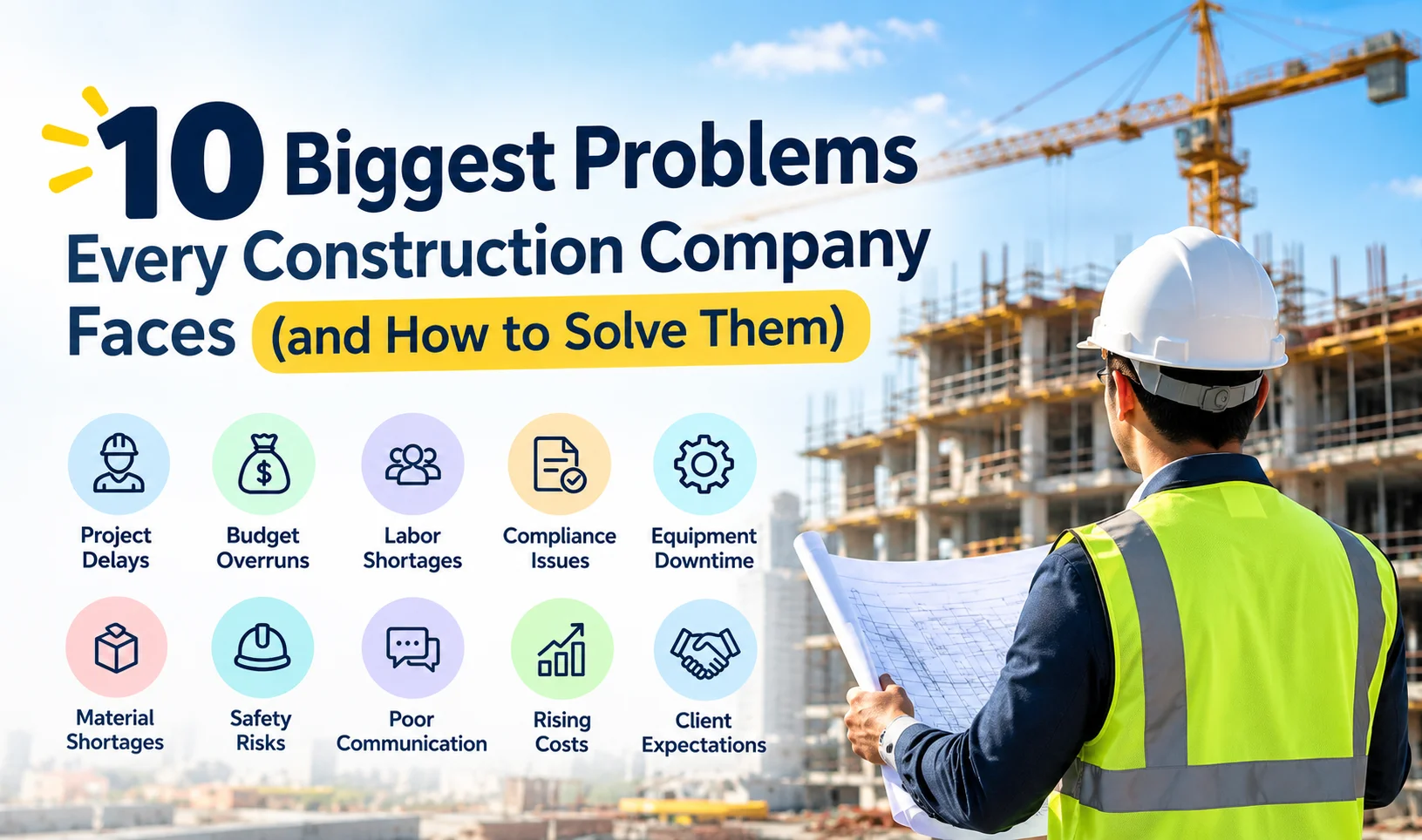
Construction projects often fail to meet expectations because of delays, poor communication, budget overruns, and resource mismanagement. When different teams use different tools, it becomes hard to maintain consistency and accuracy.
Construction ERP software solves these problems by creating a connected ecosystem. It gives managers access to real-time information, helps teams collaborate more effectively, and reduces the chances of miscommunication.
Some of the most common challenges it addresses include:
With ERP software, these issues can be managed more efficiently and proactively.
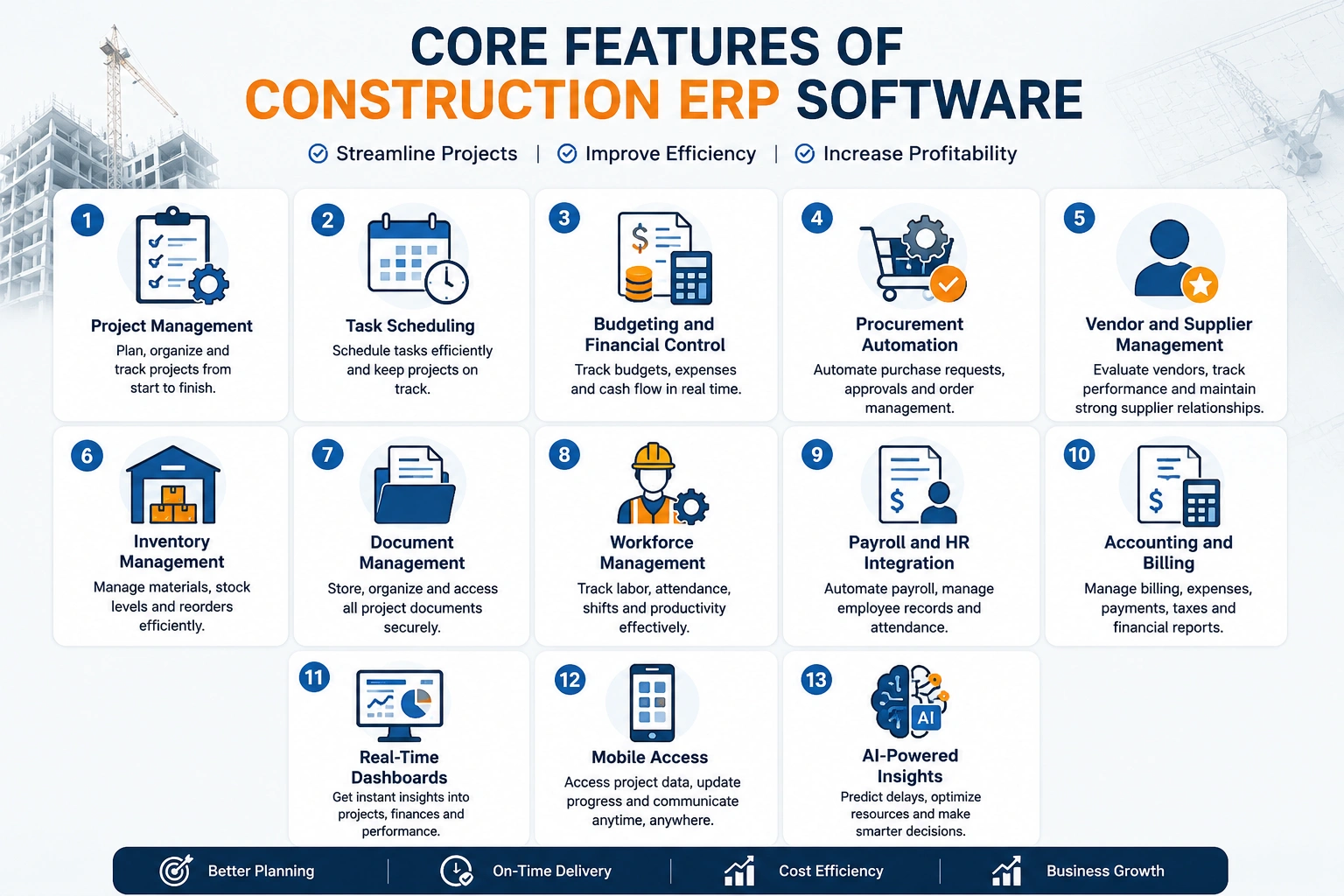
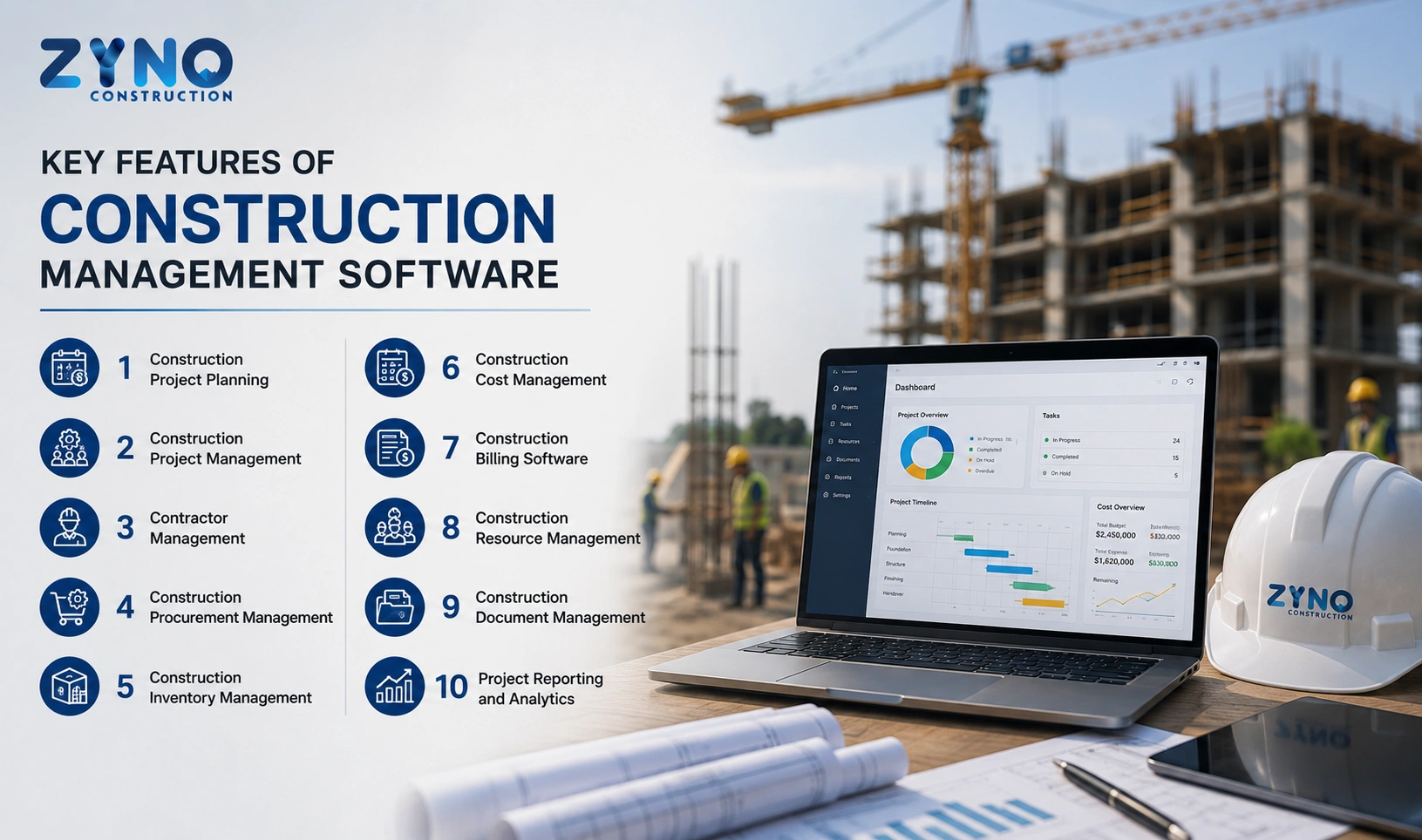
A good construction ERP platform should support the complete project lifecycle, from planning to delivery. Below are the most important features to look for.

Project management is at the heart of any construction ERP system. It helps define tasks, assign responsibilities, track timelines, and monitor work progress across multiple teams.
Scheduling tools allow project managers to organize activities in the right sequence, reduce delays, and ensure that each phase of construction starts on time.
Construction projects often exceed their initial budgets if costs are not monitored carefully. ERP software helps track estimated, committed, and actual expenses, making financial management more transparent.
From raising purchase requests to approving vendor orders, ERP software automates procurement workflows. This improves purchasing efficiency and reduces delays in material supply.
Construction businesses work with multiple vendors and suppliers. ERP systems help track vendor performance, purchase history, pricing, and delivery reliability.
ERP software provides clear visibility into material stock, consumption, movement, and reorder requirements. This helps avoid project delays caused by material shortages.
Construction generates a huge amount of paperwork, including contracts, blueprints, approvals, compliance records, and invoices. ERP software stores and organizes these documents securely in one place.
Managing workers, labor attendance, shifts, and productivity becomes easier with ERP. Some platforms also support biometric or mobile attendance tracking.
Construction ERP software often connects with HR and payroll systems, allowing accurate salary calculations, attendance-based payments, and employee record management.
ERP platforms integrate accounting functions like billing, expense tracking, payment management, tax records, and financial reporting.
Live dashboards help managers see the current state of each project, financial status, labor allocation, and material usage instantly.
Mobile access allows site teams to update progress, upload photos, record attendance, and access project information from anywhere.
Advanced ERP platforms use AI to analyze data, identify trends, predict project delays, optimize resources, and support better planning.
Implementing ERP software in construction can create major operational and financial improvements. Below are the key benefits.
All important business functions are managed in one system, reducing dependency on multiple disconnected tools.
Managers can track the status of projects in real time and take immediate action when problems arise.
ERP helps companies monitor spending closely, reduce unnecessary costs, and prevent budget overruns.
By connecting office and site teams, ERP improves communication and reduces confusion.
Automated approval processes save time and help projects move forward without unnecessary delays.
ERP minimizes duplicate data entry and human mistakes, which improves accuracy across operations.
The system helps allocate labor, equipment, and materials more effectively, reducing waste.
Construction businesses can maintain better records, approvals, and audit trails, making regulatory compliance easier.
When projects are delivered on time and within budget, client trust and satisfaction improve significantly.
ERP software supports business expansion by handling more projects, more users, and more data without losing control.
AI is transforming traditional ERP systems into intelligent business platforms. Rather than simply storing information, AI helps construction businesses use that information effectively.
This makes AI-powered ERP especially valuable for companies that want a competitive edge in planning and execution.
Construction ERP software can support a wide range of project and business scenarios.
Builders and developers can use ERP to manage housing projects, track material usage, and control budgets.
For offices, malls, and retail spaces, ERP helps coordinate large teams, vendors, and timelines.
Roads, bridges, utilities, and public works require strong planning and reporting, which ERP supports well.
Engineering, procurement, and construction firms benefit from ERP because it connects complex workflows into one system.
Even subcontractors can use ERP tools to manage jobs, invoices, labor, and reporting more efficiently.
Experience the power of AI-driven automation, predictive analytics, smart project planning, cost optimization, and real-time decision-making with ZYNO AI-Powered Construction ERP. Build faster, reduce risks, and maximize profitability.
Not all ERP systems are the same. Before selecting one, construction businesses should evaluate their needs carefully.
Here are some important factors to consider:
The right ERP solution should match your current business model while preparing you for future expansion.
Construction ERP software helps solve some of the most persistent industry problems, such as:
By addressing these pain points, ERP improves both daily operations and long-term profitability.
The future of construction ERP is becoming more intelligent, connected, and automation-driven. As AI, cloud computing, IoT, and mobile technologies continue to advance, ERP systems will become even more predictive and efficient.
In the coming years, we can expect ERP platforms to offer:
Construction companies that adopt ERP early will be better prepared for this digital shift.
Construction businesses need speed, accuracy, visibility, and control to stay competitive. Manual systems and disconnected tools are no longer enough to manage the complexity of modern projects. That is why construction ERP software has become such an important investment.
With features like project management, budgeting, procurement, inventory tracking, workforce management, and reporting, ERP software helps companies work more efficiently. When enhanced with AI, it goes one step further by helping businesses predict problems, reduce waste, and make smarter decisions.
If your construction company wants to improve productivity, reduce costs, and manage projects more effectively, now is the right time to explore a modern ERP solution.
The main purpose of construction ERP software is to bring all critical business operations into a single integrated platform. It helps construction companies manage project planning, budgeting, procurement, inventory, equipment, workforce, subcontractors, accounting, and financial reporting from one centralized system. By eliminating manual processes and disconnected spreadsheets, construction ERP improves collaboration, enhances project visibility, reduces operational costs, and enables faster decision-making. It also provides real-time insights into project performance, helping businesses complete projects on time and within budget.
Yes. Construction ERP software is highly beneficial for small and medium-sized construction companies as well as large enterprises. It helps smaller businesses streamline daily operations, improve budget control, monitor project progress, manage resources efficiently, and reduce paperwork. By automating repetitive tasks such as invoicing, procurement, and payroll, small companies can save valuable time, minimize errors, and focus on business growth. Many modern ERP solutions are scalable, allowing businesses to add new features as they expand.
AI-powered ERP software goes beyond traditional ERP by using artificial intelligence, machine learning, and predictive analytics to automate business processes and provide intelligent recommendations. It can forecast project risks, predict material shortages, automate routine approvals, optimize resource allocation, and generate real-time business insights. AI also enables natural language reporting, allowing users to generate reports through simple prompts. These intelligent capabilities improve operational efficiency, support data-driven decisions, reduce manual effort, and help organizations stay competitive in a rapidly changing business environment.
Yes. Construction ERP software plays a significant role in reducing project delays by providing real-time visibility into project schedules, procurement activities, inventory levels, workforce availability, and equipment utilization. Automated task tracking, milestone monitoring, and instant notifications help project managers identify potential bottlenecks before they become major issues. Better communication between project teams, vendors, and stakeholders ensures smoother coordination, while accurate resource planning minimizes downtime. These capabilities help keep construction projects on schedule and improve overall project delivery.
Yes. Most modern construction ERP solutions are highly customizable to meet the unique needs of different construction businesses. Organizations can configure workflows, approval processes, dashboards, reports, user roles, project modules, and financial settings based on their operational requirements. Whether a company specializes in residential, commercial, infrastructure, or industrial projects, the ERP system can be tailored to support specific business processes. This flexibility ensures the software aligns with existing workflows while remaining scalable to accommodate future growth and changing business needs.
Sneha Singh
Content Writer
Sneha Singh is a B2B tech content strategist with 4+ years of experience. She specializes in SEO-driven SaaS content, whitepapers, and platform-native social media campaigns that simplify complex technology and drive business growth. Sneha's core exp
What is Construction ERP Software in India 2026?
Read More →

Construction ERP Software – Features, Benefits & Complete Guide
Read More →
Complete Guide to the Best Construction ERP Software in Dubai, UAE
Read More →
What is Construction ERP Software?
Read More →
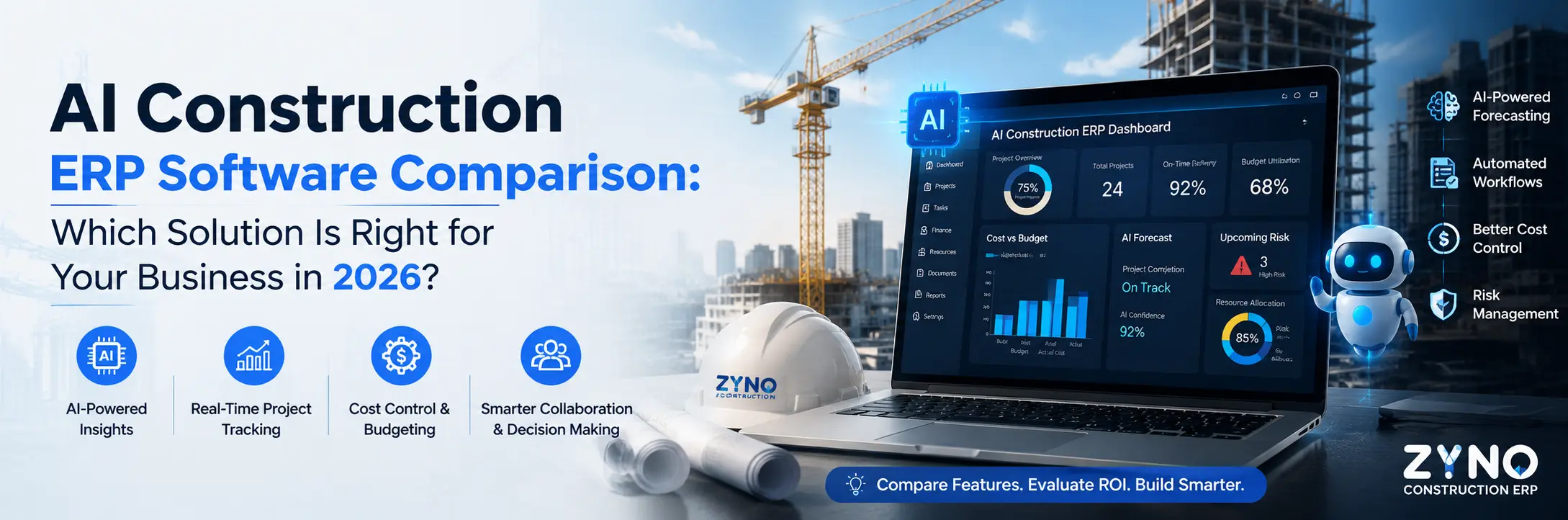
AI-Powered Construction ERP Software: Complete Guide to Features, Benefits, and Business Growth
Read More →
How to Choose the Best Construction ERP Software for Your Business
Read More →
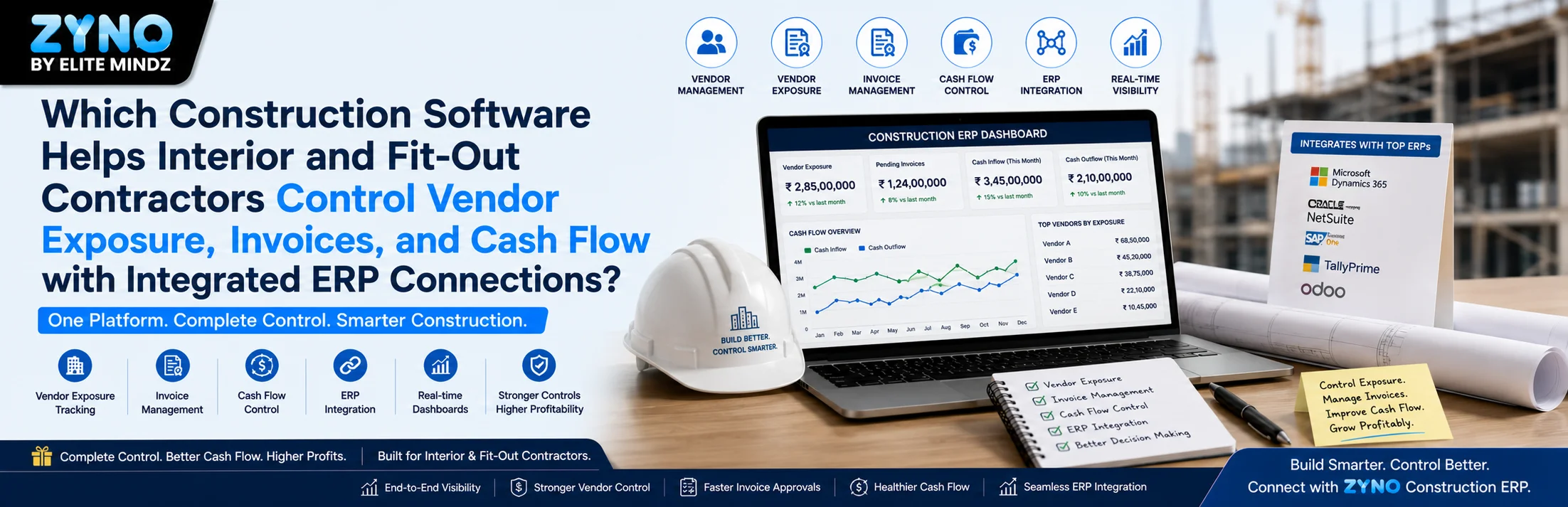
Which Construction Software Helps Interior and Fit-Out Contractors Control Vendor Exposure, Invoices, and Cash Flow with Integrated ERP Connections?
Read More →Partner with ZYNO by Elite Mindz to revolutionize how your business works. Fill out the form, and we’ll reach out with AI-powered solutions made just for you.
We use browser cookies to ensure you get the best experience on our website. Learn more
The form was submitted successfully!
ZYNO Digital
Fueling Smarter Digital Growth
ZYNO Digital fuels smarter digital growth through data-driven marketing, creative storytelling, and performance strategies that boost visibility, engagement, and measurable business outcomes across global platforms.
ZYNO Tech
Engineering the Future of IT
ZYNO Tech delivers cutting-edge IT solutions — including web, mobile, and digital transformation services — helping businesses scale efficiently, innovate faster, and stay ahead in a connected world.
ZYNO AI
AI Built for Business Growth
ZYNO AI harnesses the power of artificial intelligence to automate processes, enhance decision-making, and deliver predictive insights — driving innovation, agility, and measurable business growth.
ZYNO by Elite Mindz
Your Partner in the AI-Powered Future
ZYNO by Elite Mindz offers AI-powered products and services that unify operations, boost productivity, and drive digital transformation — helping businesses scale smarter and innovate faster.
* In just 2 mins you'll get a response
* Your idea is 100% protected by our Non-Disclosure Agreement