What is Construction ERP Software in India 2026?
Read More →
×
Construction ERP software pricing in India varies based on users, projects, modules, implementation, integrations, customization, training, and support. Businesses should compare three-to-five-year Total Cost of Ownership (TCO), functionality, scalability, security, and expected ROI instead of choosing software based only on subscription price. A suitable construction ERP should also align with project workflows and support business growth across multiple sites.
Businesses using ZYNO Books cut accounting time by 70% and stay 100% ZATCA-compliant — automatically.
Choosing construction software is not only about finding the lowest subscription price. For builders, contractors, EPC companies, and developers, the real investment depends on users, project volume, required modules, implementation, integrations, support, and customization.
So, what does construction ERP software really cost in India?
The answer varies from business to business. Some companies need a simple cloud solution for a few projects, while others require an integrated platform for project planning, estimation, procurement, budgeting, billing, equipment, vendors, and multiple sites.
This guide explains the major cost factors, pricing models, hidden expenses, and ROI considerations so you can evaluate construction software with a realistic budget.
There is no single price that applies to every construction company. Vendors generally calculate pricing based on the scope and complexity of implementation.
The most important factors include:
User count is one of the most common pricing factors.
A small contractor with 5–10 users will usually have a different requirement from a construction company with project managers, site engineers, procurement teams, finance staff, supervisors, and management users across multiple locations.
Before comparing quotes, identify:
Do not compare two software prices until you know whether both vendors are charging for the same number and type of users.
A company managing one project has very different software requirements from an organization managing 20 active sites.
Multi-project construction businesses may need centralized dashboards, project-level budgets, resource planning, progress tracking, procurement visibility, and consolidated reporting.
Therefore, ask vendors whether pricing changes according to:
Construction ERP pricing also depends heavily on functionality.
A basic system may cover project tracking and billing, while a broader construction management platform may include:
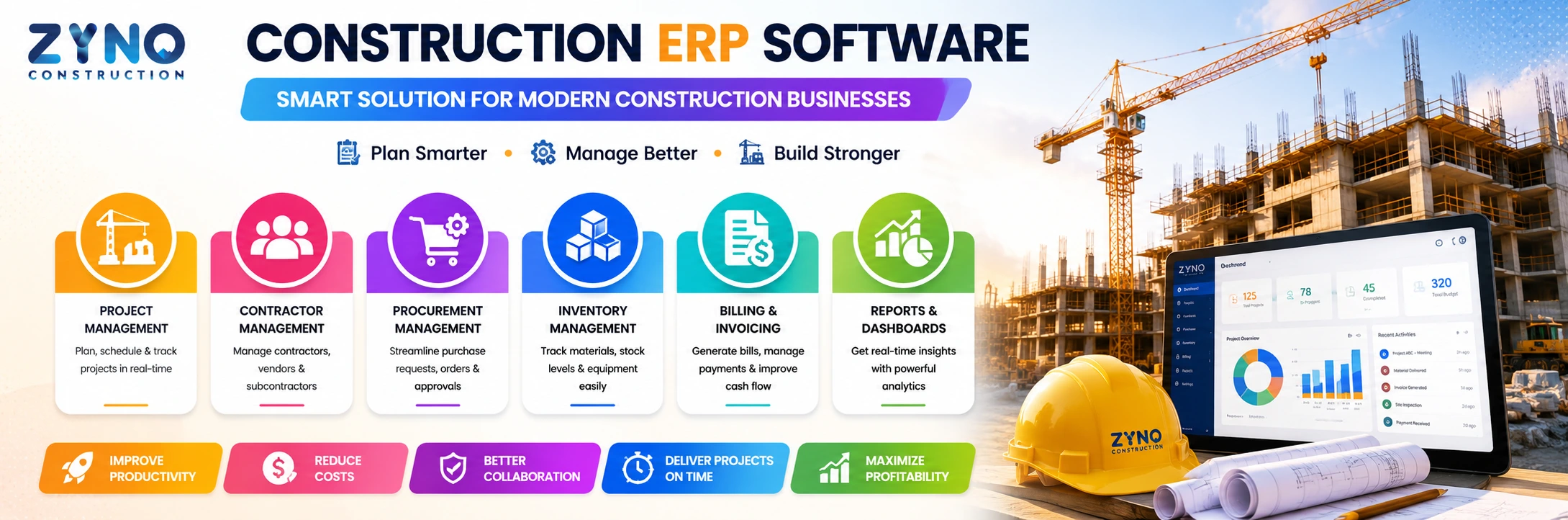
ZYNO Construction brings multiple construction workflows into one platform, including tendering and estimation, project planning, sales management, design management, and budgeting.
The important point is to pay for the capabilities your business actually needs instead of buying a large system with unused modules.
See how ZYNO Construction connects project planning, cost control, procurement, billing, equipment, vendors, and financial workflows to improve visibility across construction projects.
Different vendors use different pricing structures. Understanding them makes quotations much easier to compare.
In this model, you pay according to the number of users.
It can work well for smaller teams, but costs may increase as more employees need access.
Cloud software is commonly offered through monthly or annual subscriptions.
The advantage is that you generally avoid large upfront infrastructure expenses. However, you should calculate the total cost over three to five years rather than comparing only the monthly subscription.
Some platforms structure pricing around the number of projects or sites.
This can be useful for companies with a predictable number of active projects, but you should understand what happens when project volume increases.
Large construction organizations may require customized workflows, integrations, data migration, advanced permissions, and multiple entities.
In such cases, vendors may provide a customized quotation instead of a fixed public price.
Market pricing varies significantly depending on company size and software scope. Published 2026 market guides show examples ranging from entry-level cloud subscriptions of a few thousand rupees per user per month to much higher annual investments for mid-market and enterprise implementations.
A practical way to think about your budget is:
| Business Type | Typical Requirement | Budget Consideration |
|---|---|---|
| Small Contractor | Basic project, billing and site management | Entry-level cloud solution |
| Growing Contractor | Multiple projects, procurement, budgeting and reporting | Mid-tier platform |
| Mid-size Builder | Integrated project, finance, procurement and vendor workflows | Full construction ERP |
| Mid-size Builder | Integrated project, finance, procurement and vendor workflows | Full construction ERP |
| Large Enterprise | Multiple entities, sites, integrations and custom workflows | Enterprise/custom implementation |
These should be treated as budgeting categories rather than fixed market prices, because actual quotes depend on users, modules, implementation and integrations.
For example, some published Indian pricing guides place small construction businesses in the low-lakh annual range, while more complex mid-market and enterprise implementations can reach significantly higher levels once implementation and customization are included.
The software subscription is not always the complete cost.
Before signing a contract, ask the vendor to clearly identify the following:
Implementation can include account setup, workflows, permissions, configuration, project structures, and system deployment.
For complex construction businesses, implementation may represent a significant part of the initial investment.
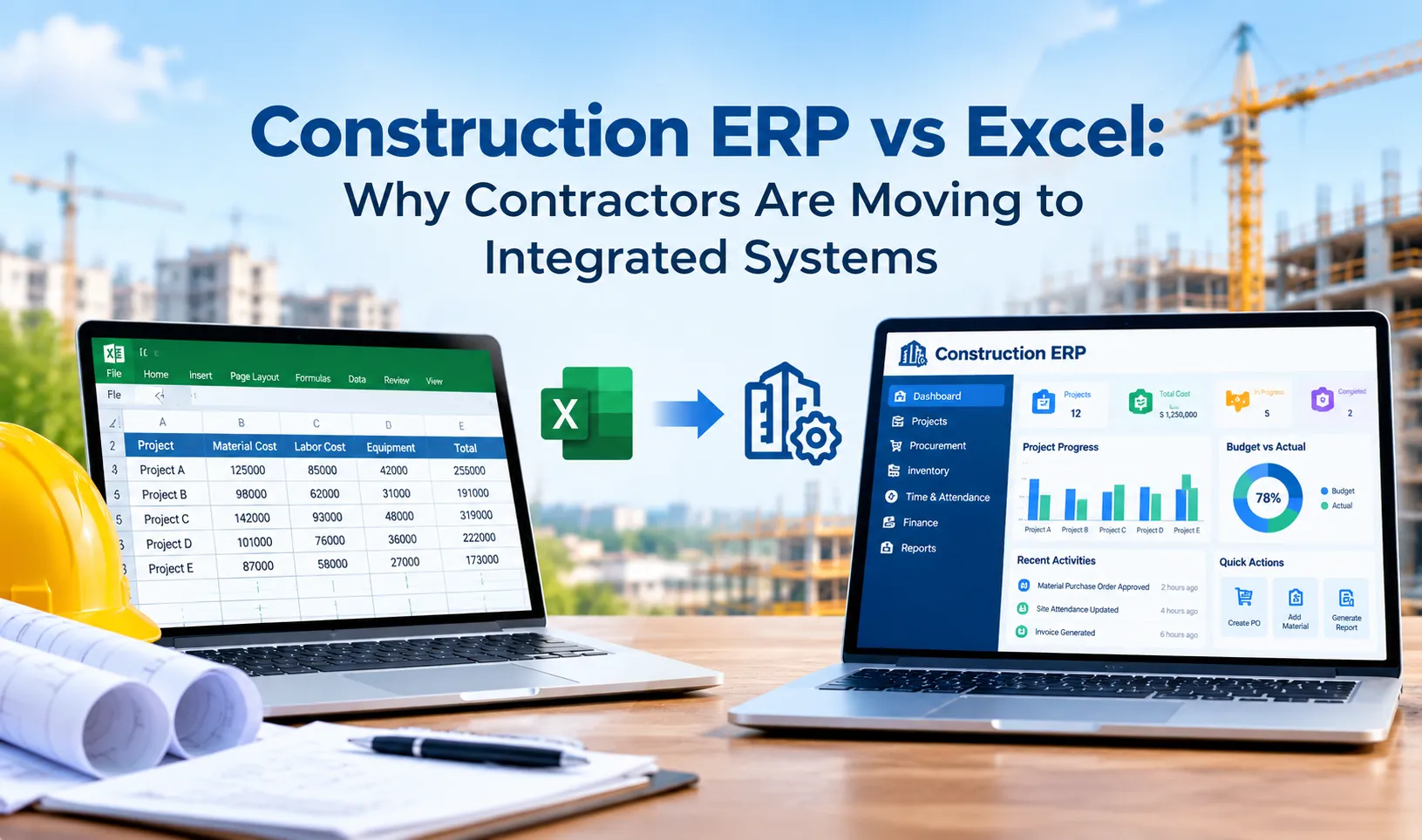
If your company currently uses Excel, accounting software, legacy ERP systems, or multiple databases, moving historical data can require additional work.
Ask whether migration is included in the quotation or billed separately.
Construction companies often have specific workflows for BOQs, approvals, billing, procurement, project costing, or reporting.
Find out which configurations are included and which changes will be charged separately.
A system only delivers value when your team actually uses it.
Ask whether training for project managers, site teams, finance users, procurement teams, and administrators is included.
You may need the ERP to connect with accounting software, payment systems, CRM, document systems, or other business applications.
Integration costs can vary considerably depending on the systems involved.
Always check:
A low initial quotation can become expensive if essential support and integrations are charged separately.
Cloud-based construction software generally reduces the need for businesses to purchase and maintain their own servers and infrastructure.
On-premise systems may involve additional costs for:
For growing construction businesses, cloud deployment can simplify access for teams working across offices and project sites.
However, the right choice should depend on security, compliance, IT requirements, scalability, and total cost of ownership rather than price alone.
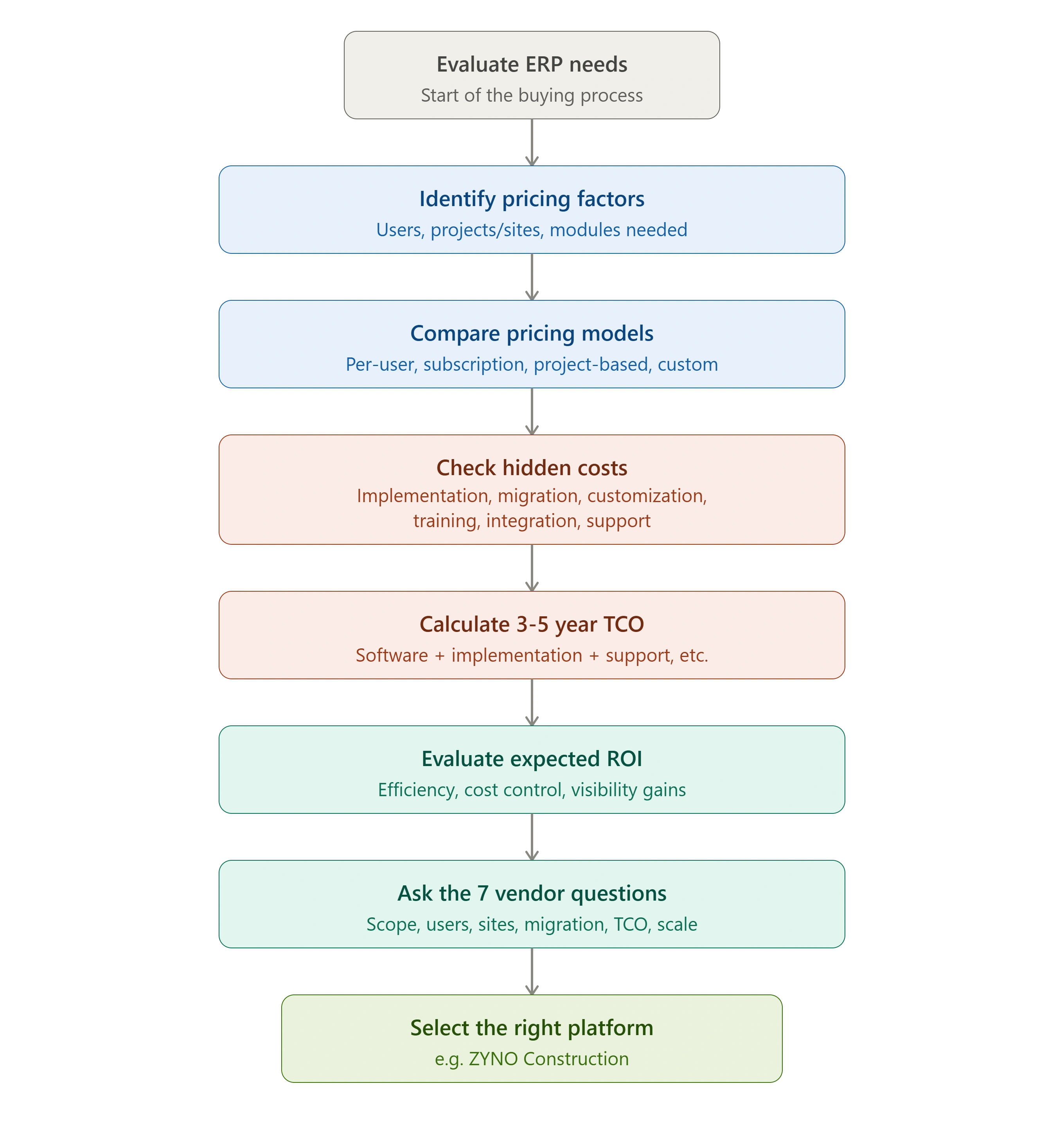
The most useful number is not the first-year subscription price. It is the Total Cost of Ownership (TCO).
A simple calculation is:
TCO = Software + Implementation + Migration + Training + Customization + Integration + Support
For example, if a software subscription appears inexpensive but requires significant customization, data migration, and paid integrations, its actual cost may be much higher.
Several Indian construction ERP software pricing guides also recommend comparing the total cost of ownership rather than focusing only on the headline license or subscription fee.
Instead of asking only, “How much does the software cost?”, ask:
“How much can the software help us save or control?”
Consider areas such as:
For a company managing multiple projects, even small improvements in cost visibility and operational efficiency can have a meaningful financial impact.
Price should be evaluated alongside functionality.
Before selecting a platform, check whether it supports:
The goal is not to find the cheapest software. The goal is to find the platform that provides the right combination of features, scalability, usability, support, and total cost.
For construction businesses looking for a connected digital platform, ZYNO Construction brings key construction workflows together instead of requiring teams to manage separate tools for different processes.
Its capabilities include tendering and estimation, project planning and scheduling, sales management, design management, and budgeting.
This integrated approach can help construction organizations create better visibility across project planning, financial control, procurement, and day-to-day operations.
The benefit is particularly relevant for businesses managing multiple projects where disconnected spreadsheets and applications can make it difficult to maintain a consistent view of project performance.
Before selecting any platform, ask the vendor:
Ask for a complete breakdown of software, implementation, training, support, and integrations.
Understand how the cost changes when your team grows.
This is important for expanding construction businesses.
Clarify what historical data can be migrated and whether there is an additional charge.
Get custom development costs in writing.
Do not evaluate software using only the first-year price.
Your ERP should support additional projects, users, workflows, and business growth without forcing a complete system replacement.
Discover how ZYNO Construction helps businesses streamline project planning, budgeting, procurement, billing, equipment, and financial management through one connected platform.
Construction ERP software pricing in India depends on much more than the subscription or license fee. Users, projects, modules, implementation, customization, integrations, training, and support all influence the final investment.
The smartest approach is to compare vendors using Total Cost of Ownership, functionality, scalability, and expected ROI rather than choosing the cheapest quotation.
For construction companies planning to move from disconnected spreadsheets and systems to a more integrated workflow, ZYNO Construction provides a connected platform covering important areas such as estimation, project planning, budgeting, design management, sales, and construction operations.
If your business is evaluating construction ERP software, start by defining your projects, users, workflows, and must-have modules. Then request a solution and pricing structure based on your actual requirements rather than a generic package.
Explore ZYNO Construction to see how an integrated construction management platform can fit your project and business workflows.
Construction ERP pricing varies according to users, projects, modules, implementation, integrations, and customization. Entry-level cloud solutions can cost significantly less than full enterprise implementations, so businesses should compare total cost of ownership rather than one subscription price.
Depending on the vendor, pricing may include software access, selected modules, hosting, implementation, support, training, and updates. Always request an itemized quotation to identify additional charges.
Cloud software can reduce infrastructure and IT maintenance costs because businesses do not need to manage their own ERP servers. However, the right option depends on business requirements and total cost of ownership.
Common additional costs can include implementation, data migration, customization, integrations, training, premium support, and additional users or projects.
Compare features, implementation requirements, scalability, integrations, support, security, user experience, and three-to-five-year TCO. Do not compare vendors only on their advertised subscription price.
Yes. Small contractors can benefit from cloud-based solutions when they need better project visibility, budgeting, procurement, billing, or document control. The key is choosing a platform that matches their current requirements and can scale as the business grows.
It can help improve financial visibility by connecting project budgets, costs, procurement, billing, and operational information. Better visibility can help management identify issues earlier and make more informed decisions.
ZYNO Construction is designed as an AI-powered construction ERP platform with capabilities covering areas such as tendering and estimation, project planning, sales, design management, and budgeting.
What is Construction ERP Software in India 2026?
Read More →

Construction ERP Software – Features, Benefits & Complete Guide
Read More →
Complete Guide to the Best Construction ERP Software in Dubai, UAE
Read More →
What is Construction ERP Software?
Read More →
AI-Powered Construction ERP Software: Complete Guide to Features, Benefits, and Business Growth
Read More →
How to Choose the Best Construction ERP Software for Your Business
Read More →
Which Construction Software Helps Interior and Fit-Out Contractors Control Vendor Exposure, Invoices, and Cash Flow with Integrated ERP Connections?
Read More →
Construction Inventory Management Software: The Smart Way to Reduce Costs and Prevent Stockouts
Read More →
Best AI Construction ERP Software Comparison: Which Solution Is Right in 2026?
Read More →
Labor Management System: Features, Benefits & Complete Guide for 2026
Read More →
What is Maintenance Management Software? Types, Features & Benefits
Read More →
Construction Project Management Software for Real Estate Companies in Kenya: Complete Guide
Read More →Tender Management Software: Top Tools and How to Choose in 2026
Read More →
Top 5 Inventory Management Software for Enterprises in India
Read More →
Top 10 Best Equipment Management Software for 2026
Read More →
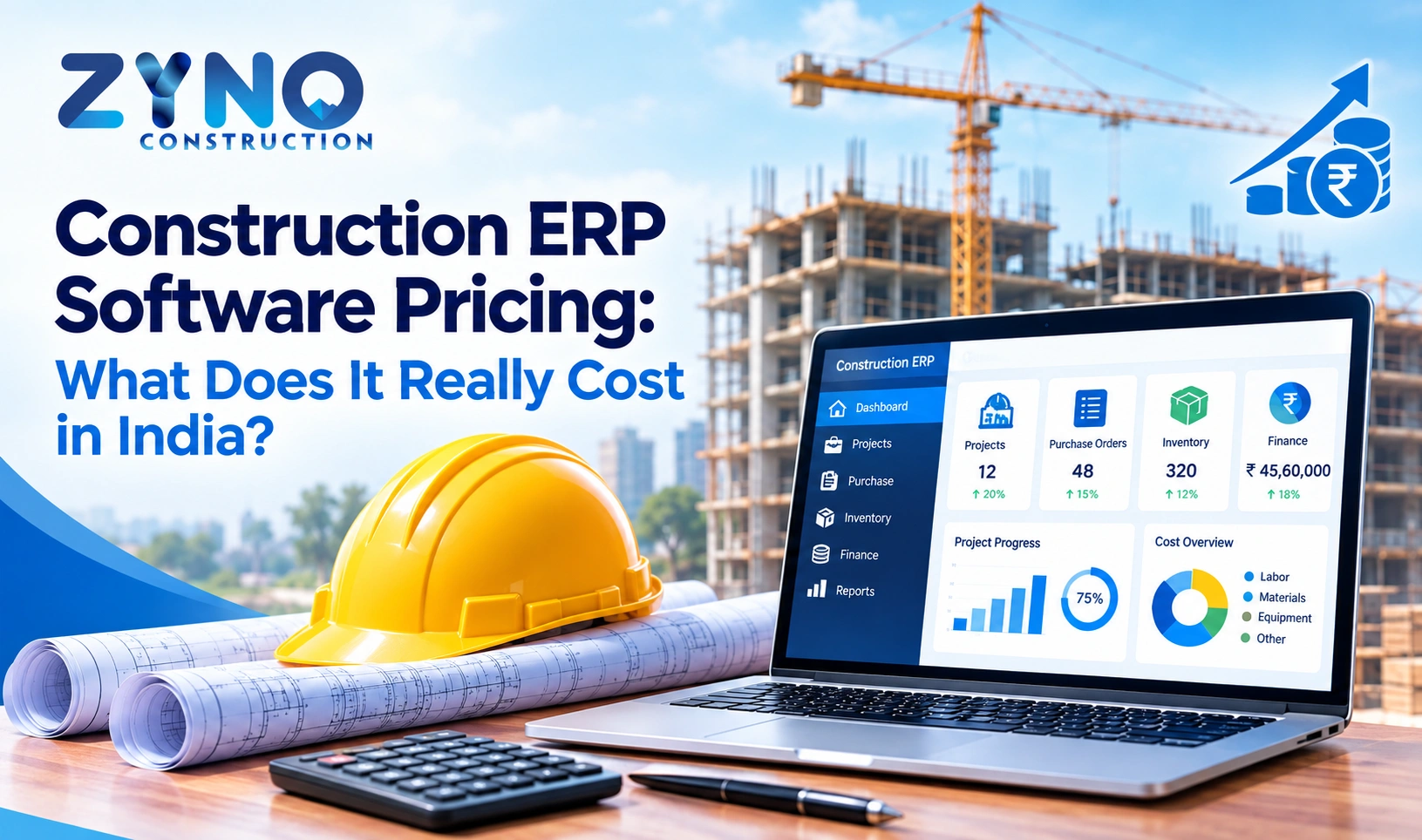
Construction ERP Software Pricing: What Does It Really Cost in India?
Read More →Partner with ZYNO by Elite Mindz to revolutionize how your business works. Fill out the form, and we’ll reach out with AI-powered solutions made just for you.
We use browser cookies to ensure you get the best experience on our website. Learn more
The form was submitted successfully!