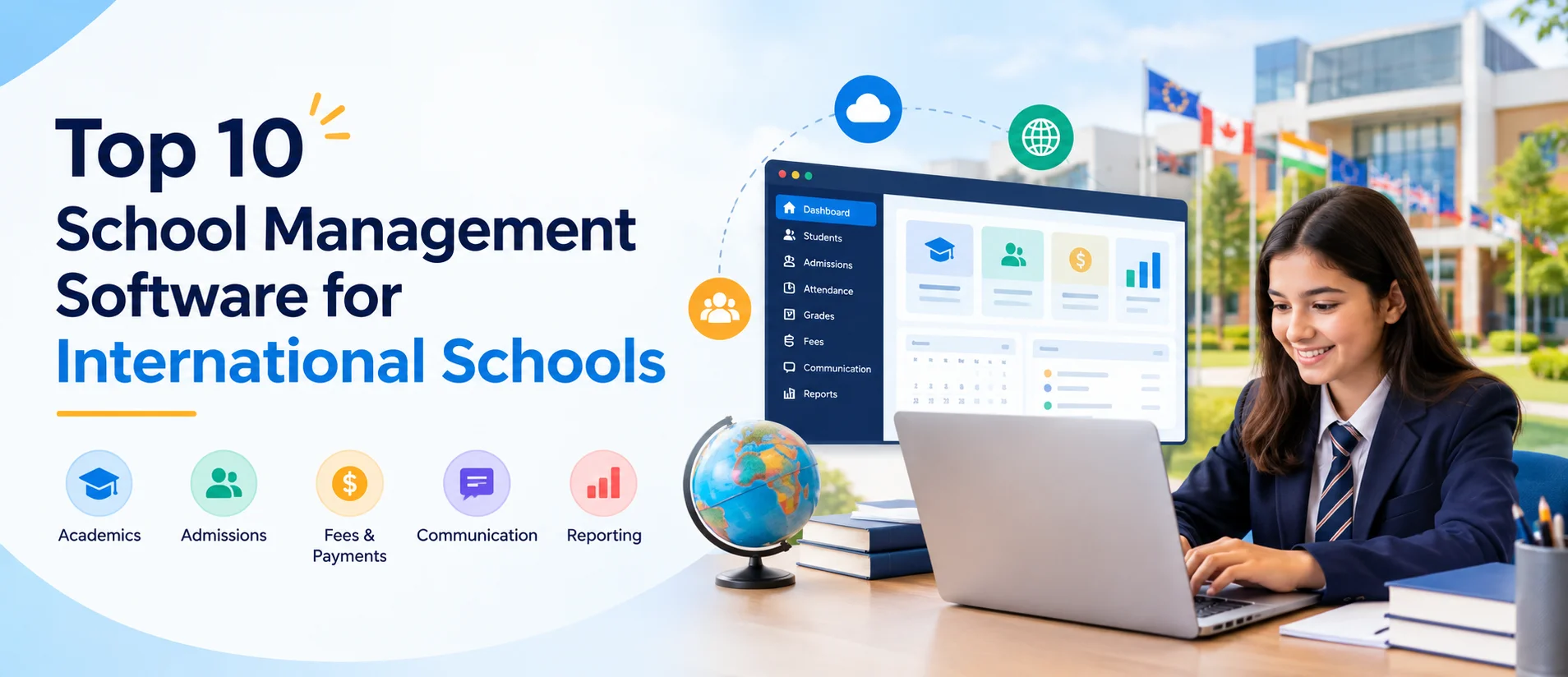
Top 10 School Management Software in India
Read More →

×
Manual registers and scattered spreadsheets are costing your school time and accuracy. See how modern school ERP system brings admissions, fees, attendance, and exams into one system - explore ZYNO EduVibe School ERP today.
Businesses using ZYNO Books cut accounting time by 70% and stay 100% ZATCA-compliant — automatically.
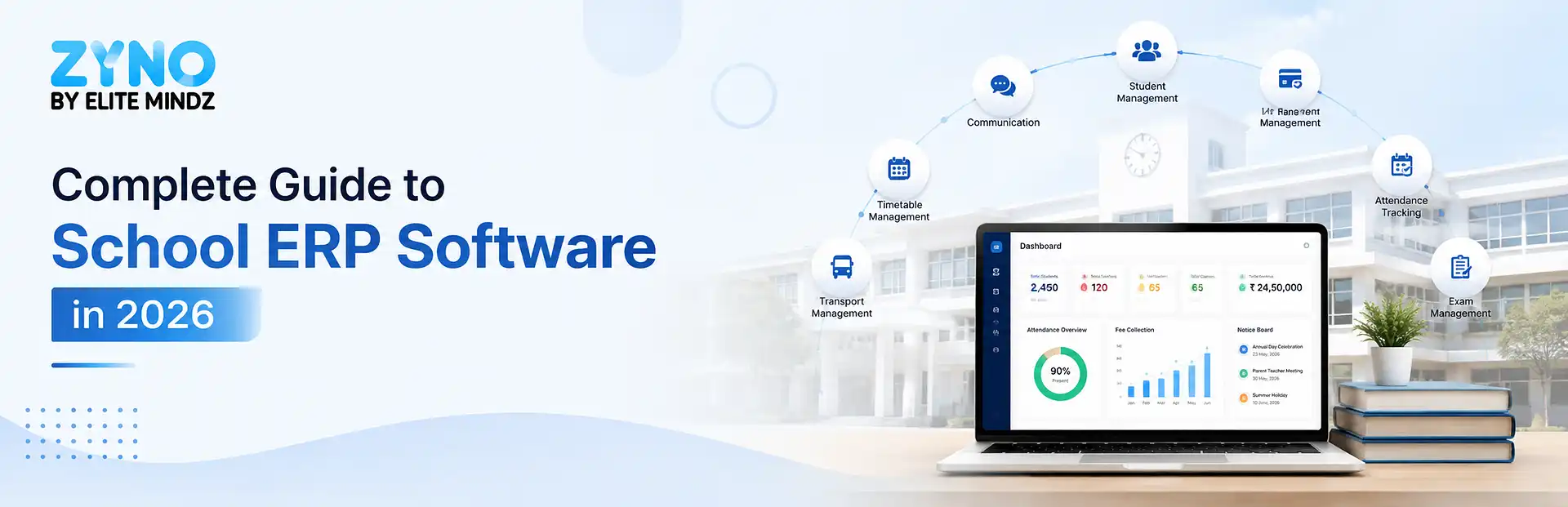
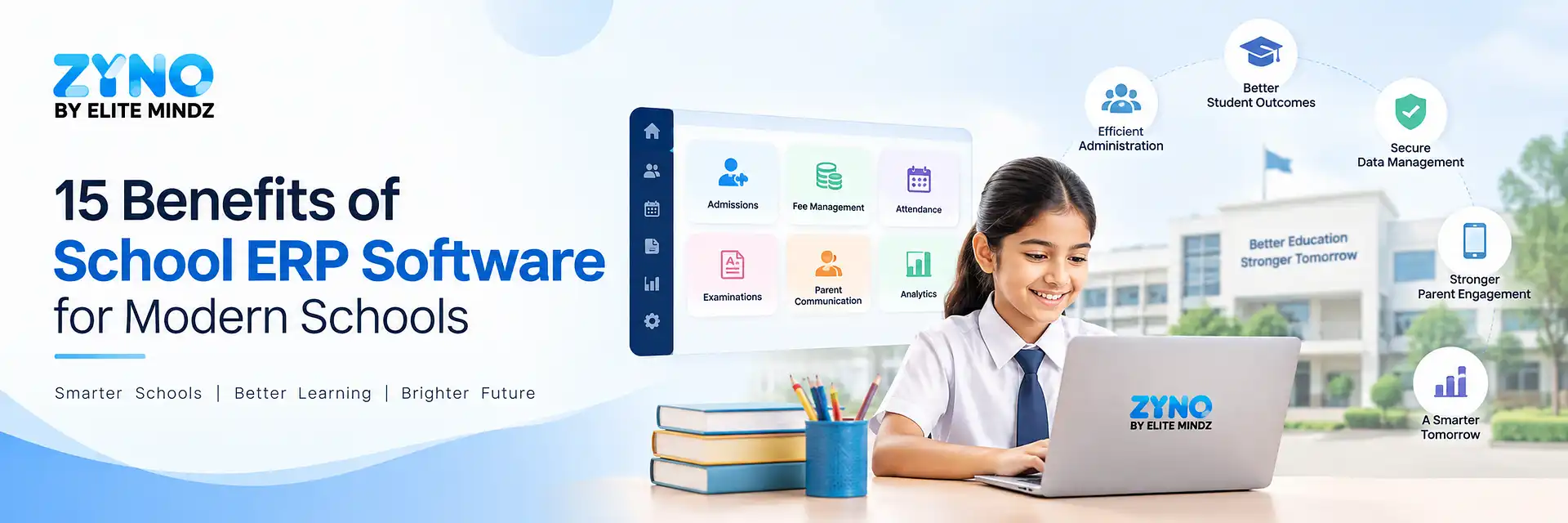
Running a school in 2026 means juggling admissions, fee collection, attendance, exams, transport, payroll, and parent communication - often across five different registers, three spreadsheets, and a WhatsApp group that never stops buzzing. Most administrators know this isn't sustainable. That's exactly the gap school ERP software is built to close: a single digital system that connects every academic and administrative process a school runs, so staff spend less time on paperwork and more time on students.
This guide walks through what a school ERP system actually does, why 2026 is a turning point for adoption, which features matter most, how AI is reshaping the category, and how to choose a system that will still serve your school five years from now.
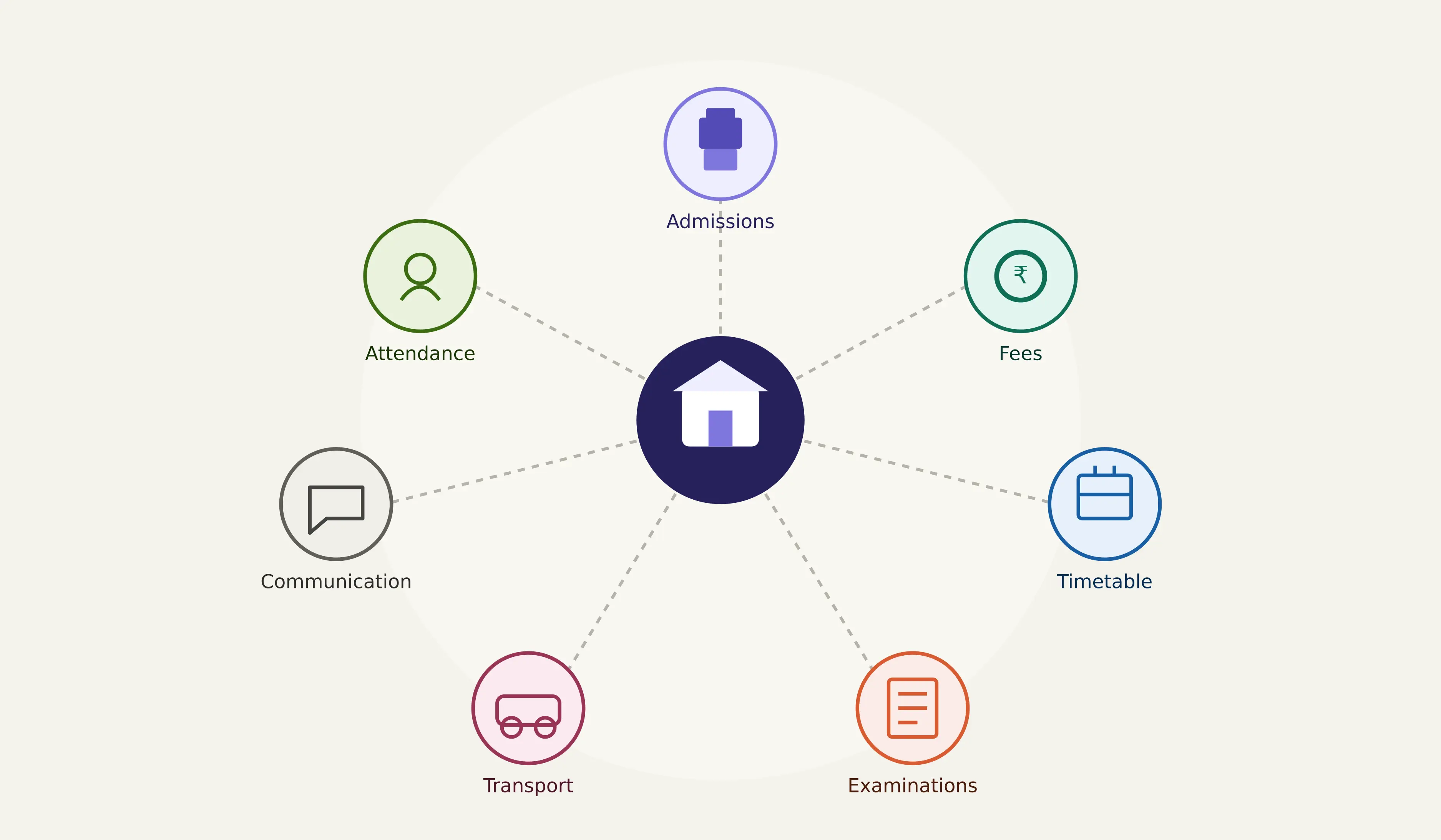
School ERP software is a cloud-based management platform that unifies a school's academic, administrative, and financial operations - admissions, attendance, fees, examinations, timetables, payroll, transport, and communication - into one connected system accessible to staff, parents, and students. Instead of separate registers, spreadsheets, and standalone apps, everything runs through a shared database that updates in real time.
At its core, a school ERP system (sometimes called a school information system or campus management platform) is built around a central database. Every module - admissions, attendance, fees, exams - reads from and writes to that same database. When a teacher marks attendance, the record instantly reflects in the parent app, the admin dashboard, and the attendance report, with no manual re-entry required.
Most modern platforms are delivered as cloud school ERP solutions, meaning schools don't need to install servers or maintain in-house IT infrastructure. Staff log in through a browser or mobile app, and updates roll out automatically.
School ERP systems are used by a wide range of institutions, including:
If your school currently relies on registers, Excel sheets, or disconnected apps for attendance, fees, or communication, that's usually the clearest sign it's time to evaluate a school management software platform.
Schools need school ERP software in 2026 because manual, paper-based, and disconnected digital processes can no longer keep pace with parent expectations, regulatory reporting, and the operational complexity of running a modern institution. Digital learning, hybrid communication, and data-driven administration have become baseline expectations, not add-ons.
Several shifts are driving this:
Parent expectations have changed. Parents who manage banking, shopping, and healthcare from their phones expect the same real-time visibility into their child's attendance, homework, and fee status. A school still sending paper diaries is increasingly seen as behind the curve.
Compliance and reporting have grown heavier. Board affiliations (CBSE, ICSE, state boards) increasingly require structured digital records for audits, inspections, and accreditation renewals. Manual record-keeping makes this process slow and error-prone.
Remote and hybrid access is now standard. Whether it's a teacher checking a timetable from home or a parent approving a transport route change while traveling, administrators need systems accessible beyond the school gate.
Automation reduces avoidable staff burden. Fee reminders, report card generation, and attendance summaries that once took hours of manual work can now run automatically, freeing academic staff to focus on teaching rather than data entry.
Data-driven decision-making is now expected. School leadership increasingly needs dashboards - not just files - to track enrollment trends, fee collection rates, and academic performance across terms.
Institutions that delay digital transformation typically face rising administrative overhead exactly as expectations for transparency and speed increase.
Ready to Digitize Your School?
Streamline admissions, fees, attendance, exams, and parent communication with ZYNO EduVibe School ERP.
Learn More Book Free DemoThe core features of school ERP software span the full academic and administrative lifecycle - admissions, student records, fees, timetables, exams, attendance, communication, HR, transport, and inventory - with each module designed to remove a specific manual bottleneck. Below is a breakdown of what each module handles and why it matters.
Problem: Student records scattered across admission forms, transfer certificates, and Excel sheets are hard to track and easy to lose.
How ERP solves it: A centralized student information management module stores every student's academic history, personal details, health records, and documents in one searchable profile.
Benefit: Staff retrieve complete student records in seconds instead of digging through physical files, and historical data stays intact even as students move between grades or campuses.
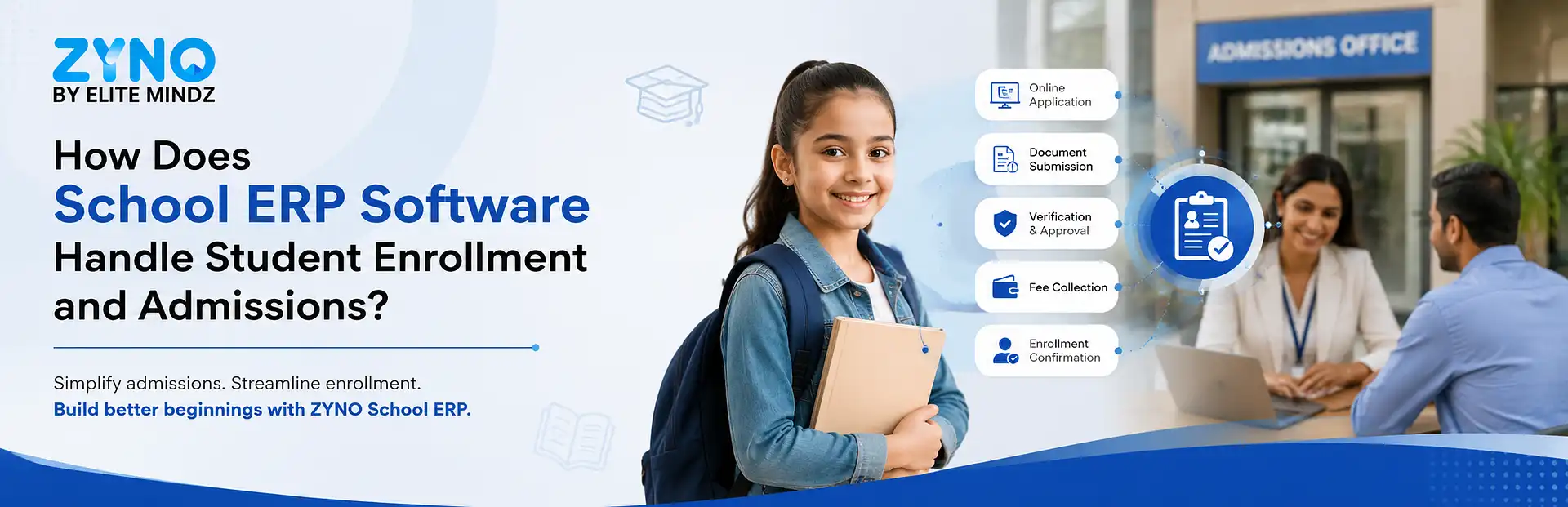
Problem: Manual admission processes involve long queues, paper forms, and duplicate data entry across departments.
How ERP solves it: An admission and enrollment management module lets parents apply online, upload documents digitally, and track application status, while staff manage seat allocation and merit lists from a dashboard.
Real-world example: Schools that digitize admissions typically cut application processing time significantly during peak enrollment season, since data entered at application stage flows directly into the student database without re-typing.
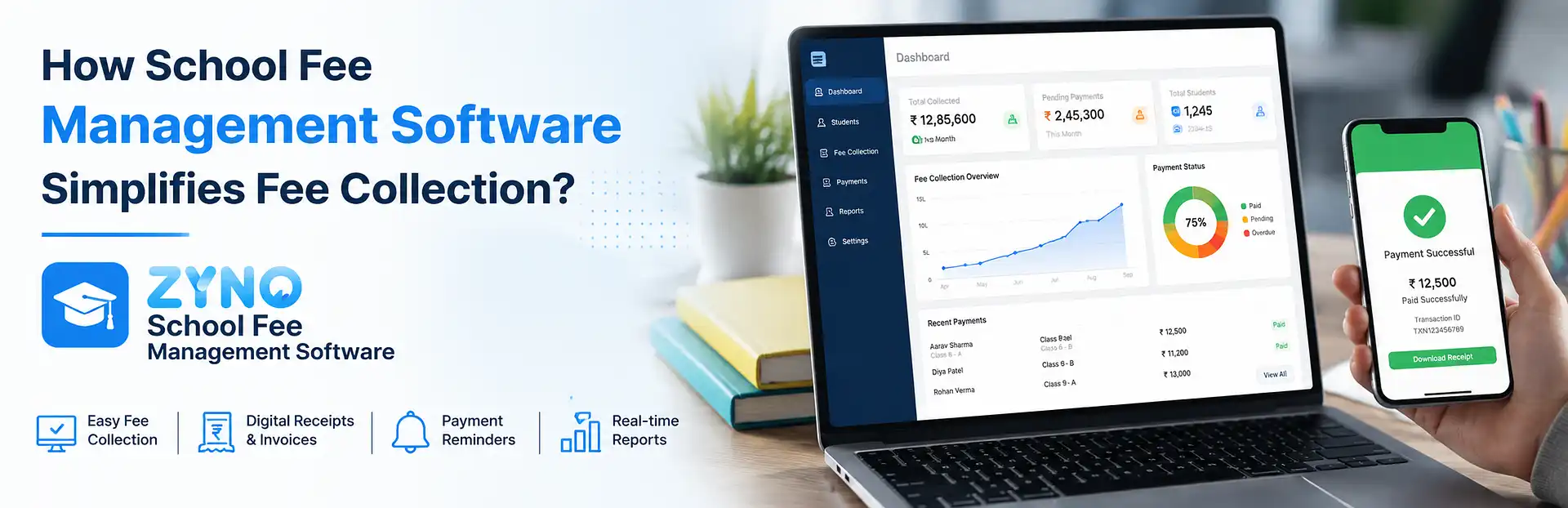
Problem: Manual fee collection means long queues, receipt books, reconciliation errors, and constant follow-up on defaulters.
How ERP solves it: Fee management software automates fee structure setup, online payment collection, receipt generation, and automated reminders for overdue payments.
Benefit: Finance teams get real-time visibility into collection rates, outstanding dues, and payment trends without manually reconciling ledgers at month-end.
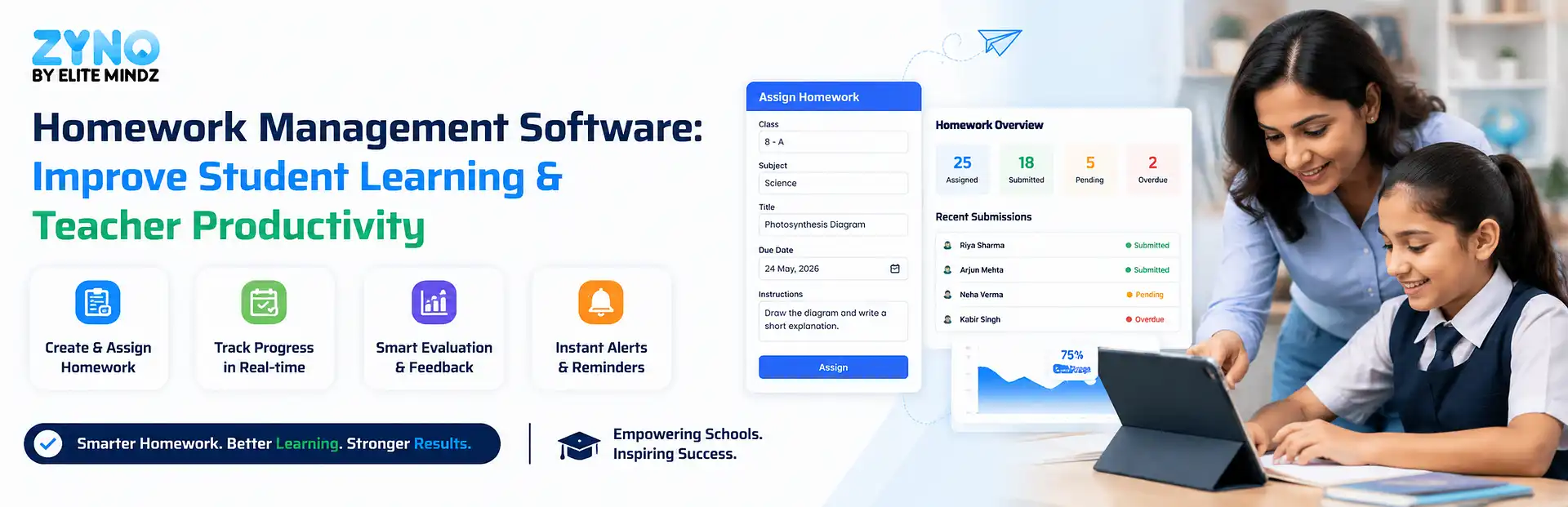
Problem: Homework tracked only in physical diaries is hard for parents to verify and easy for students to lose.
How ERP solves it: Homework and assignment management tools let teachers post assignments digitally, attach resources, and record submissions, with automatic notifications to parents.
Benefit: Parents see exactly what's due and when, reducing the "I forgot" excuse and improving homework completion visibility for teachers.
Problem: Manually calculating grades, formatting report cards, and distributing results is time-consuming and error-prone.
How ERP solves it: Examination and result management software automates mark entry, grade calculation, report card generation, and result publishing.
Benefit: Report cards that once took days to compile can be generated and shared within hours, with built-in checks that reduce calculation errors.
Problem: Manually building timetables around teacher availability, room capacity, and subject requirements is a logistical puzzle, especially when changes happen mid-term.
How ERP solves it: Timetable management tools generate conflict-free schedules and let administrators make real-time adjustments that instantly reflect for staff and students.
Benefit: Substitute teacher assignments and room reallocations happen in minutes instead of requiring a full manual reshuffle.
Problem: Circulars, PTM notices, and individual student updates sent through scattered channels (SMS, WhatsApp, paper notices) are inconsistent and hard to track.
How ERP solves it: A parent-teacher communication module centralizes messaging, circulars, and PTM scheduling in one app with delivery and read tracking.
Benefit: Schools get a documented communication trail and higher message visibility compared to informal channels.
Problem: Parents and staff who can only access information from a desktop portal often check it too late - or not at all.
How ERP solves it: A dedicated school mobile app puts attendance, fees, homework, and notices directly on parents' and teachers' phones.
Benefit: Real-time push notifications mean urgent updates (an early dismissal, a fee deadline) reach parents immediately rather than being missed in an inbox.
Problem: Manual payroll processing for teaching and non-teaching staff is time-consuming and prone to compliance errors around statutory deductions.
How ERP solves it: HR and payroll management software automates salary calculation, attendance-linked pay, leave tracking, and statutory compliance.
Benefit: HR teams process payroll faster with fewer manual errors, and staff get self-service access to payslips and leave balances.
Problem: Coordinating bus routes, driver schedules, and parent anxiety about "where is the bus" is a daily operational headache.
How ERP solves it: Transport management software handles route planning, vehicle tracking, and parent notifications for pickup and drop times.
Benefit: Parents get real-time visibility into bus location, significantly reducing the volume of "where is my child's bus" calls to the front office.
Problem: Data spread across disconnected tools creates duplication, version conflicts, and security gaps.
How ERP solves it: Centralized database management ensures every module draws from a single, secure, backed-up source of truth.
Benefit: Administrators avoid the classic problem of "which spreadsheet is the correct one" and gain confidence that reports reflect current, accurate data.
Problem: Tracking lab equipment, library books, and school assets manually leads to loss, duplication, and unaccounted spending.
How ERP solves it: Inventory and asset management tools log stock levels, assign assets to departments, and flag reorder points automatically.
Benefit: Schools reduce unnecessary repurchase costs and get a clear audit trail for asset accountability.
Problem: Coordinating school events, exam dates, and holidays across departments without a shared calendar leads to scheduling conflicts.
How ERP solves it: Event and calendar management tools give the entire school community - staff, students, and parents - a single, always-updated academic calendar.
Benefit: Fewer scheduling clashes and a single source of truth for "when is that happening."
Problem: Manual roll calls consume valuable class time and are difficult to audit or analyze over a term.
How ERP solves it: Digital attendance capture - via biometric, RFID, or app-based check-in - records attendance in seconds and flags irregular patterns automatically.
Benefit: Teachers reclaim classroom time, and administrators can spot chronic absenteeism trends early enough to intervene.
| Module | Core Function | Primary Beneficiary |
|---|---|---|
| Student Information Management | Centralized student records | Administrators, Teachers |
| Admission & Enrollment | Online applications, seat allocation | Admissions Team, Parents |
| Fee Management | Online payments, dues tracking | Finance Team, Parents |
| Homework & Assignment | Digital assignment tracking | Teachers, Students |
| Examination & Results | Automated grading, report cards | Academic Team, Parents |
| Timetable Management | Conflict-free scheduling | Teachers, Administrators |
| Parent-Teacher Communication | Centralized messaging | Parents, Teachers |
| Transport Management | Route planning, live tracking | Transport Team, Parents |
| HR & Payroll | Salary and compliance automation | HR Team, Staff |
| Inventory & Assets | Stock and asset tracking | Admin Staff |
Looking for the Best School ERP Software?
ZYNO EduVibe helps schools automate admissions, attendance, fee management, examinations, HR, payroll, transport, and parent communication—all from one intelligent platform.
Explore Features Schedule a Free Demo →School ERP software delivers measurable benefits across every stakeholder group - reducing administrative workload, improving financial visibility, strengthening academic tracking, and giving parents real-time access to their child's school life. The value compounds because every module feeds a shared database, so improvements in one area (like faster fee collection) reduce friction elsewhere (like finance reconciliation).
| Module | Core Function | Primary Beneficiary |
|---|---|---|
| Student Information Management | Centralized student records | Administrators, Teachers |
| Admission & Enrollment | Online applications, seat allocation | Admissions Team, Parents |
| Fee Management | Online payments, dues tracking | Finance Team, Parents |
| Homework & Assignment | Digital assignment tracking | Teachers, Students |
| Examination & Results | Automated grading, report cards | Academic Team, Parents |
| Timetable Management | Conflict-free scheduling | Teachers, Administrators |
| Parent-Teacher Communication | Centralized messaging | Parents, Teachers |
| Transport Management | Route planning, live tracking | Transport Team, Parents |
| HR & Payroll | Salary and compliance automation | HR Team, Staff |
| Inventory & Assets | Stock and asset tracking | Admin Staff |
Operationally, schools reduce time spent on repetitive administrative tasks. Financially, automated fee reminders and online payments typically improve on-time collection rates. Academically, digital examination and homework tracking creates a consistent record that supports better student performance conversations. For parents, the shift from paper diaries to a mobile app materially changes how connected they feel to their child's daily school experience.
AI-powered school ERP software applies machine learning and automation to functions that were traditionally manual or purely reactive - attendance verification, performance analysis, communication timing, and administrative reporting - turning routine data into proactive insight. Rather than replacing staff judgment, AI in this context mostly removes repetitive analytical work.
Key areas where AI is changing school ERP systems:
ZYNO EduVibe School ERP is designed with an AI-ready architecture that supports these kinds of intelligent automation as schools adopt them - from automated attendance insights to smart notification prioritization - without requiring schools to overhaul their existing workflows. As with any AI capability in education, results depend on data quality and how consistently a school uses the system, so it's worth evaluating AI features based on documented functionality rather than marketing claims alone.
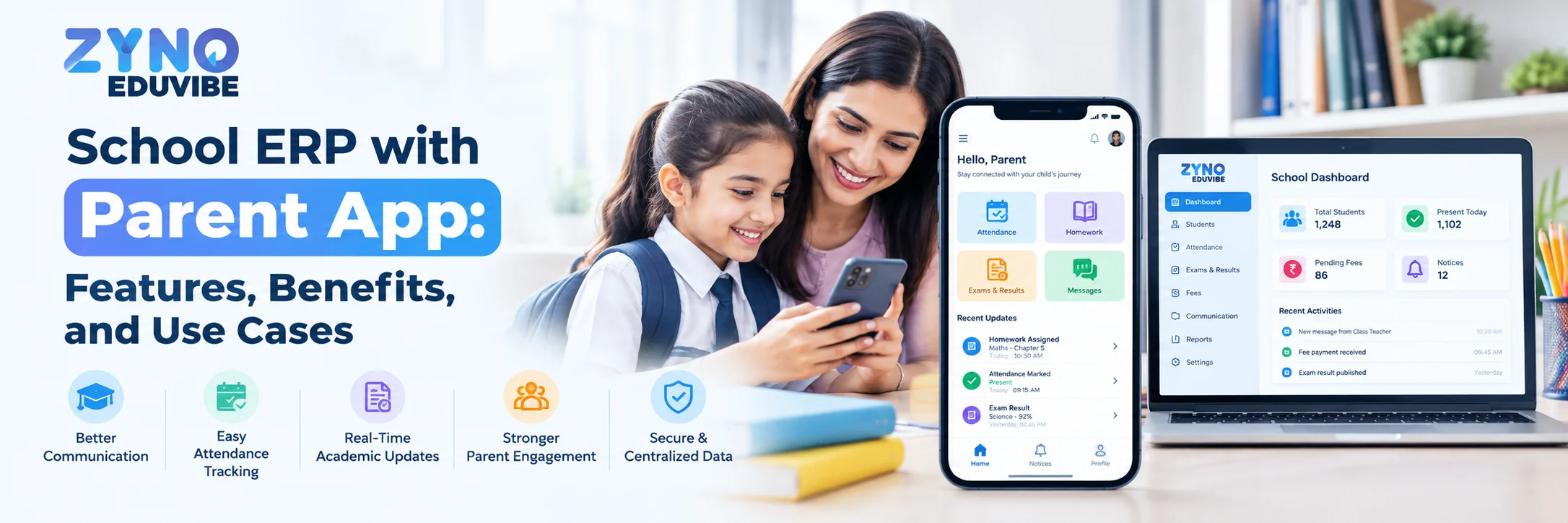
ZYNO EduVibe is a cloud-based school ERP system built by Elite Mindz to unify admissions, fees, academics, communication, and administration into a single AI-ready platform designed for CBSE, ICSE, private, and international schools. The platform is built around a centralized dashboard, role-based access, and mobile accessibility, so different stakeholders - administrators, teachers, and parents - each get a view tailored to what they need.
Key characteristics of the platform include:
The platform is built to serve CBSE schools, ICSE schools, private schools, international schools, and higher-education institutions that need a system flexible enough to match their specific compliance and reporting requirements.
Transform Your School with ZYNO EduVibe School ERP
Simplify admissions, automate fee collection, manage attendance, examinations, HR, payroll, transport, and parent communication—all from one secure cloud-based platform designed for modern schools.
Explore School ERP Book a Free Demo✔ Cloud-Based | ✔ Mobile App | ✔ AI Automation | ✔ CBSE • ICSE • IB • State Board Ready
| School Operation | Without School ERP | With ZYNO EduVibe School ERP |
|---|---|---|
| Student Records | Scattered files and spreadsheets | Centralized cloud-based student database |
| Communication | Phone calls, SMS, paper circulars | Instant notifications through mobile app and portal |
| Exam Management | Manual scheduling and result preparation | Automated exams, grading, and report cards |
| Homework Management | Homework diaries and printed worksheets | Online assignments with submission tracking |
| Transport | Manual route planning and parent inquiries | GPS-enabled tracking and automated route management |
| Compliance | Manual report preparation for boards | One-click compliance reports for CBSE, ICSE, IB, and State Boards |
| Decision Making | Based on delayed or incomplete reports | Real-time analytics and performance dashboards |
Explore the full platform at the ZYNO EduVibe School ERP page for a detailed look at each module.
Traditional school management relies on paper registers, spreadsheets, and manual coordination between departments, while school ERP software centralizes the same functions into one connected digital system with real-time updates. The practical difference shows up most clearly in speed, accuracy, and accessibility.
| School Operation | Without School ERP | With ZYNO EduVibe School ERP |
|---|---|---|
| Student Records | Scattered files and spreadsheets | Centralized cloud-based student database |
| Communication | Phone calls, SMS, paper circulars | Instant notifications through mobile app and portal |
| Exam Management | Manual scheduling and result preparation | Automated exams, grading, and report cards |
| Homework Management | Homework diaries and printed worksheets | Online assignments with submission tracking |
| Transport | Manual route planning and parent inquiries | GPS-enabled tracking and automated route management |
| Compliance | Manual report preparation for boards | One-click compliance reports for CBSE, ICSE, IB, and State Boards |
| Decision Making | Based on delayed or incomplete reports | Real-time analytics and performance dashboards |
The shift isn't just about going digital - it's about removing the re-entry and reconciliation work that manual systems require at every handoff between departments.
Choosing the best school ERP software depends on matching a system's features, security standards, and support model to your school's actual size, curriculum, and growth plans - not simply picking the platform with the longest feature list. A structured evaluation process helps avoid costly mismatches after implementation.
School ERP pricing generally varies based on student count, number of modules required, and whether the school needs custom integrations. Schools should request a clear breakdown of what's included in a base plan versus what counts as an add-on, since module-based pricing can otherwise create unexpected costs during scale-up.
Because school ERP systems store sensitive student and financial data, cloud security should be a non-negotiable evaluation criterion - not an afterthought. Ask vendors directly about data encryption standards, backup frequency, and their incident response process.
The next phase of school ERP software will be shaped by deeper AI integration, predictive analytics, voice-based interfaces, and increasingly connected "smart campus" ecosystems that treat data as a continuous input rather than a term-end report. Schools evaluating systems today should consider not just current features but a vendor's direction of development.
Trends to watch:
Schools that adopt AI-ready platforms now are better positioned to benefit from these capabilities as they mature, rather than facing a disruptive system migration later.
School administration in 2026 runs on data - admissions numbers, fee collection rates, attendance trends, exam results, and constant parent communication. Manual processes and disconnected tools make that data hard to trust and slower to act on. School ERP software solves this by giving every stakeholder - administrators, teachers, parents, and students - real-time access to the information they need, from a single connected system.
Whether your school is evaluating its first digital management system or replacing a platform that's outgrown its usefulness, the right choice comes down to matching features, security, and support to your school's specific needs. Platforms like ZYNO EduVibe School ERP by Elite Mindz are built to bring admissions, fees, academics, and communication together in one AI-ready system designed for CBSE, ICSE, private, and international schools alike - helping schools modernize operations without adding complexity to daily work. You can explore the full feature set on the ZYNO EduVibe School ERP page.
School ERP software is a cloud-based platform that centralizes a school's academic and administrative operations - including admissions, fee collection, attendance, examinations, timetables, and communication - into a single connected system. It replaces manual registers and disconnected spreadsheets with real-time, shared data accessible to administrators, teachers, and parents. Most systems are delivered as cloud-based software, meaning schools don't need in-house servers or dedicated IT infrastructure to run them. The goal is to reduce repetitive administrative work while improving accuracy and accessibility for everyone connected to the school.
School ERP pricing typically depends on the number of students, the modules selected, and whether custom integrations are needed. Some vendors charge a flat annual fee, while others price per student or per module. Because pricing structures vary significantly between vendors, schools should request a detailed breakdown covering setup costs, ongoing subscription fees, and what's included in a base plan versus paid add-ons. It's worth comparing at least two or three vendors' pricing models directly, since a system that looks cheaper upfront may cost more once necessary modules are added separately.
There's no single "best" school ERP software for every institution - the right choice depends on a school's size, curriculum board, budget, and specific administrative needs. Schools should evaluate platforms based on feature coverage (admissions, fees, exams, communication), security standards, ease of use, customer support quality, and how well the vendor understands Indian curriculum and compliance requirements. Requesting a demo using your school's actual data structure - rather than a generic walkthrough - is the most reliable way to judge fit. Platforms like ZYNO EduVibe are built specifically with CBSE and ICSE school requirements in mind.
Yes. School ERP systems are widely used by CBSE schools to manage board-mandated reporting, structured academic records, examination workflows, and compliance documentation. A good ERP system should support the specific grading and reporting formats CBSE schools require, along with attendance and academic record-keeping that aligns with board audit expectations. When evaluating a system for a CBSE school specifically, confirm that report card formats, grading structures, and compliance reports can be configured to match board requirements rather than needing manual workarounds.
Implementation timelines vary based on school size, the number of modules being deployed, and how much historical data needs to be migrated. Smaller single-campus schools with straightforward data migration can often go live within a few weeks, while larger schools or multi-campus groups migrating years of historical records may take longer. A structured implementation typically includes data migration, staff training, a pilot phase with one or two modules, and a full rollout. Schools should ask vendors for a realistic implementation timeline based on their specific student count and data complexity, rather than a generic estimate.
Reputable cloud-based school ERP platforms use data encryption, role-based access controls, and regular automated backups to protect student and financial data - generally offering stronger security than paper records or unmanaged local spreadsheets. That said, security standards vary between vendors, so schools should directly ask about encryption practices, backup frequency, data center standards, and incident response procedures before choosing a platform. Role-based access is particularly important, ensuring staff only see the data relevant to their function rather than having open access to the entire student database.
Most modern school ERP platforms are designed to integrate with commonly used tools like payment gateways, SMS/communication services, and in some cases existing learning management systems. However, integration capability varies by vendor and by the specific systems a school already uses. Before choosing a platform, schools should confirm which integrations are natively supported versus which would require custom development. This is especially important for schools that have already invested in a separate learning management system or accounting software and want to avoid duplicating data entry across platforms.
School ERP Software: Complete Guide | School ERP for Attendance, Fees, and Examination Management | Admission Management Software Guide | Can School ERP Software Reduce Manual Work in Schools?
Ready to Modernize Your School Operations?
Join schools using ZYNO EduVibe School ERP to simplify administration, improve parent engagement, and enhance academic efficiency.
View School ERP Get a Free Consultation →Top 10 School Management Software in India
Read More →What Is School ERP Software? The Complete Guide for Modern Schools
Read More →
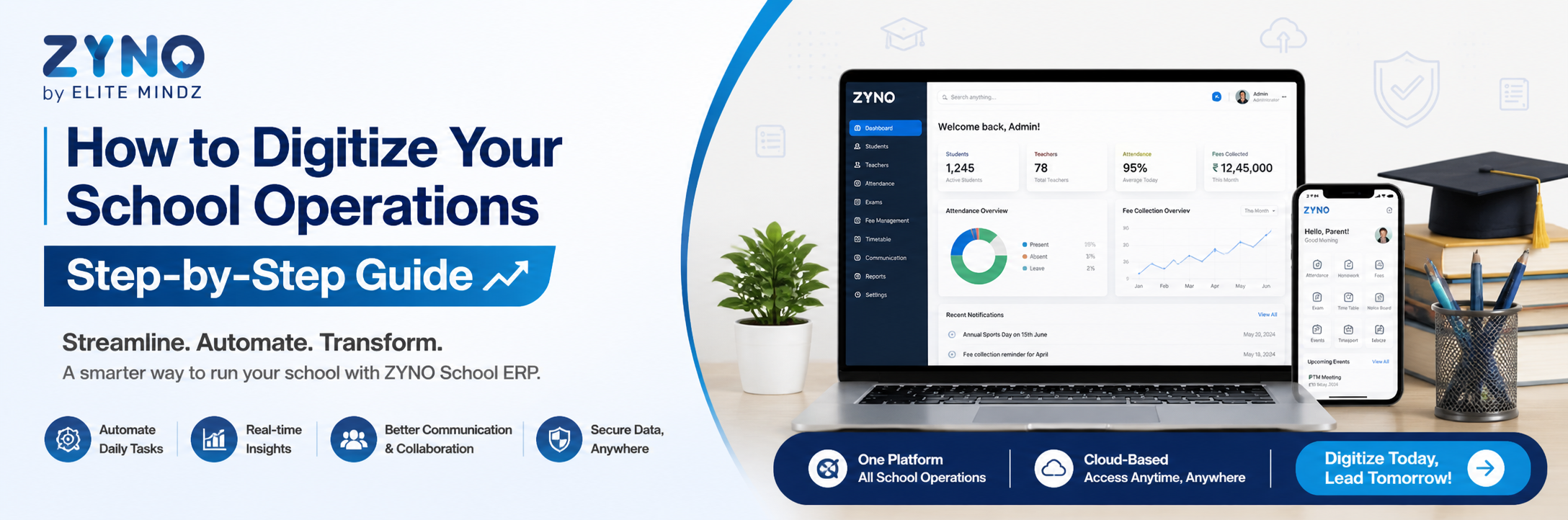
How to Digitize Your School Operations Step-by-Step Guide
Read More →
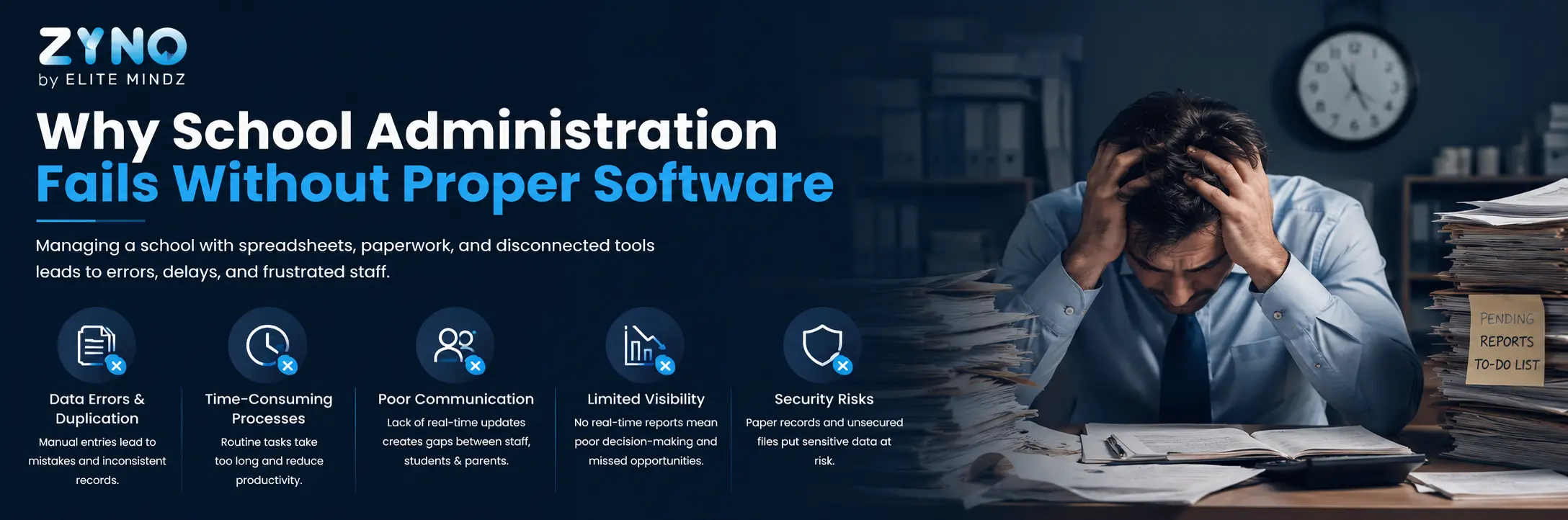
Why School Administration Fails Without Proper Software
Read More →
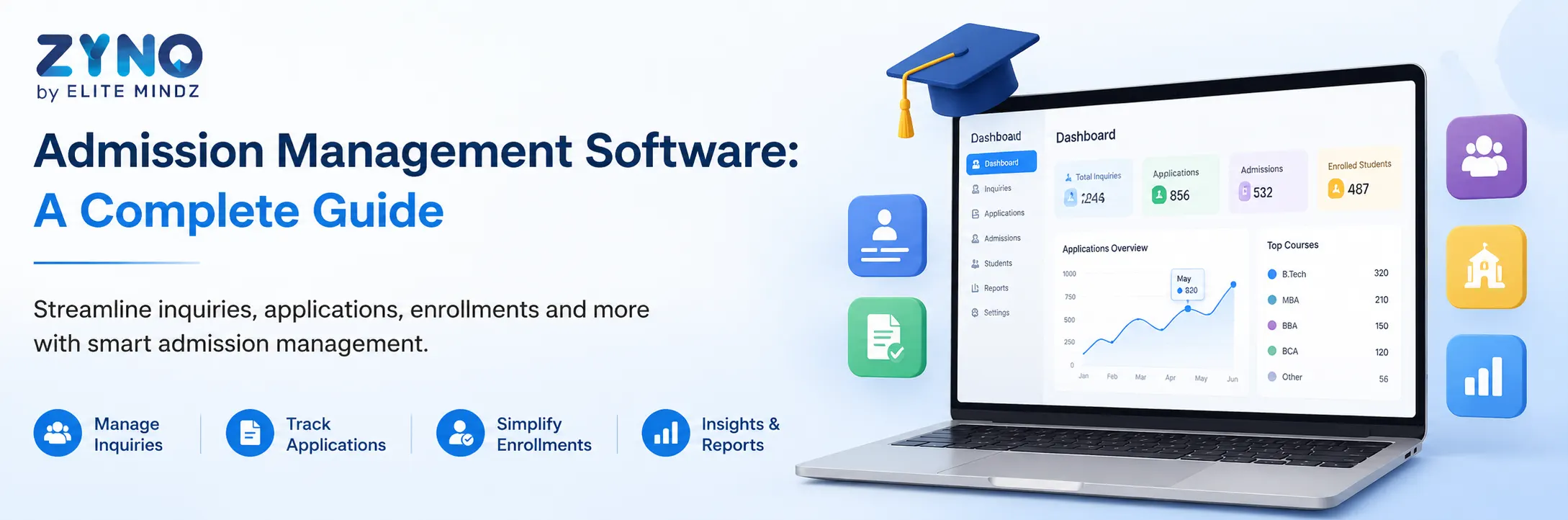
Admission Management Software: A Complete Guide
Read More →
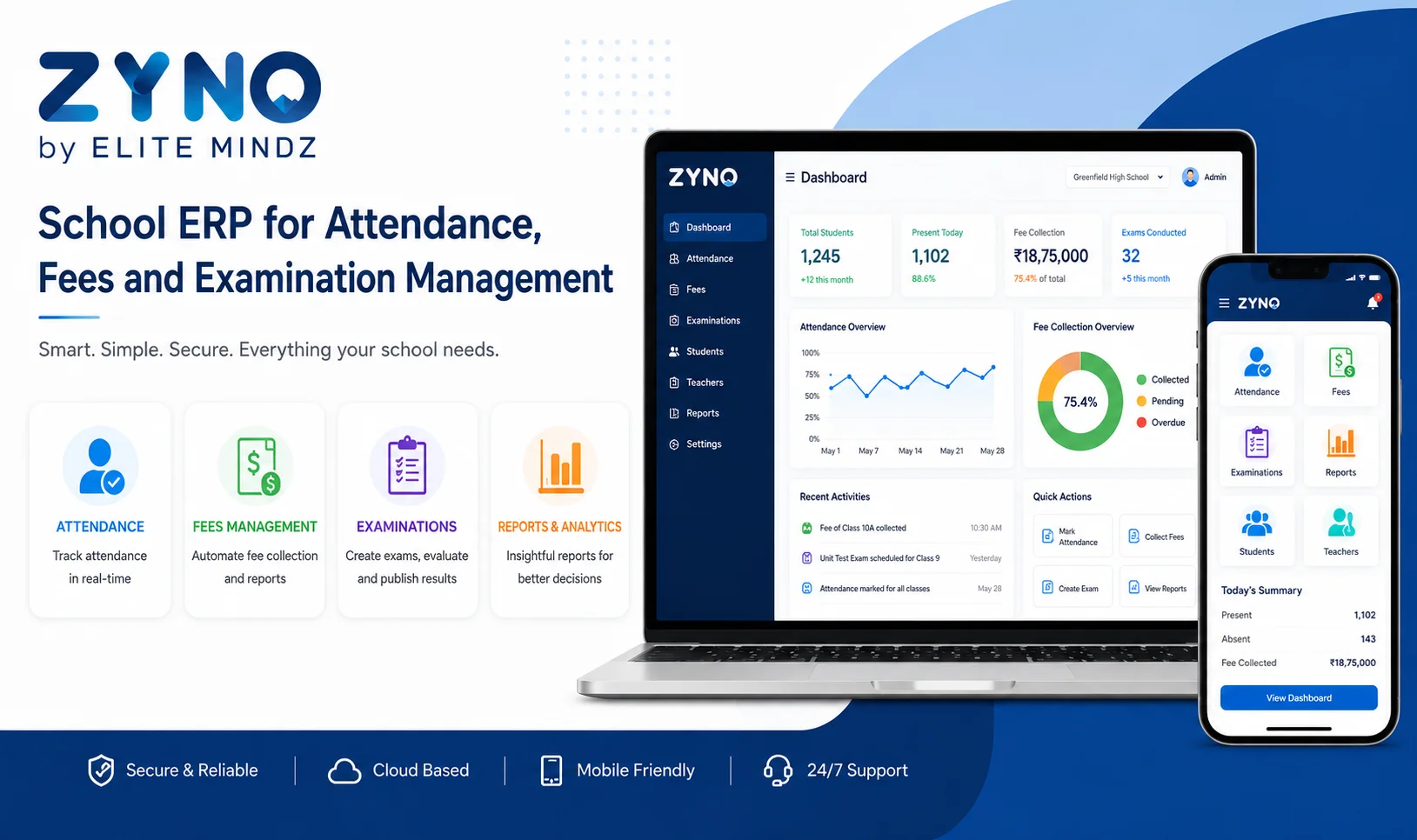
School ERP for Attendance, Fees, and Examination Management
Read More →
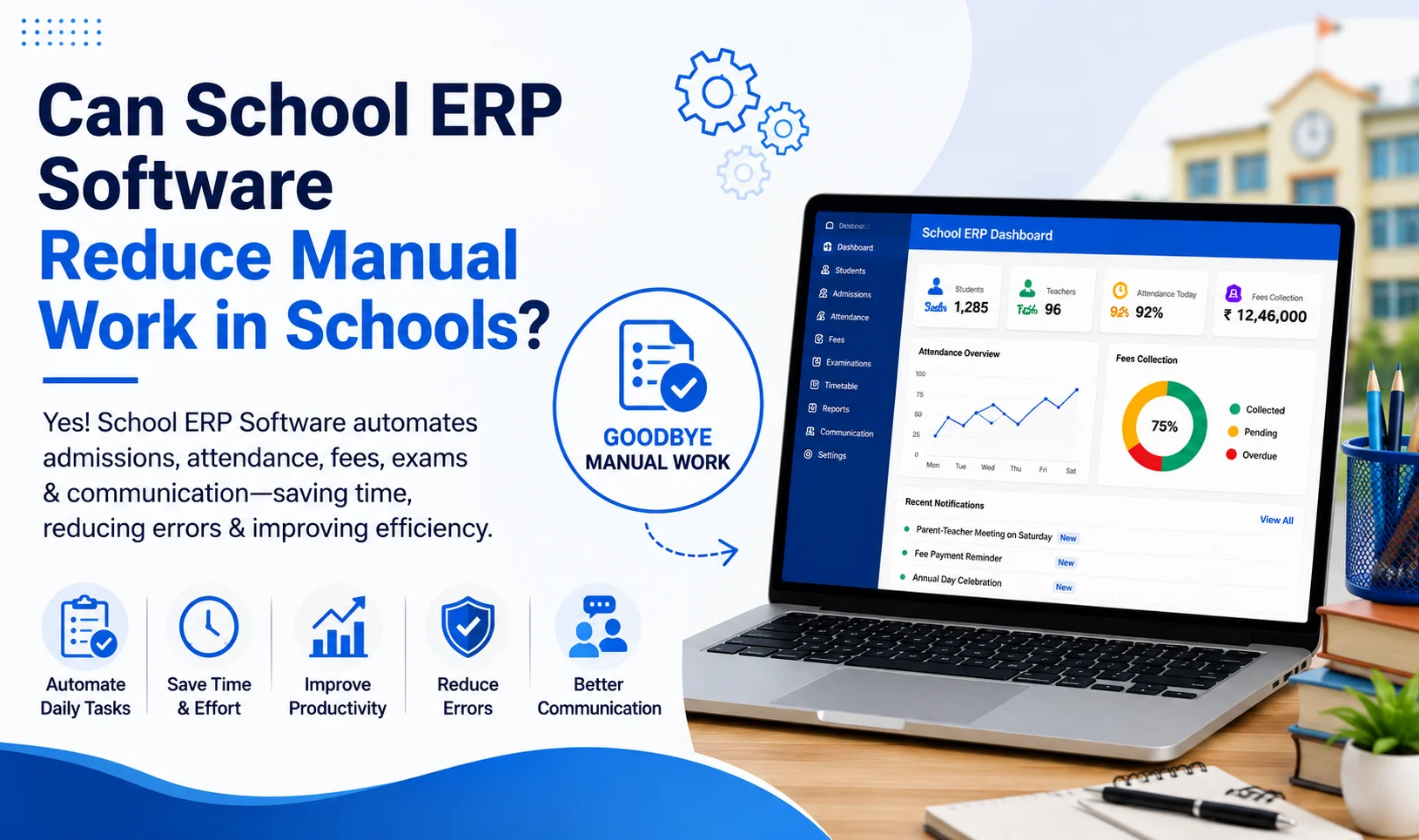
Can School ERP Software Reduce Manual Work in Schools?
Read More →
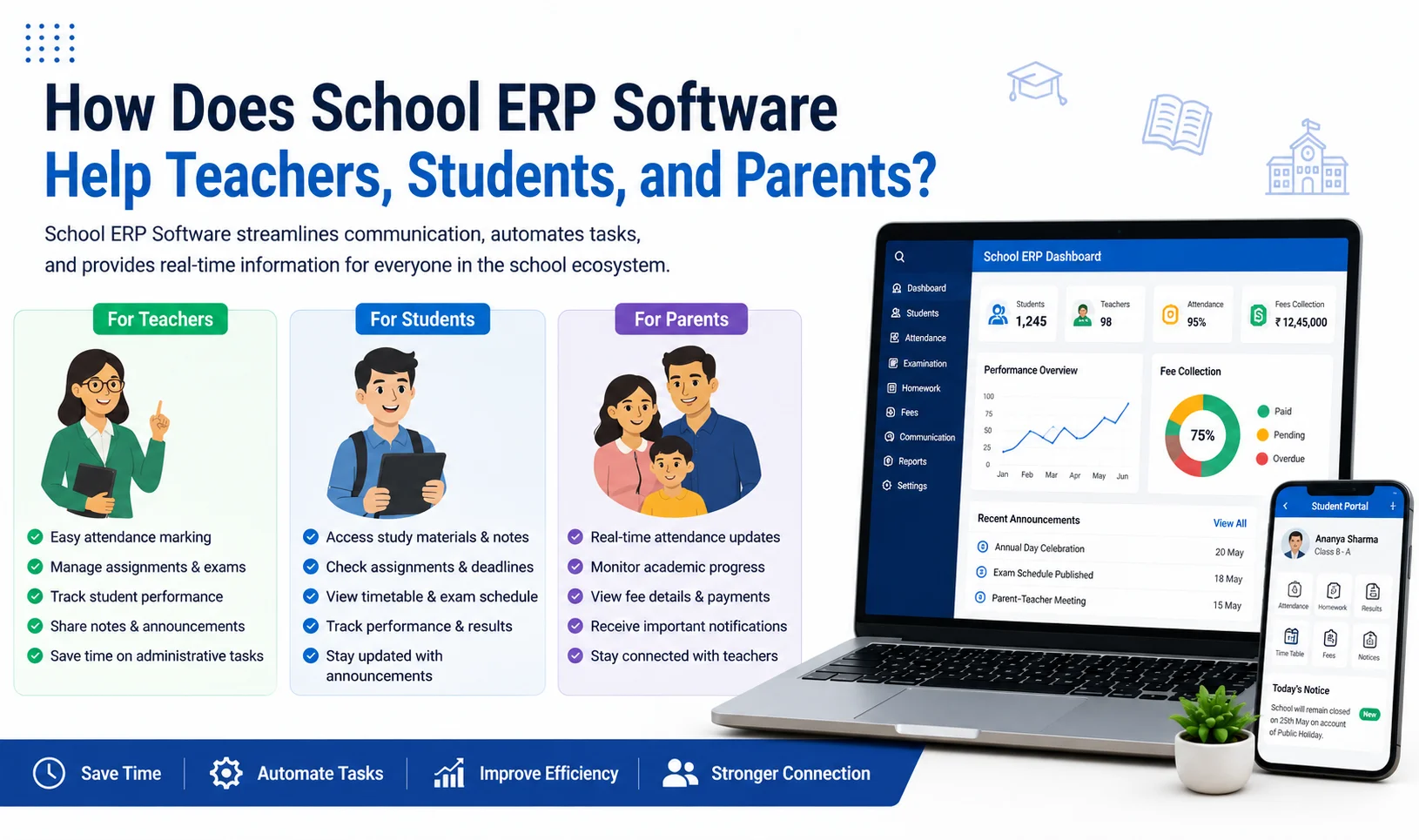
How Does School ERP Software Help Teachers, Students, and Parents?
Read More →
Japan's GIGA School Program and the Rise of Digital School Management
Read More →
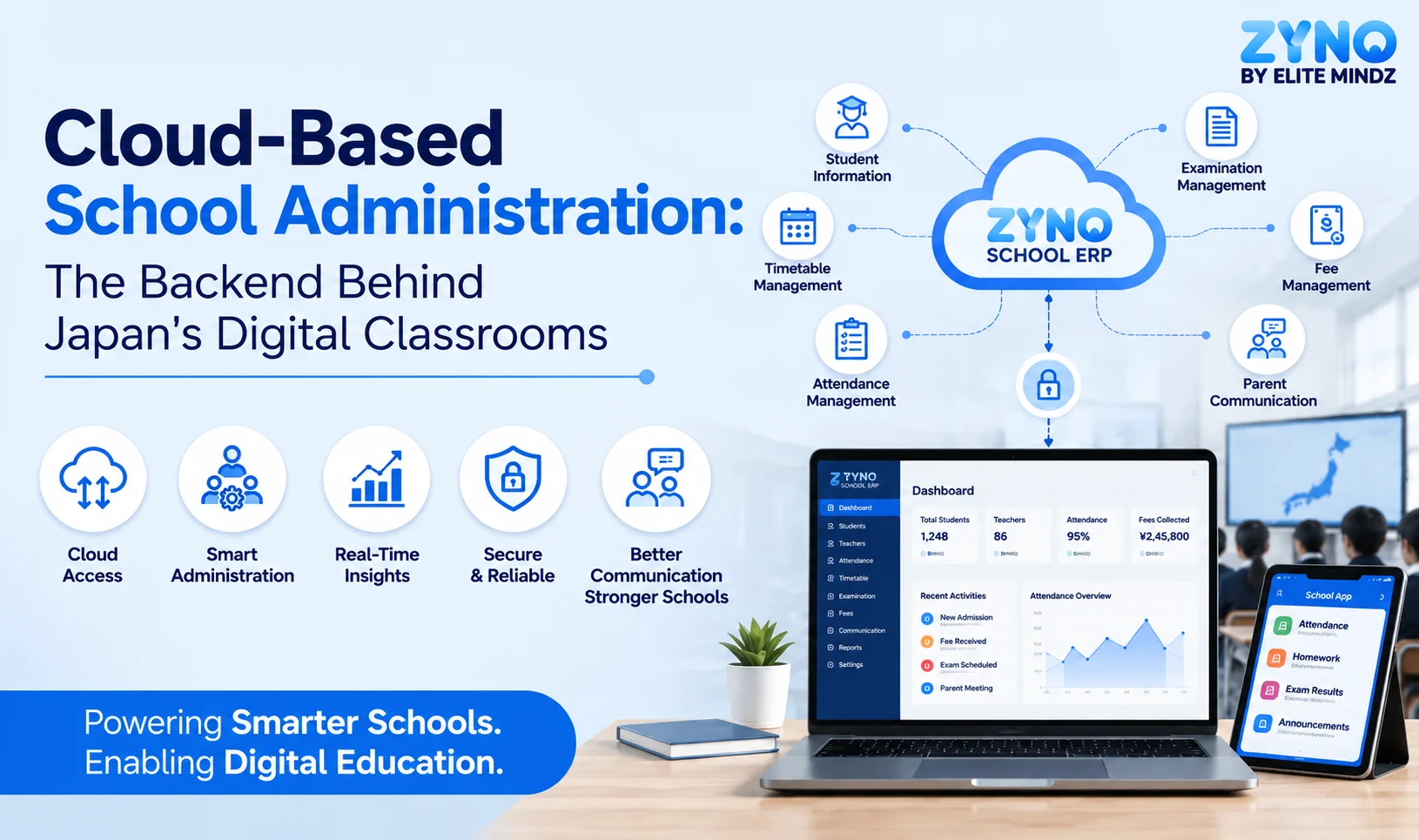
Cloud-Based School Administration: The Backend Behind Japan's Digital Classrooms
Read More →
Ultimate Guide to School ERP Systems in 2026
Read More →Partner with ZYNO by Elite Mindz to revolutionize how your business works. Fill out the form, and we’ll reach out with AI-powered solutions made just for you.
Download your exclusive guide
We use browser cookies to ensure you get the best experience on our website. Learn more
The form was submitted successfully!