Top 10 School Management Software in India
Read More →

×
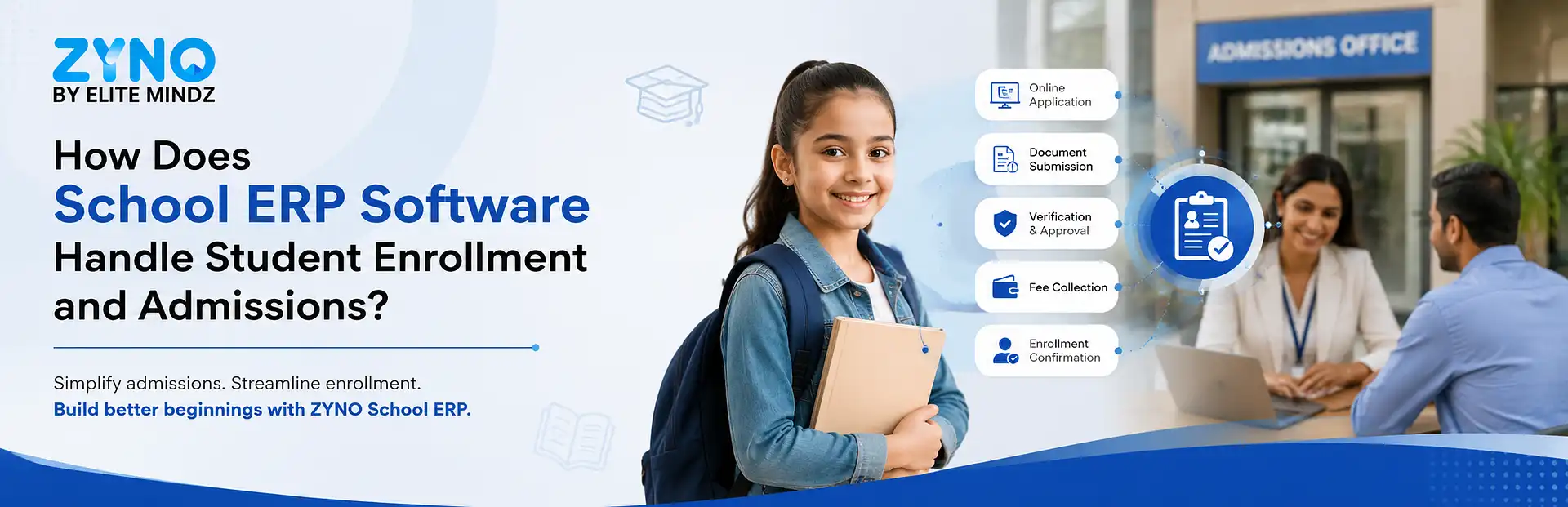
In this guide, we’ll explain how school ERP software manages the complete student admission and enrollment process, from handling enquiries and applications to RTE quotas, document verification, and final enrollment. We’ll walk through each step and show how automation can reduce manual work, admission delays, and data errors, while also highlighting what schools should check before choosing an ERP for the next admission season.
Businesses using ZYNO Books cut accounting time by 70% and stay 100% ZATCA-compliant — automatically.
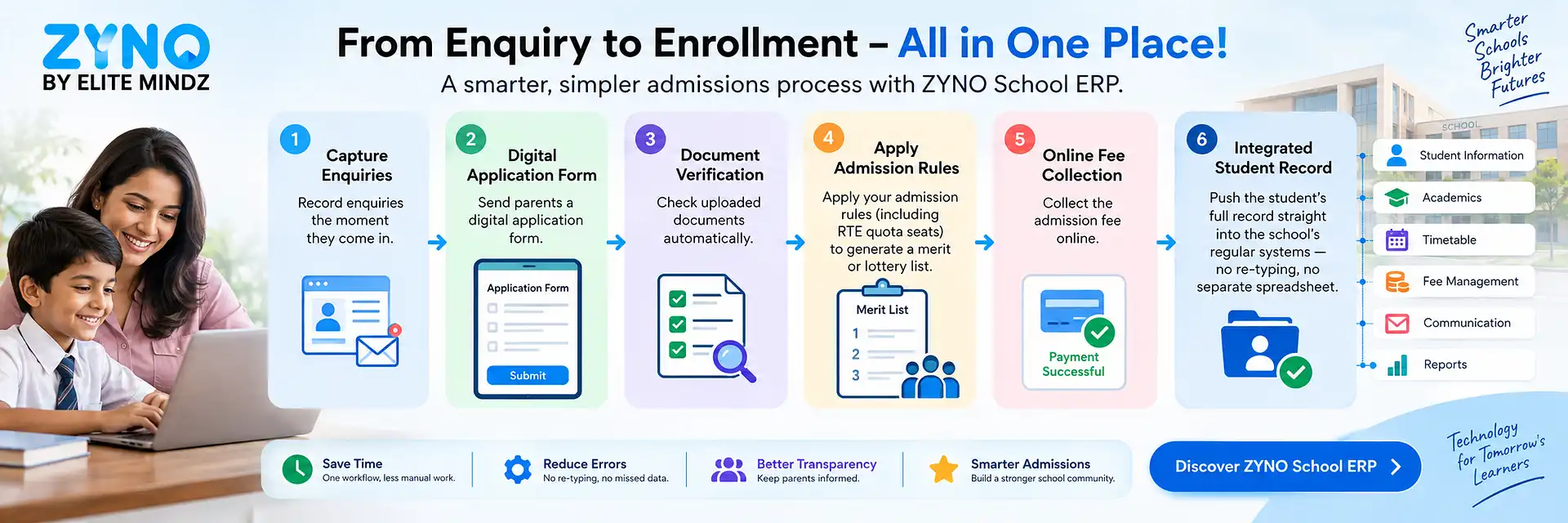
A school ERP handles admissions by moving every applicant through one connected pipeline instead of scattered paper files: it captures enquiries the moment they come in, sends parents a digital application form, checks uploaded documents automatically, applies your admission rules (including RTE quota seats) to generate a merit or lottery list, collects the admission fee online, and then pushes the student's full record straight into the school's regular systems — no re-typing, no separate spreadsheet. The whole thing runs as one workflow rather than five disconnected tasks that someone has to manually stitch together.
Anyone who's worked a front desk during admission season knows the pattern. A parent calls, someone jots the enquiry on a sticky note or a random Excel row, and three days later nobody remembers to follow up. A different parent walks in with photocopies, half of which turn out to be the wrong document, and there's no way to know that until they've already gone home. Meanwhile the merit list is being built by hand in a spreadsheet that one person understands, and if that person is out sick during the busiest week of the year, everything stalls.
None of this happens because staff aren't capable. It happens because admissions genuinely involve a lot of moving parts — enquiries, documents, eligibility rules, payments, and finally getting a confirmed student's data into the rest of the school's systems — and paper or spreadsheets were never built to hold all of that together at once.
Whether a parent fills out a form on the school website, messages on WhatsApp, or just walks in, the enquiry gets logged into a single dashboard the moment it arrives, timestamped and assigned to whoever's handling follow-ups that week. Nothing sits in someone's inbox waiting to be remembered.
Once an enquiry turns into an application, the parent gets a digital form they can fill out from a phone, at whatever hour suits them. They upload the required documents in the same session, so the school isn't chasing a birth certificate three weeks later.
This is where a lot of the manual pain used to live. Instead of a staff member flipping through a folder to see if everything's there, the system checks the uploads against the required list and flags anything missing right away. If a document's wrong or blurry, the parent finds out the same day, not at the interview stage.
This is the part that generic "admissions software" articles tend to skip past, and it's genuinely one of the more complicated pieces for Indian schools specifically. Under Section 12(1)(c) of the Right to Education Act, 2009, every private unaided school has to reserve 25% of its entry-level seats — typically Class 1 or pre-primary — for children from economically weaker and disadvantaged sections. In April 2026, the Supreme Court ruled directly on how strictly this has to be followed: once a state allots a child to a school under this quota, the school can't delay the admission, refuse it, or invent extra conditions to get around it. A school ERP that's actually built for the Indian context keeps RTE seats as a distinct category from the start — tracked separately, reserved automatically, and matched against whatever lottery or allotment list the state education department issues, so it isn't something a front-office team has to manually reconcile against 25% of total capacity by hand every year.
For the general (non-RTE) seats, the school sets its own rules — age cutoffs, sibling priority, staff-ward quotas, catchment area, whatever applies — and the system ranks applicants and generates the list without someone building it in a spreadsheet at 11pm the night before results go out. Waitlists get handled the same way: if an admitted seat is declined or a family doesn't respond within the window, the next name on the list moves up automatically instead of a staff member having to notice the no-show and manually escalate.
Acknowledgements, document reminders, interview slots, results, offer letters — all of it goes out through SMS, email, or WhatsApp the moment there's something to say. This is also where a connected parent-teacher communication layer earns its keep — the same channel a parent used during admissions is the one they'll keep getting updates through once their child is actually enrolled, rather than switching to a completely different system.
As soon as an offer is accepted, the parent pays the admission fee online, and that payment reconciles automatically against the school's records. Nobody's cross-checking a bank statement against a stack of receipts to figure out who's actually paid and who hasn't.
This is really the whole point of doing admissions inside an ERP instead of a standalone tool. Once enrollment is confirmed, the same data that was collected during the application — name, documents, contact details, class assigned — flows directly into the school's ongoing student records, without anyone retyping it. A student's file doesn't get "created twice" the way it does when admissions and student records live in separate systems that don't talk to each other.
Admission forms collect some of the most sensitive information a school will ever hold on a child — income certificates, caste certificates, health details, sometimes disability documentation for quota eligibility. Under India's Digital Personal Data Protection Act, 2023, schools processing this kind of data are treated as Data Fiduciaries, and children's data specifically requires verifiable parental consent before it's processed at all. That consent step matters just as much during a five-minute online admission form as it does anywhere else in a school's systems. If a platform doesn't have a real answer for how consent is captured and how long that documentation is retained, that's worth pausing on before you commit to it for admission season.
| Task | Doing It by Hand | Running It Through an ERP |
|---|---|---|
| Enquiry tracking | Sticky notes, missed follow-ups | Logged and assigned automatically, nothing falls through |
| Application collection | Paper forms, in-person visits | Online forms, submitted from any device |
| Document verification | Staff manually check each file | Checked against a required list, gaps flagged immediately |
| RTE quota seats | Manually reserved and cross-checked | Tracked as a separate category, matched to state allotment lists |
| Merit list / seat allocation | Built in a spreadsheet, error-prone | Generated against defined rules, waitlists auto-advance |
| Parent updates | Phone calls, missed messages | Automated SMS/email/WhatsApp at every stage |
| Fee collection | Cash or cheque, manual reconciliation | Online payment, reconciled automatically |
| Student record handoff | Re-typed into a separate system | Flows directly into existing student records |
It runs the whole process as one connected pipeline — capturing enquiries, collecting applications and documents online, applying admission rules including RTE quota seats, generating merit and waitlists, collecting fees, and pushing the confirmed student's data directly into the school's regular records.
A properly built one does — reserving the mandated 25% of entry-level seats as a separate category and matching applicants against state-issued allotment or lottery lists, rather than requiring a staff member to calculate and track the quota by hand.
Schools processing a minor's personal data — including income, caste, or health documents submitted for admission — need verifiable parental consent before that data is processed, and that consent trail should be documented by whatever system is collecting it.
Yes, in a properly integrated system — the application, document upload, and fee payment all happen digitally, and the payment reconciles automatically against the school's records once a seat is confirmed.
No, not in a genuinely integrated school ERP — the data collected during application becomes the student's actual ongoing record rather than a separate file that gets copied into another system later.
No — even a school processing a few hundred applications a year benefits from not manually tracking enquiries, documents, and RTE quotas by hand, since the error risk (a missed follow-up, a miscounted quota seat) doesn't scale down just because the school is smaller.
ZYNO EduVibe's Admission & Enrollment Management module runs this exact pipeline — enquiry capture, AI-assisted document verification, automated merit list and waitlist handling, integrated fee collection, and a direct handoff into Student Information Management once a seat is confirmed, so nothing gets typed twice. Because it's part of a full school ERP rather than a standalone admissions tool, an enrolled student's record is already connected to fees, attendance, and communication from day one — not something that needs a separate import later.
See how ZYNO EduVibe handles admissions →
Top 10 School Management Software in India
Read More →What Is School ERP Software? The Complete Guide for Modern Schools
Read More →
How to Digitize Your School Operations Step-by-Step Guide
Read More →
Why School Administration Fails Without Proper Software
Read More →
Admission Management Software: A Complete Guide
Read More →
School ERP for Attendance, Fees, and Examination Management
Read More →
Can School ERP Software Reduce Manual Work in Schools?
Read More →
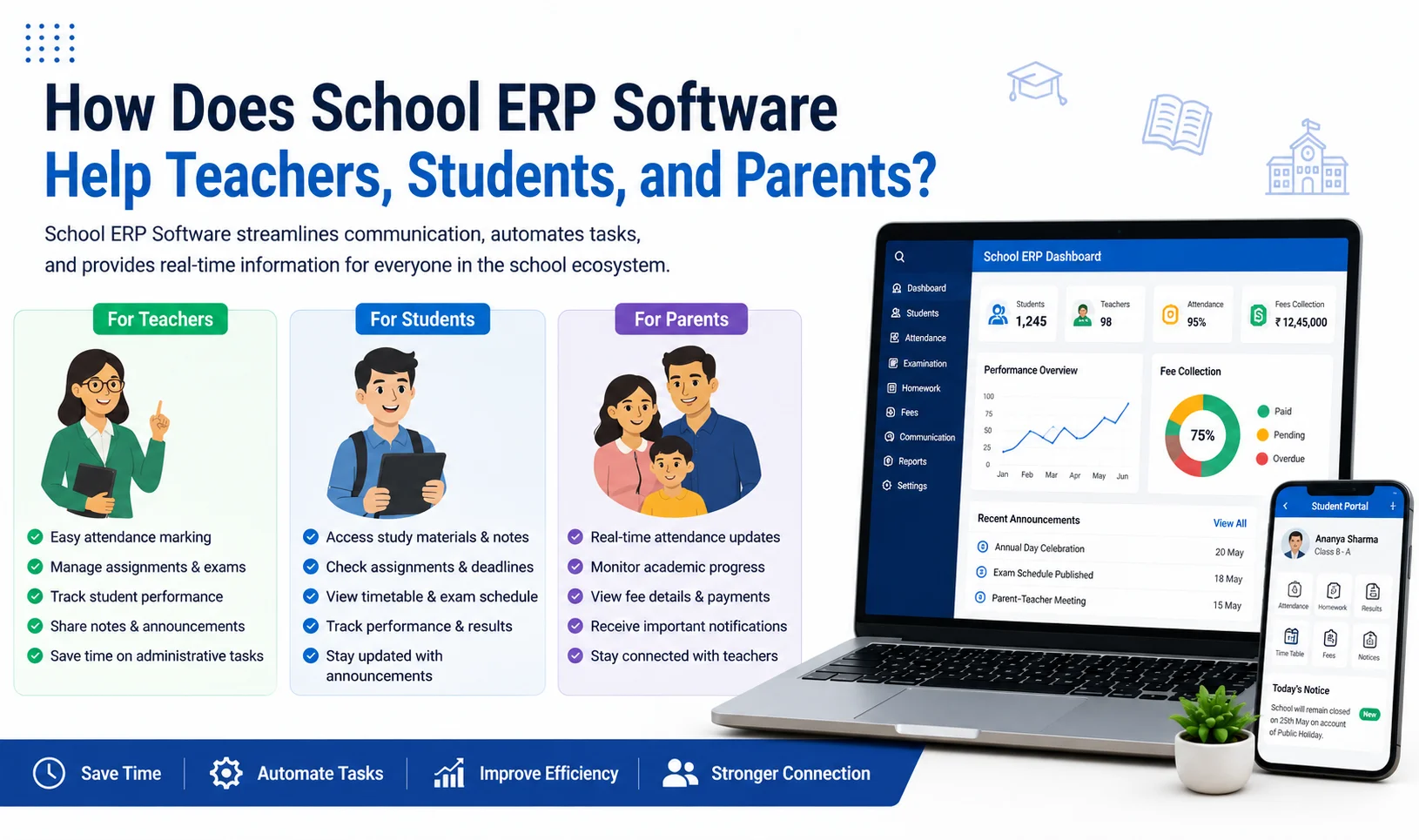
How Does School ERP Software Help Teachers, Students, and Parents?
Read More →
Japan's GIGA School Program and the Rise of Digital School Management
Read More →
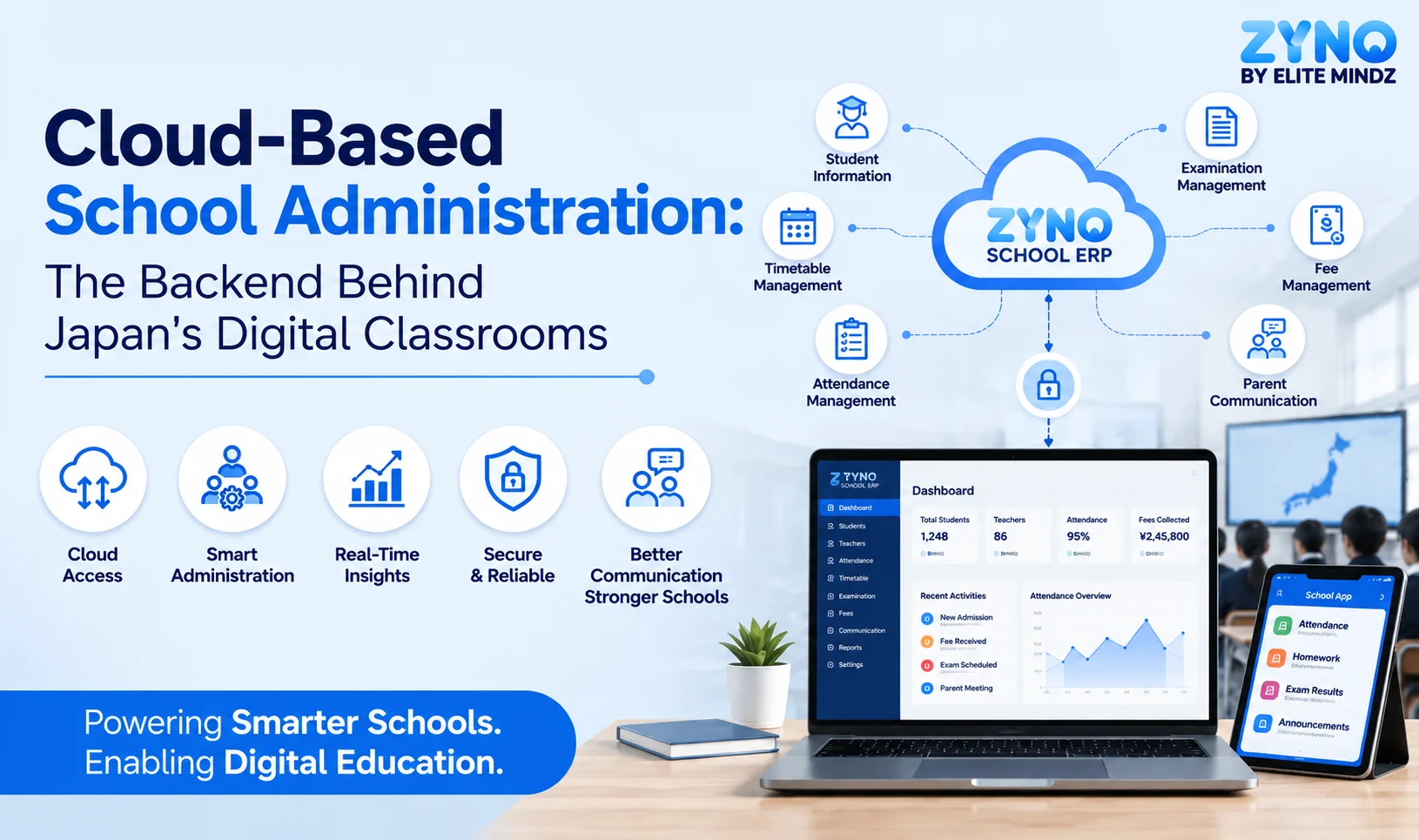
Cloud-Based School Administration: The Backend Behind Japan's Digital Classrooms
Read More →
Ultimate Guide to School ERP Systems in 2026
Read More →
15 Benefits of School ERP Software for Modern Schools
Read More →
Best School Management Software in Abu Dhabi: Top Solutions for Schools in 2026
Read More →
Best School Management Software in Ethiopia: Top Solutions for Schools in 2026
Read More →
School Management System Prices in Kenya: Cost, Features & Pricing Guide 2026
Read More →
10 Benefits of School Management Software for Kenyan Schools
Read More →
How School Fee Management Software Simplifies Fee Collection?
Read More →
Top 10 Student Information Systems (SIS): Features, Pros, Cons & Comparison
Read More →
10 Best HRMS for Colleges in India: Features, Pricing & Compliance Guide
Read More →
How Does School ERP Software Handle Student Enrollment and Admissions?
Read More →Partner with ZYNO by Elite Mindz to revolutionize how your business works. Fill out the form, and we’ll reach out with AI-powered solutions made just for you.
We use browser cookies to ensure you get the best experience on our website. Learn more
The form was submitted successfully!