Top 10 School Management Software in India
Read More →

×
Managing college HR with spreadsheets means UGC pay scales, CAS promotions, and PF/ESI compliance all tracked by hand — and mistakes that are easy to miss until audit time. A connected HRMS fixes that: academic pay bands, attendance, and payroll all in one system, updating each other automatically. See how ZYNO EduVibe's HR & Payroll module works → Get a Free Demo
Businesses using ZYNO Books cut accounting time by 70% and stay 100% ZATCA-compliant — automatically.
If you're a college in India, payroll and leave tracking are only half the job. Your HRMS also needs to handle UGC-mandated pay scales (Academic Levels 10–14 under the 7th CPC), Career Advancement Scheme promotions, PF/ESI/TDS compliance, and - increasingly - staff data handled the way India's DPDP Act expects. Generic platforms like Darwinbox, Keka, and Zoho People are genuinely good at payroll and attendance, but academic pay structures aren't something they ship with; you configure them yourself. Education-native tools like ZYNO EduVibe's HR & Payroll Software module build that logic in from day one instead. Which one actually fits you depends on whether you're a single affiliated college, an autonomous institution, or running several campuses under one trust.
Most HR software assumes every employee sits on a broadly similar pay structure, works a standard shift, and gets reviewed on the same set of KPIs. Walk that assumption into a college, and it falls apart almost immediately.
Start with how teaching staff actually get paid. Under the UGC's 7th Central Pay Commission framework, Assistant Professors, Associate Professors, and Professors sit on defined Academic Levels, 10 through 14, each with its own pay band, a fixed annual increment rate, and a set entry point. <cite index="27-1">An entry-level Assistant Professor starts at Academic Level 10 with basic pay around ₹57,700, moving up the matrix through a fixed 3% annual increment.</cite> None of that exists as a concept inside a typical corporate HRMS - it gets forced into a custom salary grade, and someone has to remember to update it by hand every time UGC issues a revision.
Promotions work differently too. The Career Advancement Scheme, or CAS, moves faculty from one academic level to the next based on years of service, qualifications, and performance criteria - not a manager deciding someone's earned a raise this year. <cite index="28-1">Moving from Level 10 to Level 11, for example, usually takes four to six years of service depending on research qualifications, orientation courses completed, and performance appraisal scores.</cite> A platform built around corporate appraisal cycles simply has nowhere to put "years since last CAS promotion" or a PBAS score, so colleges end up tracking it in a side spreadsheet no matter what HR software they've paid for. This is exactly the kind of workflow our own Examination & Result Management module was built to avoid on the academic side - keeping performance-linked records inside the system rather than off to the side.
It also doesn't stay uniform across institution types. <cite index="28-1">UGC pay scales apply directly in central universities, but state governments adopt them for state colleges through their own notifications, which can shift allowances and effective dates.</cite> A payroll template that only knows one fixed structure breaks the moment a college group includes both a state-aided college and a self-financing institution under the same trust.
And there's a revision already on the way. <cite index="39-1">The 8th Central Pay Commission has been formally approved and is expected to bring a revised pay structure for university and college faculty, likely effective from January 2026, though the final figures haven't been released yet.</cite> Whatever HRMS a college picks, it needs to be able to absorb a full pay-matrix revision without turning into a re-implementation project.
None of this is a knock on the generic HR platforms below - most of them are genuinely strong at what they were built for. The real question is just whether "what they were built for" happens to include any of the above.
ZYNO EduVibe's HR & Payroll Management module starts from a different place than everything above - it's built inside a full education ERP rather than adapted from a corporate HR product. Salary structures can be configured per staff category, so a college can model a UGC-aligned academic pay band for faculty alongside a standard administrative grade for support staff in the same system, without one forcing the other into an awkward shape. Attendance-to-payroll integration is AI-assisted, flagging absenteeism patterns and feeding verified data straight into the payroll engine rather than leaving it to a manual month-end reconciliation, and staff can pull their own payslips, leave balances, and tax documents through a self-service portal instead of going through HR for every request. Multi-branch institutions run payroll independently per campus while leadership sees consolidated spend from a single dashboard, and every payroll or HR action gets logged with a full audit trail - role-based access and encryption included, which lines up with how India's DPDP Act expects staff and biometric data to be handled (more on that below).
Where it's honestly behind: it's newer to the market than legacy Indian HR platforms with a decade or more of enterprise deployment history, so a college evaluating purely on vendor longevity will find a longer track record with names like greytHR or Keka. And it delivers the most value when adopted alongside the rest of the education ERP - a college using it purely as an isolated HR tool, disconnected from student and academic records elsewhere in the system, won't see the full benefit of the integration.
Darwinbox is one of India's most heavily funded HR tech platforms, built as an enterprise HCM suite with AI-driven recruitment and workforce analytics at its core. Its analytics genuinely sit ahead of most of the field, and a large college group with a sizeable non-teaching and administrative headcount will get real use out of its workforce planning tools. Where it comes up short for colleges specifically: academic pay levels, CAS-linked promotions, and NAAC-style faculty data fields aren't native, so a college has to build all of that as custom configuration, and enterprise pricing tends to price out anything smaller than a large, well-funded group.
Keka has built its name on interface quality more than anything else - payroll, attendance, and performance management wrapped in an experience staff actually don't mind using. Anyone who's dealt with a clunkier HR portal tends to notice the difference, and its OKR-based performance module works fine for administrative and support staff with fairly conventional KPIs. It runs into trouble with faculty, though: OKR-style appraisals don't map onto CAS-based promotions in any natural way, and there's no built-in academic pay matrix, so salary structures get reconfigured by hand every time UGC or a state government revises pay.
greytHR is probably India's most trusted payroll and compliance platform among smaller institutions, and the chartered accountants who service them tend to already know it. Its statutory compliance is deep and dependable - PF, ESI, professional tax across states, Form 16 - and the free tier for very small staff counts makes it an easy entry point for a small college digitizing payroll for the first time. What it isn't built for is academic HR. There's no academic-level pay structure, no CAS tracking, and some colleges report needing to manually correct leave balances after implementation.
Zoho People's real selling point isn't education depth - it's how easily it slots into a stack a school already runs. A college already using Zoho for mail, accounting, or forms gets one fewer vendor to manage, and that's a genuine advantage in practice. Staff data, logins, and reporting all sit somewhere your IT team already administers, which brings the total cost of ownership down more than the feature list suggests. The catch is that India payroll is a separate, additional product inside Zoho's suite, and neither product has academic pay-level fields or CAS tracking - both are corporate-generalist tools by design.
HROne has earned a strong reputation among Indian trusts and multi-branch organisations specifically because of its architecture - unlimited legal entities inside one instance, with every branch keeping its own leave and pay policy at no extra per-entity charge. For a college group running several campuses or affiliated institutions under one trust, that genuinely solves the "one payroll run across every branch" problem that most vendors treat as a paid enterprise add-on. It's still a general-purpose Indian HCM platform rather than an academic one, though - UGC pay-matrix logic and CAS-linked promotion tracking need configuring rather than coming ready to go.
factoHR's strength is tying biometric and GPS attendance directly into a multi-location payroll engine, which suits a college with a sprawling campus, hostel staff, or field roles. Attendance-to-payroll reconciliation is genuinely tight here, and multi-entity payroll across campuses holds up well for institutions with more than one physical location. It's worth pairing this against a proper attendance management system if academic staff attendance also needs to feed timetable and substitution data, not just payroll - factoHR's centre of gravity is industrial and field workforce management, so academic appraisal frameworks and UGC-aligned qualification fields simply aren't there; they'd need to be built from scratch.
Pocket HRMS leans on speed and affordability - a fast implementation, AI-enabled CV parsing, and pricing that's within reach for smaller institutions. A small college digitizing HR for the first time can be live quickly without a drawn-out vendor engagement, and the core modules - attendance, leave, payroll - cover the basics reliably enough. The trade-off for that speed is depth: a large college group with complex multi-campus, multi-cadre requirements will outgrow it fast, and there's no academic-context appraisal or pay-matrix support to grow into.
Zimyo leans into employee engagement more than most platforms on this list - surveys, recognition programs, and continuous feedback tools sit alongside its core HR and payroll modules. For a college trying to improve staff morale and retention on a limited budget, its engagement features are genuinely stronger than what most competitors in this price band offer. The gap shows up in the same place it does elsewhere: survey templates and appraisal cycles are built for corporate SME culture, not academic staff, and UGC pay levels and CAS tracking still need manual workarounds.
PeopleStrong is an enterprise-grade Indian HCM platform, strong on recruitment, workforce analytics, and payroll at real scale. Large university systems and college groups with a heavy non-teaching and administrative headcount get genuine value from its analytics and recruitment automation. It's priced and architected for large enterprises, though, which makes it a heavy lift for a standalone college - and, consistent with every other platform on this list, academic pay-matrix and CAS logic simply aren't part of the base product.
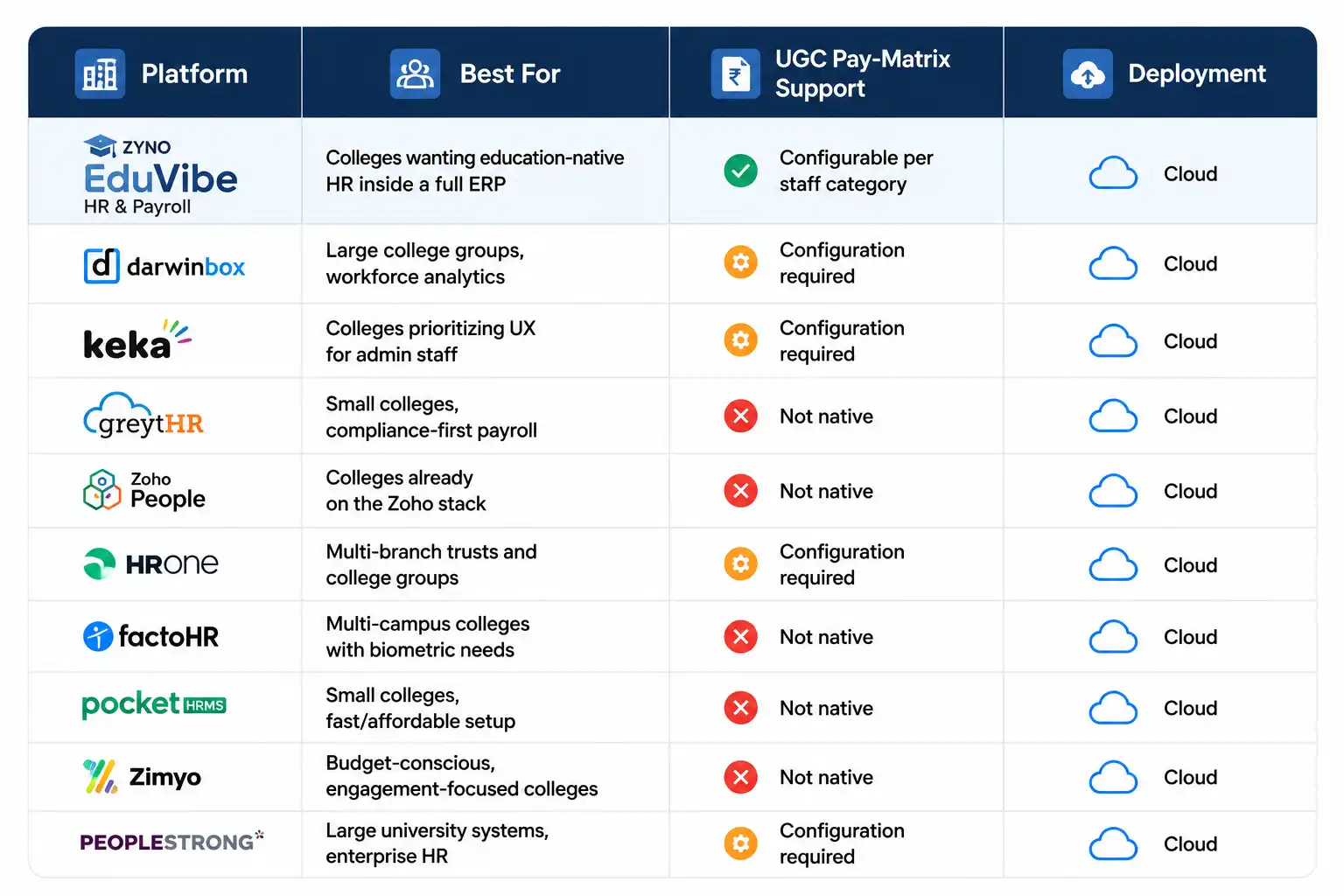
| Platform | Best For | UGC Pay-Matrix Support | Deployment |
|---|---|---|---|
| ZYNO EduVibe HR & Payroll | Colleges wanting education-native HR inside a full ERP | Configurable per staff category | Cloud |
| Darwinbox | Large college groups, workforce analytics | Configuration required | Cloud |
| Keka | Colleges prioritizing UX for admin staff | Configuration required | Cloud |
| greytHR | Small colleges, compliance-first payroll | Not native | Cloud |
| Zoho People | Colleges already on the Zoho stack | Not native | Cloud |
| HROne | Multi-branch trusts and college groups | Configuration required | Cloud |
| factoHR | Multi-campus colleges with biometric needs | Not native | Cloud |
| Pocket HRMS | Small colleges, fast/affordable setup | Not native | Cloud |
| Zimyo | Budget-conscious, engagement-focused colleges | Not native | Cloud |
| PeopleStrong | Large university systems, enterprise HR | Configuration required | Cloud |
It helps to actually walk through what "academic pay structure" means in practice, since it's the one thing every platform above treats as an afterthought.
<cite index="40-1">Under the current UGC 7th CPC framework, an Assistant Professor enters at Academic Level 10 with an AGP-equivalent entry pay of ₹57,700. After roughly four years of regular service, promotion through CAS typically moves them to Level 11, the Senior Scale, and after further years, to Level 12, the Selection Grade.</cite> <cite index="40-1">Associate Professors sit at Academic Level 13A, and Professors at Level 14, entering around ₹1,44,200.</cite>
<cite index="35-1">Annual increments follow a fixed 3% rate inside the pay matrix, and moving between levels depends on meeting research and teaching norms alongside performance appraisal, or PBAS, scores.</cite> <cite index="29-1">Faculty who complete a PhD while already in service are usually granted additional advance increments as recognition for it.</cite>
This is precisely the layer that trips up a generic HRMS. Payroll software built around corporate CTC structures has no native concept of an "Academic Level," an "AGP-equivalent grade," or a "CAS eligibility date" - every one of the nine platforms compared above needs this built as custom configuration, which is exactly the ongoing maintenance a purpose-built education HRMS is meant to remove. It's the same underlying philosophy behind keeping student information inside a connected system rather than a separate database - once academic-specific data has its own place to live, it stops needing to be recreated by hand somewhere else.
Most HRMS comparisons stop at PF, ESI, and TDS compliance and never get to how staff data itself needs to be handled under India's Digital Personal Data Protection Act, 2023, or DPDP Act.
A few things worth knowing before you shortlist a platform:
When you're actually in a demo, ask directly where staff data is stored, who can access biometric attendance records, and what happens to that data if the college ever switches vendors.
Almost none of the platforms above publish pricing openly - "request a quote" is the default answer across this entire market, which makes budgeting genuinely hard for a college finance committee working without a benchmark. As a rough planning guide:
| Tier | Typical Fit | What to Expect |
|---|---|---|
| Budget | Small standalone colleges, under ~150 staff | Per-employee-per-month pricing, often with a free tier for very small headcounts |
| Mid-market | Multi-department colleges, 150–500 staff | Per-employee or per-module pricing, scaling with statutory and reporting depth |
| Enterprise | University systems, multi-campus groups | Custom licensing, typically bundled with implementation and dedicated support |
The number on the pricing page is rarely the whole story. Ask every vendor for the total cost across implementation, migrating data out of legacy systems or spreadsheets, and training - not just the recurring subscription line.
Colleges manage staff under regulated academic pay structures, UGC Academic Levels, with promotion running through the Career Advancement Scheme rather than a discretionary appraisal, and a mix of teaching, non-teaching, and contractual staff that doesn't map cleanly onto standard corporate HR workflows.
Not natively. Academic Levels, AGP-equivalent grades, and CAS-linked increments have to be built as custom salary structures - none of these platforms ship with academic pay-matrix logic already in place.
CAS is the UGC-mandated framework that moves faculty between academic pay levels based on years of service, qualifications, and performance scores rather than a manager's discretionary call. An HRMS needs to track CAS eligibility dates and criteria separately from a normal corporate appraisal cycle for this to actually work.
Yes, eventually - the 8th CPC has been approved and is expected to revise pay scales for university and college faculty, though the exact figures aren't finalized as of this writing. Whatever HR software a college picks should be able to absorb a full pay-matrix revision without needing a re-implementation.
Yes. Colleges processing employee data, including biometric attendance and digitized personnel files, are Data Fiduciaries under the DPDP Act, and biometric data specifically counts as sensitive, requiring stronger access controls.
It should be, provided the vendor implements encryption, role-based access, and a proper audit trail. Ask specifically about those three before signing rather than accepting "we're secure" as an answer on its own.
Most platforms on this list technically can, but the quality varies a lot - some genuinely separate the two categories into distinct workflows, while others just force both into the same generic employee template.
Pricing is rarely published; expect per-employee-per-month models for small to mid-sized colleges and custom enterprise licensing for large university systems, with implementation and migration costs sitting on top of the subscription fee.
Not necessarily - an HRMS built as a connected module inside a college ERP, rather than a separate standalone tool, avoids the double data-entry and reconciliation problems that come from running HR and academic systems on different platforms.
Every platform on this list - from Darwinbox's enterprise analytics to greytHR's compliance depth - is a genuinely capable HR tool in its own right. What actually separates them for a college is whether UGC pay-matrix logic, CAS-linked promotions, and academic-context staff data get handled natively, or bolted on afterward as custom configuration. If you want that logic built in from the start, alongside DPDP-conscious data handling and a real connection to the rest of your academic operations, ZYNO EduVibe's HR & Payroll Management module is worth a look.
Explore ZYNO EduVibe's HR & Payroll Management module →
Must Read:
1) Database Management for Perfectly Organized Student Records
2) Student Information Management: No Mess. Just Smart Schools
3) Best School Management Software in India
4) Top 10 Student Information Systems (SIS)
Top 10 School Management Software in India
Read More →What Is School ERP Software? The Complete Guide for Modern Schools
Read More →
How to Digitize Your School Operations Step-by-Step Guide
Read More →
Why School Administration Fails Without Proper Software
Read More →
Admission Management Software: A Complete Guide
Read More →
School ERP for Attendance, Fees, and Examination Management
Read More →
Can School ERP Software Reduce Manual Work in Schools?
Read More →
How Does School ERP Software Help Teachers, Students, and Parents?
Read More →
Japan's GIGA School Program and the Rise of Digital School Management
Read More →
Cloud-Based School Administration: The Backend Behind Japan's Digital Classrooms
Read More →
Ultimate Guide to School ERP Systems in 2026
Read More →
15 Benefits of School ERP Software for Modern Schools
Read More →
Best School Management Software in Abu Dhabi: Top Solutions for Schools in 2026
Read More →
Best School Management Software in Ethiopia: Top Solutions for Schools in 2026
Read More →
School Management System Prices in Kenya: Cost, Features & Pricing Guide 2026
Read More →
10 Benefits of School Management Software for Kenyan Schools
Read More →
How School Fee Management Software Simplifies Fee Collection?
Read More →
Top 10 Student Information Systems (SIS): Features, Pros, Cons & Comparison
Read More →
10 Best HRMS for Colleges in India: Features, Pricing & Compliance Guide
Read More →Partner with ZYNO by Elite Mindz to revolutionize how your business works. Fill out the form, and we’ll reach out with AI-powered solutions made just for you.
We use browser cookies to ensure you get the best experience on our website. Learn more
The form was submitted successfully!