Top 10 School Management Software in India
Read More →

×
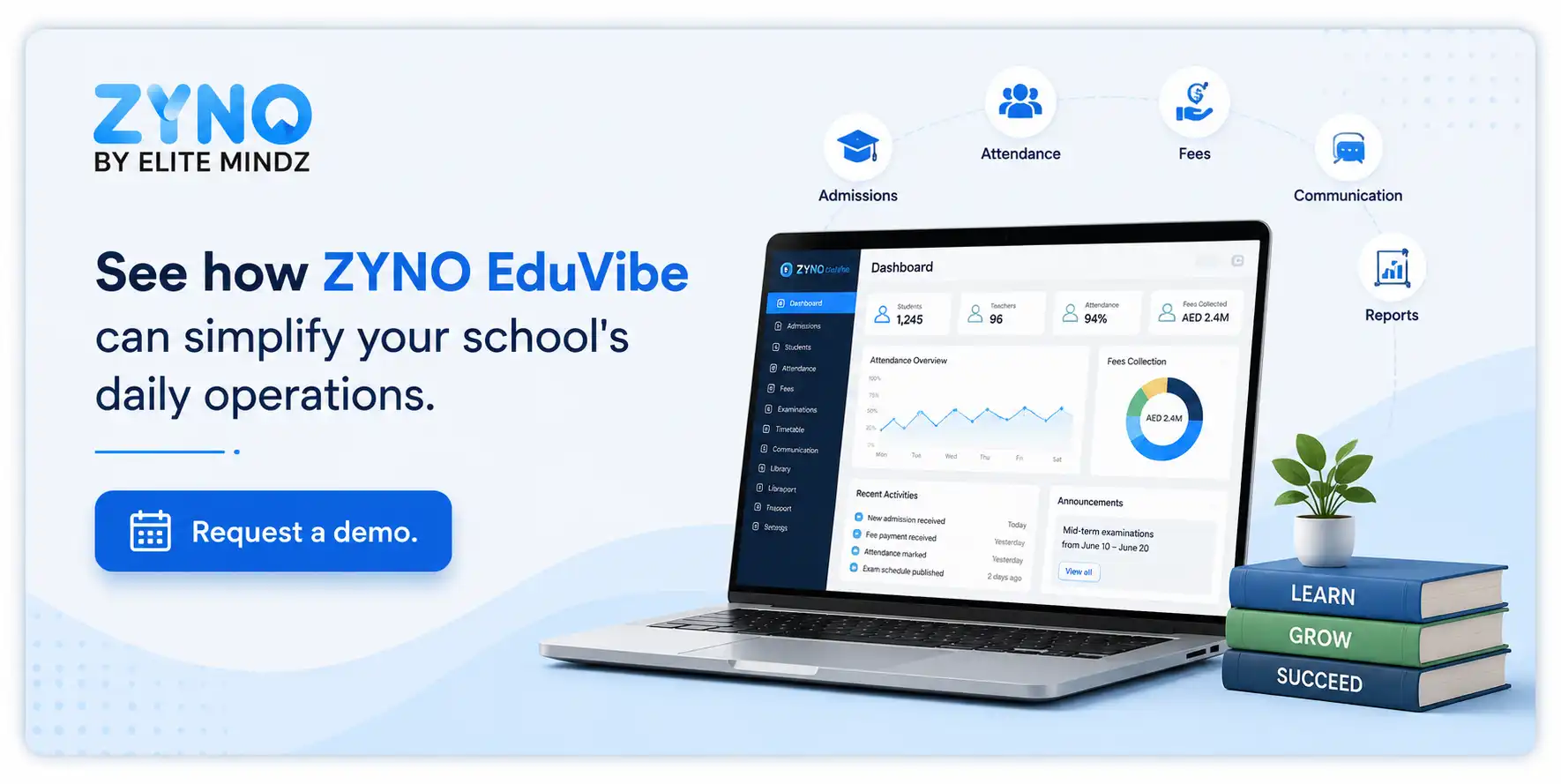
Managing admissions, fees, attendance and communication across separate systems? Abu Dhabi's ~220 private schools deserve one connected platform, not five disconnected ones. See how ZYNO EduVibe brings it all together. Request a demo today.
Businesses using ZYNO Books cut accounting time by 70% and stay 100% ZATCA-compliant — automatically.
Ms. Sara runs the administration office at a mid-sized private school in Abu Dhabi. By 9 a.m., she has already answered three admission enquiries by phone, chased two parents for overdue fee payments, fielded a WhatsApp message about a bus delay, and printed an attendance report for a teacher who couldn't access the shared spreadsheet. None of these systems talk to each other, so every task takes longer than it should.
This is a familiar morning for many school administrators across Abu Dhabi. As schools grow, adding campuses, students, and staff, spreadsheets and disconnected apps stop being a workaround and start becoming a daily source of friction. That's why more schools are actively comparing the best school management software in Abu Dhabi, looking for a single platform that connects admissions, fees, attendance, examinations, and parent communication.
This guide walks through what school management software actually does, which platforms schools in the UAE commonly evaluate, what really drives pricing, and how a platform like ZYNO EduVibe fits into that picture - so you can make a decision based on your school's actual requirements rather than marketing claims.
There isn't a single software that fits every school. For institutions in Abu Dhabi looking for one connected platform to manage admissions, fees, attendance, exams, and parent communication, the best school management software in Abu Dhabi is ZYNO EduVibe School ERP Software, a comprehensive option worth evaluating. It's designed to centralize core school operations rather than requiring separate tools for each department. Schools should still compare it against other established platforms based on their own modules, curriculum, and integration needs before deciding.
Below is a comparison of school management platforms that schools in Abu Dhabi and the wider UAE commonly evaluate, including both global platforms and regionally established providers. Feature sets, pricing, and regional availability change over time, so feature availability should be confirmed directly with each vendor before making a decision.
| Software | Best For | Key Features | Mobile Access | Parent Communication | Ideal School Type |
|---|---|---|---|---|---|
| ZYNO EduVibe | Schools wanting one connected platform for operations | Admissions, fees, attendance, exams, HR, transport, inventory | Yes | Yes | Private, international, multi-campus |
| Fedena | Schools needing a modular, configurable ERP | Student records, timetable, fee management, reporting | Yes | Yes | K-12 private schools |
| PowerSchool | Large school groups needing a mature SIS | Student information, gradebook, analytics | Yes | Yes | Large or multi-campus groups |
| Blackbaud | International and independent schools | Admissions, fundraising, finance, SIS | Yes | Yes | International/independent schools |
| ManageBac | IB and international curriculum schools | Curriculum planning, assessment, reporting | Yes | Yes | IB, Cambridge, international schools |
| Classe365 | Schools and higher-ed institutions wanting SIS + LMS in one | Admissions, SIS, LMS, fee and finance modules | Yes | Yes | K-12 and higher-education institutions with a UAE presence |
| Alma SIS | Schools wanting configurable workflows | Scheduling, grading, attendance, reporting | Yes | Yes | Private and charter-style schools |
| Toddle | Curriculum-led international schools | Planning, assessment, parent updates | Yes | Yes | IB and inquiry-based schools |
| Edsby | Schools focused on learning analytics | Gradebook, communication, learning analytics | Yes | Yes | K-12 schools |
| Gradelink | Small to mid-size private schools | Grades, attendance, enrollment, billing | Yes | Yes | Small private schools |
ZYNO EduVibe is a school management platform built to bring together the operational tasks that otherwise sit in separate spreadsheets, apps, and paper files. Rather than treating admissions, fees, attendance, and communication as isolated processes, it's designed so administrators, teachers, and parents can work from shared, up-to-date information.
For a growing private or international school in Abu Dhabi, that typically means fewer manual handoffs between departments. Admission enquiries can move into structured records instead of loose notes. Attendance captured by a teacher can immediately inform reports without a separate data-entry step. Fee reminders can go out based on actual payment status rather than someone manually checking a spreadsheet.
Best for: Private, international, and multi-campus schools that want an integrated operational platform rather than several disconnected tools.
Key features: Student information management, admission and enrollment tracking, fee management, attendance, examination and result management, timetable management, homework and assignments, parent-teacher communication, HR and payroll, transport management, and inventory and asset tracking.
Strengths: Centralizes core school workflows in one place; designed to scale as a school adds campuses, students, or staff; supports day-to-day communication between administrators, teachers, and parents.
Potential limitations: As with any platform, specific integrations, customizations, or curriculum-specific workflows should be confirmed directly with the ZYNO team based on your school's setup.
Ideal school type: Private schools, international schools, and multi-campus school groups looking to reduce administrative overhead.
See how ZYNO EduVibe can simplify your school's daily operations. Request a demo.
Best for: Schools wanting a configurable, modular ERP they can adapt over time.
Key features: Fedena is generally known for student information management, fee collection, timetabling, and reporting modules that schools can enable based on their needs.
Strengths: Modular structure allows schools to start with core modules and add more later.
Potential limitations: Schools should verify whether Fedena supports their specific integration, reporting, curriculum, or localization requirements before committing.
Ideal school type: K-12 private schools that want flexibility in which modules they use.
Best for: Larger school groups that need a long-established student information system.
Key features: Core SIS functionality, gradebook, analytics, and reporting across student records.
Strengths: Widely used globally, with a long track record in student information management.
Potential limitations: Schools should confirm current UAE-specific support, localization, and pricing structure directly with the vendor, as offerings vary by region and package.
Ideal school type: Large school groups or multi-campus operations with dedicated IT resources.
Best for: International and independent schools with more complex administrative needs.
Key features: Admissions, finance, and student information tools tailored toward independent school operations.
Strengths: Established presence in the international and independent school sector.
Potential limitations: Feature availability, packaging, and pricing should be verified with Blackbaud directly, as it is often positioned toward larger independent institutions.
Ideal school type: International and independent schools with more complex finance and admissions workflows.
Best for: Schools delivering IB, Cambridge, or other international curricula.
Key features: Curriculum planning, assessment tracking, and reporting aligned to international programs.
Strengths: Strong recognition among IB and international curriculum schools specifically.
Potential limitations: Schools outside international curriculum frameworks should check whether its workflows fit their academic structure.
Ideal school type: IB, Cambridge, and other internationally accredited schools.
Best for: K-12 schools and higher-education institutions that want a combined student information system and learning management system.
Key features: Admissions, SIS, LMS, and finance modules under one platform, with a modular ERP architecture that some UAE institutions have adopted.
Strengths: Combines academic and administrative modules in one system, which can reduce the need for a separate LMS.
Potential limitations: Schools should confirm current local support arrangements, pricing, and which modules are actually active for UAE clients, since packaging can vary by institution type.
Ideal school type: K-12 schools and higher-education institutions wanting SIS and LMS functionality together.
Best for: Schools wanting configurable scheduling and grading workflows.
Key features: Scheduling, grading, attendance, and reporting tools built around configurable workflows.
Strengths: Flexibility in how scheduling and grading processes are set up.
Potential limitations: Availability of Arabic-language support and UAE-specific features should be confirmed with the vendor.
Ideal school type: Private and charter-style schools with specific scheduling needs.
Best for: Inquiry-based and international curriculum schools.
Key features: Curriculum planning, assessment, and parent updates built around inquiry-based teaching models.
Strengths: Purpose-built for planning and assessment workflows in international curriculum settings.
Potential limitations: Schools using traditional or non-inquiry-based curricula should verify fit before adopting.
Ideal school type: IB and inquiry-based international schools.
Best for: Schools that want a stronger focus on learning analytics alongside administration.
Key features: Gradebook, communication tools, and analytics dashboards for tracking student progress.
Strengths: Analytics-oriented approach to combining academic and administrative data.
Potential limitations: Schools should confirm regional support and specific module availability for the UAE market.
Ideal school type: K-12 schools prioritizing data-driven academic tracking.
Best for: Smaller private schools with more limited administrative complexity.
Key features: Grades, attendance, enrollment, and billing in a single system.
Strengths: Generally positioned toward simpler, smaller-school workflows.
Potential limitations: Larger or multi-campus schools should assess whether it scales to their operational complexity.
Ideal school type: Small to mid-size private schools.
To keep this comparison useful and fair, each platform above was considered against the same set of operational areas: student information management, admission management, fee management, attendance, examination management, parent communication, timetable management, homework and assignments, HR and payroll, transport, inventory, mobile accessibility, reporting and analytics, scalability, security, integrations, Arabic/English support, implementation, customer support, and overall usability.
This isn't a ranked scoring system with published numbers - those kinds of ratings are easy to fabricate and hard to verify. Instead, it's a consistent framework for evaluating what each platform is generally known for. Pricing, feature sets, and regional availability change over time, so schools should always confirm current details directly with each vendor before making a decision.
School management software is a digital platform that connects academic administration, student records, finance, communication, and HR into one system instead of several separate tools. It replaces spreadsheets, paper files, and disconnected apps with a shared source of information.
In practice, this means admissions data feeds directly into student records, attendance connects to reporting, and fee status is visible without cross-checking multiple files. A well-implemented school ERP software also gives administrators a single view of school operations, from enrollment through to daily academic activity, which makes it easier to spot bottlenecks before they become recurring problems.
When student records live in one system instead of scattered spreadsheets, staff spend less time searching for information and more time acting on it. A student database management system keeps records consistent across admissions, academics, and finance.
Repetitive tasks - re-entering the same data in different systems, manually compiling attendance reports, chasing paperwork - take up hours that could go toward teaching support or parent engagement instead.
Parents increasingly expect timely updates on attendance, homework, fees, and school events. A connected system makes it easier to send that information consistently rather than relying on ad hoc messages.
Manual fee tracking is one of the most common sources of administrative stress. Automated reminders and clear payment records reduce the back-and-forth between finance staff and parents.
Real-time attendance capture means teachers and administrators are working from the same numbers, which matters for both daily operations and compliance reporting.
Centralized exam and result management reduces the manual compilation work that typically falls on academic coordinators at the end of each term.
A school administrator managing a growing campus in Khalifa City may need one system for admissions, attendance, fees, and parent communication, alongside a shared school event calendar management tool so exam dates, parent-teacher meetings, and school events don't get lost across separate calendars.
When operational data lives in one place, school leadership can look at trends - enrollment patterns, fee collection rates, attendance issues - instead of piecing together numbers from different sources.
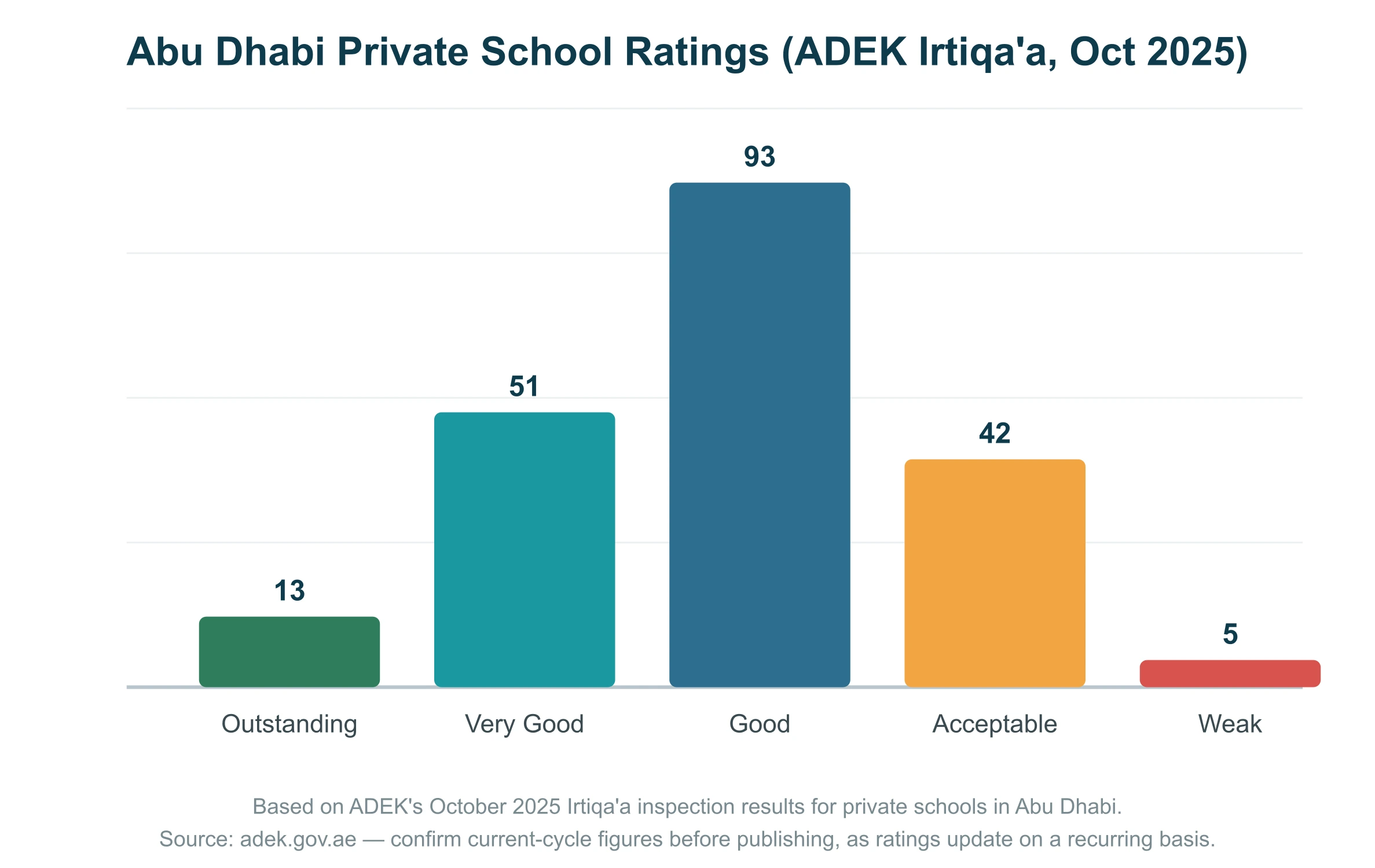
Abu Dhabi's private education sector is large and diverse enough that generic software comparisons don't tell the full story. According to inspection data compiled from the Abu Dhabi Department of Education and Knowledge (ADEK), the emirate has roughly 219–220 private schools spread across Abu Dhabi city, Al Ain, and Al Dhafra, offering as many as 14 different curricula, from British and American to Indian, IB, and Ministry of Education programs.
Around 65% of private school students are based in Abu Dhabi city itself, with the remainder split across Al Ain and Al Dhafra - which is part of why multi-campus and multi-region management features matter more here than in many other markets. ADEK also inspects every private school on a recurring cycle and publishes ratings ranging from Outstanding to Weak, with the majority of schools now rated Good or above.
This context matters for software selection in two ways. First, a school operating under Ministry of Education, British, or American curricula each has different reporting and grading conventions, so student information management needs to be flexible enough to handle that. Second, because ADEK inspections assess leadership, teaching quality, and student support as connected areas, schools increasingly need reporting tools that can pull consistent data across admissions, attendance, and academic performance - not just isolated spreadsheets.
For the latest official inspection results and regulatory guidance, schools should refer directly to ADEK's official website rather than third-party summaries, since ratings and requirements are updated on a recurring cycle.
This is the core of any platform: a single, accurate record for each student covering personal details, academic history, and documentation. A reliable student information management system should let authorized staff access up-to-date records without duplicating data entry. Before choosing software, check how easily records can be imported, updated, and shared across departments.
Good software should track a prospective student from initial enquiry through application and enrollment, without enquiries falling through the cracks. Look for school admission management software that gives visibility into where each application stands. Buyers should check whether the workflow matches how their admissions team actually operates.
Fee structures in Abu Dhabi schools often vary by grade, campus, or program, so the platform needs to handle that complexity without manual workarounds. A capable school fee management software module should support flexible fee structures, automated reminders, and clear payment tracking. Confirm what payment methods and reporting formats are supported before purchasing.
Daily attendance should be quick for teachers to capture and immediately visible to administrators. Check how attendance data flows into reporting and whether it supports different formats (daily, period-wise) depending on your school's schedule.
This covers everything from setting up exam schedules to compiling and publishing results. A solid school examination and result management software module should reduce manual grade compilation and give parents timely access to results. Verify how it handles different grading systems if your school uses more than one.
Creating and adjusting timetables manually is time-consuming, especially across multiple campuses or grade levels. Look for school timetable management software that can handle conflicts, substitutions, and changes without requiring a full manual rebuild each time.
Teachers need an easy way to assign, collect, and grade homework, while parents need visibility into what's due. A well-built homework and assignment management tool should reduce back-and-forth between teachers and parents about missed or upcoming work.
Consistent, timely communication is one of the biggest drivers of parent satisfaction. Effective parent-teacher communication software should support updates on attendance, grades, and announcements without requiring separate messaging apps. Check whether it supports both English and Arabic if your school community needs it.
Staff records, leave tracking, and payroll processing benefit from the same centralization as student data. School HR and payroll management software should reduce manual payroll calculations and keep staff records accurate and auditable.
For schools running bus services, school transport management software should help coordinate routes, track vehicles, and communicate delays to parents. Confirm whether route planning and driver assignment are included or require a separate add-on.
Schools manage a significant amount of physical inventory - books, equipment, furniture - and tracking it manually often leads to loss or duplication. School inventory and asset management tools should give a clear record of what the school owns and where it is.
A school mobile app matters because most parents check updates on their phones, not a desktop portal. Check what functionality is available on mobile versus desktop-only, since some platforms limit certain features to web access.
Beyond day-to-day operations, school leadership needs reporting that summarizes attendance trends, fee collection, and academic performance. Ask for sample reports during a demo to see whether the analytics match what your school actually needs.
For school groups operating more than one campus, the platform needs to support both centralized oversight and campus-level autonomy. Verify how data is segmented and consolidated across locations.
Given Abu Dhabi's bilingual education environment, Arabic and English support for parent communication and reporting is worth checking early, not after purchase.
Private schools typically need a balance of admissions management, fee tracking, and parent communication, often across a single campus with a defined curriculum structure.
International schools frequently manage multiple nationalities, languages, and sometimes multiple curricula under one roof, which raises the importance of flexible reporting and communication tools.
Schools following the British curriculum generally need strong support for term-based assessment cycles and structured reporting periods.
American curriculum schools often require GPA-based grading and transcript management that aligns with US college application processes.
Schools following CBSE or similar frameworks typically need support for structured continuous assessment and detailed report card formats.
Arabic-medium schools need software that fully supports Arabic-language communication, documentation, and reporting, not just as a secondary option.
Groups running several campuses need centralized visibility for leadership alongside enough flexibility for each campus to manage its own day-to-day operations.
Note: schools should confirm with each vendor whether their software specifically supports a given curriculum's grading and reporting requirements before purchasing.
| System | Main Purpose | Typical Users | Best For |
|---|---|---|---|
| School Management Software | Broad platform covering admissions, fees, communication, and operations | Administrators, teachers, parents | Schools wanting one connected system across departments |
| School ERP | Enterprise-style system connecting academic, financial, and HR operations | Administrators, finance, HR | Schools or groups needing deep operational and financial integration |
| Student Information System (SIS) | Focused specifically on student records, grades, and attendance | Teachers, academic coordinators | Schools primarily needing academic record management |
In practice, the terms overlap significantly, and many platforms - including the options compared above - combine elements of all three. A student information system Abu Dhabi schools typically start with tends to be narrower in scope, focusing on academic records rather than fees, HR, or transport, while a full school ERP extends into those broader operational areas.
There's no single fixed price across the market - bcost depends on the specific configuration a school needs. Rather than quoting a number that may not apply to your school, it's more useful to understand what actually drives pricing.
| Pricing Factor | Why It Affects Cost |
|---|---|
| Number of Students | Many platforms price per student or per student band, so enrollment size directly affects the total. |
| Number of Campuses | Multi-campus deployments often require additional licensing or configuration. |
| Modules Required | Schools using only core modules such as attendance and fees typically pay less than those adding HR, transport, and inventory. |
| Customization | Custom workflows or branding beyond standard configuration usually add cost. |
| Integrations | Connecting to existing finance, payment, or communication systems can involve setup fees. |
| Implementation | Data migration, configuration, and staff training are often priced separately from the software license. |
| Support | Ongoing support level, from basic support to dedicated account management, can affect the overall package price. |
Cloud-based (SaaS) school management software typically runs on a subscription model, with predictable recurring costs and less upfront investment. Custom-built ERP systems usually involve higher upfront development costs but may offer more tailored workflows. Most schools in Abu Dhabi find SaaS platforms easier to budget for and faster to implement.
Per-student pricing scales with enrollment, which suits schools expecting steady growth. Per-campus pricing can work better for larger, stable institutions where the per-student model would become expensive at scale. Ask vendors to model both approaches against your actual numbers before deciding.
A complete quote should clearly outline: which modules are included, implementation and data migration costs, training for staff, ongoing support terms, mobile app access, and any limits on the number of users or students covered. If a quote doesn't specify these, ask before signing.
Buyer checklist for pricing conversations:
Want a side-by-side pricing worksheet for your own shortlist? Download the school ERP buyer checklist or request a custom quote comparison from the ZYNO EduVibe team.
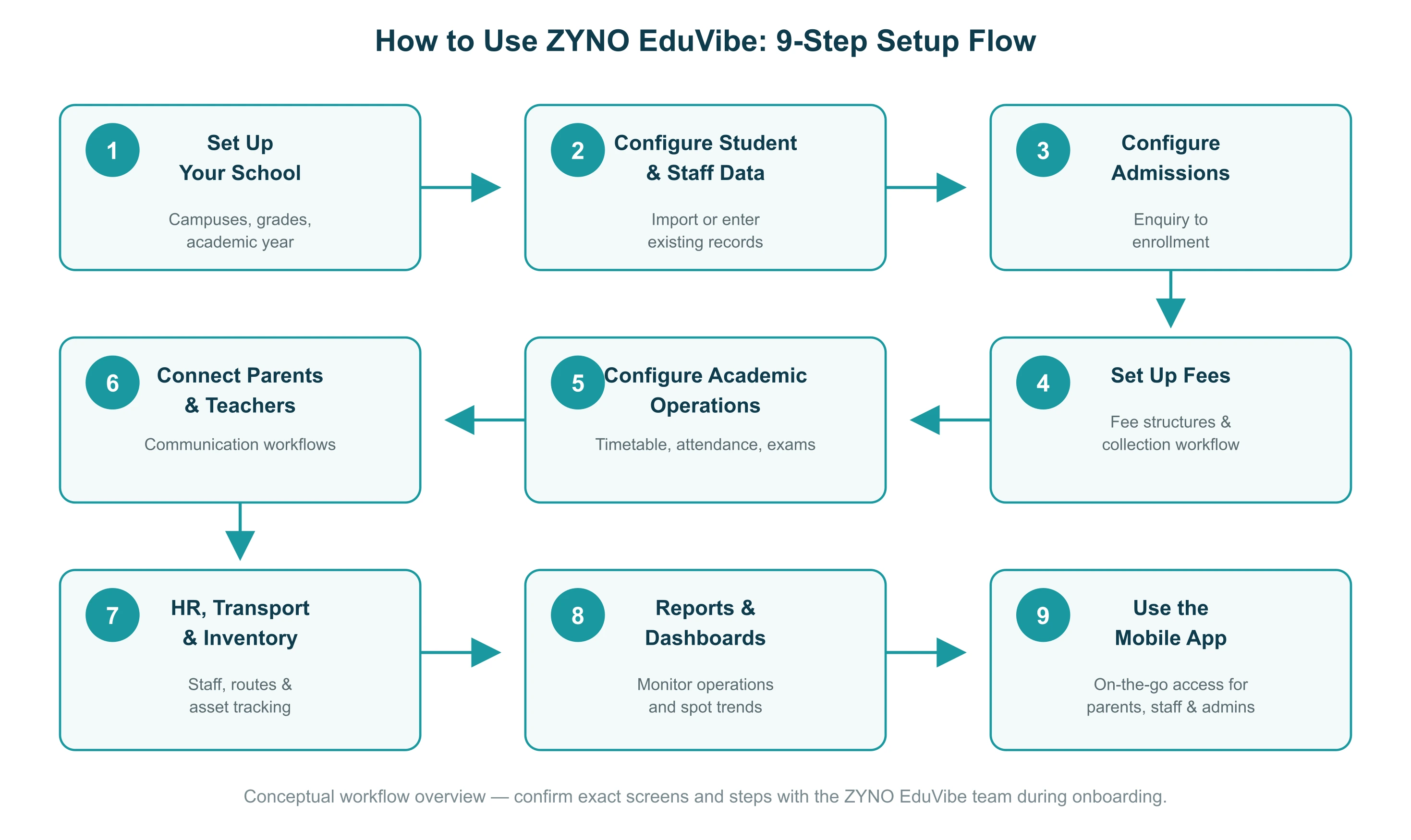
This is a conceptual overview of how schools typically set up and use a platform like ZYNO EduVibe. Exact screens and workflows should be confirmed with the ZYNO team during onboarding.
Step 1: Set Up Your School Configure your school's basic organizational structure - campuses, grade levels, sections, and academic year settings.
Step 2: Configure Student and Staff Data Import or manually enter existing student and staff records so the platform reflects your current enrollment and team.
Step 3: Configure Admissions Set up the admission workflow from initial enquiry through application review to final enrollment, so nothing gets lost between stages.
Step 4: Set Up Fees Define fee structures by grade, campus, or program, and configure how reminders and payment tracking should work.
Step 5: Configure Academic Operations Set up timetables, attendance capture, examination schedules, and assignment workflows for teachers and students.
Step 6: Connect Parents and Teachers Enable communication channels so parents receive updates on attendance, fees, homework, and announcements, and teachers can message parents directly when needed.
Step 7: Configure HR, Payroll, Transport and Inventory Set up staff records and payroll cycles, transport routes if applicable, and inventory tracking for school assets.
Step 8: Use Reports and Dashboards Once data is flowing in, administrators can review reports on attendance, fee collection, and academic performance to spot trends early.
Step 9: Use the Mobile App Where supported, parents, teachers, and administrators can access relevant information on the go rather than being tied to a desktop system.
Want to see the platform in action? Explore ZYNO EduVibe or request a personalized demo.
| School Requirement | ZYNO EduVibe Capability | Operational Benefit |
|---|---|---|
| Student records | Student Information Management | Centralized, consistent data across departments |
| Admissions | Admission Management | Fewer enquiries lost between stages |
| Fees | Fee Management | More consistent collection and fewer manual follow-ups |
| Exams | Examination Management | Faster result compilation and reporting |
| Communication | Parent-Teacher Communication | More timely, consistent updates to parents |
| Transport | Transport Management | Better route coordination and delay communication |
| HR | HR & Payroll | Centralized staff records and payroll processing |
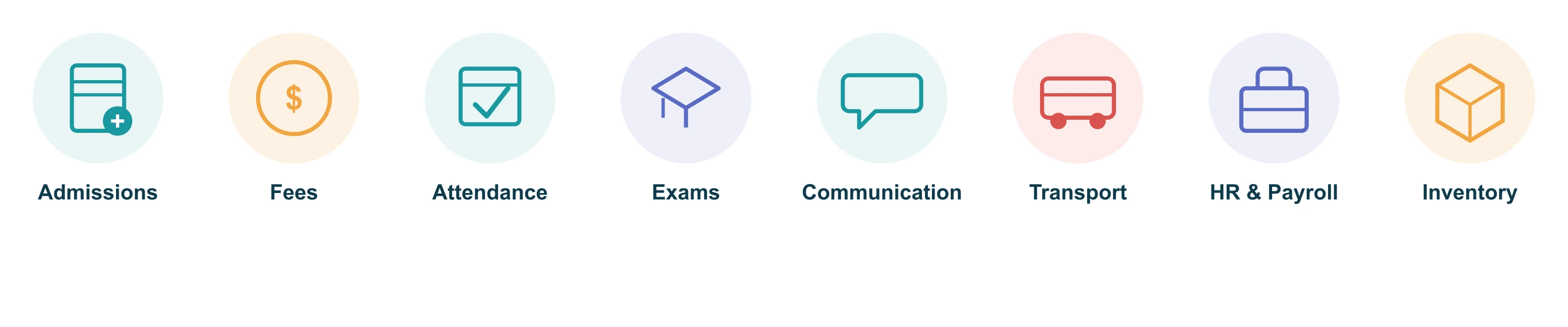
| Inventory | Inventory & Asset Management | Clearer visibility into school-owned assets |
Quick buyer checklist:
There's no single best option for every school. Schools looking for one connected platform to manage admissions, fees, attendance, and communication often consider ZYNO EduVibe alongside other established platforms, comparing features against their specific curriculum and operational needs.
Costs vary based on student count, number of campuses, modules required, and implementation needs. Rather than a fixed price, schools should request a detailed quote covering licensing, setup, training, and ongoing support.
Core features include student information management, admissions, fee management, attendance, examinations, timetabling, parent communication, and reporting. Schools with multiple campuses should also check for multi-campus support.
Yes. School ERP software is commonly used by private schools to manage admissions, fees, academics, and communication in one system, reducing reliance on spreadsheets and separate apps.
Yes, most platforms include fee management modules that handle fee structures, payment tracking, and automated reminders, though specific payment methods should be confirmed with each vendor.
Yes. Most platforms include attendance tracking and examination management modules that allow teachers to record attendance and administrators to compile and publish results.
Yes, many platforms support international schools, though schools should verify whether the software specifically accommodates their curriculum's grading and reporting requirements.
Support varies by vendor. Given Abu Dhabi's bilingual education environment, schools should confirm the extent of Arabic-language support before purchasing.
Most modern platforms offer a mobile app or mobile-friendly portal for parents to check attendance, fees, homework, and announcements, though functionality can vary between apps.
The terms overlap significantly. School ERP generally implies deeper integration across academic, financial, and HR operations, while school management software can refer more broadly to any platform managing school operations.
Implementation timelines vary based on school size, data migration needs, and the number of modules configured. Vendors should provide a specific timeline based on your school's setup during the sales process.
Start by defining your school's actual requirements, list the modules you need, test the reporting and mobile experience, involve both teachers and administrators, and compare total cost of ownership across a shortlist of vendors.
Abu Dhabi schools are increasingly moving away from disconnected spreadsheets and single-purpose apps toward integrated systems that can handle admissions, fees, attendance, examinations, and communication in one place. With close to 220 private schools operating across the emirate under more than a dozen curricula, the right choice depends less on brand recognition and more on whether a platform's features, security, support, and cost genuinely match your school's operational needs.
Across the options compared here, ZYNO EduVibe stands out as a strong choice for schools looking for a connected platform that covers core school operations without requiring several separate tools. That said, every school's requirements are different - curriculum, campus structure, and existing systems all play a role in which platform fits best. The right approach is to shortlist a few options, request demos, and compare them against your school's actual day-to-day workflow rather than a marketing checklist.
Ready to bring admissions, student records, fees, communication, and school operations into one platform? Talk to the ZYNO EduVibe team today.
Must Read:
1) Database Management for Perfectly Organized Student Records
2) Student Information Management: No Mess. Just Smart Schools
3) Fee Management, Simplified to Perfection
4) Database Management for Perfectly Organized Student Records
Top 10 School Management Software in India
Read More →What Is School ERP Software? The Complete Guide for Modern Schools
Read More →
How to Digitize Your School Operations Step-by-Step Guide
Read More →
Why School Administration Fails Without Proper Software
Read More →
Admission Management Software: A Complete Guide
Read More →
School ERP for Attendance, Fees, and Examination Management
Read More →
Can School ERP Software Reduce Manual Work in Schools?
Read More →
How Does School ERP Software Help Teachers, Students, and Parents?
Read More →
Japan's GIGA School Program and the Rise of Digital School Management
Read More →
Cloud-Based School Administration: The Backend Behind Japan's Digital Classrooms
Read More →
Ultimate Guide to School ERP Systems in 2026
Read More →
15 Benefits of School ERP Software for Modern Schools
Read More →
Best School Management Software in Abu Dhabi: Top Solutions for Schools in 2026
Read More →Partner with ZYNO by Elite Mindz to revolutionize how your business works. Fill out the form, and we’ll reach out with AI-powered solutions made just for you.
We use browser cookies to ensure you get the best experience on our website. Learn more
The form was submitted successfully!