The Ultimate Guide to Managing Your Business with ZYNO Books
Read More →3-way-matching-in-purchase-order-process

×
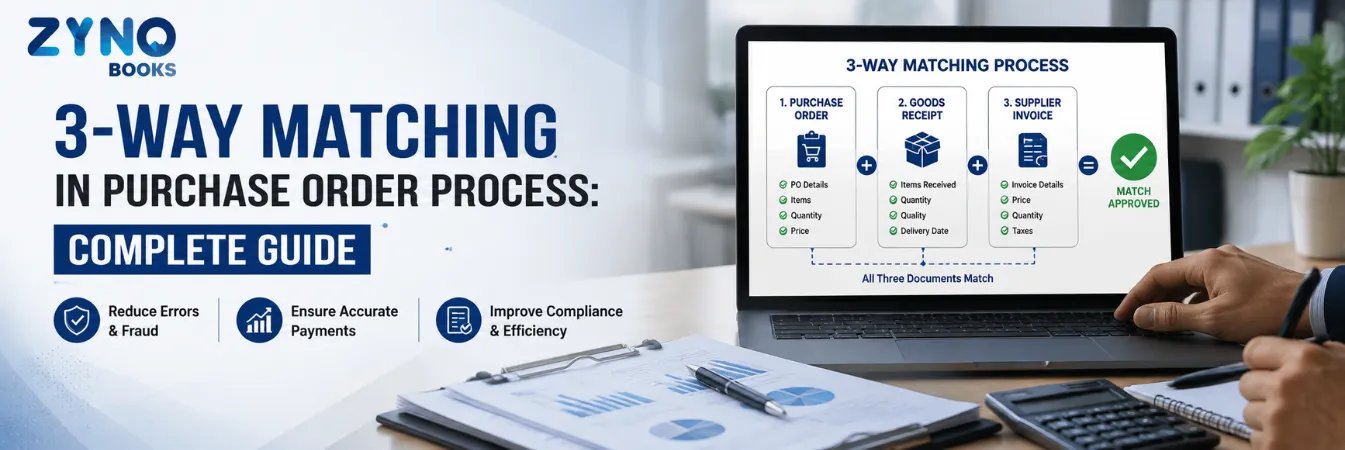
3-way matching in the purchase order process is an accounts payable control that cross-checks the purchase order (PO), goods receipt note (GRN), and supplier invoice before approving payment. If quantities, prices, or vendor details don't match across all three documents, the invoice is held for review instead of being paid automatically.
Businesses using ZYNO Books cut accounting time by 70% and stay 100% ZATCA-compliant — automatically.
3-way matching in the purchase order process is an accounts payable control that cross-checks three documents: the purchase order (PO), the goods receipt note (GRN), and the supplier invoice before a payment is approved. If the quantities, prices, or vendor details on all three don’t agree, the invoice is held back for review instead of being paid automatically.
Getting this right protects a business from overpaying, from duplicate or fraudulent invoices, and from the kind of quiet billing errors that never show up until the books don’t close. For finance teams in India where GST input tax credit is tied directly to invoice accuracy, a weak matching process doesn’t just cost money; it can cost compliance too.
This guide breaks down how 3-way matching actually works, walks through a real numeric example, compares it with 2-way and 4-way matching, and, unlike most guides on this topic, goes deep into the specific errors that derail matching in practice and how to prevent them.
3-way matching is the accounts payable step that sits between “we ordered something” and “we paid for it.” Before any vendor payment is released, an AP clerk (or, increasingly, software) lines up three separate documents and checks that the details agree:
• The Purchase Order (PO) the document your company issues to the vendor. It records what was ordered, the agreed price, quantity, and any internal approval or GL codes.
• The Goods Receipt Note (GRN) is also called a goods received note, delivery receipt, or receiving report. It’s the internal record confirming that the goods or services were actually received, and in what quantity or condition.
• The Supplier Invoices the vendor’s bill, requesting payment for what was supplied, including invoice number, GSTIN (for Indian vendors), amount, and payment terms.
When all three line up the same quantity, same price, same vendor, the invoice clears for payment. When they don’t, the system (or the AP clerk) puts a hold on it until someone investigates why.
Without this check, an AP team is essentially trusting the vendor’s word. A supplier bills for 500 units. Did 500 actually arrive? Were they the right ones? Was the rate what was agreed? Without documented proof at every stage, someone ends up chasing emails and making judgment calls under time pressure.
3-way matching replaces that guesswork with evidence. Three specific benefits stand out:
• Fraud and duplicate-payment prevention: Small businesses face billing fraud at roughly twice the rate of larger firms, and invoice fraud is estimated to cost organizations close to 5% of annual revenue when it goes undetected, according to the Association of Certified Fraud Examiners' Report to the Nations. A mismatched PO or missing GRN is usually the first flag that catches this.
• Cleaner GST input tax credit claims: For Indian businesses, ITC eligibility depends on the invoice matching what was actually procured and received. A 3-way mismatch that goes unnoticed can mean claiming credit on goods that were short-delivered or over-billed a problem that surfaces later during GSTR-2B reconciliation on the GST Portal or audit.
• Audit readiness: Every approved payment has a paper trail across three documents, which makes both internal and statutory audits considerably faster to close.
Say a manufacturing SME raises a PO to a packaging supplier for 1,000 corrugated boxes at ₹50 per box a total of ₹50,000 plus applicable GST.
The delivery arrives. The warehouse team counts and records only 950 boxes on the GRN.
The supplier then sends an invoice for ₹52,500 (before GST), billing for the full 1,000 boxes at a slightly higher rate.
At this point, the match fails on two counts: the GRN shows 950 units, not 1,000, and the invoice rate doesn’t match the PO’s agreed ₹50/unit. Before the AP team approves payment, someone needs to establish whether this was a short shipment, a pricing error, or simply a mistake on the vendor’s side. Without 3-way matching, this ₹52,500 invoice could be paid in full, along with GST charged on the discrepancy money and input credit the business would then have to chase back.
Not every purchase needs the same level of scrutiny. Here’s how the three approaches compare:
| Matching Type | Documents Compared | Best Used For | Fraud Protection |
|---|---|---|---|
| 2-Way Matching | PO + Invoice | Services, recurring bills, low-value or below-threshold purchases | Basic |
| 3-Way Matching | PO + GRN + Invoice | Physical goods, new vendors, mid-to-high value orders | Strong |
| 4-Way Matching | PO + GRN + Invoice + Inspection/QC Report | Manufacturing, pharma, regulated or specification-critical goods | Highest |
As a rule of thumb: the higher the transaction value and the more variable the delivery, the stronger the case for moving from 2-way to 3-way or, in regulated industries, to 4-way matching.
3-way matching touches more departments than most people assume it isn’t purely a finance task. Each stakeholder owns one document, and the match only holds together if every department plays its part correctly and on time. Here’s exactly who owns what:
| Department | Owns | Key Responsibility | Risk If This Fails |
|---|---|---|---|
| Procurement | Purchase Order (PO) | Raise a PO for every purchase before ordering, with the correct quantity, price, and vendor details. | Nothing to match against invoices, leading to approvals based only on trust. |
| Receiving / Warehouse | Goods Receipt Note (GRN) | Physically count and record goods on the day of delivery, not from memory or estimates. | Silent matching failures in 2-way processes; short deliveries go undetected. |
| Accounts Payable | The Match Itself | Compare the PO, GRN, and invoice; investigate and resolve discrepancies before payment. | Errors, fraud, or overpayments pass directly into the payment process. |
| Vendor / Supplier | Supplier Invoice | Invoice only for delivered goods at the agreed price, with accurate GSTIN and tax details. | Payment delays and invoice disputes when details do not match. |
| Finance / Compliance | Tolerance Policy & GST Reconciliation | Define acceptable variance thresholds and reconcile GST fields against GSTR-2B. | Inconsistent approvals and incorrect ITC claims. |
When one of these links is weak procurement skipping POs under time pressure, or receiving logging counts from memory the whole match becomes unreliable, no matter how carefully the AP team checks it on their end. This is why 3-way matching should be treated as a cross-departmental policy, not a finance-only checklist.
Most businesses don’t fail at 3-way matching because they misunderstand the concept; they fail because of process gaps in how it’s run day-to-day. These are the errors that show up most often, along with what actually fixes them.
A team member calls a vendor directly, gets what they need, and the invoice shows up weeks later with nothing to match it against. This is the single most common breakdown, and it usually happens in departments outside finance: marketing, admin, facilities.
Fix: make “no PO, no payment” a company-wide policy, not just a finance guideline, and enforce it at the procurement stage rather than at the AP stage.
Goods receipt notes are frequently filled in from memory days after delivery, estimated rather than physically counted, or never raised at all for service-based purchases. When the GRN can’t be trusted, a 3-way match effectively becomes a 2-way match without anyone realizing the protection has quietly disappeared.
Fix: assign clear ownership of goods receipt to a specific role at the warehouse or receiving point, and require it to be logged the same day, with actual counts rather than estimates.
Not every mismatch is a real problem; a rounding difference of a few rupees, or a 0.5% quantity variance on a bulk order, shouldn’t hold up payment. But without a defined tolerance band, every small variance becomes a manual judgment call, and AP teams end up either over-flagging (creating bottlenecks) or under-flagging (missing genuine discrepancies).
Fix: set explicit tolerance percentages for quantity and price variance, separately for auto-approval and manual review, and revisit them periodically as vendor relationships mature.
This one is specific to Indian AP teams and rarely covered in matching guides written for a global audience. An invoice can match perfectly on quantity and base price but still fail on the GST component: wrong GSTIN, incorrect HSN/SAC code, mismatched tax rate, or a value that doesn’t reconcile with what shows up in GSTR-2B on the GST Portal. If this slips through, the business either claims ITC it isn’t entitled to or under-claims credit it’s owed.
Fix: build GST field validation into the matching step itself, not as a separate downstream reconciliation checking GSTIN, tax rate, and HSN code alongside quantity and price, ideally auto-cross-referenced against GSTR-2B.
Month-end deadlines, staff shortages, or a sudden spike in invoice volume push AP teams to approve payments without completing the full match. When matching is a manual, multi-step task, this shortcut is always available and always tempting.
Fix: This is the error automation solves most directly. When matching happens automatically at invoice intake, there’s no manual step left to skip.
The same invoice gets submitted twice, sometimes by accident, sometimes deliberately under a slightly different invoice number or date, and gets matched and paid each time separately because no one checks for near-duplicates. This is one of the harder errors to catch manually, since each individual match can look perfectly valid on its own; the problem only becomes visible when you compare across invoices, not within one.
Fix: run duplicate-detection logic against vendor ID, amount, and date range before matching begins, not just against exact invoice numbers.
A quick-reference summary of all six, for anyone auditing their own process:
| Error | Root Cause | Quick Fix |
|---|---|---|
| No PO raised | Informal, off-system purchasing | "No PO, no payment" policy |
| Inaccurate/missing GRN | No clear receiving ownership | Assign GRN owner; log same-day |
| Undefined tolerances | No written variance policy | Set explicit % thresholds |
| GST/tax-field mismatch | GST not checked at match stage | Validate GSTIN/HSN in the match |
| Manual steps skipped | Volume or time pressure | Automate the matching step |
| Duplicate invoices paid | No cross-invoice duplicate check | Run vendor + amount + date checks |
Getting 3-way matching right has less to do with the matching step itself and more to do with the processes feeding into it.
Manual 3-way matching is workable at low invoice volumes and becomes genuinely difficult to sustain the moment a business scales more vendors, more POs, more exceptions to chase, and less time to chase them in.
AI-powered accounting platforms like ZYNO Books and ZYNO Expenz are built to handle this automatically: the moment an invoice is received, it’s compared against the PO and GRN on file, GST fields are validated against GSTIN and HSN records, and only genuine discrepancies are routed to a human for review. For Indian SMEs specifically, this also means matching and GST reconciliation happen as a single connected step, instead of two separate processes that only get compared at month-end, by which point a mismatch is far more expensive to unwind.
The result isn’t just faster payments; it’s an AP team that spends its time on the handful of invoices that genuinely need a decision, instead of manually checking the hundreds that already match.
It’s an accounts payable control that compares the purchase order, goods receipt note, and supplier invoice before a payment is approved, to confirm that what was ordered, received, and billed all agree.
Three documents: the purchase order (PO), the goods receipt note (GRN) or delivery receipt, and the supplier invoice.
2-way matching compares only the PO and the invoice, without confirming that the goods were actually received. 3-way matching adds the GRN as a third check, which is why it’s the stronger control for physical goods.
ITC eligibility depends on the invoice accurately reflecting what was ordered and received. A 3-way mismatch that isn’t caught wrong quantity, incorrect GSTIN, or a mismatched tax rate can lead to over-claiming or under-claiming credit, which typically surfaces later during GSTR-2B reconciliation on the GST Portal or during audit.
Yes. AP automation and accounting platforms such as ZYNO Books can match PO, GRN, and invoice data automatically as invoices arrive, flag discrepancies in real time, and route only genuine exceptions for manual review.
The invoice is placed on hold rather than paid. An AP clerk (or an automated workflow) investigates which document is out of line quantity, price, or vendor details and routes the discrepancy to the relevant department, such as procurement or receiving, before the payment can be released.
A tolerance threshold is a pre-defined acceptable variance, usually a small percentage of quantity or price within which a mismatch is auto-approved instead of manually reviewed. It stops minor rounding differences from creating unnecessary payment holds while still catching genuine discrepancies.
Not usually. Since services don’t have a physical delivery to count, most businesses use 2-way matching (PO plus invoice) for services and reserve 3-way matching for purchases involving physical goods, where a GRN is meaningful.
It varies with volume and document quality, but manually cross-referencing three documents and resolving a discrepancy commonly takes anywhere from a few minutes for a clean match to well over an hour when a mismatch needs investigation across departments, which is the main reason growing businesses move to automated matching.
3-way matching isn’t complicated as a concept: three documents, one comparison. What makes it hard is holding the process together under real business conditions: informal purchasing, late or estimated GRNs, undefined tolerances, and, for Indian businesses, GST fields that don’t always get checked as carefully as quantity and price. Getting the upstream discipline right mandatory POs, owned GRNs, defined tolerances, and GST validation built into the match is what turns 3-way matching from a paperwork exercise into a genuine control against fraud, overpayment, and compliance risk
The Ultimate Guide to Managing Your Business with ZYNO Books
Read More →
Why Is 206CR of Income Tax Act Important for Businesses in India?
Read More →The Best Accounting Software in Saudi Arabia
Read More →
Managing Multi-Country Taxes Made Easy with ZYNO Books Integrations
Read More →
Why TRN Validation is Essential for VAT Compliance in the UAE
Read More →
Best Accounts Payable Automation Software
Read More →Best Cloud Accounting Software in Kenya with M-Pesa Integration (2026) - eTIMS Compliant
Read More →Ultimate Cloud Accounting Software Guide That Saves Businesses 15+ Hours Weekly
Read More →ZATCA E-Invoicing Saudi Arabia - Complete Business Guide 2026
Read More →Cloud Accounting vs Desktop Accounting - Which Is Best for Your Business?
Read More →
Zyno Books: Best ZATCA-Approved Accounting Software in Saudi Arabia
Read More →
Best Tally Alternative in India (2026) — 6 Options Compared + Honest Pros & Cons
Read More →
Pin to Pin Distance GST: Free E-Way Bill Calculator, Validity & Penalty Guide (2026)
Read More →
Best Small Business Accounting Software in 2026: Complete Guide
Read More →
20 Best Accounting Software in India for 2026 - Free & Paid (GST + Tally Ready)
Read More →
Best Accounting Software for Small Business in South Africa (2026)
Read More →
What Is a Proforma Invoice? Complete Guide with Format, Examples & Free Template (2026)
Read More →
Which Accounting Software is Better for Modern Businesses?
Read More →
Bank Reconciliation Statement (BRS): Meaning, Full Form, Format & Examples
Read More →
Which Accounting Program Handles GST Best?
Read More →
AI Accounting Software in India: The Next Generation
Read More →
Which Document Management Software Offers OCR and Workflow Automation?
Read More →
How to Manage ISO Documents and Compliance Records Digitally?
Read More →
Which Are the Best Accounting Softwares Other Than Tally?
Read More →
ZYNO DMS vs SharePoint: A Detailed Comparison for Enterprise Document Control?
Read More →
How to Control Document Versions and Revisions Without Excel?
Read More →
How to Automate Document Approval Workflows Across Departments?
Read More →
Which Is the Best Accounting Software in India? (2026 Guide)
Read More →
Best Accounting Software in Kenya (2026): Cloud-Based, VAT-Ready & Built for SMEs
Read More →
Cloud Accounting Software Comparison: Which One Is Right for Your Business?
Read More →
GST Accounting Software Comparison for Indian Businesses (2026 Guide)
Read More →
Zyno Books vs Vyapar: Which One Gives You More Value?
Read More →
OCR Invoice Processing: The Complete Guide for Finance Teams in 2026
Read More →
Accounting Software: The Complete Guide for Businesses in 2026
Read More →
Purchase Order Management: Meaning, Types, Format & Complete Guide (2026)
Read More →
Purchase Order vs Purchase Requisition vs Invoice: Complete Guide (2026)
Read More →
Types of Purchase Orders Explained: SPO, PPO, BPO & CPO (With Real Examples)
Read More →
Purchase Order Format: Complete Guide (GST & HSN Compliant) & Free Template
Read More →
ZynoBooks vs QuickBooks: Which AI Powered Accounting Software Is Right for Your Business in 2026
Read More →
3-Way Matching in Purchase Order Process: Complete Guide
Read More →Partner with ZYNO by Elite Mindz to revolutionize how your business works. Fill out the form, and we’ll reach out with AI-powered solutions made just for you.
Download your exclusive guide
We use browser cookies to ensure you get the best experience on our website. Learn more
The form was submitted successfully!
From our first line of code to ZYNO's AI-powered ERP suite — 17 years of helping businesses run smarter. Celebrating with our clients and partners on 1st August.
Book a free ZYNO consultation this anniversary week and get a special 17th-year offer on your first project.
Anniversary discount on your first ZYNO engagement, valid till 7th August.
Your anniversary offer request has been received.
Our team will connect with you within one business day.
ZYNO Digital
Fueling Smarter Digital Growth
ZYNO Digital fuels smarter digital growth through data-driven marketing, creative storytelling, and performance strategies that boost visibility, engagement, and measurable business outcomes across global platforms.
ZYNO Tech
Engineering the Future of IT
ZYNO Tech delivers cutting-edge IT solutions — including web, mobile, and digital transformation services — helping businesses scale efficiently, innovate faster, and stay ahead in a connected world.
ZYNO AI
AI Built for Business Growth
ZYNO AI harnesses the power of artificial intelligence to automate processes, enhance decision-making, and deliver predictive insights — driving innovation, agility, and measurable business growth.
ZYNO by Elite Mindz
Your Partner in the AI-Powered Future
ZYNO by Elite Mindz offers AI-powered products and services that unify operations, boost productivity, and drive digital transformation — helping businesses scale smarter and innovate faster.
* In just 2 mins you'll get a response
* Your idea is 100% protected by our Non-Disclosure Agreement