The Ultimate Guide to Managing Your Business with ZYNO Books
Read More →

×
purchase order meaning comes down to this: it's a written confirmation of what a business wants to buy, how much of it, at what price, and by when sent to a vendor before any money changes hands or goods are delivered.
Businesses using ZYNO Books cut accounting time by 70% and stay 100% ZATCA-compliant — automatically.
A purchase order (PO) is a formal, legally binding document a buyer sends to a supplier to request specific goods or services at an agreed price, quantity, and delivery timeline. Once the vendor accepts it, the purchase order becomes a contract both parties must honor.
For finance and procurement teams, purchase orders aren't just paperwork; they are the foundation of controlled spending, clean audit trails, and accurate invoice matching. If you've been searching what is purchase order, this guide covers everything: purchase order meaning, the different types of purchase orders, the exact purchase order format to use, a real purchase order example, and how modern purchase order management software is changing the way Indian businesses handle procurement.
In simple terms, purchase order meaning comes down to this: it's a written confirmation of what a business wants to buy, how much of it, at what price, and by when sent to a vendor before any money changes hands or goods are delivered.
This is the key difference between a purchase order and an invoice. A PO is issued by the buyer before the transaction to request goods or services. An invoice is issued by the seller after delivery to request payment. Confusing the two is one of the most common mistakes new procurement teams make.
Once a supplier accepts a purchase order by signing it, confirming it in writing, or fulfilling the order it becomes a legally binding agreement. That's why accuracy in a PO matters: errors in quantity, pricing, or delivery terms can lead to disputes, delayed payments, or compliance issues, especially under GST where invoice-to-PO mismatches can hold up input tax credit claims.
In early-stage businesses, purchasing is often informal: a WhatsApp message to a vendor, a verbal approval from a manager, and an invoice paid on trust. This works fine at low volume. But as a company scales, purchases multiply across departments, and without a structured purchase management process, businesses lose visibility into what was ordered, what was approved, and what's still outstanding.
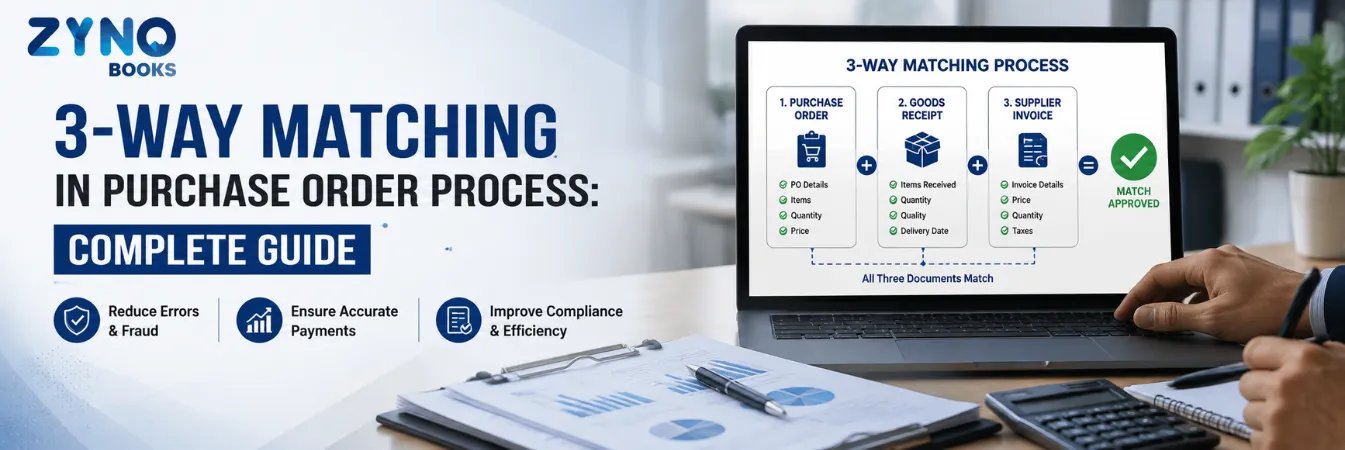
A purchase order fixes this by creating a single, shared source of truth for both buyer and vendor. It documents the order details upfront, gives legal clarity once accepted, and builds an audit trail that supports budget forecasting and three-way invoice matching (PO, goods receipt, and invoice) later in the cycle.
Purchase orders directly support purchase management by helping businesses:
Not every purchase follows the same pattern, so businesses rely on different types of purchase orders depending on how predictable the order is and how often it repeats.
The most common type, used for one-time purchases with clearly defined item, quantity, price, and delivery date. Ideal for ad-hoc or non-recurring orders.
Used when the item, quantity, and pricing are already known, but the exact delivery schedule is spread out over time. Release dates are confirmed closer to the actual need.
Issued for recurring purchases from the same vendor over a set period common for raw materials, office supplies, or maintenance services. Pricing and terms are locked in advance, while exact quantities can vary per release.
A broader framework agreement that sets terms and conditions with a vendor without committing to specific quantities or delivery dates upfront. Individual POs are then issued under this master contract as needed.
Choosing the right type of purchase order instead of defaulting to a standard PO for everything reduces administrative overhead and makes forecasting far more accurate, which is the real goal of purchase order management.
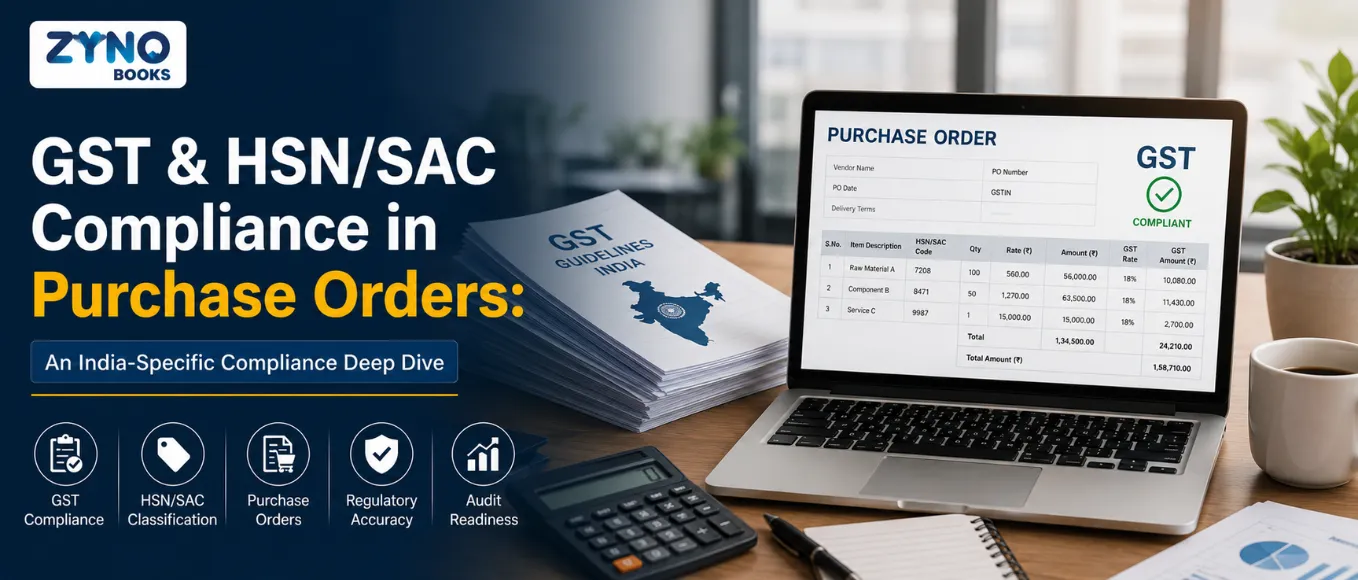
A well-structured purchase order format leaves no room for ambiguity. For Indian businesses, this also means factoring in GST fields, HSN/SAC codes, and TDS terms details that generic, global PO templates often miss. Here's a complete breakdown of what a standard purchase order format should contain:
| Field | What It Covers |
|---|---|
| PO Number | Unique identifier used to track and reference the order across systems. |
| Issue Date & Delivery Date | When the PO was raised and when delivery is expected. |
| Buyer Details | Company name, GSTIN, billing address, and contact person. |
| Vendor Details | Supplier name, GSTIN, address, and bank details. |
| Item Description | SKU/product code, description, HSN/SAC code, quantity, and unit. |
| Pricing | Unit price, subtotal, applicable GST (CGST/SGST/IGST), and grand total. |
| Payment Terms | Net 30, advance payment, TDS applicability, or milestone-based terms. |
| Shipping Details | Delivery address, mode of transport, and freight terms. |
| Terms & Conditions | Warranty, return policy, penalty clauses, and cancellation terms. |
| Authorized Signatory | Approval signature or digital approval trail confirming validity. |
The exact fields can vary slightly by industry and company policy, but skipping GST or HSN details on a purchase order raised in India is a common and costly mistake, since it complicates reconciliation with GSTR filings later.
Download our professionally designed Purchase Order Template and streamline your purchasing process. Available in Excel, Word, or PDF format, it's completely free and ready to use.
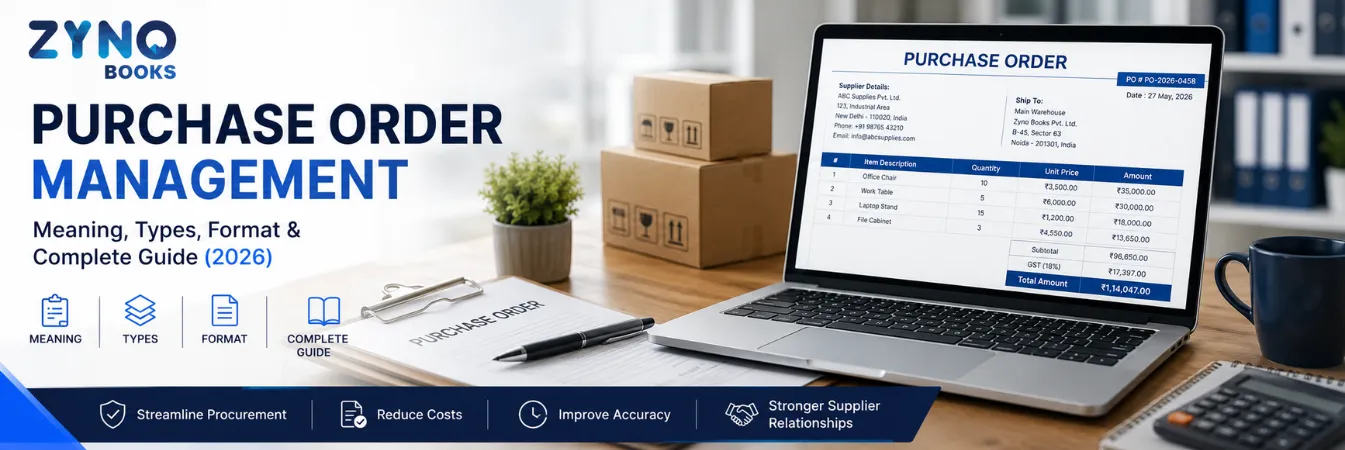
⬇ Download Free TemplateHere's a simplified purchase order example to show how the format comes together in a real document:
This example shows why a consistent purchase order format matters; every field maps directly to what accounts payable will need later to match the invoice and process payment without back-and-forth.
This cycle from requisition to payment is exactly what purchase order management software is built to automate and monitor end-to-end.
These three documents are often used interchangeably, but each plays a distinct role in the purchase management cycle:
| Document | Purchase Requisition | Purchase Order | Invoice |
|---|---|---|---|
| Raised by | Internal department/employee | Buyer's purchasing team | Seller/vendor |
| Sent to | Internal approver | External vendor | Buyer |
| Purpose | Requests permission to buy | Confirms and requests the order | Requests payment after delivery |
| Timing | Before purchase | Before delivery | After delivery |
| Legally binding? | No | Yes, once accepted | Yes, as payment demand |
As purchase volumes grow, manual purchase order management spreadsheets, email approvals, and physical signatures becomes a bottleneck rather than a control. For Indian SMEs specifically, this is compounded by GST return filing, TDS deduction under Section 194Q, and e-invoicing requirements that demand tighter, cleaner documentation than a generic PO process was ever designed for.
Digital purchase order management software solves this by connecting requisition, approval, PO creation, GST-compliant formatting, and invoice matching into a single workflow instead of scattered emails and disconnected files. Businesses evaluating a shift typically see improvements in three areas: faster approval cycles, fewer invoice mismatches, and real-time visibility into committed spend before it hits the books.
ZYNO Expenz, Elite Mindz's AI-powered expense management platform built for Indian SMEs, brings purchase order management into the same system businesses already use for expense tracking and approvals. Instead of juggling separate tools for POs, expense claims, and vendor payments, teams get:
For growing businesses that have outgrown spreadsheet-based purchase management but aren't ready for a heavy, complex ERP rollout, this kind of integrated, India-first approach closes the gap between control and simplicity.
Having a PO process in place isn't the same as having good purchase order management. These practices separate businesses that run purchasing smoothly from ones that constantly firefight mismatched invoices and approval delays.
When one department includes full vendor, GST, and pricing details, and another skips half of them, invoice matching becomes inconsistent. A locked template with mandatory fields for GSTIN, HSN/SAC, and payment terms removes the guesswork.
Not every purchase needs three levels of sign-off. Tiered approval limits based on order value keep small, low-risk purchases moving fast while still enforcing oversight on larger commitments.
Waiting until month-end to see how much has actually been committed defeats the purpose of purchase management. Real-time tracking flags overspending before it happens, not after the invoice lands.
Every invoice should be checked against its PO and the goods receipt before payment is released. Skipping this step is how duplicate payments and "no-PO" invoices slip through.
Late deliveries, price deviations, and repeated disputes show up clearly once PO data is centralized giving procurement teams a factual basis for vendor negotiations rather than relying on memory.
Even businesses with a formal PO process run into avoidable problems. The most frequent ones include:
Most of these mistakes trace back to one root cause: managing purchase orders manually across emails, spreadsheets, and paper files instead of a single connected system.
A purchase order is a formal document a buyer sends to a vendor requesting specific goods or services at an agreed price and delivery timeline. Once accepted by the vendor, it becomes a legally binding contract.
Purchase order meaning, in plain language, is a written promise from a buyer: this is what we want, how much, at what price, and by when issued before goods are delivered or paid for.
The four main types are Standard Purchase Orders (one-time buys), Planned Purchase Orders (known pricing, scheduled delivery), Blanket Purchase Orders (recurring purchases from one vendor), and Contract Purchase Orders (framework agreements without fixed quantities).
At minimum: PO number, issue and delivery dates, buyer and vendor details (including GSTIN for Indian businesses), itemized descriptions with HSN/SAC codes, pricing and GST breakup, payment terms, shipping details, and an authorized signature.
Yes once the vendor accepts the terms of a purchase order, whether by signature, written confirmation, or fulfillment, it becomes a legally binding agreement enforceable by both parties.
Purchase order management is the end-to-end process of creating, approving, tracking, and closing purchase orders from initial requisition through vendor acceptance, delivery, invoice matching, and payment. Effective purchase order management keeps spend visible and audit-ready at every stage.
A purchase order is the actual document issued for a specific transaction, while a purchase order example or template is a reusable format with standard fields like PO number, GSTIN, HSN/SAC codes, and payment terms that businesses fill in each time they raise a new PO.
Yes. Modern purchase order management tools are built to sync with accounting platforms so that approved POs, GST details, and payment terms flow through without manual re-entry. ZYNO Books, Elite Mindz's AI accounting software, connects directly with ZYNO Expenz so that purchase orders, vendor invoices, and ledger entries stay reconciled automatically instead of being tracked separately.
Even low-volume buyers benefit once purchases cross a handful of vendors or recurring orders. A formal purchase order format prevents pricing disputes, keeps GST input tax credit claims clean, and gives a paper trail that informal WhatsApp or email orders simply don't provide.
A purchase order is far more than a formality; it's the control point that keeps spending visible, vendors accountable, and invoices accurate. Whether you're issuing a handful of standard POs a month or managing hundreds of blanket and contract orders across departments, the fundamentals stay the same: a consistent purchase order format, clear approval routing, and disciplined 3-way matching before payment goes out.
For Indian businesses, getting purchase order management right also means building GST, HSN/SAC, and TDS compliance into the process from day one, rather than fixing it during reconciliation. As purchase volumes grow, moving from spreadsheets and email approvals to a connected purchase order management system like ZYNO Expenz is what turns purchasing from a recurring headache into a predictable, audit-ready proces
The Ultimate Guide to Managing Your Business with ZYNO Books
Read More →
Why Is 206CR of Income Tax Act Important for Businesses in India?
Read More →The Best Accounting Software in Saudi Arabia
Read More →
Managing Multi-Country Taxes Made Easy with ZYNO Books Integrations
Read More →
Why TRN Validation is Essential for VAT Compliance in the UAE
Read More →
Best Accounts Payable Automation Software
Read More →Best Cloud Accounting Software in Kenya with M-Pesa Integration (2026) - eTIMS Compliant
Read More →Ultimate Cloud Accounting Software Guide That Saves Businesses 15+ Hours Weekly
Read More →ZATCA E-Invoicing Saudi Arabia - Complete Business Guide 2026
Read More →Cloud Accounting vs Desktop Accounting - Which Is Best for Your Business?
Read More →
Zyno Books: Best ZATCA-Approved Accounting Software in Saudi Arabia
Read More →
Best Tally Alternative in India (2026) — 6 Options Compared + Honest Pros & Cons
Read More →
Pin to Pin Distance GST: Free E-Way Bill Calculator, Validity & Penalty Guide (2026)
Read More →
Best Small Business Accounting Software in 2026: Complete Guide
Read More →
20 Best Accounting Software in India for 2026 - Free & Paid (GST + Tally Ready)
Read More →
Best Accounting Software for Small Business in South Africa (2026)
Read More →
What Is a Proforma Invoice? Complete Guide with Format, Examples & Free Template (2026)
Read More →
Which Accounting Software is Better for Modern Businesses?
Read More →
Bank Reconciliation Statement (BRS): Meaning, Full Form, Format & Examples
Read More →
Which Accounting Program Handles GST Best?
Read More →
AI Accounting Software in India: The Next Generation
Read More →
Which Document Management Software Offers OCR and Workflow Automation?
Read More →
How to Manage ISO Documents and Compliance Records Digitally?
Read More →
Which Are the Best Accounting Softwares Other Than Tally?
Read More →
ZYNO DMS vs SharePoint: A Detailed Comparison for Enterprise Document Control?
Read More →
How to Control Document Versions and Revisions Without Excel?
Read More →
How to Automate Document Approval Workflows Across Departments?
Read More →
Which Is the Best Accounting Software in India? (2026 Guide)
Read More →
Best Accounting Software in Kenya (2026): Cloud-Based, VAT-Ready & Built for SMEs
Read More →
Cloud Accounting Software Comparison: Which One Is Right for Your Business?
Read More →
GST Accounting Software Comparison for Indian Businesses (2026 Guide)
Read More →
Zyno Books vs Vyapar: Which One Gives You More Value?
Read More →
OCR Invoice Processing: The Complete Guide for Finance Teams in 2026
Read More →
Accounting Software: The Complete Guide for Businesses in 2026
Read More →
Purchase Order Management: Meaning, Types, Format & Complete Guide (2026)
Read More →Partner with ZYNO by Elite Mindz to revolutionize how your business works. Fill out the form, and we’ll reach out with AI-powered solutions made just for you.
We use browser cookies to ensure you get the best experience on our website. Learn more
The form was submitted successfully!
ZYNO Digital
Fueling Smarter Digital Growth
ZYNO Digital fuels smarter digital growth through data-driven marketing, creative storytelling, and performance strategies that boost visibility, engagement, and measurable business outcomes across global platforms.
ZYNO Tech
Engineering the Future of IT
ZYNO Tech delivers cutting-edge IT solutions — including web, mobile, and digital transformation services — helping businesses scale efficiently, innovate faster, and stay ahead in a connected world.
ZYNO AI
AI Built for Business Growth
ZYNO AI harnesses the power of artificial intelligence to automate processes, enhance decision-making, and deliver predictive insights — driving innovation, agility, and measurable business growth.
ZYNO by Elite Mindz
Your Partner in the AI-Powered Future
ZYNO by Elite Mindz offers AI-powered products and services that unify operations, boost productivity, and drive digital transformation — helping businesses scale smarter and innovate faster.
* In just 2 mins you'll get a response
* Your idea is 100% protected by our Non-Disclosure Agreement