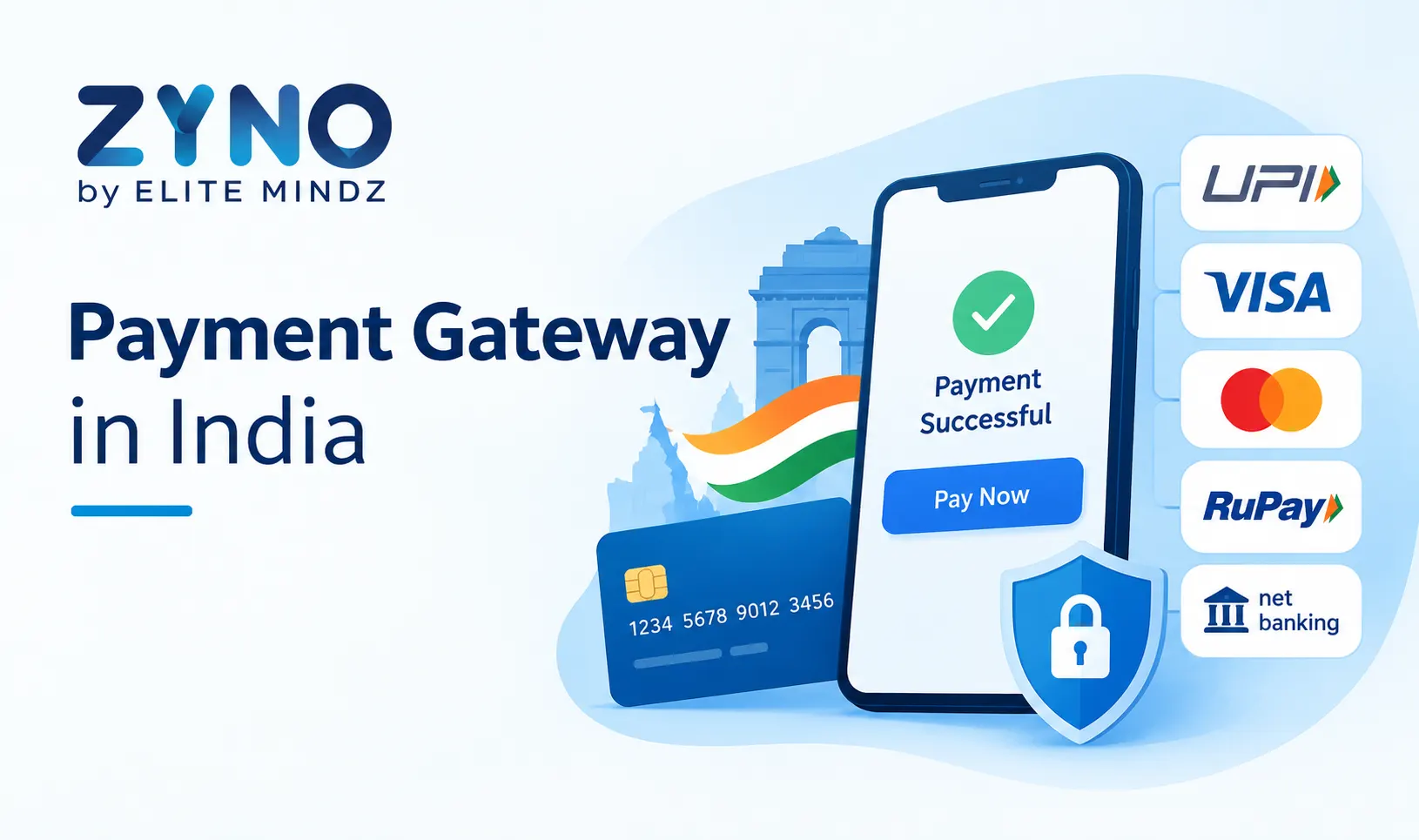
Payment Gateway in India
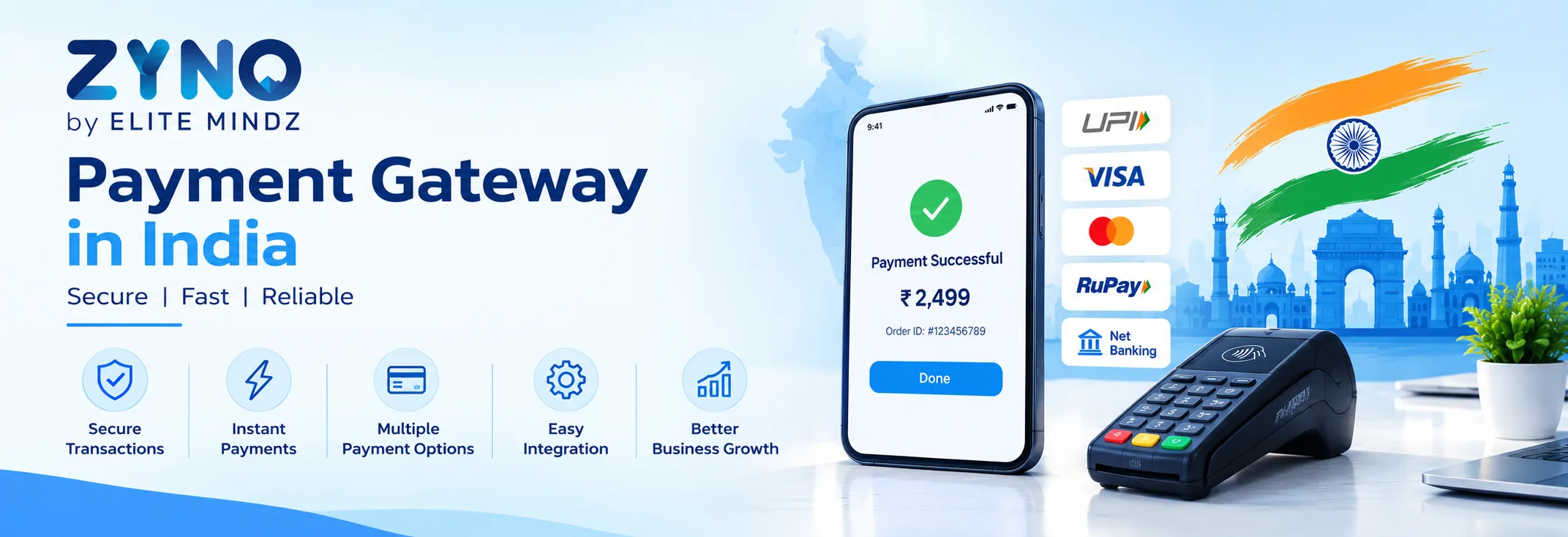
A payment gateway in India is a technology that enables businesses to accept online payments securely through UPI, debit and credit cards, net banking, and digital wallets. It connects customers, merchants, and banks to process transactions and confirm payment status. When choosing a payment gateway, businesses should compare transaction fees, settlement timelines, security features, refund management, and integration options. A reliable payment gateway helps e-commerce stores, service providers, and other businesses simplify checkout, improve payment tracking, and deliver a smoother customer experience.

Stop Losing Money to VAT Penalties & Manual Errors
Businesses using ZYNO Books cut accounting time by 70% and stay 100% ZATCA-compliant — automatically.

A payment gateway in India is a B2B solution that allows an Indian merchant to accept online payments through a website, payment link, or QR code. The practical question is whether its merchant onboarding rules, local payment methods, and transaction controls match the business. Operators should establish that fit before committing development resources.
A non-licensed technology gateway cannot take on regulated fund-handling functions merely by supplying checkout or routing software. Its role, the role of any financial partner, and the entity responsible for settlement must be clear in the commercial documents. The payment gateway provider may require incorporation records, tax details, bank evidence, ownership information, product descriptions, customer terms, and a working sales channel.
Missing documents, restricted products, unclear fulfillment, or inconsistent business details can stop activation before technical work begins. A B2B payment gateway also may approve one payment method without approving every method the merchant requested. Confirm the legal entity, business category, supported channels, and local-method availability for the live account rather than relying on a general feature page. This article is for merchant operators assessing enablement; it does not promise acceptance or a particular settlement schedule.
What Sets Merchant Payment Gateways Apart in India?
Local method access is useful only when it is enabled for merchant acceptance. A consumer’s ability to use UPI, PhonePe, PayTM, PayTM Wallet, or another wallet does not prove that a merchant can offer the same option through a commercial account. When assessing a payment gateway in India, the operator should confirm the payment modes, transaction type, checkout presentation, refund process, and settlement route in the proposed configuration.
Merchant KYC requires evidence that identifies the legal business, its owners, bank account, sales activity, website or app, and fulfillment model. This changes the go decision because a provider can decline a complete application when the underlying activity falls outside its policy; compare every application detail with the live storefront before submission. Resolve a bank account name that differs from the contracting entity during review, and make sure the refund, delivery, privacy, and contact pages describe the actual operation.
The GEO-method matters because it helps determine whether local payment rails are available for B2B acceptance, allowing the user to decide whether a gateway fits the intended market; a wallet logo alone says nothing about merchant activation. Obtain confirmation for UPI, PhonePe, and PayTM under the intended entity and use case. Check whether the method appears inside hosted checkout, an API process, a link, or a merchant QR. Also verify which status marks a completed payment and which results remain pending, failed, expired, refunded, or reversed.
Unified Payments Interface availability can vary by approved setup. Providers that support UPI may still restrict it by merchant category or channel, so check the enabled methods in the live account. PhonePe and PayTM likewise need method-level confirmation for the merchant account rather than an assumption based on their consumer products. If the business sells through several channels, ask whether approval applies to each website, app, online store, or remote collection process.
An E-commerce payment system needs reliable records for fulfillment and reconciliation. Compare the dashboard result with API notifications, order references, refund records, and bank credits. A recognizable brand or a broad set of payment options does not establish operational fit. The useful setup is the one that approves the merchant’s real sales activity and supplies records the team can reconcile.
Comparing Payment Gateway Features for Indian Merchants
A useful payment gateway comparison India review starts with evidence and operating consequences, rather than a logo list. The right payment gateway is the approved configuration whose methods, controls, and records match the merchant’s actual operation.
| Feature category | Check before onboarding | Fit signal | Failure or delay signal |
|---|---|---|---|
| Merchant KYC | Match legal name, owners, bank proof, tax details, storefront, product description, and fulfillment terms. | The application and customer-facing channel describe the same business. | Unclear ownership, mismatched records, hidden products, or incomplete policies trigger questions or refusal. |
| Local method support | Confirm merchant acceptance for local choices, including UPI, PhonePe, PayTM, wallets, and net banking, as well as refunds and each transaction status. | The approved methods cover the expected customer journey. | A consumer app is available, but commercial acceptance for the merchant category is not. |
| Cross-border acceptance | Check supported payer locations, currencies, contracting arrangement, acquiring route, and records required for international transactions and each international card payment. | The provider confirms the intended international payment corridor and business model for global customers. | The proposal assumes international acceptance without approval for the merchant or use case. |
| Integration options | Compare APIs, hosted checkout, payment links, and QR code against engineering and reconciliation needs. | The selected channel returns a durable reference for every payment attempt. | The sales channel works, but operations cannot match a transaction to an order or refund. |
| Commercial terms | Review how transaction volume, annual maintenance, recurring billing, requested features, and transaction charges affect the written proposal. | The proposal states the applicable commercial conditions and how changes are approved. | Charges or conditions are assumed from a general page rather than documented for the merchant. |
| Fund handling | Identify which authorized party receives customer funds and settles them to the merchant. | Contracts and statements clearly identify each party’s role. | A technology provider appears to pool or transfer funds without a clear authorized arrangement. |
| Settlement and exceptions | Review the settlement cycle, holds, reserves, deductions, dispute handling, customer support route, and escalation path. | Finance can reconcile gross collections, adjustments, net credits, and their effect on cash flow. | Pending verification, account review, disputes, or unmatched records delay access to funds. |
No ranking of the top payment gateway providers or list of popular payment gateways in India can replace these checks. PayU, Razorpay, Cashfree Payments, Cashfree, and CCAvenue should be assessed through the live commercial proposal and contract, as should other payment gateway providers in India. Availability can differ by merchant category and configuration. CCAvenue is one option to assess, not evidence that a particular method or account will be approved. Compare PayU and Razorpay separately if their proposed methods, contracting parties, or settlement conditions differ. A widely used payment service still requires merchant-specific approval.
Read this blog on your favourite platform
Key Steps to Enable a Payment Gateway for Your Indian Business
Map the commercial setup. Record the legal entity, beneficial owners, bank account, products, expected customer locations, currencies, sales channels, refund policy, and fulfillment process. A merchant onboarding payment gateway India review can stall when the application describes a marketplace while the website appears to be a direct seller. Correct the mismatch before submission and identify every domain or app intended for acceptance. A business in India should also state whether it expects payments across storefront, app, counter, or remote sales channels.
- Prepare onboarding evidence. Gather current incorporation, tax, identity, address, ownership, and bank documents requested by the provider. Make the business name and contact details consistent across the application and customer-facing pages. If a document is unavailable or outdated, disclose that early and ask whether an accepted substitute exists. Do not alter a document to force a match.
- Request method-level approval. List the required choices. Access to one local rail does not establish that every requested method is available. Record any restrictions that affect refunds, recurring payments, customer location, or order value.
- Select the acceptance channel. A payment link allows merchants to collect payments remotely without a full website integration because the buyer opens a hosted request; test the amount, expiration behavior, customer return, and reference captured by operations.
- Skip it when the order requires real-time inventory reservation or another control that only an API can coordinate.
- Assess QR acceptance. A merchant QR helps a business accept a payment at a point of sale or through a remote message because the customer can scan the QR code to open the request; check whether it is fixed or order-specific and how the resulting payment is matched. A static code can require a separate reconciliation procedure. Confirm that staff know which system result permits release of goods.
- Build and test the integration. Use test credentials where supplied, protect production credentials, validate results on the server, and store the provider reference with the order. Cover successful, failed, pending, duplicate, expired, refunded, and reversed outcomes before launch. Repeat the checks for every approved channel rather than assuming the API, link, and QR behave identically.
- Set operating ownership. Assign responsibility for transaction exceptions, reconciliation, verification requests, refunds, and settlement issues. Define who can release an order, who can issue a refund, and who contacts the provider when records disagree. Launch only after the dashboard export or API data can be matched to bank credits without relying on a customer screenshot.
Fit and Failure: When a Payment Gateway Works for Indian Merchants
The payment gateway India fit failure test starts with business transparency. The model fits a registered online business that can document its ownership, explain what it sells, publish clear customer terms, and reconcile each transaction from order through bank credit. It may fail when the applicant hides part of its catalog, submits inconsistent entity details, sells an unsupported category, or cannot show how customers receive the purchased product.
KYC refusal is not always a missing-document problem. A complete file can still be declined when risk policy excludes the activity, ownership cannot be verified, the website is unfinished, refund terms are unclear, or projected activity does not match operating evidence. Unsupported business types should be identified before technical work begins. Have the provider review the category, sales channel, payer locations, and fulfillment model before allocating engineering work. Approval for one entity, domain, or product line should not be treated as approval for another.
Settlement means the approved transfer of collected funds to the merchant and requires clear contractual roles because verification reviews, disputes, reserves, or unmatched transaction records can create settlement delays; check the agreed schedule and every condition that permits a hold. Faster settlements may improve cash flow only when the written arrangement, eligibility rules, and reconciliation process support them. Compare each settlement report with transaction references, refunds, adjustments, and the bank credit. If the figures differ, stop treating the dashboard total as final and trace the unmatched records before closing the period.
A provider that supplies payment infrastructure may rely on authorized financial partners for fund handling. The contract should identify the merchant’s counterparty and explain operational responsibility for collection, refunds, disputes, and settlement. For example, the Paykassma payment gateway should be assessed against the same method, contracting, KYC, and settlement criteria.
This approach is a poor fit for an applicant that cannot disclose ownership, maintain accurate customer-facing terms, or supply evidence for its sales. It also cannot remove provider policy restrictions or guarantee acceptance. No standard timeline is promised here because timing depends on the approved arrangement, transaction status, and any review conditions.
How to Integrate Local Payment Methods (UPI, PhonePe, PayTM)
Confirm eligibility before writing code. Give the provider the legal entity, merchant category, website or app, payer profile, products, refund terms, and expected acceptance channels. State that the request is to integrate UPI PhonePe PayTM payment gateway India methods for commercial acceptance. Obtain method-specific approval, since access to one option does not establish approval for the others.
- Choose the customer entry point. Use API checkout when an order system must create amounts and receive status automatically. Select a hosted page when the provider should present multiple payment choices. A payment link suits assisted or remote sales, while a QR code can support counter or remote collection.
- Record which channel owns expiration, cancellation, and return behavior.
- Define the order and payment records. Create an internal order reference before requesting payment, then store the provider's reference, amount, currency, method, timestamps, and current transaction state. Do not mark an order paid from a browser return alone. The server-side status or authenticated notification should control fulfillment.
- Configure UPI integration. Enable only the approved UPI presentation offered for the account and verify how the customer authorizes the payment. Test successful authorization, abandonment, pending status, expiry, duplicate notifications, reversal, and refund. Check whether the provider returns a stable reference that finance can use to locate the same payment later.
- Activate PhonePe and PayTM where approved. Determine whether they appear as distinct checkout choices or operate through another approved local route. The PhonePe payment gateway option must be approved for the merchant account before launch. Test each option on supported devices without assuming that the presence of a consumer application guarantees merchant acceptance. Confirm how method names appear in reports and whether refunds use the original reference.
- Secure the API implementation. Keep credentials on the server, validate notification signatures by the documented method, restrict access, log state changes, and make callback processing idempotent. API access helps automate payment status because the order system can query or receive provider records; check that a repeated notification cannot trigger fulfillment twice.
- Test transaction exceptions. Cover incorrect amounts, expired sessions, customer abandonment, delayed confirmation, duplicate attempts, partial fulfillment, refunds, reversals, and card transactions. Compare what the customer sees with the provider dashboard and server record. If one screen says successful while the authoritative record remains pending, pause fulfillment until the status is resolved.
- Reconcile before production launch. Export or retrieve payment records and match them to orders, refunds, adjustments, settlement entries, and bank credits. Investigate missing references rather than editing them manually. A suitable payment gateway in India for a particular business is the configuration that gives operations enough evidence to resolve these exceptions.
Visual Guide: Payment Flow for Indian Merchants
Use this numbered path to trace the payment flow India merchant teams see across their order system, gateway records, and bank reporting. Menu names vary by provider, so select the closest live label where an exact option is unavailable.
Open Payments or the equivalent live menu, then create or locate the order reference. The merchant’s website, hosted checkout, payment link, or QR starts the online payment process with an amount and approved method. Confirm that the merchant order reference is stored before sending the customer onward.
- At Checkout, the customer selects an available option and completes authorization through the relevant financial participant. A return to the merchant site does not establish final success. Show a waiting state when the authoritative result remains pending.
- Open Transactions and locate the provider reference. The gateway routes the request and records its status. The merchant system receives an authenticated notification or checks the API, then updates the order only when the result permits fulfillment. If a callback and a status query disagree, keep the order on hold and follow the provider’s documented status hierarchy.
- Open Orders in the merchant system and compare the order reference, amount, currency, method, and provider reference. Duplicate notifications should update the existing record rather than create another paid order. A failed or expired result must leave inventory and fulfillment in the correct state.
- Open Refunds when money must be returned. Link the request to the original transaction and track the refund under its own status rather than replacing the original payment record.
- Confirm whether partial refunds are supported before exposing that option to staff.
- Open Settlements or the corresponding report and compare eligible collections, refunds, disputes, adjustments, and the resulting bank credit. Settlement records complete the payment flow only when finance can match them to the merchant account. Escalate unexplained differences with the relevant transaction references.
API, payment link, and QR are distinct integration options, but each needs the same core controls: a stable order reference, an authoritative transaction result, and a reconciliation record. The dashboard may show an accepted request while a pending or reversed result still prevents fulfillment.
Indian merchant enablement starts before technical integration. Confirm that the provider accepts the legal entity, business category, payer profile, sales channel, and requested local payment methods. This is especially relevant to D2C brands and other businesses that need online acceptance across storefront and remote sales channels. Submit consistent ownership, bank, tax, storefront, and fulfillment evidence, then resolve any policy concern before allocating engineering work.
Method names need a commercial check. Verify UPI, PhonePe, and PayTM for the approved account, then test customer authorization, pending payments, failures, reversals, refunds, and duplicate notifications. Choose API checkout when order automation is required; use a hosted page, link, QR, or approved wallet when that operating model offers sufficient payment acceptance.
Before launch, match every transaction reference to the order record and test reconciliation through settlement and bank credit. Pause if the contracting parties or fund-handling roles are unclear, if an unsupported category appears in the catalog, or if operations cannot distinguish pending from successful payments. An Indian payment setup should be selected from documented fit, method approval, and usable exception data rather than a generic ranking.
A secure payment setup depends on approved methods, protected credentials, authenticated status updates, and reconciled records. These controls support the decision to accept payments via the approved channels; they do not guarantee provider approval or eliminate transaction reviews.
Table of Contents
Related Blogs
What Is a Point of Sale System and How Does It Work?
Read More →
Top 10 Point of Sale Software in India
Read More →
POS Systems Explained: A Beginner’s Guide
Read More →
Restaurant POS System in India: A Complete Buying Guide
Read More →
How a Multi-Store POS System Simplifies Multi-Location Business Management
Read More →
Best POS System for Retail Store: Features, Benefits & Buying Guide
Read More →
Supermarket POS Software in UAE: How to Simplify Sales, Inventory & Store Management
Read More →
Point of Sale Systems in Kenya: Features, Benefits & How to Choose the Right POS
Read More →
Store Inventory Excel Sheet Free Download: Templates, Formulas, and Tracking Tips
Read More →
Best Khatabook Alternatives in India 2026 (Free & Paid)
Read More →
POS Machine: Types, Features & How to Choose the Right One
Read More →
Top 8 Square Alternatives for Small Businesses in 2026
Read More →
Modern POS Solutions in Kenya for Retail, Restaurants and Growing Businesses
Read More →
Top Vyapar Alternatives: Best Billing & POS Software
Read More →
Grocery Store POS Software: Features, Benefits & Buying Guide
Read More →
POS System for Small Businesses: Features, Costs & Benefits
Read More →
POS Software Checklist: 15 Features Every Business Should Consider
Read More →
Top 10 POS Software for Retail Shops in India: Which One Fits Your Shop? (2026 Guide)
Read More →
Top 10 Restaurant Billing Software in India for 2026: Detailed Comparison Guide
Read More →
Cloud POS vs Traditional POS: Which Is Better for Your Business?
Read More →
Best POS Software for Clothing Stores With Size and Colour Inventory Tracking
Read More →
Best POS Software for Jewellery Shops: Features, Benefits and Buying Checklist
Read More →
Best POS for Pharmaceutical Wholesale and Retail: Features, Benefits and How to Choose
Read More →
10 Best POS Softwares in UAE for Retail and Restaurants
Read More →
Top 10 Mobile POS Systems for Small Retailers
Read More →
10 Best Pharmacy POS Software with Batch and Expiry Tracking
Read More →
Payment Gateway in India
Read More →
Best Salon Software with Billing and Appointment Booking (2027 Guide)
Read More →Let’s Build the Future Together
Partner with ZYNO by Elite Mindz to revolutionize how your business works. Fill out the form, and we’ll reach out with AI-powered solutions made just for you.

We use browser cookies to ensure you get the best experience on our website. Learn more
Thank you
The form was submitted successfully!