AI Enablement in the Age of Generative AI: ZYNO by Elite Mindz Leading the Charge
Read More →
×
How much does custom AI agent development cost in 2026? Explore real project price ranges from $15K to $300K+, compare development stages, hidden costs, timelines, and use our AI Agent Team Budget Calculator to estimate your project budget.
Businesses using ZYNO Books cut accounting time by 70% and stay 100% ZATCA-compliant — automatically.
If you're budgeting for an AI agent, the honest short answer is: typically, custom AI agent development costs are between $15,000 for a focused proof of concept and $300,000+ for a fully autonomous, enterprise-grade multi-agent system. Most mid-sized businesses building a real, production-ready agent land somewhere between $40,000 and $150,000.
The wide range isn't vague pricing — it reflects how differently "AI agent" gets used. A simple FAQ bot and a multi-system agent that reads your CRM, checks inventory, and processes payments are both called "AI agents," but they cost 10x apart. This guide breaks down exactly where your budget goes, what drives the price up or down, and how to plan a realistic number before you talk to a vendor.
| Build Type | Cost Range | Typical Timeline |
|---|---|---|
| Prototype / PoC | $15,000 – $35,000 | 4–6 weeks |
| MVP Agent Real Integrations | $25,000 – $60,000 | 6–10 weeks |
| Business Process Agent CRM / ERP | $60,000 – $150,000 | 3–6 months |
| Enterprise Agentic System Multi-Agent | $100,000 – $300,000+ | 6–9 months |
| Annual Ongoing Cost Hosting, tokens & maintenance | 15–30% of build cost | Ongoing |
These numbers hold up across the industry — most custom AI agent development quotes cluster in the same bands regardless of who's building it, because the same cost drivers apply everywhere: autonomy level, integration depth, memory architecture, and compliance needs.
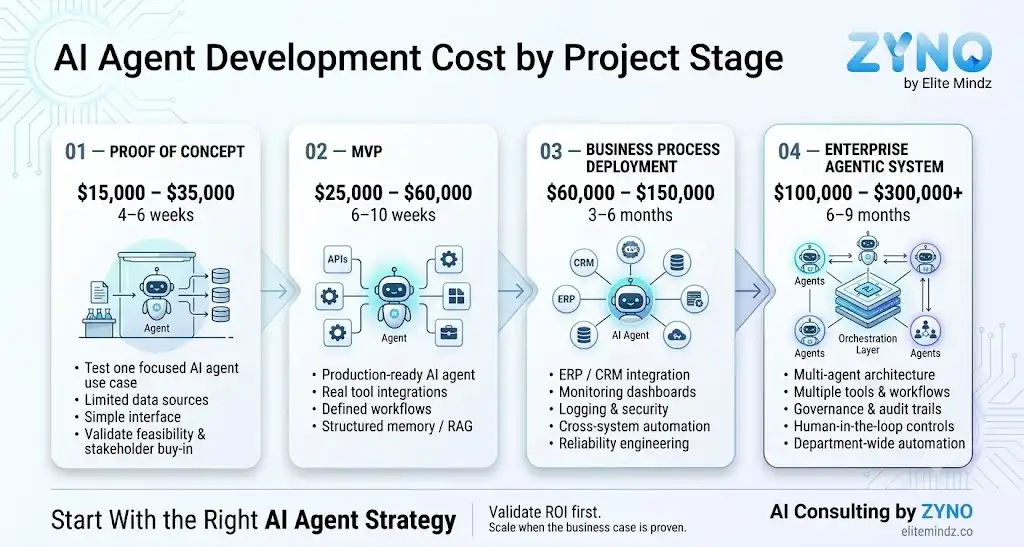
The smartest way to budget isn't to ask "what does an AI agent development cost" — it's to decide how far you actually need to go right now. A staged approach lets you validate the idea before committing real money.
1. Proof of Concept — $15,000–$35,000, 4–6 weeks: Tests one focused use case with limited data sources, a simple interface, and narrow success criteria. Good for validating feasibility and getting stakeholder buy-in before scaling.
2. MVP — $25,000–$60,000, 6–10 weeks: A production-ready agent with real tool integrations, defined workflows, and structured memory (RAG). This is where the gap between "chatbot" and "agent" becomes obvious — the system starts supporting an actual process, not just answering prompts.
3. Full Business Process Deployment — $60,000–$150,000, 3–6 months: Deep integration into ERP, CRM, or internal systems with monitoring dashboards, logging, security hardening, and reliability engineering built in. Designed for cross-system automation and mission-critical processes.
4. Enterprise Agentic System — $100,000–$300,000+, 6–9 months: A multi-agent architecture coordinating several agents, tools, and workflows across departments — with governance layers, audit trails, and human-in-the-loop controls throughout.
This staged path is exactly how our AI Consulting engagements start: define the use case and ROI target first, then decide whether a PoC, MVP, or full build makes sense.

Cost also depends heavily on the underlying agent architecture — how the system decides what to do.
| Agent Type | Cost Range | What It's Used For |
|---|---|---|
| Rule-based / Simple Reflex Agent | $10,000 – $30,000 | FAQ bots, scripted workflows |
| Contextual / Model-based Agent | $40,000 – $80,000+ | CRM-integrated support with memory |
| Goal-based Agent | $40,000 – $150,000+ | Planning and multi-step task execution |
| Utility-based Agent | $80,000 – $200,000 | Prioritization across competing outcomes |
| RAG (Retrieval-Augmented) Agent | $100,000 – $300,000 | Real-time Q&A grounded in your own data |
| Learning Agent | $100,000 – $300,000+ | Personalization, adaptive recommendations |
| Multi-Agent System | $200,000 – $500,000+ | Coordinated agents across departments |
A simple rule-based bot follows predefined logic and costs the least because there's little reasoning to build or test. Learning agents and multi-agent systems cost the most because they require ongoing training loops, orchestration between agents, and significantly more testing to catch edge cases before production.
The more independently an agent operates, the more engineering, safeguards, and monitoring it needs — and that shows up directly in the budget.
| Autonomy Level | Human Involvement | Typical Cost | Example |
|---|---|---|---|
| Reactive | High | $5,000 – $20,000 | FAQ chatbot with predefined flows |
| Contextual | Medium | $30,000 – $100,000 | CRM-integrated support agent with memory |
| Autonomous | Low | $75,000 – $250,000+ | Multi-system workflow automation agent |
Higher autonomy typically adds 15–25% to total cost because it requires extensive edge-case testing, human-in-the-loop review dashboards, guardrails, real-time monitoring, and compliance controls. This isn't wasted spend — it's what keeps an autonomous agent reliable once it's making decisions without a person checking every step.
Regardless of the final price tag, most AI agent budgets get allocated across the same core phases:
| Phase | % of Total Budget | Typical Cost |
|---|---|---|
| Discovery & Planning | 10–15% | $5,000 – $15,000 |
| Data Collection & Preparation | Varies | $10,000 – $70,000+ |
| Model Setup, Training & Development | 20–30% | $20,000 – $200,000+ |
| Integration & Workflow Orchestration | 15–25% | $20,000 – $50,000+ |
| Testing, Validation & Red-Teaming | 10–15% | $5,000 – $50,000+ |
| Deployment & Infrastructure Setup | 5–10% | $10,000 – $30,000 |
| Maintenance & Scaling (Annual) | Ongoing | $5,000 – $50,000+ |
The pattern worth remembering: in a typical enterprise deployment, 40–60% of the total cost goes to system integrations and compliance layers — not the AI model itself. Teams that budget only for "the AI part" almost always run over.
Estimating the cost of a custom AI agent starts with the development team. Your budget can change significantly based on the number of specialists involved, their hourly rates, and how many weeks the project requires. Use this calculator to create a quick team-budget estimate before requesting a detailed quote from an AI agent development company.
How to use it: Enter the number of team members, their estimated hourly rate, weekly hours, and project duration. You can add different roles such as AI engineers, developers, UI/UX specialists, and QA engineers to build a more realistic estimate.
Estimate your AI agent development budget based on project duration, team size, working hours, and hourly development rates.
Integration depth. A single CRM connection is cheap. Connecting to three or more legacy systems with different data formats, authentication methods, and security requirements can add $20,000–$50,000+ on its own.
Memory and context management. Basic prompting is inexpensive. Persistent memory via retrieval-augmented generation (RAG), vector databases, and embedding pipelines adds real infrastructure cost — RAG implementations alone commonly run $50,000–$300,000 depending on scale.
AI model choice. Proprietary APIs (OpenAI, Anthropic, Google) charge per token with low upfront infrastructure cost but ongoing usage fees. Self-hosted open-source models avoid token fees but require GPU infrastructure and DevOps — typically 30–50% higher infrastructure cost.
Security and compliance requirements. Encryption, role-based access control, audit logging, and regulatory alignment (HIPAA, GDPR, SOC 2) add engineering overhead but are non-negotiable in regulated industries.
Human-in-the-loop (HITL) workflows. Adding approval dashboards, audit trails, and role-based review for high-risk decisions typically adds 15–20% to development cost — a worthwhile trade for reduced compliance risk.
UI/UX complexity. A simple text chat interface is the cheapest option. Voice support (speech-to-text/text-to-speech) or document and image understanding both add meaningful cost on top of the base build.
Team expertise and delivery model. In-house AI/ML talent runs $80–$180/hour in the US; specialized outsourcing partners often deliver comparable quality faster and with less hiring risk. See our AI Agent Development services for how ZYNO structures delivery teams around this.
Regulated industries pay more — not because the AI is different, but because the governance layer around it is heavier.
| Industry | Cost Impact | Typical Range |
|---|---|---|
| Healthcare & Life Sciences | +25–40% (HIPAA, audit trails, validation) | $80,000 – $250,000 |
| Financial Services & FinTech | +20–35% (explainability, fraud safeguards, reporting) | $100,000 – $300,000 |
| Enterprise SaaS & Technology | Moderate (integration-focused) | $40,000 – $120,000 |
| Retail & E-commerce | Lower regulatory overhead | $30,000 – $100,000 |
In any regulated industry, governance and compliance work often costs more than the AI model itself — which is why we build compliance into the architecture from day one rather than retrofitting it after launch. Learn more about how this fits into broader AI Consulting engagements.
Development is only the first bill. Every deployed AI agent carries recurring operational costs — LLM token usage, API calls, cloud hosting, vector database storage, and monitoring.
| Usage Level | Estimated Monthly Cost |
|---|---|
| Small (~5,000 conversations) | $1,000 – $3,000 |
| Medium (~50,000 conversations) | $3,000 – $10,000 |
| Enterprise Scale | $10,000+ |
Costs climb further with voice channels, additional integrations, multi-language support, or high traffic volumes. As a rule of thumb, budget 20–30% of your initial build cost annually for hosting, monitoring, and continuous optimization — this is the number vendors most often leave out of a first quote.
Projects that blow past budget usually aren't failing because the AI itself cost more than expected — it's the operational layer around it that gets underestimated.
| Delivery Model | Cost | Risk | Control |
|---|---|---|---|
| In-house Team | $150,000+/year | High (hiring, ramp-up, retention) | Full ownership |
| Outsourcing Partner | $25,000–$200,000/project | Medium (vendor dependency) | Shared governance |
| Self-build / No-code Tools | $5,000–$40,000 | Skill-dependent | Limited flexibility |
For most businesses outside of Big Tech, an experienced outsourcing partner offers the best balance — faster delivery, lower hiring risk, and architectural expertise you'd otherwise spend a year building in-house.
Ready to find out what your AI agent would actually cost? Get a free scoping call with ZYNO by EliteMindz and walk away with a realistic budget — not a guess.
ZYNO is EliteMindz's dedicated AI agent development practice, and we approach cost the same way this guide does — transparently, by scope and stage, not a single flat number.
Explore our AI Agent Development Services, see how we approach Generative AI Development, check pricing, or read more on our blog — including our breakdown of the top trends shaping AI agents and how agentic AI is transforming business.
Custom AI agent development typically ranges from $15,000 for a proof of concept to $300,000+ for a fully autonomous, multi-system enterprise agent. Most production-ready builds for mid-sized businesses fall between $40,000 and $150,000.
A no-code or low-code MVP built on a single use case, with 1–2 integrations, typically costs $5,000–$25,000. It won't scale to complex, multi-system automation, but it's the fastest way to validate an idea.
A proof of concept takes 4–6 weeks, an MVP 6–10 weeks, a business process agent 3–6 months, and a full enterprise agentic system 6–9 months, depending on integration complexity.
Because "AI agent" describes a spectrum — from a scripted FAQ bot to a multi-agent system coordinating across ERP, CRM, and finance tools. The model itself is rarely the biggest expense; integrations, memory architecture, compliance, and testing are.
Plan for 15–30% of your initial build cost annually, covering LLM token usage, cloud hosting, monitoring, and periodic retraining. A small deployment might run $1,000–$3,000/month; enterprise-scale usage can exceed $10,000/month.
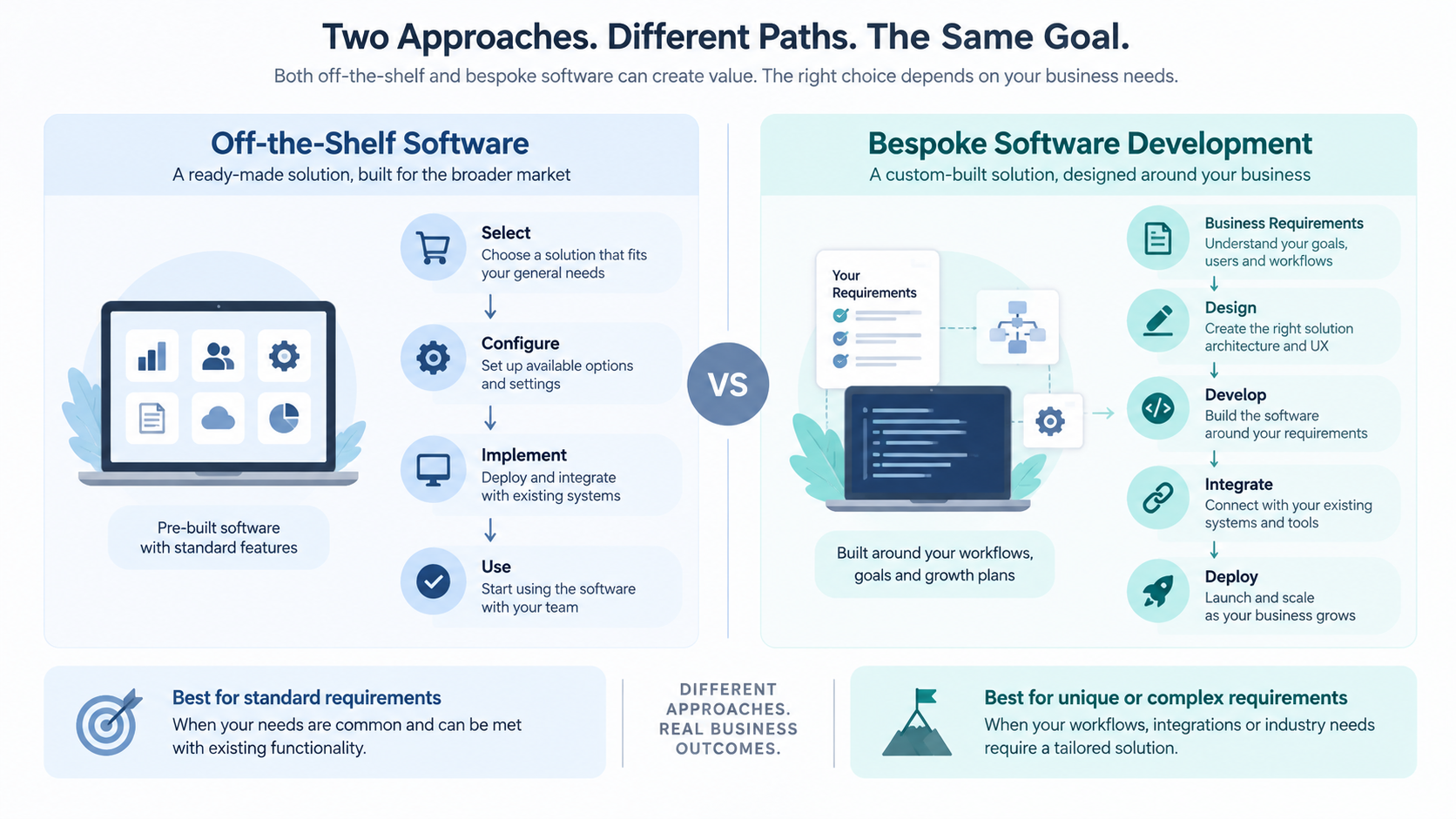
Pre-built agents are cheaper and faster to deploy but limited to what the vendor supports. Custom AI agent development costs more upfront but is the right call when the agent needs to work with your specific data, systems, and business logic — which is most enterprise use cases beyond simple FAQ handling.
Integration and compliance work — not the AI model. In a typical enterprise deployment, 40–60% of total cost goes to connecting systems and meeting security/compliance requirements, which first-pass estimates often miss.
Start with a scoping conversation that defines the use case, required integrations, data readiness, and compliance needs — talk to ZYNO for a free assessment before committing to a build.
AI Enablement in the Age of Generative AI: ZYNO by Elite Mindz Leading the Charge
Read More →

Top 10 Trends Shaping the Future of AI Agents in 2025
Read More →
Top 6 AI Chatbot Features Transforming Customer Engagement in 2026
Read More →
Top 10 AI Integration Strategies for Seamless ERP and CRM Upgrades in 2025
Read More →
Best GAI Consulting Approaches for Ethical Business Transformation in 2025
Read More →
From Vision to Value: The Ultimate Guide to Enterprise GenAI Platforms
Read More →
Top 10 GAI Development Trends Shaping Autonomous Agents in 2025
Read More →
The Future of Computer Vision: Trends to Watch in 2025
Read More →
Generative AI in 2025: How ZYNO BY Elite Mindz is Transforming Enterprise Workflows
Read More →
10 Real-World Applications of Computer Vision in 2025
Read More →
Integrating Computer Vision with IoT and AI: Driving the Next Wave of Intelligent Systems in 2025
Read More →
Agentic AI Explained: How AI Agents Are Transforming Business in 2025
Read More →
From Chatbots to Autonomous Agents: The Evolution of Agentic AI
Read More →
The Rise of Multi-Agent Systems: How Agentic AI Teams Will Run Enterprises of the Future
Read More →
Agentic AI vs Generative AI: What Business Leaders Need to Know
Read More →
The Power of Autonomous Agents: Understanding Agentic AI for Enterprises
Read More →
The Role of Agentic AI in Enhancing Enterprise Agility and Responsiveness
Read More →
Agentic AI as a Competitive Advantage: Why Businesses Can’t Ignore It
Read More →
The Shift from Automation to Autonomy: How Agentic AI is Redefining Enterprise Operations
Read More →
From Reactive to Proactive: How Agentic AI Changes Enterprise Decision-Making
Read More →
Why Every Business Will Hire an AI Agent Soon
Read More →
Agentic AI for Startups: Leveling the Playing Field
Read More →
Agentic AI: The New Digital Workforce
Read More →
The Future of Business: Autonomous Teams of AI Agents
Read More →
From Insights to Action: How AI Agents Close the Gap
Read More →
Agentic AI in 2026: From Hype to Enterprise-Ready Transformation
Read More →
The Competitive Edge: Why Early Adopters of Agentic AI Are Winning Markets
Read More →
Beyond Automation: Why Agentic AI is the Key to Enterprise Agility in 2025
Read More →
The Human-AI Partnership: Building Smarter Teams with Agentic AI
Read More →
The Rise of Autonomous Teams: Why Agentic AI is the New Digital Workforce
Read More →
Top Machine Learning Use Cases You Didn’t Know About
Read More →
What Is Low Code/No Code and Why It Matters in 2025
Read More →
Top Use Cases of Generative AI in 2026
Read More →
The Future of Generative AI in Enterprises
Read More →
How Generative AI Is Reshaping Enterprise Operations in 2025
Read More →
Top AI Features Every Modern Taxi App Must Include in 2026
Read More →The Future of Events: How Artificial Intelligence Is Changing the Industry
Read More →Why Are AI Agents the Next Big Shift in Banking and Finance
Read More →How AI-Driven Analytics Improve Learning Outcomes
Read More →How AI Is Optimizing Every Step of Food Delivery Apps
Read More →How AI-Powered CRM Is Transforming the Media & Entertainment Industry
Read More →
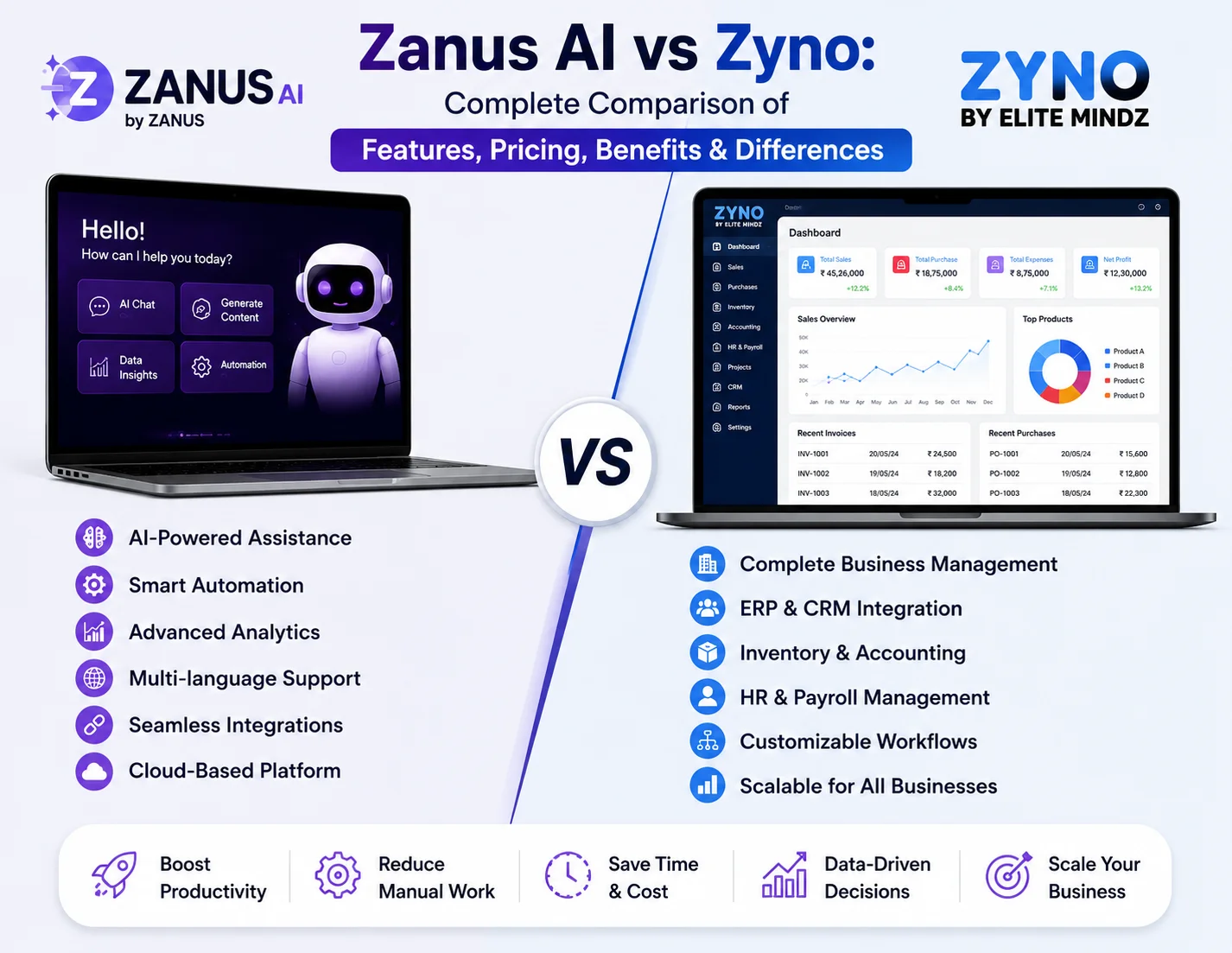
Zanus AI vs Zyno: Complete Comparison of Features, Pricing, Benefits & Differences
Read More →
Why US Companies Are Outsourcing Agentic AI Development to India

Read More →
Top Agentic AI Development Companies in India for US Businesses (2026)
Read More →
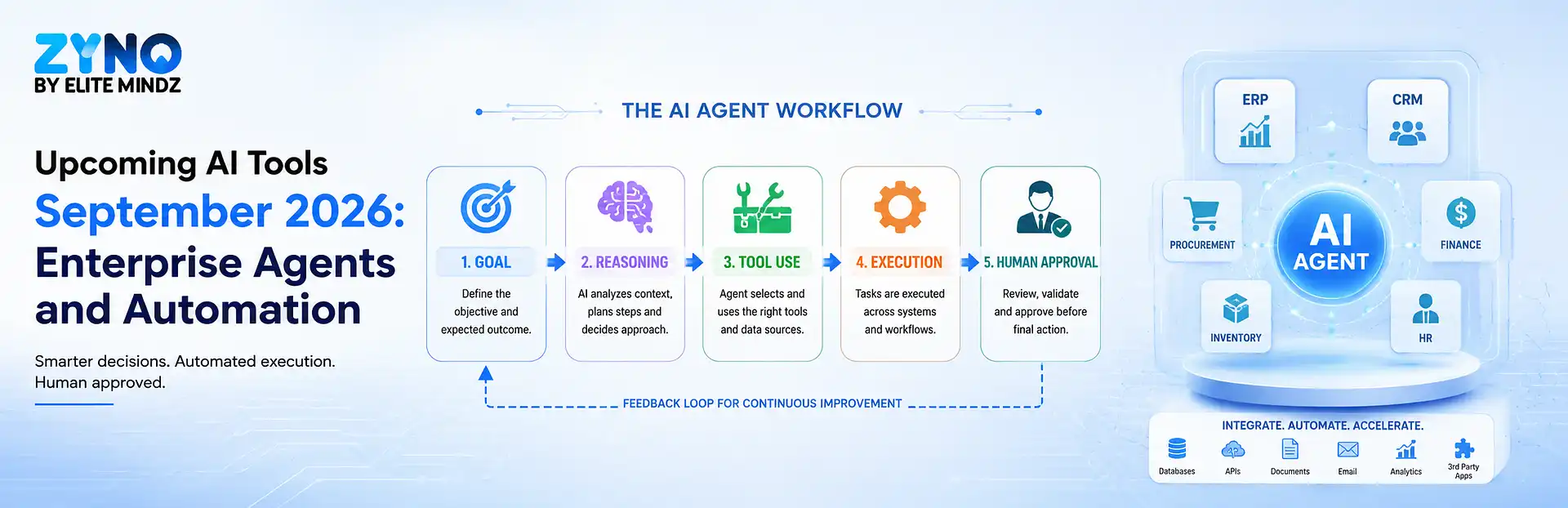
Top Upcoming AI Tools of September 2026 You Must Watch
Read More →
Google Opal vs Tilda Bio AI: What Each Tool Actually Does (and Why They Aren't True Rivals)
Read More →
AI Agent Development Services: A Practical Guide for Business Teams

Read More →
Enterprise AI Agent Development Services: The Complete Guide to Cost, Benefits, Use Cases & Implementation

Read More →
How Much Does Custom AI Agent Development Cost in 2026? Calculate Real Price Ranges
Read More →Partner with ZYNO by Elite Mindz to revolutionize how your business works. Fill out the form, and we’ll reach out with AI-powered solutions made just for you.
We use browser cookies to ensure you get the best experience on our website. Learn more
The form was submitted successfully!