AI Enablement in the Age of Generative AI: ZYNO by Elite Mindz Leading the Charge
Read More →
×
Turn AI hype into an action plan. This guide breaks down the confirmed vs. upcoming AI tools for September 2026 — enterprise agents, coding tools, ERP, and procurement AI — mapped to real business decisions, not marketing claims. Stop guessing which AI tool fits your workflow. Read the full breakdown and see where your business stands → Explore ZYNO by EliteMindz
Businesses using ZYNO Books cut accounting time by 70% and stay 100% ZATCA-compliant — automatically.
September 2026 is turning out to be less about one headline product launch and more about a structural shift: AI is moving from something employees ask questions to, into something that actually finishes the work. That distinction is the lens this whole guide uses.
If competitors seem to be moving faster, your team is juggling several disconnected AI subscriptions, or you're not sure your last AI pilot paid for itself, you're asking the right questions. The upcoming AI tools September 2026 brings should be judged against one standard: can this system take a goal, use your data and tools, and complete a task with the right human oversight? Chatbots that summarize and draft are table stakes now. What's worth watching is agentic execution, enterprise governance, and real systems integration.
This guide separates confirmed releases from expected developments and technology worth monitoring, then connects each one to a business decision: buy the tool, integrate it, build an agent around it, or invest in something custom.
Editorial note: AI product roadmaps change quickly. Availability, pricing, and regional access should be verified on each vendor's official website before making purchasing decisions.
Build Smarter with Custom AI Solutions
Turn complex business workflows into intelligent, scalable AI solutions with custom AI software development and AI agents built around your business needs.
Direct answer: The categories to watch are enterprise agent platforms from OpenAI, Anthropic, Google, and Microsoft; AI infrastructure from NVIDIA, Databricks, and AWS; AI coding agents; agent governance and interoperability standards; and industry-specific AI for procurement, ERP, finance, and healthcare.
Explanation: The single biggest shift is the move from AI that answers questions to AI that executes multi-step work. OpenAI's Enterprise Signals research found that as of June 2026, agentic use accounted for 64% of combined Codex and ChatGPT output tokens among enterprise customers, a sign that agents are enabling a shift toward more substantive, delegated work. Anthropic's 2026 State of AI Agents report, based on insights from over 500 technical leaders and real-world implementations at companies including Novo Nordisk, Doctolib, L'Oréal, and Shopify, found that 80% of organizations reported measurable ROI from AI agents as adoption moved from pilot projects into production.
Example: A sales rep no longer just asks an AI assistant to summarize an account. They ask it to pull the account history, flag buying signals, and draft the next-action plan, then a human reviews before anything goes to the customer. That's the practical difference between assistance and delegation.
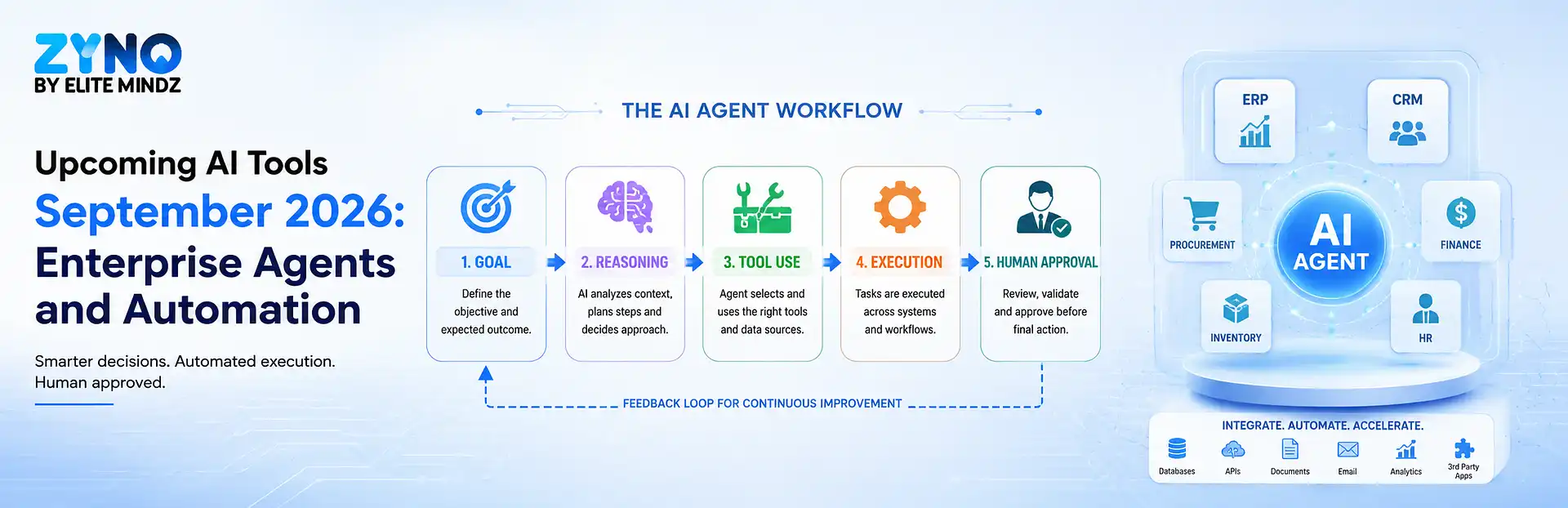
Traditional AI worked like this: prompt in, answer out. Agentic AI works differently:
Goal → Reason → Access data → Use tools → Execute workflow → Verify result → Escalate when needed
In plain business language, an employee no longer has to translate their own intent into ten separate app actions. They state what they need, and the system pulls the right data, takes permitted actions, and hands off to a human when the decision is too consequential to automate.
Three developments this quarter make that shift concrete rather than theoretical:
Agent standards are consolidating. On August 20, 2026, Google's A2A protocol formally joined the Linux Foundation-directed Agentic AI Foundation, bringing it under the same neutral governance as Anthropic's Model Context Protocol, alongside members including AWS, Block, Bloomberg, Cloudflare, and Microsoft. That lowers the risk of locking into one vendor's agent ecosystem.
Agent usage is spreading past engineering. OpenAI's research shows enterprise Codex adoption growing far faster outside developer teams: weekly active enterprise Codex users have grown 108x in legal, 41x in sales, 41x in recruiting, and 26x in marketing since February, compared with 5x in engineering.
Adoption is accelerating, but not blindly. Industry research citing Gartner projects that 40% of enterprise applications will embed task-specific AI agents by the end of 2026, up from under 5% in 2025, while also noting Gartner expects a meaningful share of agentic pilots to be cancelled once ROI is scrutinized. The message for business leaders is not "adopt everything." It is "adopt deliberately, and measure."
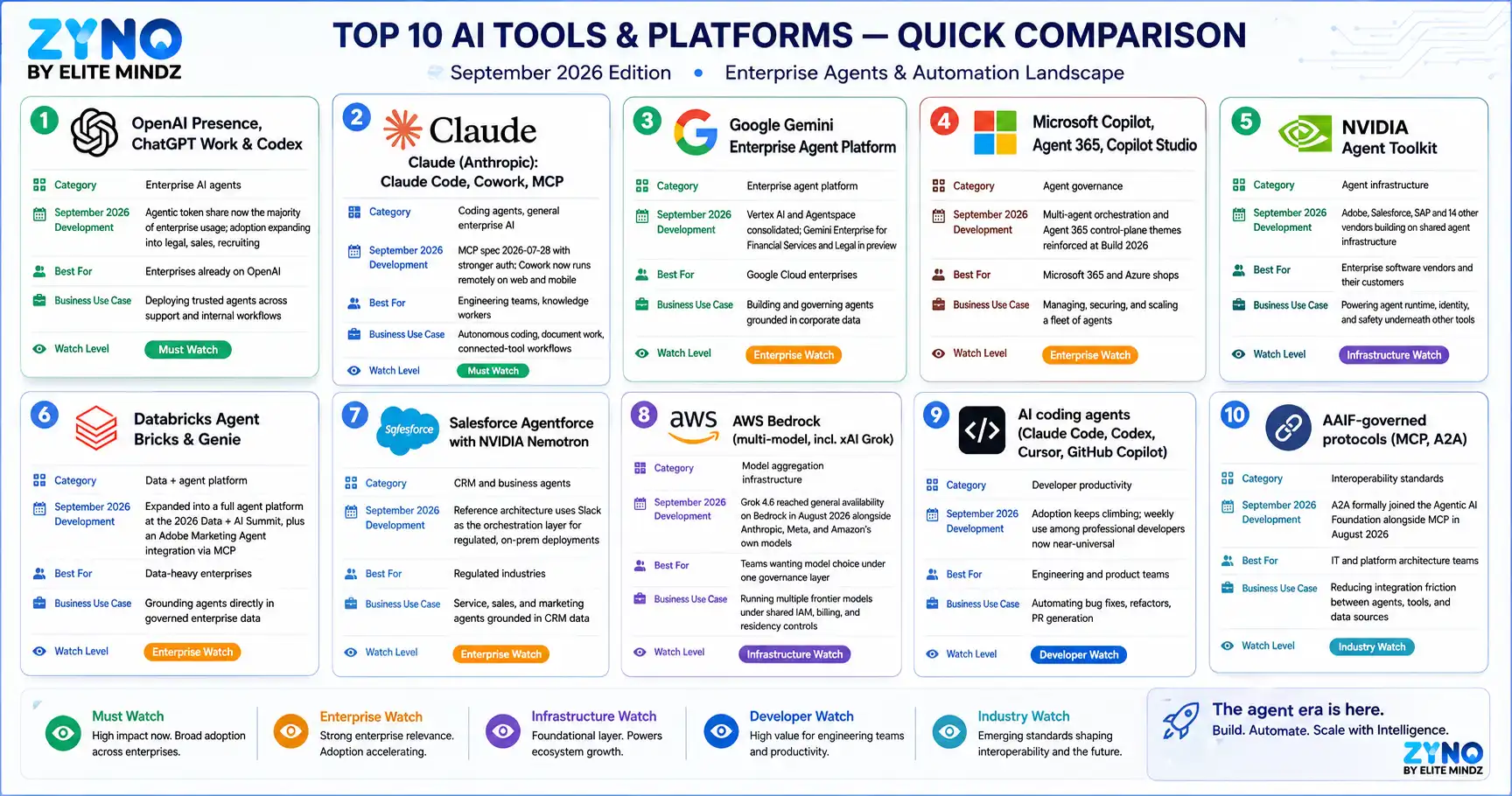
| AI Tool / Platform | Category | September 2026 Development | Best For | Business Use Case | Watch Level |
|---|---|---|---|---|---|
| OpenAI Presence, ChatGPT Work & Codex | Enterprise AI agents | Agentic token share now the majority of enterprise usage; adoption expanding into legal, sales, and recruiting. | Enterprises already on OpenAI | Deploying trusted agents across support and internal workflows | Must Watch |
| Claude (Anthropic): Claude Code, Cowork, MCP | Coding agents, general enterprise AI | MCP spec 2026-07-28 with stronger auth; Cowork now runs remotely on web and mobile. | Engineering teams, knowledge workers | Autonomous coding, document work, connected-tool workflows | Must Watch |
| Google Gemini Enterprise Agent Platform | Enterprise agent platform | Vertex AI and Agentspace consolidated; Gemini Enterprise for Financial Services and Legal in preview. | Google Cloud enterprises | Building and governing agents grounded in corporate data | Enterprise Watch |
| Microsoft Copilot, Agent 365, Copilot Studio | Agent governance | Multi-agent orchestration and Agent 365 control-plane themes reinforced at Build 2026. | Microsoft 365 and Azure shops | Managing, securing, and scaling a fleet of agents | Enterprise Watch |
| NVIDIA Agent Toolkit | Agent infrastructure | Adobe, Salesforce, SAP and 14 other vendors building on shared agent infrastructure. | Enterprise software vendors and their customers | Powering agent runtime, identity, and safety underneath other tools | Infrastructure Watch |
| Databricks Agent Bricks & Genie | Data + agent platform | Expanded into a full agent platform at the 2026 Data + AI Summit, plus an Adobe Marketing Agent integration via MCP. | Data-heavy enterprises | Grounding agents directly in governed enterprise data | Enterprise Watch |
| Salesforce Agentforce with NVIDIA Nemotron | CRM and business agents | Reference architecture uses Slack as the orchestration layer for regulated, on-prem deployments. | Regulated industries | Service, sales, and marketing agents grounded in CRM data | Enterprise Watch |
| AWS Bedrock (multi-model, incl. xAI Grok) | Model aggregation infrastructure | Grok 4.6 reached general availability on Bedrock in August 2026 alongside Anthropic, Meta, and Amazon's own models. | Teams wanting model choice under one governance layer | Running multiple frontier models under shared IAM, billing, and residency controls | Infrastructure Watch |
| AI Coding Agents (Claude Code, Codex, Cursor, GitHub Copilot) | Developer productivity | Adoption keeps climbing; weekly use among professional developers now near-universal. | Engineering and product teams | Automating bug fixes, refactors, and PR generation | Developer Watch |
| AAIF-Governed Protocols (MCP, A2A) | Interoperability standards | A2A formally joined the Agentic AI Foundation alongside MCP in August 2026. | IT and platform architecture teams | Reducing integration friction between agents, tools, and data sources | Industry Watch |
OpenAI Presence is a deployment product built for enterprises that need agents to operate reliably in production, not just in a demo: it helps them deploy agents that answer questions, resolve issues, use company systems, take approved actions, and escalate to people when needed. ChatGPT Work and Codex are the surfaces employees and developers actually use, with Codex handling the agentic, multi-step execution side.
This solves a real problem: companies that adopted ChatGPT for drafting and Q&A are now asking whether the same system can complete a workflow end to end, with the right guardrails, as policies and data change. It's the natural next step for mid-market and enterprise IT teams already standardized on OpenAI, and for support, sales, and security teams ready to hand off structured tasks.
The catch is a widening usage gap: firms in the top 10% of AI usage now generate 8.3x as many output tokens per active user as typical firms, up from 2.6x in January, meaning most companies are under-using the agentic capability they already pay for. If you're already on OpenAI, close that gap through plugins and skills adoption before adding new tools. If you're new to agentic AI, this is a reasonable starting point with real production evidence behind it.
Claude Code is Anthropic's terminal-first coding agent, and Cowork is its broader agentic workspace for knowledge work. This quarter, Anthropic expanded support for the MCP 2026-07-28 spec, adding a stateless core and stronger OAuth and OIDC authorization; the Model Context Protocol has now surpassed 400 million monthly SDK downloads, a fourfold increase this year. Cowork also now runs on web and mobile in addition to desktop, with sessions able to run remotely, state synced across devices, and scheduled tasks running server-side with no device online.
The business case is straightforward: engineering teams need an agent that can work across a large, real codebase without losing context, and knowledge workers need sessions that persist and connect to company tools without a developer building a custom integration for each one. Independent developer research found Claude Code has become the most widely adopted AI coding tool at work, used roughly twice as often as GitHub Copilot, and MCP's growth suggests a genuine ecosystem standard rather than single-vendor lock-in. The trade-off is cost: heavier agentic workflows use more tokens, and teams need real governance once agents can read and modify production data. This is a strong choice for engineering-heavy organizations and any business that wants agents connecting into existing systems through a standardized, vendor-neutral protocol.
Google's consolidated agent-building platform brings Vertex AI and Agentspace together for building, governing, and scaling enterprise agents. Google Cloud has released a batch of updates including Agent Runtime and Agent Identity capabilities, and industry-specific expansion is underway: Gemini Enterprise for Financial Services is available in preview alongside a new solution for Legal, building on adoption from institutions including BNY, Citi Wealth, Lloyds Banking Group, and Macquarie Bank.
Regulated industries need agents that keep customer data, business rules, and model outputs private to the organization, which is the core promise behind these industry-specific previews. If you're already on Google Cloud, this is worth active evaluation. If not, treat it as one option among several enterprise agent platforms rather than a reason to switch clouds.
A few other developments won't headline anyone's roadmap slide, but they change what enterprise buyers can actually do this quarter.
Microsoft reinforced at Build 2026 that AI's greatest value may come from execution rather than assistance. Agent 365, its control plane for managing, securing, and governing a fleet of agents, adds registry, access control, and interoperability, while Copilot Studio has added GPT-5 integration.
NVIDIA is building the infrastructure layer underneath several platforms above: at GTC 2026 it announced open-source Agent Toolkit software with partners including Adobe, Atlassian, Cisco, Red Hat, SAP, Salesforce, ServiceNow, and Siemens, aimed at safer, more efficient autonomous agents. Salesforce has already built NVIDIA's Nemotron models into Agentforce, using Slack as the orchestration layer for agents operating in regulated and on-premises environments.
Databricks made agent grounding its pitch at the 2026 Data + AI Summit, expanding Agent Bricks into a full platform with over 100,000 agents already built on it, and pairing with Adobe through an MCP-based connection between Databricks Genie and Adobe Marketing Agent.
AWS Bedrock is worth watching less for a single model and more as a marketplace: xAI's Grok 4.6 reached general availability on Bedrock in August 2026 alongside Anthropic, Meta, and Amazon's own models, letting enterprises run several frontier models under one shared identity, billing, and data-residency framework instead of separate vendor contracts.
AI coding agents remain the most mature agentic category. JetBrains' developer research found that as of mid-2026, roughly 90% of professional developers were using AI coding agents at work weekly, with 68% daily, and that GitHub Copilot's adoption share has slipped even as Claude Code, Codex, and Cursor keep gaining ground. The practical question is no longer whether to adopt a coding agent, but which combination fits your codebase, since many teams now assign different agents to different tasks.
Ready to Turn Your AI Idea Into Reality?
Build intelligent AI software and autonomous AI agents designed around your workflows, data, systems, and business goals.
Your team does not necessarily need another AI subscription. If employees are already switching between ERP, CRM, procurement, email, spreadsheets, and two or three separate AI tools, the bigger problem may be integration, not capability. Adding a fourth AI subscription on top of that stack usually adds friction rather than removing it.
This is where the real fears surface, and they deserve a straight answer rather than a sales pitch. Are competitors adopting AI faster? Some are, and the frontier-gap data above shows the distance is real. Are you paying for too many disconnected tools? Possibly, and the fix is usually integration, not another subscription. Will your ERP become obsolete? Only if it stays static while the interface for using it changes around it. None of this is a reason to freeze. It's a reason to be deliberate about what you buy, integrate, and build.
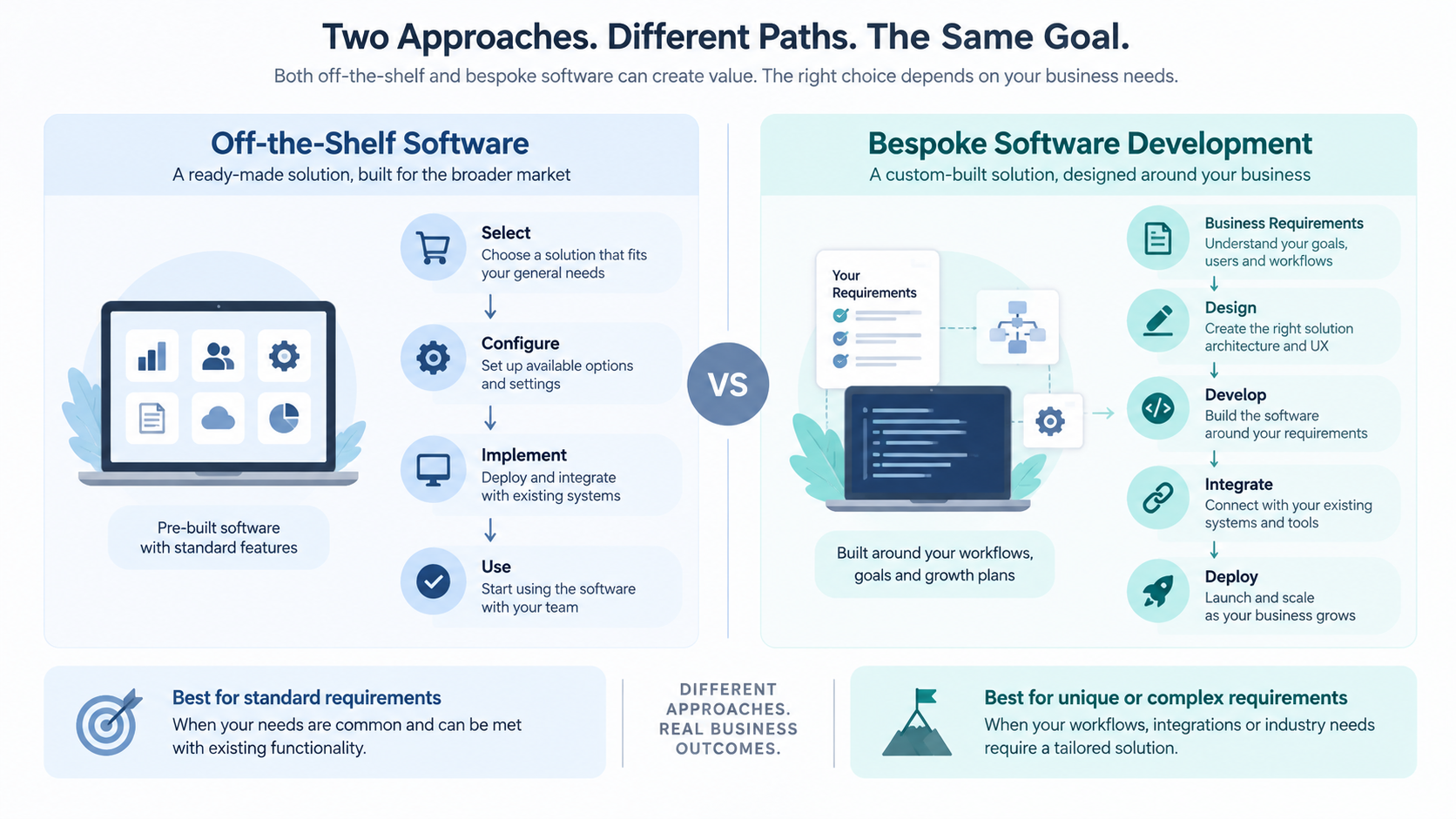
Off-the-shelf AI tools work well when the workflow is standard, the data involved is not highly specialized, integration requirements are limited, and the goal is fast experimentation.
Custom AI software becomes the better path when workflows are unique to your business, proprietary data matters, multiple systems need deep integration, compliance requirements are strict, or the AI needs to take real actions inside your ERP, CRM, or procurement system rather than just suggest them.
| Comparison Factor | Off-the-Shelf AI | Custom AI Software |
|---|---|---|
| Deployment | Faster deployment | Designed around business workflows |
| Features | Standard features | Custom functionality |
| Customization | Limited customization | Full customization |
| Integrations | Generic integrations | Deep system integration |
| Ownership & Deployment | Subscription model | Custom ownership and deployment options |
| AI Approach | General-purpose AI | Industry- and business-specific AI |
Businesses should consider custom AI development when their workflows require proprietary data, deep system integrations, industry-specific logic, or controlled AI actions that a generic subscription cannot safely provide.
The old pattern for getting something done inside a company looked like this: employee, then ERP, then search, then report, then approval, then email, then a follow-up a week later.
A well-built AI agent compresses that into something closer to this: the employee states the goal, the AI understands the business context, checks the ERP, identifies the required action, prepares the transaction within its permissions, requests approval where needed, updates records, and reports the result.
Getting there safely takes more than a capable model. It requires business context, APIs, clearly defined permissions, workflow orchestration, guardrails, monitoring, audit trails, and a human approval step for anything consequential. This is exactly the governance layer that Microsoft's Agent 365, Google's Agent Identity tooling, and NVIDIA's Agent Toolkit are all racing to build, because enterprises will not hand agents real authority without it.
Permissions, validation, and human oversight remain essential in every case below. Whether an action happens automatically or requires sign-off depends entirely on how the agent is configured.
Manufacturing. A supplier delivery runs late. Instead of manually checking three warehouse systems, a production agent checks stock across locations, flags which SKUs risk a line stoppage, and proposes a reallocation before the shortage becomes a delay.
Finance. At month-end close, a finance agent scans the AP ledger, identifies overdue invoices above a defined threshold, and prepares a payment-risk summary for the controller, cutting a day-long task down to an approval decision.
HR. An HR agent triages the week's pending requests, leave approvals, expense queries, benefits questions, sorts them by urgency and required approver, and surfaces only the cases that genuinely need a human decision.
Healthcare. A clinic facing a backlog of insurance pre-authorizations has an agent pull the relevant patient and procedure codes, check them against payer rules, and prepare the request for staff review, cutting the manual entry that usually causes the backlog.
Retail. A regional operations lead asks an inventory agent to check stock across stores, identify items likely to stock out within two weeks based on sell-through, and draft a replenishment request to the approved supplier.
Logistics. A coordinator managing a multi-carrier shipment has an agent monitor tracking data across carriers, flag shipments at risk of missing a delivery window, and draft a customer notification, so the team manages exceptions proactively instead of reacting to complaints.
Procurement is one of the clearest enterprise AI use cases because the pain points are so consistent: manual purchase requests routed through email, slow approval chains, invoice errors, duplicate invoices, maverick spending, poor supplier visibility, and spend data nobody fully trusts.
AI can meaningfully support intake and requisition creation, invoice verification, supplier comparison, approval automation, end-to-end procure-to-pay, spend analytics, duplicate invoice detection, and demand forecasting. Consider a familiar scenario: a procurement manager receives an email requesting 200 units of a component. Instead of manually re-keying that into an ERP form, an AI procurement agent could extract the requirement, check approved vendors, compare contract pricing, and prepare the request for approval, with a human reviewing before anything is committed.
This is the exact gap that AI-powered procurement automation inside ZYNO Procurement by EliteMindz is built to close: turning scattered purchase requests into structured, trackable, policy-compliant workflows. For visibility into where money is going, AI spend analytics surfaces duplicate spend, maverick purchasing, and supplier price movements, while procure-to-pay software connects the full cycle from request through payment in one governed system.
Traditional ERP forces every request through the same pattern: menu, then module, then screen, then report, then manual action. AI-powered ERP compresses that into a single interaction: a business request comes in, the AI understands intent, retrieves the relevant context, executes the permitted workflow, and returns a result.
In practice, this looks like natural-language requests such as "show me purchase orders above ₹5 lakh awaiting approval," "which suppliers increased prices this quarter," or "create a purchase requisition for 500 units from an approved supplier." Not every action is automatically executed end to end; what changes is that employees no longer need to know which module, screen, or report to open first.
AI-powered ERP from ZYNO by EliteMindz applies this prompt-based approach across finance, procurement, inventory, HR, manufacturing, CRM, reporting, and business intelligence. Businesses that need the ERP shaped around a specific industry or process, rather than a generic template, can look at custom ERP software as the starting point, and manufacturers specifically can see how this plays out on the shop floor through the platform's AI ERP assistant.
Not every business needs the same depth of AI adoption. It generally breaks down into five levels.
Level 1: Use AI tools. Adopt existing AI applications for drafting, research, and productivity. Level 2: Integrate AI. Connect AI to CRM, ERP, procurement, HRMS, finance, or internal data sources. Level 3: Build AI agents. Create agents that perform specific business workflows within defined permissions and guardrails. Level 4: Build custom AI software. Develop software around a company's unique processes, data, industry rules, and growth plans. Level 5: Build an AI-native enterprise platform. Combine agents, ERP, procurement, CRM, analytics, integrations, governance, and automation into one connected system.
ZYNO by EliteMindz is positioned around this broader progression rather than a single point solution: an AI-powered enterprise ecosystem spanning ERP, procurement, CRM, HRMS, and industry-specific modules, with custom AI agent development and AI-powered mobile app development available for businesses that need custom applications too. The goal is to meet a business wherever it sits on that five-level path, not force everyone into the same starting point.
Have an AI Idea? Let's Build It.
From AI-powered software to autonomous AI agents, build scalable solutions tailored to your business workflows and goals.
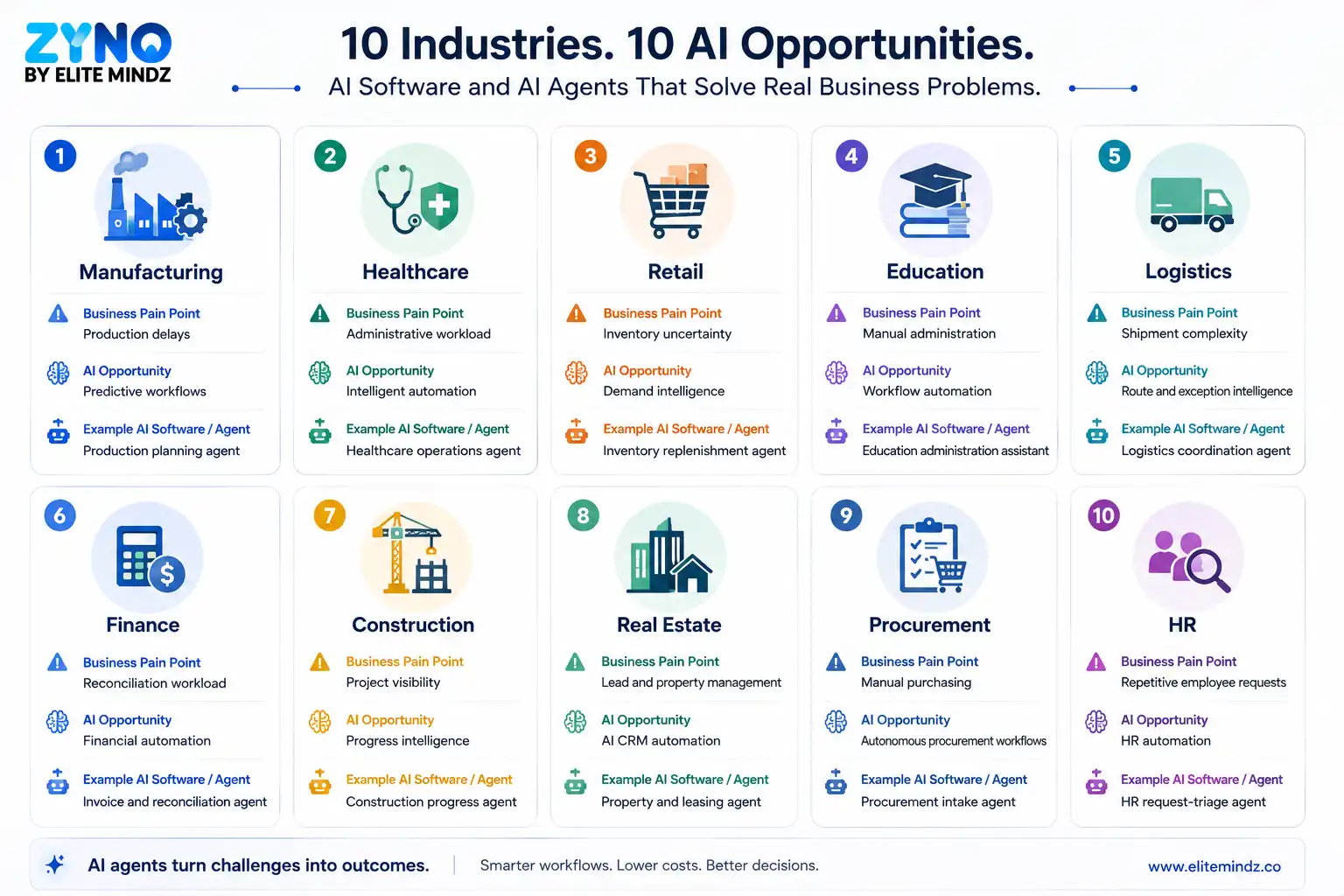
| Industry | Business Pain Point | AI Opportunity | Example AI Software / Agent |
|---|---|---|---|
| Manufacturing | Production delays | Predictive workflows | Production planning agent |
| Healthcare | Administrative workload | Intelligent automation | Healthcare operations agent |
| Retail | Inventory uncertainty | Demand intelligence | Inventory replenishment agent |
| Education | Manual administration | Workflow automation | Education administration assistant |
| Logistics | Shipment complexity | Route and exception intelligence | Logistics coordination agent |
| Finance | Reconciliation workload | Financial automation | Invoice and reconciliation agent |
| Construction | Project visibility | Progress intelligence | Construction progress agent |
| Real Estate | Lead and property management | AI CRM automation | Property and leasing agent |
| Procurement | Manual purchasing | Autonomous procurement workflows | Procurement intake agent |
| HR | Repetitive employee requests | HR automation | HR request-triage agent |
Buy an AI tool if: the problem is common across many businesses, you need fast deployment, standard integrations are sufficient, and deep customization is not a priority right now.
Build custom AI software if: your workflow is genuinely unique, your data is proprietary and valuable, your business requires deep integrations across systems, compliance is a serious constraint, or your existing software is creating operational gaps that off-the-shelf tools cannot close.
Choose a hybrid approach if: you want to use foundation models from major providers like OpenAI, Anthropic, or Google, but your business logic, workflows, integrations, and data layer need to be built specifically around how your company actually operates. This is the most common starting point for mid-sized businesses, and it's where AI software development and custom AI agent development typically enter the conversation.
Score each candidate tool from 1 to 5 on the fifteen criteria below before signing anything. A tool scoring below 3 on data privacy, security, or auditability is a hard stop for anything touching production data, regardless of how well it scores elsewhere.
☐ Define the business problem clearly
☐ Identify the specific workflow involved
☐ Measure the current cost of doing it manually
☐ Identify the data sources needed
☐ Check integration requirements against existing systems
☐ Assess AI accuracy on your actual use case, not a demo
☐ Review security posture
☐ Review permission and access models
☐ Define human approval points for high-impact actions
☐ Establish clear KPIs before rollout
☐ Run a controlled pilot with a defined scope
☐ Measure ROI against the pilot's original goals
☐ Scale only after the pilot is validated
Agentic AI, AI-native ERP and CRM, AI procurement, multimodal AI, enterprise AI governance, AI coding agents, AI infrastructure, smaller specialized models, AI orchestration, AI combined with robotics, industry-specific AI, AI-driven cybersecurity, natural-language business software, human-in-the-loop AI, and AI observability all matter commercially, because they determine whether agentic AI stays a pilot project or becomes a durable operating advantage. The protocol consolidation around MCP and A2A under the Agentic AI Foundation is worth watching closely, since it directly affects how much integration work your team will need as you add agents from different vendors.
If you are evaluating AI tools but your biggest challenge is that your business workflow does not fit neatly inside another SaaS subscription, custom AI development may be the better path.
That is where ZYNO by EliteMindz fits in. Rather than adding one more disconnected AI subscription to your stack, ZYNO focuses on AI software development, AI agent development, custom software development, AI-powered ERP, AI procurement software, and industry-specific solutions built around how your business actually runs, not a generic template.
If your team is weighing whether to buy, integrate, or build, it's worth a conversation before committing to another subscription. You can book a consultation or request a demo to discuss your use case and see whether a custom approach fits better than another off-the-shelf tool.
Build AI That Works for Your Business
Create custom AI software and intelligent AI agents that automate workflows, connect your systems, and help your team make faster, smarter decisions.
Custom AI development • AI agents • Enterprise automation
The strongest categories to watch are enterprise agent platforms from OpenAI, Anthropic, Google, and Microsoft, infrastructure from NVIDIA, Databricks, and AWS, and AI coding agents like Claude Code, Codex, Cursor, and GitHub Copilot. The right choice depends on your existing cloud and software stack.
Rather than one headline launch, September 2026 is defined by expansion of existing agent platforms: Google's Gemini Enterprise for Financial Services and Legal remain in preview, Anthropic's MCP spec continues rolling out, and Databricks and Adobe's MCP-based marketing agent integration is heading toward beta.
Watch the platforms that combine model capability with governance. Agent permission systems, audit trails, and human approval controls matter more right now than raw model benchmarks.
Agentic AI refers to systems that can interpret a goal, use connected tools or data sources, complete multiple steps, and return a result, with varying levels of human oversight built in.
An AI agent is software that can interpret a goal, use connected tools or systems, perform multiple steps, and return a result with human oversight, escalating when the task exceeds its permissions.
A chatbot answers questions inside a conversation. An AI agent can take actions across connected systems, such as updating a record, preparing a document, or routing an approval, based on defined permissions.
Yes, within defined scope. Procurement intake, invoice matching, inventory checks, and HR request triage are common early workflows, but high-impact actions should keep a human approval step.
Buy when the workflow is standard and fast deployment matters most. Build custom when your data, compliance needs, or system integrations are specific to how your business actually operates.
Cost depends heavily on scope, integration complexity, and whether you are building a single agent or a broader platform. Get a scoped estimate directly from a development partner rather than relying on a general figure.
Yes. Modern AI-powered ERP platforms allow natural-language requests to trigger permitted actions inside finance, procurement, inventory, and HR modules, while traditional ERPs typically need middleware or custom integration work to connect AI tools.
AI can automate significant parts of procurement, including purchase requisition intake, supplier comparison, invoice verification, and spend analytics, while final approval on major purchases typically still involves a human reviewer.
Manufacturing, healthcare, retail, finance, procurement, logistics, and HR all show strong early returns, largely because each has repetitive, data-heavy workflows that agents can meaningfully speed up.
Start by defining the specific business problem and workflow, not the tool. Run a scoped pilot, set clear KPIs, and only scale once ROI is validated against those KPIs.
AI Enablement in the Age of Generative AI: ZYNO by Elite Mindz Leading the Charge
Read More →

Top 10 Trends Shaping the Future of AI Agents in 2025
Read More →
Top 6 AI Chatbot Features Transforming Customer Engagement in 2026
Read More →
Top 10 AI Integration Strategies for Seamless ERP and CRM Upgrades in 2025
Read More →
Best GAI Consulting Approaches for Ethical Business Transformation in 2025
Read More →
From Vision to Value: The Ultimate Guide to Enterprise GenAI Platforms
Read More →
Top 10 GAI Development Trends Shaping Autonomous Agents in 2025
Read More →
The Future of Computer Vision: Trends to Watch in 2025
Read More →
Generative AI in 2025: How ZYNO BY Elite Mindz is Transforming Enterprise Workflows
Read More →
10 Real-World Applications of Computer Vision in 2025
Read More →
Integrating Computer Vision with IoT and AI: Driving the Next Wave of Intelligent Systems in 2025
Read More →
Agentic AI Explained: How AI Agents Are Transforming Business in 2025
Read More →
From Chatbots to Autonomous Agents: The Evolution of Agentic AI
Read More →
The Rise of Multi-Agent Systems: How Agentic AI Teams Will Run Enterprises of the Future
Read More →
Agentic AI vs Generative AI: What Business Leaders Need to Know
Read More →
The Power of Autonomous Agents: Understanding Agentic AI for Enterprises
Read More →
The Role of Agentic AI in Enhancing Enterprise Agility and Responsiveness
Read More →
Agentic AI as a Competitive Advantage: Why Businesses Can’t Ignore It
Read More →
The Shift from Automation to Autonomy: How Agentic AI is Redefining Enterprise Operations
Read More →
From Reactive to Proactive: How Agentic AI Changes Enterprise Decision-Making
Read More →
Why Every Business Will Hire an AI Agent Soon
Read More →
Agentic AI for Startups: Leveling the Playing Field
Read More →
Agentic AI: The New Digital Workforce
Read More →
The Future of Business: Autonomous Teams of AI Agents
Read More →
From Insights to Action: How AI Agents Close the Gap
Read More →
Agentic AI in 2026: From Hype to Enterprise-Ready Transformation
Read More →
The Competitive Edge: Why Early Adopters of Agentic AI Are Winning Markets
Read More →
Beyond Automation: Why Agentic AI is the Key to Enterprise Agility in 2025
Read More →
The Human-AI Partnership: Building Smarter Teams with Agentic AI
Read More →
The Rise of Autonomous Teams: Why Agentic AI is the New Digital Workforce
Read More →
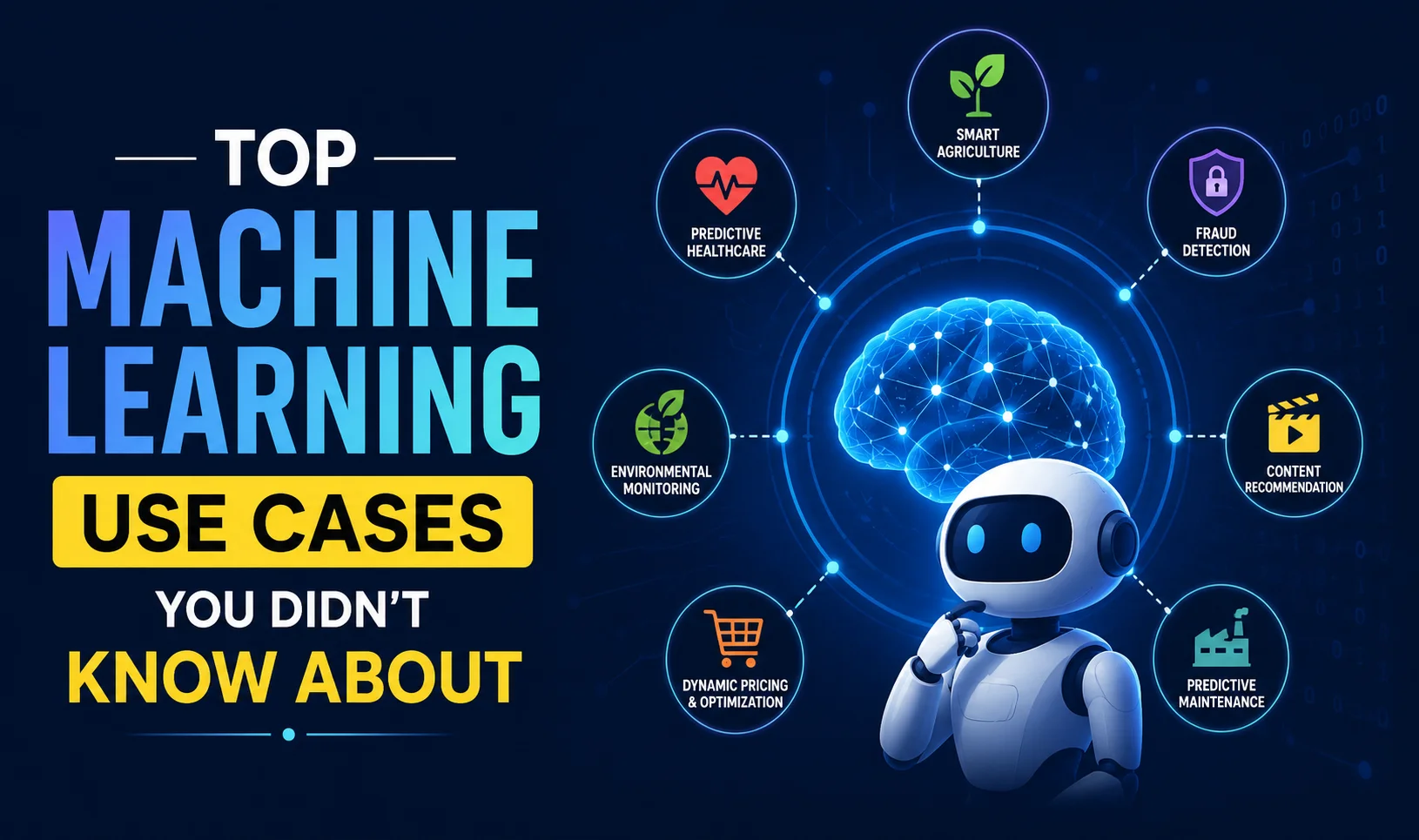
Top Machine Learning Use Cases You Didn’t Know About
Read More →
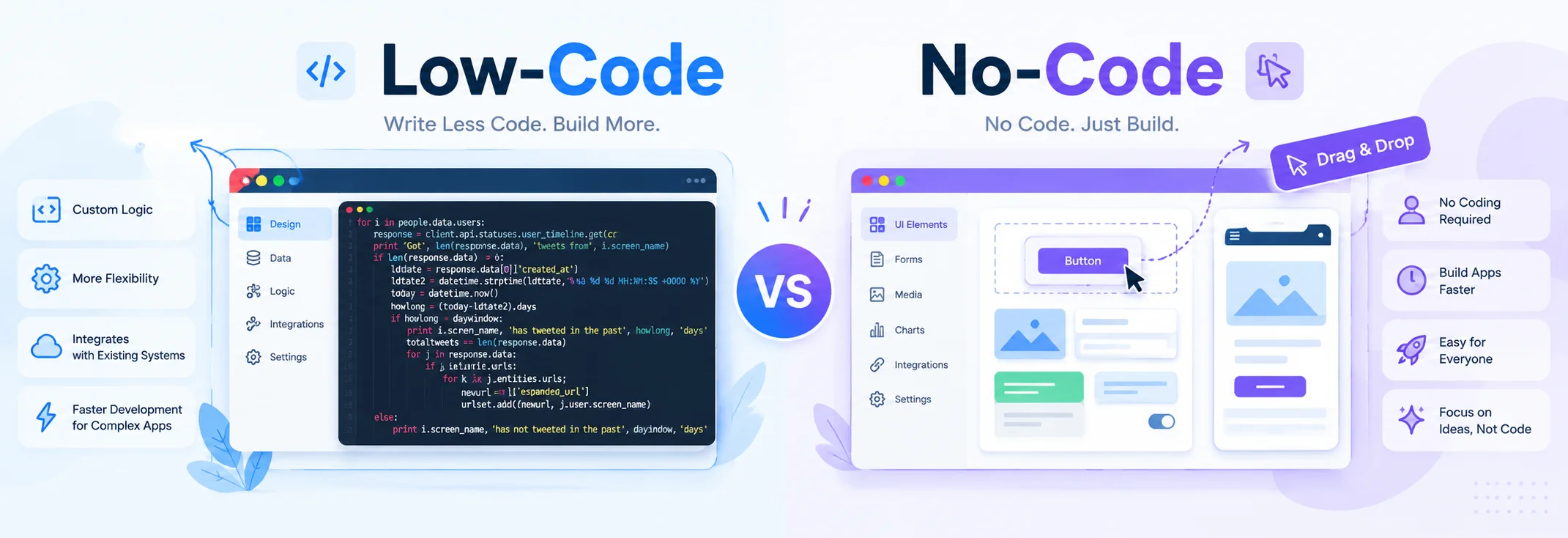
What Is Low Code/No Code and Why It Matters in 2025
Read More →
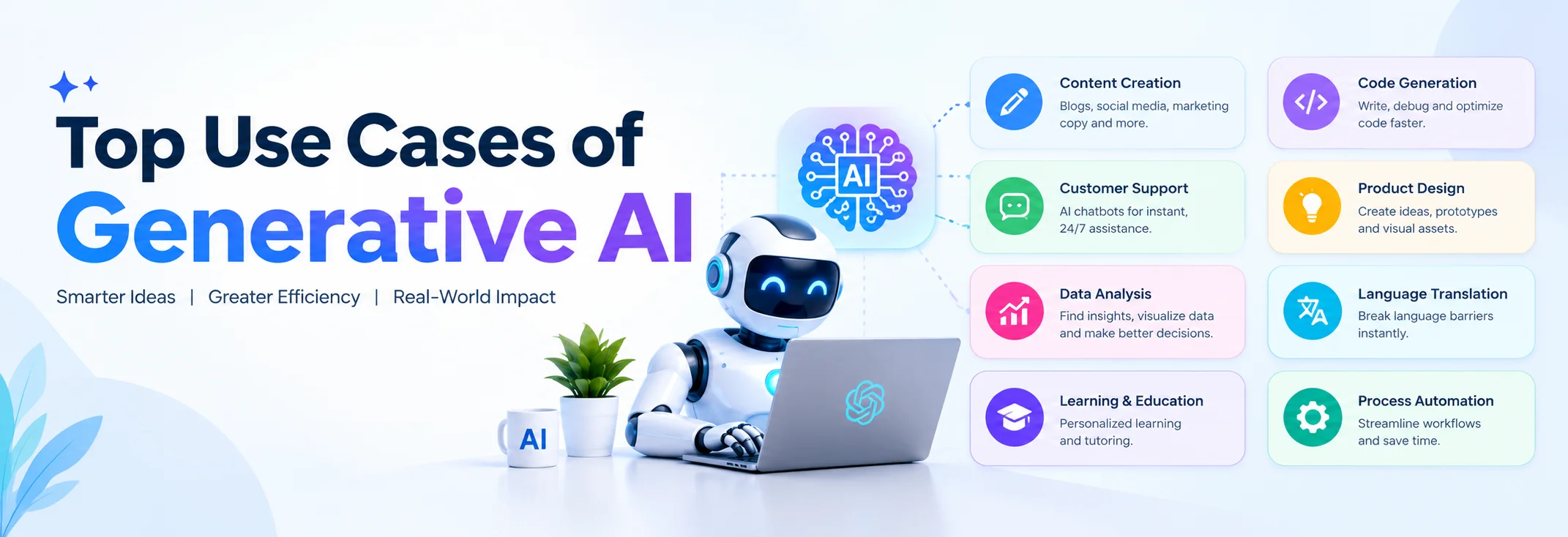
Top Use Cases of Generative AI in 2026
Read More →
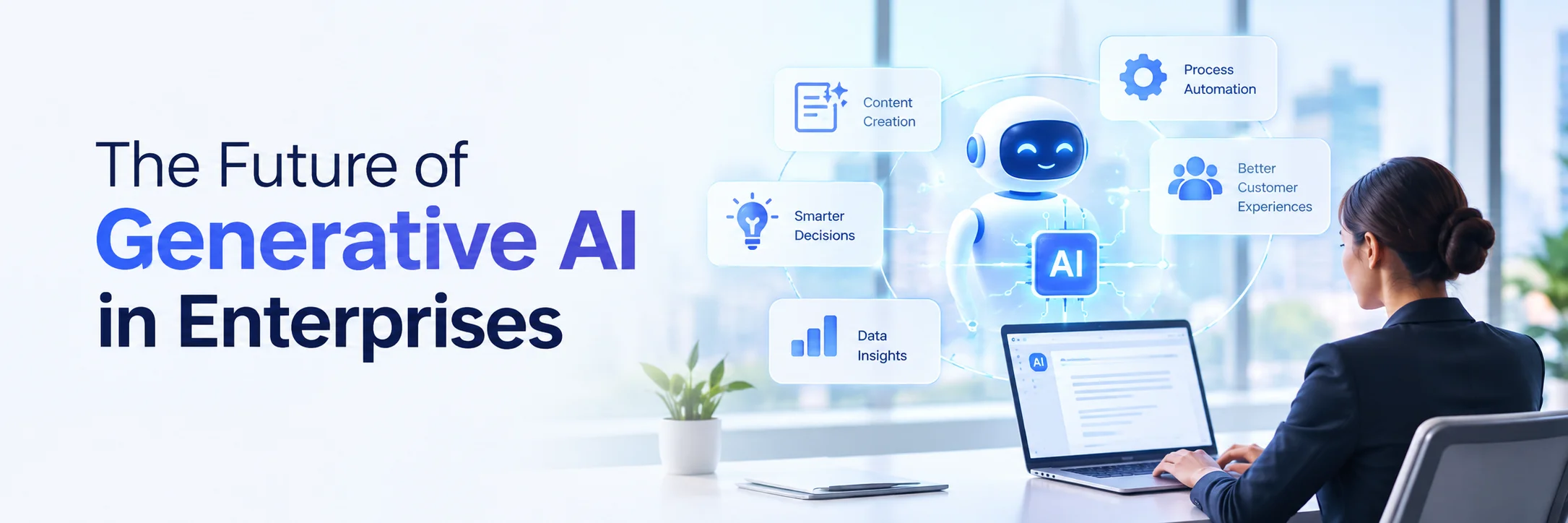
The Future of Generative AI in Enterprises
Read More →
How Generative AI Is Reshaping Enterprise Operations in 2025
Read More →
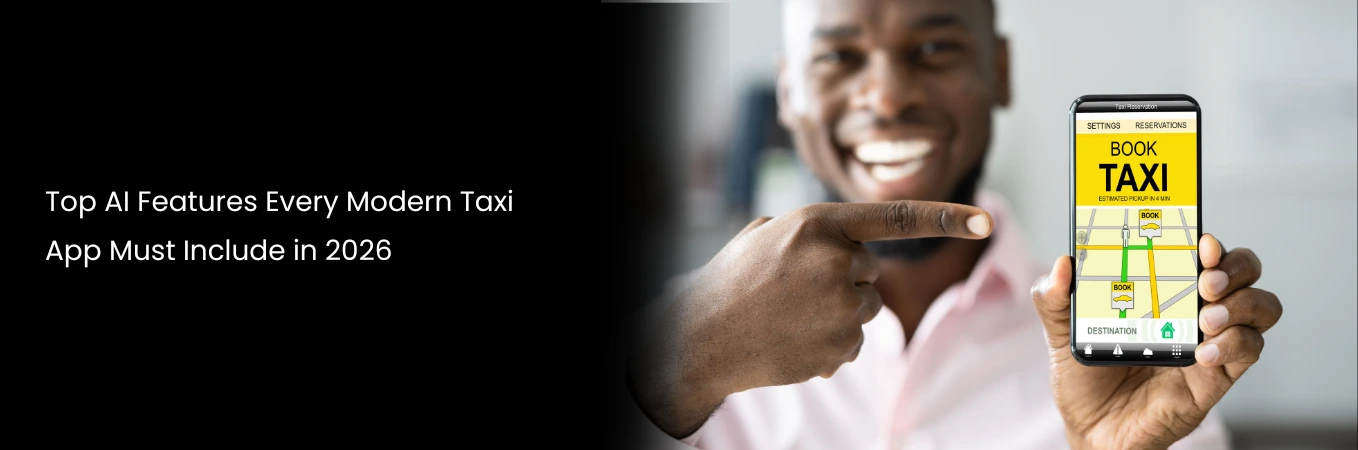
Top AI Features Every Modern Taxi App Must Include in 2026
Read More →The Future of Events: How Artificial Intelligence Is Changing the Industry
Read More →Why Are AI Agents the Next Big Shift in Banking and Finance
Read More →How AI-Driven Analytics Improve Learning Outcomes
Read More →How AI Is Optimizing Every Step of Food Delivery Apps
Read More →How AI-Powered CRM Is Transforming the Media & Entertainment Industry
Read More →
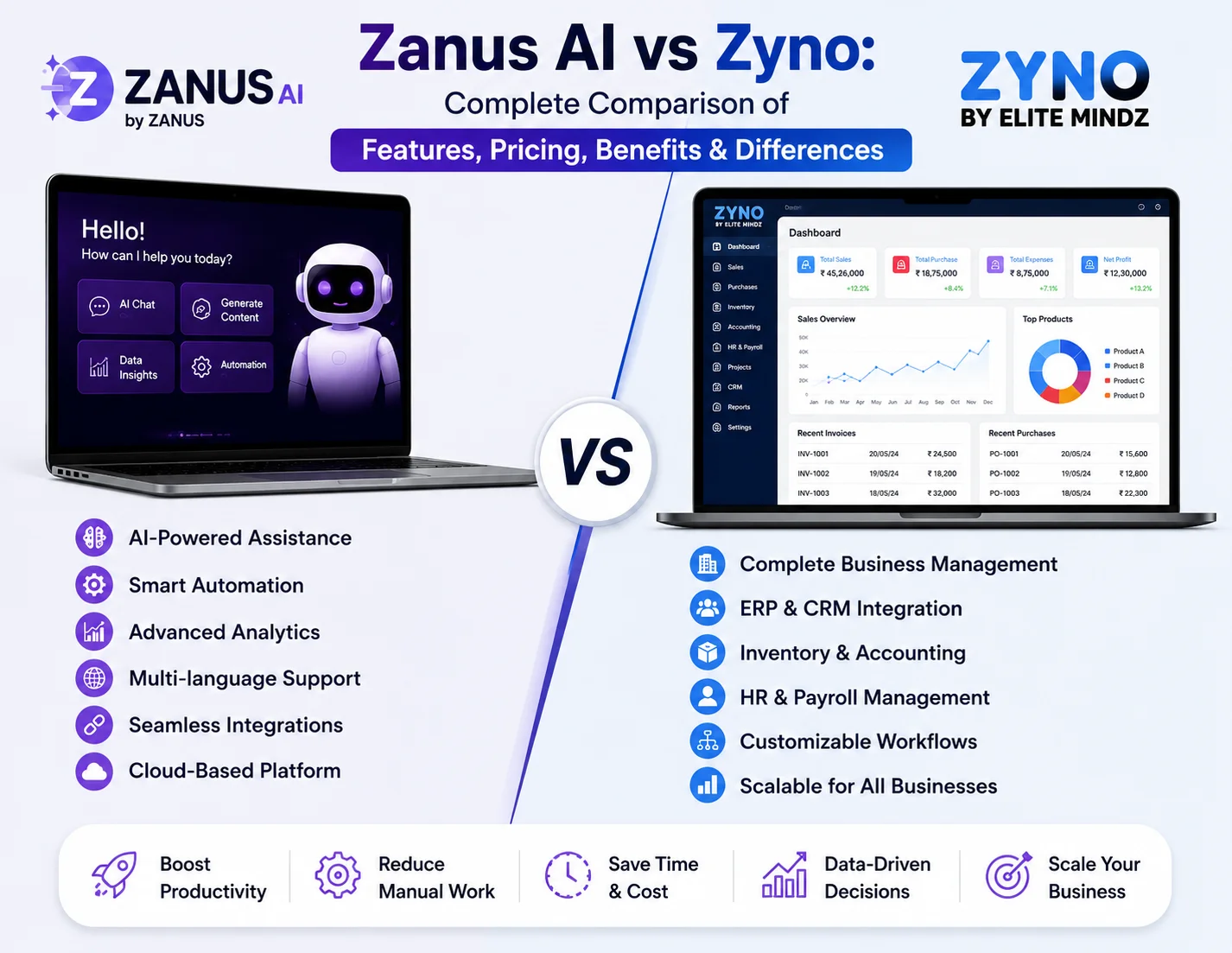
Zanus AI vs Zyno: Complete Comparison of Features, Pricing, Benefits & Differences
Read More →
Why US Companies Are Outsourcing Agentic AI Development to India

Read More →
Top Agentic AI Development Companies in India for US Businesses (2026)
Read More →
Top Upcoming AI Tools of September 2026 You Must Watch
Read More →Partner with ZYNO by Elite Mindz to revolutionize how your business works. Fill out the form, and we’ll reach out with AI-powered solutions made just for you.
We use browser cookies to ensure you get the best experience on our website. Learn more
The form was submitted successfully!