AI Enablement in the Age of Generative AI: ZYNO by Elite Mindz Leading the Charge
Read More →
×
AI identity verification uses artificial intelligence, computer vision, and biometric analysis to confirm a person matches their government-issued ID, typically through document scanning, facial matching, and liveness detection completed in seconds rather than days. It helps businesses onboard customers remotely while reducing fraud and manual review workload, though it works best paired with human oversight for edge cases. Ready to add AI-powered identity verification to your platform? Talk to ZYNO AI EliteMindz about building a verification workflow suited to your industry and compliance needs.
Businesses using ZYNO Books cut accounting time by 70% and stay 100% ZATCA-compliant — automatically.
Verifying who someone actually is has become one of the hardest problems in digital business. A bank opening a new account, a marketplace approving a new seller, or a healthcare portal confirming a patient's identity all face the same challenge: the person on the other end of the screen could be anyone.
AI identity verification is the use of artificial intelligence, computer vision, and biometric analysis to confirm that a person is who they claim to be, without requiring an in-person visit. It typically combines document verification, facial verification, and liveness detection to check a government-issued ID against a live selfie. Businesses use it because it can process verifications in seconds, reduce manual review workload, and support faster, more consistent customer onboarding. This article covers what it actually is, how it works step by step, the technologies involved, its real benefits and limitations, and what to look for when evaluating a platform.
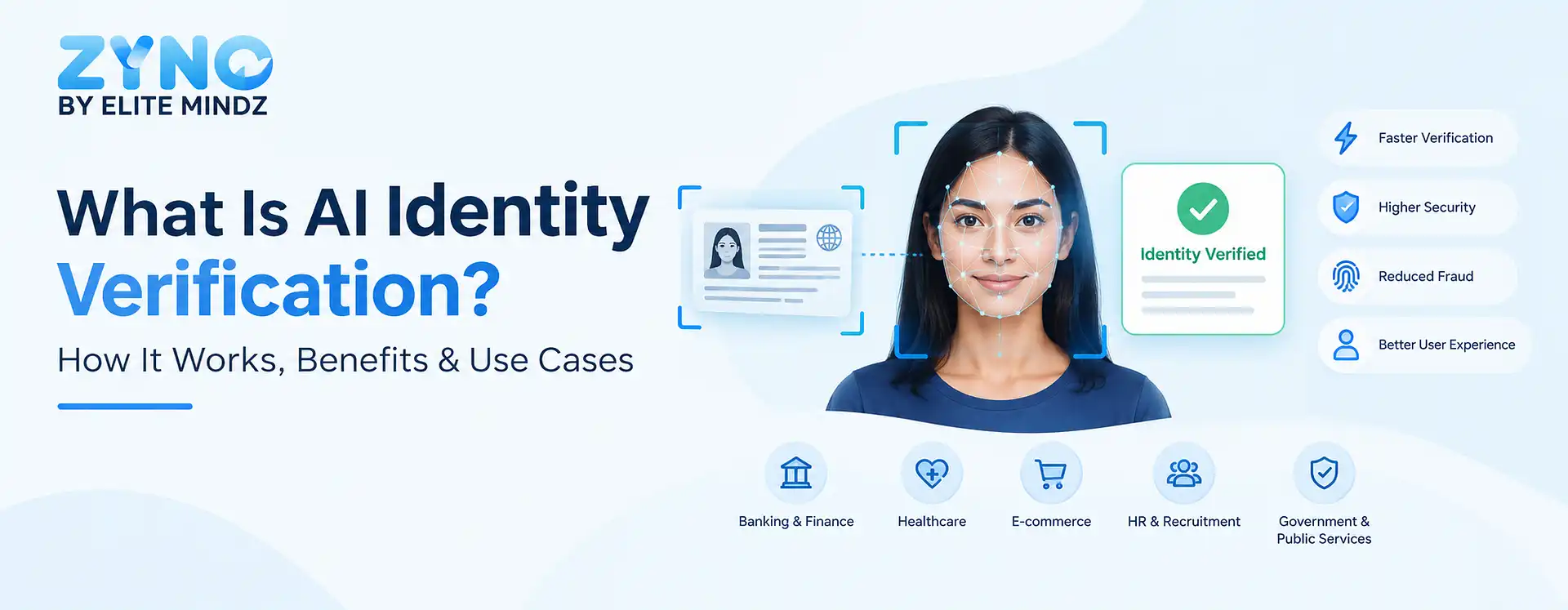
AI identity verification is the process of using artificial intelligence, computer vision, and biometric analysis to determine whether a person attempting to access a service is genuinely who they claim to be. It typically checks a government-issued document, such as a passport, driver's license, or national ID, against biometric data captured from the user, usually a live selfie or short video.
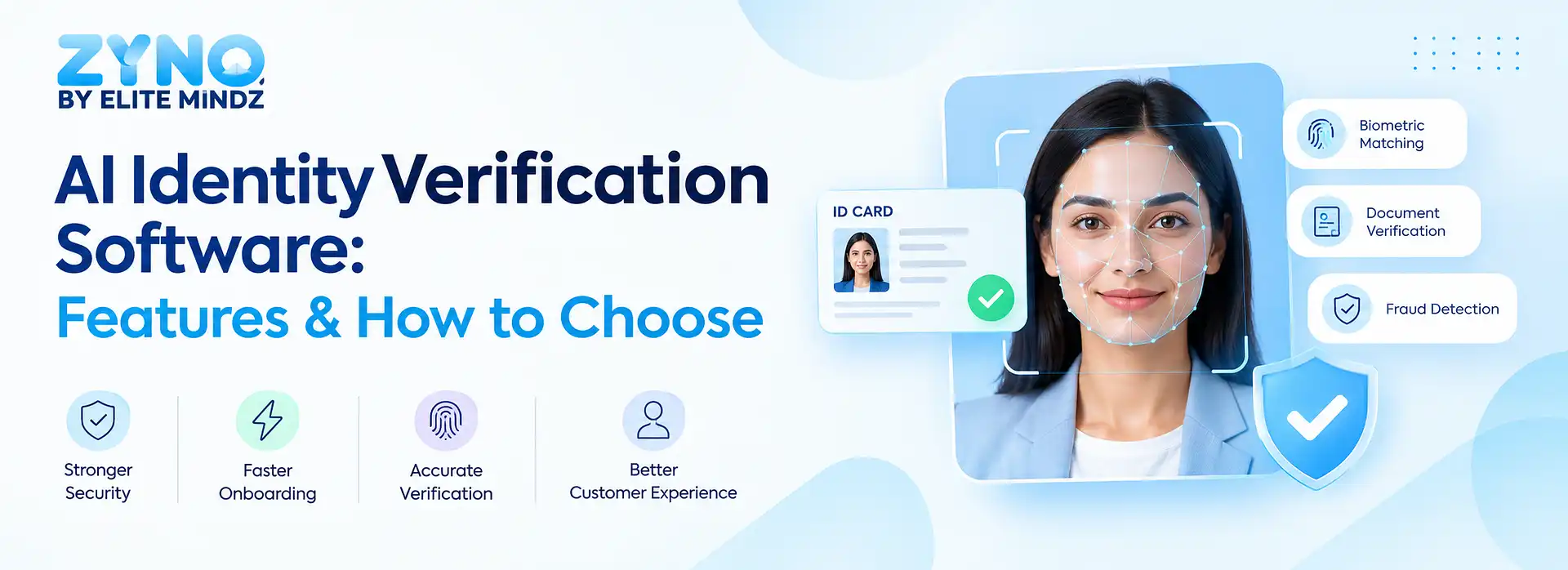
Unlike a simple form field asking for a name and date of birth, this process is designed to confirm that a real, physically present person matches a real, valid document. It draws on several capabilities working together: optical character recognition to read document data, computer vision to detect signs of tampering, facial recognition to compare a photo ID to a live face, and liveness detection to confirm the person isn't a photo, mask, or deepfake.
This matters most in remote settings, where a business cannot physically inspect a document or meet the applicant in person. It's what allows a fintech app, an online marketplace, or a digital bank to onboard a customer entirely from a phone, in minutes, with a reasonable degree of assurance that the person is real.
In plain terms, this technology answers one question: does this person match this document? It extracts data from an ID, checks that ID for authenticity indicators, captures a biometric sample from the user, and compares the two. The automated layer handles steps that used to require a trained human reviewer looking at a photocopy.
Ready to Build Smarter AI Solutions?
Explore how AI-powered computer vision can help your business automate visual processes, improve accuracy, and build smarter digital experiences.
Traditional identity checks relied on a person visually comparing a photo ID to a face, often with limited training and no way to catch subtle document tampering. Automated verification introduces capabilities that weren't practical at scale before:

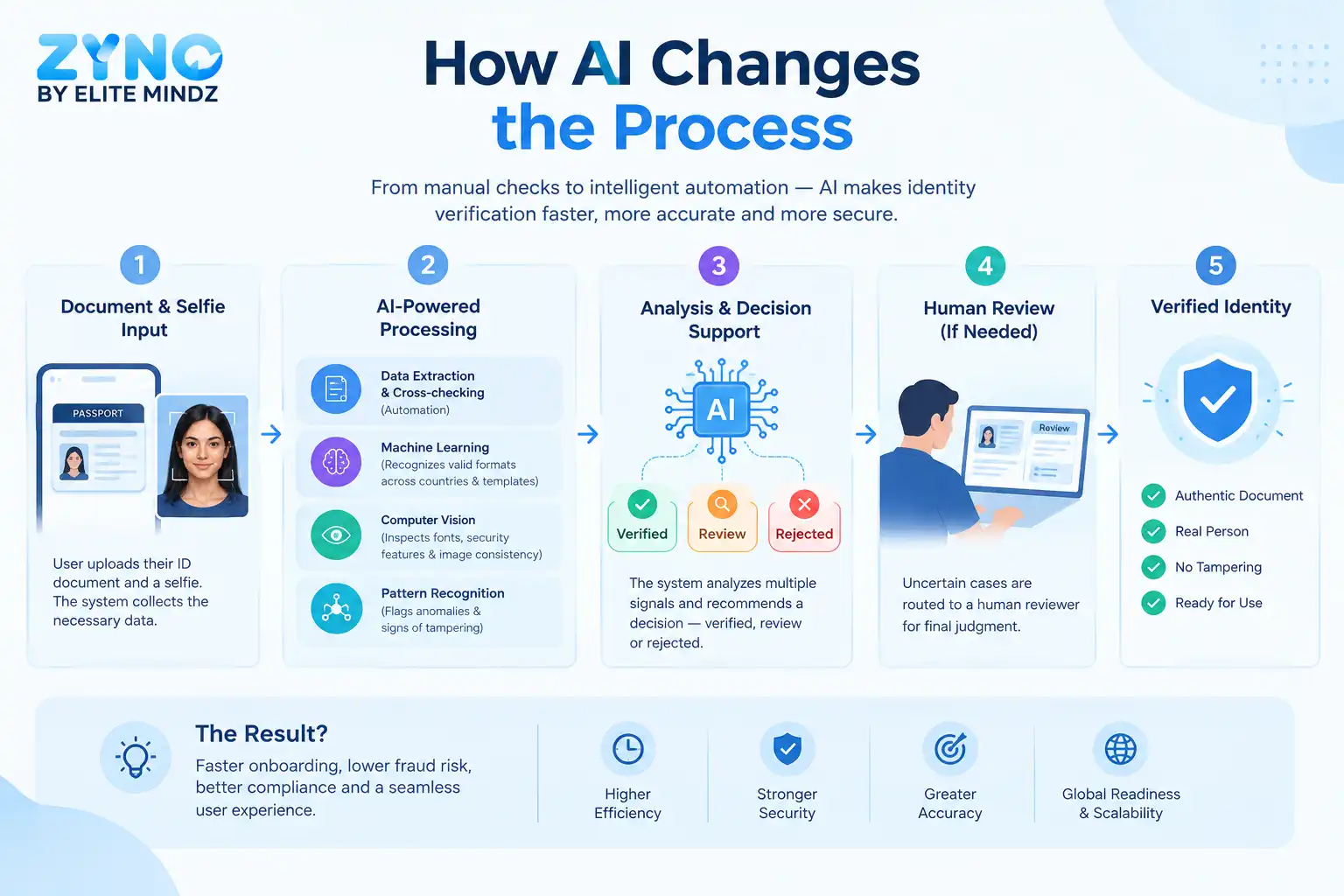
This doesn't mean human judgment is removed entirely. Most platforms still route uncertain cases to a reviewer.
| Factor | Traditional Verification | AI Identity Verification |
|---|---|---|
| Process | Manual document review, often in person | Automated document and biometric analysis |
| Speed | Minutes to days | Typically seconds to a few minutes |
| Human Involvement | High: every case reviewed manually | Lower: humans handle exceptions and edge cases |
| Scalability | Limited by staff capacity | Scales with infrastructure, not headcount |
| Document Analysis | Visual inspection only | OCR, tamper detection, and cross-referencing |
| Fraud Detection | Relies on reviewer experience | Pattern-based detection across large data sets |
| Customer Experience | Often requires branch visits or mailed documents | Can be completed remotely on a phone or laptop |
It generally moves faster and scales further, but it isn't inherently more accurate in every scenario. Implementation quality and document coverage still matter.
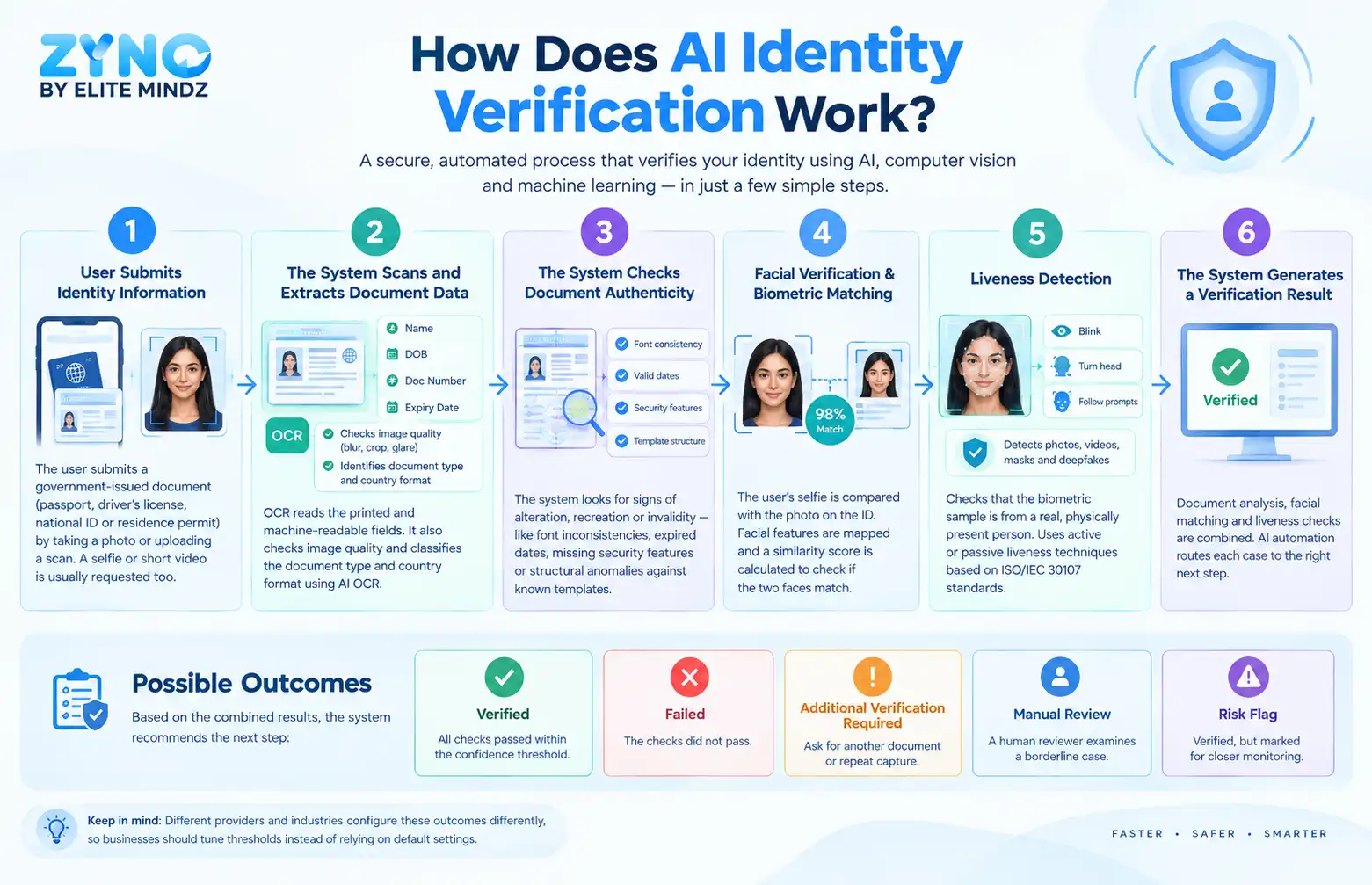
Most platforms follow a similar sequence, even though exact steps and terminology vary by provider.
The process starts with the user submitting a government-issued document (passport, driver's license, national ID, or residence permit), usually by photographing it with a smartphone camera or uploading a scan. Many workflows also request a selfie or short video at this stage.
OCR reads the printed and machine-readable fields on the document: name, date of birth, document number, and expiration date. Purpose-built AI OCR also checks image quality, flagging blurry, cropped, or glare-affected photos, and classifies which document type and country format it's dealing with.
Next, it looks for signs the document has been altered, recreated, or is simply invalid: font inconsistencies, expired dates, missing security features where supported, and structural anomalies against known templates. No system can catch every fake document; sophisticated forgeries and unsupported document types remain a real limitation.
The user's selfie is compared against the photo on the submitted ID. Facial verification technology maps key facial features and calculates a similarity score, which the platform uses to decide whether the two faces plausibly match.
Liveness detection checks whether the biometric sample came from a real, physically present person rather than a photo, video replay, mask, or digitally generated face. Active liveness may ask the user to blink, turn their head, or follow on-screen prompts; passive liveness analyzes subtle cues in a single image or short clip without requiring user action. The presentation-attack concepts most vendors build against trace back to the ISO/IEC 30107 series of standards, which define how such attacks are categorized and tested. This step defends against spoofing, though accuracy varies by provider and attack type, and no method is foolproof against every emerging technique.
Finally, document analysis, facial matching, and liveness checks combine into an outcome, often coordinated by AI agent-style automation that routes each case to the right next step:
How these outcomes are configured differs meaningfully between providers and industries, so businesses should expect to tune thresholds rather than accept default settings blindly.

Artificial intelligence and machine learning form the decision-making layer underneath the process. Models are trained on large sets of document images and biometric samples so they generalize to new documents and faces, rather than relying on fixed, hand-coded rules.
Computer vision lets software interpret images the way a person would look at a photo, but faster and more consistently: detecting document edges, reading holograms or microprint where possible, and assessing image quality.
OCR converts printed and machine-readable text into structured digital data, which is then compared against other fields, such as a passport's machine-readable zone, to check for inconsistencies.
Facial recognition maps distinguishing features of a face into a mathematical representation, compared against the ID photo. The output is typically a similarity score rather than a simple yes or no, letting businesses set their own match thresholds.
Biometric verification broadly means using unique physical characteristics, most often a face, to confirm identity. In most consumer flows, facial biometrics are the default because they only require a smartphone camera.
Fraud detection models can look beyond a single verification event, analyzing patterns across many attempts (device fingerprints, IP behavior, submission timing) to flag activity consistent with organized fraud rather than isolated legitimate errors.
Deepfake and spoof detection has become more important as synthetic media has grown more accessible. Providers are actively developing detection layers aimed specifically at AI-generated faces and manipulated video, in addition to traditional photo and mask detection. This is a fast-moving area, and capability varies significantly across vendors.
Build a Smarter AI Identity Verification Platform
Strengthen digital onboarding with AI-powered document verification, facial matching, liveness detection, and automated identity checks designed for faster and more secure verification.
Explore AI Identity VerificationEach feature exists to remove a specific point of friction or risk: manual data entry, unverified self-reported information, or blind trust in submitted documents. Building this stack from scratch is a substantial undertaking, which is why many businesses lean on dedicated AI development partners rather than assembling it entirely in-house.
None of this amounts to guaranteed fraud elimination or guaranteed compliance. Outcomes depend heavily on configuration, document coverage, and how exceptions are handled.
| Industry | Use Case | Business Benefit |
|---|---|---|
| Fintech | Account opening, KYC | Faster onboarding, reduced fraud exposure |
| Banking | Remote account opening | Branch-free customer acquisition |
| E-commerce | Seller and buyer verification | Fewer fake accounts and scams |
| Crypto / Web3 | KYC and AML workflows | Supports regulatory obligations |
| Healthcare | Patient identity matching | Reduced unauthorized record access |
| Insurance | Onboarding and claims | Reduced identity-related claims fraud |
| Recruitment | Candidate verification | Confidence in remote hiring |
| Travel | Digital check-in | Faster, self-serve guest verification |
Fintech and banking. Confirming applicant identity before enabling money movement supports KYC and helps reduce fraudulent account creation, a persistent risk in an industry that moves money quickly. Digital-first banks depend on this especially, since many have no physical branches at all.
E-commerce and marketplaces. Confirming seller identity before granting selling privileges, and reducing fake buyer or seller accounts, limits scams that damage platform trust.
Cryptocurrency and Web3. Exchanges use identity checks to support KYC and AML-related workflows, since many jurisdictions now require confirmed identity before trading or withdrawals.
Healthcare. Confirming patient identity before granting access to digital records or telehealth appointments reduces the risk of one person accessing another's medical information. This is identity matching, not a medical determination.
Insurance. Onboarding and claims-stage checks help confirm applicants and claimants are who they say they are, which can reduce identity-related claims fraud.
Recruitment. Employers hiring remotely use identity checks to confirm the person interviewed is the same person who shows up for work, addressing a growing concern around remote-hire identity fraud.
Travel and hospitality. Digital check-in reduces front-desk friction while still confirming guest identity against a booking.
Identity verification is a core building block of know-your-customer programs, but it isn't the same thing as complete KYC or AML compliance. KYC also typically requires customer due diligence, ongoing monitoring, and risk-based assessment. Identity verification confirms who the customer is; it doesn't by itself assess transaction risk or monitor ongoing behavior.
In the United States, NIST's Digital Identity Guidelines lay out the assurance-level framework many providers reference when designing identity-proofing workflows, covering identity proofing, authentication, and federation.
Automation can reduce the manual workload of the identity-confirmation step within KYC, freeing compliance teams to focus more on due diligence and risk analysis. For AML specifically, identity verification supports the foundation that transaction monitoring, sanctions screening, and suspicious activity reporting are built on, but it doesn't perform those functions on its own. An identity verification platform is one component of a KYC and AML program, not a substitute for the full regulatory framework a given jurisdiction requires.
Power Secure Onboarding with AI Identity Verification Software
Automate identity checks with AI-powered document verification, facial matching, and liveness detection. Build faster, safer, and more reliable digital verification experiences for your customers.
This section matters as much as the benefits above; no serious evaluation of the technology should skip it.
Privacy and data protection. The process involves collecting sensitive personal data, including biometric information, which carries real obligations and risk if mishandled or breached.
False positives and false negatives. No system is perfect. A false positive rejects a legitimate user, causing friction and lost business; a false negative approves a fraudulent attempt. Providers tune thresholds to balance these trade-offs, but neither error type can be eliminated entirely.
Bias and accuracy considerations. Facial recognition accuracy can vary across demographic groups and document types, depending on training data and model design. This is a legitimate, well-documented concern businesses should ask vendors about directly rather than assume is solved.
Integration complexity. Connecting an identity verification API into existing onboarding flows, especially across multiple products or regions, takes real engineering effort and ongoing maintenance.
Consent and transparency. Collecting biometric data typically requires clear user consent and disclosure about how it will be used, stored, and retained. This isn't optional in most jurisdictions.
Regulatory requirements. Data protection and biometric privacy laws vary significantly by country and even by state, and requirements change over time. Businesses need ongoing legal review, not a one-time compliance check.
| Selection Factor | What to Confirm |
|---|---|
| Document Coverage | Countries and document types actually supported |
| Biometric Accuracy | Independent or demographic-segmented performance data |
| Liveness Method | Active vs. passive, and known attack resistance |
| Integration | API and SDK quality, and engineering effort required |
| Data Handling | Storage, retention, encryption, deletion policy |
| Compliance Scope | What's covered vs. what remains your responsibility |
| Pricing Model | Per verification, per user, or tiered |
Confirm which document types and countries a platform actually supports; coverage gaps are a common surprise after go-live. Ask how facial matching accuracy is measured and whether performance data is broken down across demographics and conditions. Understand whether liveness detection is active or passive, and what known attack types it's been tested against. Look for fraud detection that works across sessions, not just single-transaction checks. Check what KYC and AML support actually covers versus what your compliance team still needs to handle separately.
Review API and SDK documentation quality and the realistic engineering effort to integrate. Ask about encryption, data residency, and retention policies, and confirm the platform can handle your peak verification volume without degraded response times. If you operate internationally, document coverage by country becomes a primary decision factor, not a secondary one. Finally, understand whether pricing is per verification, per active user, or tiered, and how retries or manual reviews are billed.
For businesses that don't have this expertise in-house, working through the selection and integration process with an AI consulting partner can help avoid the coverage gaps and integration surprises noted above.
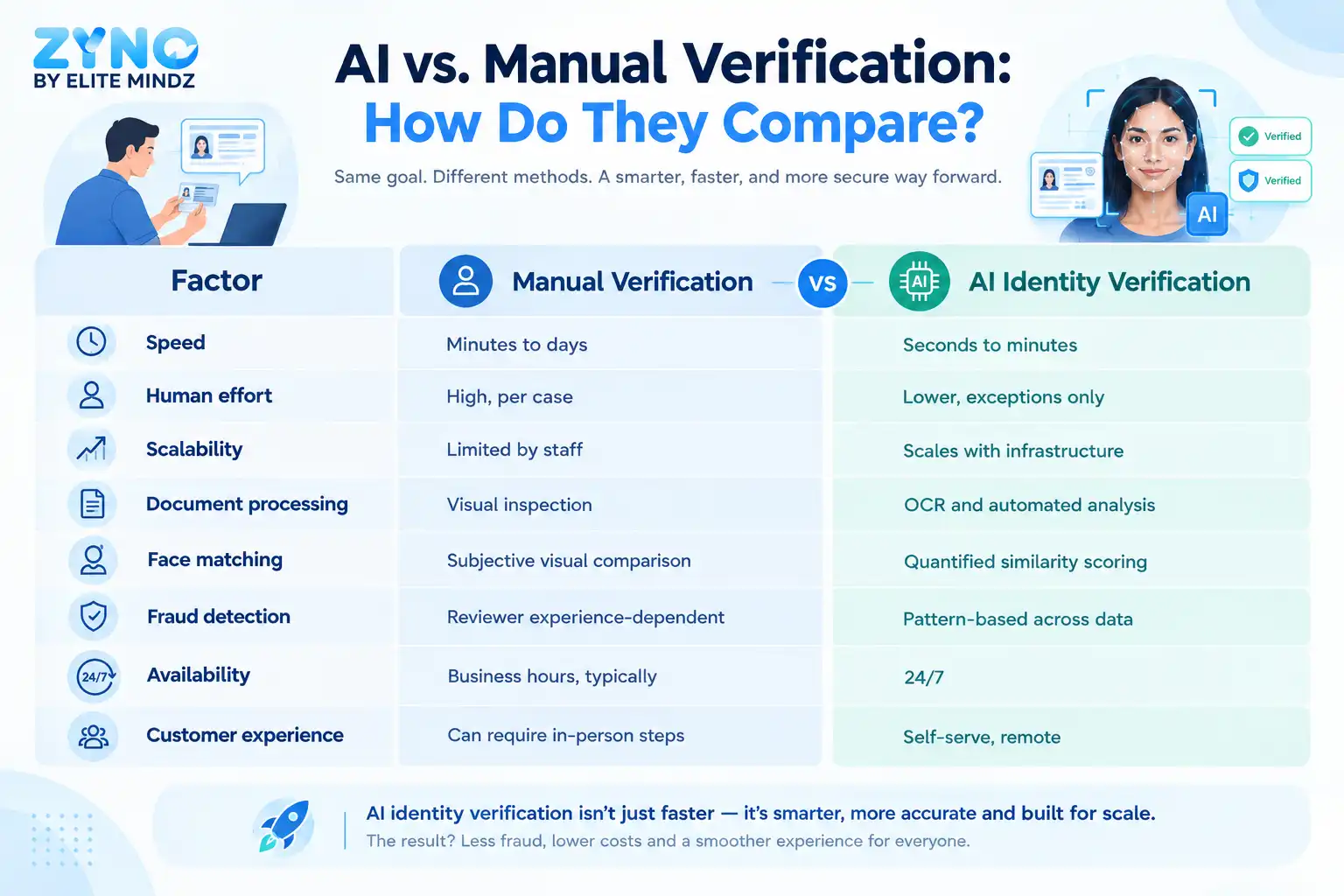
| Factor | Manual Verification | AI Identity Verification |
|---|---|---|
| Speed | Minutes to days | Seconds to minutes |
| Human Effort | High, per case | Lower, exceptions only |
| Scalability | Limited by staff | Scales with infrastructure |
| Document Processing | Visual inspection | OCR and automated analysis |
| Face Matching | Subjective visual comparison | Quantified similarity scoring |
| Fraud Detection | Reviewer experience-dependent | Pattern-based across data |
| Availability | Business hours, typically | 24/7 |
| Customer Experience | Can require in-person steps | Self-serve, remote |
Manual review isn't obsolete. A hybrid approach, where automation handles routine cases and trained staff handle exceptions or high-risk profiles, is a reasonable and common model for higher-risk industries.

Reusable digital identity. Credentials verified once and referenced across services are gaining attention as a way to reduce repeated verification friction.
Deepfake detection. As synthetic media becomes more accessible, detection aimed at AI-generated faces and voices will likely keep evolving alongside the threat.
Passive biometrics. Methods requiring less active user action, while still confirming liveness, are an active area of development aimed at reducing friction without weakening security.
Continuous authentication. Rather than a single event at sign-up, some platforms are exploring ongoing, lower-friction identity signals throughout a session.
Privacy-preserving verification. Techniques that confirm identity claims without storing or transmitting raw biometric data are gaining interest as privacy regulation tightens.
Decentralized identity. Some efforts aim to let users control and share verified credentials directly, rather than relying on each business to verify from scratch.
More AI-assisted workflows, with routine verification increasingly automated while human reviewers stay central to ambiguous, high-risk, or appealed cases. Full replacement of human oversight isn't a realistic near-term expectation.
Simplify Digital Verification with an AI Identity Verification Solution
Verify identities faster with intelligent document checks, facial recognition, and liveness detection. Create a secure and seamless verification experience while reducing manual verification efforts.
AI identity verification combines document analysis, facial verification, and liveness detection to confirm a person's identity remotely, without requiring an in-person visit. It works through a defined sequence: document submission, data extraction, authenticity checks, facial matching, liveness detection, and a final decision, drawing on OCR, computer vision, and machine learning to do so.
Its main benefits are speed, scalability, and a smoother remote onboarding experience, and its main use cases span fintech, banking, e-commerce, healthcare, and beyond. But it isn't a complete solution on its own: false positives and negatives, bias considerations, privacy obligations, and regulatory requirements all remain real factors businesses need to plan for. A balanced approach, pairing automation with human oversight for exceptions, tends to serve businesses better than treating it as a fully autonomous system.
Businesses exploring AI-powered identity workflows, document automation, or broader AI-driven digital transformation can look at how platforms like ZYNO by Elite Mindz approach AI-powered enterprise technology as one example of how this space is evolving.
It's the use of artificial intelligence, computer vision, and biometrics to confirm a person matches the identity document they submitted, typically combining document analysis, facial verification, and liveness detection for remote, automated checks.
It extracts and analyzes data from a submitted ID, checks the document for tampering, compares a live selfie to the document photo, and runs liveness detection to confirm the person is physically present, combining the results into a verification outcome.
It can meaningfully improve security compared with unverified self-reported data, but no system is immune to sophisticated fraud. Security depends on the specific platform, its liveness detection quality, and how data is protected and stored.
Most platforms support passports, driver's licenses, and national ID cards, with coverage varying by country. Some also support residence permits or other government-issued documents, depending on the provider.
Identity verification confirms who a person is. KYC is a broader compliance process that includes identity verification plus customer due diligence, risk assessment, and ongoing monitoring required under financial regulations.
It maps distinguishing features from a live selfie and compares them against the photo on a submitted ID, producing a similarity score used to decide whether the two images plausibly show the same person.
It confirms a biometric sample comes from a real, physically present person rather than a photo, video replay, or mask, helping defend against spoofing attempts during verification.
It can detect many common tampering indicators and inconsistencies, but it can't guarantee detection of every forged document, particularly sophisticated ones. Detection capability varies by provider and document type.
Pricing varies by provider and typically depends on verification volume, document types supported, and whether it's charged per verification, per user, or tiered. Businesses should request a quote based on their specific use case.
Fintech, banking, e-commerce, cryptocurrency, healthcare, insurance, recruitment, and travel are among the industries that commonly use it to support onboarding, compliance, and fraud prevention.
AI Enablement in the Age of Generative AI: ZYNO by Elite Mindz Leading the Charge
Read More →

Top 10 Trends Shaping the Future of AI Agents in 2025
Read More →
Top 6 AI Chatbot Features Transforming Customer Engagement in 2026
Read More →
Top 10 AI Integration Strategies for Seamless ERP and CRM Upgrades in 2025
Read More →
Best GAI Consulting Approaches for Ethical Business Transformation in 2025
Read More →
From Vision to Value: The Ultimate Guide to Enterprise GenAI Platforms
Read More →
Top 10 GAI Development Trends Shaping Autonomous Agents in 2025
Read More →
The Future of Computer Vision: Trends to Watch in 2025
Read More →
Generative AI in 2025: How ZYNO BY Elite Mindz is Transforming Enterprise Workflows
Read More →
10 Real-World Applications of Computer Vision in 2025
Read More →
Integrating Computer Vision with IoT and AI: Driving the Next Wave of Intelligent Systems in 2025
Read More →
Agentic AI Explained: How AI Agents Are Transforming Business in 2025
Read More →
From Chatbots to Autonomous Agents: The Evolution of Agentic AI
Read More →
The Rise of Multi-Agent Systems: How Agentic AI Teams Will Run Enterprises of the Future
Read More →
Agentic AI vs Generative AI: What Business Leaders Need to Know
Read More →
The Power of Autonomous Agents: Understanding Agentic AI for Enterprises
Read More →
The Role of Agentic AI in Enhancing Enterprise Agility and Responsiveness
Read More →
Agentic AI as a Competitive Advantage: Why Businesses Can’t Ignore It
Read More →
The Shift from Automation to Autonomy: How Agentic AI is Redefining Enterprise Operations
Read More →
From Reactive to Proactive: How Agentic AI Changes Enterprise Decision-Making
Read More →
Why Every Business Will Hire an AI Agent Soon
Read More →
Agentic AI for Startups: Leveling the Playing Field
Read More →
Agentic AI: The New Digital Workforce
Read More →
The Future of Business: Autonomous Teams of AI Agents
Read More →
From Insights to Action: How AI Agents Close the Gap
Read More →
Agentic AI in 2026: From Hype to Enterprise-Ready Transformation
Read More →
The Competitive Edge: Why Early Adopters of Agentic AI Are Winning Markets
Read More →
Beyond Automation: Why Agentic AI is the Key to Enterprise Agility in 2025
Read More →
The Human-AI Partnership: Building Smarter Teams with Agentic AI
Read More →
The Rise of Autonomous Teams: Why Agentic AI is the New Digital Workforce
Read More →
Top Machine Learning Use Cases You Didn’t Know About
Read More →
What Is Low Code/No Code and Why It Matters in 2025
Read More →
Top Use Cases of Generative AI in 2026
Read More →
The Future of Generative AI in Enterprises
Read More →
How Generative AI Is Reshaping Enterprise Operations in 2025
Read More →
Top AI Features Every Modern Taxi App Must Include in 2026
Read More →The Future of Events: How Artificial Intelligence Is Changing the Industry
Read More →Why Are AI Agents the Next Big Shift in Banking and Finance
Read More →How AI-Driven Analytics Improve Learning Outcomes
Read More →How AI Is Optimizing Every Step of Food Delivery Apps
Read More →How AI-Powered CRM Is Transforming the Media & Entertainment Industry
Read More →
ZYNO vs Zanus AI: Which Is Better for Your Business?
Read More →
Why US Companies Are Outsourcing Agentic AI Development to India

Read More →
Top Agentic AI Development Companies in India for US Businesses (2026)
Read More →
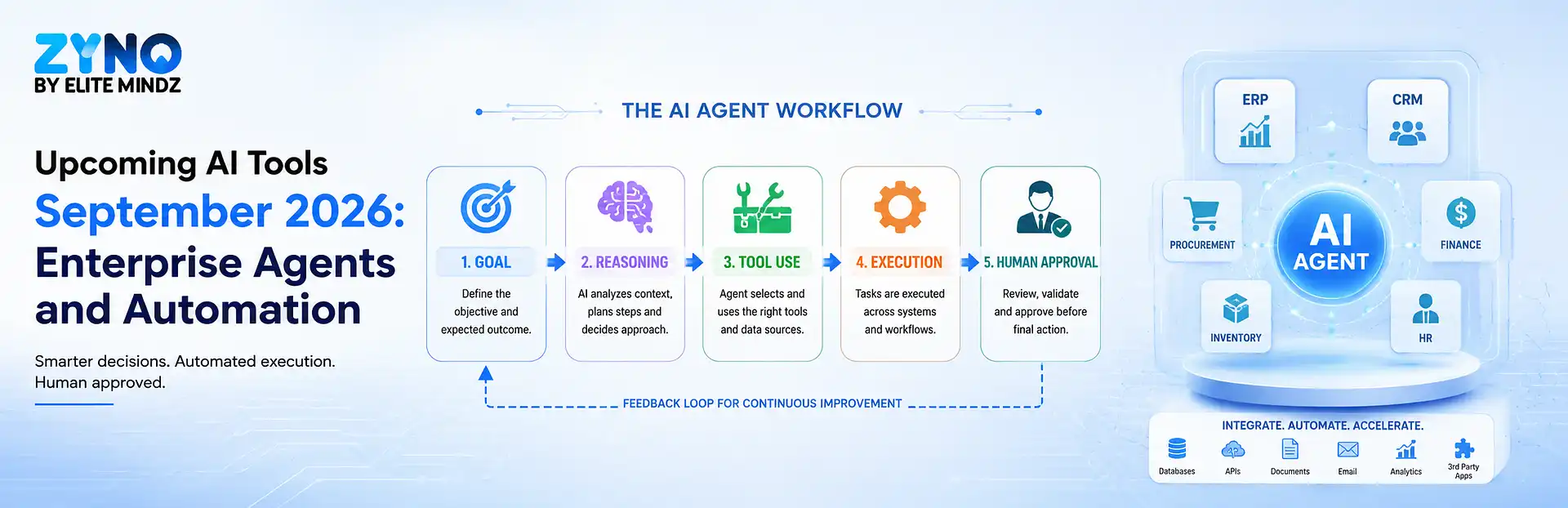
Top Upcoming AI Tools of September 2026 You Must Watch
Read More →
Google Opal vs Tilda Bio AI: What Each Tool Actually Does (and Why They Aren't True Rivals)
Read More →
AI Agent Development Services: A Practical Guide for Business Teams

Read More →
Enterprise AI Agent Development Services: The Complete Guide to Cost, Benefits, Use Cases & Implementation

Read More →
How Much Does Custom AI Agent Development Cost in 2026? Calculate Real Price Ranges
Read More →
Machine Learning Software: Features, Benefits, Pricing & How to Choose the Right Solution in 2026
Read More →
Computer Vision in AI: How It Works, Types, Applications & Benefits
Read More →
Computer Vision Software Development Services
Read More →
What Is AI Identity Verification? How It Works, Benefits & Use Cases
Read More →
AI Identity Verification Software: Features & How to Choose
Read More →Partner with ZYNO by Elite Mindz to revolutionize how your business works. Fill out the form, and we’ll reach out with AI-powered solutions made just for you.
We use browser cookies to ensure you get the best experience on our website. Learn more
The form was submitted successfully!