AI Enablement in the Age of Generative AI: ZYNO by Elite Mindz Leading the Charge
Read More →
×
Enterprise AI agents are no longer a "someday" project — they're already cutting costs and response times for companies that moved first. The real question is which process to automate, not if. Ready to build yours? Talk to ZYNO by EliteMindz about Enterprise AI Agent Development Services — scope your first agent free.
Businesses using ZYNO Books cut accounting time by 70% and stay 100% ZATCA-compliant — automatically.
AI agents have moved out of the innovation lab and into daily enterprise operations — approving invoices, triaging support tickets, screening resumes, monitoring fraud, and reconciling accounts, often without a human touching every step. For any organization evaluating Enterprise AI Agent Development Services, the real question isn't whether autonomous AI belongs in the business anymore — it's which process to automate first, how much custom AI agent development will cost, and which AI agent development company can actually take a working pilot to reliable production. This guide covers all of it — from agentic AI development fundamentals to enterprise AI automation ROI.
The convergence of cheaper compute, more capable large language models, and enterprises finally having their data in a usable state has created a genuine window for deploying intelligent, autonomous AI agents at scale. These are no longer side projects run by an innovation team — they are becoming core infrastructure inside digital transformation strategies across nearly every industry.
Forward-looking leadership teams increasingly treat Enterprise AI Agent Development Services as a fundamental shift in how the business operates, decides, and serves customers — not a bolt-on feature. The competitive question has changed from "should we invest in AI-powered business automation" to "how fast can we integrate intelligent AI agents into core processes before competitors do." Organizations exploring agentic AI solutions often start with our AI & Generative AI services overview before scoping a specific custom AI agent development project.
Ready to Scale with Enterprise AI Agents?
Automate complex workflows, connect your enterprise systems, and build intelligent AI agents designed around your business goals with ZYNO by Elite Mindz.
Explore Enterprise AI Agent Services Talk to an AI ExpertSeveral forces have converged to make this the right moment to invest in Enterprise AI Agent Development Services:
That combination — cost optimization and revenue enhancement from the same enterprise AI agent development investment — is uncommon in enterprise technology, which is part of why boards are paying closer attention to AI agent roadmaps this year.
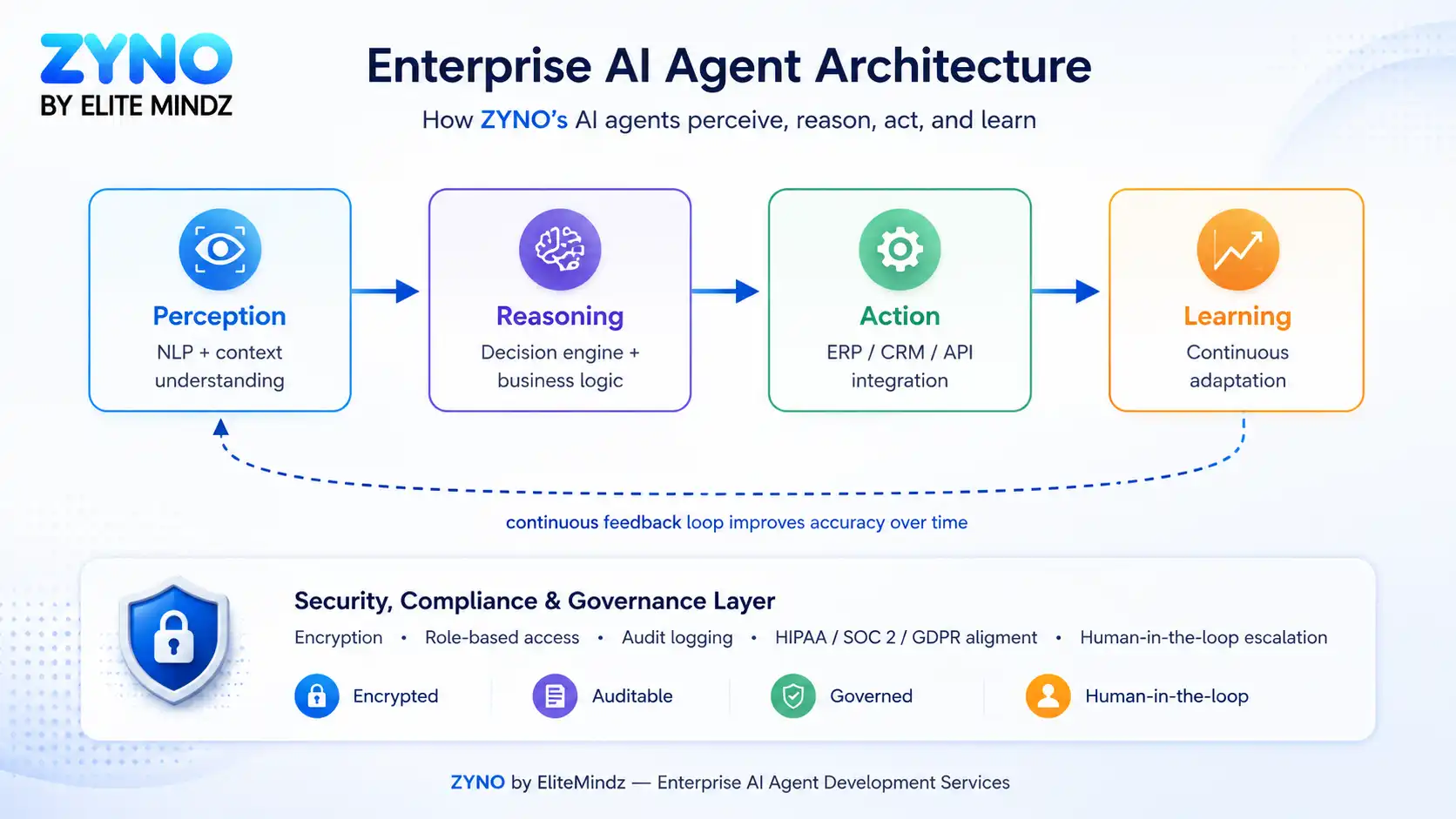
Enterprise AI agent development is the discipline of designing, building, and continuously improving autonomous AI systems that can perceive business context, reason through multi-step problems, and take action within complex enterprise environments — with minimal human intervention at each step.
This is meaningfully different from traditional automation. A scripted workflow does exactly what it's told, in the order it's told, and breaks the moment reality deviates from the script. A true AI business agent understands the goal, evaluates the situation, and decides the next best action — which is why agentic AI systems can handle exceptions and edge cases that would stop RPA in its tracks.
Delivering reliable enterprise AI agent development services requires deep expertise across machine learning, natural language processing (NLP), knowledge representation, LLM-powered agents, and enterprise systems integration. The strongest implementations blend cutting-edge generative AI agent capability with pragmatic business requirements — solutions that deliver value in the first quarter, not just in a slide deck. That combination of technical depth and business pragmatism is exactly what ZYNO's Enterprise AI Agent Development Services are built around.
Perception and context understanding. Enterprise agents need to understand industry-specific terminology, organizational hierarchies, and process workflows — not generic language. This requires natural language processing paired with domain-specific knowledge graphs that encode institutional expertise and business rules, so the AI agent isn't reasoning from scratch every time.
Reasoning and decision engines. This is the cognitive core of any autonomous business agent — combining rule-based logic with machine learning models to evaluate a situation, weigh alternatives, and select an action. These engines have to balance speed with accuracy while remaining auditable, since enterprise decisions often need to be explained after the fact, not just made quickly.
Action and integration capabilities. An AI agent that can't act isn't useful. Robust AI agent integration frameworks let agents interact securely with ERP platforms, CRM databases, ticketing systems, and communication tools, while respecting existing data governance and compliance standards. This is where a lot of AI pilots quietly fail — the reasoning works, but the integration layer was never built for production load or security requirements.
Learning and adaptation systems. The most valuable intelligent AI agents improve through experience — learning from both successful and unsuccessful interactions to refine decision-making over time. These learning loops need governance too, so improvements stay aligned with business objectives instead of drifting or amplifying bias.
This distinction comes up in nearly every AI agent consulting call, so it's worth being precise:
In practice, the most mature enterprise AI automation deployments use all three together — RPA for stable, high-volume mechanical steps; chatbots for simple conversational interfaces; and AI agents to handle the reasoning and coordination layer that ties everything together.
Microservices-based agent design. Enterprise-grade AI agents benefit from modular architectures that separate perception, reasoning, and action into independent services. This enables independent scaling, easier maintenance, and the ability to upgrade one capability without disrupting the whole system.
Event-driven communication patterns. Scalable AI agent architecture leans on event-driven design so agents can respond to business events in real time while staying loosely coupled to other components. This supports high-volume processing and graceful degradation under load — critical for anything customer-facing.
Hybrid cloud deployment models. Most enterprises need a multi-agent deployment strategy that balances data security, performance, and cost. Hybrid architectures let sensitive data stay on-premises while cloud resources handle intensive computation and model training — a pattern our cloud consulting team frequently designs around for regulated industries.
Successful AI integration services have to solve both technical and organizational challenges. Technical integration needs robust APIs, data mapping, and real-time synchronization. Organizational integration needs change management, user training, and clear governance — technology alone doesn't get an AI agent solution adopted.
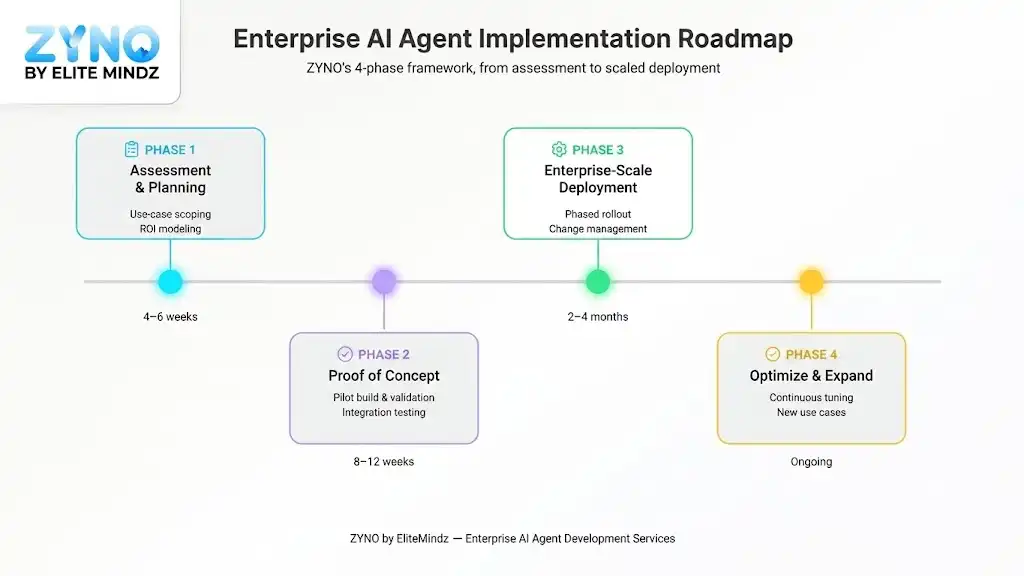
Deploying enterprise AI agents well requires a structured approach that balances speed to market with long-term sustainability. Organizations that follow a disciplined AI agent implementation methodology consistently achieve higher success rates and faster value realization. Here's the framework ZYNO uses across every Enterprise AI Agent Development Services engagement.
Every successful AI agent development initiative starts with a real assessment, not assumptions. This phase typically runs 4–6 weeks and delivers a concrete roadmap.
Before committing to a full rollout, validate the concept with a focused AI agent pilot — typically 8–12 weeks — on a use case that's high-impact but manageable in scope. Success criteria should be defined upfront, with milestone reviews to keep the project honest.
With validation complete, move to scaled enterprise AI agent deployment — coordinating technical teams, business units, and any external partners for a smooth transition from pilot to production.
The work isn't done at go-live — it's just getting started. This phase focuses on continuous improvement: refining AI agent performance, expanding use cases, and incorporating emerging generative AI capabilities as they mature. Organizations that treat enterprise AI agent development as an ongoing capability — not a completed project — are the ones who keep compounding returns year over year.
Build Smarter Enterprise AI Agents
Transform complex business processes with AI agents that automate workflows, connect your ERP and CRM systems, and help your teams make faster, smarter decisions.
Explore AI Agent Services Discuss Your AI ProjectWhile enterprise AI agents share common technical foundations, the highest-value applications vary a lot by industry. Understanding sector-specific opportunities is essential to designing AI agent solutions that actually move the needle. See how these map to real builds on our industries page.
Financial institutions use AI agents for banking and fraud detection, risk assessment, customer service automation, and compliance monitoring — applications that demand exceptional accuracy, auditability, and regulatory compliance while handling sensitive financial data.
Healthcare organizations deploy AI agents in healthcare for patient engagement, clinical decision support, administrative automation, and research acceleration — all under strict privacy requirements and high accuracy demands.
Manufacturers use AI agents for supply chain automation, predictive maintenance, quality control, and production scheduling — applications that need real-time data processing and integration with industrial control systems and IoT devices.
Retailers implement AI shopping agents and customer service, inventory management, personalized marketing, and demand forecasting agents — high-volume applications that need consistent experience across channels.
Beyond customer-facing use cases, AI automation agents are increasingly deployed internally to reduce operational drag:
Enterprise AI agent development has to prioritize security, compliance, and governance from the outset — not as an afterthought. Organizations in regulated industries face additional requirements around data protection, audit trails, and explainability, and skipping these considerations can create real legal, financial, and reputational exposure.
AI agents must operate within established security frameworks that protect sensitive data, prevent unauthorized access, and preserve system integrity — addressed at every layer of the AI agent stack, from data ingestion to model deployment.
Different industries face different regulatory obligations that shape AI agent design and deployment. Financial services must align with SEC and FINRA requirements, healthcare organizations must follow HIPAA, and multinational companies must navigate GDPR and other regional data protection laws.
Compliance has to be designed into the system from the start — audit trails, explainability features, and documentation processes that demonstrate regulatory adherence — not retrofitted after the agent is already in production. Our AI governance & compliance practice builds exactly this into every Enterprise AI Agent Development Services engagement.
Effective data governance is essential for responsible enterprise AI. Organizations need clear policies for data collection, usage, retention, and disposal, with privacy addressed through technical measures like anonymization and differential privacy where appropriate.
AI agents should be designed with privacy-by-design principles — minimizing data collection while preserving functionality — with regular audits ensuring ongoing compliance as regulations and organizational policy evolve.
A compelling Enterprise AI Agent Development Services business case needs to show both financial return and strategic value clearly enough for executive decision-makers to act on.
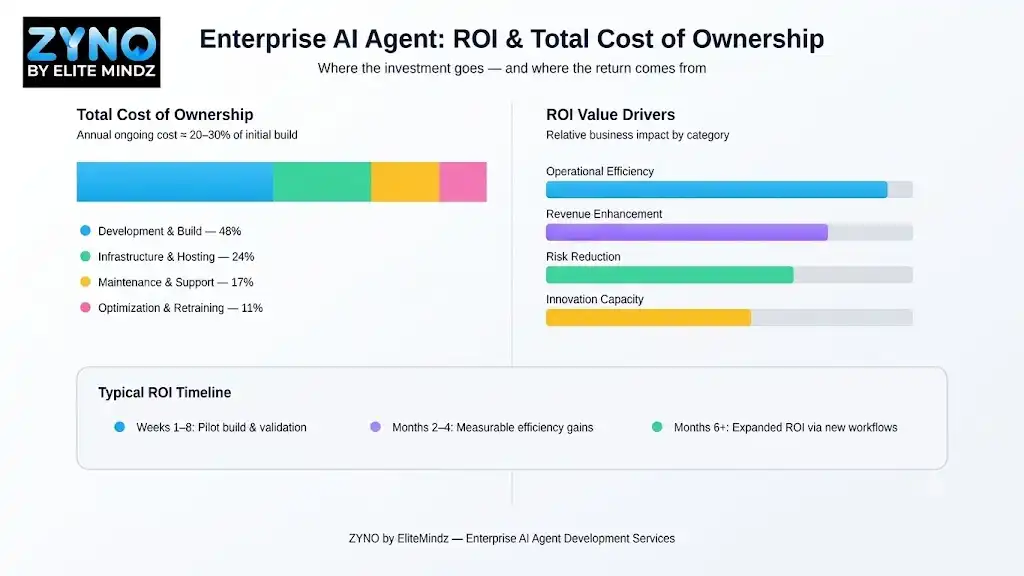
AI agent ROI analysis needs to capture both direct financial benefits and indirect strategic advantages. Direct benefits include cost reduction, revenue enhancement, and productivity gains. Strategic benefits include competitive positioning, customer satisfaction, and market differentiation.
Enterprise AI agent development cost analysis has to extend beyond the initial build to include ongoing infrastructure, maintenance, training, and optimization costs. As a rule of thumb, budget 20–30% of the initial investment annually for these ongoing requirements.
Comprehensive risk assessment identifies potential challenges before they become business problems. Technical risks include model accuracy, system reliability, and integration complexity. Business risks include user adoption, competitive response, and regulatory change.
Effective risk management is continuous — mitigation strategies need to evolve as AI agent capabilities and business requirements evolve, with regular reassessment as systems scale.
Even well-resourced organizations stumble on AI agent rollouts. The most common pitfalls:
Enterprise AI agents will keep evolving as algorithms get more sophisticated, compute gets cheaper, and organizations build more AI maturity. Expect enhanced reasoning capabilities, deeper personalization, and tighter integration into core business processes.
Emerging directions include multimodal AI agents that process text, voice, and visual input simultaneously; federated learning approaches that enable collaboration without raw data sharing; and increasingly autonomous multi-agent systems that self-improve and adapt to changing business conditions. Organizations building strong AI agent foundations today — through disciplined Enterprise AI Agent Development Services — will be best positioned to take advantage of these advances as they mature.
ZYNO is EliteMindz's dedicated Enterprise AI Agent Development Services practice — built for organizations that need AI agents running reliably in production, not stuck in perpetual pilot mode.
As a trusted AI agent development company, EliteMindz combines deep agentic AI development expertise with real enterprise delivery experience — explore our full Enterprise AI Agent Development Services, browse case studies across industries, or book a free consultation to scope your first agent.
Ready to scope your first enterprise AI agent?
Talk to ZYNO by EliteMindz about Enterprise AI Agent Development Services built for production — not just proof of concept.
Explore AI Agent Development Talk to ZYNO ExpertsIt's the design, development, and deployment of autonomous AI systems that perceive business context, reason through multi-step decisions, and take action inside enterprise software — going well beyond simple chat interfaces or scripted automation. Enterprise AI Agent Development Services cover this entire lifecycle, from strategy to deployment.
Cost depends on scope. A single-workflow pilot with limited integrations costs far less than a multi-department, multi-agent deployment. Either way, budget for ongoing costs too — typically 20–30% of the initial build cost annually for infrastructure, monitoring, and optimization.
A focused pilot on one workflow can go live in a matter of weeks. Multi-agent or enterprise-wide AI agent deployments typically take a few months, depending on integration complexity, data readiness, and the number of systems involved.
No. Chatbots mostly respond conversationally to queries. AI agents reason about a goal, plan multi-step actions, and execute across systems — they can act, not just answer.
RPA follows fixed, scripted steps and breaks when the underlying process changes. AI agents can interpret ambiguous input, decide on next steps, and adapt when conditions shift — making them far more resilient to real-world exceptions.
Financial services, healthcare, manufacturing, retail, and IT operations tend to see the fastest returns from enterprise AI agent development, though any process with high volume, clear rules, and a measurable cost baseline is a strong candidate.
Yes, when designed correctly. Encryption, role-based access controls, audit logging, and regulatory alignment (HIPAA, SOC 2, GDPR, and industry-specific standards) should be part of the AI agent architecture from day one — not retrofitted after deployment.
Reasonably clean, accessible data in the systems the agent will use — not necessarily a huge dataset. A well-documented workflow with consistent rules often matters more than raw data volume.
Look for demonstrated enterprise delivery experience, industry-specific expertise, transparent cost and total-cost-of-ownership estimates, and a proven AI agent implementation framework — not just an impressive demo.
Pick a high-volume, well-documented process where the current manual cost is easy to measure — invoice processing, ticket triage, or claims intake are common starting points that make an AI agent pilot's ROI easy to prove.
Most well-scoped enterprise AI agent pilots show measurable efficiency or cost gains within the first few months of production use, with ROI expanding further as the agent's scope grows into adjacent workflows.
Generally, AI agents absorb repetitive, rules-based volume so human teams can focus on judgment calls, relationship-building, and exceptions — most successful enterprise AI agent development deployments are designed around human-in-the-loop oversight rather than full replacement.
AI Enablement in the Age of Generative AI: ZYNO by Elite Mindz Leading the Charge
Read More →

Top 10 Trends Shaping the Future of AI Agents in 2025
Read More →
Top 6 AI Chatbot Features Transforming Customer Engagement in 2026
Read More →
Top 10 AI Integration Strategies for Seamless ERP and CRM Upgrades in 2025
Read More →
Best GAI Consulting Approaches for Ethical Business Transformation in 2025
Read More →
From Vision to Value: The Ultimate Guide to Enterprise GenAI Platforms
Read More →
Top 10 GAI Development Trends Shaping Autonomous Agents in 2025
Read More →
The Future of Computer Vision: Trends to Watch in 2025
Read More →
Generative AI in 2025: How ZYNO BY Elite Mindz is Transforming Enterprise Workflows
Read More →
10 Real-World Applications of Computer Vision in 2025
Read More →
Integrating Computer Vision with IoT and AI: Driving the Next Wave of Intelligent Systems in 2025
Read More →
Agentic AI Explained: How AI Agents Are Transforming Business in 2025
Read More →
From Chatbots to Autonomous Agents: The Evolution of Agentic AI
Read More →
The Rise of Multi-Agent Systems: How Agentic AI Teams Will Run Enterprises of the Future
Read More →
Agentic AI vs Generative AI: What Business Leaders Need to Know
Read More →
The Power of Autonomous Agents: Understanding Agentic AI for Enterprises
Read More →
The Role of Agentic AI in Enhancing Enterprise Agility and Responsiveness
Read More →
Agentic AI as a Competitive Advantage: Why Businesses Can’t Ignore It
Read More →
The Shift from Automation to Autonomy: How Agentic AI is Redefining Enterprise Operations
Read More →
From Reactive to Proactive: How Agentic AI Changes Enterprise Decision-Making
Read More →
Why Every Business Will Hire an AI Agent Soon
Read More →
Agentic AI for Startups: Leveling the Playing Field
Read More →
Agentic AI: The New Digital Workforce
Read More →
The Future of Business: Autonomous Teams of AI Agents
Read More →
From Insights to Action: How AI Agents Close the Gap
Read More →
Agentic AI in 2026: From Hype to Enterprise-Ready Transformation
Read More →
The Competitive Edge: Why Early Adopters of Agentic AI Are Winning Markets
Read More →
Beyond Automation: Why Agentic AI is the Key to Enterprise Agility in 2025
Read More →
The Human-AI Partnership: Building Smarter Teams with Agentic AI
Read More →
The Rise of Autonomous Teams: Why Agentic AI is the New Digital Workforce
Read More →
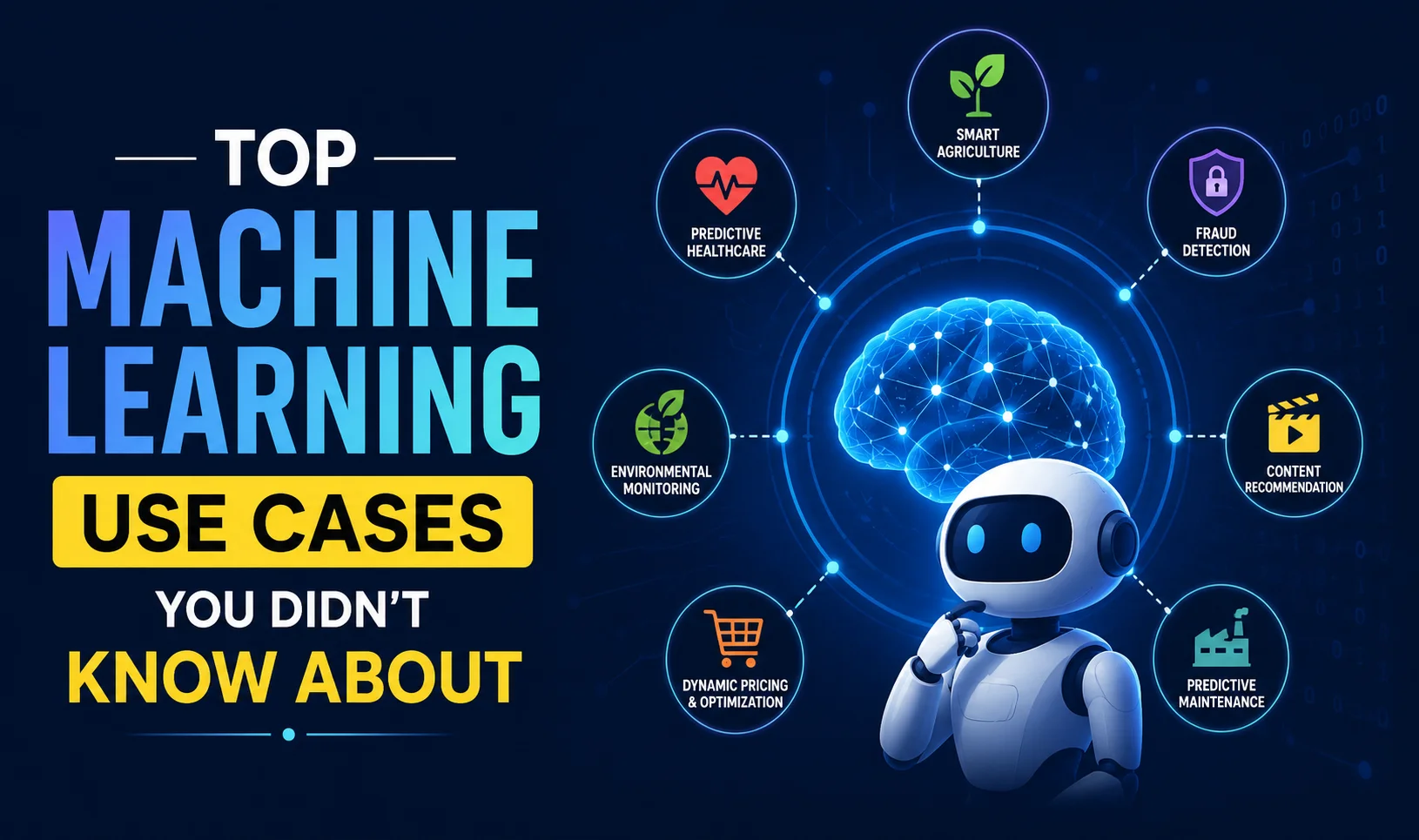
Top Machine Learning Use Cases You Didn’t Know About
Read More →
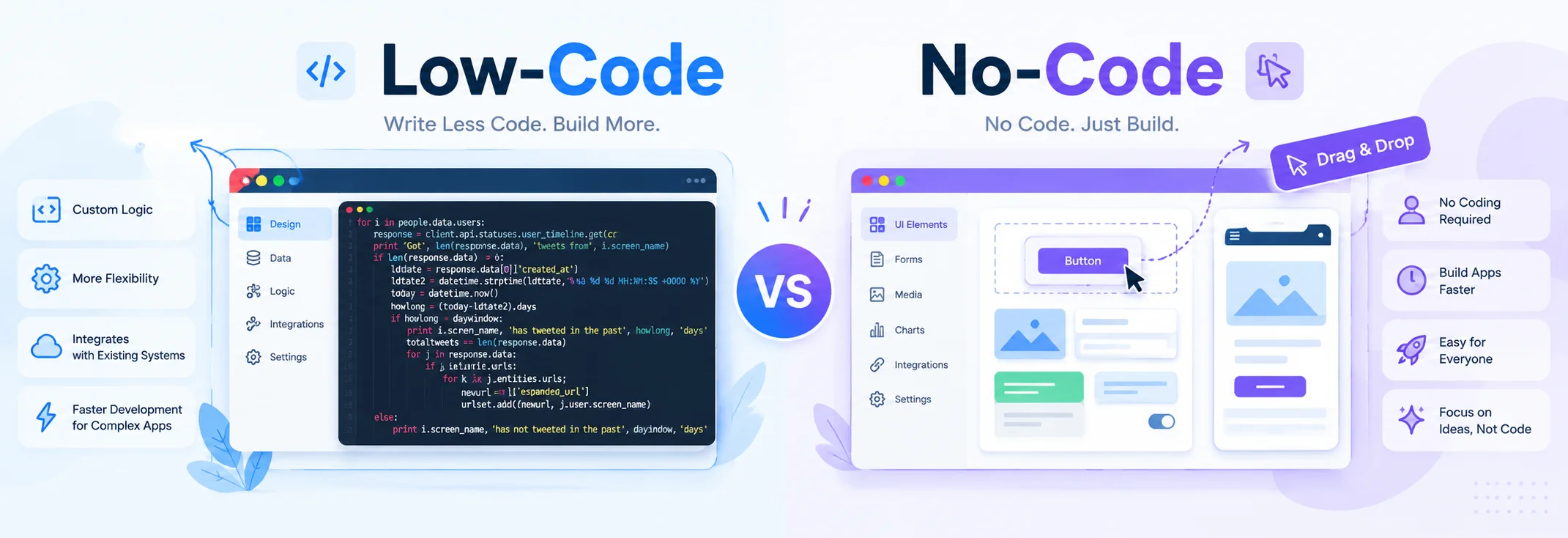
What Is Low Code/No Code and Why It Matters in 2025
Read More →
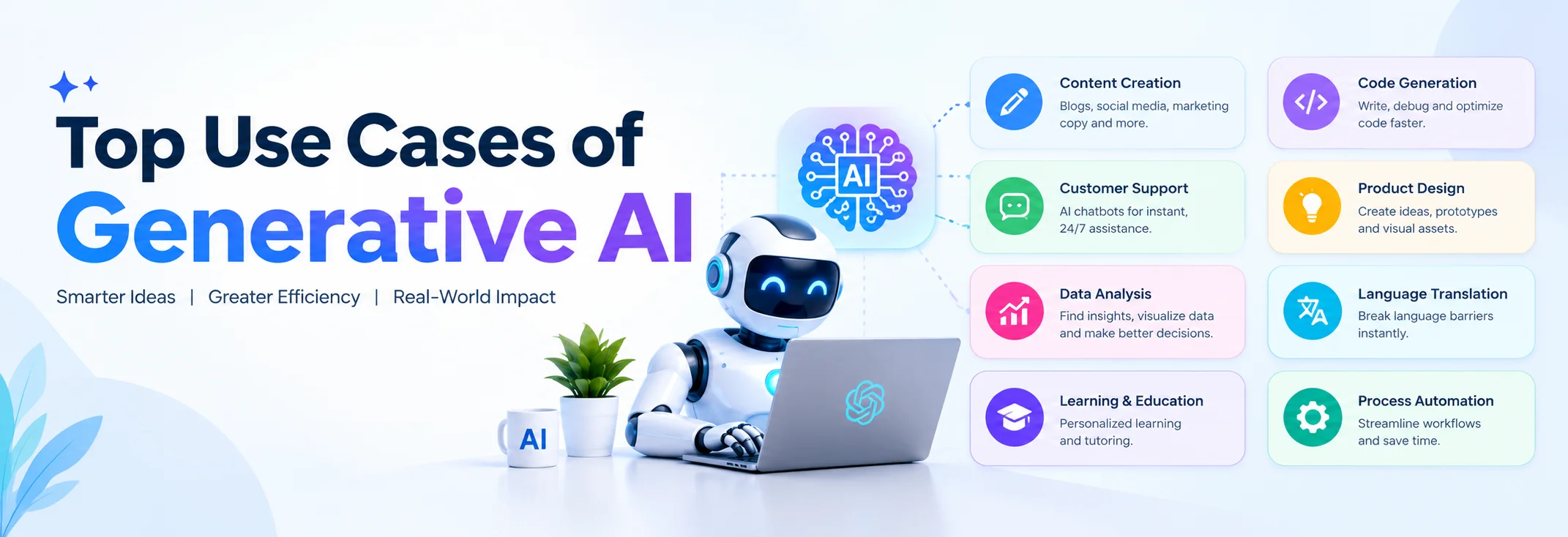
Top Use Cases of Generative AI in 2026
Read More →
The Future of Generative AI in Enterprises
Read More →
How Generative AI Is Reshaping Enterprise Operations in 2025
Read More →
Top AI Features Every Modern Taxi App Must Include in 2026
Read More →The Future of Events: How Artificial Intelligence Is Changing the Industry
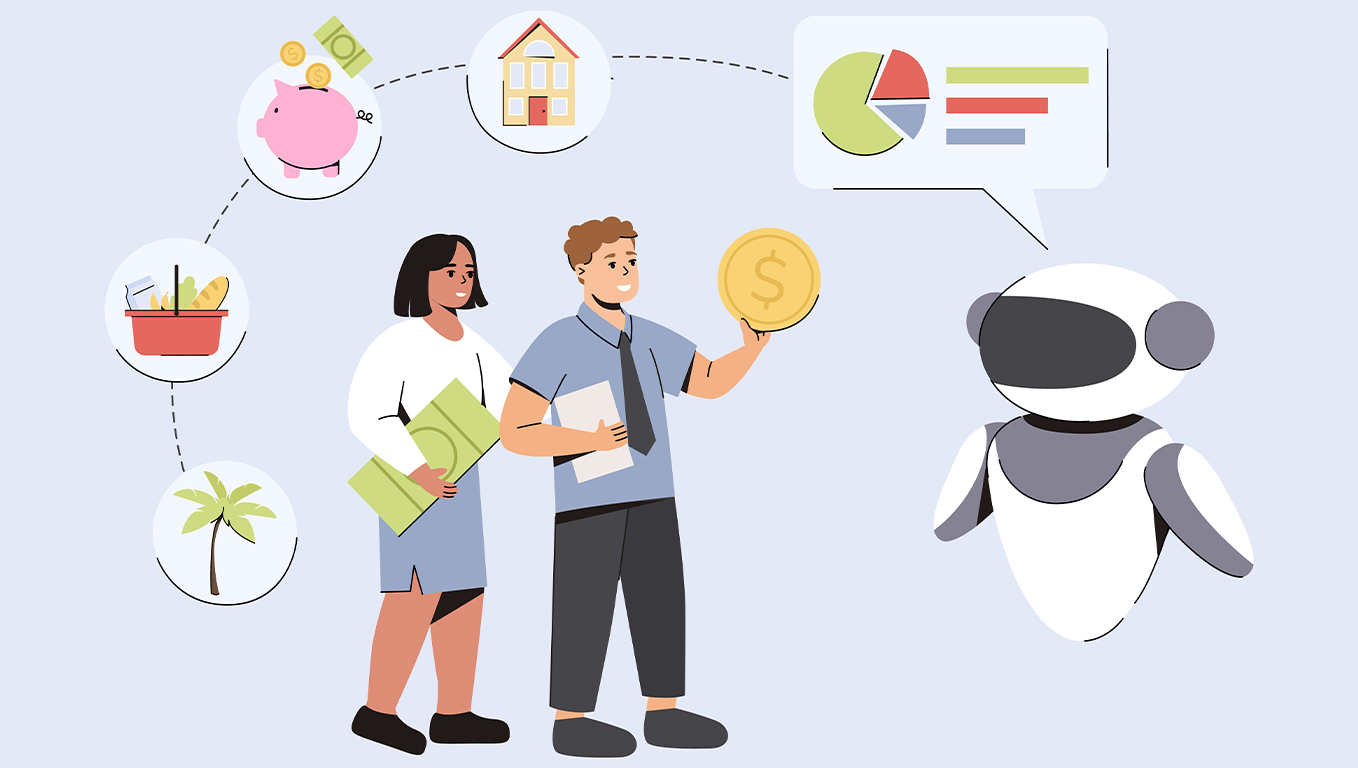
Read More →Why Are AI Agents the Next Big Shift in Banking and Finance
Read More →How AI-Driven Analytics Improve Learning Outcomes
Read More →How AI Is Optimizing Every Step of Food Delivery Apps
Read More →How AI-Powered CRM Is Transforming the Media & Entertainment Industry
Read More →
Zanus AI vs Zyno: Complete Comparison of Features, Pricing, Benefits & Differences
Read More →
Why US Companies Are Outsourcing Agentic AI Development to India

Read More →
Top Agentic AI Development Companies in India for US Businesses (2026)
Read More →
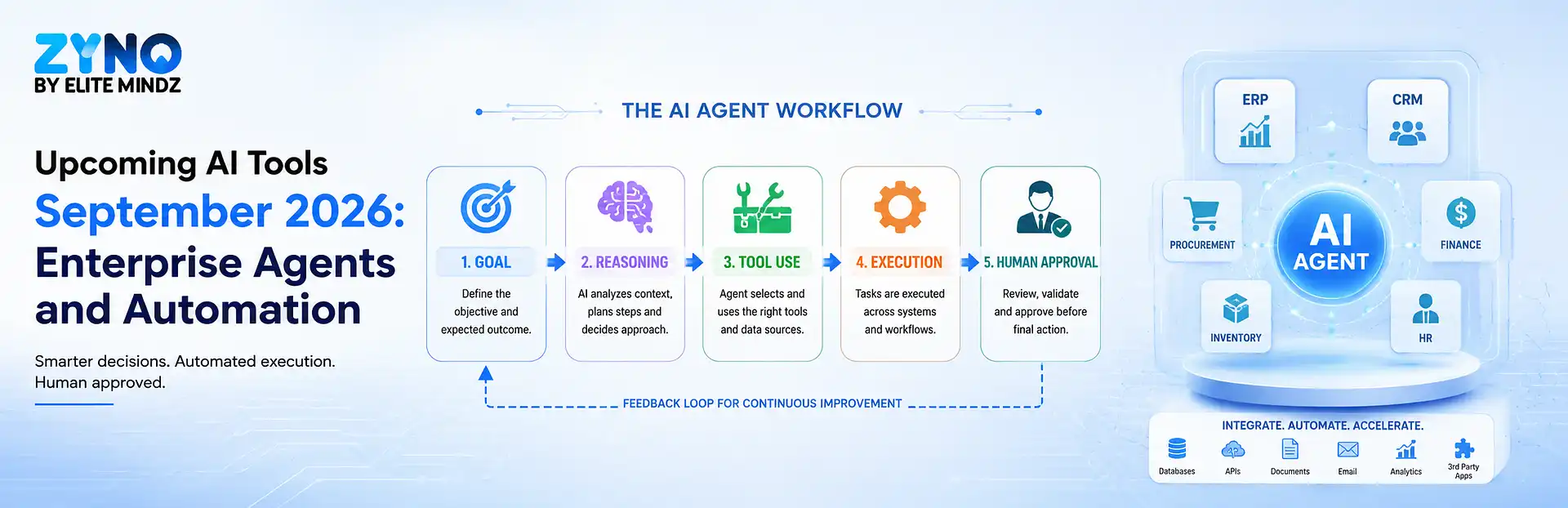
Top Upcoming AI Tools of September 2026 You Must Watch
Read More →
Google Opal vs Tilda Bio AI: What Each Tool Actually Does (and Why They Aren't True Rivals)
Read More →
AI Agent Development Services: A Practical Guide for Business Teams

Read More →
Enterprise AI Agent Development Services: The Complete Guide to Cost, Benefits, Use Cases & Implementation

Read More →Partner with ZYNO by Elite Mindz to revolutionize how your business works. Fill out the form, and we’ll reach out with AI-powered solutions made just for you.
We use browser cookies to ensure you get the best experience on our website. Learn more
The form was submitted successfully!