AI Enablement in the Age of Generative AI: ZYNO by Elite Mindz Leading the Charge
Read More →
×
In this guide, we discuss everything you need to know about machine learning software — what it actually does, which features matter, how much it really costs, and whether you should buy an existing platform or build a custom solution for your business. We also cover integration with your ERP and CRM, how to judge if a model is accurate enough for production, and what happens after your model goes live. Read the full guide — or request a Machine Learning Consultation to talk through your specific use case.
Businesses using ZYNO Books cut accounting time by 70% and stay 100% ZATCA-compliant — automatically.
Machine learning software is the layer of technology that lets a business turn raw data into predictions, automated decisions and measurable outcomes — without every team building models from scratch. If you're evaluating machine learning software right now, you're probably not asking "what is machine learning." You're asking something closer to: will this actually work with our data, will it scale, and what is this really going to cost us once the pilot is over?
That last question matters more than most vendors admit. A large share of machine learning software purchases stall after the pilot stage — not because the models don't work in a lab, but because nobody planned for integration, monitoring, or the ongoing engineering effort a production model demands. This guide is written to help you avoid that outcome: what machine learning software actually does, which features matter, what it costs, and how to decide between buying a platform and building custom machine learning software for your business.
Machine learning software is any platform, framework or application that automates part or all of the machine learning lifecycle: preparing data, training algorithms on that data, deploying the resulting models, and monitoring how they perform once they're making real decisions.
It sits somewhere between raw open-source libraries (like scikit-learn or PyTorch, which require engineers to build everything manually) and fully packaged business intelligence tools (which report on the past but don't predict the future). Good machine learning software gives you the infrastructure and tooling to go from a dataset to a working, monitored model — without reinventing the underlying plumbing every time.
This is also why "machine learning software" and "machine learning platform" are often used interchangeably, though a platform typically implies a broader, end-to-end environment — data pipelines, experiment tracking, model registry, deployment and monitoring — while "software" can refer to any single tool inside that stack.
This is the question most buyers skip, and it's the one that causes the most expensive mistakes.
A dashboard that shows you last quarter's churn rate is analytics. Machine learning software that predicts which customers will churn next month, and lets you act on that prediction automatically, is a fundamentally different category of tool. Many products marketed as "AI-powered" or "predictive analytics software" are really business intelligence tools with a forecasting chart bolted on — useful, but not the same as a system that trains, deploys and continuously improves predictive models.
Before you evaluate features or pricing, ask any vendor three direct questions:
If the answers are vague, you're likely looking at an analytics tool wearing an AI label, not genuine machine learning software.
Machine learning software earns its budget when it's pointed at a specific, recurring business problem — not a vague ambition to "use AI." Some of the clearest, most proven applications include:
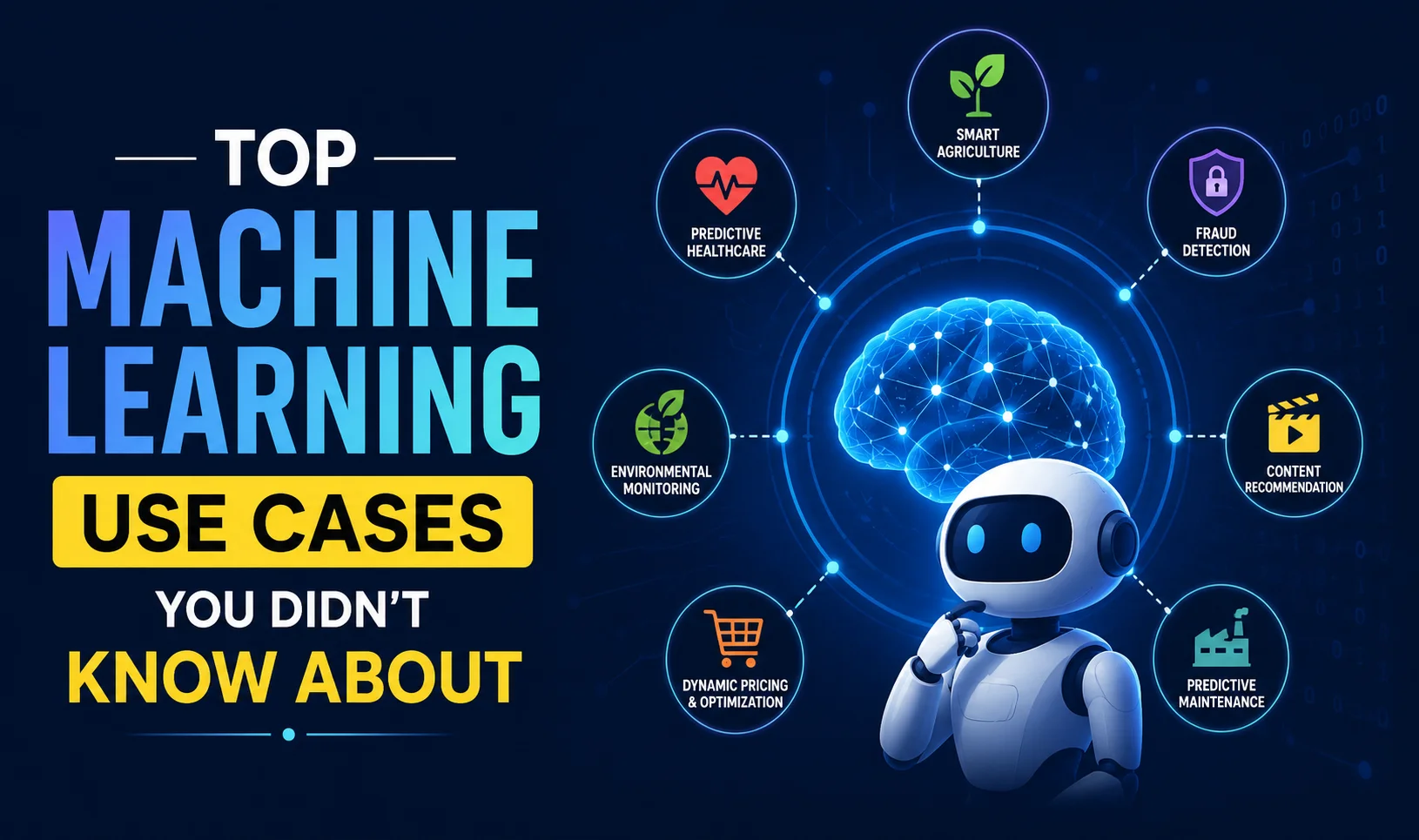
Each of these is a distinct machine learning problem with its own data requirements, model types and accuracy expectations — which is exactly why "which features actually matter" depends heavily on which of these problems you're solving. For a broader sweep of applications, top ML use cases you didn't know about is a useful next read.
Vendor feature lists tend to blur together. In practice, a small set of capabilities determines whether machine learning software will actually work for your business:
If a platform is strong on training but weak on monitoring and integration, it will produce impressive demos and disappointing production results — which is precisely the pattern behind most stalled pilots.
How Machine Learning Software Works: From Data to Prediction
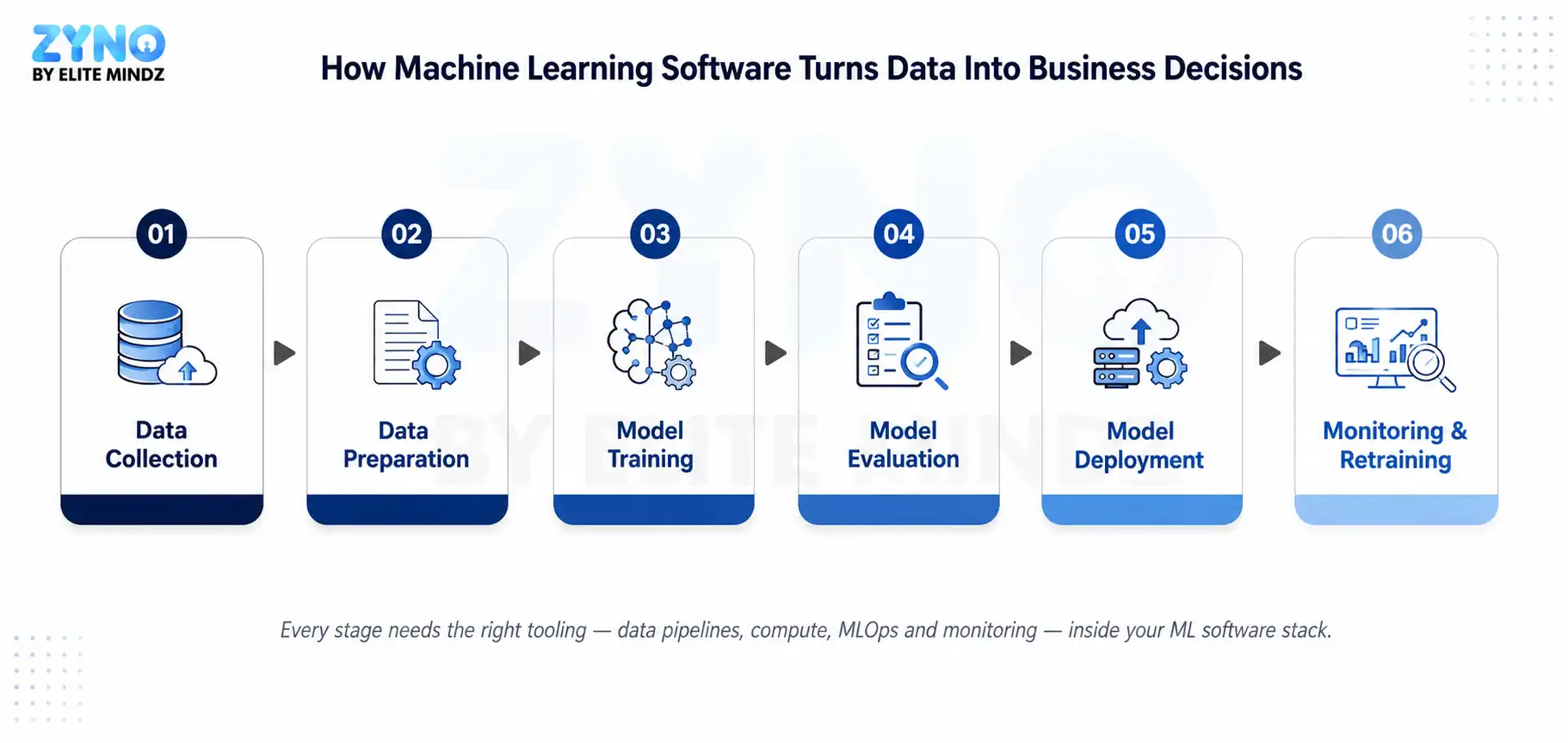
Every serious machine learning software platform, regardless of vendor, moves through the same underlying stages:
Understanding this pipeline matters because it reframes the buying decision: you're not buying "a model," you're buying (or building) the infrastructure that supports every one of these six stages, indefinitely.
The honest version of this section skips inflated ROI percentages and focuses on what machine learning software structurally changes about how a business operates:
None of these benefits are automatic. They depend directly on data quality, the right use case, appropriate model selection and a realistic deployment plan — which is exactly why the sections below on cost, integration and choosing the right approach matter as much as the technology itself.
These are illustrative patterns based on common, well-documented use cases — not claims about any specific company's results. For a wider view, see 10 industries being transformed by ML.
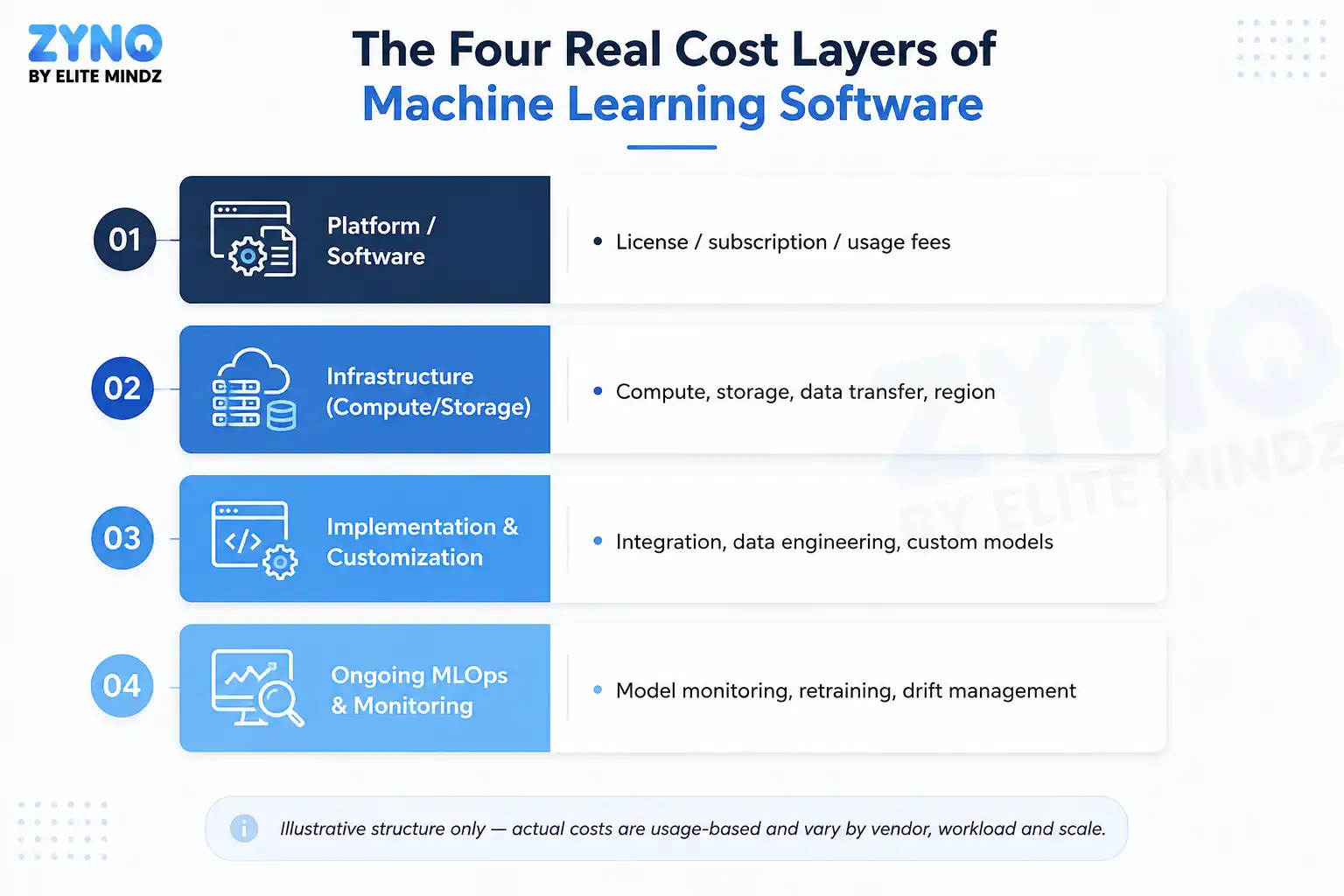
Short answer: Enterprise machine learning software is almost never priced as a flat monthly fee. Costs are usage-based, driven by compute time, storage, data processing volume, model size and deployment scale — plus separate costs for implementation and ongoing monitoring. A realistic budget needs to account for four distinct layers, not just a subscription line item.
The four layers to budget for:
Many buyers budget only for the first layer and are then surprised by the second and fourth. Model monitoring and retraining, in particular, is not optional maintenance — it's the difference between a model that stays useful and one that quietly degrades until someone notices the predictions have stopped making sense.
Below is an indicative comparison of three major enterprise machine learning platforms. None of these figures should be treated as fixed pricing — always confirm current rates directly with each vendor, since enterprise ML pricing is usage-based and varies by region, workload and configuration.
| Platform | Indicative Pricing Model | What Drives Cost |
|---|---|---|
|
Amazon SageMaker AI
|
Pay-as-you-go, billed by compute instance, storage, and data processing used. | Instance type and size, training duration, inference endpoint uptime, and storage volume. |
|
Microsoft Azure Machine Learning
|
Consumption-based, billed through Azure compute and storage services. | Compute cluster size, managed endpoint hours, dataset storage, and region. |
|
Google Vertex AI
|
Usage-based, billed by training node-hours and prediction requests. | Model type, training node-hours, prediction volume, storage, and region. |
All three follow the same underlying logic: you pay for what you actually consume, not for a fixed number of "seats" or "models." This makes early cost estimation genuinely difficult without a clear use case, expected data volume and deployment architecture defined up front — which is precisely why a scoping conversation before committing to a platform tends to save money later.
Need an ML cost estimate for your use case? Request a free scoping call and get a realistic view of platform, infrastructure and implementation costs — mapped to your actual data and use case — before you commit to a vendor.
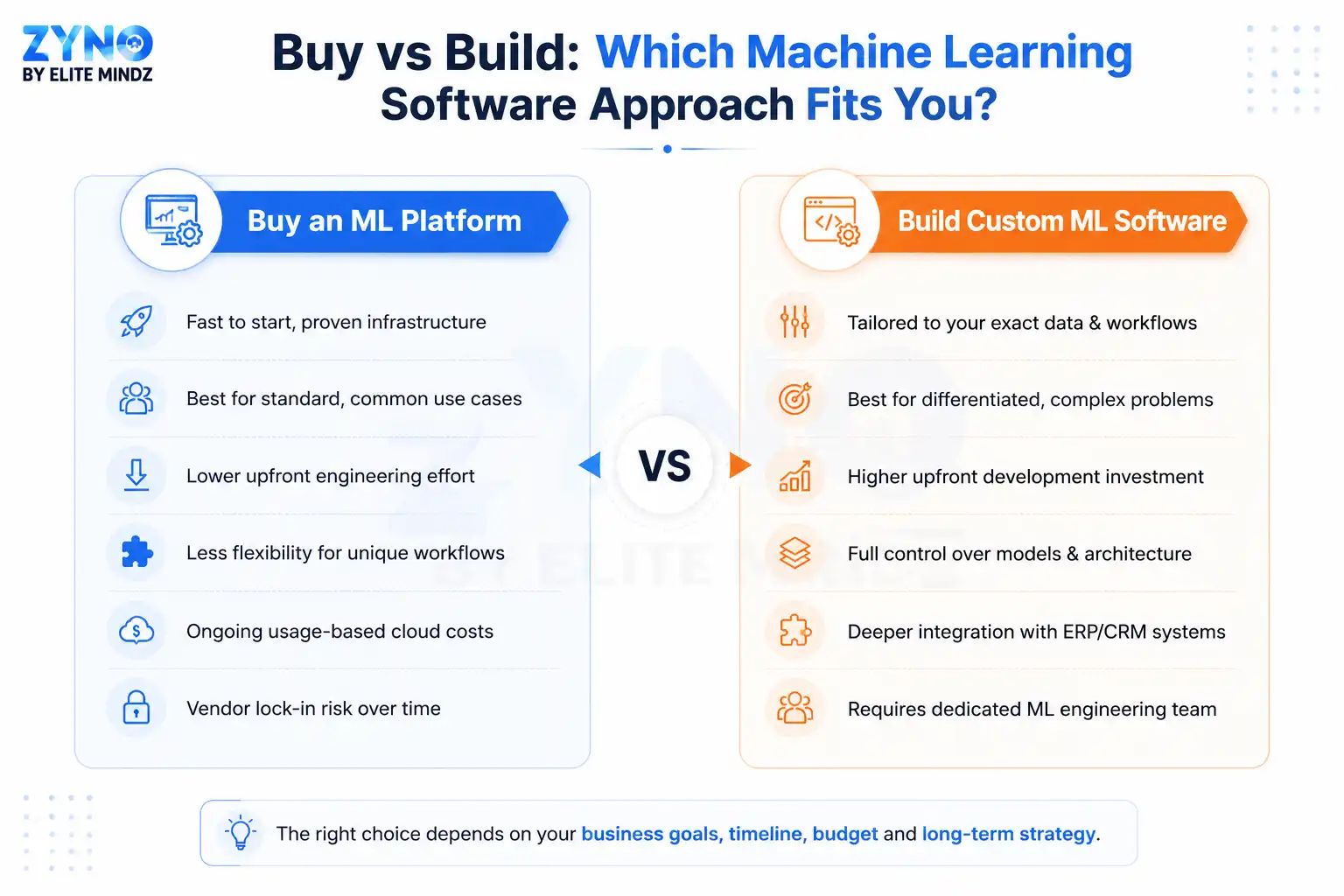
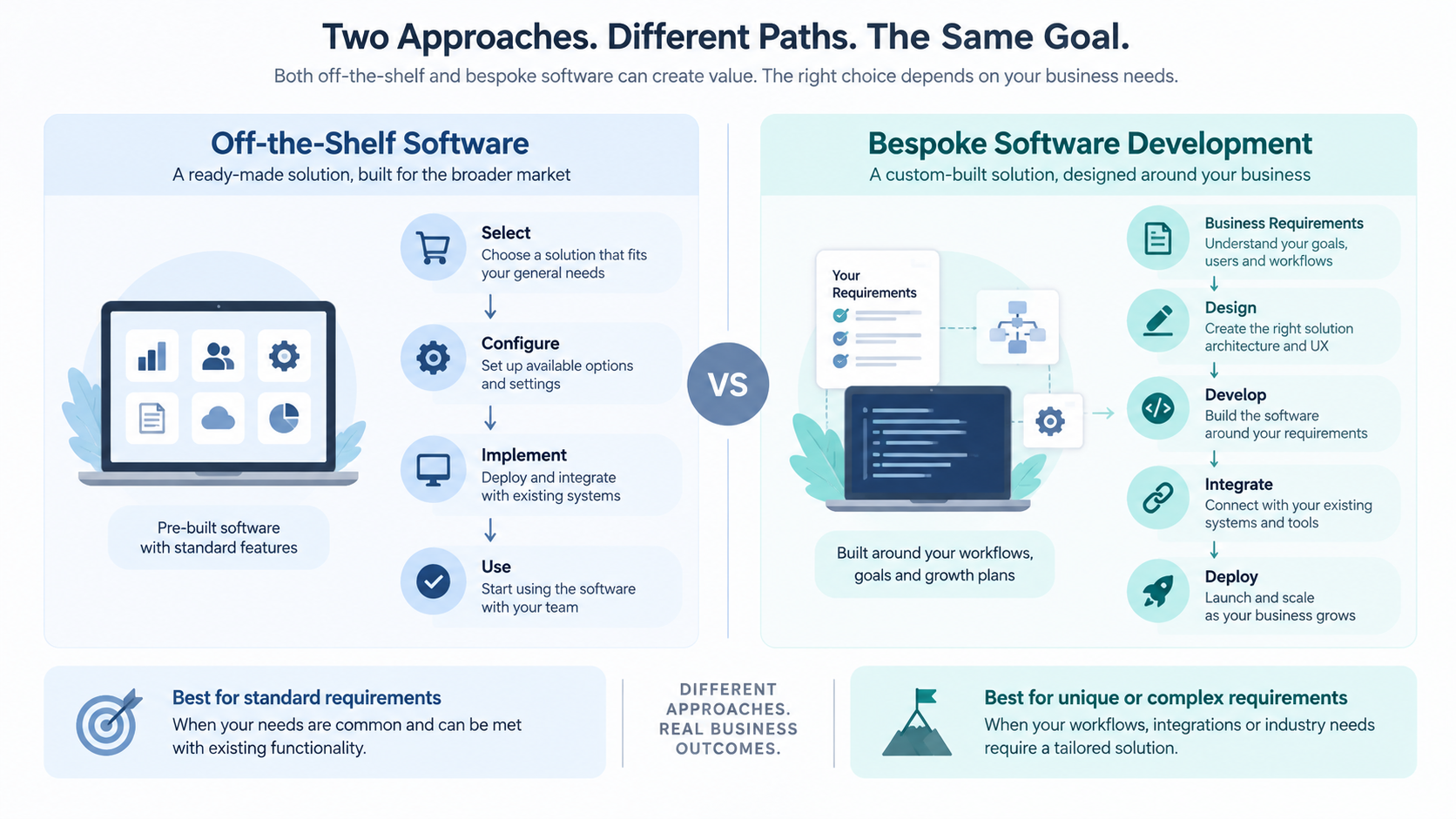
Short answer: Buy an existing ML platform when your problem is common and well-understood — fraud detection, demand forecasting, recommendations — and speed matters more than differentiation. Build custom machine learning software when your data, workflows or competitive advantage are genuinely unique, or when off-the-shelf platforms can't integrate deeply enough with your existing systems.
A few practical signals that point toward custom machine learning software development instead of an off-the-shelf platform:
There's also a middle path many businesses underuse: starting with a cloud ML platform for infrastructure, but investing in custom model development and integration on top of it — rather than treating buy vs build as strictly binary. If you're weighing this trade-off in detail, ZYNO Tech's AI consulting service is built specifically to work through that decision with you before any development starts.
Not sure whether to buy, customize or build? Discuss your requirements with ZYNO Tech and get a straight answer based on your data and systems, not a generic sales pitch.
This is often the single biggest predictor of whether a machine learning software project succeeds or stalls. A model that performs well in isolation is close to worthless if its predictions can't reach the system where a human or process actually acts on them.
Genuine machine learning integration means:
This is also where generic ML platforms most often fall short — they're built to be data-source-agnostic, which means deep, workflow-specific integration with something like a manufacturing ERP or industry-specific CRM often requires custom engineering on top of the platform. ZYNO CRM's built-in AI capability and the broader AI in ERP approach are two working examples of what this integration looks like in practice. For more on the integration playbook itself, see top AI integration strategies for seamless ERP and CRM upgrades.
See how ZYNO Tech can integrate ML with your existing business systems through machine learning solutions built around real ERP and CRM integration, not a standalone dashboard.
Short answer: There's no universal accuracy threshold — "accurate enough" depends on the cost of a wrong prediction in your specific use case. A fraud model missing a low-value transaction carries different risk than a clinical risk model missing a high-severity case. Evaluation has to be tied to business impact, not a single generic accuracy percentage.
Practical evaluation criteria to insist on before trusting any model with production decisions:
Editorial note: Machine learning model performance is never a fixed, guaranteed number — it depends on data quality, the specific use case, model selection and the deployment environment. Any vendor claiming a universal accuracy figure without qualifying it against your data should be treated with caution. That's exactly why trusted, experienced partners like ZYNO Tech evaluate accuracy against your specific data and use case rather than quoting a one-size-fits-all number — it's a more honest starting point for a production decision.
Deployment is not the finish line — it's closer to the starting line for the operational half of machine learning software ownership. After go-live, three things need to happen continuously:
Businesses that treat model monitoring as an afterthought are the ones most likely to see a promising pilot quietly lose value in production — not because the underlying approach was wrong, but because nobody was watching after launch.
A prediction that no one acts on has no business value — it's just a number. The gap between "the model works" and "the business benefited" is closed by three things: integration into an actual workflow, a clear owner accountable for acting on the prediction, and a monitoring loop that keeps the model trustworthy over time. Machine learning automation matters here specifically because it removes the dependency on someone remembering to check a dashboard — predictions trigger actions directly inside existing systems.
This is also the practical difference between "AI-powered software" as a marketing phrase and machine learning software as an operational asset: the former demos well, the latter changes how decisions actually get made, day after day.
Bringing the previous sections together, a structured evaluation should walk through:
Businesses that work through this sequence before talking to vendors consistently end up with a shorter, more relevant shortlist — and fewer surprises after signing.
Off-the-shelf ML platforms are a strong fit for common, well-understood problems. But when your data lives across multiple legacy systems, your workflows are specific to your industry, or you need predictions embedded directly inside your ERP, CRM or operational tools, a generic platform often can't close the gap alone.
ZYNO Tech works with businesses that need machine learning software built around their actual systems, not a standalone dashboard bolted on top. Core capabilities include:
If you're deciding between buying a platform and building something tailored to your business, explore ZYNO Tech's machine learning solutions to see where a custom approach makes more sense than an off-the-shelf one. Businesses exploring the broader generative AI layer alongside traditional ML may also find GenAI development relevant.
Talk to ZYNO Tech about your ML use case — a scoping conversation up front is far cheaper than a stalled pilot six months in. Start that conversation here.
Machine learning rarely operates in isolation — it's most valuable when it's connected to the systems that already run your business. ZYNO Tech's broader product ecosystem includes several platforms with a direct connection to machine learning use cases:
Each of these products can incorporate machine learning capability where it's genuinely relevant to the workflow — not as a bolt-on feature, but as part of how the underlying decisions get made.
Choosing machine learning software is less about picking the platform with the longest feature list, and more about matching the right approach — buy, build or a hybrid of both — to your specific data, systems and business problem. Get that decision right, and machine learning software becomes an operational asset that keeps paying off long after the pilot ends.
Request a Machine Learning Consultation →
Prefer to explore on your own first? Browse ZYNO Tech's machine learning solutions or see pricing for the wider ZYNO product suite.
Machine learning software is a platform or application that automates the machine learning lifecycle — preparing data, training models, deploying them into production and monitoring their performance — so businesses don't have to build every component from scratch.
At minimum: data preparation and pipeline tools, model training and experimentation, deployment capability, ongoing model monitoring, MLOps automation, integration with existing business systems, and security/governance controls.
Enterprise machine learning software is typically priced on usage — compute, storage, data processing and deployment scale — rather than a flat fee. Budget separately for platform cost, infrastructure, implementation and ongoing monitoring.
There's no single best option — it depends on your use case, data infrastructure and integration needs. Amazon SageMaker AI, Microsoft Azure Machine Learning and Google Vertex AI are strong general-purpose platforms; custom machine learning software fits better when requirements are highly specific.
"ML software" can refer to any single tool in the machine learning lifecycle, while an "ML platform" typically means a broader, end-to-end environment covering data pipelines, training, deployment and monitoring in one integrated system.
Buy an existing platform for common, well-understood problems where speed matters. Build custom machine learning software when your data, workflows or competitive differentiation are unique, or when deep integration with existing systems is required.
Yes, but the depth of integration varies significantly by vendor. Genuine integration means pulling training data from and pushing predictions back into ERP/CRM systems directly — not just exporting data manually between separate tools.
Through continuous model monitoring for accuracy and data drift, periodic retraining as patterns change, and governance practices like the ones outlined in NIST's AI Risk Management Framework.
Accuracy depends entirely on data quality, the specific use case and model selection — there's no universal number. What matters more is whether accuracy is measured on unseen data and tracked continuously after deployment.
It's worth it when your use case is differentiated enough, or your integration requirements are deep enough, that off-the-shelf platforms would require heavy customization anyway. For common, standard problems, an existing platform is usually faster and more cost-effective.
AI Enablement in the Age of Generative AI: ZYNO by Elite Mindz Leading the Charge
Read More →

Top 10 Trends Shaping the Future of AI Agents in 2025
Read More →
Top 6 AI Chatbot Features Transforming Customer Engagement in 2026
Read More →
Top 10 AI Integration Strategies for Seamless ERP and CRM Upgrades in 2025
Read More →
Best GAI Consulting Approaches for Ethical Business Transformation in 2025
Read More →
From Vision to Value: The Ultimate Guide to Enterprise GenAI Platforms
Read More →
Top 10 GAI Development Trends Shaping Autonomous Agents in 2025
Read More →
The Future of Computer Vision: Trends to Watch in 2025
Read More →
Generative AI in 2025: How ZYNO BY Elite Mindz is Transforming Enterprise Workflows
Read More →
10 Real-World Applications of Computer Vision in 2025
Read More →
Integrating Computer Vision with IoT and AI: Driving the Next Wave of Intelligent Systems in 2025
Read More →
Agentic AI Explained: How AI Agents Are Transforming Business in 2025
Read More →
From Chatbots to Autonomous Agents: The Evolution of Agentic AI
Read More →
The Rise of Multi-Agent Systems: How Agentic AI Teams Will Run Enterprises of the Future
Read More →
Agentic AI vs Generative AI: What Business Leaders Need to Know
Read More →
The Power of Autonomous Agents: Understanding Agentic AI for Enterprises
Read More →
The Role of Agentic AI in Enhancing Enterprise Agility and Responsiveness
Read More →
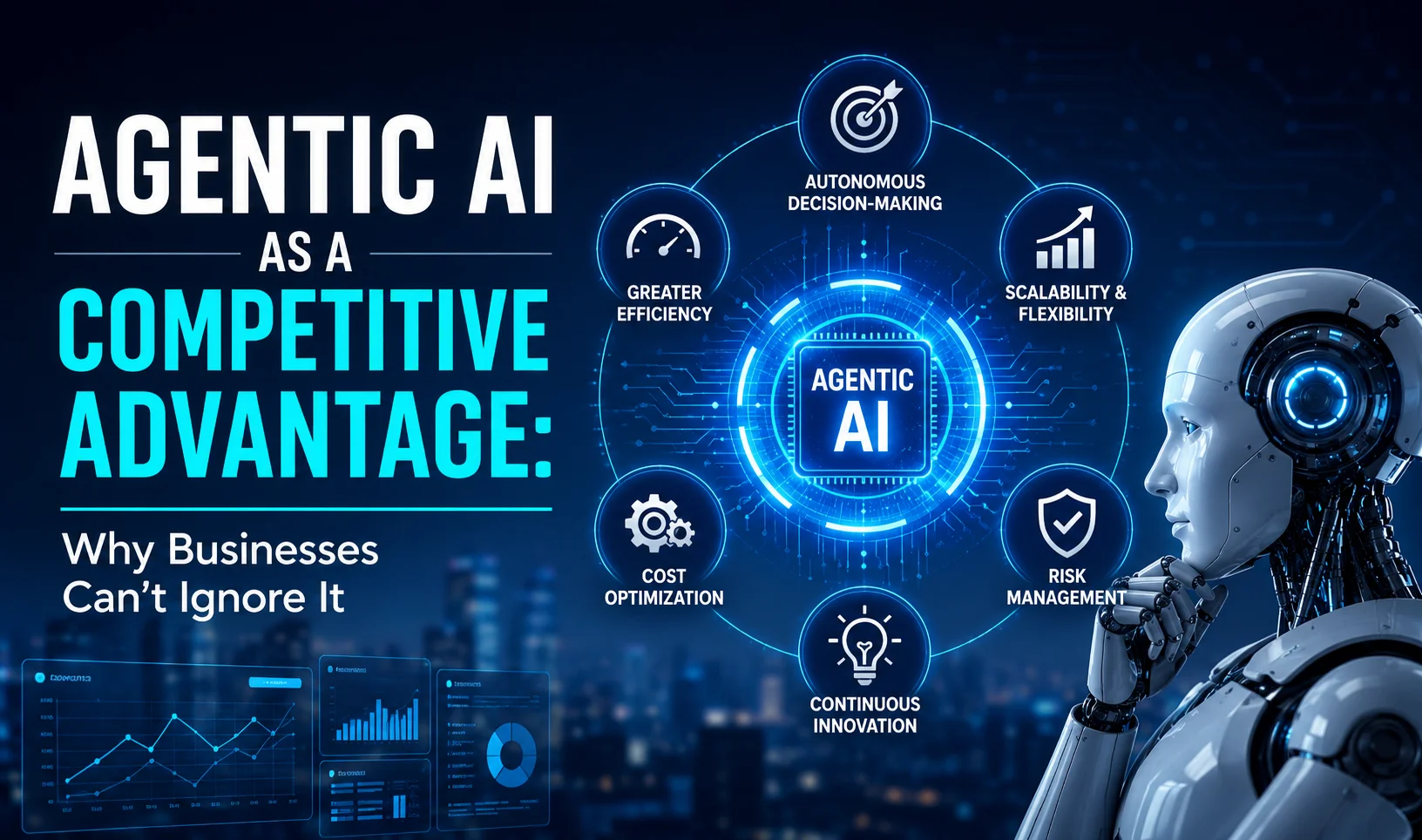
Agentic AI as a Competitive Advantage: Why Businesses Can’t Ignore It
Read More →
The Shift from Automation to Autonomy: How Agentic AI is Redefining Enterprise Operations
Read More →
From Reactive to Proactive: How Agentic AI Changes Enterprise Decision-Making
Read More →
Why Every Business Will Hire an AI Agent Soon
Read More →
Agentic AI for Startups: Leveling the Playing Field
Read More →
Agentic AI: The New Digital Workforce
Read More →
The Future of Business: Autonomous Teams of AI Agents
Read More →
From Insights to Action: How AI Agents Close the Gap
Read More →
Agentic AI in 2026: From Hype to Enterprise-Ready Transformation
Read More →
The Competitive Edge: Why Early Adopters of Agentic AI Are Winning Markets
Read More →
Beyond Automation: Why Agentic AI is the Key to Enterprise Agility in 2025
Read More →
The Human-AI Partnership: Building Smarter Teams with Agentic AI
Read More →
The Rise of Autonomous Teams: Why Agentic AI is the New Digital Workforce
Read More →
Top Machine Learning Use Cases You Didn’t Know About
Read More →
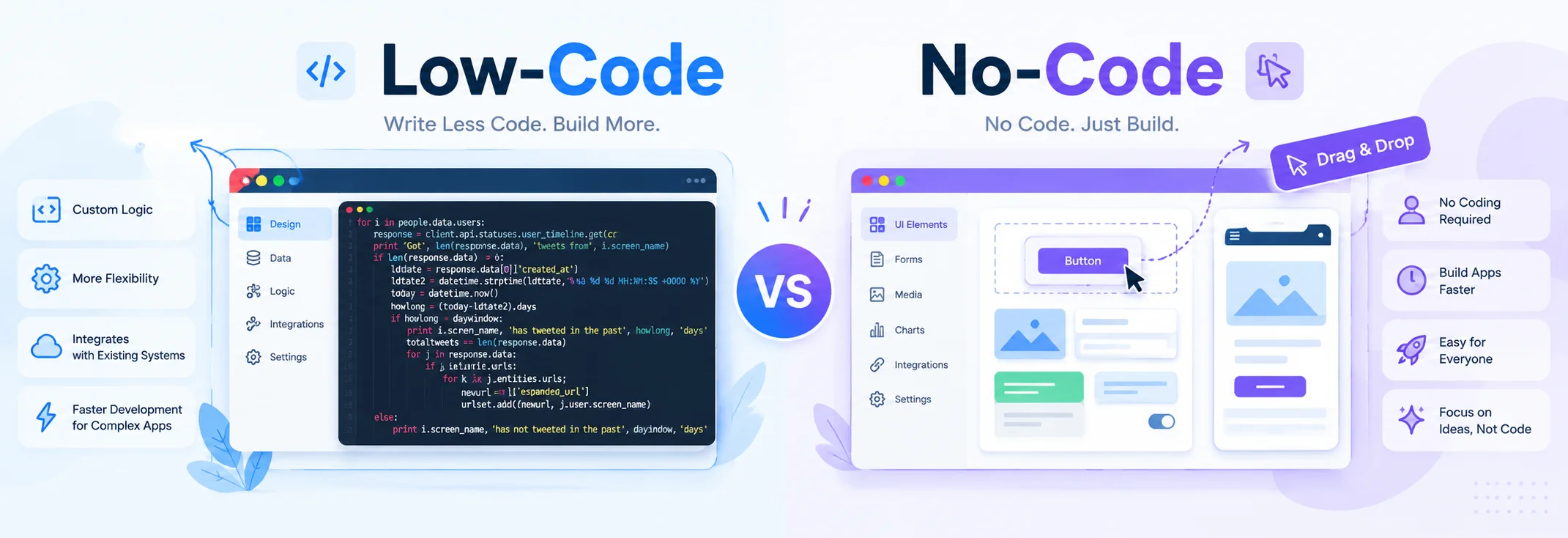
What Is Low Code/No Code and Why It Matters in 2025
Read More →
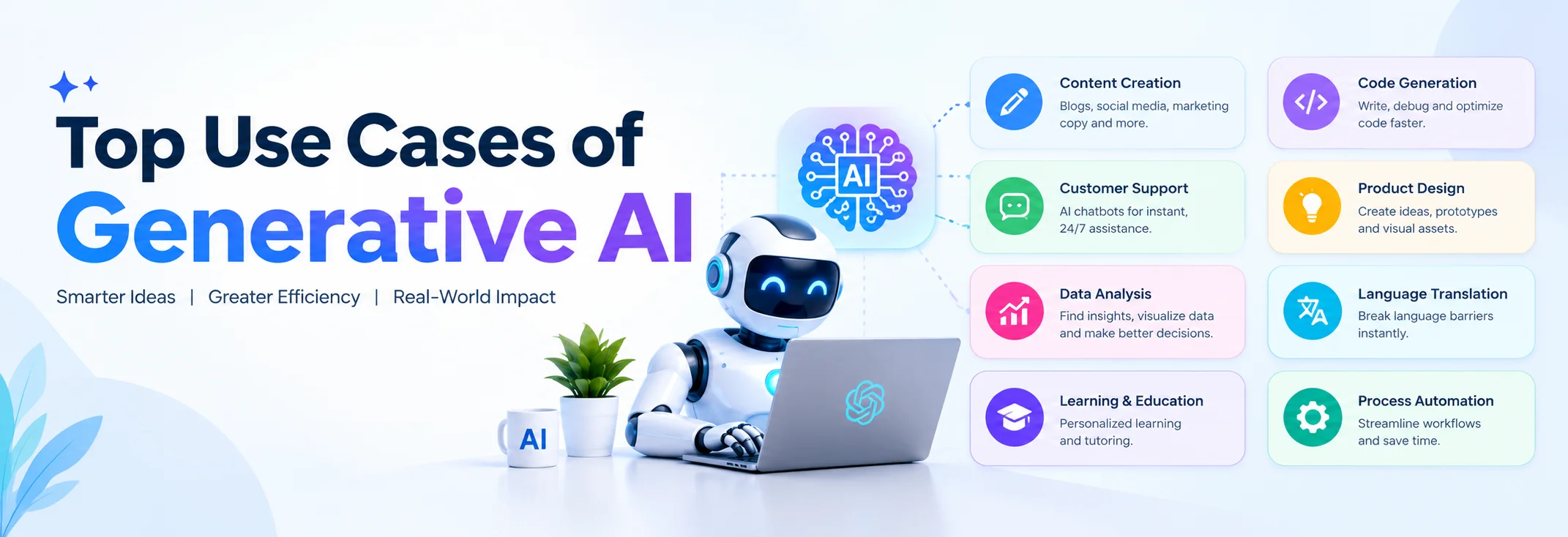
Top Use Cases of Generative AI in 2026
Read More →
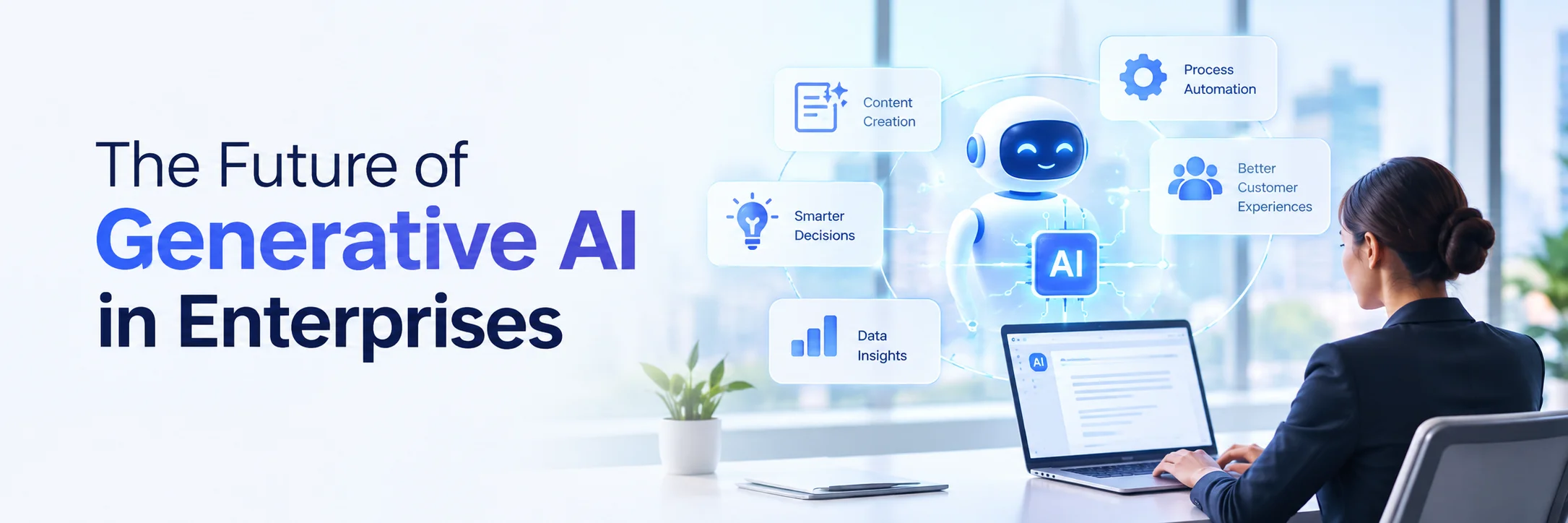
The Future of Generative AI in Enterprises
Read More →
How Generative AI Is Reshaping Enterprise Operations in 2025
Read More →
Top AI Features Every Modern Taxi App Must Include in 2026
Read More →The Future of Events: How Artificial Intelligence Is Changing the Industry
Read More →Why Are AI Agents the Next Big Shift in Banking and Finance
Read More →How AI-Driven Analytics Improve Learning Outcomes
Read More →How AI Is Optimizing Every Step of Food Delivery Apps
Read More →How AI-Powered CRM Is Transforming the Media & Entertainment Industry
Read More →
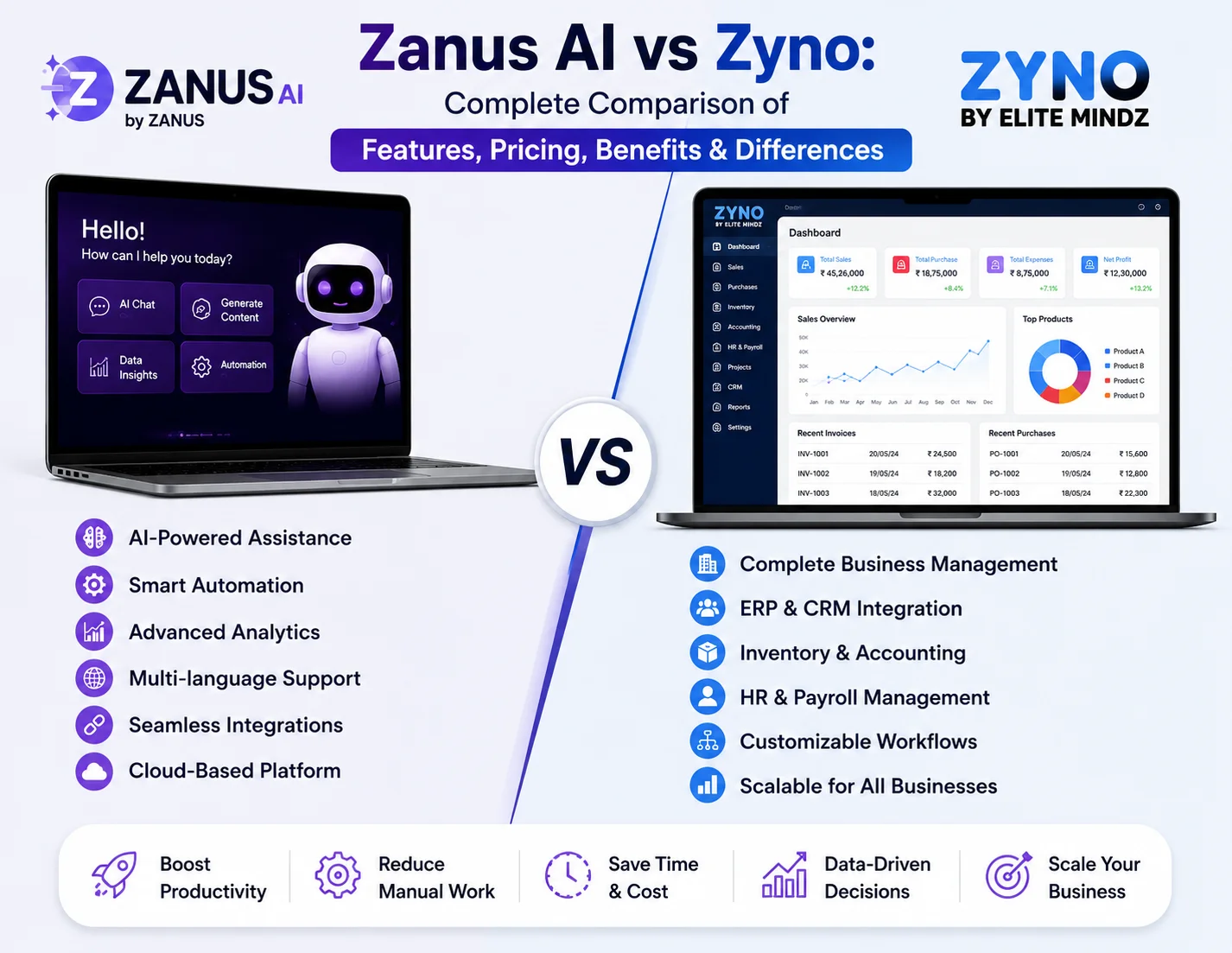
Zanus AI vs Zyno: Complete Comparison of Features, Pricing, Benefits & Differences
Read More →
Why US Companies Are Outsourcing Agentic AI Development to India

Read More →
Top Agentic AI Development Companies in India for US Businesses (2026)

Read More →
Top Upcoming AI Tools of September 2026 You Must Watch
Read More →
Google Opal vs Tilda Bio AI: What Each Tool Actually Does (and Why They Aren't True Rivals)
Read More →
AI Agent Development Services: A Practical Guide for Business Teams

Read More →
Enterprise AI Agent Development Services: The Complete Guide to Cost, Benefits, Use Cases & Implementation

Read More →
How Much Does Custom AI Agent Development Cost in 2026? Calculate Real Price Ranges
Read More →
Machine Learning Software: Features, Benefits, Pricing & How to Choose the Right Solution in 2026
Read More →Partner with ZYNO by Elite Mindz to revolutionize how your business works. Fill out the form, and we’ll reach out with AI-powered solutions made just for you.
We use browser cookies to ensure you get the best experience on our website. Learn more
The form was submitted successfully!