AI Enablement in the Age of Generative AI: ZYNO by Elite Mindz Leading the Charge
Read More →
×
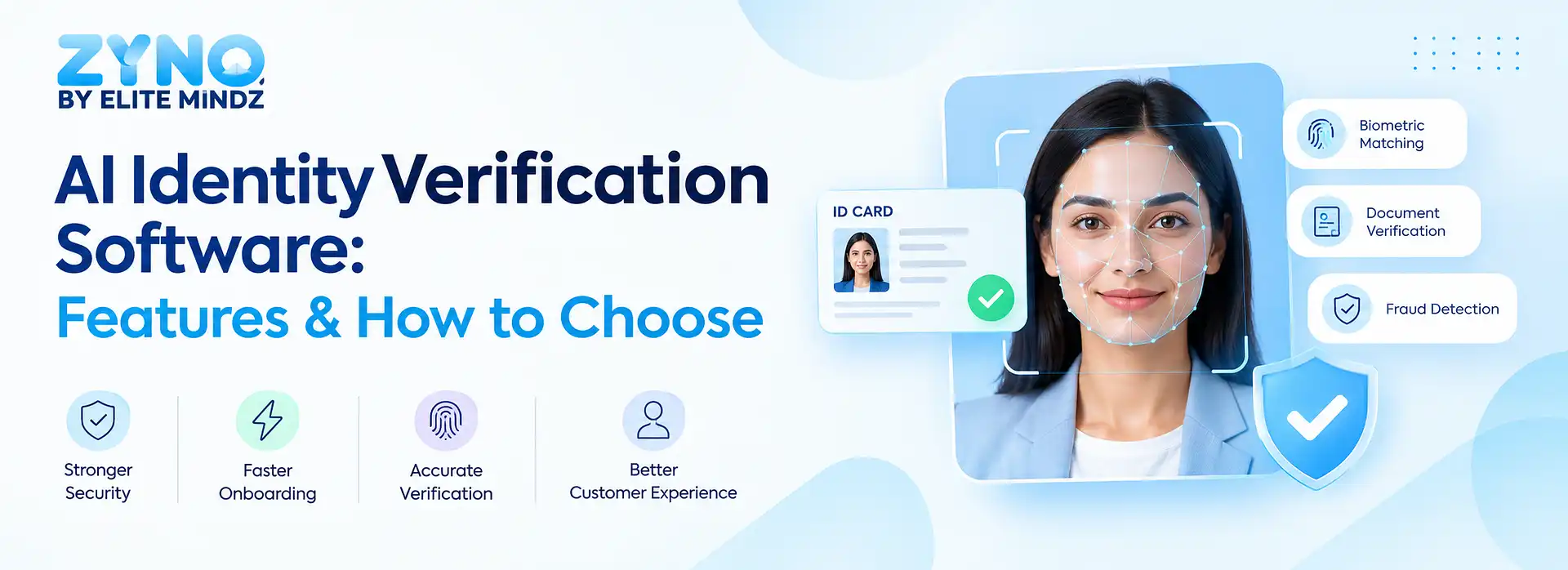
AI identity verification software automates identity checks using document verification, biometric matching, liveness detection, and fraud screening. It helps businesses verify users faster, reduce manual work, and support secure digital onboarding.
Businesses using ZYNO Books cut accounting time by 70% and stay 100% ZATCA-compliant — automatically.
Choosing an identity verification platform usually starts after a business already understands the concept: they know they need document checks, facial matching, and fraud screening. What's harder is comparing platforms and knowing where the gaps are before signing a contract.
This guide focuses on the practical side: what the software does, which features matter, the benefits worth expecting, how the process works, and a checklist for shortlisting a platform without buying into marketing claims.
AI identity verification software is a platform or API that automates the process of confirming a user's identity using document analysis, biometric matching, and fraud detection models, rather than a human reviewer checking each case manually.
It's built for digital identity verification during onboarding: a fintech app confirming a new account holder, a marketplace approving a seller, or a healthcare portal verifying a patient, all without an in-person visit.
Compared with manual verification, these platforms process documents and biometrics through automated pipelines that return a decision in seconds and route only ambiguous cases to a reviewer. It's not a replacement for judgment on edge cases — it just removes repetitive work so people can focus on what needs attention.
For a fuller breakdown of the underlying concept, the guide on how AI identity verification works covers the definition and technology in more depth than this article will repeat here.
Looking for AI Identity Verification Software?
Simplify digital identity checks with AI-powered document verification, biometric matching, liveness detection, and fraud screening. Explore a smarter AI Identity Verification Software solution for secure, faster onboarding.
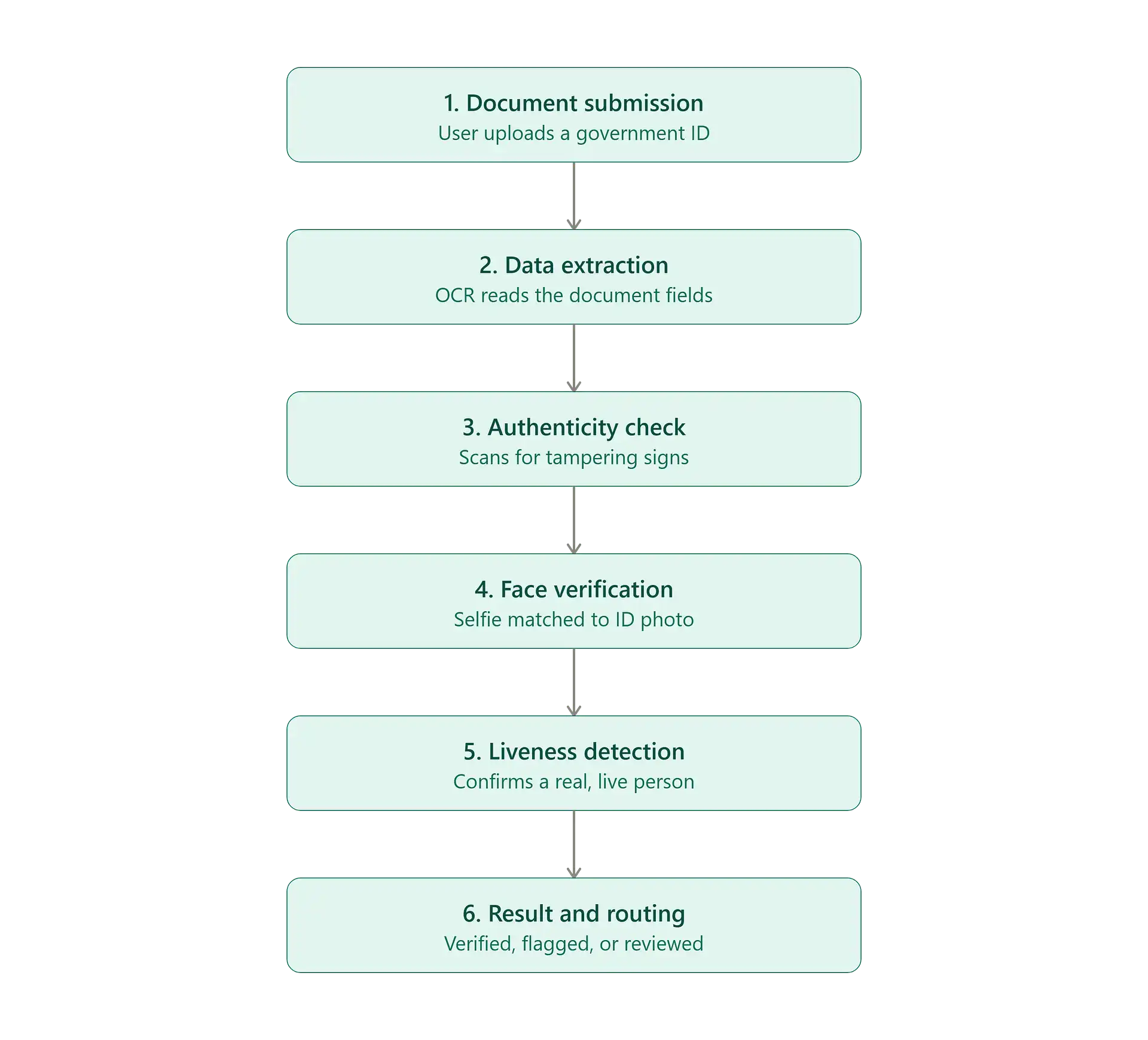
Explore AI Verification Software Talk to Our ExpertsMost platforms follow the same general pipeline, even if vendor terminology differs.
The user photographs or uploads a government-issued ID, usually a passport, driver's license, or national ID card.
OCR reads the printed and machine-readable fields, pulling structured data like name, document number, and expiration date.
The software scans for tampering signs, font mismatches, and structural anomalies against known document templates.
A live selfie is compared against the document photo, producing a similarity score rather than a simple pass or fail.
The system confirms the selfie came from a real, present person rather than a photo, video replay, or mask.
The signals combine into an outcome: verified, failed, needs additional input, or routed to manual review — often via workflow automation that decides the next step.

These are the features that actually differentiate platforms once you're past the basic pitch.

This checks document type, format, and validity against known templates for the countries a business operates in. Coverage gaps here are the most common reason businesses switch providers.
Accurate OCR feeds clean, structured data directly into onboarding forms, cutting manual entry and its errors. Weak OCR shows up as high false-flag rates on real, valid documents.
Facial verification compares the selfie to the ID photo and returns a similarity score businesses can tune to their own risk appetite, not a fixed accept-or-reject rule.
Beyond the face, some platforms extend biometric identity verification to fingerprint or voice signals for higher-assurance use cases, though facial biometrics remain the default because they only need a smartphone camera.
Passive liveness detection, which doesn't require the user to blink or turn their head, has become the preferred option for reducing friction while still defending against spoofing.
Fraud detection models trained through dedicated machine learning pipelines look across sessions, not single transactions, to catch patterns a single reviewer would likely miss.
This is the identity-proofing layer that KYC verification software builds on, feeding into the due diligence and risk scoring that happen elsewhere in the compliance stack.
Returning a decision within the same session, not hours later, is what makes remote onboarding actually usable.
A well-documented API lets engineering teams embed verification directly into existing signup flows. Businesses building this layer from scratch often work with AI development specialists rather than assembling it in-house.
Compliance and operations teams need visibility into outcomes, retry rates, and exception queues, not just a pass/fail log buried in API responses.
Secure Your Digital Onboarding with AI
Use AI Identity Verification Software to automate document checks, facial verification, liveness detection, and fraud screening while delivering a faster verification experience.
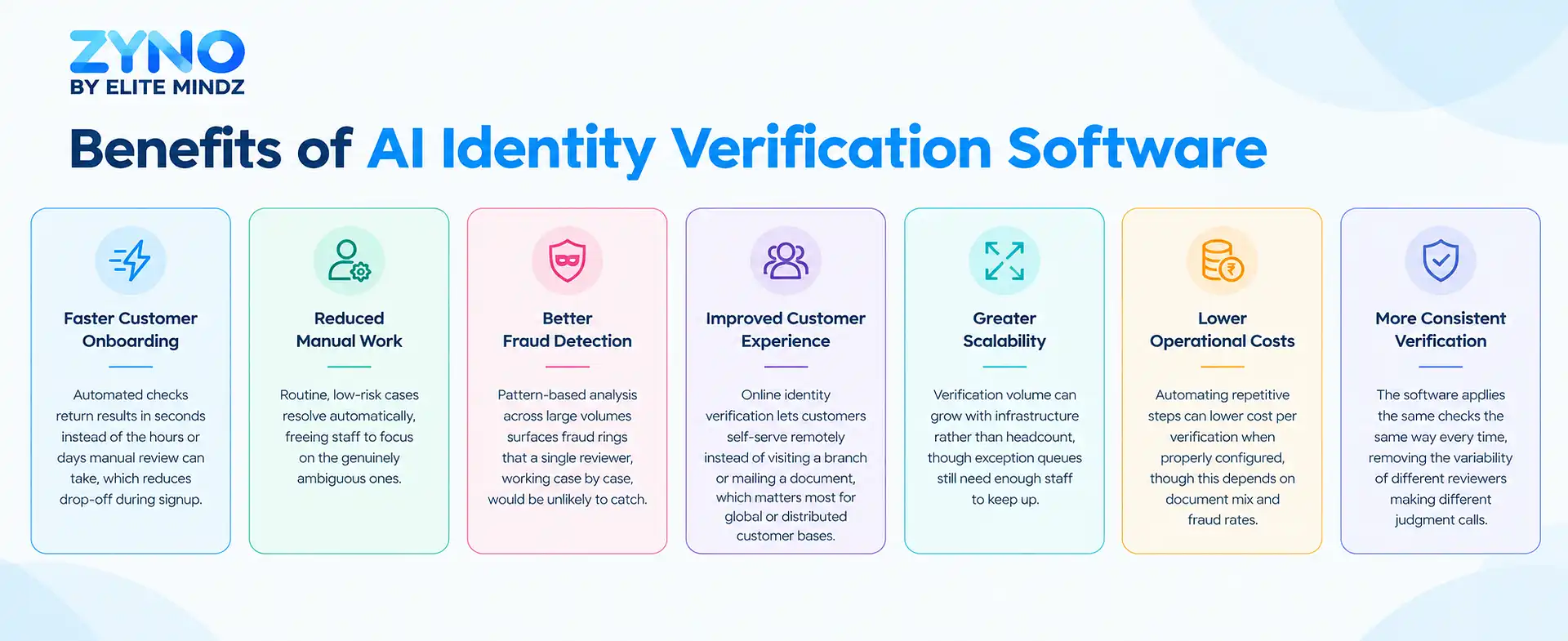
Explore the Solution Get in TouchAutomated checks return results in seconds instead of the hours or days manual review can take, which reduces drop-off during signup.
Routine, low-risk cases resolve automatically, freeing staff to focus on the genuinely ambiguous ones.
Pattern-based analysis across large volumes surfaces fraud rings that a single reviewer, working case by case, would be unlikely to catch.
Online identity verification lets customers self-serve remotely instead of visiting a branch or mailing a document, which matters most for global or distributed customer bases.
Verification volume can grow with infrastructure rather than headcount, though exception queues still need enough staff to keep up.
Automating repetitive steps can lower cost per verification when properly configured, though this depends on document mix and fraud rates.
The software applies the same checks the same way every time, removing the variability of different reviewers making different judgment calls.

Confirm the countries and document types actually supported. Coverage gaps are a common surprise after go-live, not before.
Ask how facial matching accuracy is measured, and whether performance data is broken down by demographic group.
Understand whether liveness is active or passive, and what known attack types it's been tested against.
Look for detection that works across sessions and devices, not just single-transaction checks.
Check what's actually covered versus what your compliance team still has to handle separately; no platform performs full KYC or AML on its own.
Review documentation quality and realistic engineering effort. This is where timelines slip most often.
Ask about encryption, data residency, and retention policy directly, since biometric data carries real regulatory weight if mishandled.
Confirm the platform can handle peak volume without degraded response times, especially if you operate across multiple regions.
A verification flow that takes too many steps or fails too often on legitimate users will hurt conversion regardless of how accurate it is on paper.
Understand whether pricing for the identity verification solution is per verification, per active user, or tiered, and how retries or manual reviews are billed.
Selection checklist:
Businesses without this evaluation experience in-house sometimes work through the shortlisting process with an outside AI consulting partner to avoid the integration surprises above. Elite Mindz's broader ZYNO AI Verse ecosystem is one example of how AI-powered enterprise technology is being packaged for this kind of evaluation.
Choose ZYNO AI Identity Verification Software
Simplify digital identity verification with AI-powered document checks, biometric matching, and fraud detection. Free demo available.
Explore ZYNO AI Verification Book Free Demo| Factor | Manual Verification | AI Verification Software |
|---|---|---|
| Processing | Manual | Automated |
| Speed | Slower | Faster |
| Scalability | Limited | High |
| Document analysis | Human-led | AI-assisted |
| Fraud checks | Manual/rules | Automated/AI-assisted |
| Human review | High | Used for exceptions |
Human review still matters for complex or high-risk cases. A hybrid model, automation for routine cases and trained staff for exceptions, remains the more realistic setup for most regulated industries.
Fintech and banking need it to confirm applicants before enabling money movement, since fraudulent account creation is a persistent risk in a fast-moving industry.
E-commerce and marketplaces use it to confirm seller identity before granting selling privileges, limiting the fake accounts that damage buyer trust.
Cryptocurrency and Web3 platforms rely on it for KYC and AML obligations, since many jurisdictions require confirmed identity before withdrawals.
Healthcare uses it to confirm patient identity before granting access to digital records, reducing unauthorized access to another person's information.
Insurance applies automated identity verification at onboarding and claims stages to reduce identity-related fraud.
Recruitment teams hiring remotely use it to confirm the person interviewed is the same person who shows up to work.
This kind of software handles sensitive personal data, including biometric information, which carries real regulatory obligations if mishandled. Encryption, data residency, and retention policy should be documented, not just claimed in a sales pitch.
Collecting biometric data typically requires clear user consent and disclosure about how it's used and stored — this isn't optional in most jurisdictions. Requirements vary by country and change over time, so ongoing legal review matters more than a one-time check.
No software automatically guarantees KYC or AML compliance on its own; it supports the identity-proofing step, while due diligence, risk-based assessment, and ongoing monitoring still need a broader compliance program. Auditability — a clear log of what was checked and when — is what actually demonstrates that program works.
Digital-first onboarding has made remote verification a baseline expectation, not a convenience. Fraud risk has grown alongside that shift, and manual review alone can't scale with rising volume.
Automation lets businesses handle routine cases without adding headcount, while customer expectations for fast, self-serve signup keep rising. Most adopters are responding to volume and risk, not chasing a trend.
AI identity verification software brings document analysis, biometric matching, and fraud detection together into one automated workflow, cutting the manual work that once slowed remote onboarding. Its real value is in the details: document coverage, liveness accuracy, integration effort, and how clearly a vendor documents its security practices.
None of this replaces judgment entirely. False positives, false negatives, and edge cases still need human review, and no platform guarantees compliance on its own. Businesses are better served comparing platforms against their own document mix and volume than against a features list, and exploring an AI-powered ecosystem like ZYNO AI Verse is a reasonable place to start.
It's a platform or API that automates identity checks using document analysis, biometric matching, and fraud detection, returning a verification result without requiring manual review of every case.
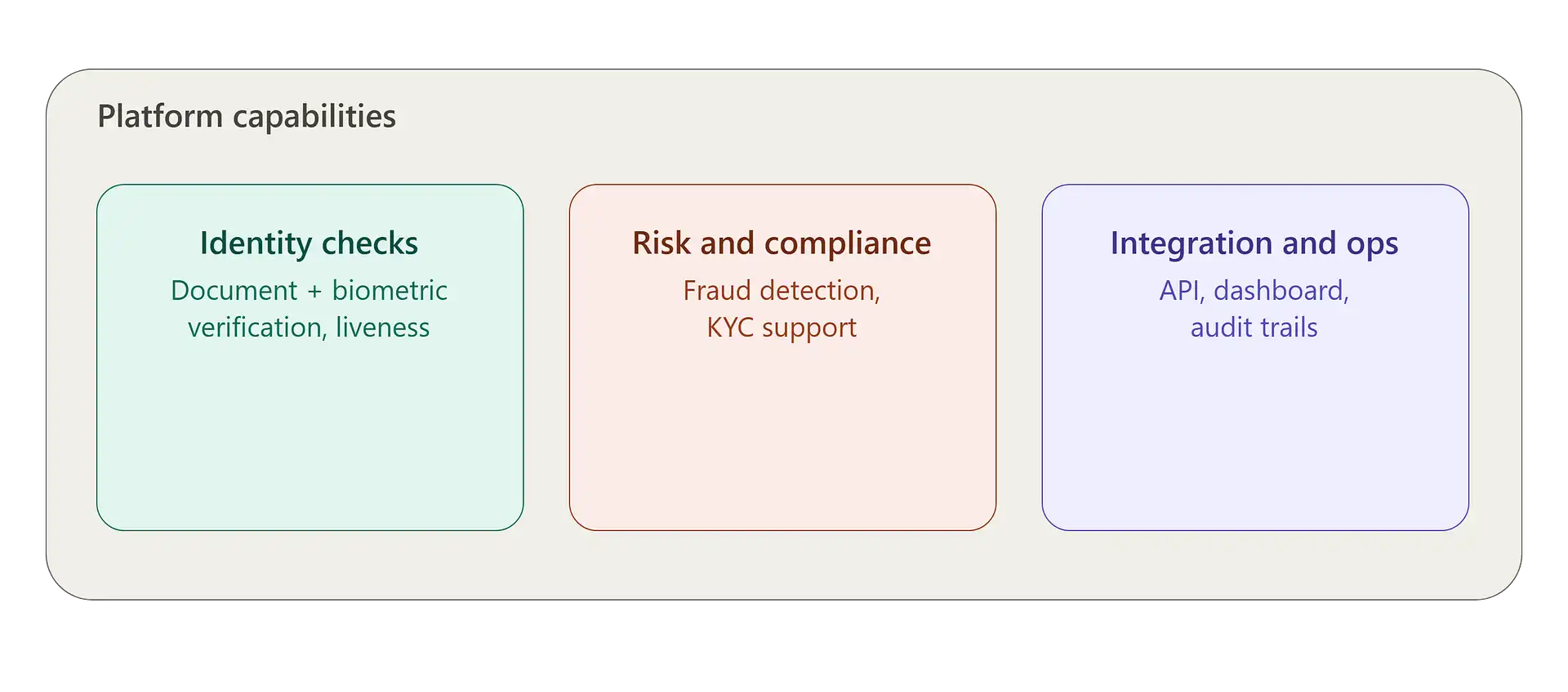
At minimum: document verification, facial and liveness checks, fraud detection, an integration API, and clear audit trails. Coverage and accuracy vary between vendors.
It extracts data via OCR, checks the document against known templates for tampering signs, and cross-references fields for consistency before combining results into a decision.
It can meaningfully improve on unverified self-reported data, but security depends on the specific platform's liveness quality and how it protects stored data. No system is immune to sophisticated fraud.
Identity verification confirms who someone is. KYC software is broader, adding due diligence, risk scoring, and ongoing monitoring on top of that identity check.
Most platforms do, comparing a live selfie to the ID photo and producing a similarity score used to decide whether the two images plausibly match.
Pricing typically depends on verification volume, document types supported, and whether it's billed per verification, per user, or tiered. Get a quote based on your actual use case rather than a published rate card.
By checking document coverage, biometric and liveness accuracy, fraud detection scope, integration effort, and data security policies, then testing against their own volume and document mix before committing.
AI Enablement in the Age of Generative AI: ZYNO by Elite Mindz Leading the Charge
Read More →

Top 10 Trends Shaping the Future of AI Agents in 2025
Read More →
Top 6 AI Chatbot Features Transforming Customer Engagement in 2026
Read More →
Top 10 AI Integration Strategies for Seamless ERP and CRM Upgrades in 2025
Read More →
Best GAI Consulting Approaches for Ethical Business Transformation in 2025
Read More →
From Vision to Value: The Ultimate Guide to Enterprise GenAI Platforms
Read More →
Top 10 GAI Development Trends Shaping Autonomous Agents in 2025
Read More →
The Future of Computer Vision: Trends to Watch in 2025
Read More →
Generative AI in 2025: How ZYNO BY Elite Mindz is Transforming Enterprise Workflows
Read More →
10 Real-World Applications of Computer Vision in 2025
Read More →
Integrating Computer Vision with IoT and AI: Driving the Next Wave of Intelligent Systems in 2025
Read More →
Agentic AI Explained: How AI Agents Are Transforming Business in 2025
Read More →
From Chatbots to Autonomous Agents: The Evolution of Agentic AI
Read More →
The Rise of Multi-Agent Systems: How Agentic AI Teams Will Run Enterprises of the Future
Read More →
Agentic AI vs Generative AI: What Business Leaders Need to Know
Read More →
The Power of Autonomous Agents: Understanding Agentic AI for Enterprises
Read More →
The Role of Agentic AI in Enhancing Enterprise Agility and Responsiveness
Read More →
Agentic AI as a Competitive Advantage: Why Businesses Can’t Ignore It
Read More →
The Shift from Automation to Autonomy: How Agentic AI is Redefining Enterprise Operations
Read More →
From Reactive to Proactive: How Agentic AI Changes Enterprise Decision-Making
Read More →
Why Every Business Will Hire an AI Agent Soon
Read More →
Agentic AI for Startups: Leveling the Playing Field
Read More →
Agentic AI: The New Digital Workforce
Read More →
The Future of Business: Autonomous Teams of AI Agents
Read More →
From Insights to Action: How AI Agents Close the Gap
Read More →
Agentic AI in 2026: From Hype to Enterprise-Ready Transformation
Read More →
The Competitive Edge: Why Early Adopters of Agentic AI Are Winning Markets
Read More →
Beyond Automation: Why Agentic AI is the Key to Enterprise Agility in 2025
Read More →
The Human-AI Partnership: Building Smarter Teams with Agentic AI
Read More →
The Rise of Autonomous Teams: Why Agentic AI is the New Digital Workforce
Read More →
Top Machine Learning Use Cases You Didn’t Know About
Read More →
What Is Low Code/No Code and Why It Matters in 2025
Read More →
Top Use Cases of Generative AI in 2026
Read More →
The Future of Generative AI in Enterprises
Read More →
How Generative AI Is Reshaping Enterprise Operations in 2025
Read More →
Top AI Features Every Modern Taxi App Must Include in 2026
Read More →The Future of Events: How Artificial Intelligence Is Changing the Industry
Read More →Why Are AI Agents the Next Big Shift in Banking and Finance
Read More →How AI-Driven Analytics Improve Learning Outcomes
Read More →How AI Is Optimizing Every Step of Food Delivery Apps
Read More →How AI-Powered CRM Is Transforming the Media & Entertainment Industry
Read More →
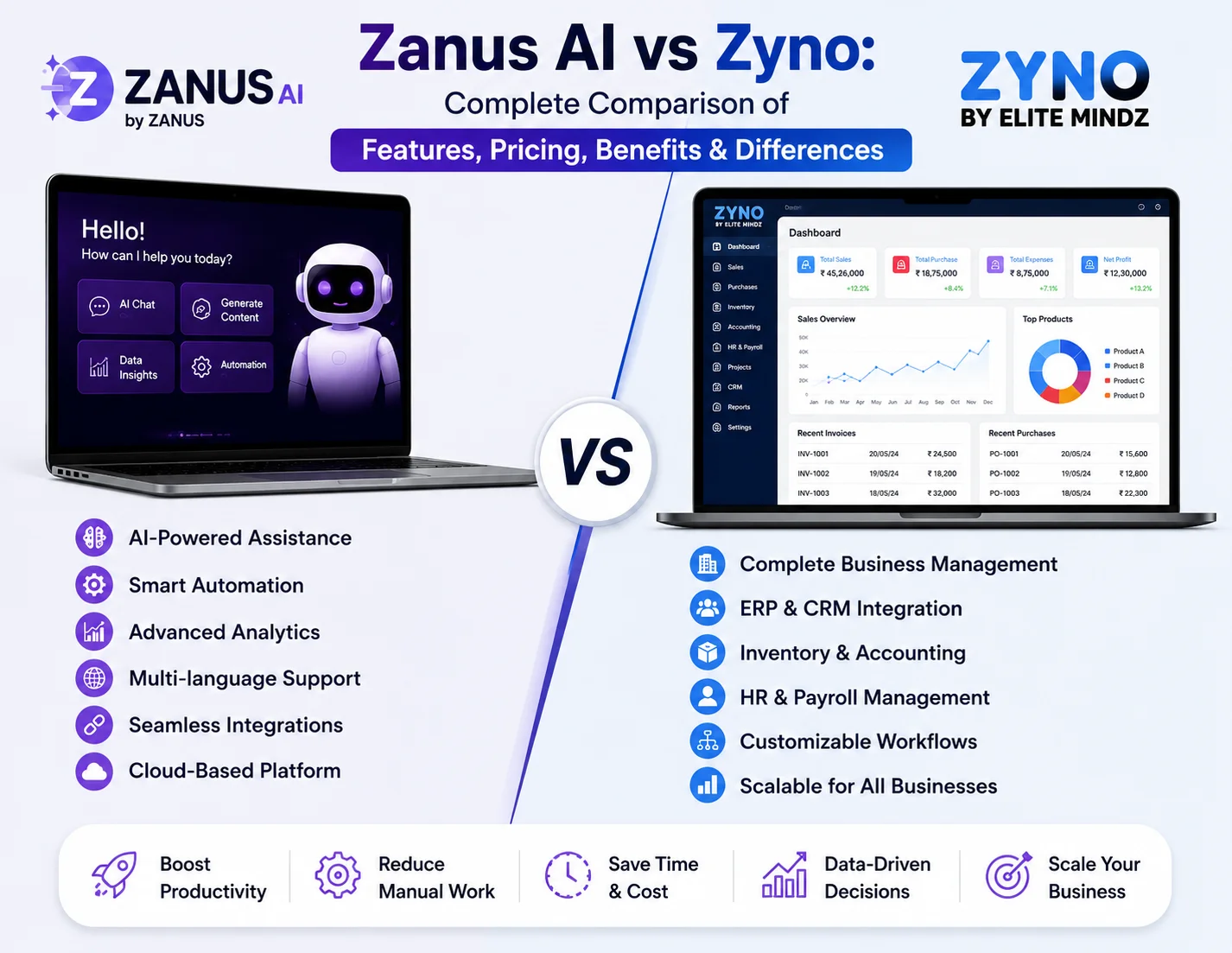
ZYNO vs Zanus AI: Which Is Better for Your Business?
Read More →
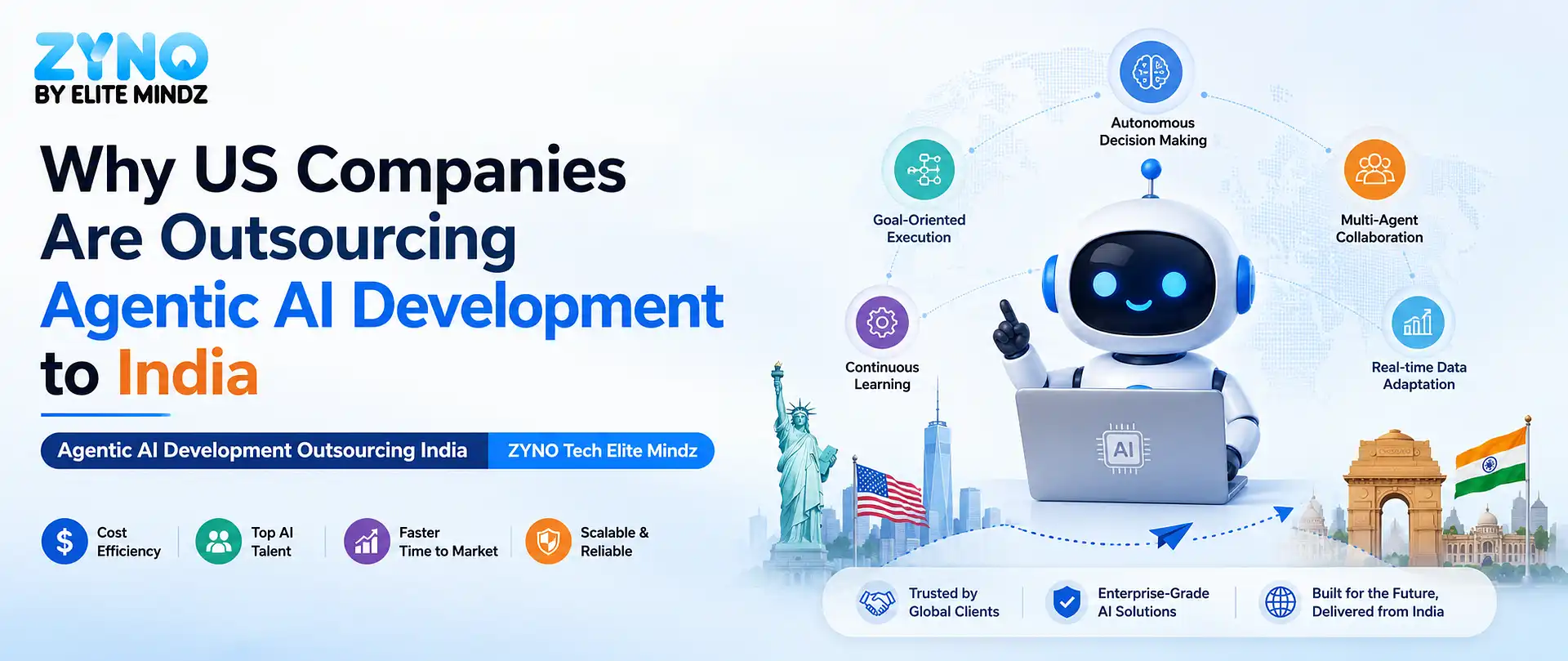
Why US Companies Are Outsourcing Agentic AI Development to India

Read More →
Top Agentic AI Development Companies in India for US Businesses (2026)

Read More →
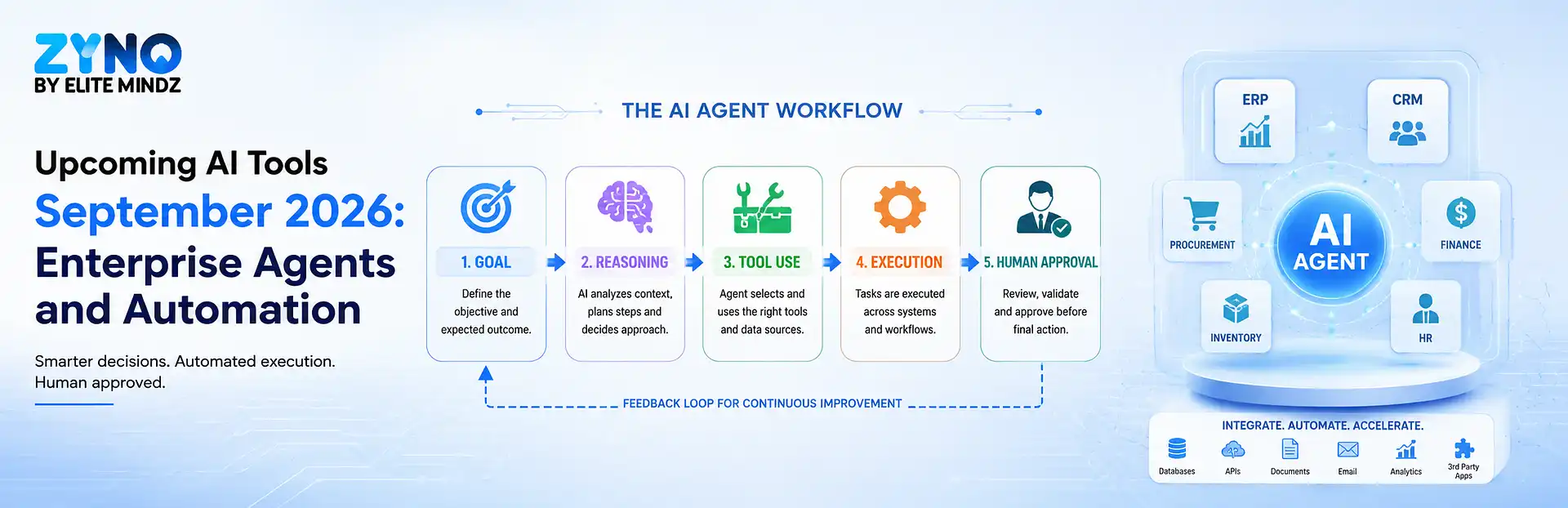
Top Upcoming AI Tools of September 2026 You Must Watch
Read More →
Google Opal vs Tilda Bio AI: What Each Tool Actually Does (and Why They Aren't True Rivals)
Read More →
AI Agent Development Services: A Practical Guide for Business Teams

Read More →
Enterprise AI Agent Development Services: The Complete Guide to Cost, Benefits, Use Cases & Implementation

Read More →
How Much Does Custom AI Agent Development Cost in 2026? Calculate Real Price Ranges
Read More →
Machine Learning Software: Features, Benefits, Pricing & How to Choose the Right Solution in 2026
Read More →
Computer Vision in AI: How It Works, Types, Applications & Benefits
Read More →
Computer Vision Software Development Services
Read More →
What Is AI Identity Verification? How It Works, Benefits & Use Cases
Read More →
AI Identity Verification Software: Features & How to Choose
Read More →Partner with ZYNO by Elite Mindz to revolutionize how your business works. Fill out the form, and we’ll reach out with AI-powered solutions made just for you.
We use browser cookies to ensure you get the best experience on our website. Learn more
The form was submitted successfully!