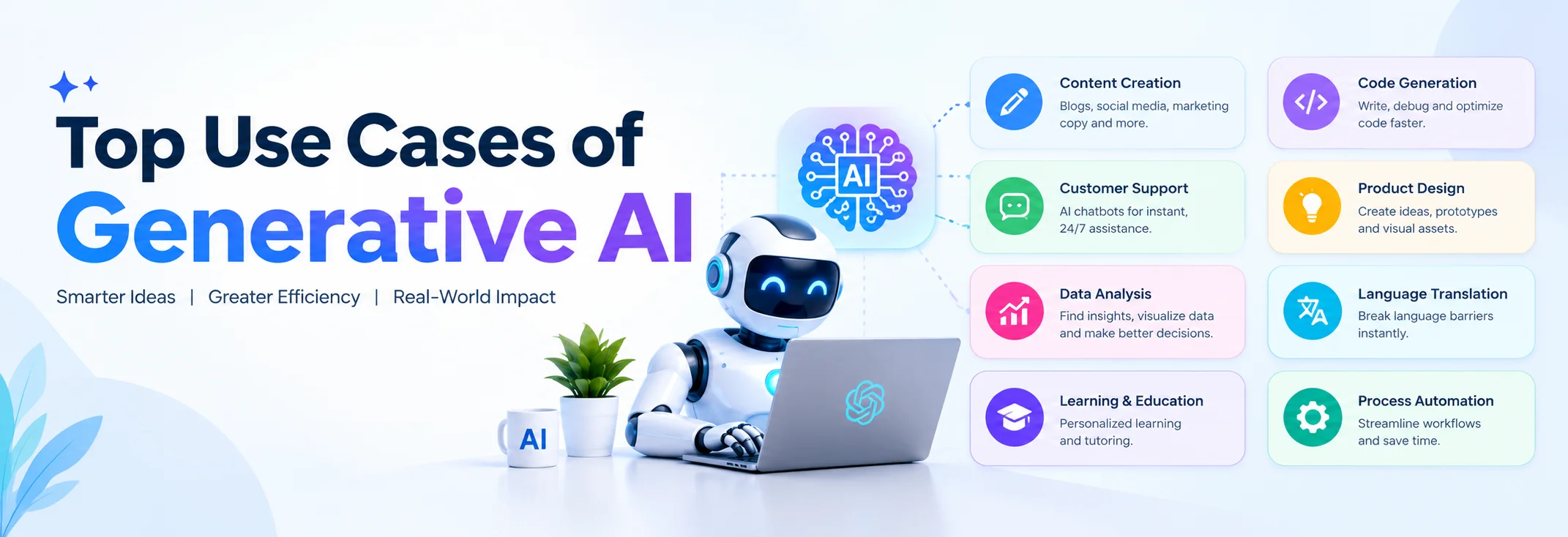
AI Enablement in the Age of Generative AI: ZYNO by Elite Mindz Leading the Charge
Read More →
×
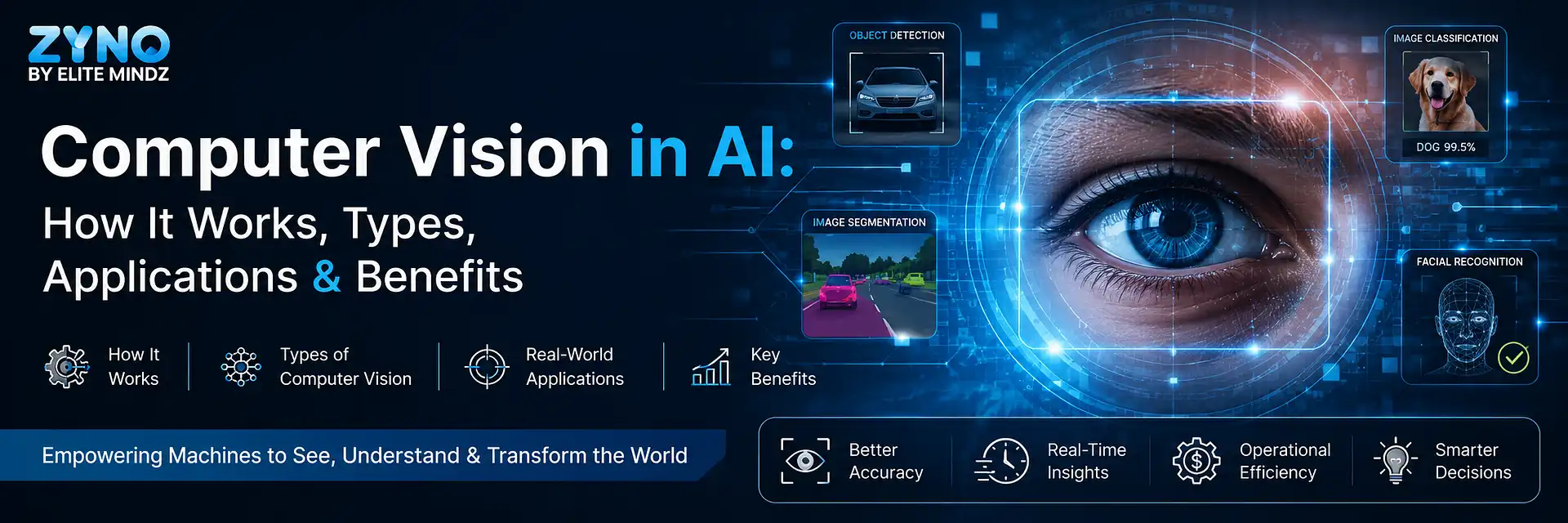
Computer vision is a field of artificial intelligence that trains computers to interpret and understand visual information from images and videos, then take action or make decisions based on that understanding. It combines image processing, machine learning, and deep learning so machines can identify objects, recognize patterns, and extract meaning from visual data, much like the human eye and brain do, but at machine speed and scale.
Businesses using ZYNO Books cut accounting time by 70% and stay 100% ZATCA-compliant — automatically.
Every time a smartphone unlocks with a glance, a warehouse robot picks the right package, or a doctor gets an AI-assisted second opinion on an X-ray, computer vision is working quietly in the background. It has moved from a research topic into one of the most widely deployed branches of artificial intelligence, powering everything from agriculture drones scanning fields in Punjab to fraud-detection systems screening digital payments across Indian banks.
This guide breaks down what computer vision is, how it actually works inside an AI system, the different types and capabilities it covers, and where it delivers the most business value today. Whether you are a student trying to understand the basics or a business leader evaluating computer vision development for your company, this pillar page is built to answer both the broad question and the specific ones that follow it.
Computer vision is the branch of artificial intelligence that enables machines to derive meaningful information from digital images, videos, and other visual inputs. Rather than simply storing or displaying pixels, a computer vision system analyzes visual data to identify objects, classify scenes, track movement, and trigger automated decisions.
At its core, computer vision tries to replicate a narrow slice of human visual perception, the ability to look at something and recognize what it is, where it is, and what is happening. The difference is that a machine "sees" through numerical pixel data rather than optical nerves, and it "understands" that data using statistical models trained on large volumes of labeled images.
Computer vision is not a single algorithm; it is a discipline that draws from image processing, pattern recognition, neural networks, and increasingly, deep learning architectures like convolutional neural networks (CNNs) and vision transformers.
Transform Your Business with Computer Vision
Build smarter visual solutions with AI-powered computer vision for automation, image analysis, object detection, quality inspection, and real-world business applications.
Explore Computer Vision Solutions Talk to Our ExpertsComputer vision matters because visual data is one of the largest and fastest-growing categories of information generated today, from CCTV footage and satellite imagery to medical scans and product photos. Manually reviewing this volume of visual content is neither scalable nor cost-effective.
A few reasons computer vision has become a business priority:
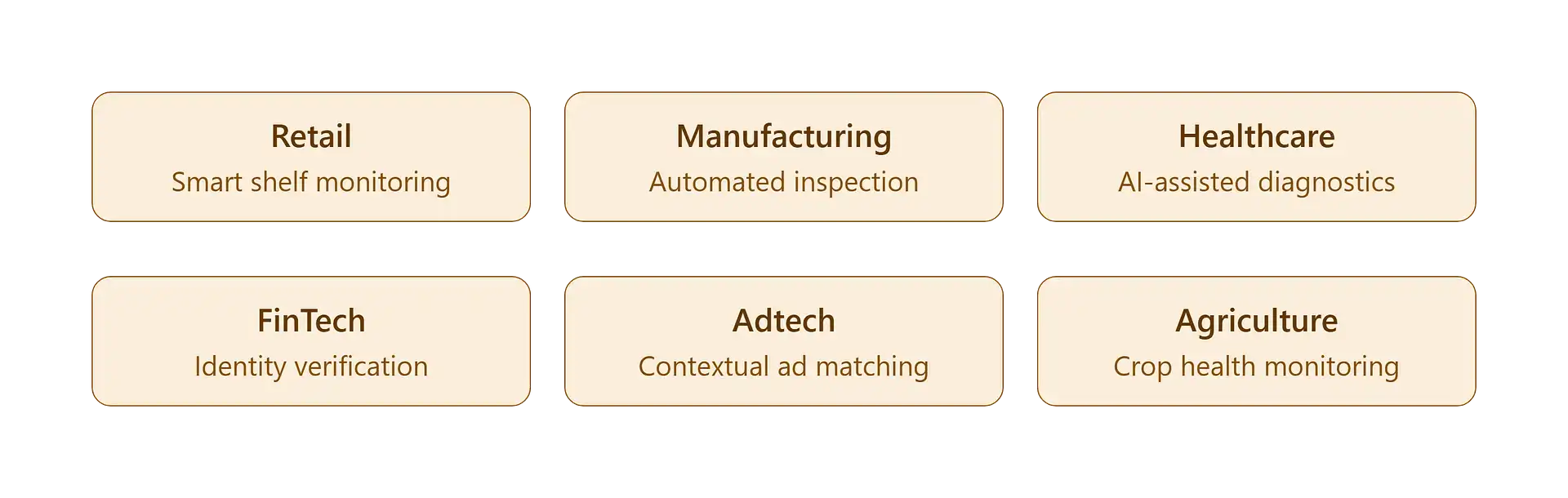
In India specifically, computer vision is playing a growing role in sectors like agriculture, where visual data from drones supports crop health monitoring, and in fintech, where it strengthens identity verification for digital onboarding under frameworks like e-KYC.
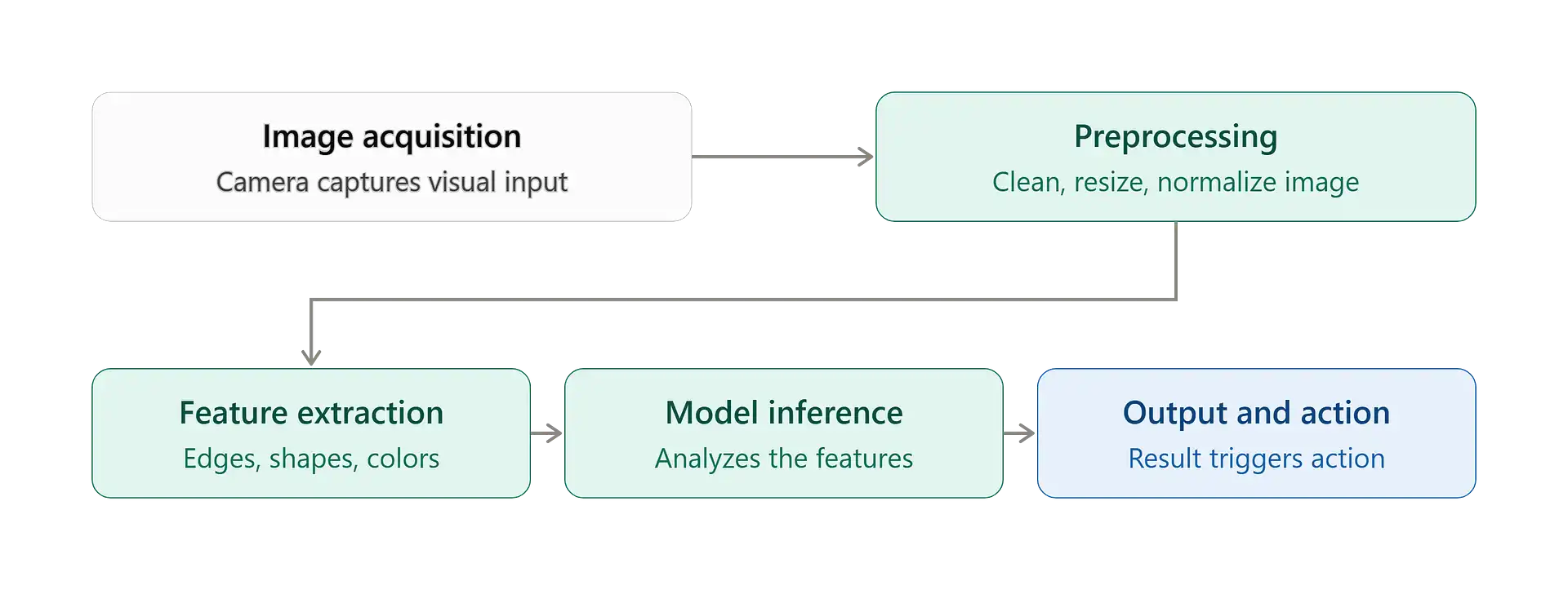
Computer vision works by converting visual input into numerical data, then applying trained algorithms to interpret that data and produce an output, such as a label, a bounding box, or a decision.
The general workflow inside an AI-powered computer vision system looks like this:

This pipeline can run in milliseconds on modern hardware, which is why computer vision is used in real-time applications like autonomous vehicles and live video surveillance.
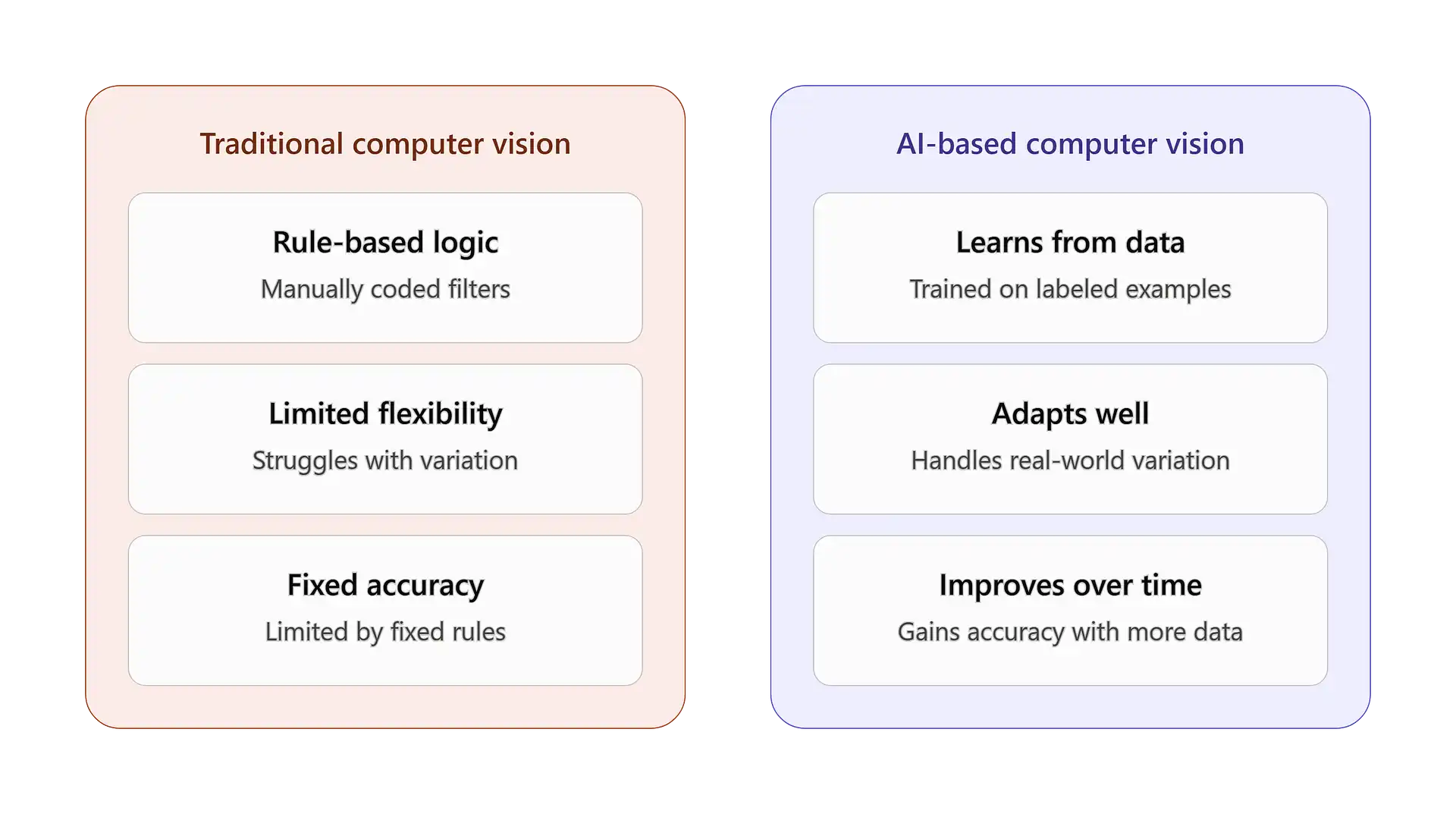
Not all computer vision systems are built the same way. It helps to understand the shift from traditional, rule-based methods to modern, AI-driven approaches.
| Aspect | Traditional Computer Vision | AI-Based Computer Vision |
|---|---|---|
| Approach | Manually programmed rules and filters | Learns patterns from labeled training data |
| Flexibility | Struggles with variation in lighting, angle, or background | Adapts well to varied real-world conditions |
| Accuracy | Limited by handcrafted features | Improves with more training data |
| Examples | Edge detection, template matching | Deep learning, CNNs, vision transformers |
| Development Effort | Requires domain-specific rule engineering | Requires large datasets and model training |
| Maintenance | Rules need constant manual updates | Models can be retrained as new data arrives |

Traditional computer vision relies on explicitly coded logic, such as detecting edges by measuring pixel intensity changes. AI-based computer vision, by contrast, learns these patterns on its own from thousands or millions of labeled examples, which is why it now dominates most modern applications.
Beyond the general workflow, a computer vision system depends on several key components working together:
Each component plays a distinct role, but the real intelligence emerges from how they are integrated into a single pipeline built around a specific business problem, such as detecting fraud in scanned documents or spotting quality defects on a production line.
Ready to Build Smarter Computer Vision Solutions?
Use AI-powered computer vision to automate visual tasks, detect objects, analyze images, improve quality control, and make faster business decisions.
Explore Computer Vision Get StartedRather than a technical taxonomy (covered later under "Types of Computer Vision"), capabilities describe what businesses can actually do once these technical building blocks are put to work:
These capabilities are rarely delivered in isolation; most real-world systems combine several of them, built on top of the specific computer vision types described below, to solve a complete business problem.
Machine learning is what gives modern computer vision its accuracy and adaptability. Instead of manually coding rules for every possible visual scenario, a machine learning model is trained on large datasets of labeled images so it can learn the underlying patterns itself.
Deep learning, a subset of machine learning, has become the dominant approach in computer vision through architectures like:
The training process typically involves feeding a model thousands of labeled examples, measuring how far its predictions are from the correct answer, and adjusting the model's internal parameters until accuracy improves. This is why data quality and volume are just as important as the algorithm itself.
A more recent shift is the move toward foundation models and multimodal AI, where a single large model, trained on massive image and text datasets, can handle many vision tasks without being retrained from scratch for each one. Vision-language models can connect what they see in an image with written or spoken context, which is why computer vision is increasingly discussed alongside natural language processing rather than as a separate field.
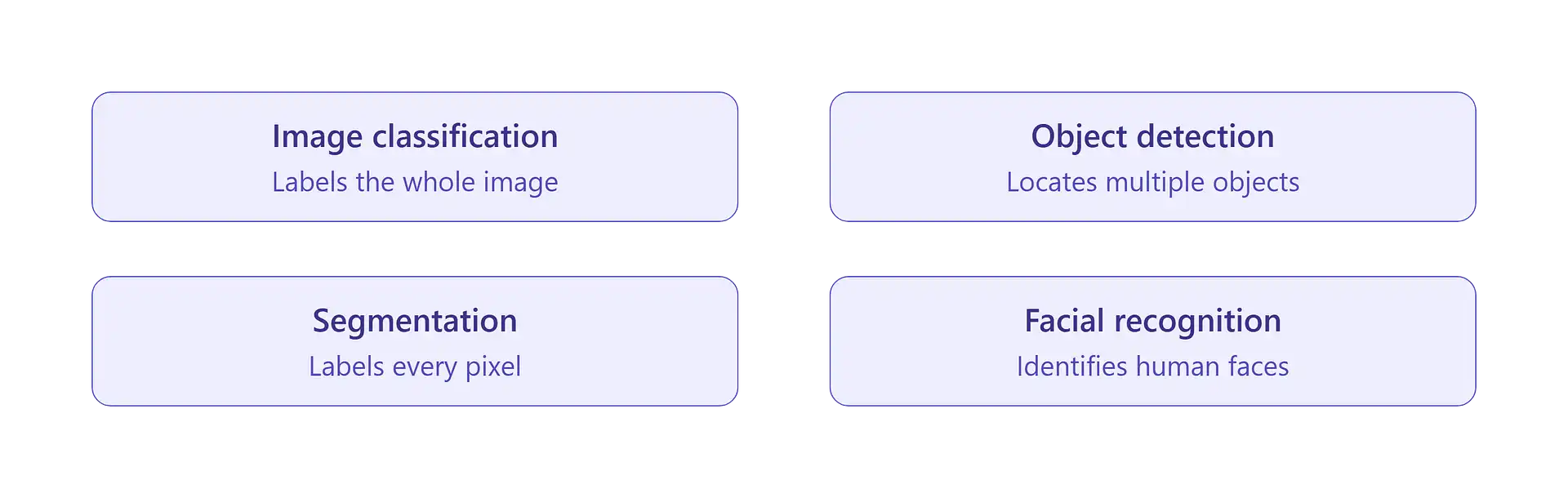
While capabilities describe business outcomes, types describe the underlying technical tasks that make those outcomes possible. Computer vision can be grouped into several core types based on the task being performed:

Each type serves a different purpose, and choosing the right one depends entirely on the problem a business is trying to solve.
Organizations adopting computer vision typically see gains across several dimensions:
For businesses expanding across India's diverse manufacturing, retail, and agricultural landscape, these benefits translate directly into measurable cost savings and faster time-to-decision.
Computer vision delivers real value, but it is not without constraints, and understanding these limitations matters just as much as understanding its capabilities:
None of these challenges rule out computer vision as a solution, but they do mean it works best when paired with realistic expectations, quality data, and a plan for monitoring performance after deployment.

Retailers use computer vision for shelf-monitoring systems that detect out-of-stock items, self-checkout systems that identify products without barcodes, and visual search tools that let customers find products by uploading a photo. In-store cameras can also analyze footfall patterns and queue lengths to optimize staffing, a growing trend among large retail chains in India's metro markets.
On the factory floor, computer vision powers automated quality inspection, catching defects like scratches, misalignments, or missing components far faster and more consistently than manual checks. It also supports predictive maintenance by visually monitoring equipment wear and enables robotic guidance systems that help machines pick, sort, and assemble parts with precision.
In healthcare, computer vision assists radiologists by flagging anomalies in X-rays, MRIs, and CT scans, supports pathology by analyzing tissue slides, and enables remote patient monitoring through video-based vital sign tracking. Indian hospitals and diagnostic chains are increasingly piloting AI-assisted imaging tools to manage high patient volumes and support faster preliminary screening in tier-2 and tier-3 cities.
Financial technology companies rely on computer vision for document verification during digital onboarding, facial recognition for secure authentication, and fraud detection by analyzing signature patterns or scanned identity documents. This is especially relevant in India, where e-KYC and Aadhaar-linked digital verification depend heavily on accurate, real-time image analysis.
In advertising technology, computer vision enables contextual ad placement by analyzing video or image content, audience measurement through anonymized facial analysis at digital billboards, and brand-safety checks that scan visual content for inappropriate context before ads are served alongside it.
Computer vision supports precision agriculture through drone-captured imagery that assesses crop health, detects pest infestation, and estimates yield. It is also used in automated sorting systems that grade fruits and vegetables by size, ripeness, or quality, a capability gaining traction among agri-tech startups working with Indian farm cooperatives.
Several open-source libraries form the backbone of most computer vision projects:
Alongside open-source libraries, many businesses use managed cloud vision APIs instead of building models from scratch:
These libraries are typically combined with deep learning frameworks rather than used as standalone solutions for complex, model-driven tasks, while cloud APIs are often the faster starting point when a business wants to test a use case before investing in custom model development.
For building and training deep learning-based computer vision models, developers commonly rely on:
The right framework choice depends on the specific task, the required inference speed, and whether the deployment environment is cloud-based, on-premise, or edge hardware.
Adopting computer vision is not just about picking a model; it involves data collection, labeling, model training, integration with existing systems, and ongoing maintenance as real-world conditions change. This is where ZYNO by EliteMindz comes in.
ZYNO by EliteMindz helps businesses design and deploy custom computer vision solutions tailored to their specific industry and workflow, whether that means building a defect-detection system for a manufacturing line, an automated visual inspection tool for retail shelves, or a document verification pipeline for fintech onboarding. Rather than forcing a generic off-the-shelf model into a unique business problem, the approach focuses on understanding the actual visual data a business generates and building a pipeline around it, from data collection and annotation through to model training, deployment, and monitoring.
For companies in India exploring AI adoption, working with a team that understands both the technical depth of computer vision and the practical realities of deployment (data availability, infrastructure costs, regulatory considerations) can significantly shorten the path from pilot project to production system.
See More. Automate More. Grow Smarter.
Harness AI-powered computer vision to automate visual inspection, detect objects, analyze images, and turn visual data into actionable insights.
Computer vision has moved from an academic research topic to one of the most practically deployed areas of artificial intelligence, touching industries as varied as healthcare, retail, agriculture, and finance. Understanding what computer vision is, how it works, and where it delivers real value is the first step toward evaluating whether it belongs in your own business strategy.
As datasets grow larger and models become more efficient, computer vision will keep expanding into new use cases, but the fundamentals covered in this guide, image acquisition, feature extraction, model inference, and the underlying machine learning techniques, will remain the foundation for understanding any new development in the field.
Computer vision is a field of AI that enables machines to interpret images and videos, allowing them to identify objects, patterns, and scenes much like human vision does.
Image processing focuses on manipulating or enhancing images (like sharpening or resizing), while computer vision goes further by interpreting the content of the image to extract meaning or make decisions.
Python is the most widely used language for computer vision, largely due to its rich ecosystem of libraries like OpenCV, TensorFlow, and PyTorch.
No. Machine learning is a broader technique used to train models on data, while computer vision is a specific application domain that often uses machine learning, particularly deep learning, to interpret visual data.
Healthcare, retail, manufacturing, fintech, agriculture, and automotive are among the industries with the most mature computer vision applications today.
Generally yes, though techniques like transfer learning and data augmentation allow businesses to build effective models with smaller, well-curated datasets.
Yes. Frameworks like YOLO and MediaPipe are specifically optimized for real-time inference, making them suitable for applications like live video surveillance or autonomous navigation.
Most businesses start with a narrow, high-impact use case, such as automated quality inspection or document verification, and partner with an experienced AI development team like ZYNO by EliteMindz to build, train, and deploy a pilot solution before scaling further.
AI Enablement in the Age of Generative AI: ZYNO by Elite Mindz Leading the Charge
Read More →

Top 10 Trends Shaping the Future of AI Agents in 2025
Read More →
Top 6 AI Chatbot Features Transforming Customer Engagement in 2026
Read More →
Top 10 AI Integration Strategies for Seamless ERP and CRM Upgrades in 2025
Read More →
Best GAI Consulting Approaches for Ethical Business Transformation in 2025
Read More →
From Vision to Value: The Ultimate Guide to Enterprise GenAI Platforms
Read More →
Top 10 GAI Development Trends Shaping Autonomous Agents in 2025
Read More →
The Future of Computer Vision: Trends to Watch in 2025
Read More →
Generative AI in 2025: How ZYNO BY Elite Mindz is Transforming Enterprise Workflows
Read More →
10 Real-World Applications of Computer Vision in 2025
Read More →
Integrating Computer Vision with IoT and AI: Driving the Next Wave of Intelligent Systems in 2025
Read More →
Agentic AI Explained: How AI Agents Are Transforming Business in 2025
Read More →
From Chatbots to Autonomous Agents: The Evolution of Agentic AI
Read More →
The Rise of Multi-Agent Systems: How Agentic AI Teams Will Run Enterprises of the Future
Read More →
Agentic AI vs Generative AI: What Business Leaders Need to Know
Read More →
The Power of Autonomous Agents: Understanding Agentic AI for Enterprises
Read More →
The Role of Agentic AI in Enhancing Enterprise Agility and Responsiveness
Read More →
Agentic AI as a Competitive Advantage: Why Businesses Can’t Ignore It
Read More →
The Shift from Automation to Autonomy: How Agentic AI is Redefining Enterprise Operations
Read More →
From Reactive to Proactive: How Agentic AI Changes Enterprise Decision-Making
Read More →
Why Every Business Will Hire an AI Agent Soon
Read More →
Agentic AI for Startups: Leveling the Playing Field
Read More →
Agentic AI: The New Digital Workforce
Read More →
The Future of Business: Autonomous Teams of AI Agents
Read More →
From Insights to Action: How AI Agents Close the Gap
Read More →
Agentic AI in 2026: From Hype to Enterprise-Ready Transformation
Read More →
The Competitive Edge: Why Early Adopters of Agentic AI Are Winning Markets
Read More →
Beyond Automation: Why Agentic AI is the Key to Enterprise Agility in 2025
Read More →
The Human-AI Partnership: Building Smarter Teams with Agentic AI
Read More →
The Rise of Autonomous Teams: Why Agentic AI is the New Digital Workforce
Read More →
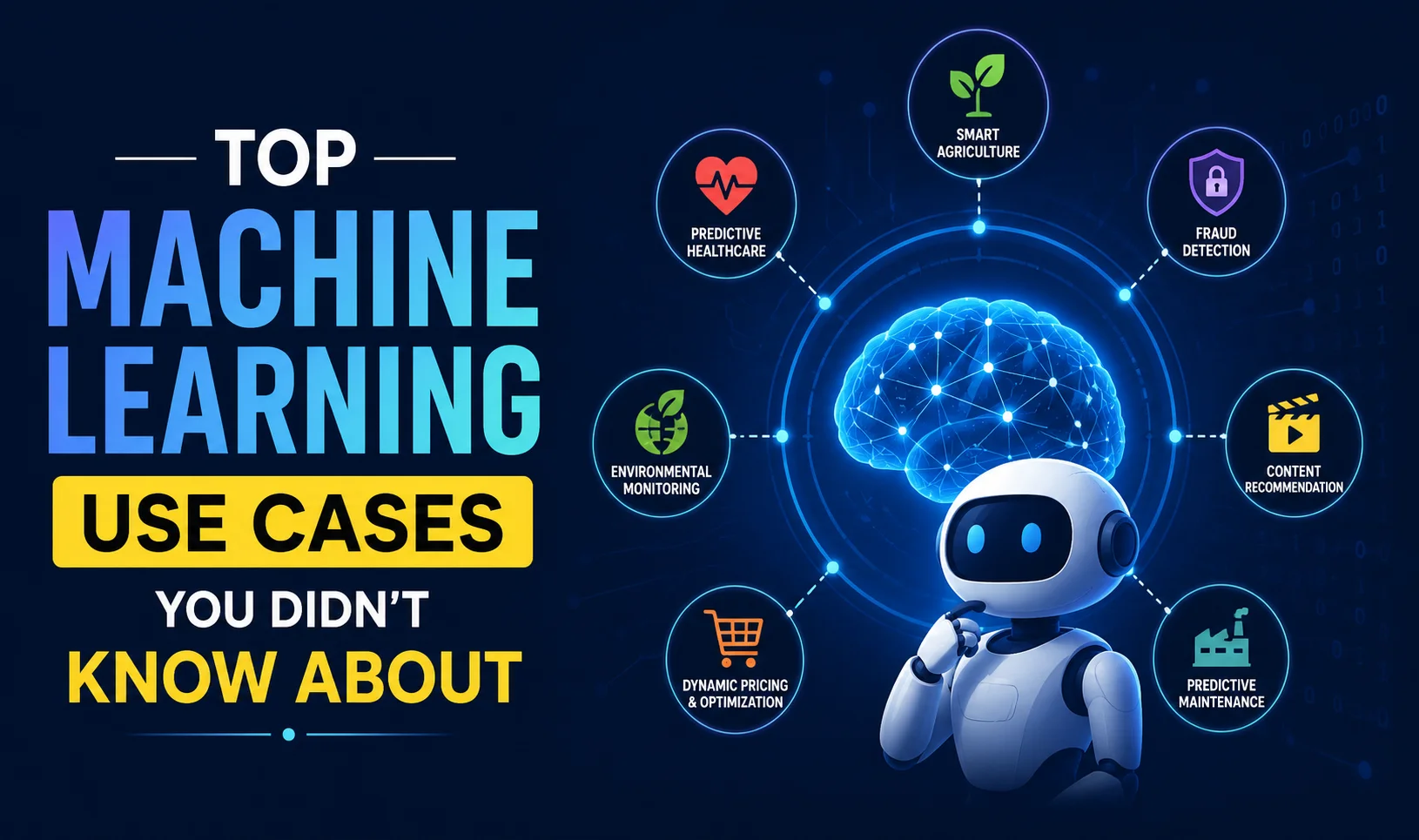
Top Machine Learning Use Cases You Didn’t Know About
Read More →
What Is Low Code/No Code and Why It Matters in 2025
Read More →
Top Use Cases of Generative AI in 2026
Read More →
The Future of Generative AI in Enterprises
Read More →
How Generative AI Is Reshaping Enterprise Operations in 2025
Read More →
Top AI Features Every Modern Taxi App Must Include in 2026
Read More →The Future of Events: How Artificial Intelligence Is Changing the Industry
Read More →Why Are AI Agents the Next Big Shift in Banking and Finance
Read More →How AI-Driven Analytics Improve Learning Outcomes
Read More →How AI Is Optimizing Every Step of Food Delivery Apps
Read More →How AI-Powered CRM Is Transforming the Media & Entertainment Industry
Read More →
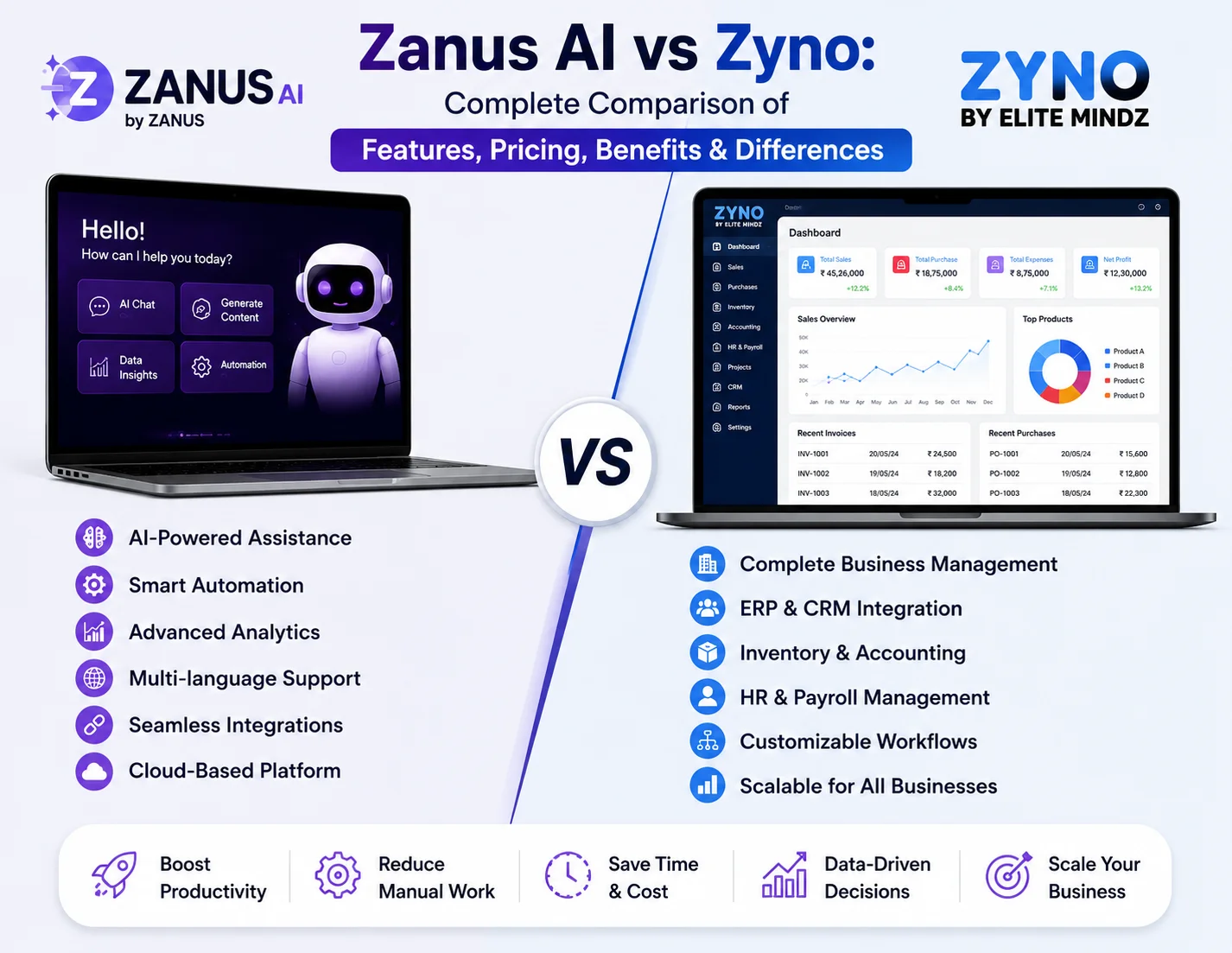
ZYNO vs Zanus AI: Which Is Better for Your Business?
Read More →
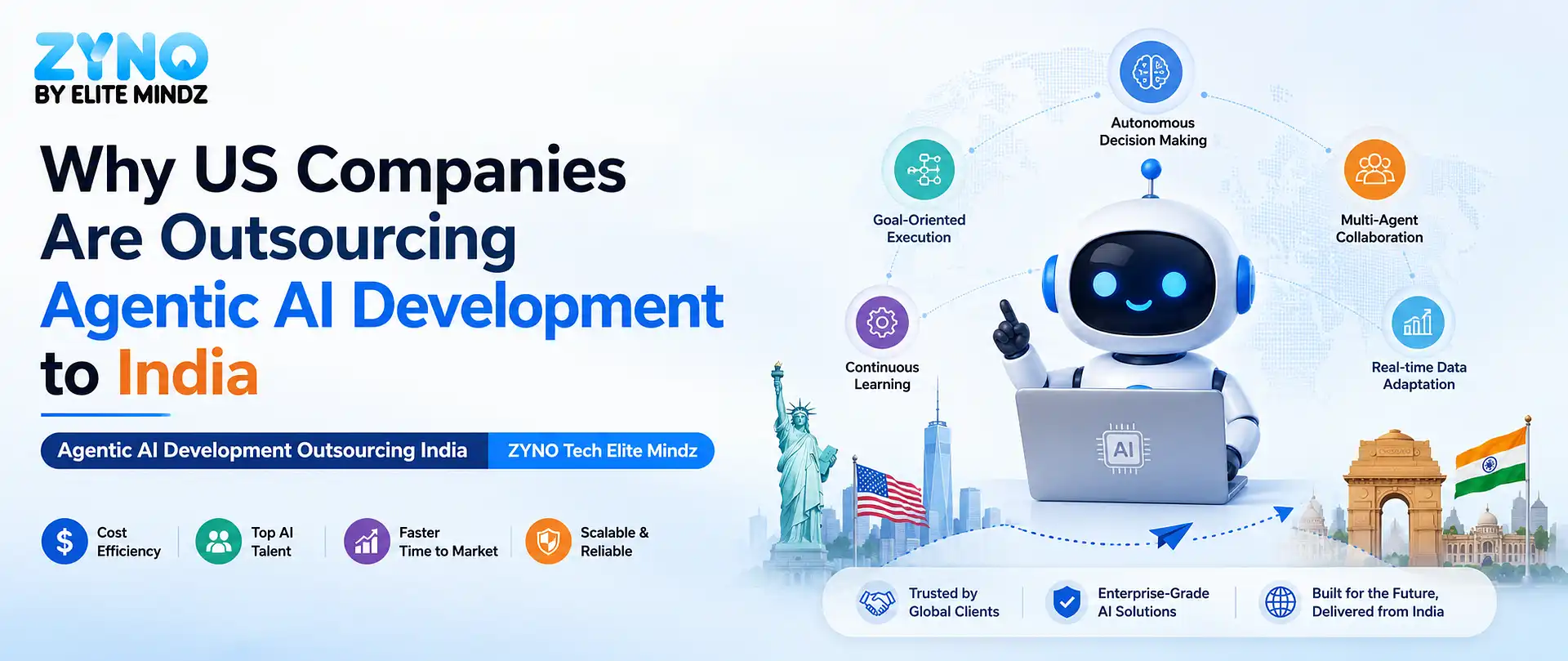
Why US Companies Are Outsourcing Agentic AI Development to India

Read More →
Top Agentic AI Development Companies in India for US Businesses (2026)

Read More →
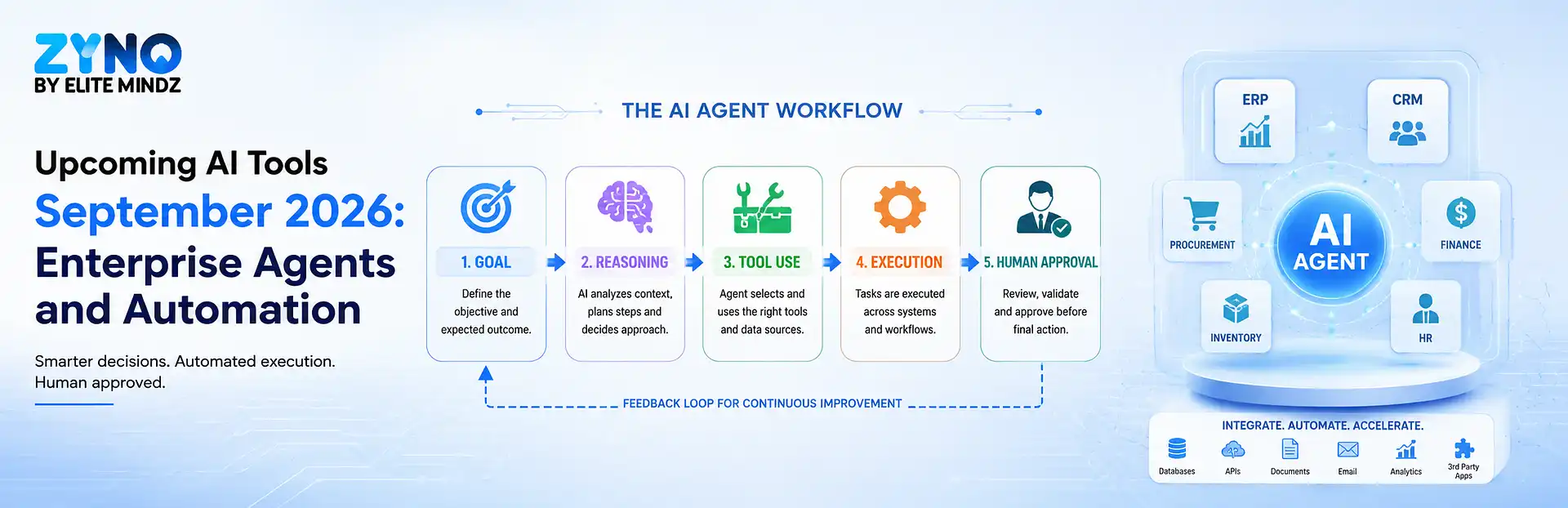
Top Upcoming AI Tools of September 2026 You Must Watch
Read More →
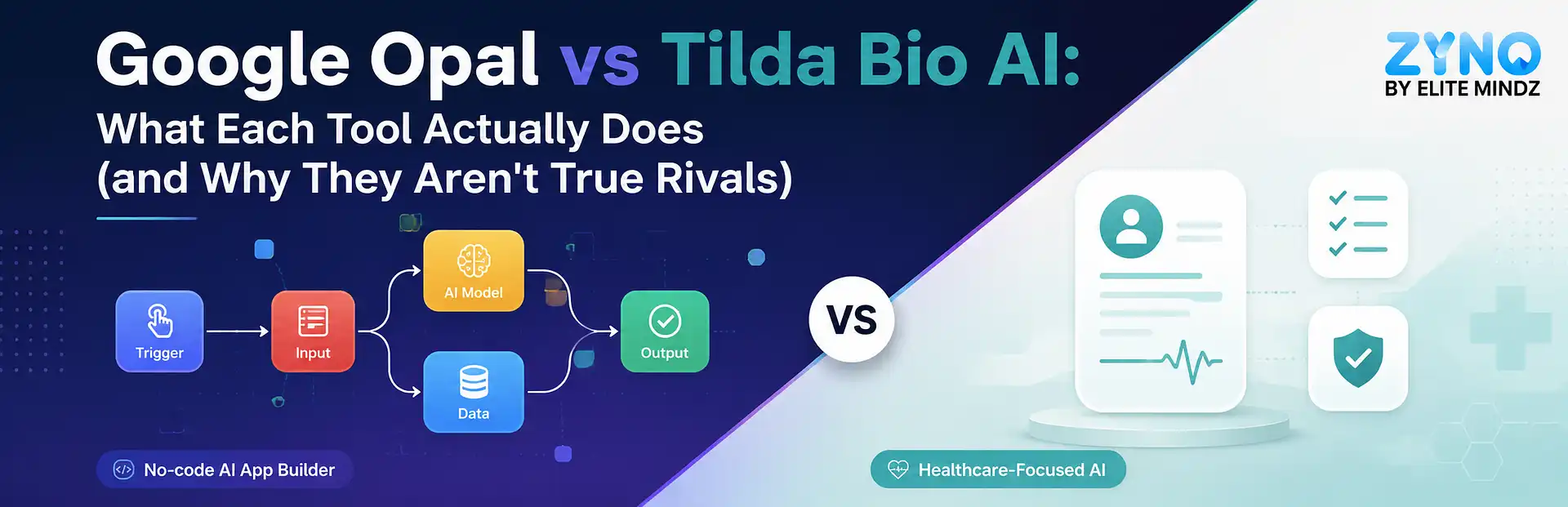
Google Opal vs Tilda Bio AI: What Each Tool Actually Does (and Why They Aren't True Rivals)
Read More →
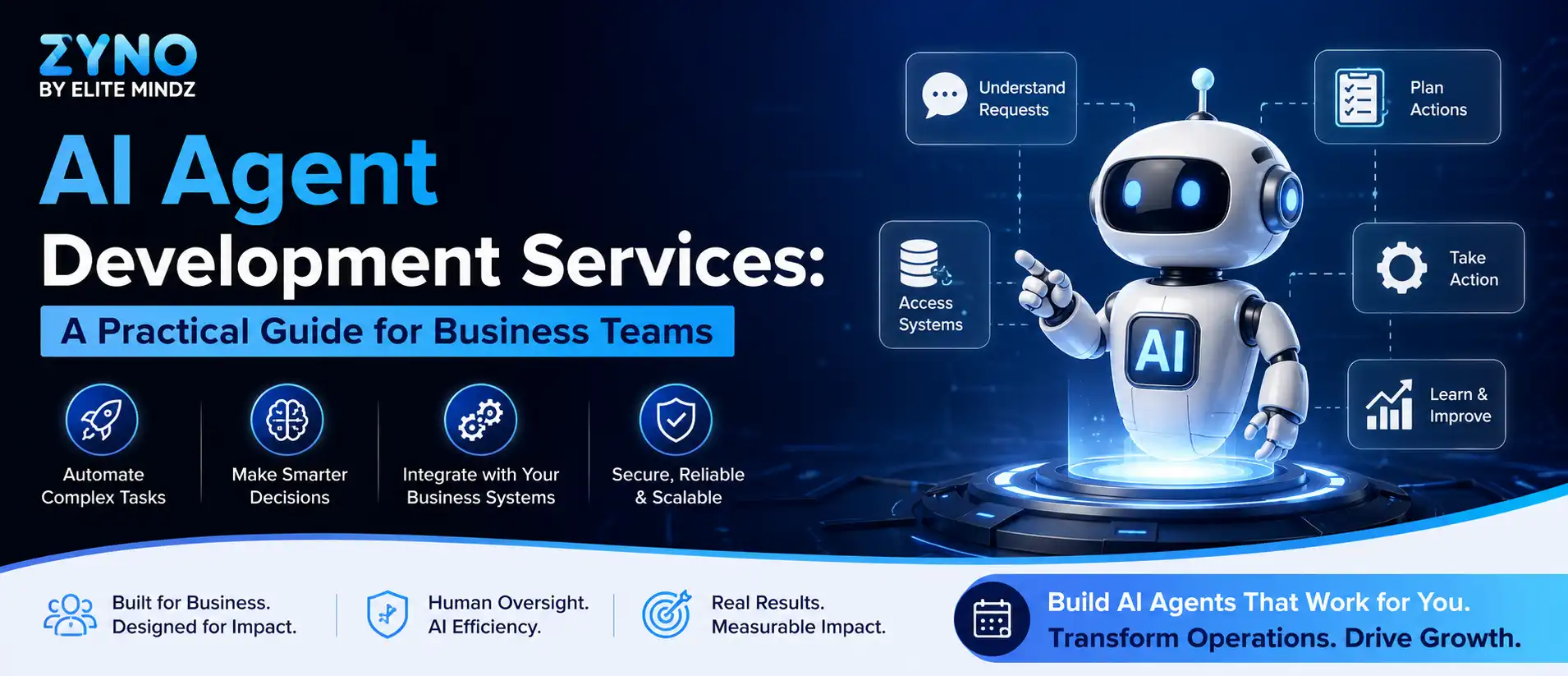
AI Agent Development Services: A Practical Guide for Business Teams

Read More →
Enterprise AI Agent Development Services: The Complete Guide to Cost, Benefits, Use Cases & Implementation

Read More →
How Much Does Custom AI Agent Development Cost in 2026? Calculate Real Price Ranges
Read More →
Machine Learning Software: Features, Benefits, Pricing & How to Choose the Right Solution in 2026
Read More →
Computer Vision in AI: How It Works, Types, Applications & Benefits
Read More →Partner with ZYNO by Elite Mindz to revolutionize how your business works. Fill out the form, and we’ll reach out with AI-powered solutions made just for you.
We use browser cookies to ensure you get the best experience on our website. Learn more
The form was submitted successfully!