AI Enablement in the Age of Generative AI: ZYNO by Elite Mindz Leading the Charge
Read More →
×
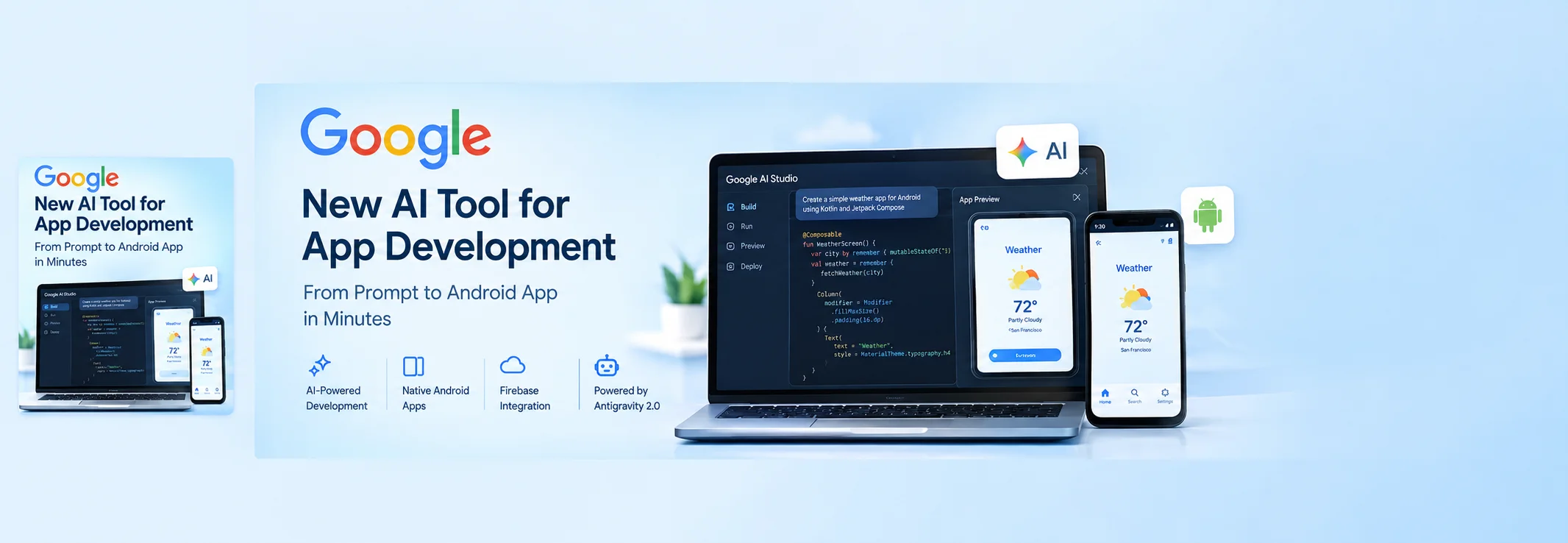
Thinking about building an app with AI? Explore Google's new AI tool for app development and see how it can make Android app creation simpler, faster, and more accessible for beginners and developers.
Businesses using ZYNO Books cut accounting time by 70% and stay 100% ZATCA-compliant — automatically.
Mobile teams no longer need weeks of setup to test an idea. With Google's new AI tool for app development, announced at Google I/O 2026, a working native Android application can go from a text prompt to a running preview inside a browser in minutes. This shift is part of a much larger push across Google's ecosystem, one that blends generative AI, agentic workflows, and traditional coding into a single pipeline. For founders, in-house teams, and agencies alike, understanding what this tool actually does and where it fits next to other mobile app development services is quickly becoming essential.
At its core, Google's new AI tool for app development lives inside Google AI Studio, the company's browser-based building environment. Instead of opening Android Studio, configuring a Gradle project, and writing boilerplate UI code, a developer or first-time creator types a plain-language description of the app they want. AI Studio then generates a functional native Android application written in Kotlin using Jetpack Compose, Google's modern UI toolkit. The result can be previewed instantly inside an embedded Android Emulator, tested on a physical device over USB, and eventually pushed toward Google Play's internal testing track, all from the same interface. This is a meaningful departure from earlier prompt-to-code tools, most of which only produced web app development output rather than fully native mobile experiences.
Unlike browser-based mockups, apps built with this tool can tap into GPS, Bluetooth, and NFC sensors, meaning a prompt-generated app can behave like genuine Android app development work rather than a static demo. Google has positioned this as suited to personal utilities, simple social apps, and hardware-aware experiences, with support for sharing apps with family and friends still on the roadmap.
Sitting alongside AI Studio is Antigravity 2.0, Google's agent orchestration platform. It ships as a standalone desktop app, a Go-based CLI, a developer SDK, and a Managed Agents tier inside the Gemini API. In practice, this means multiple AI agents can work on different parts of a codebase simultaneously (one testing, one refactoring, one documenting) while a human developer supervises. Google positions this as the backbone for how its custom software development tooling will operate going forward.
The Android CLI reached a stable 1.0 release alongside these announcements, giving AI agents, whether from Antigravity, Claude Code, or third-party tools, programmatic access to Android Studio's build, analysis, and testing systems. This closes a long-standing gap where AI-generated code still needed a human to manually compile, test, and debug it inside a traditional IDE.
A new annotation tool lets builders draw directly on the live app preview to request visual changes. At the same time, Firebase integrations for Firestore, Authentication, and App Check are being added so that apps built with Google's new AI tool for app development can connect to real backend infrastructure without leaving the browser. Google's own developer blog confirms these Firebase integrations are rolling out as part of the same release (Android Developers Blog).
Placed against the wider Google new AI tools list unveiled at I/O 2026, this app-builder sits closer to the developer-facing end of the spectrum than to consumer products like Gemini Omni. It shares infrastructure with Gemini 3.5 but is scoped specifically toward shipping software, which is why publications tracking Google AI tools for developers have grouped it with Antigravity and the Android CLI rather than with search or productivity features. Teams evaluating a full build should also weigh where MVP and proof-of-concept work fits before committing an AI-first prototype to production.
It's worth separating this from a Google AI tool for marketing, since the two solve entirely different problems. Marketing-focused Google AI tools, think automated ad copy generation, campaign optimization, or creative testing inside Google Ads, are built to drive customer acquisition and messaging, not to compile code. Google's new AI tool for app development, by contrast, is a builder: it produces the application itself. Businesses that need both sides covered- an app built with AI assistance and a strategy to market it- typically pair development work with a dedicated digital marketing strategy rather than expecting one tool to do both jobs.
Yes, access to Google AI Studio's app-building capability is currently free to use, with no subscription required to start prototyping. This matters for anyone comparing a free AI tools list before committing budget to paid platforms like Cursor, Replit, Bolt, or Lovable, all of which Google is now directly competing against. The trade-off is that free access currently supports personal use and testing rather than public publishing, and heavier production workloads will likely require Google Cloud or Gemini API usage once an app scales beyond prototype stage. Teams weighing no-code versus custom development paths should factor this limitation in before choosing a long-term direction.
The onboarding path is deliberately short. A user signs into Google AI Studio, describes the app in natural language, and reviews the generated Kotlin and Jetpack Compose code as it appears alongside a live emulator preview. From there, hardware permissions like location or Bluetooth can be requested through follow-up prompts rather than manual manifest edits. Once the prototype feels right, the project can be exported as a ZIP file or pushed directly to GitHub, handing it off to a full IDE for deeper iOS app development or cross-platform work if the product needs to expand beyond Android.
Google has been explicit that this isn't only for engineers. A solo founder testing a utility app idea, a student building a class project, and a professional Android developer prototyping a client concept can all use the same entry point, just at different depths. For agencies managing multiple client builds, the appeal is speed: turning a client's verbal brief into a clickable prototype within a single meeting is now realistic, something that previously required a full product development sprint.
Google's new AI tool for app development signals that Google intends to own more of the mobile build pipeline end to end, from prompt to code, to testing, to Play Store discovery through its new "Ask Play" conversational search feature. For teams that don't want to manage this shifting toolchain internally, working with a partner familiar with emerging tech and digital transformation can shortcut the learning curve considerably.
Google's new AI tool for app development is not a gimmick layered onto Android Studio. It's a genuine rethink of how native apps get prototyped, tested, and eventually shipped. Combined with Antigravity 2.0 and the stable Android CLI, it points toward a near future where AI agents handle much of the repetitive build work while developers focus on product logic, design, and user experience. Whether you're exploring the free AI tools list as a solo builder or comparing it against other Google AI tools for developers for a client project, it's worth testing directly in Google AI Studio before deciding how it fits your workflow. If you'd rather have an experienced team build, launch, and market the app around it, Elite Mindz's app development services can help take a prototype from idea to production.
Yes. Google AI Studio's app-building feature is currently free, with no subscription needed for prototyping. Heavier, production-scale use may eventually draw on paid Google Cloud or Gemini API usage as apps grow beyond the testing stage.
It creates native Android apps written in Kotlin using Jetpack Compose, not web wrappers. This means generated apps can access device hardware like GPS, Bluetooth, and NFC directly.
Not yet for public distribution. Apps can be pushed to Google Play's internal testing track and shared for personal use, but public publishing for family, friends, or the general public is still on Google's roadmap.
Those tools focus mainly on web and general-purpose code generation. Google's new AI tool for app development is scoped specifically to native Android apps and is backed by Google's own infrastructure, including Antigravity 2.0 and the stable Android CLI, for deeper agent-driven workflows.
No. Google designed the tool for both experienced developers prototyping faster and first-time creators with no coding background, though editing the generated code directly still requires basic familiarity with Kotlin.
AI Enablement in the Age of Generative AI: ZYNO by Elite Mindz Leading the Charge
Read More →

Top 10 Trends Shaping the Future of AI Agents in 2025
Read More →
Top 6 AI Chatbot Features Transforming Customer Engagement in 2026
Read More →
Top 10 AI Integration Strategies for Seamless ERP and CRM Upgrades in 2025
Read More →
Best GAI Consulting Approaches for Ethical Business Transformation in 2025
Read More →
From Vision to Value: The Ultimate Guide to Enterprise GenAI Platforms
Read More →
Top 10 GAI Development Trends Shaping Autonomous Agents in 2025
Read More →
The Future of Computer Vision: Trends to Watch in 2025
Read More →
Generative AI in 2025: How ZYNO BY Elite Mindz is Transforming Enterprise Workflows
Read More →
10 Real-World Applications of Computer Vision in 2025
Read More →
Integrating Computer Vision with IoT and AI: Driving the Next Wave of Intelligent Systems in 2025
Read More →
Agentic AI Explained: How AI Agents Are Transforming Business in 2025
Read More →
From Chatbots to Autonomous Agents: The Evolution of Agentic AI
Read More →
The Rise of Multi-Agent Systems: How Agentic AI Teams Will Run Enterprises of the Future
Read More →
Agentic AI vs Generative AI: What Business Leaders Need to Know
Read More →
The Power of Autonomous Agents: Understanding Agentic AI for Enterprises
Read More →
The Role of Agentic AI in Enhancing Enterprise Agility and Responsiveness
Read More →
Agentic AI as a Competitive Advantage: Why Businesses Can’t Ignore It
Read More →
The Shift from Automation to Autonomy: How Agentic AI is Redefining Enterprise Operations
Read More →
From Reactive to Proactive: How Agentic AI Changes Enterprise Decision-Making
Read More →
Why Every Business Will Hire an AI Agent Soon
Read More →
Agentic AI for Startups: Leveling the Playing Field
Read More →
Agentic AI: The New Digital Workforce
Read More →
The Future of Business: Autonomous Teams of AI Agents
Read More →
From Insights to Action: How AI Agents Close the Gap
Read More →
Agentic AI in 2026: From Hype to Enterprise-Ready Transformation
Read More →
The Competitive Edge: Why Early Adopters of Agentic AI Are Winning Markets
Read More →
Beyond Automation: Why Agentic AI is the Key to Enterprise Agility in 2025
Read More →
The Human-AI Partnership: Building Smarter Teams with Agentic AI
Read More →
The Rise of Autonomous Teams: Why Agentic AI is the New Digital Workforce
Read More →
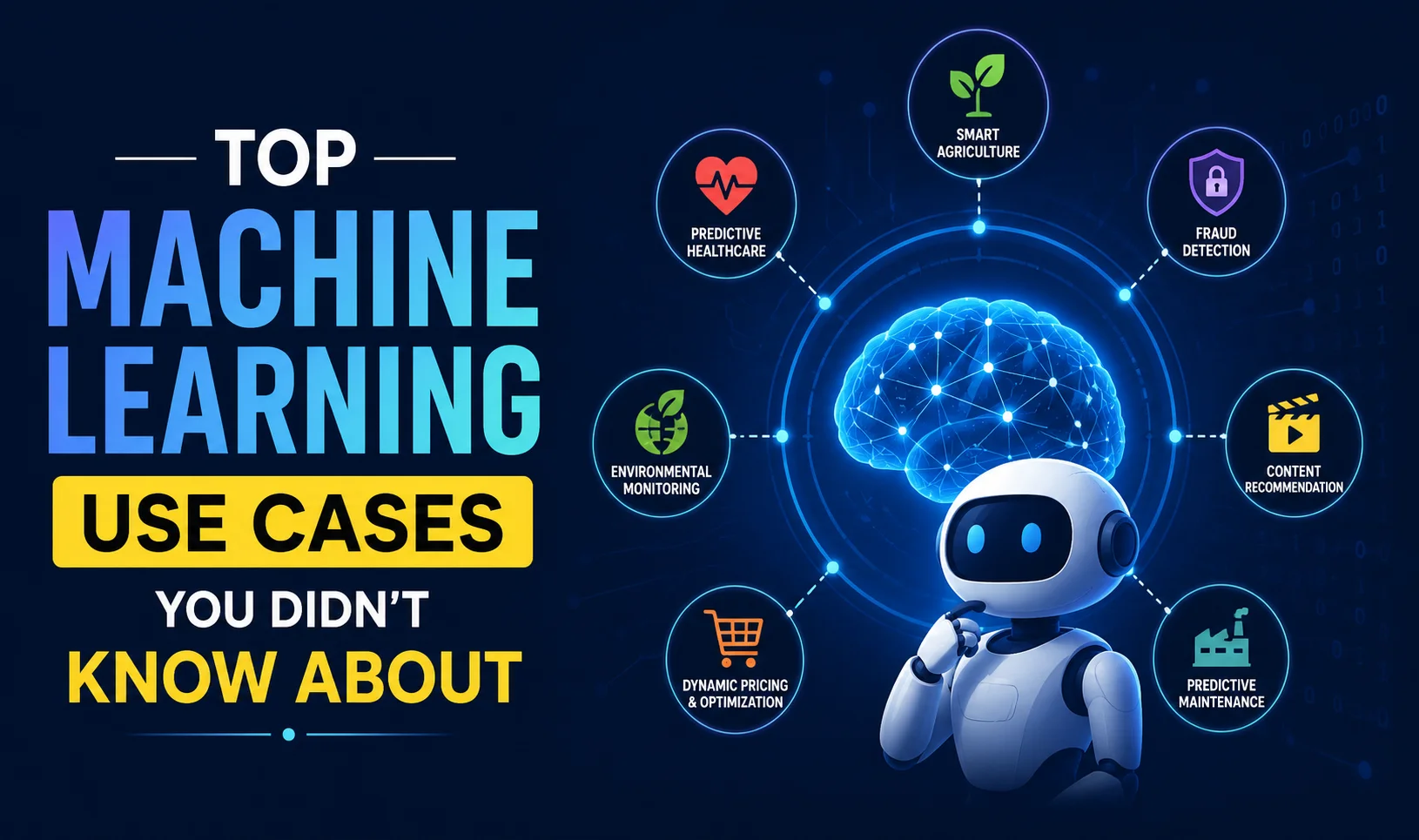
Top Machine Learning Use Cases You Didn’t Know About
Read More →
What Is Low Code/No Code and Why It Matters in 2025
Read More →
Top Use Cases of Generative AI in 2026
Read More →
The Future of Generative AI in Enterprises
Read More →
How Generative AI Is Reshaping Enterprise Operations in 2025
Read More →
Top AI Features Every Modern Taxi App Must Include in 2026
Read More →The Future of Events: How Artificial Intelligence Is Changing the Industry
Read More →Why Are AI Agents the Next Big Shift in Banking and Finance
Read More →How AI-Driven Analytics Improve Learning Outcomes
Read More →How AI Is Optimizing Every Step of Food Delivery Apps
Read More →How AI-Powered CRM Is Transforming the Media & Entertainment Industry
Read More →
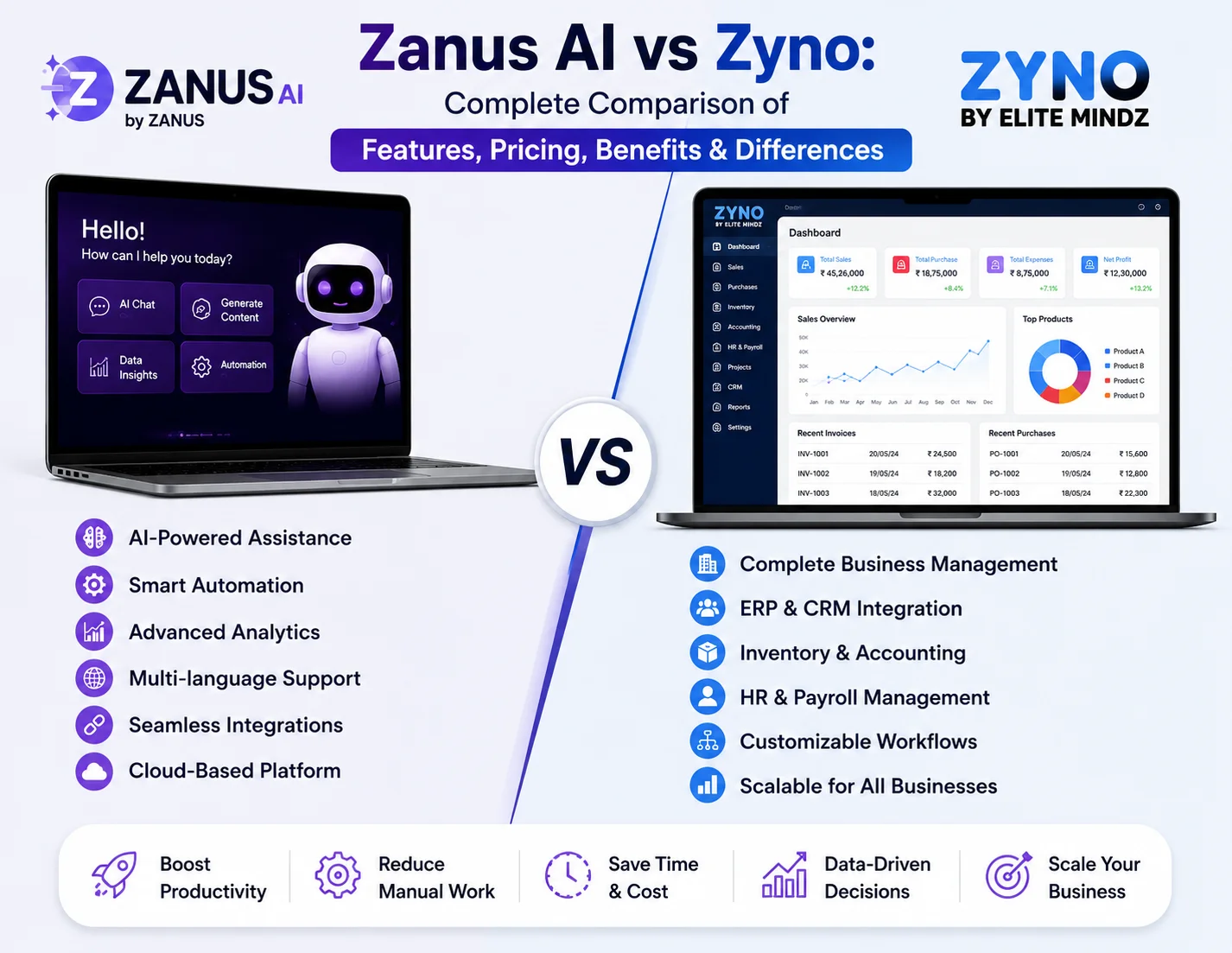
ZYNO vs Zanus AI: Which Is Better for Your Business?
Read More →
Why US Companies Are Outsourcing Agentic AI Development to India

Read More →
Top Agentic AI Development Companies in India for US Businesses (2026)

Read More →
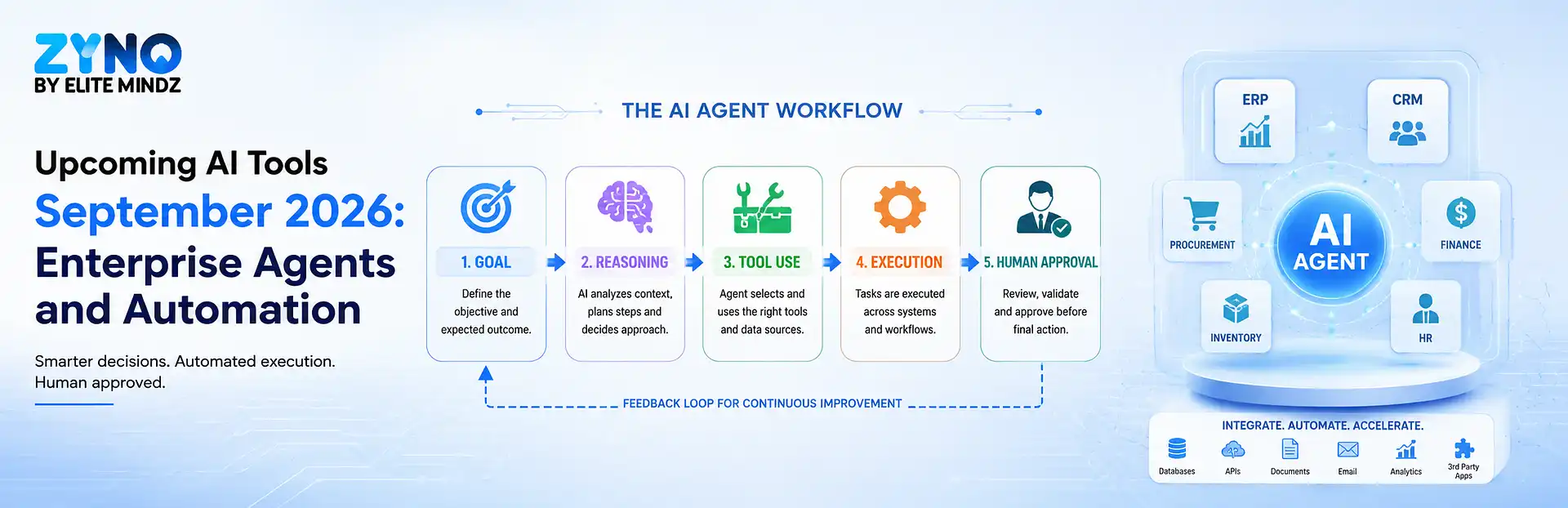
Top Upcoming AI Tools of September 2026 You Must Watch
Read More →
Google Opal vs Tilda Bio AI: What Each Tool Actually Does (and Why They Aren't True Rivals)
Read More →
AI Agent Development Services: A Practical Guide for Business Teams

Read More →
Enterprise AI Agent Development Services: The Complete Guide to Cost, Benefits, Use Cases & Implementation

Read More →
How Much Does Custom AI Agent Development Cost in 2026? Calculate Real Price Ranges
Read More →
Machine Learning Software: Features, Benefits, Pricing & How to Choose the Right Solution in 2026
Read More →
Computer Vision in AI: How It Works, Types, Applications & Benefits
Read More →
Computer Vision Software Development Services
Read More →
What Is AI Identity Verification? How It Works, Benefits & Use Cases
Read More →
AI Identity Verification Software: Features & How to Choose
Read More →
Google's New AI Tool for App Development
Read More →Partner with ZYNO by Elite Mindz to revolutionize how your business works. Fill out the form, and we’ll reach out with AI-powered solutions made just for you.
We use browser cookies to ensure you get the best experience on our website. Learn more
The form was submitted successfully!