×
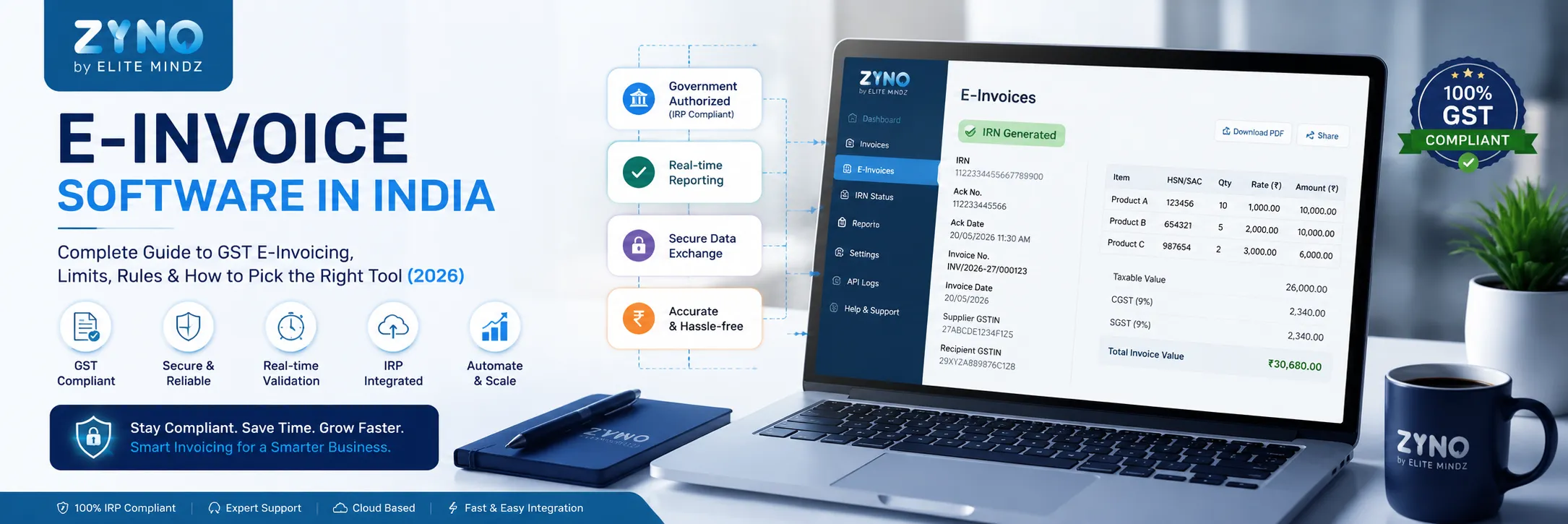
E-Invoice Software in India Complete Guide to GST E-Invoicing, Limits, Rules & How to Pick the Right Tool.
Businesses using ZYNO Books cut accounting time by 70% and stay 100% ZATCA-compliant — automatically.

If you run a business in India and your turnover has crossed a certain mark, chances are you've already heard the term "e-invoicing" more times than you'd like. Maybe your accountant mentioned it. Maybe you got a notice. Or maybe you're just trying to figure out whether this applies to you before it becomes a problem.
Either way, you're in the right place. In this guide, we'll break down what e-invoicing actually means, who needs to follow it, what the current turnover limits are, how the whole process works, and most importantly how a good e-invoice software can take this entire headache off your plate.
Simplify GST compliance with smart e-invoicing software automate billing, generate IRNs instantly, and grow faster.
Let's start simple. E-invoicing, short for electronic invoicing, doesn't mean the government is creating your invoices for you. That's a common misconception, and it trips up a lot of business owners.
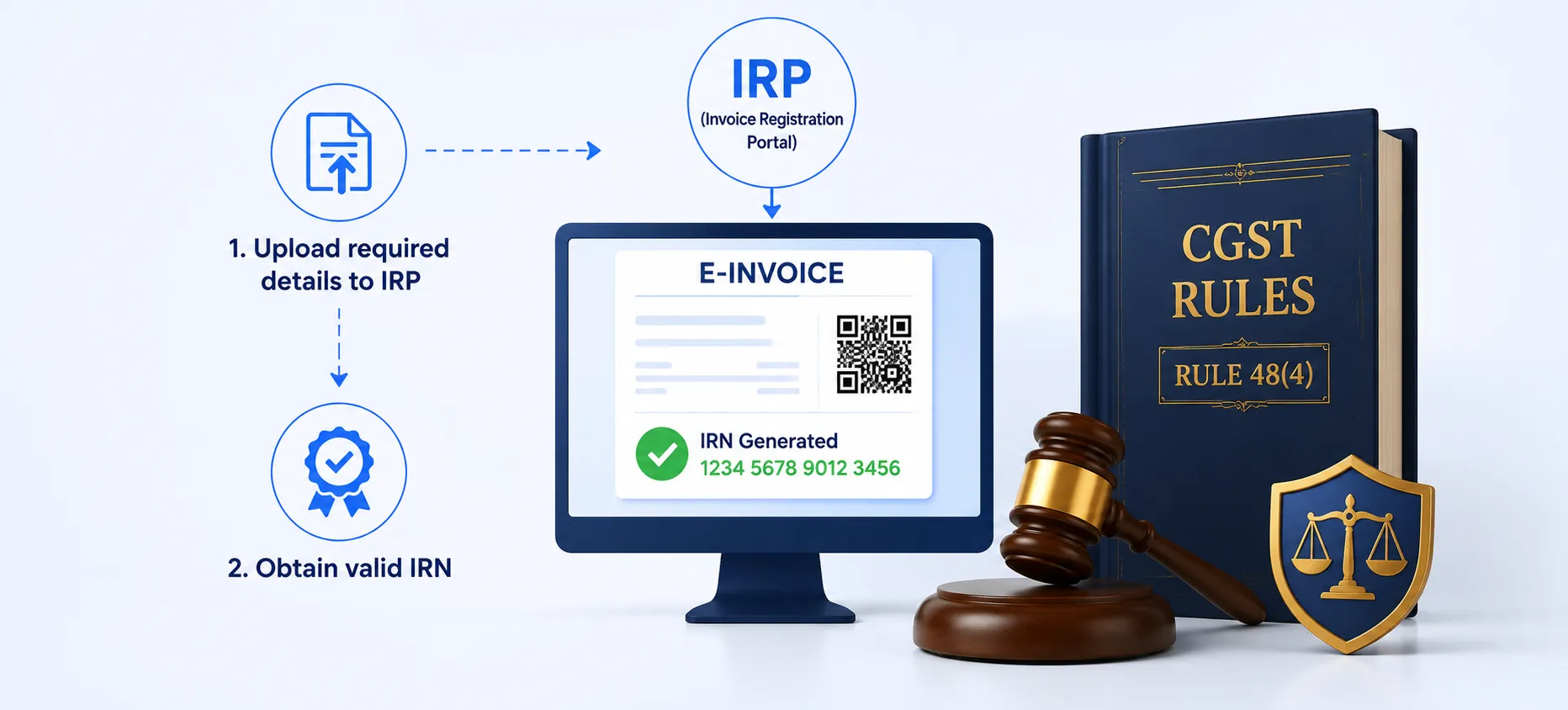
What actually happens is this: you generate your invoice as usual, through your accounting software or ERP. That invoice data is then sent to the government's Invoice Registration Portal (IRP), where it gets validated. Once approved, the IRP returns a unique Invoice Reference Number (IRN), a QR code, and a digital signature. Only after this step is your invoice considered legally valid for GST purposes.
So in short e-invoicing under GST is a system where B2B invoices are electronically authenticated by the IRP before they can be used for filing returns, claiming input tax credit, or generating an e-way bill.
This system was first rolled out on January 1, 2020, and has since expanded in phases to cover more and more businesses. Which brings us to the question everyone actually wants answered.
The e-invoice turnover limit has come down steadily over the past few years, and it's worth understanding how we got here because it tells you exactly where things are headed next.
Here's how the e-invoicing applicability rolled out, phase by phase with official notification numbers for reference:
| Phase | Effective Date | Turnover Threshold | Notification No. |
|---|---|---|---|
| Phase 1 | October 1, 2020 | Above ₹500 crore | No. 61/2020 – Central Tax |
| Phase 2 | January 1, 2021 | Above ₹100 crore | No. 88/2020 – Central Tax |
| Phase 3 | April 1, 2021 | Above ₹50 crore | No. 5/2021 – Central Tax |
| Phase 4 | April 1, 2022 | Above ₹20 crore | No. 1/2022 – Central Tax |
| Phase 5 | October 1, 2022 | Above ₹10 crore | No. 17/2022 – Central Tax |
| Phase 6 | August 1, 2023 | Above ₹5 crore | No. 10/2023 – Central Tax |
As of now, any registered business with an aggregate annual turnover (AATO) of ₹5 crore or more in any financial year since 2017-18 must generate e-invoices for B2B supplies and exports. And here's the part many people miss: even if your turnover drops below ₹5 crore in a later year, the requirement doesn't go away. Once you've crossed the threshold, you stay in the e-invoicing net.
Also important: from April 1, 2026, e-invoicing becomes applicable if your AATO crossed ₹5 crore in FY 2025-26. So if your business is growing and getting close to that number, this is the year to start preparing not after you've already crossed it.
One important thing many business owners miss: aggregate turnover is calculated PAN-wise, across all GSTINs. So if your business operates in multiple states with separate GST registrations, the combined turnover of all of them decides whether e-invoicing applies to you. You cannot avoid compliance by splitting operations across states.
Here's exactly what is and isn't included when calculating your AATO:
| Included in AATO | NOT Included in AATO |
|---|---|
| Taxable supplies (goods + services) | Inward supplies under reverse charge (RCM) |
| Exempt supplies | GST itself (tax amount excluded) |
| Zero-rated supplies (exports) | — |
| Inter-state supplies | — |
This PAN-based calculation means the moment any of your GSTINs collectively crosses ₹5 crore, all of them are covered under e-invoicing not just the one that crossed the threshold.
Not every business and not every transaction falls under this rule. Here's a quick look at who's exempt:
| Exempted Businesses | Exempted Documents / Transactions |
|---|---|
| Banks, insurers, NBFCs, financial institutions | B2C sales |
| Goods Transport Agencies (GTA) | Nil-rated, exempt, or non-taxable B2B and B2G supplies |
| Passenger transport service providers | Imports, high-sea sales, bonded warehouse sales |
| Cinema / multiplex exhibition services | Free Trade and Warehousing Zone (FTWZ) supplies |
| SEZ units (notified) | Supplies under reverse charge (Section 9(4)) |
| Government departments and local authorities | Delivery challans, bill of supply, ISD invoices |
| OIDAR service providers (Rule 14) | — |
If your business falls in any of the above categories, you can breathe a little easier but it's still worth keeping an eye on future notifications, since the government has been gradually widening the scope every year.
This is where most of the confusion sets in, so let's walk through it step by step, the way it actually plays out in real life.
Your accounting software or ERP creates the invoice with all standard details buyer info, items, HSN codes, taxable value, and so on.
The invoice data is converted into a JSON file following the fixed e-invoice schema (GST INV-01). This schema requires around 50 mandatory fields supplier details, invoice number and date, item-level information, place of supply, and more.
The JSON is uploaded to the Invoice Registration Portal (IRP). This can happen through API integration, a Tally connector, an Excel upload, or directly through e-invoice software connected to the portal.
The Invoice Reference Number (IRN) is a 64-character hash, created using the supplier's GSTIN, invoice number, and financial year. No IRN means no valid invoice it's that simple.
The QR code contains key details like GSTIN of both parties, invoice number, date, value, and the IRN itself useful for quick verification, even offline.
Once your invoice is registered, it shows up in your draft GSTR-1 and Part A of the e-way bill gets auto-populated cutting down a huge chunk of manual reconciliation work.
This entire flow from invoice creation to IRN generation typically takes just a few seconds when you're using e-invoice software with a direct API connection. Without it, you're looking at manual JSON uploads, repeated logins to the GST e-invoice portal, and a lot of room for human error.
Earlier, this 30-day restriction only applied to companies with turnover above ₹100 crore. Now it covers a much larger pool of businesses, and the IRP has also tightened its data validation checks GSTIN format, HSN codes, and invoice values are scrutinised more strictly before approval.
What does this mean for you practically? If you're still uploading invoices in batches at month-end, or relying on manual data entry, you're playing with fire. A 30-day window sounds like a lot until you realise how easily invoices can pile up during a busy sales month.

Rule 48(4) of the CGST Rules is the legal backbone of e-invoicing. It states that notified businesses must prepare their e-invoices by uploading the required details to the IRP and obtaining a valid IRN there's no way around it.
If you skip this step, your invoice isn't just "incomplete" under GST law it's treated as if it doesn't exist. That has real consequences:
• The recipient cannot claim Input Tax Credit (ITC) on an invoice without a valid IRN.
• Penalties under Section 122 of the CGST Act can go up to ₹10,000 or 100% of the tax due, whichever is higher.
• A penalty of ₹25,000 can apply for every incorrect invoice.
• Goods being transported with an invalid invoice can be detained at checkpoints.
In other words, this isn't a "we'll fix it later" kind of compliance item. It's the kind of thing that can directly affect your customer relationships because if your buyer can't claim ITC because of your invoicing error, that's a problem they'll bring straight back to you.
It's easy to focus only on the compliance burden, but e-invoicing genuinely does make life easier once it's set up properly:
• Less manual work. Your GSTR-1 gets pre-filled with invoice data, and e-way bills are generated automatically wherever applicable.
• Fewer errors. Since the same data goes to both the tax department and your buyer, there's far less room for mismatches and transcription mistakes.
• Real-time tracking. You can see the status of every invoice generated, validated, cancelled as it happens.
• Stronger ITC position. A complete digital trail of B2B invoices makes it much easier for genuine businesses to claim and defend their input tax credit during audits.
• Reduced fraud. Fake invoicing and circular trading to inflate ITC claims become significantly harder when every invoice needs real-time government validation.
That said, e-invoicing isn't entirely smooth sailing especially for small and mid-sized businesses. Some recurring pain points include:
• ERP/accounting software compatibility. Many older systems weren't built with the e-invoice schema in mind, leading to JSON validation errors and API integration headaches.
• The 30-day deadline. As mentioned earlier, this catches out businesses that batch-process their invoicing.
• Validation errors. Small mistakes a wrong GSTIN, duplicate invoice number, incorrect place of supply can cause an IRN to be rejected outright.
• Cancellation limits. An e-invoice can only be cancelled within 24 hours of generation, and partial cancellations aren't allowed. This becomes tricky when there's a price revision or goods return after that window.
• Portal dependency. During peak filing periods, IRP downtime or slow API response times can disrupt high-volume billing operations.
Most of these issues aren't about the law itself they're about how the data is submitted. Here are the most common rejection triggers to watch for:
1. Invalid or inactive GSTIN of buyer or supplier
2. Duplicate invoice number for the same GSTIN and financial year
3. Incorrect or missing HSN/SAC codes
4. Mismatch in place of supply vs. state codes
5. Uploading after the 30-day window (for businesses with AATO above ₹10 crore)
If you've crossed the ₹5 crore threshold or you're getting close manually logging into the GST e-invoice portal every time you raise an invoice simply isn't sustainable. This is exactly where dedicated e-invoice software earns its place.
But not all e-invoicing tools are built the same. Here's what to actually look for:
The best software connects directly to the Invoice Registration Portal, so IRN and QR codes are generated the moment you raise an invoice no separate uploads, no waiting.
Whether you're on Tally, Zoho, SAP, or a custom ERP, look for software that offers ready-made connectors. Switching your entire accounting system just for e-invoicing compliance is rarely worth it.
Good software flags errors wrong GSTIN format, missing HSN codes, mismatched values before you hit submit, not after the IRP rejects it.
If you're generating dozens or hundreds of invoices a day, your software needs to support bulk uploads and batch IRN generation without slowing down.
This is where the real time-saving happens. Look for tools that auto-populate your returns and generate e-way bills from the same invoice data without duplicate entry.
If your business operates across states, your software should let you manage e-invoicing for all your GSTINs from a single dashboard.
Since invoicing is a daily, time-sensitive activity, even a few hours of downtime can pile up. Check the provider's uptime track record and how responsive their support team is.
Given the 24-hour cancellation window, your software should make cancelling and reissuing invoices quick along with clear reports for reconciliation and audits.
E-invoicing has gone from being a "large enterprise" concern to something most mid-sized and growing businesses in India now have to deal with. The ₹5 crore threshold means a huge number of MSMEs, exporters, and service providers are now part of this system and with the 30-day reporting rule and stricter validations, the margin for manual error has shrunk considerably.
The good news is that once you set up the right e-invoice software and connect it to your billing process, this entire compliance requirement runs quietly in the background. Invoices get validated, IRNs and QR codes are generated automatically, and your GSTR-1 and e-way bills stay in sync without anyone in your team chasing it down manually every month.
If you're approaching the ₹5 crore mark, or you're already there and still managing this manually, now's a good time to make the switch before the next filing season catches up with you.
Simplify GST compliance with smart e-invoicing software automate billing, generate IRNs instantly, and grow faster.
Q What is e-invoicing in GST?
E-invoicing is a system where B2B invoices are electronically reported to and validated by the government's Invoice Registration Portal (IRP), which then issues a unique Invoice Reference Number (IRN) and QR code making the invoice legally valid.
Q What is the current e-invoice limit?
As of 2026, e-invoicing is mandatory for businesses with an aggregate annual turnover of ₹5 crore or more in any financial year since 2017-18, as per Notification No. 10/2023 – Central Tax.
Q What is the e-invoice time limit for reporting?
Businesses with an AATO of ₹10 crore or more must upload their e-invoices to the IRP within 30 days of the invoice date, effective from April 1, 2025. Invoices reported after this window are rejected and considered invalid for ITC.
Q Can an e-invoice be cancelled after generation?
Yes, but only within 24 hours of generating the IRN. Partial cancellation isn't allowed the entire invoice must be cancelled and a fresh one issued if corrections are needed.
Q What is the difference between an invoice number and an IRN?
The invoice number is assigned by your business as part of your normal billing process. The IRN (Invoice Reference Number) is a unique 64-character code generated by the IRP after validating your invoice without it, the invoice isn't valid under GST.
Q What is included in Aggregate Annual Turnover (AATO) for e-invoicing?
AATO includes taxable supplies, exempt supplies, zero-rated supplies (exports), and inter-state supplies all calculated PAN-wise across all your GSTINs. Inward supplies under reverse charge (RCM) are not included.
Q Does e-invoicing apply to B2C transactions?
No. E-invoicing currently applies only to B2B supplies, exports, and certain B2G transactions. B2C sales are outside its scope as of now.
Q Does e-invoice data automatically update GSTR-1 and e-way bills?
Yes. Once an invoice is validated and an IRN is generated, the data flows automatically into your draft GSTR-1, and Part A of the e-way bill (where applicable) is auto-populated reducing manual reconciliation significantly.
Q What happens if I don't comply with e-invoicing rules?
Non-compliance can attract penalties under Section 122 of the CGST Act up to ₹10,000 or 100% of the tax due (whichever is higher), plus ₹25,000 per incorrect invoice. Recipients also lose the ability to claim ITC on invoices without a valid IRN, and goods in transit can be detained.
Q Is e-invoicing mandatory below ₹5 crore?
No, it is not mandatory for businesses with AATO below ₹5 crore. However, the threshold has been reduced multiple times since 2020, and it's advisable for growing businesses to prepare in advance
Sneha Singh
Head of Content Writer
Sneha Singh is a B2B tech content strategist with 4+ years of experience. She specializes in SEO-driven SaaS content, whitepapers, and platform-native social media campaigns that simplify complex technology and drive business growth.
Smart IT Powering U.S. Fintech Success
Read More →

From Booking to Reimbursement: AI-Driven Travel and Expense Management
Read More →
A New Era Begins: ZYNO Expenz Brings Smarter Corporate Travel to the Middle East
Read More →
5 Hidden Pharmacy Cost Leakages ZYNO Expenz Can Eliminate
Read More →
Top AI-Powered Expense Management Systems Transforming GCC Businesses
Read More →
Technology Expense Management in 2026: A Complete Guide to Trends and Optimization
Read More →
Step by Step Guide to Build Expense Management Software
Read More →
Best Expense Management Software in the Middle East 2026
Read More →
How AI and Machine Learning Are Transforming Expense Management Software in 2026
Read More →
Top Financial Reporting Software for Accurate Business Insights
Read More →Travel Expense Management: Complete Guide for Businesses & Teams
Read More →
How Does AI Automate Expense Auditing?
Read More →Manual vs Automated Expense Management: Why Automation is the Future
Read More →Corporate Travel Booking Software: The Smart Way to Manage Business Travel
Read More →
ZYNO Expenz vs Expensify: Which One Actually Saves Your Business Money in 2026?
Read More →
Best Expense Management Software a Complete Guide in 2026
Read More →
Expense Management vs Spend Management: What's the Real Difference?
Read More →
Best Financial Reporting Software in 2026: Top Tools CFOs Actually Use
Read More →
What Is Spend Management? Definition, Process, Strategies & Best Practices
Read More →
Business Expense Tracker: The Complete Guide to Managing Corporate Expenses in 2026
Read More →
Invoice vs Receipt: What's the Real Difference
Read More →
Best OCR Receipt Scanner Apps in 2026
Read More →
Corporate Tax UAE: Complete Guide for Businesses in 2026
Read More →
EXPENSE TRACKING A Complete Guide for Small Businesses to Growing Companies
Read More →
What Is Per Diem? Complete Guide for India & US Businesses 2026
Read More →
Expense Management: The Complete Guide (2026)
Read More →
What Is Petty Cash? Definition, Management, and Best Practices
Read More →
E-Invoice Software in India
Read More →Partner with ZYNO by Elite Mindz to revolutionize how your business works. Fill out the form, and we’ll reach out with AI-powered solutions made just for you.
We use browser cookies to ensure you get the best experience on our website. Learn more
The form was submitted successfully!
ZYNO Digital
Fueling Smarter Digital Growth
ZYNO Digital fuels smarter digital growth through data-driven marketing, creative storytelling, and performance strategies that boost visibility, engagement, and measurable business outcomes across global platforms.
ZYNO Tech
Engineering the Future of IT
ZYNO Tech delivers cutting-edge IT solutions — including web, mobile, and digital transformation services — helping businesses scale efficiently, innovate faster, and stay ahead in a connected world.
ZYNO AI
AI Built for Business Growth
ZYNO AI harnesses the power of artificial intelligence to automate processes, enhance decision-making, and deliver predictive insights — driving innovation, agility, and measurable business growth.
ZYNO by Elite Mindz
Your Partner in the AI-Powered Future
ZYNO by Elite Mindz offers AI-powered products and services that unify operations, boost productivity, and drive digital transformation — helping businesses scale smarter and innovate faster.
* In just 2 mins you'll get a response
* Your idea is 100% protected by our Non-Disclosure Agreement