×
Learn everything about Expense Management for Small Businesses in India in this complete 2026 guide. Discover how GSTIN, ITC, GBTA, and SMB expense management practices can help businesses streamline spending, improve compliance, maximize tax benefits, and gain better financial control. Explore key strategies, best practices, and tools to manage business expenses efficiently and support sustainable growth in the Indian market.
Businesses using ZYNO Books cut accounting time by 70% and stay 100% ZATCA-compliant — automatically.

Every Indian small business owner knows the feeling: month-end arrives, and the finance team is buried in WhatsApp-forwarded bill photos, mismatched Excel rows, and a reimbursement claim still pending from three weeks ago. Someone paid a vendor invoice twice. And GST input credit? Nearly half of it is already lost because employees paid vendors from personal accounts.
This isn't an edge case. It's the everyday financial reality for India's 63 million small businesses.
According to a Global Business Travel Association study, processing a single expense report costs an average of $58 (approximately ₹4,800), and 19% of all expense reports contain errors each requiring an additional 18 minutes to correct. An Association of Certified Fraud Examiners report further found that organisations lose 5% of annual revenue to fraud, with 20% of small businesses specifically reporting fraudulent expense reimbursements.
For Indian SMBs processing 450+ invoices monthly, a 1.29% invoice duplication rate alone translates to ₹12,000 in avoidable losses every month.
Expense management for small businesses is no longer just bookkeeping hygiene. In 2026, it is the backbone of cash flow control, GST compliance, and financial decision-making. This guide covers everything from what small business expense management actually means, to the five non-negotiables of a working system, to a precise ROI calculation you can take to your accountant.
Small business expense management is the systematic process of recording, categorising, approving, and reconciling all company expenditures from employee travel claims to vendor invoices through defined spending policies and digital tools.
For Indian businesses, this means going well beyond basic bookkeeping. A complete expense management system covers:
The goal isn't simply to know where money went after the fact. It's to control spending before it happens, recover every eligible GST credit, eliminate duplicate payments, and give finance teams the real-time visibility needed to make confident decisions.
This guide focuses on expense management for small businesses specifically teams of 5 to 200 people who need structure without enterprise-level complexity.
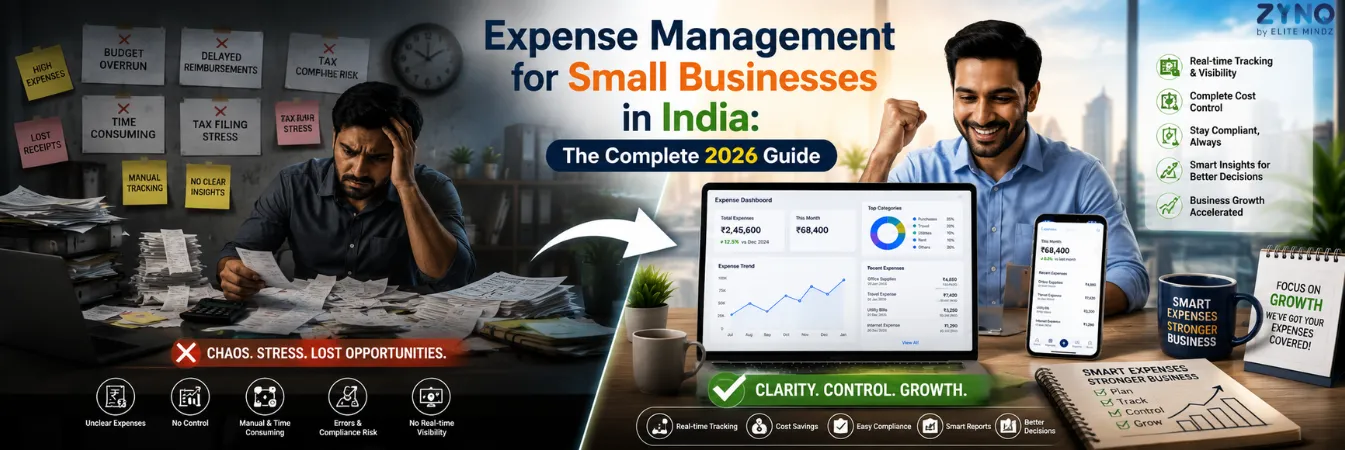
Most Indian small businesses still run expense management through a combination of Excel sheets, WhatsApp photos of bills, and verbal manager approvals. This approach works until it silently doesn't.
Here's what the data actually shows:
| Problem | Measurable Impact | Source |
|---|---|---|
| Manual report processing time | 10 hours/employee/month wasted | GBTA Research |
| Invoice duplication rate | ₹12,000+/month in losses (1.29% rate) | SMB Finance Report 2024 |
| Delayed reimbursements | 60% of employees affected | ACFE Global Survey |
| Lack of spending visibility | 71% of SMBs lack clear expense insight | SMB Finance Report 2024 |
| GST ITC not claimed | Up to 60% of eligible ITC lost | GST Council Compliance Data |
| Fraud exposure | 48% of Indian companies have no fraud detection | ACFE Report |
The root problem isn't discipline it's infrastructure. Without a real-time, policy-driven small business expense tracking system, even the most organised teams leak money silently every single month. And because the losses are distributed across dozens of small transactions, they rarely trigger alarm bells until they've compounded for months.
Building a reliable expense management system for a small business requires getting five fundamentals right. Shortcuts on any one of these creates downstream problems from missed ITC claims to audit failures.
The moment an employee spends company money, it must appear on your finance dashboard — not in a weekly CSV export or month-end reconciliation. Real-time small business expense tracking catches budget overruns before they compound, enables accurate cash flow forecasting, and eliminates the guesswork from finance decisions.
What to look for: Live transaction feeds with instant categorisation, not batch-updated or settlement-delayed reports.
Most small businesses apply expense policies reactively reviewing claims after money has already been spent. Proactive policy enforcement means configuring spending limits, approved vendor categories, and per-transaction caps at the system level before any transaction occurs. Employees physically cannot exceed defined limits. This single shift eliminates the majority of policy violations without requiring manual oversight.
Every expense claim in an Indian business requires a valid GST invoice containing your company's GSTIN, the vendor's GSTIN, HSN/SAC code, and a proper tax breakup (CGST + SGST or IGST). Manual receipt collection fails this check consistently. Effective expense management software uses mobile OCR to capture invoices, extract GSTIN and HSN data automatically, and flag non-compliant receipts before claims are submitted protecting your ITC eligibility on every transaction.
A flat approval structure breaks the moment a team has more than 10 people. Best-practice expense management for small businesses uses tiered approvals based on amount:
Mobile-first approval flows mean decisions happen in seconds, not after a week of email chains.
Expense data must flow automatically into your accounting software. Whether you use Tally Prime, ZohoBooks, or QuickBooks, your expense system should push transactions with proper cost-centre tagging and TDS deduction flags particularly for contractor payments where Sections 194C, 194H, or 194J apply. Manual export-import cycles add days to month-end close and introduce reconciliation mismatches that take hours to debug.
This is where Indian small businesses either protect or silently bleed thousands of rupees every month and most finance teams don't realise it until they sit down for annual ITR preparation.
India's GST framework allows businesses to claim input tax credit on all eligible business expenses. The catch: the invoice must carry your company's GSTIN to be valid for ITC claim.
When employees pay vendors from personal accounts and submit reimbursement claims, vendor invoices carry their personal details — not your company's GSTIN. That ITC claim is invalid and permanently lost.
Indian businesses lose up to 60% of eligible GST input tax credit on travel and non-recurring expenses due to personal-account payment practices and manual documentation gaps.
GST Council Compliance Data, 2024
For a small business spending ₹5 lakh monthly on GST-applicable expenses at 18%, recoverable ITC is ₹90,000/month. Losing 60% of that is ₹54,000 gone every month — ₹6.48 lakh annually — that could have stayed in your business.
A properly designed expense management system for Indian SMBs must include:
For a 25-person Indian small business, here is what the numbers actually look like side by side:
| Parameter | Manual (Excel + WhatsApp) | Automated (ZYNO Expenz) |
|---|---|---|
| Time per expense report | 20–30 minutes | 3–5 minutes |
| Month-end close time | 5–7 days | 1–2 days |
| GST ITC recovery rate | 40–60% of eligible | 90–100% of eligible |
| Duplicate invoice detection | Manual, frequently missed | Automated, 100% coverage |
| Employee reimbursement cycle | 15–30 days | 2–5 days |
| Fraud and policy violations | No automated detection | Real-time policy-based flagging |
| Audit readiness | Low — scattered, incomplete docs | High — timestamped, cloud-stored |
| Tally/ZohoBooks sync | Manual export, error-prone | Auto-sync with cost-centre tagging |
| Monthly cost | ₹0 upfront, ₹50,000+ in hidden losses | ₹99–₹399/user/month |
The math is straightforward: automated expense management doesn't cost money — it recovers money that was already leaking.
With dozens of solutions in the market from Zoho Expense and Happay to SAP Concur and global tools like Expensify selecting the right expense management software for an Indian small business comes down to five criteria.
Tools like SAP Concur and Expensify are architected for Western markets. They lack native GST ITC tracking, Tally integration, and INR-centric workflows. Look for solutions specifically built or configured for India's GST and TDS compliance requirements.
Avoid tools that sync data daily via CSV exports or show transactions 24–48 hours after settlement. Real-time transaction visibility is non-negotiable for proactive spend control — budget overruns caught in real time cost nothing; overruns discovered at month-end have already happened.
Can you configure tiered approvals by amount threshold, expense category, department, and approver role? Cookie-cutter flat approval flows break down quickly for real business structures. Your finance manager shouldn't be approving every ₹500 fuel receipt.
Does the tool offer a native, bidirectional integration with Tally Prime or ZohoBooks India's dominant accounting platforms? Or is it a manual CSV push? True integration auto-maps categories, applies cost-centre codes, and eliminates double entry at month-end close.
A 30-day implementation timeline defeats the purpose of adopting expense software. Look for solutions that are fully operational within 24–72 hours. Every day without automated controls costs money through duplicate payments and untracked spend.
Here is a concrete ROI breakdown for a small business with 30 employees at an average fully-loaded salary of ₹40,000/month:
Manual expense processing consumes 10 hours per employee monthly.
30 employees × 10 hours × ₹250/hour (₹40K ÷ 160 working hours) = ₹75,000/month recovered
450 invoices/month × 1.29% duplication = ~6 duplicate invoices
At an average value of ₹2,000 per duplicate = ₹12,000/month recovered
₹3 lakh monthly spend × 18% GST × 60% ITC recovery improvement = ₹32,400/month recovered
Total Monthly Savings: ₹1,19,400
Annual savings: ₹14,32,800
Against software cost of ₹99–₹399/user/month (₹3,000–₹12,000/month for 30 users), the ROI is 10x to 40x.
This calculation doesn't even include reduced audit risk, faster investor reporting, or the retention improvement from eliminating 30-day reimbursement delays
The most effective approach combines three elements: a documented expense policy with clear spending limits, a digital expense management tool with real-time GST-compliant tracking, and automated accounting integration. Businesses that automate approval workflows and accounting integrations report 75% faster processing times and significantly higher GST input tax credit recovery compared to spreadsheet-based systems. For Indian SMBs specifically, the most critical first step is ensuring all business payments flow through company accounts not employee personal accounts so every vendor invoice carries your GSTIN and remains ITC-eligible.
GST-compliant expense management software validates vendor GSTIN numbers against the government portal, flags invoices with missing HSN codes or incorrect tax breakups, tracks input tax credit eligibility per transaction category, and generates GSTR-2A reconciliation reports. This ensures your business recovers the maximum eligible ITC instead of losing 40–60% through manual reimbursement processes where vendor invoices don't carry your company's GSTIN. Some platforms also support e-invoice generation for B2B transactions above the mandatory threshold.
Under the Income Tax Act, Indian small businesses can claim deductions on employee travel and conveyance, office rent, utilities, professional service fees, marketing and advertising, equipment and software purchases, and business entertainment within limits. All claims require valid GST invoices carrying GSTIN, HSN/SAC codes, and proper tax breakup. Businesses must also deduct TDS under Sections 194C (contractor payments), 194H (commission), or 194J (professional fees) where applicable, and ensure proper documentation is maintained for all expense categories.
Modern cloud-based expense management software for Indian SMBs can be fully operational within 24 to 72 hours, including account setup, expense policy configuration, employee onboarding, and Tally or QuickBooks integration. Traditional enterprise platforms like SAP Concur require 5 to 10 days and significant training. The fastest platforms using digital KYC and cloud-based onboarding can activate employee access in under 2 hours. As a rule, avoid solutions with more than a 72-hour implementation timeline every day without automated controls costs money.
Expense tracking is reactive it records transactions after money has already been spent. Expense management is proactive it controls spending before and during the transaction through defined policies, spending limits, multi-level approval workflows, and real-time visibility. Think of expense tracking as a rear-view mirror and expense management as a steering wheel. Effective small business expense management combines both: it tracks every rupee in real time while simultaneously enforcing controls that prevent policy violations, budget overruns, and fraudulent reimbursement claims before they happen.
Expense management for small businesses in India isn't about replacing trust with surveillance. It's about replacing financial chaos with control. When your system automatically validates GST invoices, routes approvals to the right people in seconds, catches duplicate payments before they process, and syncs every rupee to Tally you don't just save administrative time. You recover real money that was silently leaking every month.
The businesses pulling ahead in 2026 aren't just selling better or hiring faster. They're operating tighter. Real-time expense visibility, zero-leakage GST compliance, and automated workflows have stopped being enterprise luxuries they are the baseline for any serious Indian SMB trying to scale.
The question isn't whether your business can afford to automate expense management. Based on the ROI numbers above, the question is whether you can afford not to
Priya Sharma
Senior Finance Content Strategist
Priya has 8 years of experience writing about SMB financial operations, GST compliance, and fintech for Indian businesses. She has covered expense management, payroll automation, and tax compliance for audiences across India, having previously writte
Smart IT Powering U.S. Fintech Success
Read More →

From Booking to Reimbursement: AI-Driven Travel and Expense Management
Read More →
A New Era Begins: ZYNO Expenz Brings Smarter Corporate Travel to the Middle East
Read More →
5 Hidden Pharmacy Cost Leakages ZYNO Expenz Can Eliminate
Read More →
Top AI-Powered Expense Management Systems Transforming GCC Businesses
Read More →
Technology Expense Management in 2026: A Complete Guide to Trends and Optimization
Read More →
Step by Step Guide to Build Expense Management Software
Read More →
Best Expense Management Software in the Middle East 2026
Read More →
How AI and Machine Learning Are Transforming Expense Management Software in 2026
Read More →
Top Financial Reporting Software for Accurate Business Insights
Read More →Travel Expense Management: Complete Guide for Businesses & Teams
Read More →
How Does AI Automate Expense Auditing?
Read More →Manual vs Automated Expense Management: Why Automation is the Future
Read More →Corporate Travel Booking Software: The Smart Way to Manage Business Travel
Read More →
ZYNO Expenz vs Expensify: Which One Actually Saves Your Business Money in 2026?
Read More →
Best Expense Management Software a Complete Guide in 2026
Read More →
Expense Management vs Spend Management: What's the Real Difference?
Read More →
Best Financial Reporting Software in 2026: Top Tools CFOs Actually Use
Read More →
What Is Spend Management? Definition, Process, Strategies & Best Practices
Read More →
Business Expense Tracker: The Complete Guide to Managing Corporate Expenses in 2026
Read More →
Invoice vs Receipt: What's the Real Difference
Read More →
Best OCR Receipt Scanner Apps in 2026
Read More →
Corporate Tax UAE: Complete Guide for Businesses in 2026
Read More →
EXPENSE TRACKING A Complete Guide for Small Businesses to Growing Companies
Read More →
What Is Per Diem? Complete Guide for India & US Businesses 2026
Read More →
Expense Management: The Complete Guide (2026)
Read More →
What Is Petty Cash? Definition, Management, and Best Practices
Read More →
E-Invoice Software in India
Read More →
Expense Management for Small Businesses in India: The Complete 2026 Guide
Read More →Partner with ZYNO by Elite Mindz to revolutionize how your business works. Fill out the form, and we’ll reach out with AI-powered solutions made just for you.
We use browser cookies to ensure you get the best experience on our website. Learn more
The form was submitted successfully!
ZYNO Digital
Fueling Smarter Digital Growth
ZYNO Digital fuels smarter digital growth through data-driven marketing, creative storytelling, and performance strategies that boost visibility, engagement, and measurable business outcomes across global platforms.
ZYNO Tech
Engineering the Future of IT
ZYNO Tech delivers cutting-edge IT solutions — including web, mobile, and digital transformation services — helping businesses scale efficiently, innovate faster, and stay ahead in a connected world.
ZYNO AI
AI Built for Business Growth
ZYNO AI harnesses the power of artificial intelligence to automate processes, enhance decision-making, and deliver predictive insights — driving innovation, agility, and measurable business growth.
ZYNO by Elite Mindz
Your Partner in the AI-Powered Future
ZYNO by Elite Mindz offers AI-powered products and services that unify operations, boost productivity, and drive digital transformation — helping businesses scale smarter and innovate faster.
* In just 2 mins you'll get a response
* Your idea is 100% protected by our Non-Disclosure Agreement