Expense Reimbursement Policy Template
Ready-to-use expense policy template for Indian businesses.
Download Now
×
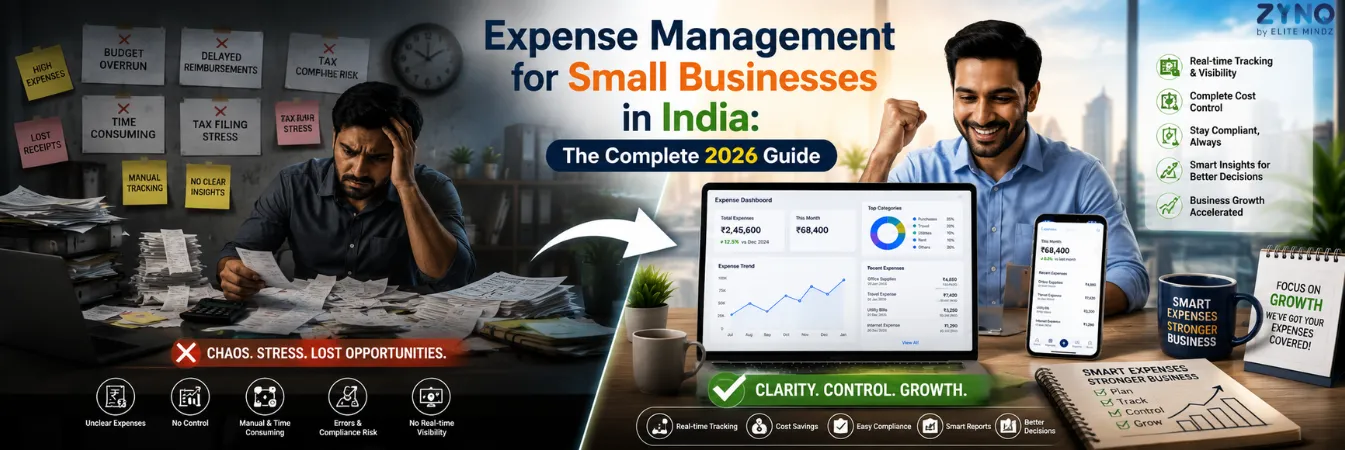
Expense Management is the process of tracking, approving, reimbursing, and analyzing business expenses. It helps organizations control costs, improve compliance, automate workflows, and gain real-time visibility into company spending.
Expense management is the end-to-end system that controls, tracks, approves, and analyzes every rupee employees spend on behalf of the business. For Indian companies, this goes beyond basic bookkeeping — it is the foundation of GST Input Tax Credit recovery, TDS compliance under the new Income Tax Act 2025, and real-time financial control.
This guide covers everything an Indian business needs in 2026: what Expense Management is and why it matters, how to set up a compliant process step by step, a full breakdown of GST ITC rules (including the new hard block from January 2026 and mandatory e-invoicing above Rs.5 crore), TDS obligations now restructured under Section 393 of the Income Tax Act 2025, a comparison of manual vs. automated systems, the top Indian software tools by company size, 8 best practices, and a ready-to-use Expense Reimbursement Policy framework.
Why businesses are moving towards automated expense management solutions.
| Statistic | Value | Source |
|---|---|---|
| Expense reports with errors | 19% | GBTA Research |
| Average cost per paper expense report (India) | ₹3,200 | Industry Estimate, 2024 |
| Businesses switching to automation within 2 years | 83% | Deloitte SMB Survey |
Expense management is the end-to-end process of tracking, controlling, approving, and analyzing every rupee employees spend on behalf of the business — from a ₹200 auto fare to a ₹2 lakh client event.
But it's not just tracking. There's a critical difference:
Understand the difference between simply recording expenses and actively controlling business spending.
| Expense Tracking | Expense Management |
|---|---|
| Records what was spent | Controls and optimizes what gets spent |
| Reactive — after the fact | Proactive — pre-approval, real-time monitoring |
| Basic spreadsheet or receipt storage | Policy engine, approval workflows, and reporting |
| No compliance layer | GST, TDS, IT Act compliance built-in |
| Tells you what happened | Tells you what's happening and why |
Done well, expense management connects day-to-day employee spending to your company's financial health — feeding clean data into your accounting system, supporting budget forecasting, and helping you control costs without slowing your team down.
• Policy Setting — Clear rules on what employees can spend, how much, and what documentation is required.
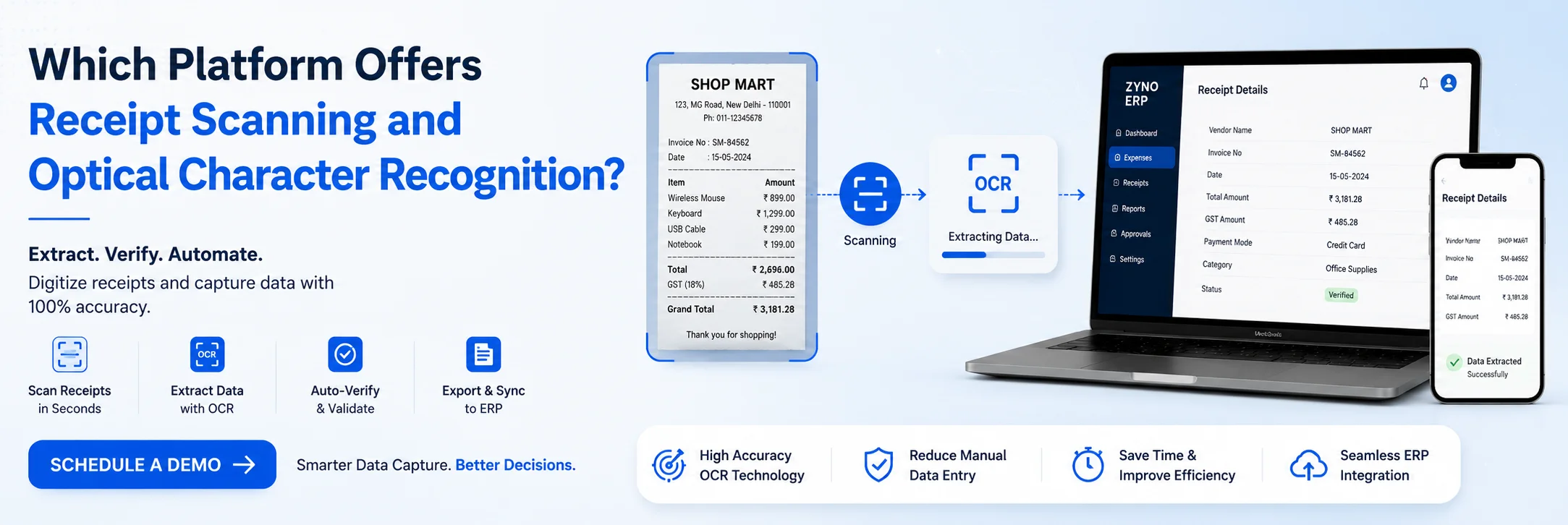
• Expense Capture — Real-time receipt collection via mobile, email forwarding, or OCR scanning.
• Approval Workflows — Rule-based routing to the right approver based on amount, category, or department.
• Reimbursement — Fast, accurate payback to employees via salary credit, NEFT, or corporate card reconciliation.
• Reporting & Analytics — Real-time dashboards by department, category, vendor, project.
• Compliance & Audit Trail — Every transaction logged with who submitted, who approved, when, and supporting documents.
Understanding how expenses are categorized helps you write better policies, apply the right controls, and claim the correct deductions under Indian tax law.
Recurring costs of running the business — predictable, budgetable, and easier to control:
• Office supplies & equipment: Laptops, stationery, furniture, tools
• Software subscriptions: SaaS tools, cloud platforms, productivity software
• Utilities & rent: Electricity, internet, telephone, office lease
• Professional services: Legal, accounting, consulting retainers
The highest-risk category for fraud and policy violations. T&E requires strict documentation:
• Business travel: Flights, trains, cabs, Ola/Uber, parking, tolls
• Client entertainment: Dinners, events, hospitality — must document business purpose and attendees
• Hotel stays: Require GST-compliant invoices for ITC claims (mandatory for stays above ₹2,500/day)
• Per diem allowances: Fixed daily amounts set by company policy or IT Act norms
India-specific note: Under the Income Tax Act, meal allowances up to ₹50 per meal (twice a day) are exempt from tax. Daily food coupons/card credits up to ₹2,200/month are also tax-free. Build these into your policy explicitly.
• Reimbursable purchases: Office supplies, client-facing costs, business subscriptions paid personally
• Corporate card expenses: Still require receipts, categorization, and approval — just no reimbursement step
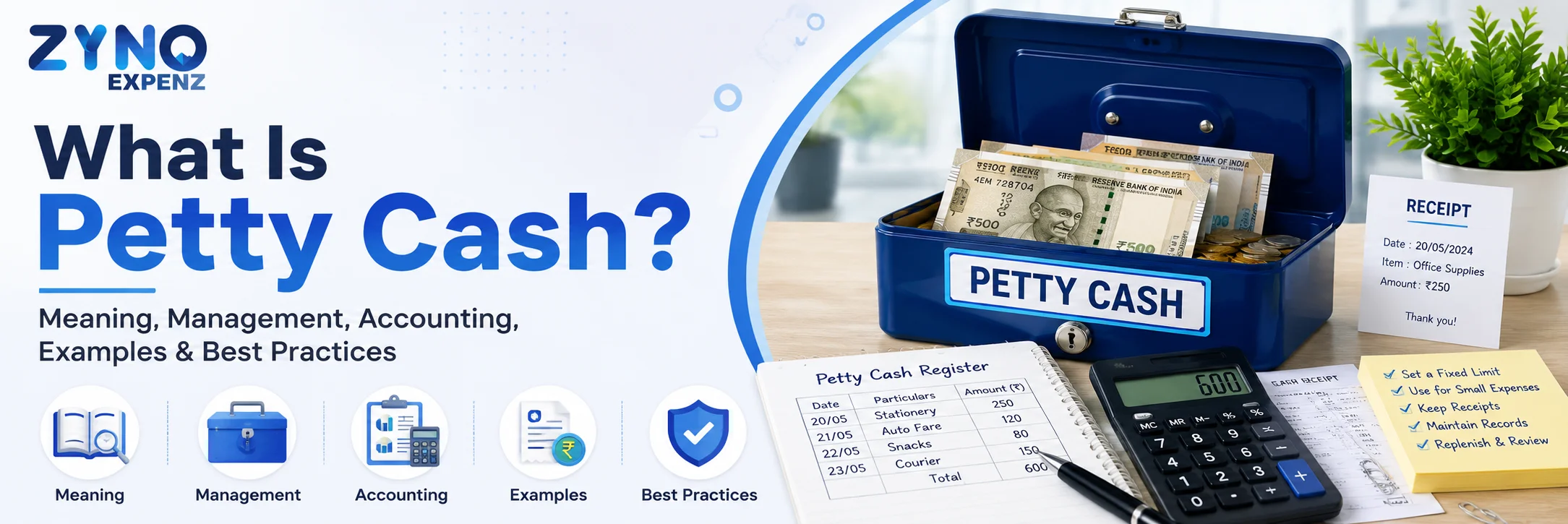
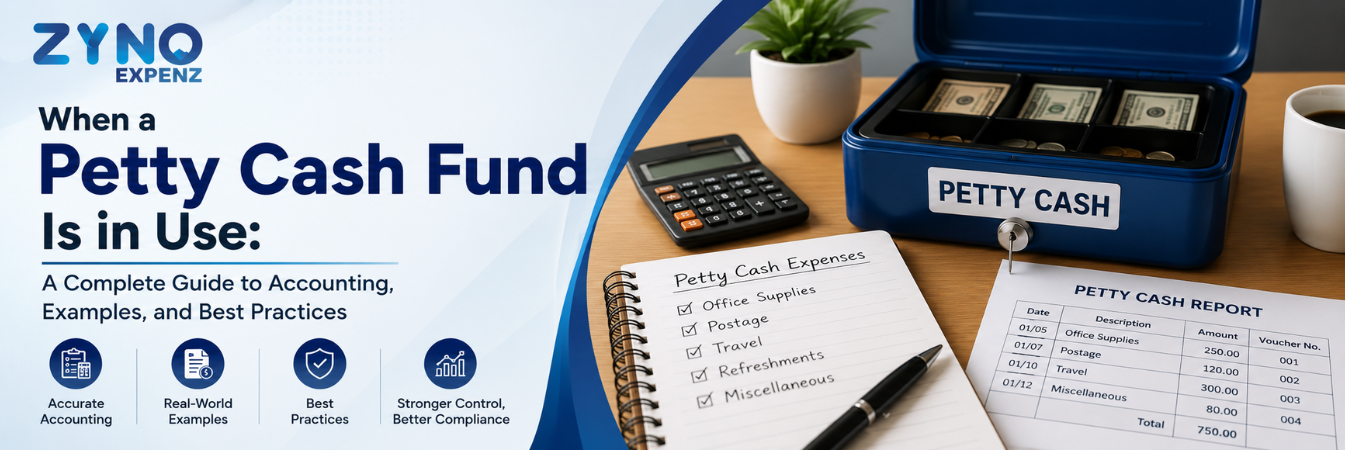
• Petty cash: Small discretionary expenses — require a petty cash log and monthly reconciliation
Every expense follows a predictable lifecycle — from the moment it's incurred to when it's recorded in your books. Here's how a well-run process looks:
Employee makes a business purchase and immediately captures the receipt — via mobile app scan, email forward, or upload. OCR auto-extracts merchant, amount, date, and GST number. No receipt = no reimbursement is a policy, not just a preference.
Employee categorizes the expense (travel, meals, supplies, etc.), adds a business justification, tags a project/cost center, and submits within the required window (typically 7–30 days). System auto-checks for policy violations before the report even reaches a manager.
Route-based approval — line manager for amounts under ₹10,000; Finance Head for anything above. Exception items require documented justification. SLA-based auto-escalation if no action in 48 hours.
Finance team validates GST invoice compliance — GST on invoice, HSN/SAC codes, correct tax breakup (CGST+SGST or IGST). Checks vendor GSTIN against GST portal to ensure ITC eligibility. TDS deductibility assessed for contractor payments above ₹30,000.
Approved expenses paid to employee's bank account — ideally within 7 working days. Corporate card expenses reconciled in the same cycle. Faster reimbursement = higher employee satisfaction and more complete receipt submission.
Expenses posted to the correct GL account with department, cost center, and project codes. Synced to Tally, Zoho Books, or ERP. Complete audit trail created. ITC-eligible expenses flagged for GSTR-2B reconciliation.
This is where Indian businesses lose lakhs every year — unclaimed GST Input Tax Credit (ITC) and improper TDS deductions
You can reclaim the GST you pay on most business expenses — but only if you follow the rules precisely. Key 2026 changes:
• From January 2026, the GST portal enforces a HARD ITC block in GSTR-3B — if your supplier hasn't filed their returns, your ITC is automatically blocked, not just flagged.
• From April 2026, e-invoicing is mandatory for all businesses with turnover above ₹5 crore.
• GST 2.0 introduces a rationalized 4-slab structure: 0%, 5%, 18%, and 40% — replacing the old 5-12-18-28% system. Manual invoices from suppliers above ₹5 crore are no longer valid for ITC compliance.
| Category | Examples / Updates |
|---|---|
| ITC Allowed | Hotel stays, office supplies, software subscriptions, professional services, conference registrations, cab services (GST invoice required) |
| ITC Blocked | Food & beverages (restaurants), health club memberships, insurance (personal), club memberships, personal use expenses |
| Conditional ITC | Motor vehicle fuel (only if used for further supply), air travel (business purpose must be documented), employee gifts (up to ₹50,000/year) |
| NEW 2026
Intermediary Services
|
Indian companies acting as intermediaries for overseas clients can now claim ITC. The place of supply rule was amended under Budget 2026-27. Previously, these services were taxable at 18% GST even when provided to overseas clients. |
• Supplier GSTIN must be on invoice
• Your company GSTIN as recipient
• HSN/SAC code on invoice
• Tax amount broken up: CGST+SGST or IGST
• Invoice must match GSTR-2B — supplier's return must be filed (hard block from Jan 2026)
• For suppliers above ₹5 crore turnover: e-invoice (IRN) mandatory from April 2026
• 3-year time bar: GST returns cannot be filed after 3 years — file on time or lose the period permanently
IMPORTANT: From April 1, 2026, India's new Income Tax Act 2026 has replaced the old 194-series TDS sections. All TDS provisions are now consolidated under Section 393 (non-salary payments) and Section 392 (salary). Old section codes like 194C, 194J, 194I will cause system-level validation errors if used for FY 2026-27 filings. Rates and thresholds are largely unchanged — only the referencing structure has changed.
| Old Section (Pre-Apr 2026) | New Section (FY 2026-27) |
|---|---|
| Section 194C Contractors (event management, logistics, transport) |
Section 393 1% (individual) / 2% (company); threshold ₹30,000 single or ₹1L aggregate |
| Section 194J Professional services (lawyers, consultants, doctors, architects) |
Section 393 10% on fees; 2% for technical services; threshold ₹30,000/year |
| Section 194I Rent (office space, equipment, vehicle hire) |
Section 393 10% on rent above ₹2.4 lakh/year |
| Section 17(2) Perquisites (club memberships, school fees, excess accommodation) |
Section 17(2) Taxable as employee salary perquisite |
TDS Filing Alert FY 2026-27: TDS challans and returns must now use numeric payment codes (1001–1067) under Section 393, not old section numbers. Update your ERP and TDS software before filing Q1 FY 2026-27 returns. TDS returns filed with old 194C/194J codes will be rejected by CPC.
Reverse Charge Mechanism (RCM): If you receive services from an unregistered supplier (e.g., a freelancer without GSTIN), you may need to pay GST under RCM and account for it separately. This applies to legal services from advocates, GTA services, and import of services. Consult your CA for your specific category.
Most growing Indian businesses run expenses on WhatsApp messages, email chains, and Excel. Here's the real cost of staying manual:
| Old Section (pre-Apr 2026) | New Section (FY 2026-27) | Description | Rate & Threshold |
|---|---|---|---|
| Section 194C | Section 393 | Contractors (event management, logistics, transport) | 1% (individual) / 2% (company); threshold ₹30,000 single or ₹1L aggregate |
| Section 194J | Section 393 | Professional services (lawyers, consultants, doctors, architects) | 10% on fees; 2% for technical services; threshold ₹30,000/year |
| Section 194I | Section 393 | Rent (office space, equipment, vehicle hire) | 10% on rent above ₹2.4 lakh/year |
| Section 17(2) | Section 17(2) | Perquisites (club memberships, school fees, excess accommodation) | Taxable as employee salary perquisite |
Annual Savings for a 200-Person Indian Company: Switching from manual to automated expense management — combining processing cost reduction, ITC recovery improvement (₹3–5L annually), and finance team hours saved — typically yields ₹8–12 lakh in annual savings. The ROI on software is usually achieved in the first quarter.
Paper receipts, WhatsApp photos, and email threads create data entry nightmares. Finance teams spend hours reconciling submissions, chasing missing GST invoices, and fixing categorization errors. Each error costs ₹700–900 in correction time — and they compound monthly.
The root cause: Capture happens at the wrong time. Employees collect receipts in their wallets for weeks, then submit a crumpled pile. Mobile-first capture at the point of purchase eliminates 70% of documentation issues.
When your expense policy lives in a 3-year-old PDF nobody's read, employees guess. Some book ₹8,000/night hotels. Others claim personal meals. The problem isn't intent — it's access. Embedding policy rules directly into your submission system (with hard limits, not just guidelines) solves this at scale.
This is India-specific and expensive. Employees book hotels, get a 'receipt' that isn't GST-compliant, and the company loses the ITC claim. For a ₹50-crore revenue company spending 3% of revenue on T&E, this can mean ₹7–10 lakh in annual ITC loss.
Solution: Mandate GST-compliant invoices as a prerequisite for reimbursement. Train employees on what a valid tax invoice looks like.
Everything routes to the same CFO. She's busy. Reports pile up. Employees wait 3 weeks for reimbursement. Fix with tiered approval: amounts under ₹5,000 auto-approve if policy-compliant; ₹5K–25K to line manager; above that to Finance.
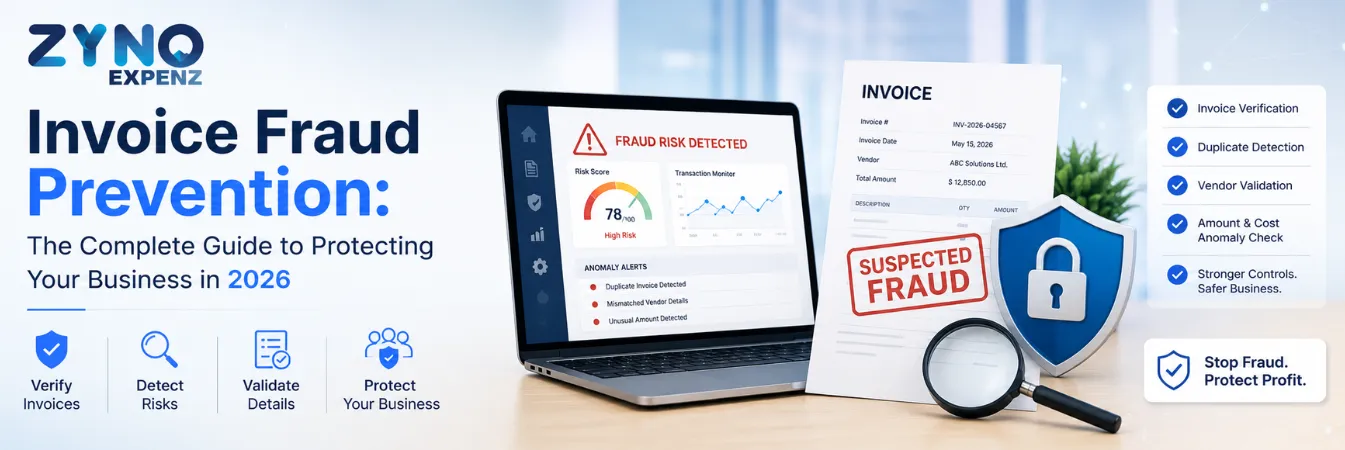
Expense fraud in Indian SMBs is more common than most founders think — studies suggest 5–10% of T&E claims have some element of inflation or duplication. Common patterns: same receipt submitted twice, personal expenses claimed as business, inflated per-diem claims. Automated systems catch duplicates instantly; manual systems often never catch them.
The right software automates your entire expense lifecycle — capture, approval, reimbursement, and compliance — in one system. For Indian businesses, GST integration and Tally/Zoho compatibility are non-negotiables.
• Mobile Receipt Capture & OCR — Snap a photo, extract data automatically. Must work without internet for on-the-road employees.
• GST Invoice Validation — Auto-validate GSTIN, check GSTR-2B matching, flag blocked ITC categories.
• Accounting Integration — Direct sync with Tally Prime, Zoho Books, QuickBooks, SAP. Eliminates double data entry.
• Real-Time Dashboards — Spend by department, category, vendor, project. Exception alerts. Budget vs. actuals.
• Configurable Workflows — Multi-level approvals, auto-escalation on SLA breach, delegation for traveling managers.
• Corporate Card Integration — Auto-import card transactions, match to receipts, flag unsubmitted charges.
| Metric | Manual Process | Automated System |
|---|---|---|
| Time to process one expense report | 2–4 hours (avg) | 15–20 minutes |
| Error rate | 19–25% | 2–4% |
| Cost per report | ₹2,800–₹4,000 | ₹400–₹800 |
| Reimbursement turnaround | 15–45 days | 3–7 days |
| GST ITC captured | 30–50% of eligible | 85–95% of eligible |
| Policy violations detected | After the fact (if at all) | At point of submission |
| Audit readiness | Takes weeks to prepare | Real-time, always ready |
| Employee satisfaction | Low | High |
| Company Size | Recommended Approach | Budget (approx.) |
|---|---|---|
| 1–25 employees | Kredily (free) or Zoho Expense basic | ₹0–₹3,000/month |
| 25–150 employees | Zoho Expense, Fyle, or Happay | ₹8,000–₹35,000/month |
| 150–500 employees | Happay or Keka HR | ₹30,000–₹80,000/month |
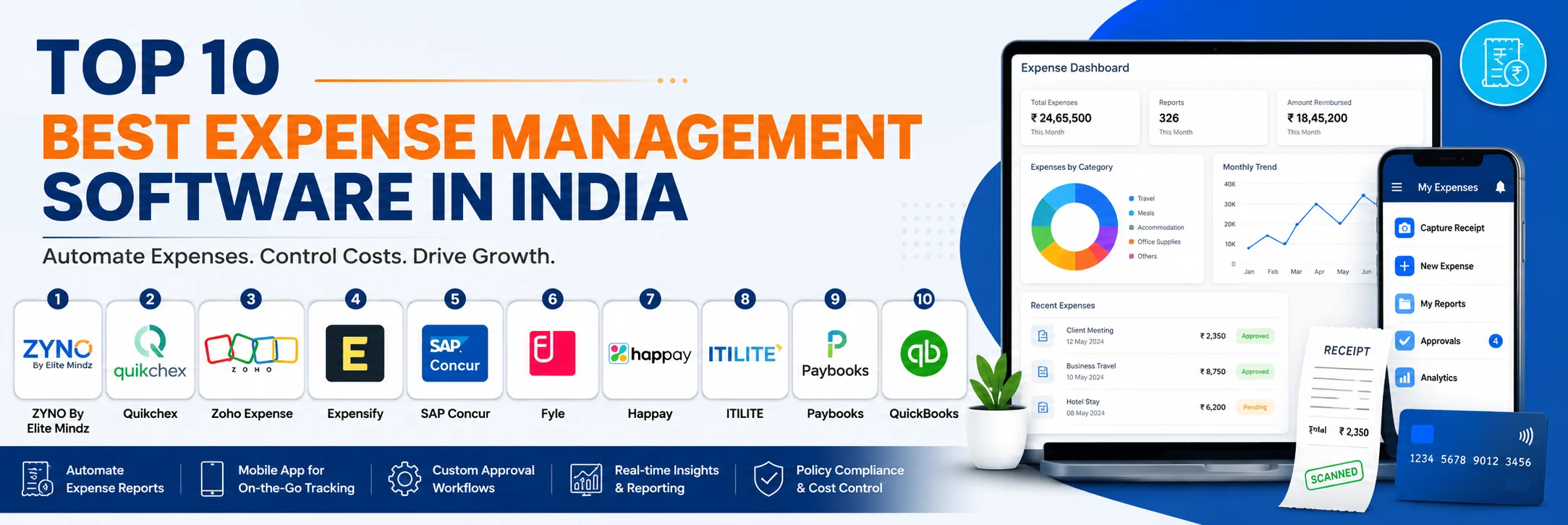
| 500+ employees | SAP Concur, Oracle, or custom ERP module | ₹1L+/month |
01. Write Your Policy in Plain Language
A policy nobody reads is not a policy. One page, clear limits, real examples. 'Hotel limit: ₹6,000/night in metro cities. ₹4,000/night elsewhere.' No ambiguity.
02. Mandate GST-Compliant Invoices for All Reimbursable Expenses
Build this into your policy AND your software. No GSTIN on invoice = reimbursement held. Train employees once; your ITC recovery will pay for the training in a week.
03. Set Submission Deadlines — and Enforce Them
Expenses submitted 60 days late create accounting chaos and GST period mismatches. A hard 30-day rule (with rare exceptions) keeps your books clean and your finance team sane.
04. Use Category-Specific Spending Limits
Set different limits for hotels (₹5,000–8,000), meals (₹800–1,500 per meal), flights (economy for under 2.5 hours), client entertainment (pre-approval above ₹5,000).
05. Do Monthly Spend Reviews, Not Just Annual Audits
Monthly department-level spend reviews catch problems early — a vendor relationship growing 40% month-on-month, a team consistently exceeding hotel limits, a subscription nobody's using.
06. Automate TDS Calculations for Vendor Payments (Updated for FY 2026-27)
From April 1, 2026, TDS is governed by the new Income Tax Act 2025 — old sections 194C, 194J, 194I are now consolidated under Section 393. Update your ERP/accounting software to use new payment codes (1001–1067). The rates and thresholds are unchanged, but returns filed with old section numbers will be rejected by CPC. The penalty for non-deduction remains: 30% disallowance of the expense plus interest.
07. Publish a Reimbursement SLA
'All approved expenses are reimbursed within 7 working days' — say it clearly, then keep it. Fast reimbursement drives fast submission, which gives you cleaner data. It's a virtuous cycle.
08. Separate Expense Management from Spend Management
Expense management handles employee out-of-pocket spending. Spend management covers all company spending — vendor payments, procurement, SaaS subscriptions. Start with expenses, then expand to full spend management.
Must Read: What Is Per Diem? Complete Guide for India & US Businesses 2026
Ready-to-use expense policy template for Indian businesses.
Download NowQ) What is the difference between expense management and accounts payable?
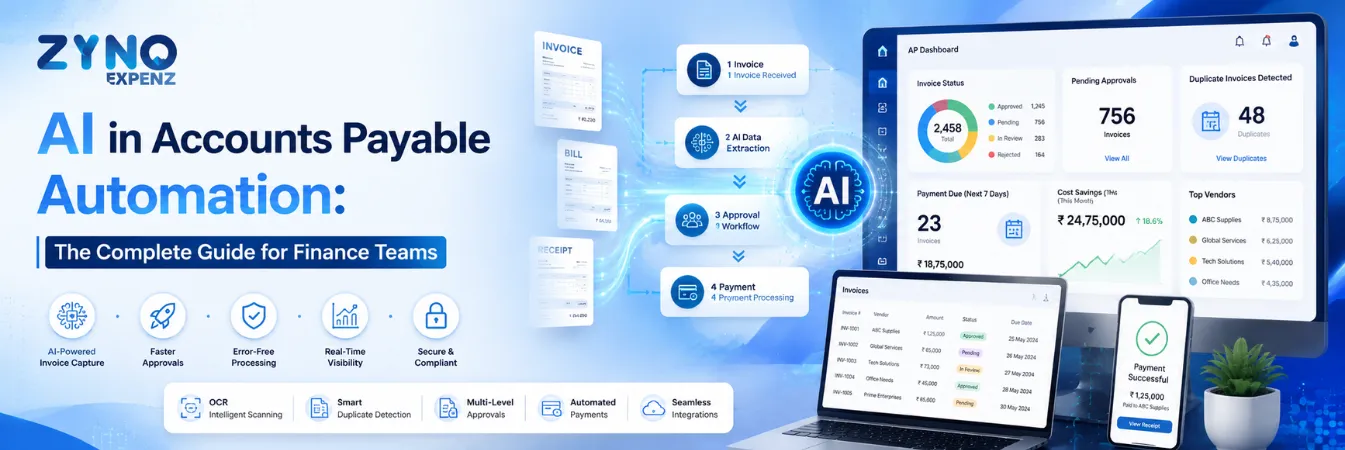
Expense management covers employee-initiated spending — travel reimbursements, petty cash, corporate card transactions. Accounts payable covers vendor invoices and supplier payments. They're related but separate: expense management feeds into AP when reimbursements are processed, but the workflow, approval chain, and compliance requirements differ significantly.
Q) Can a small business (under 20 employees) benefit from expense management software?
Yes — and the earlier you start, the better your habits. Tools like Kredily (free) and Zoho Expense (low cost) are built for small teams. The bigger benefit at this stage isn't processing efficiency — it's creating the audit trail and GST discipline that becomes critical when you raise funding, file tax returns, or face an assessment.
Q) Are restaurant bills reimbursable as business expenses in India?
Yes, with documentation — the business purpose and attendees must be noted. However, GST ITC cannot be claimed on restaurant bills (blocked under Section 17(5)). For income tax purposes, the expense is deductible as a business expense if the business connection is documented. Meal allowances within the prescribed limits (₹50/meal, twice daily) are tax-free for the employee.
Q) How long should expense records be retained in India?
For GST purposes (Section 36, CGST Act): 6 years (72 months) from the due date of filing the annual return. Important 2026 update: The GST portal has started archiving returns beyond 7 years — download and save your data locally before it becomes inaccessible. For Income Tax (Income Tax Act 2025): 8 years from the end of the relevant financial year. In practice, keep all records for 8 years — the longer period applies. If any appeal or legal proceeding is pending, retain records until 1 year after the final disposal of the matter.
Q) What is an expense policy, and what should it cover?
An expense policy is a written document that defines what employees can spend, how much, with what documentation, and through what approval process. A good Indian expense policy (2026) should cover: per-category spending limits (hotels, meals, flights, client entertainment), GST e-invoice requirements (mandatory for suppliers above ₹5 crore), submission deadlines, reimbursement timelines, TDS thresholds under Section 393 (new Income Tax Act 2025) for vendor payments, petty cash procedures, and consequences for policy violations.
Radhika Menon
Head of Finance Operations
Radhika has spent over 11 years managing corporate finance and travel expense operations for companies scaling across India and Southeast Asia. She has helped businesses cut reimbursement processing time by over 60% through smarter policy designs.
Smart IT Powering U.S. Fintech Success
Read More →

From Booking to Reimbursement: AI-Driven Travel and Expense Management
Read More →
A New Era Begins: ZYNO Expenz Brings Smarter Corporate Travel to the Middle East
Read More →
5 Hidden Pharmacy Cost Leakages ZYNO Expenz Can Eliminate
Read More →
Top AI-Powered Expense Management Systems Transforming GCC Businesses
Read More →
Technology Expense Management in 2026: A Complete Guide to Trends and Optimization
Read More →
Step by Step Guide to Build Expense Management Software
Read More →
Best Expense Management Software in the Middle East 2026
Read More →
How AI and Machine Learning Are Transforming Expense Management Software in 2026
Read More →
Top Financial Reporting Software for Accurate Business Insights
Read More →Travel Expense Management: Complete Guide for Businesses & Teams
Read More →
How Does AI Automate Expense Auditing?
Read More →Manual vs Automated Expense Management: Why Automation is the Future
Read More →Corporate Travel Booking Software: The Smart Way to Manage Business Travel
Read More →
ZYNO Expenz vs Expensify: Which One Actually Saves Your Business Money in 2026?
Read More →
Best Expense Management Software a Complete Guide in 2026
Read More →
Expense Management vs Spend Management: What's the Real Difference?
Read More →
Best Financial Reporting Software in 2026: Top Tools CFOs Actually Use
Read More →
What Is Spend Management? Definition, Process, Strategies & Best Practices
Read More →
Business Expense Tracker: The Complete Guide to Managing Corporate Expenses in 2026
Read More →
Invoice vs Receipt: What's the Real Difference
Read More →
Best OCR Receipt Scanner Apps in 2026
Read More →
Corporate Tax UAE: Complete Guide for Businesses in 2026
Read More →
EXPENSE TRACKING A Complete Guide for Small Businesses to Growing Companies
Read More →
What Is Per Diem? Complete Guide for India & US Businesses 2026
Read More →
Expense Management: The Complete Guide (2026)
Read More →Partner with ZYNO by Elite Mindz to revolutionize how your business works. Fill out the form, and we’ll reach out with AI-powered solutions made just for you.
We use browser cookies to ensure you get the best experience on our website. Learn more
The form was submitted successfully!
ZYNO Digital
Fueling Smarter Digital Growth
ZYNO Digital fuels smarter digital growth through data-driven marketing, creative storytelling, and performance strategies that boost visibility, engagement, and measurable business outcomes across global platforms.
ZYNO Tech
Engineering the Future of IT
ZYNO Tech delivers cutting-edge IT solutions — including web, mobile, and digital transformation services — helping businesses scale efficiently, innovate faster, and stay ahead in a connected world.
ZYNO AI
AI Built for Business Growth
ZYNO AI harnesses the power of artificial intelligence to automate processes, enhance decision-making, and deliver predictive insights — driving innovation, agility, and measurable business growth.
ZYNO by Elite Mindz
Your Partner in the AI-Powered Future
ZYNO by Elite Mindz offers AI-powered products and services that unify operations, boost productivity, and drive digital transformation — helping businesses scale smarter and innovate faster.
* In just 2 mins you'll get a response
* Your idea is 100% protected by our Non-Disclosure Agreement