Γ
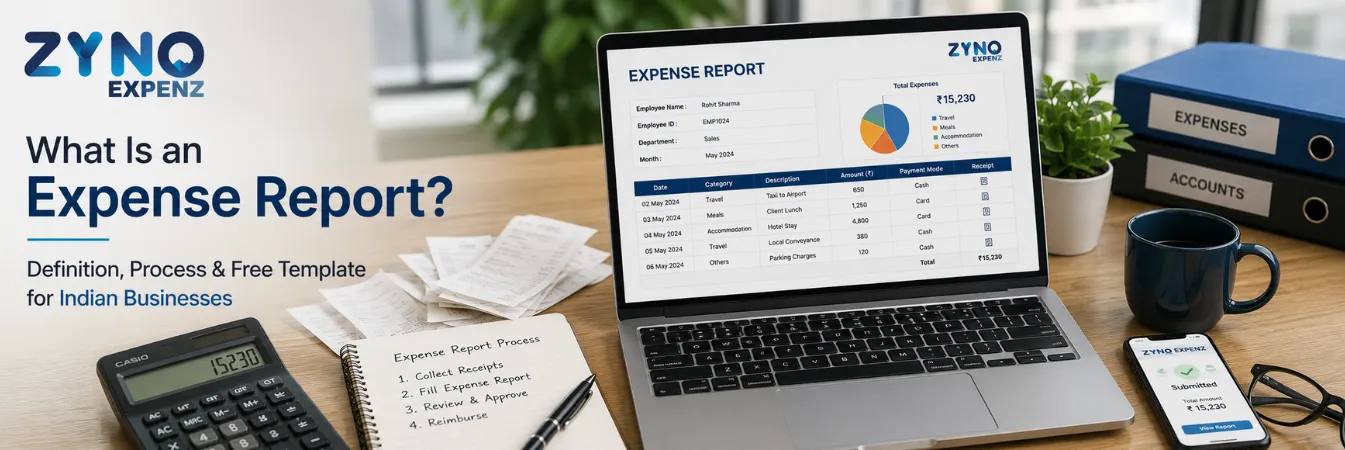
An expense report is a formal document submitted by an employee to claim reimbursement for business-related expenses paid from their own pocket. It includes the date, description, amount, vendor name, GST details, and supporting receipts for each expense. Businesses use it to verify spending, process reimbursements, maintain tax records, and track project-wise costs. In India, a GST-compliant expense report must include the vendor's GSTIN and a proper tax invoice to claim Input Tax Credit (ITC).
Businesses using ZYNO Books cut accounting time by 70% and stay 100% ZATCA-compliant β automatically.

If you run a small or mid-size business in India, you've probably faced this situation: an employee returns from a client visit and asks, "Sir, when will I receive my reimbursement?" And somewhere in your finance team, someone is still chasing receipts on WhatsApp.
This is exactly where an expense report comes in.
In this guide, we'll cover everything you need to know about expense reports what they are, what goes into them, the step-by-step process, and most importantly, how they work in the Indian context with GST compliance, Income Tax rules, and TDS implications.
An expense report is a formal document that lists all business-related expenses incurred by an employee on behalf of the company, along with supporting receipts and justification for each expense.
It is used by businesses to:
In simple words, an employee spends their own money for company-related work, and later the company reimburses that amount. However, the reimbursement is made with proper documentation and records. That documentation is called an expense report.
A standard expense report contains the following details:
The more detailed and accurate the report, the faster the approval and reimbursement.
Different businesses use different types of expense reports depending on their needs:
Employee Reimbursement Report The most common type. An employee submits this when they've spent their own money on a business task and wants it back.
Travel Expense Report Covers business trip expenses like flights, hotels, cab fares, and daily allowances (per diem). Very common for field sales teams in India.
Monthly or Quarterly Expense Report Used by finance teams to track all company spending across departments within a given period.
Project-Specific Expense Report Tracks expenses tied to a particular client or project. Useful for agencies, consultancies, and construction firms.
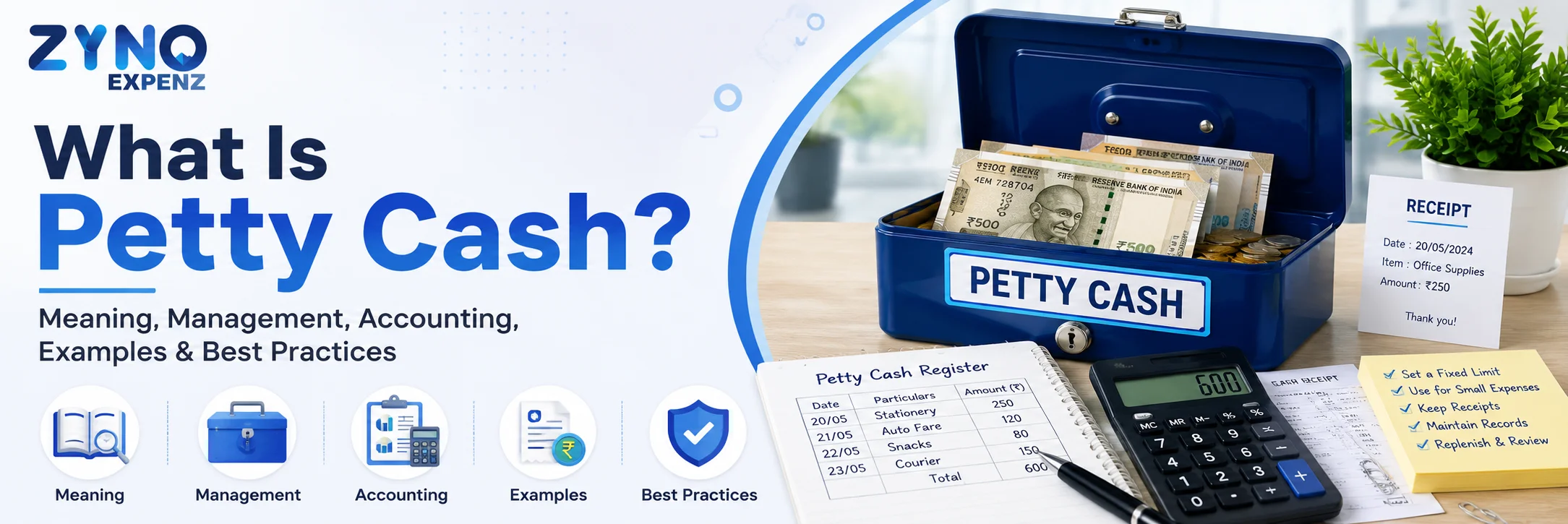
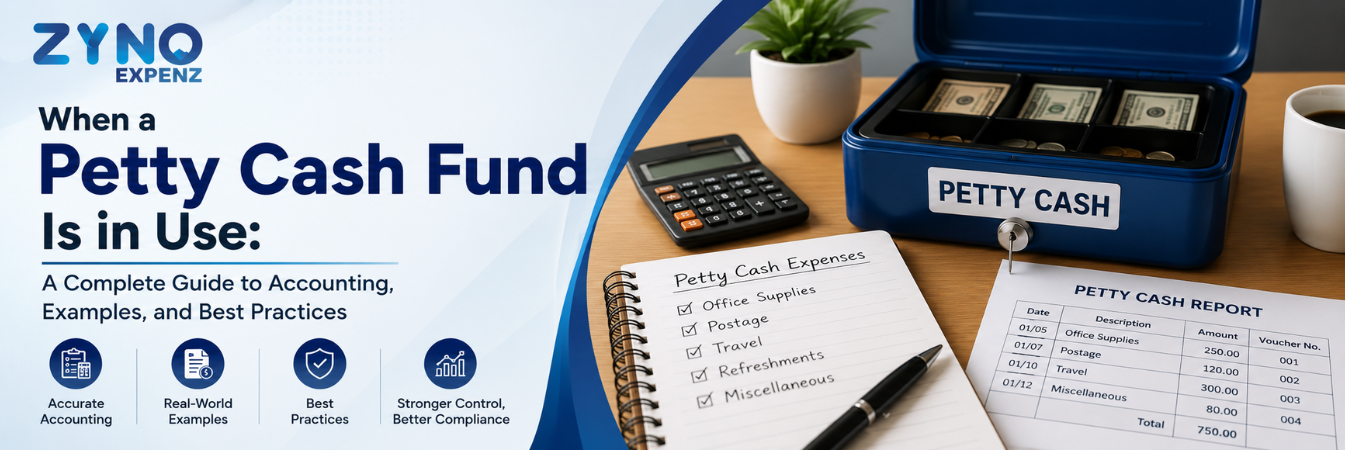
Petty Cash Report Tracks small day-to-day cash expenses from the petty cash fund. (More on this below.)
The process is fairly standard across businesses:
This is where most Indian businesses make mistakes. A basic expense report is not enough if you want to claim Input Tax Credit (ITC) on your business expenses under GST.
For a GST-compliant expense report, each expense entry must include:
Common mistake: Employees often attach cash memos or informal receipts instead of proper GST invoices. These cannot be used to claim ITC.
Pro tip: If your vendor is unregistered under GST, you may need to pay GST under the Reverse Charge Mechanism (RCM) this applies to specific categories like legal services, GTA (goods transport), etc.
For ITC eligibility, always ensure:
In India, not all reimbursements are tax-free. Here's how they are treated under the Income Tax Act:
Section 10(14) Exempted Allowances: Certain allowances paid to employees are fully or partially exempt from tax, provided they are used for official duties. These include:
These must be supported by proper expense reports and receipts.
Section 17(2) Perquisites: If an employer reimburses expenses that are personal in nature like fuel for personal commuting, personal phone bills, or family meals these are treated as perquisites and become taxable in the hands of the employee.
The key rule is: reimbursement is tax-free only when it is for a specific business purpose and backed by bills.
Important for HRA + rent reimbursement: These are separate and governed by different provisions. Expense reports discussed here are for operational/business expenses only.
Many small businesses in India get confused between these two. Here's the difference:
| Petty Cash | Expense Report | |
|---|---|---|
| Definition | A small fixed fund kept for minor day-to-day expenses. | A formal document listing all business expenses for reimbursement or tracking. |
| Who Manages It | Designated petty cash custodian. | Individual employee. |
| Payment Method | Cash paid in advance from the petty cash box. | Employee pays first and submits a claim later. |
| Used For | Tea, stationery, small courier charges. | Travel, client dinners, hotel stays, software subscriptions. |
| Approval | Often informal or post-facto. | Requires a formal approval workflow. |
| Audit Trail | Petty cash vouchers. | Expense reports with supporting receipts. |
Problem in SMBs: Many small businesses use petty cash for everything including large expenses which creates accounting confusion and GST compliance issues. If an expense is large enough to generate a GST invoice, it should go through an expense report, not petty cash.
A good rule of thumb: anything above βΉ500 should be tracked via an expense report, not petty cash.
TDS (Tax Deducted at Source) generally does not apply to genuine expense reimbursements because reimbursements are not income for the employee.
However, certain payments can attract TDS depending on how they are structured:
When TDS does NOT apply:
When TDS DOES apply:
Safe practice: Always collect bills, maintain expense reports, and ensure the nature of payment is clearly documented. Lump-sum allowances without documentation create tax risk both for the employee and the employer.
Beyond reimbursement, expense reports serve critical business functions:
Budgeting and Cost Control: When you have detailed data on where money is being spent by department, category, or project you can set realistic budgets and identify areas of overspending.
Tax Deductions: Business expenses are deductible under the Income Tax Act. But deductions can only be claimed if expenses are properly documented. An expense report with valid invoices is your strongest evidence.
Audit Readiness: Both GST audits and Income Tax assessments require you to prove that expenses were incurred for business purposes. Well-maintained expense reports make this straightforward.
Fraud Prevention: A structured expense approval process with receipts, manager approval, and finance review significantly reduces the risk of fraudulent or inflated claims.
Employee Satisfaction: Employees who travel or spend for work expect timely reimbursements. A clear process reduces friction and builds trust.
1. Submitting without GST invoices: Plain receipts or cash memos do not qualify for ITC. Always collect proper tax invoices from vendors.
2. Missing or mismatched dates: The expense date on the report must match the receipt date. Discrepancies lead to rejection.
3. No clear business purpose: "Dinner βΉ2,400" is not enough. The report should mention who was entertained and for what business reason.
4. Mixing personal and business expenses: Especially common with corporate cards. Expense policies must clearly define what is reimbursable.
5. Late submissions: Most companies have a submission deadline (e.g., within 7 days of travel). Delayed submissions complicate bookkeeping and can lead to ITC lapsing.
For small teams, a standard Excel template works fine. Your expense report should include:
As your team grows, manual templates become difficult to manage especially across multiple departments and projects. Software like ZYNO Expenz solves this by:
No more WhatsApp receipt forwarding. No more end-of-month chaos.
Want to get started right away? Use the expense report template below. It's structured for Indian businesses with GST columns included.
Columns to include in your Excel template:
Create professional expense reports in minutes — built specifically for India.
GST columns, auto-calculations, and manager sign-off all included.
No sign-up required. Instant download. Free forever.
Categories to pre-define:
Additional fields in the header:
Must Read: Best Expense Management Software a Complete Guide in 2026
Q. What is the difference between an expense report and an invoice?
An invoice is a bill issued by a vendor for goods or services provided. An expense report is an internal document prepared by an employee to claim reimbursement for multiple business-related expenses. The invoice is usually attached to the expense report as supporting evidence.
Q. Can an expense be reimbursed without a GST invoice?
Yes, reimbursement can still be processed. However, you cannot claim Input Tax Credit (ITC) on that expense. Additionally, without a valid invoice, the expense may not qualify as a deductible business expense during an Income Tax assessment.
Q. How soon should an expense report be submitted?
Most companies require employees to submit expense reports within 7 days of incurring the expense. For travel-related expenses, reports are typically submitted within 3 days of returning. Always refer to your company’s expense policy for specific timelines.
Q. Can an expense report be submitted using a mobile phone?
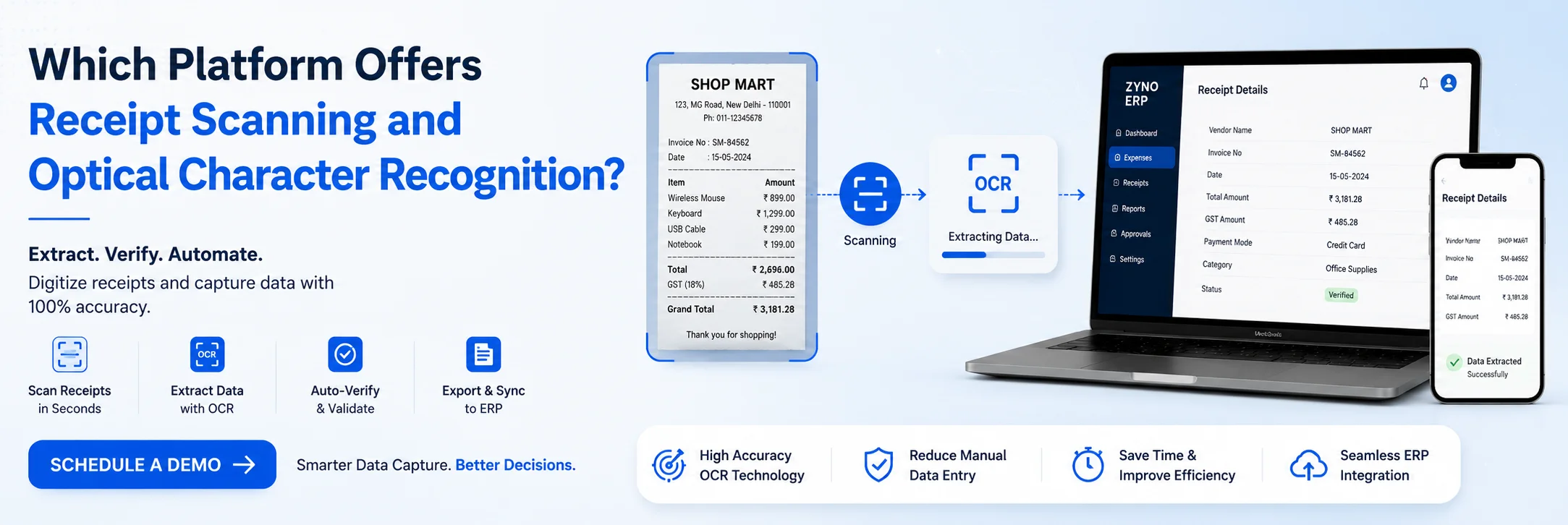
Yes. With software like ZYNO Expenz, employees can simply take a photo of a receipt and submit the expense report directly from their mobile device. No paperwork and no unnecessary delays.
Q. How should an expense report handle an advance payment?
The total advance amount is deducted from the overall expense report total. If the actual expenses are lower than the advance received, the employee must return the remaining balance. If the expenses exceed the advance amount, the company reimburses the difference.
An expense report is not just an administrative form, it is a core financial document that keeps your business compliant, your employees fairly reimbursed, and your books clean.
For Indian businesses especially, the stakes are higher because of GST compliance, Income Tax documentation requirements, and TDS considerations. A well-designed expense reporting process backed by the right software saves your finance team hours every month and protects your business from tax risk.
Ready to simplify your expense management? ZYNO Expenz helps small and mid-size Indian businesses automate the entire process from expense submission to GST-ready reports in one simple platform
Sneha
Head of Content Writer
Sneha Singh is a B2B technology content strategist with over 4 years of experience creating SEO-focused SaaS content. She excels in crafting engaging blogs and social media campaigns that simplify complex tech concepts and support business growth.
Smart IT Powering U.S. Fintech Success
Read More β
From Booking to Reimbursement: AI-Driven Travel and Expense Management
Read More β
A New Era Begins: ZYNO Expenz Brings Smarter Corporate Travel to the Middle East
Read More β
5 Hidden Pharmacy Cost Leakages ZYNO Expenz Can Eliminate
Read More β
Top AI-Powered Expense Management Systems Transforming GCC Businesses
Read More β
Technology Expense Management in 2026: A Complete Guide to Trends and Optimization
Read More β
Step by Step Guide to Build Expense Management Software
Read More β
Best Expense Management Software in the Middle East 2026
Read More β
How AI and Machine Learning Are Transforming Expense Management Software in 2026
Read More β
Top Financial Reporting Software for Accurate Business Insights
Read More βTravel Expense Management: Complete Guide for Businesses & Teams
Read More β
How Does AI Automate Expense Auditing?
Read More βManual vs Automated Expense Management: Why Automation is the Future
Read More βCorporate Travel Booking Software: The Smart Way to Manage Business Travel
Read More β
ZYNO Expenz vs Expensify: Which One Actually Saves Your Business Money in 2026?
Read More β
Best Expense Management Software a Complete Guide in 2026
Read More β
Expense Management vs Spend Management: What's the Real Difference?
Read More β
Best Financial Reporting Software in 2026: Top Tools CFOs Actually Use
Read More β
What Is Spend Management? Definition, Process, Strategies & Best Practices
Read More β
Business Expense Tracker: The Complete Guide to Managing Corporate Expenses in 2026
Read More β
Invoice vs Receipt: What's the Real Difference
Read More β
Best OCR Receipt Scanner Apps in 2026
Read More β
Corporate Tax UAE: Complete Guide for Businesses in 2026
Read More β
EXPENSE TRACKING A Complete Guide for Small Businesses to Growing Companies
Read More β
What Is Per Diem? Complete Guide for India & US Businesses 2026
Read More β
Expense Management: The Complete Guide (2026)
Read More β
What Is Petty Cash? Definition, Management, and Best Practices
Read More β
E-Invoice Software in India
Read More β
Expense Management for Small Businesses in India: The Complete 2026 Guide
Read More β
What Is an Expense Report? Definition, Process & Free Template for Indian Businesses
Read More βPartner with ZYNO by Elite Mindz to revolutionize how your business works. Fill out the form, and weβll reach out with AI-powered solutions made just for you.
We use browser cookies to ensure you get the best experience on our website. Learn more
The form was submitted successfully!
ZYNO Digital
Fueling Smarter Digital Growth
ZYNO Digital fuels smarter digital growth through data-driven marketing, creative storytelling, and performance strategies that boost visibility, engagement, and measurable business outcomes across global platforms.
ZYNO Tech
Engineering the Future of IT
ZYNO Tech delivers cutting-edge IT solutions β including web, mobile, and digital transformation services β helping businesses scale efficiently, innovate faster, and stay ahead in a connected world.
ZYNO AI
AI Built for Business Growth
ZYNO AI harnesses the power of artificial intelligence to automate processes, enhance decision-making, and deliver predictive insights β driving innovation, agility, and measurable business growth.
ZYNO by Elite Mindz
Your Partner in the AI-Powered Future
ZYNO by Elite Mindz offers AI-powered products and services that unify operations, boost productivity, and drive digital transformation β helping businesses scale smarter and innovate faster.
* In just 2 mins you'll get a response
* Your idea is 100% protected by our Non-Disclosure Agreement