×
An expense policy is a formal document that defines what business expenses employees can incur on behalf of the company, how those expenses should be recorded and submitted, who approves them, and when and how reimbursements happen. In India, it also has direct implications for GST Input Tax Credit claims, Income Tax deductions under Section 37(1), and perquisite taxation under Section 17(2).
Businesses using ZYNO Books cut accounting time by 70% and stay 100% ZATCA-compliant — automatically.

Key Takeaways
Quick Glossary
| Term | Meaning |
|---|---|
| ITC | Input Tax Credit — GST paid on purchases, claimable against GST collected on sales. |
| TDS | Tax Deducted at Source — tax withheld on certain payments before they are paid out. |
| GSTR-2A / 2B | Auto-generated GST returns showing ITC available based on vendor filings. |
| RCM | Reverse Charge Mechanism — buyer pays GST instead of the seller (e.g., foreign SaaS). |
| LTA | Leave Travel Allowance — a salary component partly exempt from tax under certain conditions. |
| CGST Act | Central Goods and Services Tax Act, 2017 — governs GST rules nationally. |
Let me tell you something that surprised me when I first started working with Indian SMEs on their finance workflows. Most companies, even ones doing ₹10 crore in annual turnover were running expense approvals through WhatsApp messages and verbal confirmations. No written rules. No spending limits. No GST documentation trail. And then, come quarter-end, the finance team was scrambling to reconcile everything before filing GSTR-2B.
That is the real cost of not having a clear expense policy. It is not just about controlling spending it is about staying audit-ready, claiming your GST Input Tax Credit correctly, and not landing yourself in trouble during an income tax assessment.
In this guide, I will walk you through exactly what an expense policy is, what it must include for Indian businesses specifically, and how to build one that your team will actually follow.

An expense policy is a formal document that defines what business expenses employees can incur on behalf of the company, how those expenses should be recorded and submitted, who approves them, and when and how reimbursements happen.
That definition is simple enough. But here is what makes it complicated in the Indian context your expense policy is not just an internal HR document. It has direct implications for:
A weak or absent expense policy does not just create internal confusion it creates compliance gaps that the Income Tax department or GST auditors can flag during scrutiny.
A weak expense policy creates four specific compliance risks: blocked ITC, disallowed tax deductions, mismanaged employee perquisites, and GSTR-2A/2B mismatches.
I have seen this play out repeatedly. A growing business say, a manufacturing company in Pune or a service firm in Hyderabad starts hiring quickly, gives sales reps company credit cards or a petty cash float, and assumes things will sort themselves out. They rarely do.
Here is what goes wrong specifically:
Under Section 17(5) of the CGST Act, Input Tax Credit is blocked on certain categories of expenses personal consumption, motor vehicles used for non-business purposes, and employee-facing expenses unless they are obligatory under law or a contractual arrangement. Without a clear expense policy defining what is a business expense versus personal, your chartered accountant has no defensible basis to claim ITC. And if the GST department raises a notice, the burden of proof is on you.
Business expenditure is deductible under Section 37(1) only if it is wholly and exclusively for business purposes. If your expense records are vague or undocumented, the assessing officer can disallow the deduction. A written policy with approval trails, receipts, and business-purpose statements makes your case much stronger during assessment.
Certain reimbursements like club memberships, LTA beyond permissible limits, or personal hotel stays are treated as perquisites under Section 17(2) and are taxable income in the employee’s hands. If your policy does not clearly separate reimbursable business expenses from personal benefits, your payroll team will either under-report or over-report taxable perquisites. Both create problems.
When vendor invoices are not collected properly or employee-submitted bills have incorrect GSTIN or HSN/SAC codes, your GSTR-2A and GSTR-2B do not match, and your ITC claims get stuck. A structured expense policy with mandatory GST documentation requirements solves this at the source.
Before we go into what to include, let me clarify that most mid-size Indian businesses actually need more than one expense policy or at least one policy with clearly separated sections.
| Policy Type | What It Covers | Who It Applies To |
|---|---|---|
| Travel Expense Policy | Flights, hotels, local transport, TA/DA rates | Field staff, sales teams, management |
| Entertainment & Client Expense Policy | Client meals, gifts, events | Business development, senior management |
| Office & Admin Expense Policy | Stationery, courier, utilities, petty cash | All employees, admin teams |
| Technology & SaaS Expense Policy | Software subscriptions, hardware, internet | IT, remote workers |
| Training & Development Policy | Courses, certifications, books | All employees |
Now let us get practical. Here are the non-negotiable components of a well-structured expense policy for Indian businesses. I will also explain why each section matters from a compliance standpoint, not just an operational one.
Every expense policy should begin with a clear statement of what it covers and why it exists. This is not just formality it establishes the legal and financial intent of the document.
Do not just list categories map them to their GST treatment. This is something most generic expense policy templates completely miss.
| Expense Category | ITC Eligibility | Key Condition |
|---|---|---|
| Hotel stays for business travel | Eligible (18% GST) | Invoice must have company GSTIN, not employee name |
| Flights – economy class | Eligible (5% GST) | Invoice must show company GSTIN |
| Client meals at restaurants | Blocked under Section 17(5) | No ITC available regardless of documentation |
| Office stationery and supplies | Eligible (12–18% GST) | Must be for business use, proper invoice required |
| Software subscriptions (SaaS) | Eligible (18% GST) | Foreign vendor — RCM applicable under Section 9(3) |
| Employee mobile bills | Partially eligible | Only if policy mandates it as business obligation |
Note: Input Tax Credit on motor vehicle expenses is blocked under Section 17(5)(a) unless the vehicle is used for transportation of goods, transportation of passengers as a taxable supply, or for further supply of such vehicles.
Vague policies do not work. Here are sample limits that are reasonable for an Indian SME context, though you should calibrate these to your city tier and industry:
| Expense Type | Tier 1 Cities (Delhi, Mumbai, Bengaluru) | Tier 2/3 Cities |
|---|---|---|
| Hotel per night | Up to ₹5,000 + taxes | Up to ₹3,000 + taxes |
| Daily meal allowance | Up to ₹600 per day | Up to ₹400 per day |
| Local transport (cab/auto) | Up to ₹500 per day | Up to ₹300 per day |
| Client entertainment (per event) | Up to ₹2,000 (no ITC) | Up to ₹1,200 (no ITC) |
| Flight booking class | Economy only | Economy only |
| Approval threshold | Above ₹10,000 — manager + finance | Above ₹7,500 — manager + finance |
This section prevents the most common disputes. Be explicit about what the company will not pay for.
This is where most Indian companies are weakest. Employees submit handwritten receipts, photocopies, or screenshots with missing GSTIN and the finance team either accepts them (and loses ITC) or rejects them (and creates friction).
A clear expense policy should mandate:
Delayed submissions create accounting and GST problems. The rule is simple: ITC for a particular month must be claimed before the annual return filing deadline. But practically, late submissions disrupt monthly GSTR-2B reconciliation.
Approvals should be structured, not ad hoc. Here is a tiered approach that works well for Indian businesses:
| Expense Amount | Approver | Timeline |
|---|---|---|
| Up to ₹2,000 | Direct Manager (L1) | Within 2 working days |
| ₹2,001 to ₹10,000 | Manager + Finance Team | Within 3 working days |
| ₹10,001 to ₹50,000 | Department Head + Finance | Within 5 working days |
| Above ₹50,000 | CFO or Director approval required | Within 7 working days |
| Exception / Policy Override | CFO + Founder approval | Case by case |
Employees in India often complain about reimbursement delays. A clear policy builds trust and reduces finance team queries.
This section is often missing from generic templates but is critical in the Indian context.
Certain reimbursements, if they exceed the permissible thresholds or are categorised incorrectly, become taxable perquisites in the hands of the employee under Section 17(2) of the Income Tax Act. Examples:
Vehicle provided or fuel reimbursed for personal use taxable perquisite under Rule 3(2)
Your policy should clearly flag which reimbursements are non-taxable (with conditions) and which ones will be included in the employee’s Form 16 as perquisites.
Many Indian businesses operate with petty cash or travel advances. The policy must address this.
Writing a policy is one thing. Getting it right for your business is another. Here is the process I recommend:
1. Audit your current expense patterns — what do employees actually spend on? Start with 3 months of data.
2. Involve your CA or tax advisor — they will flag GST ITC eligibility issues and income tax perquisite implications early.
3. Get HR and Finance alignment — policy must work for both teams and not create friction between them.
4. Write for the employee, not the auditor — use plain language. Put the auditor-facing details in the appendix.
5. Pilot with one department before company-wide rollout — collect feedback for 30 days.
6. Connect the policy to your expense management software — manual processes do not scale.
7. Train, do not just distribute — a 30-minute session with examples is worth more than a 20-page document nobody reads.
After looking at dozens of expense policies from Indian companies, the same mistakes keep appearing:
A written policy is only enforceable if a system checks it at the point of submission not after the fact.
A written expense policy is only as good as its enforcement. That is where expense management software comes in not just as a convenience, but as a compliance tool.
Good expense management software for Indian businesses should support:
Tools like ZYNO Expenz are specifically built for this use case designed for Indian SMEs who need GST-aware expense tracking, approval workflows, and reimbursement automation without the complexity of enterprise ERP systems.
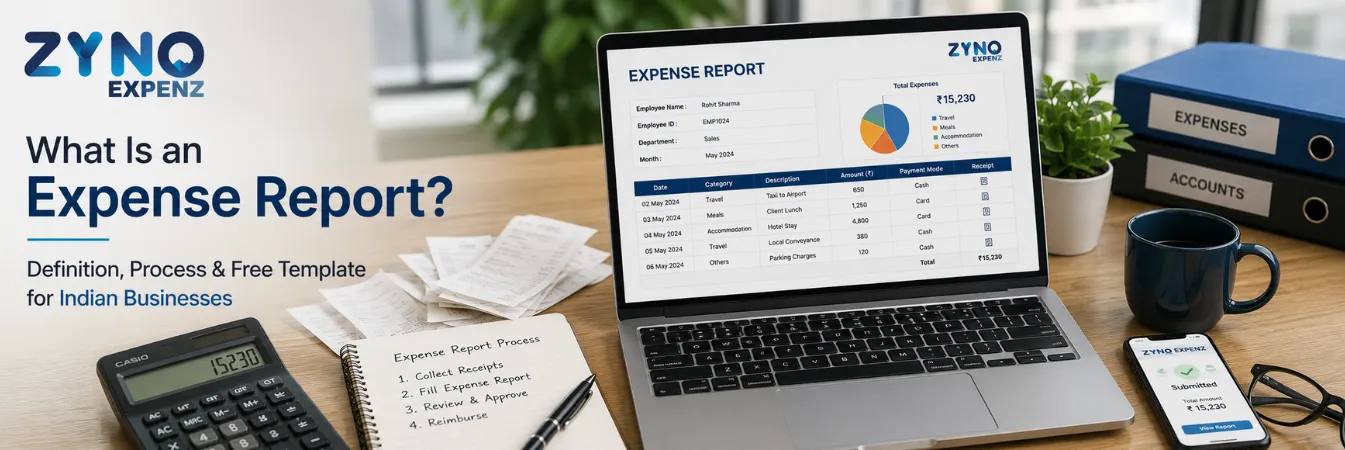
Must Read: What Is an Expense Report? Definition, Process & Free Template for Indian Businesses
Q Is it mandatory for Indian companies to have a written expense policy?
There is no specific statute that mandates a written expense policy for all companies. However, under the Companies Act, 2013, listed companies and certain categories of public companies are required to have internal financial controls which include documented expense approval processes. For tax purposes, a written policy significantly strengthens your position when claiming deductions under Section 37(1) or defending ITC claims during GST audits.
Q Can employees claim GST ITC on expenses paid from personal funds?
No. Input Tax Credit under the CGST Act can only be claimed by a registered business — not by the employee individually. The expense must be incurred in the name of the business (with the company’s GSTIN on the invoice) for ITC to be eligible. Employees submitting personal credit card bills with their own name on the invoice cannot generate ITC for the company.
Q What is the difference between a travel allowance and a travel reimbursement?
A travel allowance is a fixed sum paid to employees in advance or as part of salary structure — it may be partly exempt from tax under Section 10(14). A travel reimbursement is actual expense repayment against submitted invoices and receipts. The tax treatment differs significantly, and your expense policy should clearly define which model your company uses.
Q How often should an expense policy be reviewed?
At minimum, once a year. But also whenever there are significant GST amendments (the e-invoicing threshold has been revised multiple times), changes in income tax perquisite rules, or when your company crosses a new compliance threshold under the Companies Act. Linking policy reviews to your annual CA audit cycle is a practical approach.
Q What happens if an employee submits a fake expense bill?
Under Indian law, submitting fraudulent expense claims can attract disciplinary action under company policy, and in serious cases, legal action under Section 420 of the IPC (cheating and dishonesty) or under the Prevention of Money Laundering Act depending on the amount involved. Your expense policy should clearly state the consequences — from claim rejection and disciplinary proceedings to termination and legal referral for fraud.
Q Should my expense policy cover freelancers and contractors?
Yes, if they incur expenses on your company’s behalf. However, the tax treatment is different — contractor reimbursements may be subject to TDS under Section 194C if they exceed the threshold. Your policy should have a separate section for non-employee expense claims, specifying documentation requirements and TDS applicability.
An expense policy is not a bureaucratic formality. For Indian businesses, it is a practical tool for controlling costs, staying GST-compliant, protecting ITC claims, and keeping the Income Tax department at bay.
The best expense policies I have seen share three things: they are specific (₹ amounts, not vague guidance), they reflect actual Indian compliance requirements (GST, TDS, Income Tax Act), and they are enforced through a system — not just stored in a folder.
If you are building or revising your expense policy, start with your real expense data, involve your CA early, and invest in software that automates the enforcement. A policy that employees understand and a system that catches errors before they become compliance problems that combination is what actually works.
Radhika Menon
Head of Finance Operations
Radhika has spent over 11 years managing corporate finance and travel expense operations for companies scaling across India and Southeast Asia. She has helped businesses cut reimbursement processing time by over 60% through smarter policy designs.
Smart IT Powering U.S. Fintech Success
Read More →

From Booking to Reimbursement: AI-Driven Travel and Expense Management
Read More →
A New Era Begins: ZYNO Expenz Brings Smarter Corporate Travel to the Middle East
Read More →
5 Hidden Pharmacy Cost Leakages ZYNO Expenz Can Eliminate
Read More →
Top AI-Powered Expense Management Systems Transforming GCC Businesses
Read More →
Technology Expense Management in 2026: A Complete Guide to Trends and Optimization
Read More →
Step by Step Guide to Build Expense Management Software
Read More →
Best Expense Management Software in the Middle East 2026
Read More →
How AI and Machine Learning Are Transforming Expense Management Software in 2026
Read More →
Top Financial Reporting Software for Accurate Business Insights
Read More →Travel Expense Management: Complete Guide for Businesses & Teams
Read More →
How Does AI Automate Expense Auditing?
Read More →Manual vs Automated Expense Management: Why Automation is the Future
Read More →Corporate Travel Booking Software: The Smart Way to Manage Business Travel
Read More →
ZYNO Expenz vs Expensify: Which One Actually Saves Your Business Money in 2026?
Read More →
Best Expense Management Software a Complete Guide in 2026
Read More →
Expense Management vs Spend Management: What's the Real Difference?
Read More →
Best Financial Reporting Software in 2026: Top Tools CFOs Actually Use
Read More →
What Is Spend Management? Definition, Process, Strategies & Best Practices
Read More →
Business Expense Tracker: The Complete Guide to Managing Corporate Expenses in 2026
Read More →
Invoice vs Receipt: What's the Real Difference
Read More →
Best OCR Receipt Scanner Apps in 2026
Read More →
Corporate Tax UAE: Complete Guide for Businesses in 2026
Read More →
EXPENSE TRACKING A Complete Guide for Small Businesses to Growing Companies
Read More →
What Is Per Diem? Complete Guide for India & US Businesses 2026
Read More →
Expense Management: The Complete Guide (2026)
Read More →
What Is Petty Cash? Definition, Management, and Best Practices
Read More →
E-Invoice Software in India
Read More →
Expense Management for Small Businesses in India: The Complete 2026 Guide
Read More →
What Is an Expense Report? Definition, Process & Free Template for Indian Businesses
Read More →
Expense Policy: A Complete Guide for Indian Businesses
Read More →Partner with ZYNO by Elite Mindz to revolutionize how your business works. Fill out the form, and we’ll reach out with AI-powered solutions made just for you.
We use browser cookies to ensure you get the best experience on our website. Learn more
The form was submitted successfully!
ZYNO Digital
Fueling Smarter Digital Growth
ZYNO Digital fuels smarter digital growth through data-driven marketing, creative storytelling, and performance strategies that boost visibility, engagement, and measurable business outcomes across global platforms.
ZYNO Tech
Engineering the Future of IT
ZYNO Tech delivers cutting-edge IT solutions — including web, mobile, and digital transformation services — helping businesses scale efficiently, innovate faster, and stay ahead in a connected world.
ZYNO AI
AI Built for Business Growth
ZYNO AI harnesses the power of artificial intelligence to automate processes, enhance decision-making, and deliver predictive insights — driving innovation, agility, and measurable business growth.
ZYNO by Elite Mindz
Your Partner in the AI-Powered Future
ZYNO by Elite Mindz offers AI-powered products and services that unify operations, boost productivity, and drive digital transformation — helping businesses scale smarter and innovate faster.
* In just 2 mins you'll get a response
* Your idea is 100% protected by our Non-Disclosure Agreement