×
Indian manufacturers are no longer choosing ERP software based only on brand reputation. In 2026, the focus has shifted toward faster implementation, lower total cost of ownership, stronger GST compliance, mobile-first usability, and better shop floor visibility.
That shift is exactly why many SME and mid-size manufacturers are actively searching for SAP alternatives that are more practical for Indian operations.
SAP is one of the world's most powerful ERP platforms — and one of the most expensive and complex to implement for a mid-size Indian manufacturer.
The problems that send Indian factory owners searching for alternatives are pretty consistent:
Cost: SAP Business One licensing typically starts in the range of ₹3–5 lakh per year for smaller setups, based on publicly discussed pricing in the Indian market. When you add implementation, customization, training, and annual maintenance, the total cost of ownership over 3 years can become significant — often more than many Indian SME manufacturers expect when they first begin evaluating.
Implementation time: SAP implementations for mid-size manufacturers can stretch across many months depending on customization complexity, data migration, and partner involvement. The parallel-run period — where your team manages both the old system and the new one simultaneously — adds its own operational burden during go-live.
Indian compliance as an afterthought: SAP is a German product. GST, e-invoicing, TDS, TCS — these are supported, but through the partner ecosystem, not natively baked into the core product the way an Indian-built ERP would handle them.
Consultant dependency: Small changes — adding a custom report, modifying an approval workflow — often require a certified SAP consultant. At ₹5,000–₹15,000/hour, this adds up fast.
None of this means SAP is bad. For large enterprises with complex global operations, it's often the right answer. But for Indian SME manufacturers — companies with 20 to 500 employees running 1 to 3 plants — there are better-fit alternatives worth evaluating seriously.
Before jumping into the list, here's a framework that will save you from making a ₹50 lakh mistake:
Ask specifically: Does the system handle GST e-invoicing natively? Is TDS/TCS calculation automated? Will I need a plugin or partner module for statutory compliance? A system that needs a third-party GST plugin will cause friction every quarter.
Get a quote that includes: license, implementation, customization, training, annual maintenance, and support. The license price alone is almost meaningless.
An ERP that only works well on desktop, in English, for people with business degrees will fail on the floor. Ask for a demo that shows how a line supervisor would log a production entry or raise a quality alert.
Find out: Is support in India? What are the SLA response times? Do you get a dedicated account manager or a ticket number?
Every additional month of implementation is a month you're not getting ROI. Ask for a realistic timeline — and talk to a reference customer who went through their implementation.
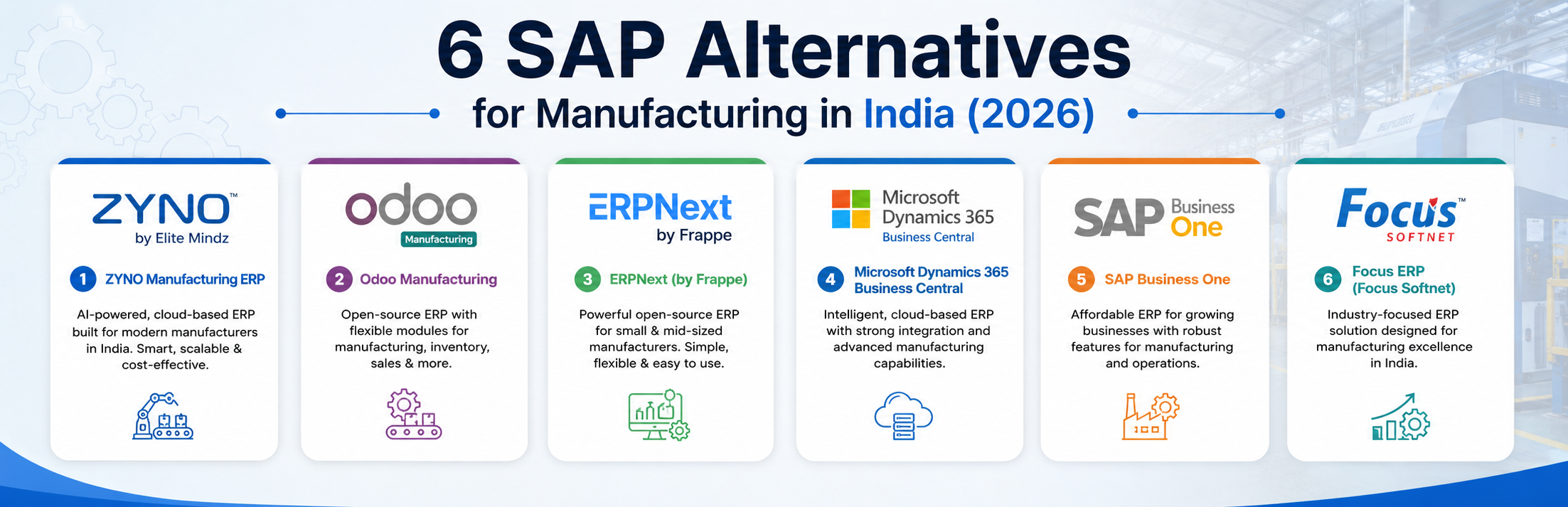
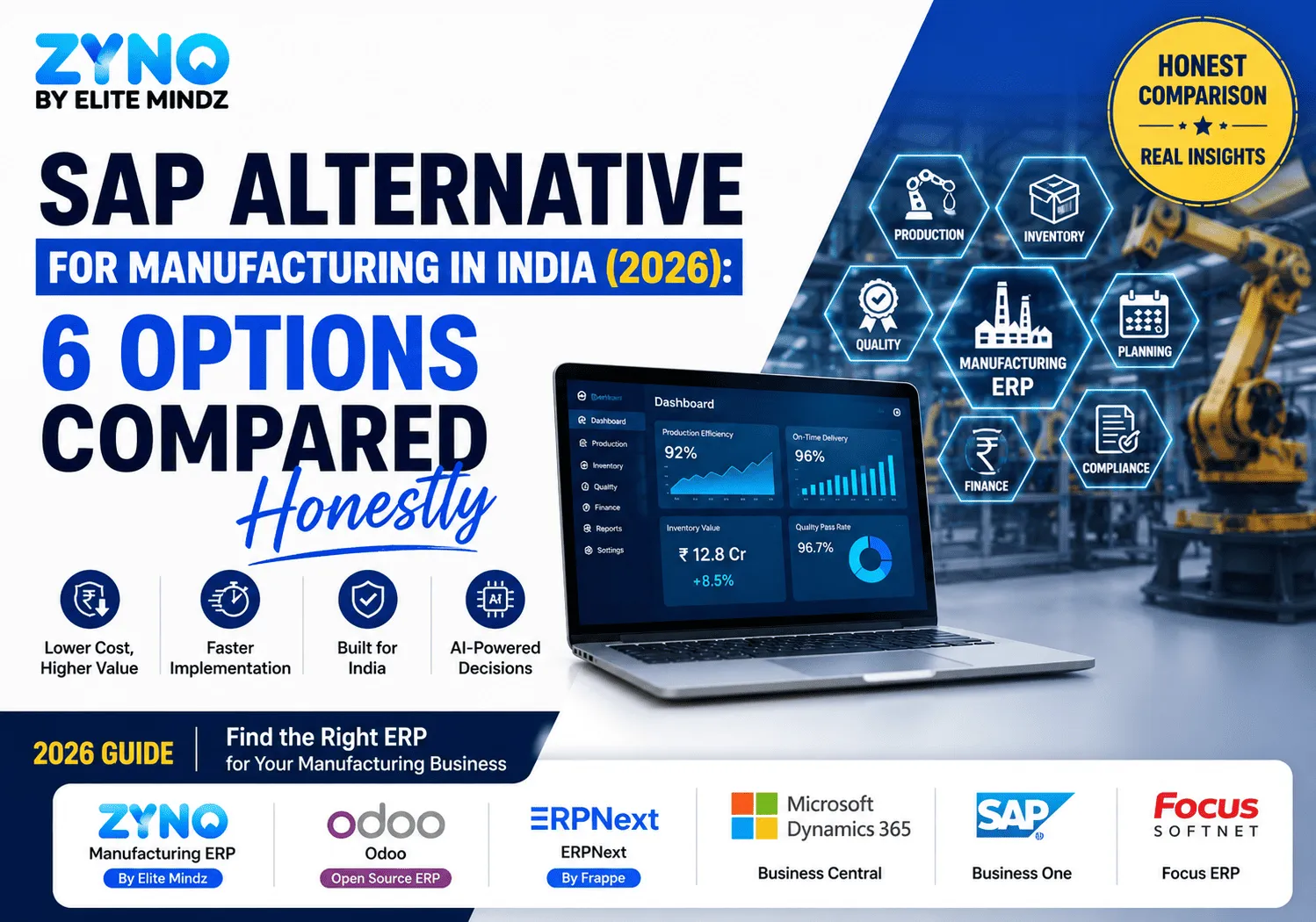
With those in mind, here are 6 genuine SAP alternatives for Indian manufacturers, compared honestly.
Best for: Indian SME manufacturers across automotive, pharma, FMCG, metals, textiles, food processing, and discrete manufacturing
Deployment: Cloud-based (on-premise available on request)
Built in India: Yes — by Elite Mindz, a Delhi-based company with 16+ years in enterprise software
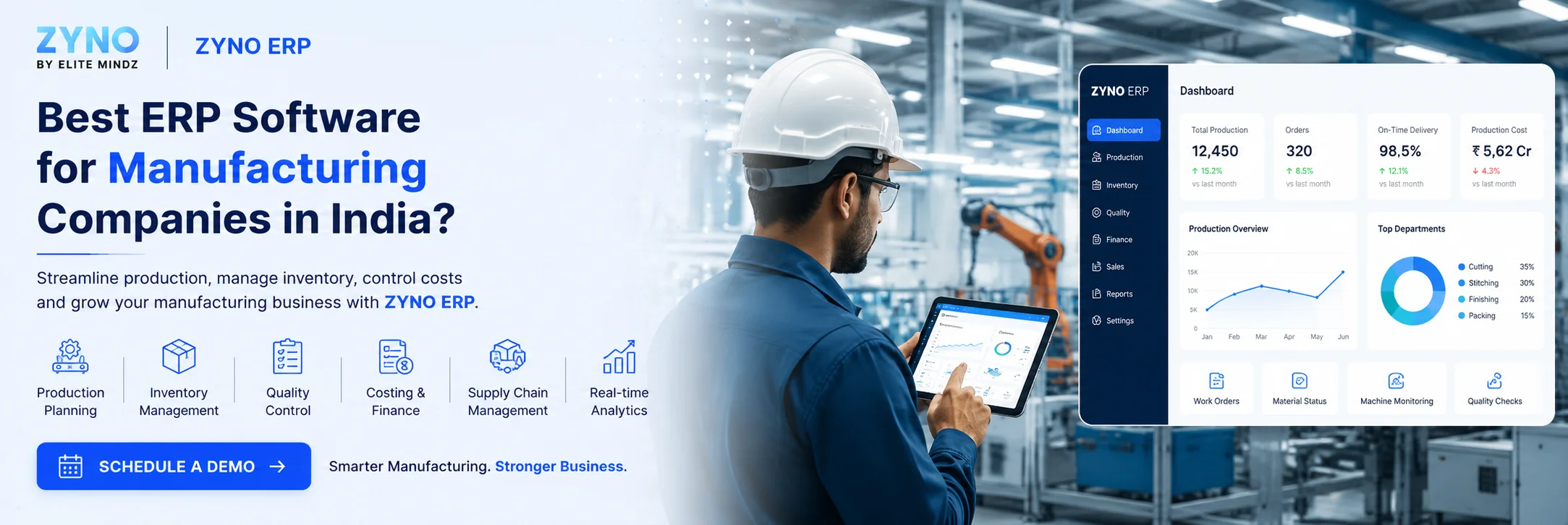
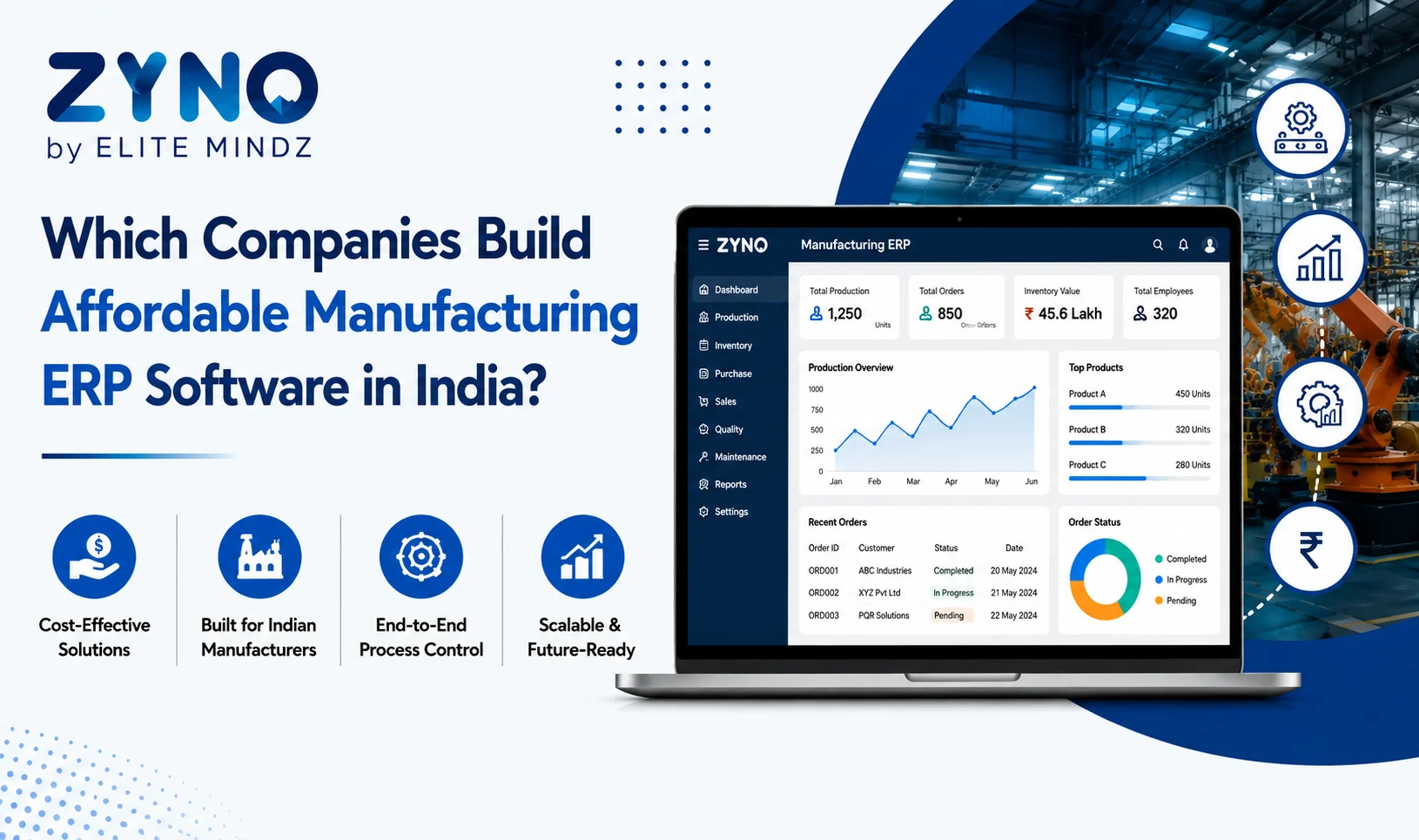
ZYNO Manufacturing ERP is Elite Mindz's dedicated manufacturing product, part of their ZYNO AI-Suite of enterprise solutions. It covers the full manufacturing lifecycle in one platform — from production planning and Bill of Materials through to shop floor execution, quality control, finance, and statutory compliance.
What it actually covers:
The platform includes Production Planning & Scheduling, multi-level BOM management, Live Shop Floor & MES reporting, Inventory & Warehouse Management, Quality Control & Compliance, Procurement & Supplier Management, Subcontracting & Outside Processing, Finance & Cost Accounting, Statutory Compliance & Taxation (GST, TDS, TCS), HR & Time Tracking, AI-Powered Demand Forecasting, and a mobile app for field and floor access.
The India-specific advantage:
Because ZYNO is built by an Indian team for Indian businesses, GST, e-invoicing, TDS, and statutory compliance are part of the core product — not add-ons. The system is also built to work on the mobile-first reality of Indian factory floors, where supervisors and procurement managers often work from phones rather than desktops.
A real-world example:
One automotive component supplier based in the NCR region — running a 3-shift discrete manufacturing operation — implemented ZYNO's shop floor MES and AI demand forecasting modules. Within the first two quarters post go-live, they reported a measurable reduction in production cycle time and a significant drop in last-minute procurement firefighting, driven primarily by the system's ability to flag demand gaps 4–6 weeks ahead rather than days before. (Shared with permission; company name withheld at their request.)
This kind of outcome isn't guaranteed — it depends heavily on how well the implementation is configured and how consistently floor teams adopt the system. But it illustrates the type of operational shift manufacturers are looking for when they move from spreadsheets or legacy ERP to a connected platform.
Honest limitations:
ZYNO Manufacturing ERP is a relatively newer product in the market compared to SAP or Odoo. It does not have the global user community, the depth of third-party integrations ecosystem, or the brand recognition that comes with 20+ years of global deployment. If you need multi-country ERP operations — India + US + Europe on one system — you should evaluate carefully whether ZYNO's international capabilities meet your specific needs. For purely Indian or Indian-first operations, this is less of a concern.
Elite Mindz's track record includes 4,200+ enterprise projects delivered for clients including L&T, KPMG, EaseMyTrip, PVR, Sony, and MapMyIndia — though it's worth noting that not all of these projects are ZYNO Manufacturing ERP implementations specifically; Elite Mindz delivers a wide range of software products and services.
Who should seriously evaluate ZYNO: Indian manufacturers (20–500 employees) who want a modern, cloud-based ERP with deep Indian compliance, AI capabilities, and direct support from an Indian team — without the SAP-level cost and implementation complexity.
Best for: Businesses that want a modular, open-source ERP and have in-house technical capability
Deployment: Cloud & Self-hosted
Origin: Belgium | Indian implementation partners available
Pricing model: Community edition free; Enterprise edition charged per user per month
Odoo is one of the most widely used ERP platforms globally, and its Manufacturing module is genuinely capable — covering MRP, work orders, routings, quality control, and maintenance.
What works well: The modular architecture means you can start with only what you need — say, Manufacturing + Inventory + Accounting — and add modules over time. The Odoo 17 (2024) and Odoo 18 (2025) versions significantly improved the manufacturing and quality control interfaces.
What to watch out for: The free Community edition lacks several important features — notably advanced manufacturing workflows, quality management, and maintenance. The Enterprise edition pricing adds up quickly, especially when you factor in Indian partner implementation fees. Indian GST compliance in Odoo typically requires a localization module — either from Odoo's official India localization or a third-party provider.
A specific pain point we see repeatedly with Indian manufacturers on Odoo: GST plugin switching headaches. When a manufacturer upgrades from one Odoo version to the next (say, Odoo 16 to Odoo 17), the Indian GST localization module often needs to be re-validated, re-configured, or swapped for a newer version — sometimes breaking historical reports or e-invoicing integrations in the process. This is manageable with the right partner, but it adds a recurring maintenance overhead that many businesses don't anticipate upfront.
Quality of implementation also varies significantly depending on which Indian partner you choose — far more than with commercially supported platforms.
Who should choose Odoo: Manufacturers with in-house technical teams who can manage configuration and customization, or businesses with simpler production workflows looking for cost-effective flexibility. Not ideal if you want a plug-and-play experience with strong India-side support included.
Best for: Budget-conscious manufacturers comfortable with open-source software
Deployment: Cloud & Self-hosted
Origin: India — built by Frappe, a Mumbai-based company
Pricing: Self-hosted is free; Frappe Cloud managed hosting starts at approximately ₹4,000–8,000/month
ERPNext is worth understanding because it's genuinely Indian — Frappe built it, the GST compliance is strong, and the Indian manufacturing community has contributed significantly to its development. It covers manufacturing, inventory, HR, accounting, and more with a modern web interface.
What works well: For a zero-license-cost starting point, ERPNext offers serious manufacturing functionality — BOM, work orders, production planning, job card management, quality inspection, and subcontracting. GST and Indian compliance is handled well because the team understands the Indian context.
Real limitations: ERPNext requires a meaningful amount of technical involvement to set up well. Complex manufacturing scenarios — multi-plant operations, advanced shop floor tracking, AI-driven forecasting, CPQ for configure-to-order products — will hit the platform's limits. Enterprise-grade SLA support is limited compared to commercial platforms. Scaling from 50 users to 500 users on ERPNext can get complicated.
A pattern we see specifically with Indian manufacturers who start on ERPNext: "ERP-ready but not shop-floor-ready." The accounting, inventory, and procurement modules work well. But when manufacturers try to extend ERPNext into live shop floor tracking — capturing machine-level OEE data, operator-level job card entries, real-time WIP visibility — they often find themselves building heavy custom logic or stitching ERPNext to a separate MES tool. For manufacturers where shop floor execution is the core challenge (not just back-office operations), this gap is worth factoring in before choosing ERPNext.
Who should choose ERPNext: Early-stage manufacturers, or those with strong in-house IT capability, who want a genuinely capable Indian-built ERP at minimal license cost and are willing to invest technical time in setup and ongoing management.
Best for: Manufacturers already using Microsoft 365, Teams, and Excel as their daily tools
Deployment: Cloud (primarily)
Origin: USA | Microsoft partners available across India
Pricing: Approximately ₹6,000–8,000 per user/month (Essential plan); higher for Premium
Business Central is a capable mid-market ERP that genuinely shines for businesses already embedded in the Microsoft ecosystem. Its 2025/2026 versions include Microsoft Copilot integration for AI-assisted analytics and reporting, and Power BI is best-in-class for data visualization.
What works well: If your team already works in Excel, Outlook, and Teams, the integration reduces friction significantly. For financial management and reporting, Business Central is very strong. Multi-location and multi-currency handling is solid.
Real limitations: Per-user pricing makes it expensive for larger teams — a 100-person implementation can get costly fast. Implementation quality in India is heavily partner-dependent, and the Indian GST localization, while available, needs to be carefully configured. Manufacturing-specific functionality (shop floor execution, advanced MES, CPQ) is less deep than dedicated manufacturing ERP platforms. For complex Indian manufacturers with non-Microsoft workflows, the Microsoft-centric integration story can become a limitation rather than an advantage.
Who should choose Dynamics 365: Manufacturers with existing Microsoft infrastructure, strong finance/reporting needs, and willingness to invest in a quality implementation partner. Better fit for manufacturing companies where finance complexity is the primary challenge, not shop floor execution complexity.
Best for: Manufacturers who need SAP's brand, have global operations, or must connect with a parent company's SAP ecosystem
Deployment: Cloud & On-Premise
Origin: Germany | SAP partner network across India
Pricing: Typically ₹4–8 lakh/year in license costs for a small setup; implementation adds ₹15–40+ lakhs
SAP Business One is on this list because it's frequently compared against other options by Indian manufacturers — and for certain situations, it's the right answer.
What works well: For manufacturers that are subsidiaries of global companies running SAP, or who need to prove enterprise-grade ERP pedigree to large clients, SAP Business One delivers credibility and integration depth. The reporting and analytics are solid, and the Indian partner network has matured significantly in recent years.
Real limitations: It's significantly more expensive than most alternatives on this list. Implementation is complex and partner-dependent. Customizations require SAP-certified developers. GST compliance works but involves the partner ecosystem rather than native simplicity. For a pure Indian SME manufacturer with no international SAP integration requirements, you're paying a significant premium for brand recognition.
Who should choose SAP Business One: Manufacturers with specific enterprise requirements — global supply chain integration, parent company SAP connectivity, multi-country statutory compliance — or those in industries where SAP certification is a procurement requirement from key customers.
Best for: Indian SME manufacturers looking for an affordable, India-first ERP with strong accounting
Deployment: Cloud & On-Premise
Origin: India — Focus Softnet, Dubai-based with strong India presence
Pricing: Contact vendor; generally positioned as affordable for SMEs
Focus ERP is less globally known but well-established in the Indian SME market. It has strong financial management, GST compliance, and basic manufacturing capabilities including production planning, job costing, BOM, and inventory management.
What works well: Affordable entry point, good Indian compliance, strong accounting foundation. For manufacturers where finance and inventory are the primary challenges rather than complex shop floor execution, Focus ERP can be a practical option.
Real limitations: Manufacturing-specific depth (shop floor MES, AI forecasting, advanced quality management) is limited compared to dedicated manufacturing ERP platforms. Less suitable for complex or process manufacturing scenarios.
Who should choose Focus ERP: Small to mid-size Indian manufacturers (fewer than 100 employees) with straightforward production workflows who want Indian compliance built in at a lower cost point than SAP.
| Feature | ZYNO Mfg ERP | Odoo | ERPNext | Dynamics 365 | SAP B1 | Focus ERP |
|---|---|---|---|---|---|---|
| Built for India | Yes | Localized | Yes | Localized | Localized | Yes |
| GST/Compliance Native | Yes | Plugin | Yes | Partner | Partner | Yes |
| AI Demand Forecasting | Yes | Basic | No | Copilot | Add-on | No |
| Shop Floor (MES) | Live | Yes | Basic | Limited | Module | Basic |
| Mobile App | Yes | Yes | Yes | Yes | Limited | Limited |
| Open Source Option | No | Yes | Yes | No | No | No |
| Best Fit Company Size | 20–500 | 10–300 | 5–200 | 50–500+ | 50–1000+ | 10–150 |
| Indian Support Direct | Yes | Partners | Yes | Partners | Partners | Yes |
| Relative Cost (3yr TCO) | Mid | Low–Mid | Low | Mid–High | High | Low–Mid |
“Localized”, “Plugin”, “Partner”, “Add-on”, and “Limited” indicate features available with additional setup, integrations, or implementation support.

These questions will separate honest vendors from ones who tell you what you want to hear:
1. Can I talk to 3 customers in my industry who went live in the last 12 months?
Any legitimate vendor with real implementations will be able to connect you. If they hesitate, that's a signal.
2. What is the total cost — license + implementation + customization + training + Year 2 support — for a company of my size?
Get this in writing. The number on the brochure is almost never the number you'll pay.
3. How do you handle GST e-invoicing updates when the government changes the format?
This happens regularly. The answer tells you whether compliance is built into their product roadmap or is an afterthought.
4. Show me exactly how a shop floor supervisor would record a production entry and flag a quality defect.
Watch the demo carefully. If it looks clunky or requires multiple screens for a simple entry, your floor team won't adopt it.
5. What happens if we need a custom report 6 months after go-live? Who does it and what does it cost?
This is where many manufacturers get surprised by ongoing consultant dependency.
This is worth saying clearly: not every business should move away from SAP.
If you're a large Indian manufacturer — 500+ employees, multi-country operations, complex global supply chains, or integration requirements with international SAP-using partners — SAP Business One or S/4HANA may genuinely be your best option despite the cost. The ecosystem depth and global support at that scale is hard to match.
The businesses that consistently benefit from switching to alternatives are those that are:
Ask yourself honestly:
There is no single "best manufacturing ERP in India." There is only the right fit for your team size, production complexity, budget, and support expectations.
Elite Mindz Content & Product Team
Elite Mindz Manufacturing ERP Implementation Team
This comparison was written by the Elite Mindz team based on 16+ years of experience implementing enterprise software across Indian manufacturers, including clients in automotive, FMCG, pharma, logistics, and discrete manufacturing. We've included ZY
What is ERP? A Beginner's Guide to Enterprise Resource Planning
Read More →

Cloud ERP vs. On-Premise vs. Hybrid: Best ERP Model for 2025
Read More →How To Customize ERP Software Without Breaking The Bank?
Read More →
The Future of Manufacturing ERP in 2026 & Beyond
Read More →Best ERP Software in India: 2026 Edition
Read More →
AI in Manufacturing ERP: The Future of Smart Factories
Read More →
How ERP Transforms Inventory Management and Reduces Costs
Read More →
Top Features to Look for in Inventory Management Software in 2025
Read More →
Top 5 Ways Asset Management Software Can Save Your Business Money
Read More →
Why Smart Businesses Are Switching to Vendor Management Systems in 2025?
Read More →
Why Manufacturing Companies Need ERP Software
Read More →
Cloud ERP vs. Traditional ERP: Which is Right for You?
Read More →
ERP for Small Business: Is It Worth the Investment?
Read More →
How to Calculate ERP ROI and Why It's Worth the Investment
Read More →
Top 10 ERP Software Companies in India 2026 Updated List (Complete Guide)
Read More →
ERP Implementation Mistakes to Avoid in 2025
Read More →
Cloud ERP vs Edge Computing: What's Right for Modern Manufacturing?
Read More →
The Future of ERP Software and the Role of Generative AI
Read More →
Digital Twin Technology & ERP: Real-Time Insights for Smarter Manufacturing
Read More →
Scalable ERP Solutions Designed for Modern Enterprises
Read More →
ERP and IoT Integration: Smart Factory Vision
Read More →Best ERP Software for Manufacturing Businesses in India
Read More →Top 10 Best Manufacturing ERP Software in India (2026)
Read More →
Best ERP Software for Manufacturing Industries in Ethiopia (2026)
Read More →
Best School ERP Software Providers in UAE (2025 Edition)
Read More →
Best School ERP Software for 2025: Guide for Educational Institutions
Read More →
Top 10 ERP Software Solutions for Nigerian Manufacturers (2025 Edition)
Read More →
Best ERP Systems for Scalable Retail and POS Integration
Read More →
Top 10 Cloud-Based Manufacturing ERP Solutions in Africa (2025 Edition)
Read More →
Top 10 Cloud-Based Manufacturing ERP in UAE
Read More →
Top 10 Cloud-Based Manufacturing ERP Software in Nigeria (2026 Edition)
Read More →
Top 10 School ERP Software Companies in Kenya (2025)
Read More →
Best School ERP Software Providers in Nigeria (2025)
Read More →
Top Cloud-Based Manufacturing ERP in Zimbabwe (2025)
Read More →
Best ERP Software in U.K
Read More →
Top 10 ERP Software Developers in the U.K. (2025)
Read More →
Best ERP Software Providers in France (2025)
Read More →
Best ERP Software Companies in Germany : A Comprehensive Guide
Read More →
Top 10 ERP Software Development Companies in Qatar
Read More →
10 Best ERP Providers in Germany - 2026 Updated List
Read More →
Best ERP Software Firms in Saudi Arabia (2025)
Read More →
Best ERP Service Providers in Indonesia for SMEs and Large Enterprises
Read More →
Top 10 Cloud-Based Manufacturing ERP Systems in Egypt for Modern Factories
Read More →
Top ERP Solutions in the USA 2025: Streamline Your Business with ZYNO ERP
Read More →
Top ERP Solutions in Qatar for Businesses of All Sizes
Read More →Top Manufacturing ERP Software in India 2026 ZYNO Manufacturing ERP
Read More →How Manufacturing Companies Reduce Production Delays Using ERP Automation
Read More →Why Legal Firms Need ERP to Manage Cases, Billing & Compliance
Read More →What Is ERP And How Does It Work
Read More →
How ERP Systems Are Evolving in 2026: What Businesses Need to Know
Read More →
Best ERP Software in India: 2025 Edition
Read More →
Top 10 ERP Software Companies in Delhi NCR
Read More →
How Manufacturing ERP Software Improves Demand Forecasting
Read More →
Top 10 Best School Management Software in India
Read More →Manufacturing & Wholesale ERP in Qatar: Complete Industry Guide 2026
Read More →Cloud ERP Software in Qatar: Why Businesses Are Moving in 2026
Read More →Is ERP a Procurement Software? Key Differences, Benefits & What to Choose
Read More →What Is Production Planning and Control? Definition, Objectives & Functions
Read More →
Garment Inventory Management Software: Complete Guide 2026
Read More →
How ERP Reduces Fabric Wastage in Garment Factories
Read More →
Why the Garment Industry Needs a Specialized ERP
Read More →
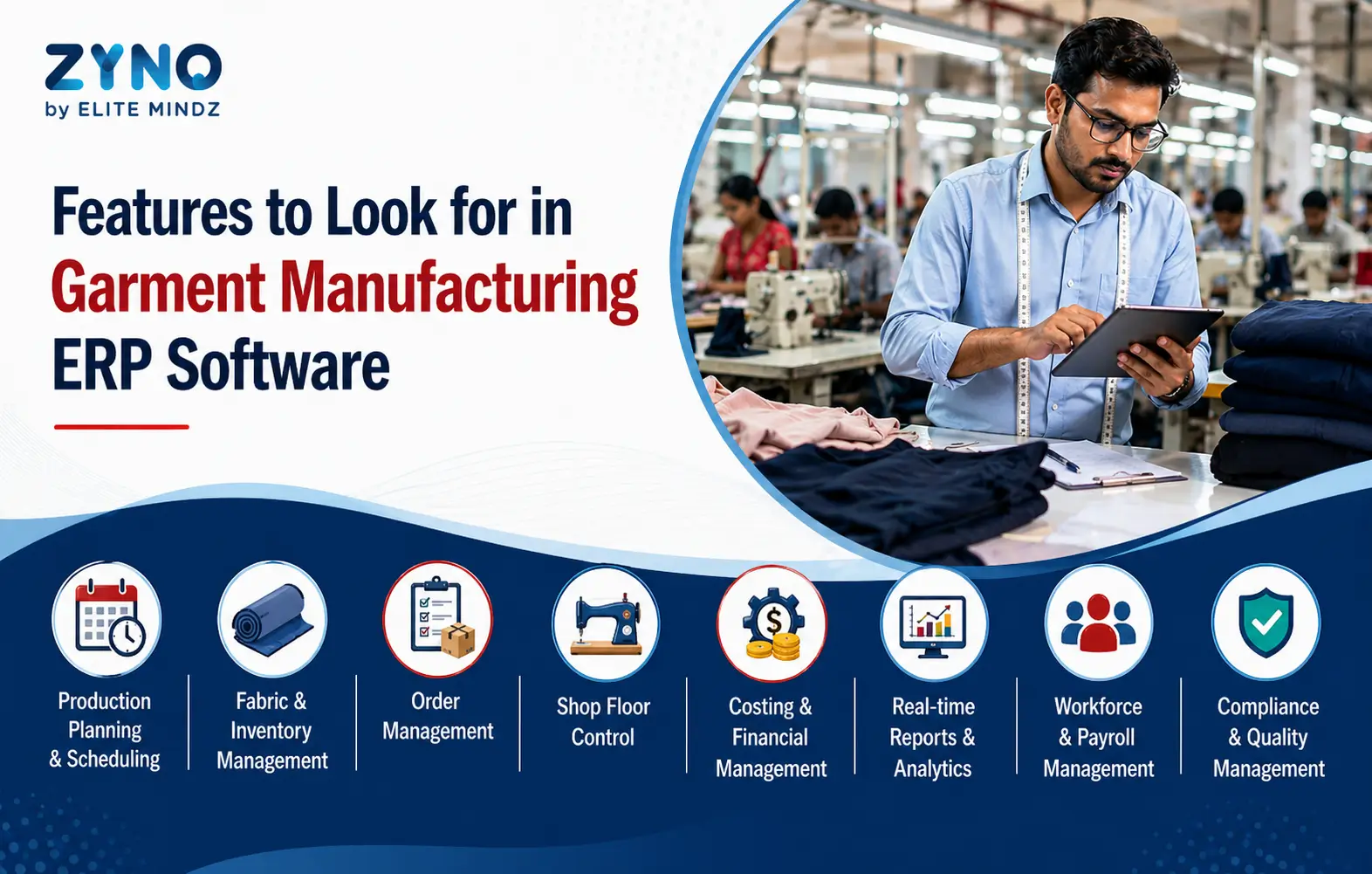
Features to Look for in Garment Manufacturing ERP Software
Read More →
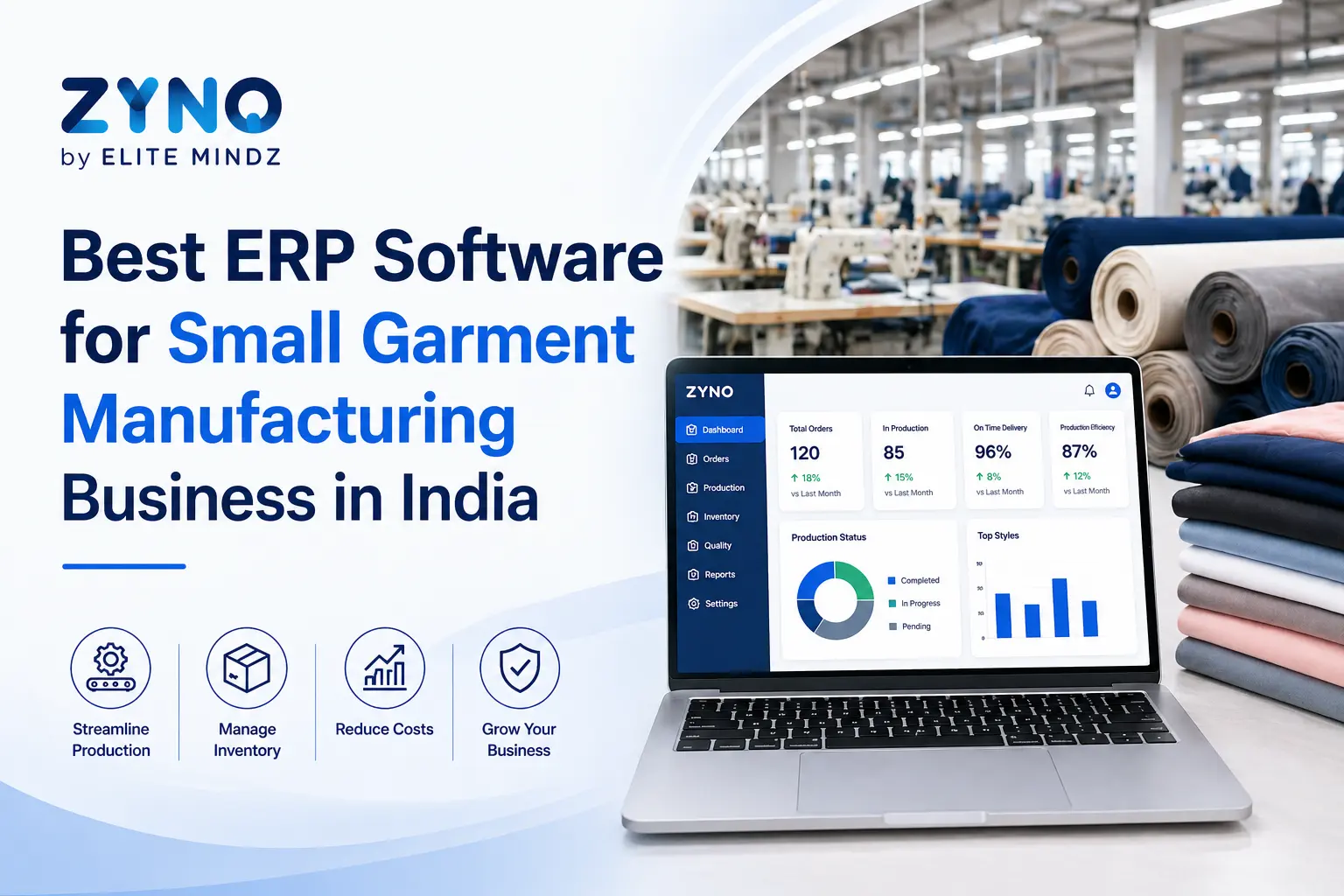
Best ERP Software for Small Garment Manufacturing Business in India
Read More →
The Real Problems Holding Back Small Garment Manufacturers in India
Read More →Garment Manufacturing ERP Software in India: Best Options, Features & Complete Guide 2026
Read More →
Which ERP is Best for Manufacturers in 2026?
Read More →
Distributor & Consumer Management System: The Complete Guide for 2026
Read More →
Best Pharma ERP Software in India 2026 – Features, Compliance & Buying Guide
Read More →
SAP Alternative for Manufacturing in India (2026): 6 Options Compared Honestly
Read More →Partner with ZYNO by Elite Mindz to revolutionize how your business works. Fill out the form, and we’ll reach out with AI-powered solutions made just for you.
We use browser cookies to ensure you get the best experience on our website. Learn more
The form was submitted successfully!
ZYNO Digital
Fueling Smarter Digital Growth
ZYNO Digital fuels smarter digital growth through data-driven marketing, creative storytelling, and performance strategies that boost visibility, engagement, and measurable business outcomes across global platforms.
ZYNO Tech
Engineering the Future of IT
ZYNO Tech delivers cutting-edge IT solutions — including web, mobile, and digital transformation services — helping businesses scale efficiently, innovate faster, and stay ahead in a connected world.
ZYNO AI
AI Built for Business Growth
ZYNO AI harnesses the power of artificial intelligence to automate processes, enhance decision-making, and deliver predictive insights — driving innovation, agility, and measurable business growth.
ZYNO by Elite Mindz
Your Partner in the AI-Powered Future
ZYNO by Elite Mindz offers AI-powered products and services that unify operations, boost productivity, and drive digital transformation — helping businesses scale smarter and innovate faster.
* In just 2 mins you'll get a response
* Your idea is 100% protected by our Non-Disclosure Agreement