×
Before diving into features, it is worth understanding the unique complexity of apparel manufacturing. Unlike discrete manufacturing, garment production involves thousands of SKU variations, multiple production stages across different vendors, tight lead times, fabric-intensive operations, and compliance demands. A purpose-built solution like ZYNO Manufacturing ERP addresses these exact challenges with industry-ready modules designed for how garment factories actually operate — not how a generic software vendor imagines they do.
The global ERP market for garment manufacturing is projected to nearly triple in value by 2032, which tells you everything about where the industry is heading. The businesses investing in the right platform today are the ones who will compete confidently tomorrow.
• Thousands of SKU variations across sizes, colors, styles, and seasons
• Multiple production stages — cutting, stitching, washing, printing, finishing — often across different vendors
• Tight lead times with buyers who expect on-time delivery, always
• Fabric-intensive operations where even minor wastage eats into margins
• Compliance demands around labor standards, safety, and sustainability
From SKU matrices to job work tracking, ZYNO Manufacturing ERP handles every complexity of garment production out of the box — no customisation required.
If there is one feature that defines ERP systems for apparel manufacturing, it is production planning that actually understands garment production stages. Good production planning ERP for garment operations should let you:
• Schedule cutting, stitching, finishing, and packing as distinct, sequenced operations
• Plan capacity by line, machine count, operator availability, and shift patterns
• Adapt dynamically to order changes without rebuilding your entire schedule
• Handle make-to-order, make-to-stock, and job-work models within the same system
ZYNO Manufacturing ERP takes this further with intelligent scheduling tools that automatically level workloads, flag bottlenecks before they become delays, and give shop-floor managers real-time visibility into every active work order. You stop firefighting and start leading production with confidence.
The BOM is the backbone of garment costing, material planning, and quality control. But in apparel, a BOM is rarely simple — a single style might have a dozen size-color variants, each with slightly different fabric requirements, trims, or packaging specs.
Essential ERP features for textiles around BOM include:
• Multi-level BOM structures that capture fabrics, linings, threads, buttons, zippers, labels, and packaging
• Variant-specific BOMs where different colors or sizes call for different material quantities
• Automated Material Requirements Planning (MRP) driven by BOM data and production schedules
• Real-time cost rollups that show how a change in fabric price cascades into style-level profitability
With ZYNO’s BOM module, merchandisers and production teams work from the same structured data. There is no version confusion, no manual recalculation, and no gap between the tech pack and the factory floor.
Poor inventory management is one of the costliest problems in the clothing industry. Inventory control in garment manufacturing ERP needs to go beyond simple stock counts.
Look for:
• Fabric roll and batch tracking for shade consistency and quality matching
• Bin and warehouse location mapping so you always know exactly where every material sits
• Real-time inventory updates triggered by every movement — issue, return, rejection, transfer
• Automated reorder alerts based on actual consumption and forecasted demand
• Multi-location visibility for businesses running multiple factories or warehouses
ZYNO provides live inventory dashboards that track raw materials, WIP, and finished goods simultaneously. Managers can spot slow-moving stock, prevent over-procurement, and ensure the right material reaches the right production line at the right time — every time.
Your buyers want answers in real time: Where is my order? Is it on track? When does it ship? Order tracking in garment ERP should provide:
• End-to-end visibility from order confirmation through cutting, stitching, finishing, quality check, and dispatch
• Live status updates tied to actual production progress, not manual entries
• Automated alerts when an order risks going off-schedule
• Buyer-facing portals or reports that communicate delivery timelines proactively
ZYNO’s order management module connects sales, production, and logistics. To understand how ERP reduces production delays — and keeps every stakeholder with an accurate, up-to-the-minute picture of where each order stands — see ZYNO in action.
Consistency is everything in garment quality. Quality management in garment ERP needs to be woven into every stage of production, not bolted on at the end. Key capabilities to look for:
• In-line and end-of-line quality inspection checkpoints
• Defect logging by style, line, operator, and production stage
• Acceptance/rejection workflows with quarantine and rework routing
• Compliance documentation for international quality standards
• Root cause analysis reporting so quality issues can be systematically eliminated
ZYNO enforces quality checks at every critical control point — from incoming fabric inspection to final audit before dispatch — ensuring your rejection rates stay low and your buyer satisfaction stays high.
Garment manufacturing depends on a web of suppliers. Supply chain management in ERP for textiles should deliver:
• Vendor onboarding and performance tracking
• Purchase order automation with approval workflows
• RFQ/RFP management for competitive sourcing
• Delivery schedule monitoring with early warning alerts for late supplies
• Landed cost tracking so your true procurement cost is always visible
ZYNO’s procurement and supply chain modules connect your buying team with your production planner, ensuring that material availability is synchronized with production schedules. No more last-minute scrambles for a critical trim that was never ordered on time.
ZYNO handles production planning, inventory, job work, quality, and costing in one unified platform — built specifically for garment manufacturers.
Most garment factories outsource at least some operations. Important ERP tools for garment job work and subcontracting include:
• Challan and gate pass management for materials sent to and received from subcontractors
• Real-time tracking of job work status and expected return dates
• Quality inspection for incoming job-worked materials
• Job cost settlement comparing actuals against estimates
• Material and price variance analysis
ZYNO handles subcontracting as a first-class workflow — not an afterthought. Every piece of material that leaves your factory and every finished unit that comes back is tracked, costed, and quality-checked with complete accountability.
Thin margins are a reality in garment manufacturing. Cost management in apparel ERP should enable:
• Style-level costing that aggregates material, labor, and overhead costs automatically
• Variance analysis comparing estimated costs to actual costs at job completion
• Fabric utilization tracking to identify and reduce wastage
• Order-level profitability reporting so you know which buyers and styles make money
• Currency management for export orders billed in foreign currency
ZYNO’s costing engine works in real time — the moment a production order is executed or a material is consumed, costs are updated. No end-of-month surprises. No cost that slips through unnoticed.
Strong buyer relationships drive repeat business. A CRM integrated into garment ERP eliminates the gap between your sales team and your production floor, so promises made to customers are promises your factory can keep. Look for CRM capabilities that include:
• Centralized buyer profiles with order history, preferences, and communication logs
• Automated follow-up workflows for samples, approvals, and order confirmations
• Sales pipeline visibility to forecast upcoming production load
• Integration with order management so confirmed orders flow directly into production planning
ZYNO’s CRM module keeps your sales and merchandising teams aligned with real production capacity. You stop overpromising delivery dates and start building the kind of buyer trust that turns one-time orders into long-term partnerships.
Manual approvals, paper-based processes, and email chains slow everything down. Workflow automation in garment ERP eliminates these friction points. Automation in a capable garment ERP should cover:
• Automatic work order creation from confirmed sales orders
• Purchase order triggers based on MRP-calculated shortfalls
• Production alerts when a stage is falling behind schedule
• Automated invoice generation on goods dispatch
• Escalation workflows for unresolved quality rejections
ZYNO’s workflow engine is configurable to your specific business processes — whether you run a make-to-order export house or a seasonal make-to-stock brand. Tasks flow automatically between departments, approvals happen faster, and your team spends time on decisions rather than on data entry.
Data is only valuable if it drives decisions. Reporting and analytics in garment ERP should give every level of your organization the visibility they need. Best-in-class reporting should include:
• Real-time KPI dashboards covering production efficiency, OTIF, inventory turns, and financials
• Drill-down capability from summary figures to individual transaction level
• Mobile access so managers can monitor operations from anywhere
• Automated scheduled reports delivered to relevant stakeholders
• Predictive analytics to forecast demand, flag risks, and guide planning decisions
ZYNO’s AI-powered analytics in manufacturing ERP go beyond standard reporting. Predictive insights flag risks before they materialize, and live dashboards ensure that decision-makers always have accurate, current data — whether they are on the production floor or traveling to a buyer meeting.
No ERP exists in isolation. A modern garment business uses e-commerce platforms, logistics partners, CAD/PLM tools, accounting software, and sometimes buyer-specific portals. Integration capabilities in garment ERP to prioritize:
• Open API architecture for connecting third-party applications
• Native integration with e-commerce channels (Shopify, Amazon, etc.)
• Accounting integration for seamless financial reconciliation
• EDI support for large retail buyers requiring electronic data interchange
• PLM and CAD tool integration for accelerating style development
ZYNO is built with an open integration framework, allowing garment businesses to connect their existing tools without disrupting proven workflows. The result is a single source of truth for your entire operation — from design to delivery.
ZYNO Manufacturing ERP by Elite Mindz is purpose-built for the complexity of modern manufacturing — and for garment businesses specifically, it delivers:
• AI-first architecture — predictive insights and intelligent scheduling built into the platform from day one
• Textile and garment-specific modules — multi-variant product management, fabric roll tracking, job work, style costing, and subcontractor management out of the box
• Cloud-native deployment — access your operations from any device, any location, with enterprise-grade security and zero infrastructure headaches
• Rapid implementation — most deployments complete in 8 to 12 weeks, so you start seeing ROI fast
• Scalable for growth — whether you are running one factory or five, ZYNO scales with your business without requiring a system replacement
The proof is in customer outcomes: manufacturers using ZYNO report reduced production downtime, improved on-time delivery, tighter cost control, and better supply chain coordination. Learn more about the best ERP software for Indian manufacturing — exactly the outcomes that define a competitive garment business in 2025 and beyond.
ZYNO deploys in 8–12 weeks, works on any device, and pays for itself in reduced wastage, better on-time delivery, and tighter cost control — from month one.
Garment manufacturing ERP centralizes complex operations like multi-variant SKUs, job work, and fabric tracking — improving visibility, reducing errors, and ensuring better control over production, inventory, and costs.
Garment ERP is built specifically for apparel workflows — handling style-color-size matrices, fabric roll tracking, and subcontracting — while generic ERP systems require heavy customization. Read: what is ERP and how does it work
Yes. A good garment ERP natively supports multi-variant product structures, allowing businesses to manage thousands of SKU combinations without confusion or manual errors.
ERP production planning for garment factories enables real-time scheduling, capacity planning, and stage-wise tracking — helping factories identify bottlenecks early and ensure timely order completion.
Absolutely. Features like BOM-based planning, roll-wise tracking, and consumption monitoring help minimize over-issue, cutting losses, and untracked wastage.
ERP for job work and subcontracting tracks materials sent to vendors, monitors job progress, records returns, and manages billing — ensuring full transparency and reducing material leakage.
Yes. ERP quality control and compliance integrates checks at multiple stages, logs defects, and enables root cause analysis — helping reduce rework and rejection rates.
ERP finance and cost accounting provides real-time cost tracking at the style and order level, including materials, labor, and overheads — allowing businesses to understand true profitability.
Very important. A modern ERP should integrate with accounting tools, e-commerce platforms, CAD/PLM systems, and logistics partners to ensure seamless data flow. See: top manufacturing ERP software in India
Modern cloud-based garment ERPs can typically be deployed within a few weeks to a few months, depending on business complexity and data readiness. Is ERP worth the investment?
Sneha Singh
Content Writer
Sneha Singh is a B2B tech content strategist with 4+ years of experience. She specializes in SEO-driven SaaS content, whitepapers, and platform-native social media campaigns that simplify complex technology and drive business growth. Sneha's core exp
What is ERP? A Beginner's Guide to Enterprise Resource Planning
Read More →

Cloud ERP vs. On-Premise vs. Hybrid: Best ERP Model for 2025
Read More →How To Customize ERP Software Without Breaking The Bank?
Read More →
The Future of Manufacturing ERP in 2026 & Beyond
Read More →Best ERP Software in India: 2026 Edition
Read More →
AI in Manufacturing ERP: The Future of Smart Factories
Read More →
How ERP Transforms Inventory Management and Reduces Costs
Read More →
Top Features to Look for in Inventory Management Software in 2025
Read More →
Top 5 Ways Asset Management Software Can Save Your Business Money
Read More →
Why Smart Businesses Are Switching to Vendor Management Systems in 2025?
Read More →
Why Manufacturing Companies Need ERP Software
Read More →
Cloud ERP vs. Traditional ERP: Which is Right for You?
Read More →
ERP for Small Business: Is It Worth the Investment?
Read More →
How to Calculate ERP ROI and Why It's Worth the Investment
Read More →
Top 10 ERP Software Companies in India 2026 Updated List (Complete Guide)
Read More →
ERP Implementation Mistakes to Avoid in 2025
Read More →
Cloud ERP vs Edge Computing: What's Right for Modern Manufacturing?
Read More →
The Future of ERP Software and the Role of Generative AI
Read More →
Digital Twin Technology & ERP: Real-Time Insights for Smarter Manufacturing
Read More →
Scalable ERP Solutions Designed for Modern Enterprises
Read More →
ERP and IoT Integration: Smart Factory Vision
Read More →Best ERP Software for Manufacturing Businesses in India
Read More →Top 10 Best Manufacturing ERP Software in India (2026)
Read More →
Best ERP Software for Manufacturing Industries in Ethiopia (2026)
Read More →
Best School ERP Software Providers in UAE (2025 Edition)
Read More →
Best School ERP Software for 2025: Guide for Educational Institutions
Read More →
Top 10 ERP Software Solutions for Nigerian Manufacturers (2025 Edition)
Read More →
Best ERP Systems for Scalable Retail and POS Integration
Read More →
Top 10 Cloud-Based Manufacturing ERP Solutions in Africa (2025 Edition)
Read More →
Top 10 Cloud-Based Manufacturing ERP in UAE
Read More →
Top 10 Cloud-Based Manufacturing ERP Software in Nigeria (2026 Edition)
Read More →
Top 10 School ERP Software Companies in Kenya (2025)
Read More →
Best School ERP Software Providers in Nigeria (2025)
Read More →
Top Cloud-Based Manufacturing ERP in Zimbabwe (2025)
Read More →
Best ERP Software in U.K
Read More →
Top 10 ERP Software Developers in the U.K. (2025)
Read More →
Best ERP Software Providers in France (2025)
Read More →
Best ERP Software Companies in Germany : A Comprehensive Guide
Read More →
Top 10 ERP Software Development Companies in Qatar
Read More →
10 Best ERP Providers in Germany - 2026 Updated List
Read More →
Best ERP Software Firms in Saudi Arabia (2025)
Read More →
Best ERP Service Providers in Indonesia for SMEs and Large Enterprises
Read More →
Top 10 Cloud-Based Manufacturing ERP Systems in Egypt for Modern Factories
Read More →
Top ERP Solutions in the USA 2025: Streamline Your Business with ZYNO ERP
Read More →
Top ERP Solutions in Qatar for Businesses of All Sizes
Read More →Top Manufacturing ERP Software in India 2026 ZYNO Manufacturing ERP
Read More →How Manufacturing Companies Reduce Production Delays Using ERP Automation
Read More →Why Legal Firms Need ERP to Manage Cases, Billing & Compliance
Read More →What Is ERP And How Does It Work
Read More →
How ERP Systems Are Evolving in 2026: What Businesses Need to Know
Read More →
Best ERP Software in India: 2025 Edition
Read More →
Top 10 ERP Software Companies in Delhi NCR
Read More →
How Manufacturing ERP Software Improves Demand Forecasting
Read More →
Top 10 Best School Management Software in India
Read More →Manufacturing & Wholesale ERP in Qatar: Complete Industry Guide 2026
Read More →Cloud ERP Software in Qatar: Why Businesses Are Moving in 2026
Read More →Is ERP a Procurement Software? Key Differences, Benefits & What to Choose
Read More →What Is Production Planning and Control? Definition, Objectives & Functions
Read More →
Garment Inventory Management Software: Complete Guide 2026
Read More →
How ERP Reduces Fabric Wastage in Garment Factories
Read More →
Why the Garment Industry Needs a Specialized ERP
Read More →
Features to Look for in Garment Manufacturing ERP Software
Read More →
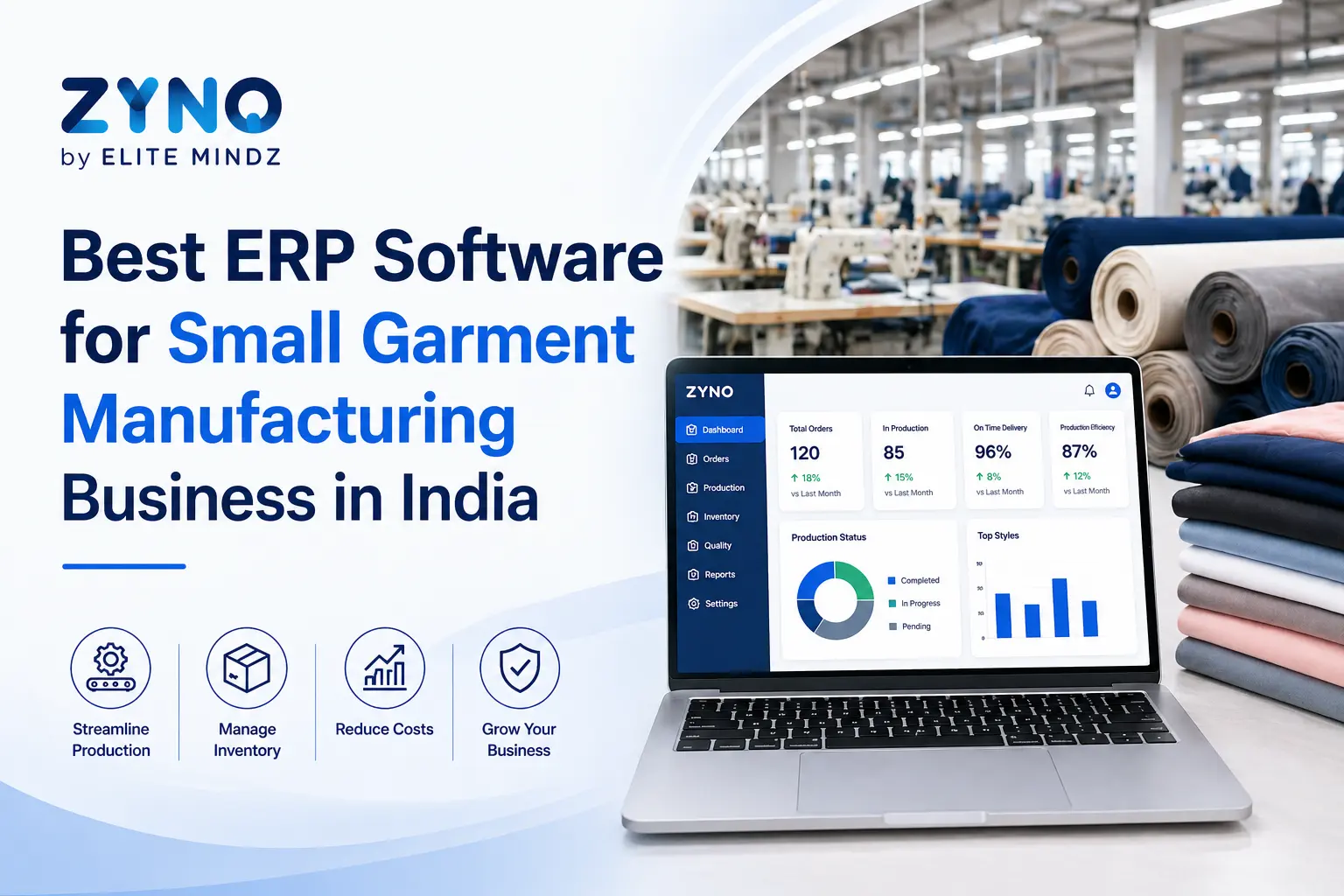
Best ERP Software for Small Garment Manufacturing Business in India
Read More →
The Real Problems Holding Back Small Garment Manufacturers in India
Read More →Partner with ZYNO by Elite Mindz to revolutionize how your business works. Fill out the form, and we’ll reach out with AI-powered solutions made just for you.
We use browser cookies to ensure you get the best experience on our website. Learn more
The form was submitted successfully!
ZYNO Digital
Fueling Smarter Digital Growth
ZYNO Digital fuels smarter digital growth through data-driven marketing, creative storytelling, and performance strategies that boost visibility, engagement, and measurable business outcomes across global platforms.
ZYNO Tech
Engineering the Future of IT
ZYNO Tech delivers cutting-edge IT solutions — including web, mobile, and digital transformation services — helping businesses scale efficiently, innovate faster, and stay ahead in a connected world.
ZYNO AI
AI Built for Business Growth
ZYNO AI harnesses the power of artificial intelligence to automate processes, enhance decision-making, and deliver predictive insights — driving innovation, agility, and measurable business growth.
ZYNO by Elite Mindz
Your Partner in the AI-Powered Future
ZYNO by Elite Mindz offers AI-powered products and services that unify operations, boost productivity, and drive digital transformation — helping businesses scale smarter and innovate faster.
* In just 2 mins you'll get a response
* Your idea is 100% protected by our Non-Disclosure Agreement