×
If you're running a garment factory, an apparel brand, or a textile export house, you already know what it feels like when inventory goes wrong. A rush order arrives and half your fabric is unaccounted for. Your warehouse team is working off a spreadsheet that's three days old. A buyer cancels because delivery is delayed — again. And somewhere in the chaos, overstocked dead inventory is eating your working capital while fast-moving sizes sit on backorder.
This isn't a management failure. It's a system failure.
And in 2026, the garment industry has no excuse for it — because garment inventory management software has evolved to a point where these problems are entirely solvable.
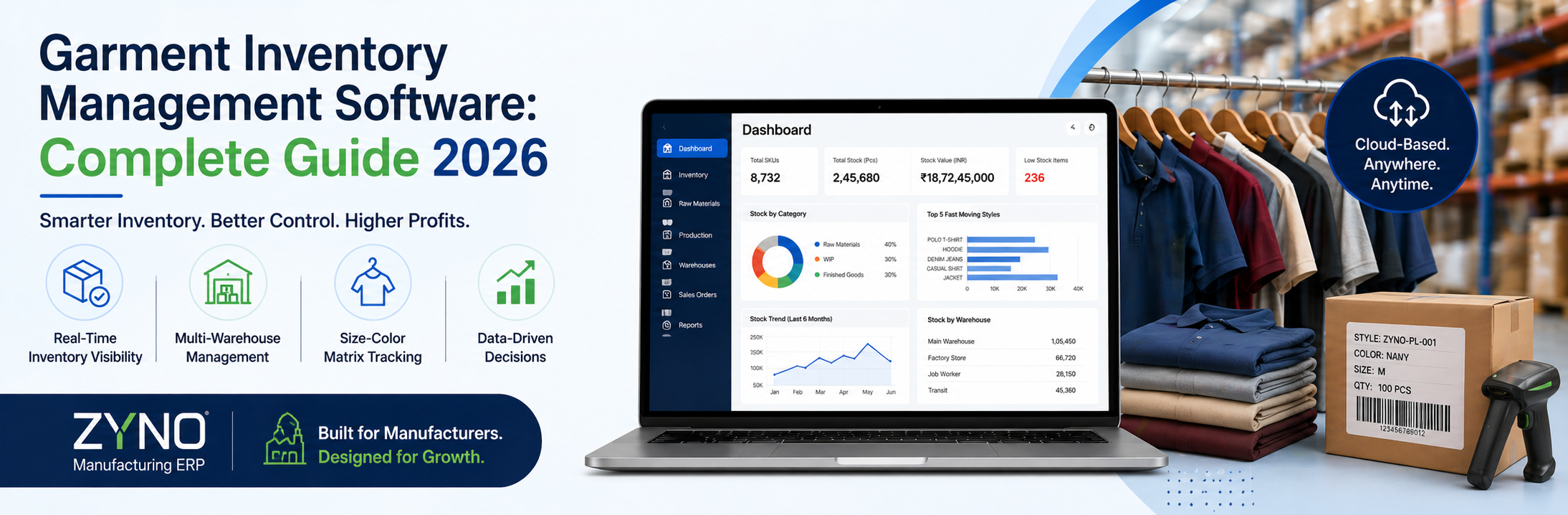
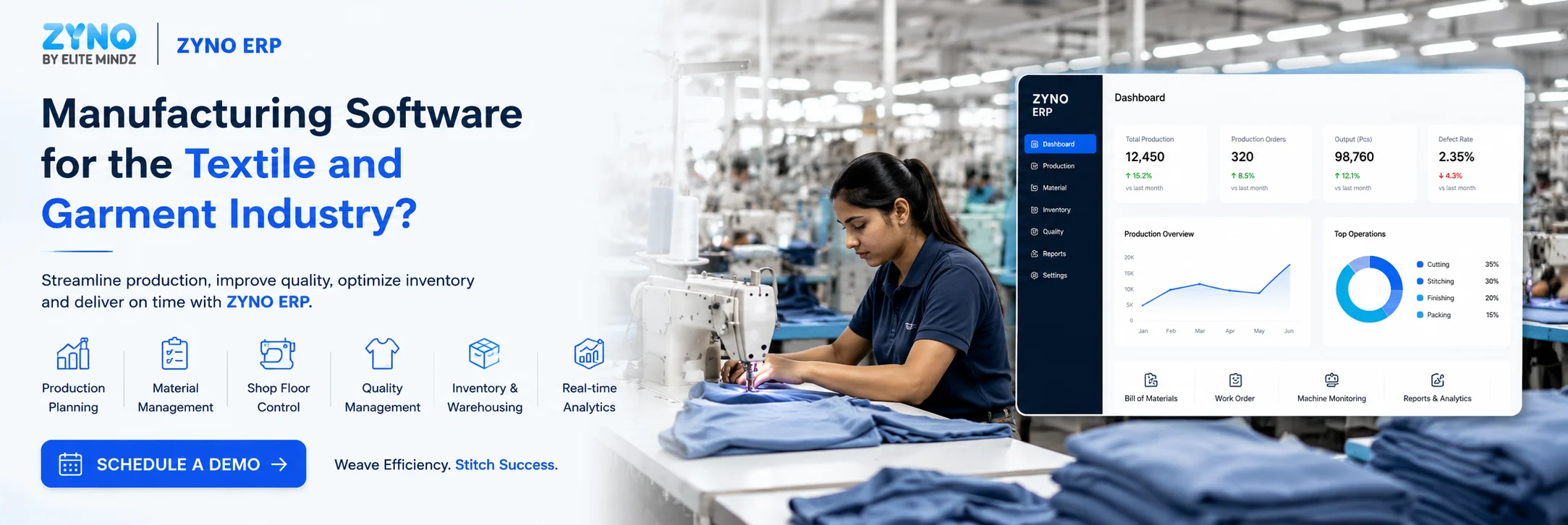
This guide walks you through everything: what the software actually does, what features matter, how 2026's top tools compare, where the industry is heading, and how ZYNO Manufacturing ERP is built specifically to solve these problems for garment and textile businesses at every scale.
The garment industry isn't like general manufacturing. A single style of shirt can generate hundreds of SKU variants — different sizes, colors, fits, fabric blends, seasonal tags, and buyer-specific requirements. A mid-size export house might easily manage 10,000+ active SKUs at any given point. Multiply that across multiple warehouses, job workers, production floors, and sales channels, and you're looking at an inventory problem that generic software simply cannot handle.
Here's what makes garment inventory uniquely difficult:
Size-Color-Style Matrix: Every style generates a grid of variants. Tracking stock at the size and color level — not just the style level — is non-negotiable. Most generic inventory tools collapse under this complexity.
Multi-Stage Production Inventory: Raw fabric goes through cutting, stitching, washing, finishing, and packing before it becomes a finished garment. At each stage, inventory changes form. Without software that tracks Work-in-Progress (WIP) at every stage, you're flying blind on production status.
Seasonal Volatility: Fashion trends shift fast. Inventory that sells like hotcakes in one quarter can become dead stock the next. Demand forecasting needs to account for seasonal cycles, buyer preferences, and trend data.
Multi-Location Complexity: Fabric might be at a job worker's facility. Finished goods could be split across three warehouses. Transit stock is in a container heading to a buyer. Good garment inventory software tracks all of it — in real time.
Buyer-Specific Requirements: Export houses deal with buyers who have specific packing, labeling, and documentation requirements. Inventory often needs to be tagged and tracked by buyer order, not just style.
This is why the best inventory software for the apparel industry isn't just a stock tracker — it's a production and supply chain command center built for textile-specific workflows.
Garment inventory management software is a specialized digital platform that tracks, manages, and optimizes stock across every stage of the garment production and distribution chain — from raw materials to finished goods delivery.
At its core, it does several things simultaneously:
When embedded into a full ERP for garment inventory control — like ZYNO Manufacturing ERP — it goes further. It connects inventory data with production planning, costing, procurement, quality control, finance, and customer order management. Everything talks to everything else. That's where the real efficiency gains happen. See also: How ERP transforms inventory management.
ZYNO Manufacturing ERP tracks fabric rolls, WIP, and finished goods — by size, colour, and style — in real time. See how it works for your factory.
Not all inventory software is built equal. The market has a lot of generic tools with a "garment module" tacked on as an afterthought. Here's what genuinely purpose-built garment industry software solutions should include:
The foundational feature. Every SKU should be trackable at the intersection of size, color, style, and any other attribute relevant to your product. Stock levels, reservations, and movements should all respect this matrix structure.
From grey fabric to cut parts to stitched panels to finished garments — every production stage should reflect in your inventory. WIP tracking prevents overselling, helps production planning, and gives you a clear picture of capacity and output.
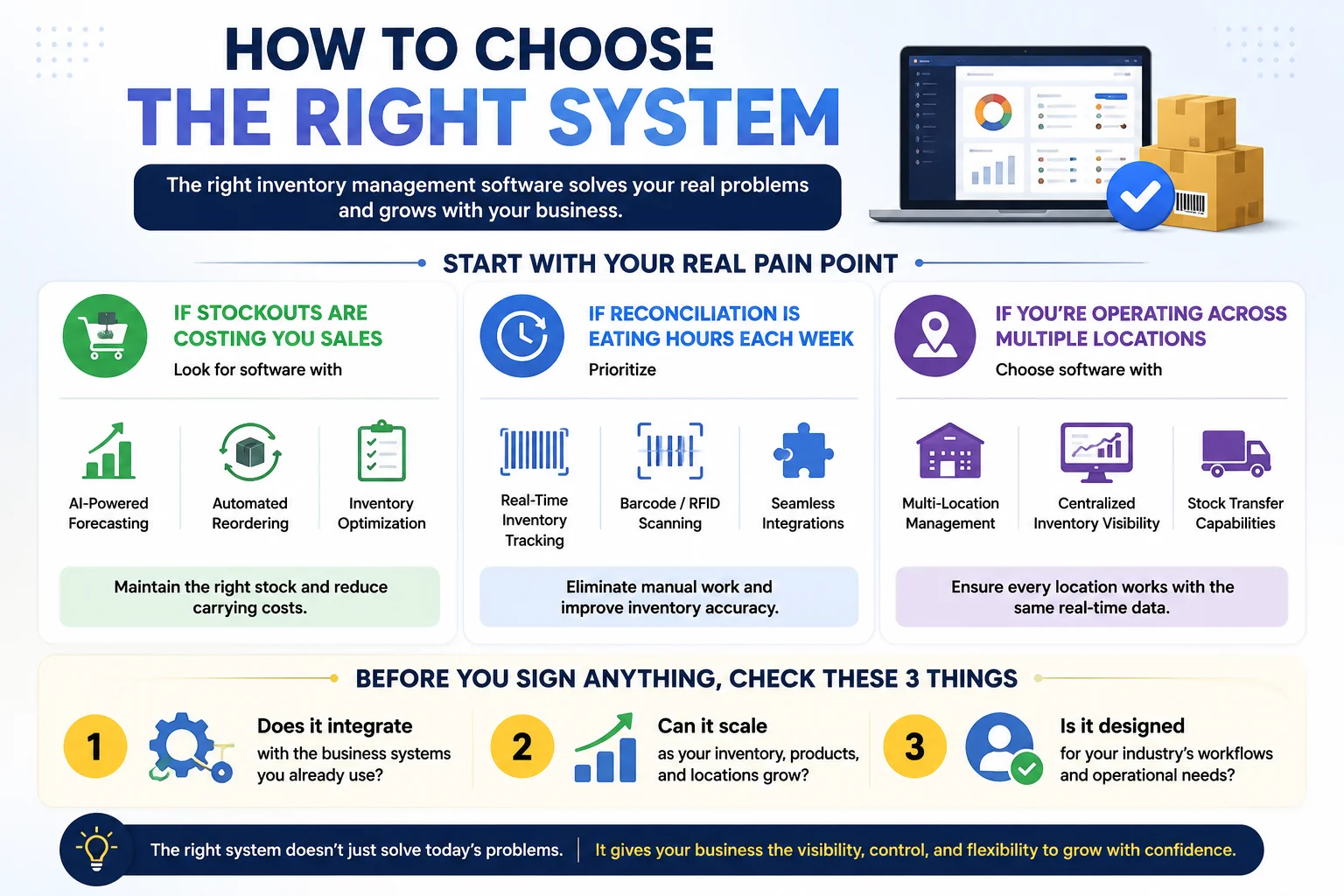
Manual stock counts are slow, error-prone, and expensive. The best garment warehouse management tools integrate with barcode scanners and RFID readers so stock movements are logged automatically at every touchpoint — goods receiving, production issue, inter-warehouse transfer, dispatch.
In 2026, batch-updated inventory data isn't good enough. Real-time inventory tracking for garments means your buyers, production managers, and warehouse teams are all looking at the same live numbers simultaneously — no discrepancies, no manual reconciliation delays.
Good software analyzes historical sales data, seasonal trends, and current order pipelines to predict what you'll need and when. AI-powered demand forecasting ensures you never hit a stockout on a fast-selling style or over-purchase on a slow-moving one.
Whether you have one warehouse or ten — including external job workers, 3PLs, or bonded warehouses — inventory positions should be visible and manageable from a single dashboard.
For export-oriented businesses, inventory needs to be reserved and tracked against specific buyer purchase orders. This prevents double-allocation and makes documentation, packing lists, and shipping confirmations far more accurate.
Inventory that fails quality inspection shouldn't re-enter the same stock pool as passed goods. Segregated QC-hold inventory tracking prevents defective stock from accidentally getting dispatched.
From ABC analysis and inventory ageing reports to style-wise sell-through rates and warehouse utilization dashboards — the reporting layer is what turns raw inventory data into business intelligence.
The 2026 inventory software trends in the garment industry are being shaped by a combination of AI maturity, cloud adoption, and a growing pressure on supply chain transparency. Here's what's defining the landscape right now:
Artificial intelligence is no longer a differentiating feature — it's quickly becoming table stakes. Leading platforms in 2026 use AI in manufacturing ERP to analyze sales patterns, seasonal cycles, social media trend signals, and even macroeconomic data to generate demand forecasts that are dramatically more accurate than rule-based systems. For garment businesses, this means smarter buying decisions and fewer markdowns.
The market is moving away from point solutions — standalone inventory tools that don't talk to anything else. Buyers are gravitating toward unified platforms where inventory management, order management, production planning, procurement, and finance all run on the same data layer. This eliminates the data silos and manual reconciliation that plague businesses running multiple disconnected systems.
On-premise ERP is losing ground fast. Cloud-based deployment means faster implementation, lower upfront cost, automatic updates, and real-time access from any device — including from factory floors via mobile. This shift is particularly relevant for garment manufacturers who operate across multiple locations or manage remote job workers.
Buyers — especially international buyers — are increasingly demanding supply chain transparency. Inventory software in 2026 is being asked to track not just stock quantities but material provenance, certifications (GOTS, OEKO-TEX), and carbon footprint data. This is becoming a real commercial requirement, not just a nice-to-have.
The days of waiting months for IT to configure your ERP are fading. Modern platforms offer low-code or no-code customization tools so businesses can adapt workflows, reports, and integrations themselves — without expensive development projects.
Inventory management and warehouse management are closely related but distinct disciplines. Garment warehouse management tools go deeper into the physical logistics of how stock is stored, located, picked, packed, and dispatched.
For garment businesses, warehouse management carries specific challenges. Garments on hangers (GOH) need different storage logic than folded knits. High-velocity styles need to be slotted near dispatch areas. Seasonal stock needs to be accessible but not taking up prime space. Returns and defective stock need to be segregated and processed without contaminating good inventory.
Good garment warehouse management software handles:
ZYNO Manufacturing ERP integrates warehouse management directly with production and inventory modules, so the garment leaves the production floor and enters the warehouse without any manual re-entry of data. That's where time and errors are saved.
The conversation around cloud-based inventory software for textiles has shifted from "should we go cloud?" to "how fast can we migrate?" Here's why:
Zero Infrastructure Cost: Cloud deployment eliminates the need for on-premise servers, IT maintenance staff, and local backup systems. For small and mid-size garment businesses, this is a significant cost reduction.
Real-Time Access Everywhere: A buyer in Germany can be looking at the same live inventory data as your warehouse manager in Tirupur. Your production manager on the factory floor can check fabric availability from a tablet. Cloud-native architecture makes this seamless.
Automatic Updates: When regulations change, when you add a new sales channel, when the software adds a new feature — cloud-based platforms update automatically. You're always on the latest version without a disruptive upgrade project.
Scalability on Demand: Going from one warehouse to three, or from domestic to export operations, shouldn't require a new software implementation. Cloud platforms scale with you — add users, locations, and modules as you grow.
Business Continuity: Unlike on-premise systems that go down when a server fails, cloud systems have built-in redundancy and disaster recovery. Your data is always safe and accessible.
ZYNO Manufacturing ERP is built cloud-native. There's no local installation required, no server to maintain, and no scheduled downtime for updates. Your garment inventory data is live, secure, and accessible from any device — always.
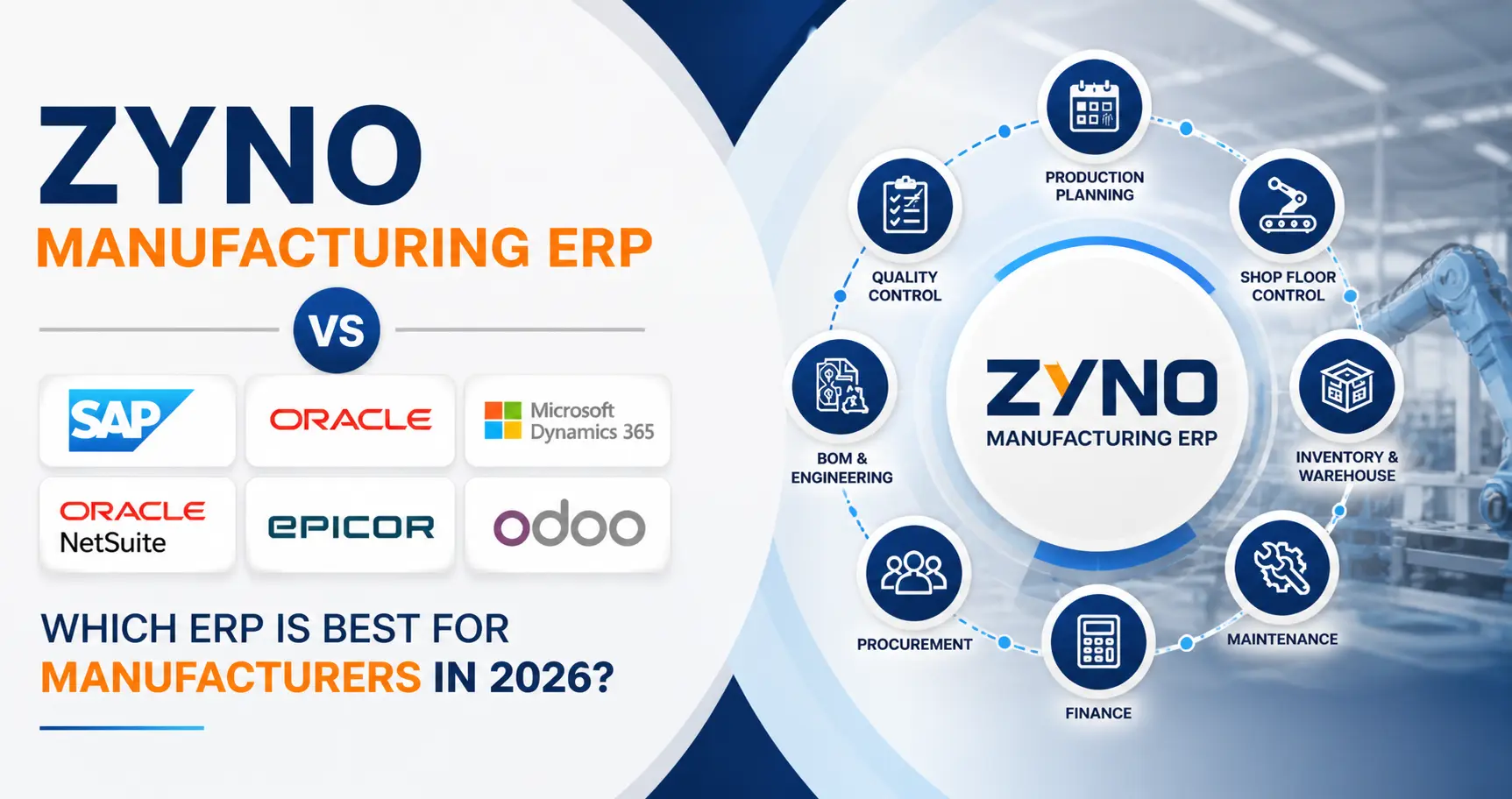
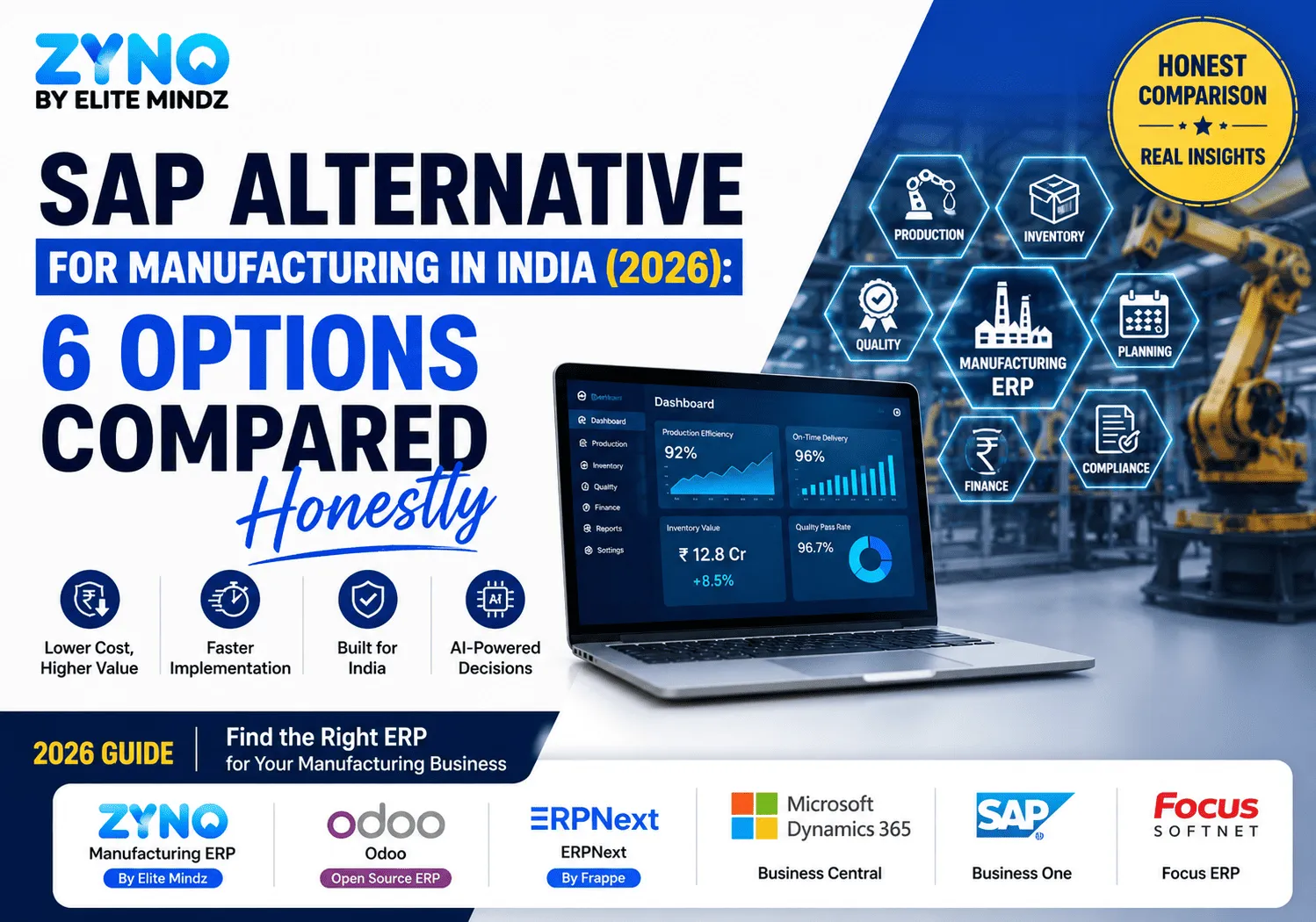
The comparison inventory software for garments conversation in 2026 comes down to a few key players. See our full roundup of top manufacturing ERP software in India.
A full-scale enterprise ERP with strong inventory and financial management capabilities. Popular with larger mid-market and enterprise apparel companies running international operations. Implementation typically takes 6–12 months and requires significant consultant investment. The scope is broad — useful if you need a complete ERP overhaul, but potentially over-engineered and expensive if you primarily need garment-specific inventory control.
A fashion-specific ERP with particularly strong inventory and order management for apparel brands. Known for its size-color matrix handling and AI-powered inventory allocation. Best suited for mid-size fashion brands and wholesale operations. Pricing is available on request.
A cloud-based inventory platform with solid multi-channel synchronization across ecommerce, POS, and 3PL. Strong for brands selling across multiple platforms. Less specialized for manufacturing-side garment workflows like WIP tracking and cut-make-trim costing.
Well-regarded for inventory plus manufacturing with strong QuickBooks integration. Good for SMBs that need production-linked inventory management. More suited to general manufacturing than textile-specific workflows.
A modular, open-source ERP that's budget-friendly and flexible. Popular with startups and early-stage businesses. The trade-off is that garment-specific functionality requires significant customization effort.
Purpose-built for manufacturing businesses — including garment factories, textile mills, and apparel export houses. ZYNO Manufacturing ERP combines garment-specific inventory management with production planning, procurement, quality control, costing, and finance in one unified platform. Unlike many of the above, ZYNO is designed with the workflows of South Asian and Southeast Asian garment manufacturers specifically in mind — with multi-currency, multi-location, and buyer-order-linked inventory tracking built into the core product, not bolted on as modules. Cost-effective pricing tiers make it accessible to SMBs while the feature depth serves mid-market and enterprise operations.
Unlike generic ERP platforms, ZYNO is built from the ground up for textile and apparel businesses — with multi-location inventory, buyer-order tracking, and WIP visibility built in.
The advantages of inventory management in garments extend well beyond "knowing what's in stock." When done properly — and supported by the right software — inventory management becomes a profit lever for your business.
Eliminating Stockouts and Lost Sales: When your most popular sizes are consistently in stock, customers don't walk away disappointed. For wholesale, it means you don't fail delivery commitments. For retail and ecommerce, it means fewer cancelled orders and better conversion rates.
Reducing Excess and Dead Stock: Overstocking ties up working capital, increases warehouse costs, and creates markdowns that eat into margins. Good inventory management — driven by demand forecasting — helps you buy and produce the right quantities, reducing the capital locked in slow-moving stock.
Faster Order Fulfillment: When every item has a known location, picking and packing is faster. Automated packing list generation eliminates manual documentation. Dispatch turnaround times drop — which matters enormously in an industry where buyers judge you on delivery performance.
Accurate Costing: For garment manufacturers, material cost is the largest component of product cost. Accurate raw material inventory — fabric consumption tracking, wastage recording, and yield variance analysis — feeds directly into accurate product costing and better pricing decisions.
Compliance and Audit Readiness: Buyer audits, customs documentation, and financial audits all require accurate inventory records. Automated inventory systems generate audit trails automatically, reducing the time and stress of compliance activities.
Better Supplier Negotiations: When you know exactly what you have and what you'll need, leverage procurement and supplier management to consolidate orders and negotiate bulk pricing.
ZYNO Manufacturing ERP approaches ERP for garment inventory control differently from generic ERP platforms — because it was designed with the realities of garment manufacturing at its core, not retrofitted after the fact.
Here's how ZYNO specifically addresses garment inventory needs:
Style-Wise, Size-Wise, Color-Wise Inventory: ZYNO maintains inventory at full matrix granularity. You can see stock — and stock movements — broken down by every attribute that matters to your business.
Raw Material to Finished Goods Traceability: From the moment fabric enters your store to the moment a finished garment is dispatched, every movement is tracked. ZYNO's production module links to inventory so that fabric issued to cutting reflects immediately in raw material stock, and finished goods entering the warehouse are immediately available for allocation.
Buyer-Order-Linked Allocation: ZYNO allows you to reserve and allocate finished goods inventory against specific buyer purchase orders. This means your warehouse team always knows what's available for open orders, preventing double-selling or delayed shipments.
Job Work Inventory Tracking: For garment businesses that outsource processes — embroidery, washing, printing, or entire CMT operations — ZYNO tracks materials sent to job workers, monitors job work status, and accounts for goods received back into your inventory.
Integrated Quality Hold Management: Garments that fail inspection are automatically moved to a segregated QC-hold inventory pool in ZYNO. They don't show up as available stock until they've been reviewed, repaired, or disposed of — preventing accidental dispatch of defective goods.
Multi-Warehouse Dashboard: All your inventory positions — across factories, finished goods warehouses, job workers, and transit — are visible in a single dashboard. No spreadsheet reconciliation required.
Real-time inventory tracking for garments is one of those phrases that every software vendor claims but few actually deliver. Here's what it means in practice with ZYNO:
When a production supervisor issues fabric to the cutting floor, it's logged immediately in ZYNO — reducing raw material stock and adding to WIP inventory in real time. No end-of-day batch update. No morning reconciliation.
When a quality inspector passes a batch of finished garments, they're immediately visible in finished goods inventory — ready for allocation or dispatch. The warehouse manager doesn't need to call the QC team; they can see the status on their screen.
When a dispatch is created and goods leave the warehouse, inventory is decremented in real time. The finance team immediately has accurate stock valuation. The sales team knows what's available to sell without calling the warehouse.
When goods are received from a supplier or job worker, a goods receipt note in ZYNO triggers an immediate inventory update — along with a payable entry in accounts, if configured.
This real-time visibility isn't just operationally convenient — it's financially critical. Accurate, live inventory data means accurate financial statements, better cash flow management, and more reliable business forecasting.
Two of the most common concerns garment businesses raise when evaluating ERP are: "Will it fit our specific processes?" and "Can we afford it?"
ZYNO is built with configuration flexibility at its core. You don't need to change your processes to fit the software — you configure ZYNO to match how your business actually operates. Whether you're a cut-make-trim factory working on job basis, a vertically integrated mill running your own brand, or an export house managing multiple buyers with different requirements — ZYNO's workflows, fields, reports, and user roles can be configured accordingly.
Custom inventory attributes, custom document templates, user-defined reports, and role-based access controls mean ZYNO works for your team — not the other way around.
ZYNO's pricing is structured to make enterprise-grade garment inventory management accessible without the enterprise-sized budget. Unlike platforms like NetSuite or SAP — where the total cost of ownership includes months of consulting, expensive licensing, and complex implementation projects — ZYNO is designed for faster deployment and predictable pricing.
For small and mid-size garment businesses, this means you get the same quality of real-time inventory visibility, multi-location tracking, and production integration that larger competitors use — at a cost that makes business sense.
The future of garment inventory software is defined by three intersecting forces: intelligence, connectivity, and sustainability.
Today, AI in garment inventory software primarily helps with demand forecasting and inventory allocation recommendations. In the near future, AI will move deeper into autonomous decision-making — automatically triggering purchase orders, rebalancing stock across locations, and flagging production anomalies without requiring human intervention. The goal is a system that doesn't just tell you what's happening but takes corrective action before problems escalate.
Innovative inventory solutions for textiles in the coming years will extend beyond the four walls of your factory. Real-time inventory visibility will include your suppliers' stock positions, your logistics partners' container tracking, and your customers' consumption data — all connected into a single supply chain intelligence layer. This kind of end-to-end visibility will dramatically reduce lead times and improve planning accuracy.
As environmental regulations tighten and buyer requirements evolve, sustainability tracking will become embedded in inventory software as a core feature — not an add-on. This means tracking fabric certifications, carbon footprint per garment, water usage in production, and recycled content percentages — all at the inventory item level.
RFID adoption in garment warehouses is already growing fast. Within a few years, automated inventory counting, real-time location tracking within warehouses, and even garment-level RFID tagging for retail will become standard practice. Software platforms will need to support this data volume and translate it into actionable insights.
ZYNO's development roadmap is aligned with all of these directions — with ongoing investment in AI-powered forecasting, IoT integration capabilities, and sustainability reporting features.
The garment and textile industry is at a genuine inflection point. The businesses that will lead their markets in the next five years aren't necessarily the ones with the most production capacity or the lowest costs. They're the ones that can move fastest — making accurate decisions about inventory, production, and supply chain with real-time data rather than yesterday's spreadsheets.
Garment inventory management software is the foundation of that agility. And in 2026, there's no longer a reason to settle for generic tools that don't understand the matrix complexity, WIP dynamics, and buyer-specific requirements that define this industry.
ZYNO Manufacturing ERP is built for exactly this. If you're a garment manufacturer, apparel exporter, or textile business looking to replace manual inventory processes with a system that actually understands how your business works — ZYNO is worth a serious look.
Ready to see ZYNO in action? Book a free demo and let our team walk you through how ZYNO handles your specific garment inventory challenges — from raw material tracking to real-time finished goods visibility and everything in between.
From raw fabric to finished goods dispatch — ZYNO Manufacturing ERP gives you real-time visibility, zero spreadsheet chaos, and inventory accuracy your buyers can count on.
Keywords: garment inventory management software, best inventory software garments, 2026 inventory software trends, features of garment inventory software, garment warehouse management tools, compare inventory software garments, cloud based inventory software textiles, garment industry software solutions, textile inventory control software, advantages of inventory management garments, top garment inventory tools 2026, inventory software for apparel industry, future of garment inventory software, real time inventory tracking garments, customizable garment inventory solutions, cost effective inventory management software, apparel stock management software, optimizing garment inventory software, innovative inventory solutions for textiles, ERP for garment inventory control
Sneha Singh
Content Writer
Sneha Singh is a B2B tech content strategist with 4+ years of experience. She specializes in SEO-driven SaaS content, whitepapers, and platform-native social media campaigns that simplify complex technology and drive business growth. Sneha's core exp
What is ERP? A Beginner's Guide to Enterprise Resource Planning
Read More →

Cloud ERP vs. On-Premise vs. Hybrid: Best ERP Model for 2025
Read More →How To Customize ERP Software Without Breaking The Bank?
Read More →
The Future of Manufacturing ERP in 2026 & Beyond
Read More →Best ERP Software in India: 2026 Edition
Read More →
AI in Manufacturing ERP: The Future of Smart Factories
Read More →
How ERP Transforms Inventory Management and Reduces Costs
Read More →
Top Features to Look for in Inventory Management Software in 2025
Read More →
Top 5 Ways Asset Management Software Can Save Your Business Money
Read More →
Why Smart Businesses Are Switching to Vendor Management Systems in 2025?
Read More →
Why Manufacturing Companies Need ERP Software
Read More →
Cloud ERP vs. Traditional ERP: Which is Right for You?
Read More →
ERP for Small Business: Is It Worth the Investment?
Read More →
How to Calculate ERP ROI and Why It's Worth the Investment
Read More →
Top 10 ERP Software Companies in India 2026 Updated List (Complete Guide)

Read More →
ERP Implementation Mistakes to Avoid in 2025
Read More →
Cloud ERP vs Edge Computing: What's Right for Modern Manufacturing?
Read More →
The Future of ERP Software and the Role of Generative AI
Read More →
Digital Twin Technology & ERP: Real-Time Insights for Smarter Manufacturing
Read More →
Scalable ERP Solutions Designed for Modern Enterprises
Read More →
ERP and IoT Integration: Smart Factory Vision
Read More →Best ERP Software for Manufacturing Businesses in India
Read More →Top 10 Best Manufacturing ERP Software in India (2026)
Read More →
Best ERP Software for Manufacturing Industries in Ethiopia (2026)
Read More →
Best School ERP Software Providers in UAE (2025 Edition)
Read More →
Best School ERP Software for 2025: Guide for Educational Institutions
Read More →
Top 10 ERP Software Solutions for Nigerian Manufacturers (2025 Edition)
Read More →
Best ERP Systems for Scalable Retail and POS Integration
Read More →
Top 10 Cloud-Based Manufacturing ERP Solutions in Africa (2025 Edition)
Read More →
Top 10 Cloud-Based Manufacturing ERP in UAE
Read More →
Top 10 Cloud-Based Manufacturing ERP Software in Nigeria (2026 Edition)
Read More →
Top 10 School ERP Software Companies in Kenya (2025)
Read More →
Best School ERP Software Providers in Nigeria (2025)
Read More →
Top Cloud-Based Manufacturing ERP in Zimbabwe (2025)
Read More →
Best ERP Software in U.K
Read More →
Top 10 ERP Software Developers in the U.K. (2025)
Read More →
Best ERP Software Providers in France (2025)
Read More →
Best ERP Software Companies in Germany : A Comprehensive Guide
Read More →
Top 10 ERP Software Development Companies in Qatar
Read More →
10 Best ERP Providers in Germany - 2026 Updated List
Read More →
Best ERP Software Firms in Saudi Arabia (2025)
Read More →
Best ERP Service Providers in Indonesia for SMEs and Large Enterprises
Read More →
Top 10 Cloud-Based Manufacturing ERP Systems in Egypt for Modern Factories
Read More →
Top ERP Solutions in the USA 2025: Streamline Your Business with ZYNO ERP
Read More →
Top ERP Solutions in Qatar for Businesses of All Sizes
Read More →Top Manufacturing ERP Software in India 2026 ZYNO Manufacturing ERP
Read More →How Manufacturing Companies Reduce Production Delays Using ERP Automation
Read More →Why Legal Firms Need ERP to Manage Cases, Billing & Compliance
Read More →What Is ERP And How Does It Work
Read More →
How ERP Systems Are Evolving in 2026: What Businesses Need to Know
Read More →
Best ERP Software in India: 2025 Edition
Read More →
Top 10 ERP Software Companies in Delhi NCR
Read More →
How Manufacturing ERP Software Improves Demand Forecasting
Read More →
Top 10 Best School Management Software in India
Read More →Manufacturing & Wholesale ERP in Qatar: Complete Industry Guide 2026
Read More →Cloud ERP Software in Qatar: Why Businesses Are Moving in 2026
Read More →Is ERP a Procurement Software? Key Differences, Benefits & What to Choose
Read More →What Is Production Planning and Control? Definition, Objectives & Functions
Read More →
Garment Inventory Management Software: Complete Guide 2026
Read More →
How ERP Reduces Fabric Wastage in Garment Factories
Read More →
Why the Garment Industry Needs a Specialized ERP
Read More →
Features to Look for in Garment Manufacturing ERP Software
Read More →
Best ERP Software for Small Garment Manufacturing Business in India
Read More →
The Real Problems Holding Back Small Garment Manufacturers in India
Read More →Partner with ZYNO by Elite Mindz to revolutionize how your business works. Fill out the form, and we’ll reach out with AI-powered solutions made just for you.
We use browser cookies to ensure you get the best experience on our website. Learn more
The form was submitted successfully!
ZYNO Digital
Fueling Smarter Digital Growth
ZYNO Digital fuels smarter digital growth through data-driven marketing, creative storytelling, and performance strategies that boost visibility, engagement, and measurable business outcomes across global platforms.
ZYNO Tech
Engineering the Future of IT
ZYNO Tech delivers cutting-edge IT solutions — including web, mobile, and digital transformation services — helping businesses scale efficiently, innovate faster, and stay ahead in a connected world.
ZYNO AI
AI Built for Business Growth
ZYNO AI harnesses the power of artificial intelligence to automate processes, enhance decision-making, and deliver predictive insights — driving innovation, agility, and measurable business growth.
ZYNO by Elite Mindz
Your Partner in the AI-Powered Future
ZYNO by Elite Mindz offers AI-powered products and services that unify operations, boost productivity, and drive digital transformation — helping businesses scale smarter and innovate faster.
* In just 2 mins you'll get a response
* Your idea is 100% protected by our Non-Disclosure Agreement