×
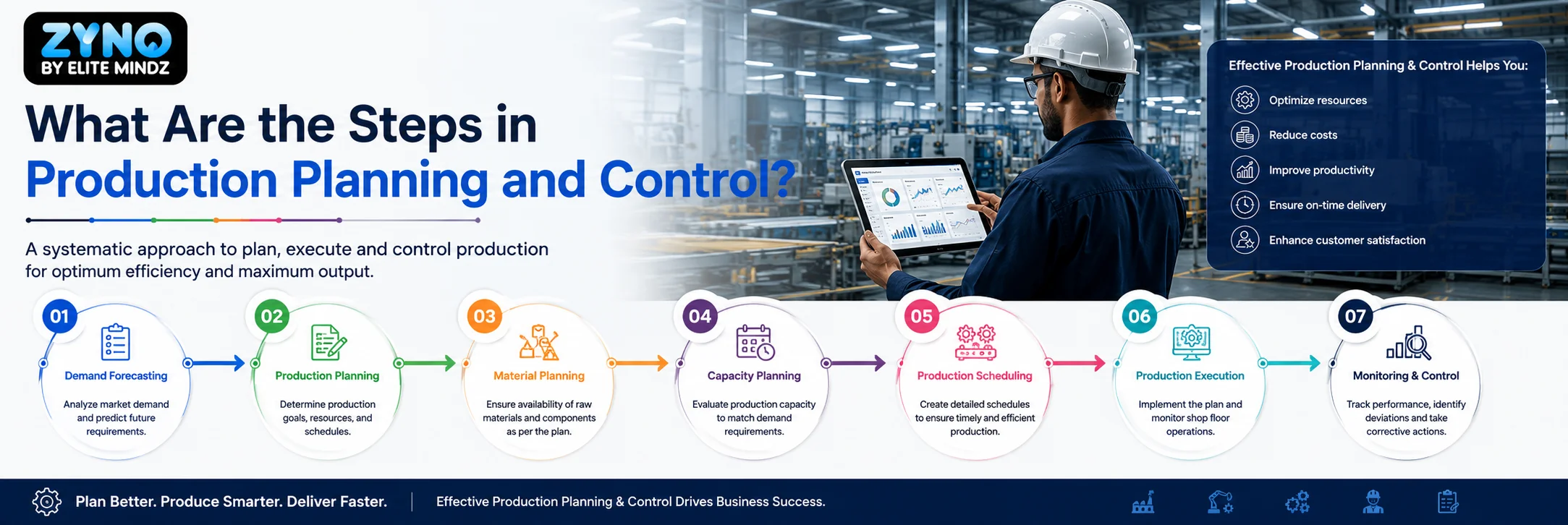
Production planning and control (PPC) is a management process that organizes, schedules, and monitors manufacturing activities. It ensures the right resources are available at the right time to meet production targets efficiently.
Have you ever wondered how large factories consistently deliver finished products on time? The answer lies in production planning and control. Every successful manufacturing operation depends on a strong PPC system. Without it, businesses face delays, resource waste, and unhappy customers.
In today's competitive market, manufacturers cannot afford to leave things to chance. Therefore, understanding what is production planning and control becomes essential for every operations manager, factory owner, and supply chain professional.
Through this blog, let’s understand the basic definition of the key functions, stages, types, and tools that make PPC work effectively. Additionally, we will show you how ZYNO by Elite Mindz helps manufacturers take their production planning to the next level.
To define production planning and control is the systematic process of planning production activities in advance and then controlling those activities to ensure they run as planned.
In simpler terms, production planning decides what to produce, how much to produce, and when to produce. On the other hand, production control makes sure everything happens according to that plan. Together, they form a complete cycle of coordination.
Moreover, production planning and control act as the backbone of any manufacturing operation. It connects raw material procurement, machine scheduling, labor allocation, and delivery timelines into a single, seamless workflow.
Note: According to McKinsey, manufacturers using advanced planning systems can reduce costs by up to 20%. Deloitte highlights that manufacturing analytics and planning significantly improve operational efficiency and inventory control.
The importance of production planning and control cannot be overstated. Businesses that invest in strong PPC systems consistently outperform those that don't. Here is why it matters so much:
According to McKinsey, manufacturers that adopt advanced planning systems reduce production costs by up to 20% and improve on-time delivery by 30%.
Reduces Waste: PPC helps eliminate unnecessary use of materials and machine time.
Improves Efficiency: It ensures every resource — labor, machines, and materials — is used optimally.
Ensures Timely Delivery: Customers receive their orders on time, which builds trust and loyalty.
Controls Costs: Proper planning reduces idle time and emergency procurement expenses.
Enhances Quality: Controlled production reduces errors and rework, thus improving quality.
Supports Decision-Making: Managers can make faster and smarter decisions with real-time data.
"Effective production planning is not just about scheduling machines — it is about creating a resilient system that can absorb disruptions and still deliver on its promises to customers."
— Dr. Rajan Suri, Professor Emeritus of Industrial Engineering, University of Wisconsin-Madison
Manufacturers using advanced planning systems cut costs by up to 20%. ZYNO by Elite Mindz gives you real-time visibility, automated scheduling, and complete production control — all in one platform.
The functions of production planning and control cover every stage of the manufacturing process. Let's explore each function in detail:
The planning function defines production goals and creates a roadmap to achieve them. It covers capacity planning, material requirements, and scheduling. This function sets the foundation for everything that follows.
Routing determines the path a product takes through the factory. Specifically, it defines which machines will be used, in what sequence, and through which departments. Good routing avoids bottlenecks and keeps production flowing.
Scheduling assigns time slots for each operation. It answers questions like — when will each job start, and when will it finish? Effective production planning and scheduling ensure machines and workers are never idle or overloaded.
Dispatching is the action phase. It releases work orders, job cards, and instructions to the shop floor. In other words, dispatching transforms plans into actual production activities.
Follow-up monitors the actual progress against the planned schedule. If delays occur, expediting steps for fast-track critical jobs. This function keeps production on track even when unexpected issues arise.
This function ensures that the finished products meet quality standards. It is integrated into the production process to catch defects early, thereby reducing rework costs.
When deviations occur between planned and actual production, this function identifies the root cause and takes corrective steps. As a result, future production cycles become more efficient.
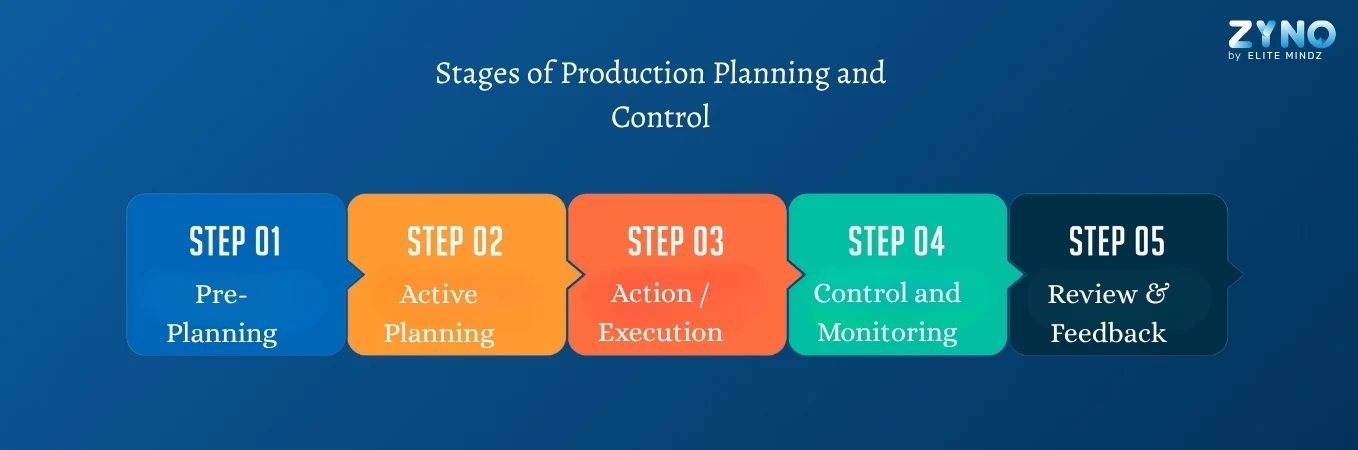
The product planning process moves through distinct stages. Each stage builds on the previous one to create a fully controlled production environment.

This stage involves forecasting demand, analyzing capacity, and gathering raw material requirements. It sets the big picture before production begins.
Here, managers create detailed production schedules, assign tasks, and allocate resources. This is where plans become specific and actionable.
The plan moves to the shop floor. Workers and machines begin their assigned tasks according to the schedule. Clear communication is key at this stage.
Supervisors track actual performance against the plan. They identify variances in output, quality, and timing. Real-time dashboards from production planning software are extremely helpful here.
After a production cycle ends, the team reviews outcomes. Lessons learned feed into the next planning cycle, continuously improving the process.
According to McKinsey, manufacturers that adopt advanced planning systems reduce production costs by up to 20% and improve on-time delivery by 30%.
Many people confuse these two terms. However, they serve very different purposes. Let's break it down clearly:
| Aspect | Production Planning | Production Control |
|---|---|---|
| Focus | Future-oriented; plans activities in advance | Present-oriented; monitors ongoing activities |
| Purpose | Decides what, how, and when to produce | Ensures actual production matches the plan |
| Tools Used | Forecasts, schedules, capacity plans | Progress reports, corrective actions, KPIs |
| Time Frame | Before production starts | During and after production |
| Outcome | A structured production schedule | On-time, quality-compliant finished goods |
As you can see, production planning and production control are two sides of the same coin. Together, they complete the PPC cycle.
Different manufacturing environments require different planning approaches. Here are the main types of production planning and control:
This type is used when products are customized per customer order. Each job is unique, so planning is done individually for each order. It is common in industries like construction, printing, and custom furniture.
Batch planning is used when products are produced in batches. Each batch follows the same sequence of operations. Food processing and pharmaceuticals commonly use this approach.
Mass production planning handles high-volume, standardized products. The focus is on efficiency and speed. Automobile manufacturing is a classic example.
This type is used for round-the-clock operations, such as oil refineries and chemical plants. Planning focuses on maintaining uninterrupted production flows and preventing breakdowns.
Lean planning eliminates waste at every step. It focuses on producing only what is needed, when it is needed. Consequently, it reduces inventory costs and improves responsiveness.
Implementing a strong production planning and control system delivers measurable advantages across the entire operation:
Better Resource Utilization: Machines, workers, and materials are used to their full potential.
Lower Production Costs: Reduced waste and better scheduling significantly reduce overall costs.
Faster Time-to-Market: Streamlined processes speed up product delivery to customers.
Higher Customer Satisfaction: On-time deliveries and consistent quality keep customers happy.
Improved Inventory Management: PPC reduces both overstock and stockouts through precise planning.
Greater Flexibility: Businesses can quickly adapt to demand changes or supply disruptions.
Stronger Compliance: Controlled processes make it easier to meet industry regulations and standards.
According to Deloitte, manufacturers using integrated production planning tools report a 25% reduction in inventory carrying costs and a 40% improvement in schedule adherence.
"Effective production planning is not just about scheduling machines — it is about creating a resilient system that can absorb disruptions and still deliver on its promises to customers."
— Dr. Rajan Suri, Professor Emeritus of Industrial Engineering, University of Wisconsin-Madison
Optimizing production planning and scheduling requires a combination of smart strategies and the right tools. Here is a step-by-step approach:
Use historical sales data and market trends to predict future demand. Accurate forecasts reduce over-production and under-production. Modern production planning software makes this much easier.
Understand exactly how much your machines and workforce can handle. Capacity mapping reveals constraints before they become problems on the shop floor.
Track production progress in real time. When you can see delays as they happen, you can correct them before they escalate into bigger issues.
Clearly documented processes reduce confusion and errors. Standardization also makes it easier to train new employees and scale operations.
Investing in manufacturing production planning software is one of the most impactful decisions a manufacturer can make. These tools automate scheduling, flag bottlenecks, and seamlessly integrate with ERP and MES systems.
Never treat your production plan as final. Regular reviews help identify inefficiencies and opportunities for improvement. Build a culture of continuous improvement into your operations.
Why build schedules manually when ZYNO does it for you? Our intelligent scheduling engine reduces planning time by up to 70% — so your team focuses on execution, not spreadsheets.
Effective production planning and scheduling depend on several critical factors. Overlooking even one of them can cause the entire plan to fall apart.
Machine Availability: Always account for planned maintenance and breakdowns in your schedule.
Labor Skills: Match workers to tasks based on their specific skills and certifications.
Material Lead Times: Factor in supplier lead times to ensure materials arrive before they are needed.
Customer Deadlines: Work backward from delivery dates to create realistic production timelines.
Quality Requirements: Build in time for inspections and rework buffers to maintain quality standards.
Production Sequence: Optimize the order of operations to minimize setup time and material handling.
External Disruptions: Plan for supply chain risks, power outages, and other unpredictable events.
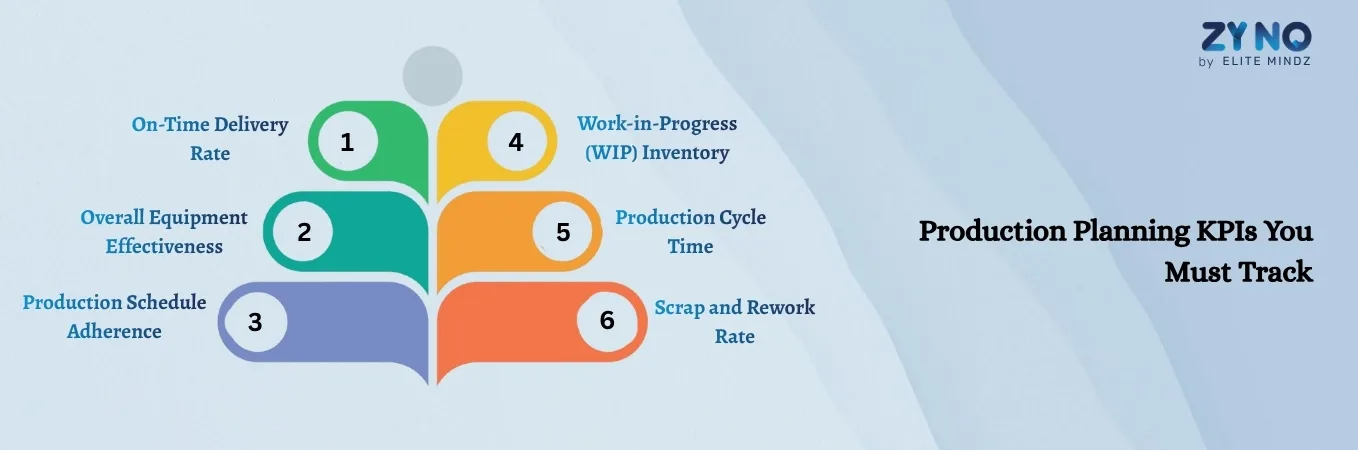
Without the right KPIs, you cannot measure the success of your production planning and control efforts. Here are the most important metrics to track:

This KPI measures the percentage of orders delivered on or before the promised date. A high OTD rate reflects strong scheduling and execution.
OEE measures how effectively your machines are being used. It combines availability, performance, and quality into a single score.
This metric shows how closely actual production follows the planned schedule. Low adherence signals problems in planning, resources, or execution.
High WIP levels indicate bottlenecks in the production process. Monitoring WIP helps identify where work is piling up and needs attention.
Cycle time measures how long it takes to complete one unit from start to finish. Reducing cycle time directly improves throughput and customer satisfaction.
This KPI tracks the percentage of products that are scrapped or require rework. A lower rate means better process control and quality management.
Even experienced operations teams make these mistakes. Being aware of them can save significant time, money, and frustration.
Ignoring Real-Time Data: Planning based on outdated information leads to poor decisions and missed deadlines.
Over-Scheduling Capacity: Pushing machines and workers beyond their limits causes breakdowns and burnout.
Lack of Communication: When planners and shop floor teams don't communicate, plans fall apart quickly.
Neglecting Maintenance: Skipping scheduled maintenance saves time now, but leads to costly breakdowns later.
Manual Planning Without Software: Spreadsheets cannot handle the complexity of modern manufacturing. They lead to errors and delays.
No Contingency Planning: Always have a backup plan for supplier delays, machine failures, and sudden demand spikes.
Ignoring Feedback Loops: Not reviewing completed cycles means repeating the same mistakes.
Managing production planning and control manually is no longer enough in today's fast-moving manufacturing world. This is exactly where ZYNO by Elite Mindz makes a transformational difference.
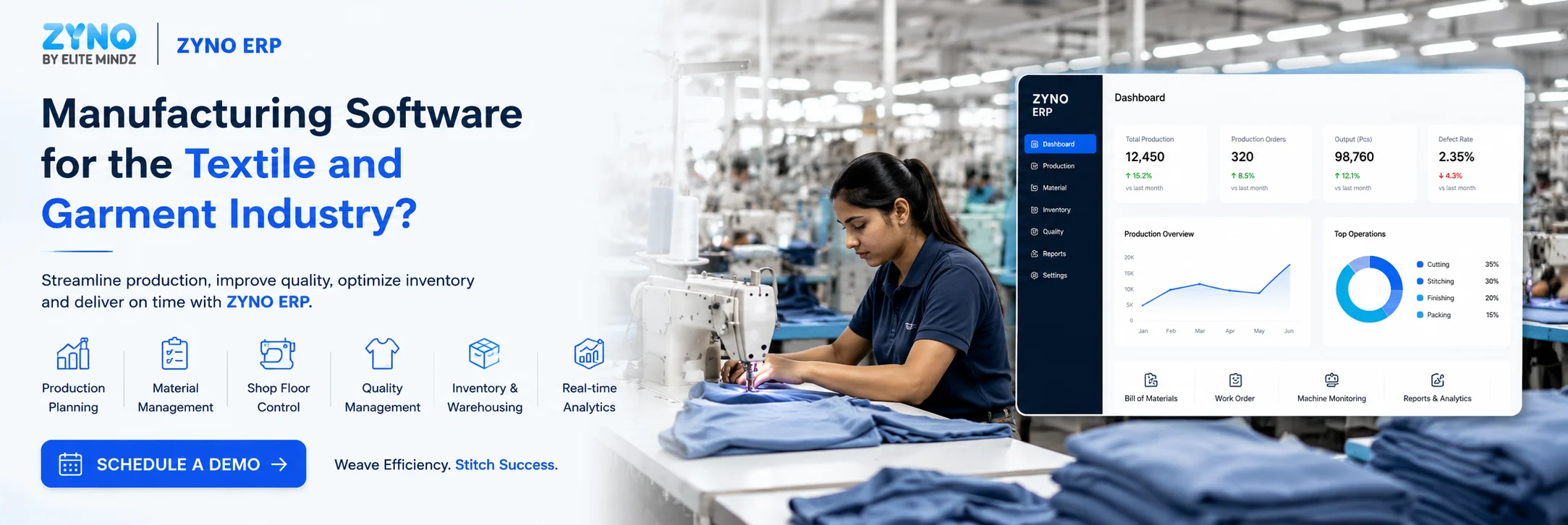
In today’s competitive landscape, digital transformation in manufacturing is no longer optional—it’s essential for efficiency and scalability. ZYNO is a powerful manufacturing production planning software built specifically for manufacturers who want to eliminate guesswork and gain complete control over their operations.
Real-Time Production Tracking: Monitor every stage of production from a single dashboard. Instantly spot delays and take corrective action.
Automated Scheduling: ZYNO's intelligent engine creates optimized production schedules, reducing planning time by up to 70%.
Capacity Planning Tools: Understand your machine and labor capacity in real time. Prevent over-scheduling before it becomes a problem.
Demand Forecasting: Use AI-driven insights to predict demand and plan production accordingly. Stay ahead of market changes.
Seamless ERP Integration: ZYNO seamlessly integrates with your existing ERP systems, ensuring data flows without manual intervention.
Custom KPI Dashboards: Track your most important production planning KPIs in real time with fully customizable dashboards.
Mobile Accessibility: Manage your production floor from anywhere. ZYNO works seamlessly on desktop and mobile devices.
Furthermore, ZYNO is designed for manufacturers of all sizes — from growing SMEs to large-scale industrial operations. Whether you are in automotive, food processing, textiles, or electronics, ZYNO adapts to your specific needs.
To summarize, production planning and control are the engine that drives efficient manufacturing. From defining what to produce to monitoring production in real time, PPC covers every critical aspect of the manufacturing process.
The objectives of production planning and control — efficiency, cost reduction, quality, and on-time delivery — are universal across all industries. Whether you run a small factory or a large industrial plant, investing in a strong PPC system always pays off.
Moreover, as manufacturing grows more complex, the need for dedicated production planning software becomes even more critical. Manual methods simply cannot keep up with today's production demands.
ZYNO by Elite Mindz gives manufacturers the tools they need to plan smarter, execute faster, and control better. It is not just software — it is a complete production management solution.
So, if you are ready to take your production planning and control to the next level, ZYNO is your answer. Connect with the Elite Mindz team today and see the difference for yourself.
Join manufacturers who have improved on-time delivery by 30% and reduced inventory costs by 25% with ZYNO by Elite Mindz. Your smarter factory starts here.
Sneha Singh
Content Writer
Sneha Singh is a B2B tech content strategist with 4+ years of experience. She specializes in SEO-driven SaaS content, whitepapers, and platform-native social media campaigns that simplify complex technology and drive business growth. Sneha's core exp
What is ERP? A Beginner's Guide to Enterprise Resource Planning
Read More →

Cloud ERP vs. On-Premise vs. Hybrid: Best ERP Model for 2025
Read More →How To Customize ERP Software Without Breaking The Bank?
Read More →
The Future of Manufacturing ERP in 2026 & Beyond
Read More →Best ERP Software in India: 2026 Edition
Read More →
AI in Manufacturing ERP: The Future of Smart Factories
Read More →
How ERP Transforms Inventory Management and Reduces Costs
Read More →
Top Features to Look for in Inventory Management Software in 2025
Read More →
Top 5 Ways Asset Management Software Can Save Your Business Money
Read More →
Why Smart Businesses Are Switching to Vendor Management Systems in 2025?
Read More →
Why Manufacturing Companies Need ERP Software
Read More →
Cloud ERP vs. Traditional ERP: Which is Right for You?
Read More →
ERP for Small Business: Is It Worth the Investment?
Read More →
How to Calculate ERP ROI and Why It's Worth the Investment
Read More →
Top 10 ERP Software Companies in India 2026 Updated List (Complete Guide)
Read More →
ERP Implementation Mistakes to Avoid in 2025
Read More →
Cloud ERP vs Edge Computing: What's Right for Modern Manufacturing?
Read More →
The Future of ERP Software and the Role of Generative AI
Read More →
Digital Twin Technology & ERP: Real-Time Insights for Smarter Manufacturing
Read More →
Scalable ERP Solutions Designed for Modern Enterprises
Read More →
ERP and IoT Integration: Smart Factory Vision
Read More →Best ERP Software for Manufacturing Businesses in India
Read More →Top 10 Best Manufacturing ERP Software in India (2026)
Read More →
Best ERP Software for Manufacturing Industries in Ethiopia (2026)
Read More →
Best School ERP Software Providers in UAE (2025 Edition)
Read More →
Best School ERP Software for 2025: Guide for Educational Institutions
Read More →
Top 10 ERP Software Solutions for Nigerian Manufacturers (2025 Edition)
Read More →
Best ERP Systems for Scalable Retail and POS Integration
Read More →
Top 10 Cloud-Based Manufacturing ERP Solutions in Africa (2025 Edition)
Read More →
Top 10 Cloud-Based Manufacturing ERP in UAE
Read More →
Top 10 Cloud-Based Manufacturing ERP Software in Nigeria (2026 Edition)
Read More →
Top 10 School ERP Software Companies in Kenya (2025)
Read More →
Best School ERP Software Providers in Nigeria (2025)
Read More →
Top Cloud-Based Manufacturing ERP in Zimbabwe (2025)
Read More →
Best ERP Software in U.K
Read More →
Top 10 ERP Software Developers in the U.K. (2025)
Read More →
Best ERP Software Providers in France (2025)
Read More →
Best ERP Software Companies in Germany : A Comprehensive Guide
Read More →
Top 10 ERP Software Development Companies in Qatar
Read More →
10 Best ERP Providers in Germany - 2026 Updated List
Read More →
Best ERP Software Firms in Saudi Arabia (2025)
Read More →
Best ERP Service Providers in Indonesia for SMEs and Large Enterprises
Read More →
Top 10 Cloud-Based Manufacturing ERP Systems in Egypt for Modern Factories
Read More →
Top ERP Solutions in the USA 2025: Streamline Your Business with ZYNO ERP
Read More →
Top ERP Solutions in Qatar for Businesses of All Sizes
Read More →Top Manufacturing ERP Software in India 2026 ZYNO Manufacturing ERP
Read More →How Manufacturing Companies Reduce Production Delays Using ERP Automation
Read More →Why Legal Firms Need ERP to Manage Cases, Billing & Compliance
Read More →What Is ERP And How Does It Work
Read More →
How ERP Systems Are Evolving in 2026: What Businesses Need to Know
Read More →
Best ERP Software in India: 2025 Edition
Read More →
Top 10 ERP Software Companies in Delhi NCR
Read More →
How Manufacturing ERP Software Improves Demand Forecasting
Read More →
Top 10 Best School Management Software in India
Read More →Manufacturing & Wholesale ERP in Qatar: Complete Industry Guide 2026
Read More →Cloud ERP Software in Qatar: Why Businesses Are Moving in 2026
Read More →Is ERP a Procurement Software? Key Differences, Benefits & What to Choose
Read More →What Is Production Planning and Control? Definition, Objectives & Functions
Read More →Partner with ZYNO by Elite Mindz to revolutionize how your business works. Fill out the form, and we’ll reach out with AI-powered solutions made just for you.
We use browser cookies to ensure you get the best experience on our website. Learn more
The form was submitted successfully!
ZYNO Digital
Fueling Smarter Digital Growth
ZYNO Digital fuels smarter digital growth through data-driven marketing, creative storytelling, and performance strategies that boost visibility, engagement, and measurable business outcomes across global platforms.
ZYNO Tech
Engineering the Future of IT
ZYNO Tech delivers cutting-edge IT solutions — including web, mobile, and digital transformation services — helping businesses scale efficiently, innovate faster, and stay ahead in a connected world.
ZYNO AI
AI Built for Business Growth
ZYNO AI harnesses the power of artificial intelligence to automate processes, enhance decision-making, and deliver predictive insights — driving innovation, agility, and measurable business growth.
ZYNO by Elite Mindz
Your Partner in the AI-Powered Future
ZYNO by Elite Mindz offers AI-powered products and services that unify operations, boost productivity, and drive digital transformation — helping businesses scale smarter and innovate faster.
* In just 2 mins you'll get a response
* Your idea is 100% protected by our Non-Disclosure Agreement