×
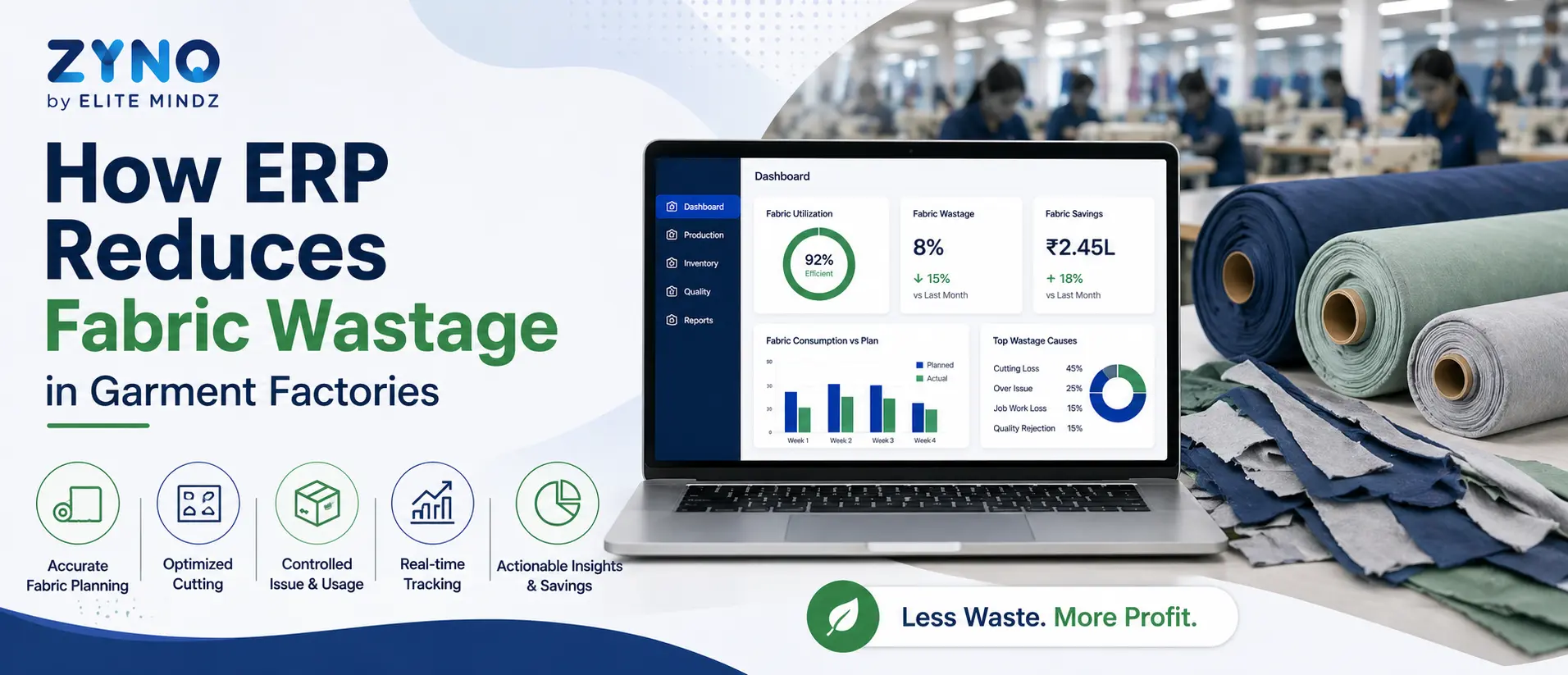
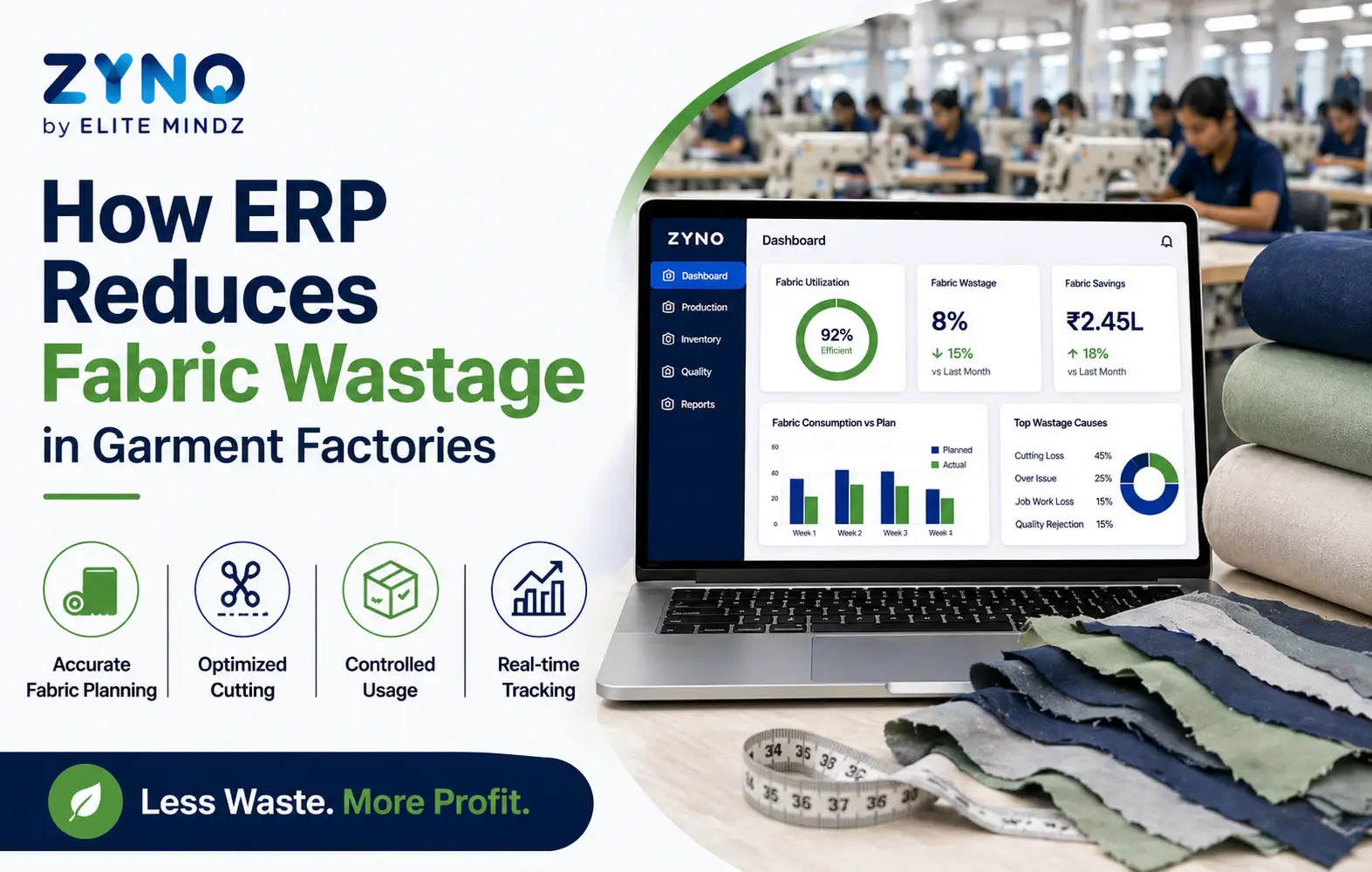
Fabric makes up 60–70% of garment cost, yet 10–20% is often wasted due to poor tracking and manual processes. ERP changes this by providing real-time visibility into fabric usage, cutting, and inventory. It helps prevent over-issue, track consumption accurately, and identify wastage early — turning uncontrolled losses into measurable, manageable costs.
Fabric wastage silently drains profits. A small unit using 10,000 metres monthly can lose ₹2.25 lakh with just 15% wastage — ₹27 lakh annually. Most losses come from cutting inefficiencies, over-issuing, poor tracking, and job work leakages. Without real-time visibility, these issues go unnoticed, turning fabric — your biggest cost — into your biggest hidden loss.
ZYNO Manufacturing ERP tracks every fabric roll from store to cutting floor to dispatch — with variance reports that show losses in rupees, not just percentages.
ERP reduces fabric wastage by bringing control and visibility at every stage. It uses BOM-based planning for accurate requirements, tracks fabric roll-wise and lot-wise, connects marker efficiency with actual cutting, and enforces controlled issues from stores. Real-time variance reports highlight losses instantly, while integrated quality checks and job work tracking prevent defects and external leakage — turning wastage into measurable, controllable data.
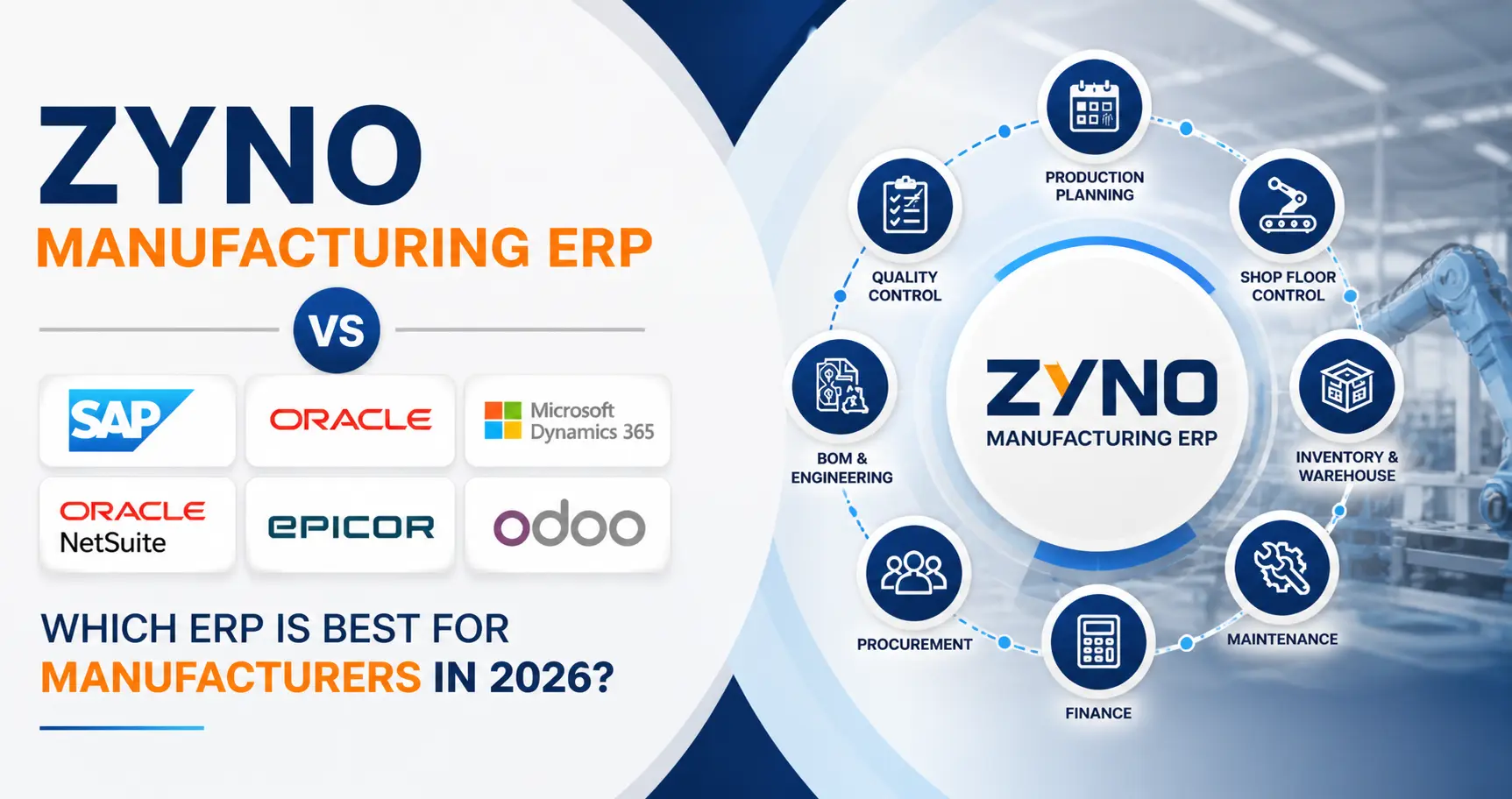
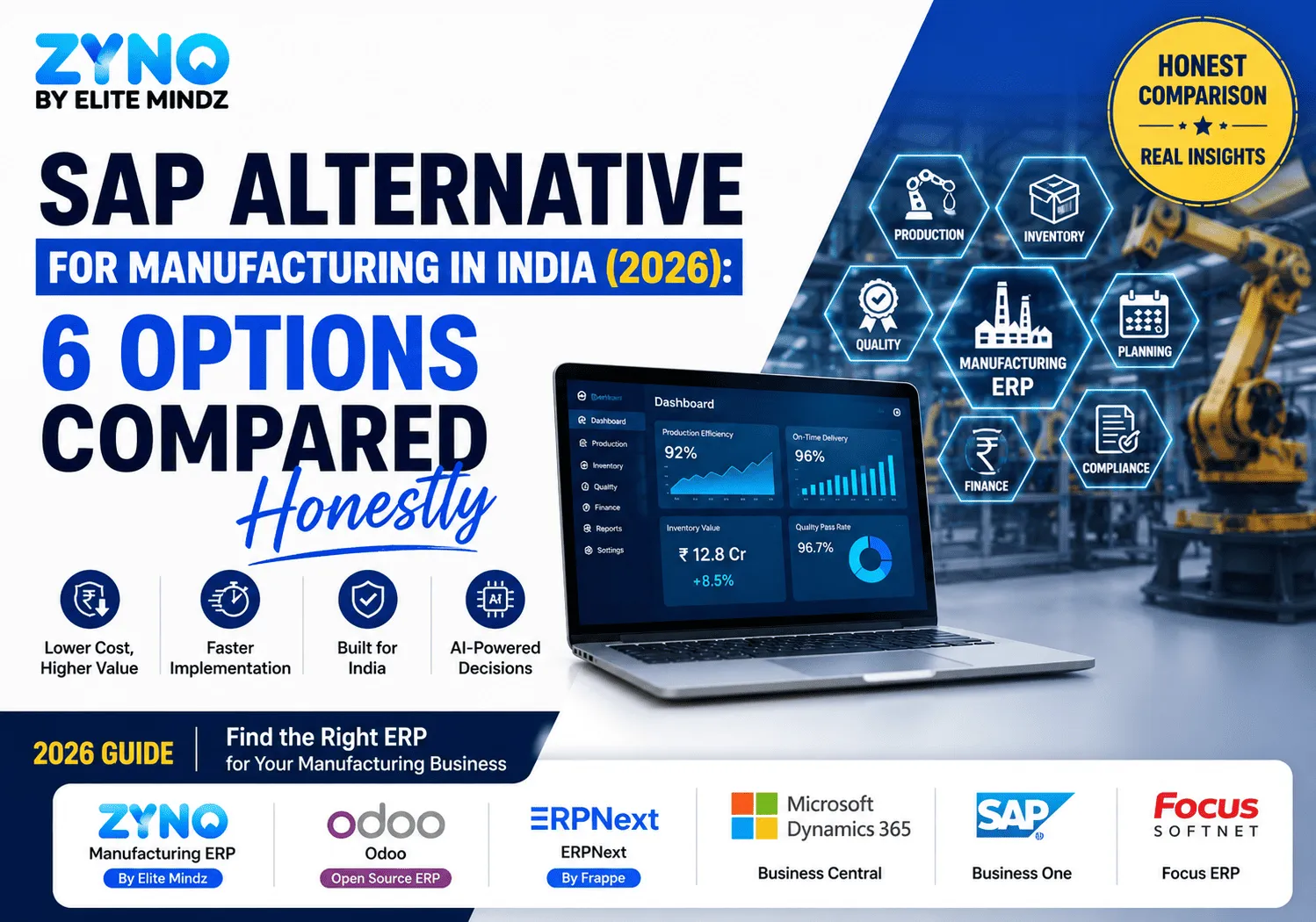
Not all ERP systems approach fabric waste reduction with the same depth. Here’s how the main competitors in India stack up specifically on this dimension:
SAP has strong inventory management capabilities, but its garment-specific features are limited without expensive customisation. BOM-based planning exists, but roll-wise fabric tracking, marker integration, and garment-specific variance analysis are not native — they require third-party add-ons or custom development. For a small garment factory in India, the implementation cost makes this path impractical. SAP is built for enterprises; fabric waste management ERP at the shop-floor level is not its sweet spot.
Through precise BoMs, meticulous planning, batch management, and quality checks, Odoo assists in reducing them. Additionally, reducing surplus inventory helps you save money on fabric, material, and storage.
Odoo’s manufacturing module supports BOM-based planning and inventory tracking. However, like SAP, it requires significant customisation to handle garment-specific needs: roll-wise fabric tracking, size-colour matrix, marker efficiency tracking, and job work with material accountability. The effort and cost of Odoo customisation for fabric waste reduction is considerable, and the out-of-box experience for garment factories is generic rather than purpose-built.
ZYNO Manufacturing ERP is purpose-built for garment factories, and fabric wastage reduction is a core design principle — not an add-on. Roll-wise inventory, BOM-driven issue control, marker efficiency tracking, job work material reconciliation, and variance analysis are all available out of the box, configured for garment workflows from day one. For small and growing garment factories in India, this means the path from implementation to measurable fabric savings is measured in weeks, not months.
LOGIC ERP has strong apparel-specific features for mid-to-large manufacturers, including style-wise production and fabric tracking. However, its complexity and pricing make it less accessible for small garment factories. For a 30-machine unit, LOGIC’s feature set is often more than required, and the implementation learning curve can slow down the waste-reduction benefits from being realised quickly.
ERPNext supports BOM and stock management, but garment-specific modules for fabric roll tracking and variance analysis require community customisation or third-party developers. The reduced operational costs ERP garment benefit is available, but requires significant technical investment to set up correctly for a garment factory context.
When a garment factory moves from manual tracking to a well-implemented garment production efficiency ERP like ZYNO, the operational impact unfolds in stages:
Month 1–2: Visibility For the first time, the factory has accurate data on how much fabric is being issued, consumed, and wasted per order. Even before making any process changes, this visibility alone surfaces wastage patterns that were invisible before. Most factories discover 3–5 specific wastage sources they weren’t aware of.
Month 3–4: Control With controlled fabric issue workflows live, casual over-issue stops. Fabric stored in the cutting room without a corresponding production order gets returned to the main store and recorded. Job work material discrepancies get flagged before they become write-offs. The fabric store becomes a managed asset rather than a black box.
Month 5–6: Improvement With variance data across multiple orders, management can identify which styles, which buyers, and which cutting supervisors have the highest wastage rates — and take targeted corrective action. Marker planning improves because the ERP shows the cost of poor marker efficiency in rupees, not just percentages.
Beyond 6 Months: Structural Savings The cost saving ERP garment factories benefit becomes structural. Fabric procurement quantities become more accurate. Safety stock levels are optimised — not too high, not too low. Quality rejections at the fabric stage are tracked, and vendor scorecards are built from this data, leading to better material from suppliers. Order profitability improves as material cost per garment comes down.
Across these stages, garment factories using ZYNO Manufacturing ERP typically see fabric wastage reduce from industry-average levels of 15–18% down to 8–10% within six months of go-live — a saving that, for most factories, is worth several times the cost of the ERP system itself.
Garment factories using ZYNO ERP see measurable fabric savings within 30 days of go-live — with controlled issue workflows, job work tracking, and live variance reports built in from day one.
Fabric wastage isn’t just a cost problem — it’s increasingly a business risk. Fast fashion-driven consumption has led to a surge in textile waste generation at both production and disposal levels. Global buyers, particularly from Europe and North America, are tightening their sustainability requirements. Factories that can demonstrate lower fabric wastage, better material utilisation rates, and structured waste tracking are better positioned to win and retain international orders.
Currently, only 34 per cent of India’s textile waste is reused — through repair or conversion into new products — and just 25 per cent is recycled into yarns, the essential base for new fabric production. The challenge of post-production textile waste in India is enormous. But the most effective place to address it is upstream — by not generating the waste in the first place.
Garment waste reduction technology implemented through ERP is the most practical, scalable approach to this upstream waste prevention. It doesn’t require enormous capital investment or restructuring of the factory. It requires data discipline — and the right software to make that discipline systematic.
ZYNO Manufacturing ERP supports garment factories in building this foundation: measurable, traceable, and continuously improving fabric utilisation that makes business sense and positions Indian manufacturers as sustainable suppliers to global buyers.
Fabric Inventory Module Track every fabric roll with roll ID, width, lot, colour, weight, and usable length. Real-time stock position by location, colour, and lot. Alerts for slow-moving fabric and dead stock. Integration with purchase orders for accurate receipt recording.
BOM and Production Planning Style-wise BOM with size breakdowns, shrinkage allowances, and accessory requirements. Automatic fabric requirement calculation when production orders are created. MRP-driven procurement suggestions based on pending orders and current stock.
Fabric Issue Control Digital fabric requisition and issue workflow. Issue quantity validation against planned consumption. Excess issues require manager authorisation. All issue transactions recorded against production orders for complete traceability.
Cutting Room Management Cutting plan creation with marker efficiency tracking. Lay plan recording with actual fabric spread quantities. Real-time comparison of planned vs. actual consumption at the cutting stage. See also: Shop Floor & MES Reporting.
Job Work Management Fabric issue to external units with roll-wise tracking. Standard process loss definition per job work type. Actual return recording and variance calculation. Automatic alert when return quantity falls below acceptable threshold.
Quality Control Fabric inspection at receiving with defect recording per roll. Defective fabric quarantine workflow with vendor notification. Rejection data linked to vendor performance scorecards.
Variance and Wastage Reports Order-wise consumption variance reports. Style-wise and size-wise waste percentage analysis. Period-wise trend reports for management review. Fabric utilisation efficiency dashboards for production and management teams.
There are several ERP systems for the textile industry competing for the attention of Indian garment manufacturers. What makes ZYNO different in the specific context of fabric waste reduction is this: every feature described in this article is available in ZYNO’s standard configuration, built specifically for garment factory workflows.
You don’t need to pay for expensive customisation to get roll-wise tracking. You don’t need a consultant to build a variance report that your production manager can actually use. You don’t need IT support to set up a job work tracking workflow. These are part of how ZYNO works, out of the box, because ZYNO is built for garment factories — not adapted for them.
ZYNO Manufacturing ERP delivers garment production ERP benefits that are measurable from the first month: less fabric disappearing from the store without a trail, fewer over-procurement orders, tighter cutting room control, and monthly reports that show exactly where material is being lost and what it’s costing.
For a small garment factory in India where margins are tight and fabric is the biggest cost, this isn’t optional. It’s how you stay profitable.
Q: How quickly can I see fabric wastage reduction after implementing ERP? Most garment factories using ZYNO Manufacturing ERP see measurable improvement in fabric consumption data visibility within the first 30 days of go-live. Actual wastage reduction becomes visible within 60–90 days as controlled issue workflows and variance tracking take effect.
Q: Does ZYNO work for factories that mix in-house cutting with job work? Yes. ZYNO handles both in-house production and job work within the same system, with complete material accountability at every stage — whether fabric is in your store, on your cutting floor, or at an external processing unit.
Q: Can ZYNO’s fabric tracking integrate with cutting machines or CAD software? ZYNO supports data import from standard marker planning and CAD tools for marker efficiency tracking. Our implementation team can discuss specific integration requirements based on the software your cutting room currently uses.
Q: Is this only for large garment factories? Not at all. ZYNO Manufacturing ERP is specifically designed for small and mid-sized garment factories in India. The system scales with your business, and the fabric waste reduction benefits are even more impactful for smaller operations where every metre of saved fabric directly improves order profitability.
Q: What if my team doesn’t have experience with ERP software? ZYNO’s interface is designed for factory-floor use — not for IT professionals. The store in-charge, cutting supervisor, and production manager can all use their respective modules with minimal training. Most ZYNO implementations include hands-on training as standard, and our support team is available through the go-live phase.
Fabric wastage in garment factories is not inevitable. It is a consequence of inadequate visibility, uncontrolled processes, and the absence of data discipline. All three of these can be addressed systematically through the right ERP for the garment industry — one that is purpose-built for garment workflows, quick to implement, and genuinely usable by your team on the factory floor.
ZYNO Manufacturing ERP brings BOM-based planning, roll-wise fabric tracking, controlled issue workflows, cutting room management, job work accountability, and variance analytics together in a single platform — designed specifically for Indian garment manufacturers who want to stop losing money to fabric wastage and start capturing that value as profit.
The fabric savings from ZYNO typically pay for the system within the first few months of operation. Everything after that is net margin improvement.
Ready to Stop Losing Fabric and Start Saving Money?
If you’re a garment manufacturer who wants to understand exactly where your fabric is going — and take control of it — ZYNO Manufacturing ERP is built for you.
Book a Free Demo — see how ZYNO’s fabric management modules work in a real garment factory setting.
Talk to our garment ERP specialists and get a customised wastage assessment for your factory.
ZYNO Manufacturing ERP — Built for Garment Factories That Demand Better.
Sneha Singh
Content Writer
Sneha Singh is a B2B tech content strategist with 4+ years of experience. She specializes in SEO-driven SaaS content, whitepapers, and platform-native social media campaigns that simplify complex technology and drive business growth. Sneha's core exp
What is ERP? A Beginner's Guide to Enterprise Resource Planning
Read More →

Cloud ERP vs. On-Premise vs. Hybrid: Best ERP Model for 2025
Read More →How To Customize ERP Software Without Breaking The Bank?
Read More →
The Future of Manufacturing ERP in 2026 & Beyond
Read More →Best ERP Software in India: 2026 Edition
Read More →
AI in Manufacturing ERP: The Future of Smart Factories
Read More →
How ERP Transforms Inventory Management and Reduces Costs
Read More →
Top Features to Look for in Inventory Management Software in 2025
Read More →
Top 5 Ways Asset Management Software Can Save Your Business Money
Read More →
Why Smart Businesses Are Switching to Vendor Management Systems in 2025?
Read More →
Why Manufacturing Companies Need ERP Software
Read More →
Cloud ERP vs. Traditional ERP: Which is Right for You?
Read More →
ERP for Small Business: Is It Worth the Investment?
Read More →
How to Calculate ERP ROI and Why It's Worth the Investment
Read More →
Top 10 ERP Software Companies in India 2026 Updated List (Complete Guide)
Read More →
ERP Implementation Mistakes to Avoid in 2025
Read More →
Cloud ERP vs Edge Computing: What's Right for Modern Manufacturing?
Read More →
The Future of ERP Software and the Role of Generative AI
Read More →
Digital Twin Technology & ERP: Real-Time Insights for Smarter Manufacturing
Read More →
Scalable ERP Solutions Designed for Modern Enterprises
Read More →
ERP and IoT Integration: Smart Factory Vision
Read More →Best ERP Software for Manufacturing Businesses in India
Read More →Top 10 Best Manufacturing ERP Software in India (2026)
Read More →
Best ERP Software for Manufacturing Industries in Ethiopia (2026)
Read More →
Best School ERP Software Providers in UAE (2025 Edition)
Read More →
Best School ERP Software for 2025: Guide for Educational Institutions
Read More →
Top 10 ERP Software Solutions for Nigerian Manufacturers (2025 Edition)
Read More →
Best ERP Systems for Scalable Retail and POS Integration
Read More →
Top 10 Cloud-Based Manufacturing ERP Solutions in Africa (2025 Edition)
Read More →
Top 10 Cloud-Based Manufacturing ERP in UAE
Read More →
Top 10 Cloud-Based Manufacturing ERP Software in Nigeria (2026 Edition)
Read More →
Top 10 School ERP Software Companies in Kenya (2025)
Read More →
Best School ERP Software Providers in Nigeria (2025)
Read More →
Top Cloud-Based Manufacturing ERP in Zimbabwe (2025)
Read More →
Best ERP Software in U.K
Read More →
Top 10 ERP Software Developers in the U.K. (2025)
Read More →
Best ERP Software Providers in France (2025)
Read More →
Best ERP Software Companies in Germany : A Comprehensive Guide
Read More →
Top 10 ERP Software Development Companies in Qatar
Read More →
10 Best ERP Providers in Germany - 2026 Updated List
Read More →
Best ERP Software Firms in Saudi Arabia (2025)
Read More →
Best ERP Service Providers in Indonesia for SMEs and Large Enterprises
Read More →
Top 10 Cloud-Based Manufacturing ERP Systems in Egypt for Modern Factories
Read More →
Top ERP Solutions in the USA 2025: Streamline Your Business with ZYNO ERP
Read More →
Top ERP Solutions in Qatar for Businesses of All Sizes
Read More →Top Manufacturing ERP Software in India 2026 ZYNO Manufacturing ERP
Read More →How Manufacturing Companies Reduce Production Delays Using ERP Automation
Read More →Why Legal Firms Need ERP to Manage Cases, Billing & Compliance
Read More →What Is ERP And How Does It Work
Read More →
How ERP Systems Are Evolving in 2026: What Businesses Need to Know
Read More →
Best ERP Software in India: 2025 Edition
Read More →
Top 10 ERP Software Companies in Delhi NCR
Read More →
How Manufacturing ERP Software Improves Demand Forecasting
Read More →
Top 10 Best School Management Software in India
Read More →Manufacturing & Wholesale ERP in Qatar: Complete Industry Guide 2026
Read More →Cloud ERP Software in Qatar: Why Businesses Are Moving in 2026
Read More →Is ERP a Procurement Software? Key Differences, Benefits & What to Choose
Read More →What Is Production Planning and Control? Definition, Objectives & Functions
Read More →
Garment Inventory Management Software: Complete Guide 2026
Read More →
How ERP Reduces Fabric Wastage in Garment Factories
Read More →
Why the Garment Industry Needs a Specialized ERP
Read More →
Features to Look for in Garment Manufacturing ERP Software
Read More →
Best ERP Software for Small Garment Manufacturing Business in IndiaÂ
Read More →
The Real Problems Holding Back Small Garment Manufacturers in India
Read More →Partner with ZYNO by Elite Mindz to revolutionize how your business works. Fill out the form, and we’ll reach out with AI-powered solutions made just for you.
We use browser cookies to ensure you get the best experience on our website. Learn more
The form was submitted successfully!
ZYNO Digital
Fueling Smarter Digital Growth
ZYNO Digital fuels smarter digital growth through data-driven marketing, creative storytelling, and performance strategies that boost visibility, engagement, and measurable business outcomes across global platforms.
ZYNO Tech
Engineering the Future of IT
ZYNO Tech delivers cutting-edge IT solutions — including web, mobile, and digital transformation services — helping businesses scale efficiently, innovate faster, and stay ahead in a connected world.
ZYNO AI
AI Built for Business Growth
ZYNO AI harnesses the power of artificial intelligence to automate processes, enhance decision-making, and deliver predictive insights — driving innovation, agility, and measurable business growth.
ZYNO by Elite Mindz
Your Partner in the AI-Powered Future
ZYNO by Elite Mindz offers AI-powered products and services that unify operations, boost productivity, and drive digital transformation — helping businesses scale smarter and innovate faster.
* In just 2 mins you'll get a response
* Your idea is 100% protected by our Non-Disclosure Agreement