×
Every growing business hits the same wall — too much data, too little clarity. You have spreadsheets in Accounts, a separate system in HR, manual stock tracking in the warehouse, and somehow the management team still doesn't have a clear picture of what's happening across the company.
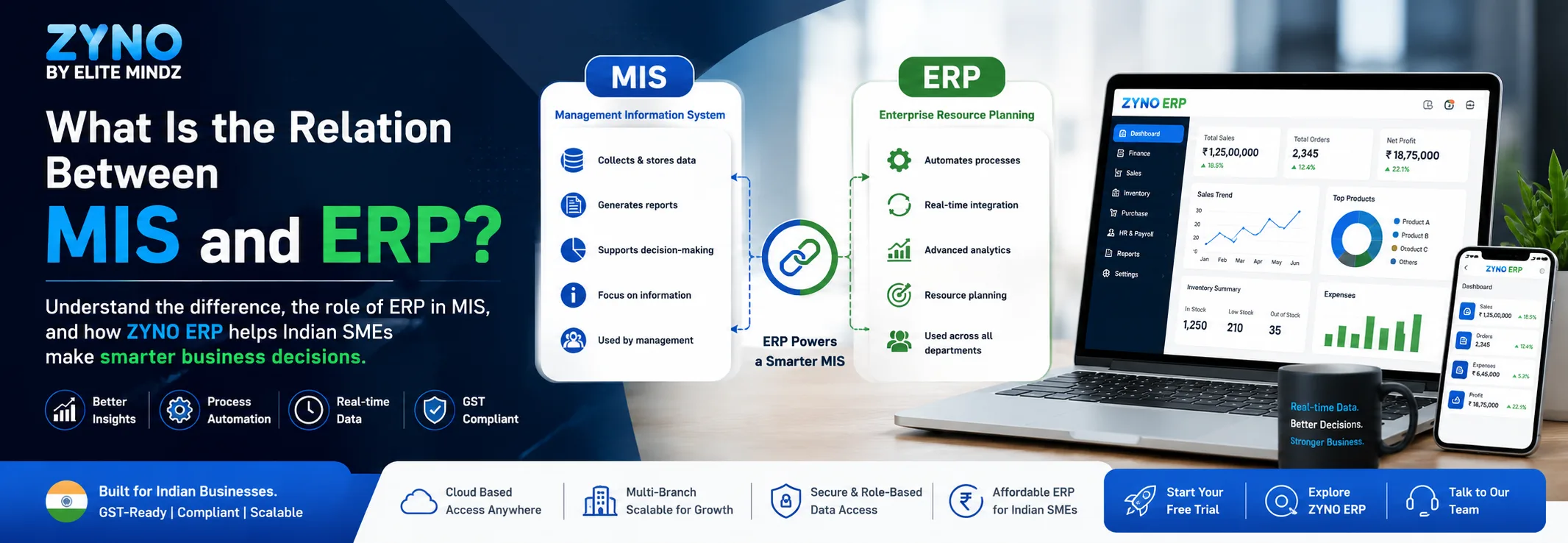
This is exactly where Management Information Systems (MIS) and Enterprise Resource Planning (ERP) come in. Both are designed to manage business data and support better decision-making — but they are not the same thing, and understanding how they relate to each other can help you choose the right solution for your business.
In this blog, we break down the difference between MIS and ERP, explain the role of ERP in MIS, and show how a modern ERP like ZYNO by Elite Mindz takes your management information system from reactive to predictive.
|
New to ERP? Read: What is ERP and How Does It Work? — a beginner-friendly guide from our team. |
MIS, or Management Information System, is a broad framework that uses technology, people, and processes to collect, store, and distribute information across an organisation. According to Gartner, enterprise-level information systems form the foundation of all modern business decision-making. Its primary job is to give managers the data they need to make informed decisions.
Think of MIS as the brain of your organisation's information flow. It gathers raw data from various departments — sales, finance, HR, operations — processes it, and converts it into structured reports and dashboards that management can use.
MIS is not limited to one software — it is a concept that encompasses multiple tools and systems, including ERP, CRM, HRMS, BI tools, and more. In fact, ERP is one of the most powerful implementations of the MIS concept.
ERP, or Enterprise Resource Planning, is a specific category of software that automates and integrates the core business processes of an organisation — all within a single platform. Unlike traditional MIS tools that mainly focus on data reporting, ERP goes a step further by actively managing and automating your workflows.
An ERP system typically includes integrated modules for finance and accounting, procurement, inventory, manufacturing, sales, HR, payroll, and more. All these modules share a common database, ensuring that data entered in one department is instantly available across the organisation.
For Indian SMEs, affordable and GST-compliant ERP solutions like ZYNO ERP by Elite Mindz are purpose-built to address local business needs — including GST filing automation — without enterprise-level pricing.
|
Also Read: Is ERP Worth It for Small Businesses in India? — Real numbers, real ROI breakdown. |
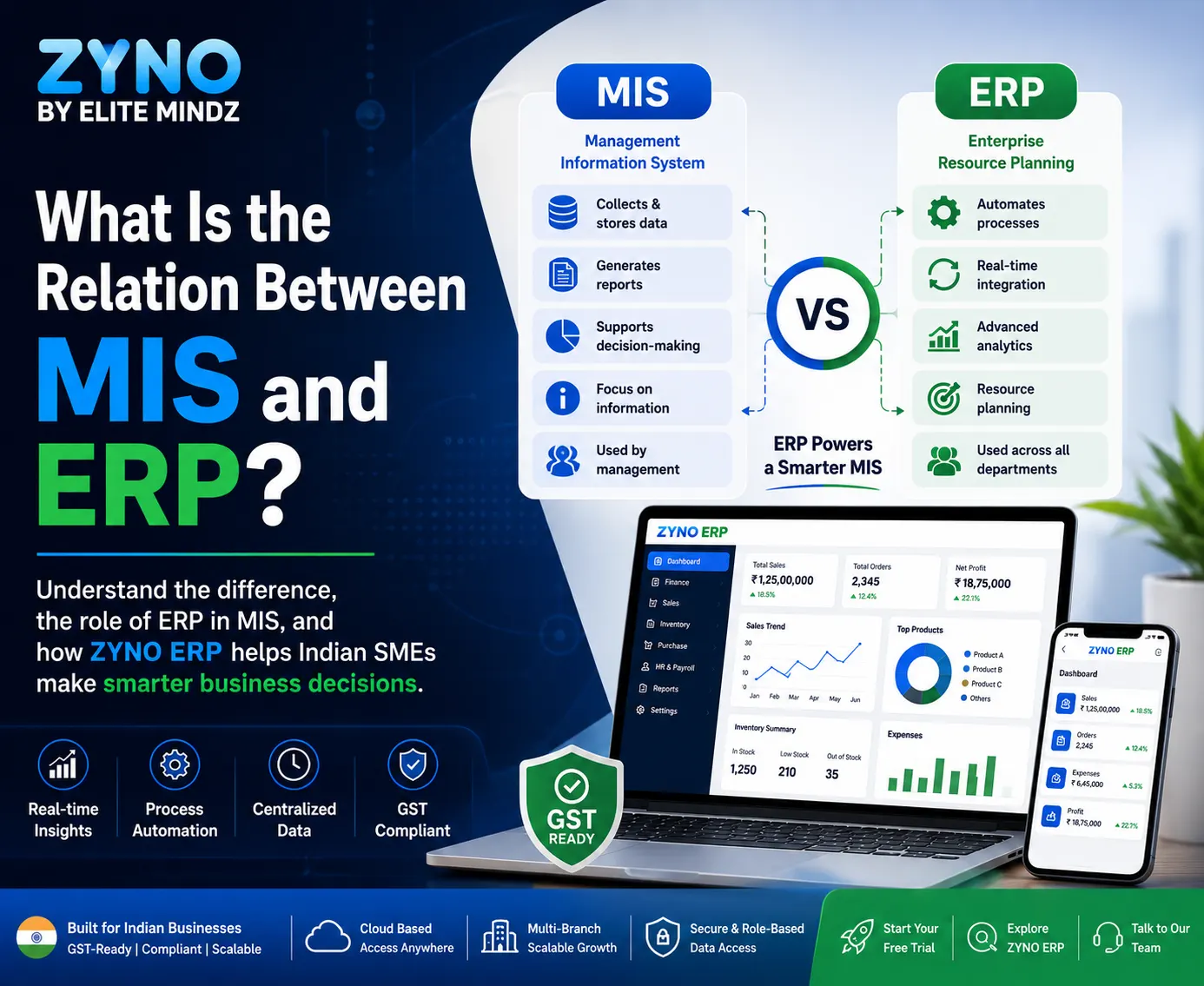
Many business owners and students ask — is MIS and ERP the same thing? The short answer: no, but they are deeply related. Here is a clear, side-by-side breakdown.
|
Parameter |
MIS (Management Information System) |
ERP (Enterprise Resource Planning) |
|---|---|---|
|
Full Form |
Management Information System |
Enterprise Resource Planning |
|
Primary Purpose |
Collect, store & report data for decision-making |
Automate & integrate end-to-end business processes |
|
Scope |
Broader — covers all information flows in an org |
Specific — a specialised subset within MIS |
|
Focus |
Reporting & analysis |
Process automation & resource planning |
|
Users |
Management & department heads |
All departments — accounts to warehouse floor |
|
Data Handling |
Stores and processes historical data |
Real-time data across integrated modules |
|
Modules |
General reporting tools |
Finance, HR, Procurement, Manufacturing, CRM, etc. |
|
Business Size |
Best for mid-sized businesses |
Scales from SMEs to large enterprises |
|
Decision Support |
Provides reports for manual decisions |
Enables automated, data-driven decisions |
|
India Compliance |
Not built for GST/TDS workflows |
GST-ready with e-way bill, GSTR automation |
The key takeaway: MIS is the overarching concept — the umbrella — and ERP is one of the most advanced, specialised tools that sits within it. Want to see how this plays out in practice? Read our guide on Modern ERP vs Excel to understand why spreadsheets can no longer replace either.
Yes — and the difference is significant, especially when you're choosing the right tool for your business.
MIS is fundamentally about information management. It collects data, organises it, and presents it in reports. It answers the question: "What happened?"
ERP, on the other hand, goes much further. It not only tells you what happened — it automates the processes that make things happen and helps you plan for what should happen next. ERP answers: "What happened, why did it happen, what should we do about it, and how do we prepare for tomorrow?"
Another important distinction: MIS is often a general concept or a collection of tools, whereas ERP is a specific, integrated software platform. You can have an MIS without a dedicated ERP system (using spreadsheets and basic BI tools), but you cannot have a modern ERP without it functioning as a powerful MIS. For a data-backed look at what switching costs and saves, see our ERP ROI calculator guide.
If MIS is the goal, ERP is the most powerful vehicle to achieve it. Here is how ERP strengthens and extends every dimension of a Management Information System.
Traditional MIS relied on periodic batch processing — data was updated weekly or monthly. ERP brings real-time data integration. Every transaction across finance, procurement, inventory, and HR is reflected instantly across the entire system. This is especially critical for businesses managing inventory and demand forecasting — you simply cannot afford stale data.
One of the biggest challenges of conventional MIS is data silos — each department maintains its own data in its own format. ERP eliminates silos by connecting all departments on a single platform. When Accounts finalises an invoice, it immediately affects the inventory module, the procurement dashboard, and the financial reports — no manual syncing required.
ERP enhances MIS reporting by automating it. Instead of manually compiling data from multiple sources, managers get automated dashboards, scheduled MIS reports, and customisable analytics — all generated from the same real-time data pool. See how ZYNO ERP's reporting module works.
Modern ERP systems go beyond historical reporting. They use integrated analytics to help managers forecast demand, plan procurement, optimise stock levels, and project cash flows. Our blog on how ERP improves demand forecasting walks through this in detail.
ERP takes the data management capabilities of MIS and adds workflow automation on top. Purchase approvals, invoice processing, payroll calculations, GST filings, stock replenishment alerts — all of these can be automated within an ERP, dramatically reducing manual effort and human error.
For Indian businesses, compliance with GST, TDS, and statutory reporting is non-negotiable. ERP embeds these compliance requirements directly into the workflow. ZYNO GST Software automatically generates GST-ready invoices, e-way bills, and GSTR reports — capabilities that a standalone MIS tool simply cannot handle.
MIS reports are the output that makes all the underlying data in an ERP meaningful. Within an ERP system, MIS reports serve several critical functions:
In a well-implemented ERP system, all of these MIS reports are available on demand — filterable by date range, department, branch, or product category. For manufacturing businesses specifically, see our guide on the best ERP software for Indian manufacturing to understand what good MIS reporting looks like in a production environment.
The answer depends on your business size, complexity, and goals — but for most growing Indian businesses, the question is not MIS or ERP. It is which ERP best delivers the MIS capabilities you need.
Very small business (under 10 employees, simple operations): Basic MIS tools may be sufficient initially. But even here, exploring a lightweight cloud ERP can save you from painful data migrations later.
Growing SME (multi-department, scaling revenue, GST compliance needs): An ERP is the right move. Check out our list of the top 10 ERP software companies in India to compare options.
Manufacturer, distributor, or construction firm: A sector-specific ERP is essential.
Read: why manufacturing companies need ERP software
ZYNO ERP is a comprehensive enterprise resource planning solution built for Indian businesses — from manufacturing and construction to retail, distribution, and professional services. It combines the information management strengths of MIS with the process automation power of modern ERP.
Whether you are transitioning from a basic MIS setup or replacing a legacy ERP, ZYNO is designed to make that shift smooth, affordable, and immediately impactful. Worried about implementation risk? Read our guide on top ERP implementation mistakes to avoid before you get started.
To sum it up: MIS and ERP are not rivals — they are parts of the same ecosystem. MIS is the broader concept of using information systems to support business decisions. ERP is the most evolved, integrated, and capable implementation of that concept.
ERP is a part of MIS — not a replacement. But for most modern businesses, ERP delivers everything a traditional MIS promises, and much more: automation, integration, real-time visibility, and the analytics needed to stay competitive in today's market.
If your business is still relying on disconnected tools, manual reports, and siloed spreadsheets, you are not running an MIS — you are running a liability. The right ERP transforms your data from a burden into a business asset. See how businesses in India are making this shift →
ERP (Enterprise Resource Planning) is a specialised subset of MIS (Management Information System). MIS is the broader concept of using technology to manage and distribute business information, while ERP is a specific software platform that automates business processes and serves as a powerful implementation of MIS.
No. MIS is a broad concept covering all information systems used for decision-making, while ERP is a specific category of software. All ERP systems can be considered part of MIS, but not all MIS tools are ERP systems.
ERP strengthens MIS by providing real-time data integration, cross-departmental visibility, automated reporting, process automation, and advanced analytics — capabilities that traditional MIS tools lack.
For most growing businesses, ERP is the better choice as it delivers all MIS capabilities plus process automation and integration. Small businesses with basic needs may find lightweight MIS tools sufficient initially, but ERP scales better as operations grow.
MIS reports in ERP are structured reports generated from the ERP's integrated database — covering sales, finance, inventory, procurement, HR, and operations — that help management make informed business decisions.
Yes. ZYNO ERP by Elite Mindz is specifically designed for Indian SMEs, with built-in GST compliance, e-way bill support, multi-branch management, and affordable cloud-based deployment. Start your free trial
Sneha Singh
Content Writer
Sneha Singh is a B2B tech content strategist with 4+ years of experience. She specializes in SEO-driven SaaS content, whitepapers, and platform-native social media campaigns that simplify complex technology and drive business growth. Sneha's core exp
What is ERP? A Beginner's Guide to Enterprise Resource Planning
Read More →

Cloud ERP vs. On-Premise vs. Hybrid: Best ERP Model for 2025
Read More →How To Customize ERP Software Without Breaking The Bank?
Read More →
The Future of Manufacturing ERP in 2026 & Beyond
Read More →Best ERP Software in India: 2026 Edition
Read More →
AI in Manufacturing ERP: The Future of Smart Factories
Read More →
How ERP Transforms Inventory Management and Reduces Costs
Read More →
Top Features to Look for in Inventory Management Software in 2025
Read More →
Top 5 Ways Asset Management Software Can Save Your Business Money
Read More →
Why Smart Businesses Are Switching to Vendor Management Systems in 2025?
Read More →
Why Manufacturing Companies Need ERP Software
Read More →
Cloud ERP vs. Traditional ERP: Which is Right for You?
Read More →
ERP for Small Business: Is It Worth the Investment?
Read More →
How to Calculate ERP ROI and Why It's Worth the Investment
Read More →
Top 10 ERP Software Companies in India 2026 Updated List (Complete Guide)
Read More →
ERP Implementation Mistakes to Avoid in 2025
Read More →
Cloud ERP vs Edge Computing: What's Right for Modern Manufacturing?
Read More →
The Future of ERP Software and the Role of Generative AI
Read More →
Digital Twin Technology & ERP: Real-Time Insights for Smarter Manufacturing
Read More →
Scalable ERP Solutions Designed for Modern Enterprises
Read More →
ERP and IoT Integration: Smart Factory Vision
Read More →Best ERP Software for Manufacturing Businesses in India
Read More →Top 10 Best Manufacturing ERP Software in India (2026)
Read More →
Best ERP Software for Manufacturing Industries in Ethiopia (2026)
Read More →
Best School ERP Software Providers in UAE (2025 Edition)
Read More →
Best School ERP Software for 2025: Guide for Educational Institutions
Read More →
Top 10 ERP Software Solutions for Nigerian Manufacturers (2025 Edition)
Read More →
Best ERP Systems for Scalable Retail and POS Integration
Read More →
Top 10 Cloud-Based Manufacturing ERP Solutions in Africa (2025 Edition)
Read More →
Top 10 Cloud-Based Manufacturing ERP in UAE
Read More →
Top 10 Cloud-Based Manufacturing ERP Software in Nigeria (2026 Edition)
Read More →
Top 10 School ERP Software Companies in Kenya (2025)
Read More →
Best School ERP Software Providers in Nigeria (2025)
Read More →
Top Cloud-Based Manufacturing ERP in Zimbabwe (2025)
Read More →
Best ERP Software in U.K
Read More →
Top 10 ERP Software Developers in the U.K. (2025)
Read More →
Best ERP Software Providers in France (2025)
Read More →
Best ERP Software Companies in Germany : A Comprehensive Guide
Read More →
Top 10 ERP Software Development Companies in Qatar
Read More →
10 Best ERP Providers in Germany - 2026 Updated List
Read More →
Best ERP Software Firms in Saudi Arabia (2025)
Read More →
Best ERP Service Providers in Indonesia for SMEs and Large Enterprises
Read More →
Top 10 Cloud-Based Manufacturing ERP Systems in Egypt for Modern Factories
Read More →
Top ERP Solutions in the USA 2025: Streamline Your Business with ZYNO ERP
Read More →
Top ERP Solutions in Qatar for Businesses of All Sizes
Read More →Top Manufacturing ERP Software in India 2026 ZYNO Manufacturing ERP
Read More →How Manufacturing Companies Reduce Production Delays Using ERP Automation
Read More →Why Legal Firms Need ERP to Manage Cases, Billing & Compliance
Read More →What Is ERP And How Does It Work
Read More →
How ERP Systems Are Evolving in 2026: What Businesses Need to Know
Read More →
Best ERP Software in India: 2025 Edition
Read More →
Top 10 ERP Software Companies in Delhi NCR
Read More →
How Manufacturing ERP Software Improves Demand Forecasting
Read More →
Top 10 Best School Management Software in India
Read More →Manufacturing & Wholesale ERP in Qatar: Complete Industry Guide 2026
Read More →Cloud ERP Software in Qatar: Why Businesses Are Moving in 2026
Read More →Is ERP a Procurement Software? Key Differences, Benefits & What to Choose
Read More →What Is Production Planning and Control? Definition, Objectives & Functions
Read More →
Garment Inventory Management Software: Complete Guide 2026
Read More →
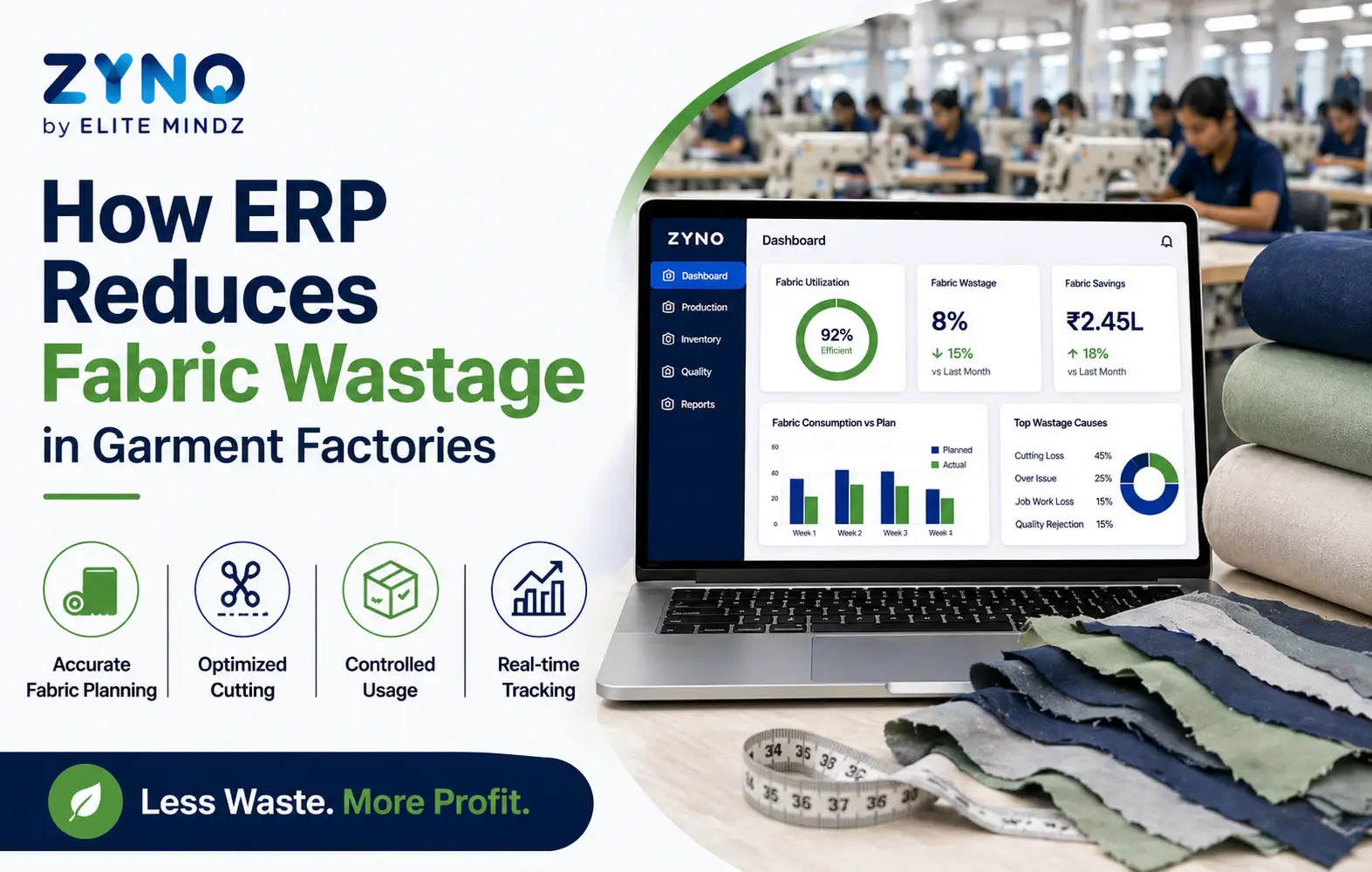
How ERP Reduces Fabric Wastage in Garment Factories
Read More →
Why the Garment Industry Needs a Specialized ERP
Read More →
Features to Look for in Garment Manufacturing ERP Software
Read More →
Best ERP Software for Small Garment Manufacturing Business in India
Read More →
The Real Problems Holding Back Small Garment Manufacturers in India
Read More →Garment Manufacturing ERP Software in India: Best Options, Features & Complete Guide 2026
Read More →
Which ERP is Best for Manufacturers in 2026?
Read More →
Distributor & Consumer Management System: The Complete Guide for 2026
Read More →
Best Pharma ERP Software in India 2026 – Features, Compliance & Buying Guide
Read More →
SAP Alternative for Manufacturing in India (2026): 6 Options Compared Honestly
Read More →
What Is the Relation Between MIS and Enterprise Resource Planning?
Read More →Partner with ZYNO by Elite Mindz to revolutionize how your business works. Fill out the form, and we’ll reach out with AI-powered solutions made just for you.
We use browser cookies to ensure you get the best experience on our website. Learn more
The form was submitted successfully!
ZYNO Digital
Fueling Smarter Digital Growth
ZYNO Digital fuels smarter digital growth through data-driven marketing, creative storytelling, and performance strategies that boost visibility, engagement, and measurable business outcomes across global platforms.
ZYNO Tech
Engineering the Future of IT
ZYNO Tech delivers cutting-edge IT solutions — including web, mobile, and digital transformation services — helping businesses scale efficiently, innovate faster, and stay ahead in a connected world.
ZYNO AI
AI Built for Business Growth
ZYNO AI harnesses the power of artificial intelligence to automate processes, enhance decision-making, and deliver predictive insights — driving innovation, agility, and measurable business growth.
ZYNO by Elite Mindz
Your Partner in the AI-Powered Future
ZYNO by Elite Mindz offers AI-powered products and services that unify operations, boost productivity, and drive digital transformation — helping businesses scale smarter and innovate faster.
* In just 2 mins you'll get a response
* Your idea is 100% protected by our Non-Disclosure Agreement