Why Cloud-Based AI HIMS is Transforming the Future of Indian Healthcare
Read More →

×
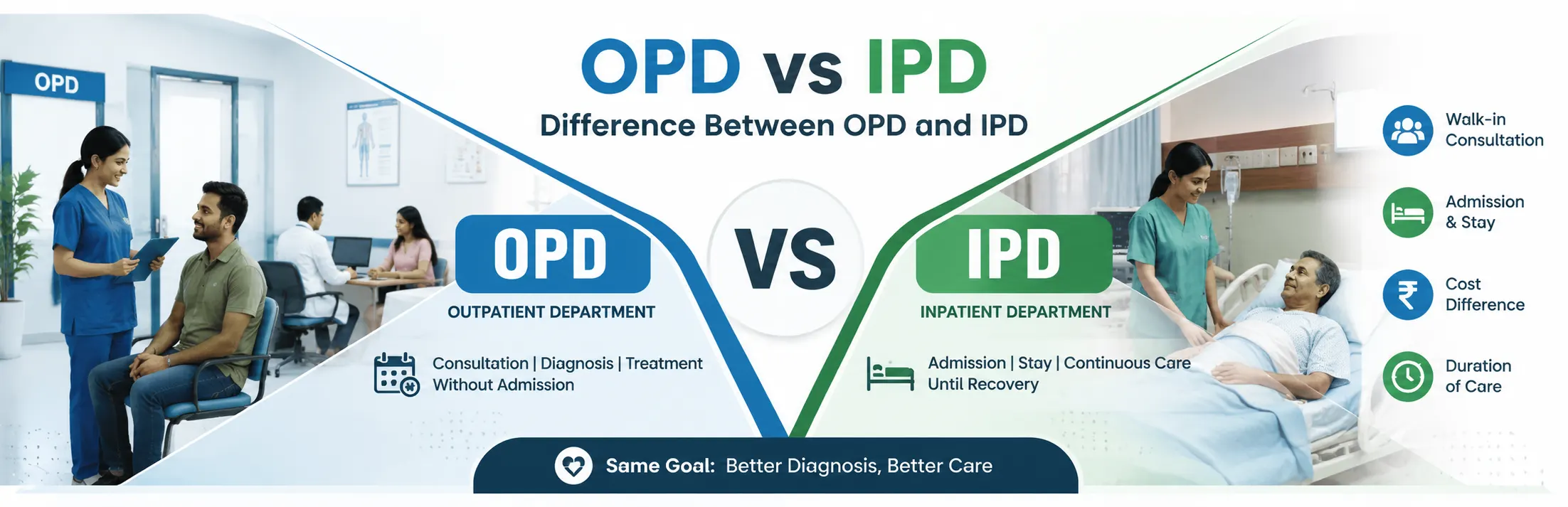
OPD vs IPD refers to two different types of hospital care. OPD provides consultation and treatment without admission, while IPD involves hospital admission, continuous monitoring, and inpatient treatment. Understand their key differences, services, costs, and management in this complete guide.
Businesses using ZYNO Books cut accounting time by 70% and stay 100% ZATCA-compliant — automatically.
Every hospital, big or small, handles two very different kinds of patient journeys every single day. Someone walks in for a quick consultation and walks back out the same afternoon. Someone else needs a bed, round-the-clock nursing, and a treatment plan that runs over several days. The first is OPD. The second is IPD.
Knowing the difference isn't just useful trivia it shapes how a patient plans their visit, how billing works, and how a hospital allocates staff, beds, and equipment. It's also exactly the kind of workflow that a well-built Hospital Information Management System (HIMS) is meant to simplify. This guide breaks down OPD and IPD in detail, and shows how a connected, AI-driven platform like ZYNO HIMS brings both departments together instead of leaving them as two disconnected systems.
Connect outpatient and inpatient workflows with an AI-powered Hospital Management System. Manage patients, appointments, records, billing, and hospital operations from one platform.
Explore ZYNO HIMSOPD stands for Outpatient Department the department that handles patients who need consultation, diagnosis, or minor treatment without being admitted to the hospital.
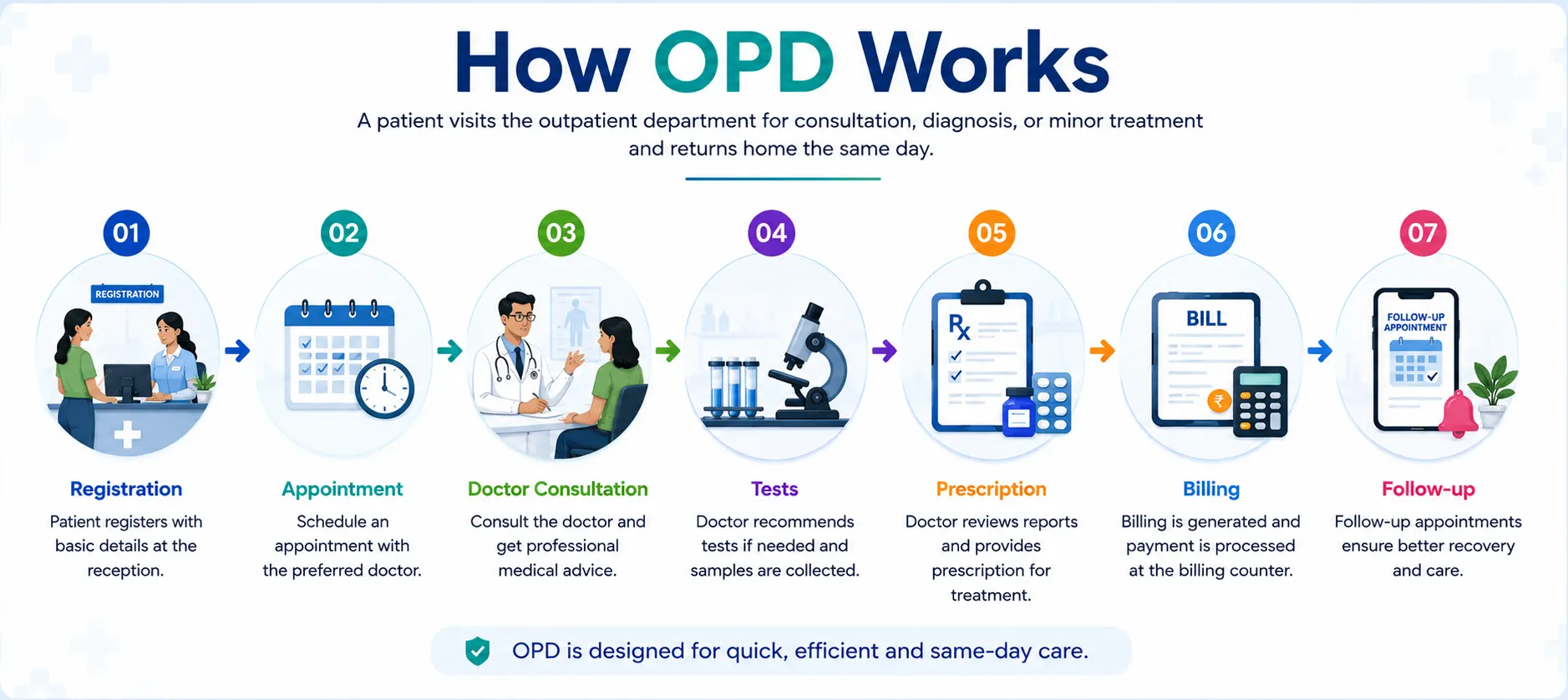
A patient walks in, meets a doctor, maybe gets a test done or a prescription written, and heads home the same day. No bed, no overnight stay, no extended nursing care.

Registration → Appointment → Doctor Consultation → Tests → Prescription → Billing → Follow-up
Because there's no bed involved, OPD visits are usually quicker and lighter on hospital resources compared to inpatient care.
IPD stands for Inpatient Department where patients are formally admitted for surgery, observation, or ongoing treatment that can't be managed in a single visit.
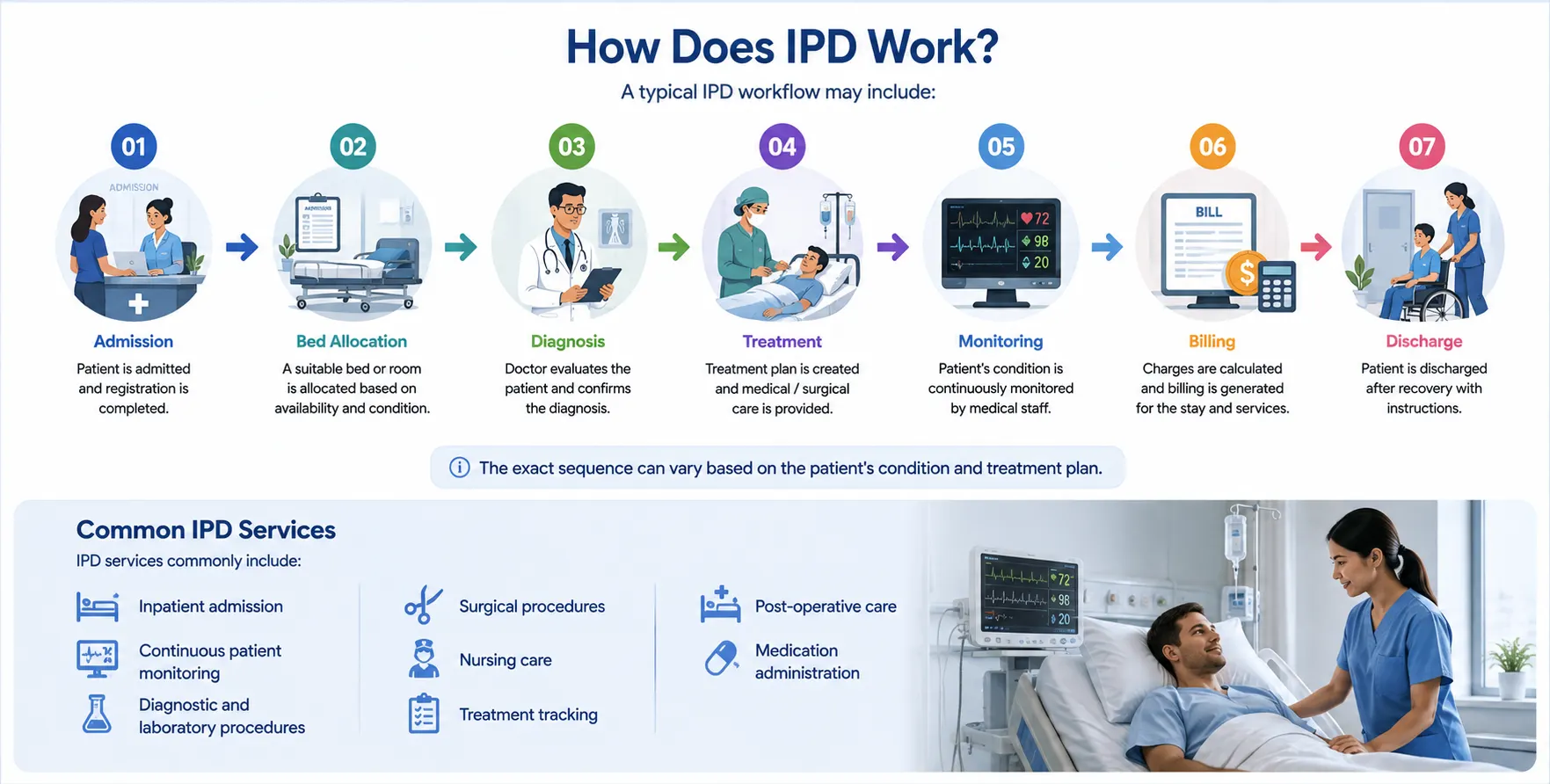
Once admitted, a patient is assigned a bed, ward, or private room, and their care becomes a coordinated effort between doctors, nurses, diagnostics, and pharmacy teams.

Admission → Bed Allocation → Diagnosis → Treatment → Monitoring → Billing → Discharge
|
Factor |
OPD |
IPD |
|
Full Form |
Outpatient Department |
Inpatient Department |
|
Admission |
Usually not required |
Required |
|
Hospital Stay |
Same-day or short visit |
Overnight or extended, depending on treatment |
|
Bed Requirement |
Usually not required |
Typically required |
|
Care Type |
Consultation and outpatient treatment |
Admission-based treatment and ongoing care |
|
Monitoring |
Limited to the visit or scheduled follow-ups |
Regular or continuous |
|
Billing |
Usually simpler |
More detailed, multiple service lines |
|
Cost |
Generally lower |
Generally higher |
|
Common Cases |
Consultation, follow-up, minor treatment |
Surgery, serious illness, prolonged treatment |
|
Discharge Process |
Not applicable |
Formal discharge required |
It's worth noting that IPD isn't defined by a rigid "24-hour rule." What really separates it from OPD is formal hospital admission and the level of ongoing care involved that can mean an overnight stay or several days, depending on the condition and hospital policy.
See how ZYNO HIMS connects OPD and IPD workflows on one AI-powered healthcare platform, helping hospitals streamline patient management, appointments, records, billing, and more.
The decision always comes down to clinical judgment, but a few factors typically guide it:
OPD may be suitable for: routine consultations, follow-ups, minor health concerns, diagnostic reviews, and health checkups.
IPD may be necessary for: surgery, continuous observation, serious illness management, and post-operative monitoring.
The final call always rests with the treating doctor no software replaces clinical judgment. What software can do is make sure that judgment is backed by complete, accessible patient data the moment it's needed.
A smooth OPD isn't just a doctor sitting in a room it's registration, scheduling, consultation, diagnostics, prescriptions, billing, and follow-ups all working together without friction.
Patient Registration
ZYNO HIMS captures patient details digitally at the first touch point and instantly creates or retrieves an existing medical record, cutting down repetitive paperwork.
Appointment Scheduling
AI-assisted scheduling in ZYNO HIMS balances doctor availability, specialty, and patient preference, reducing overbooking and long waiting-room queues.
Doctor Consultation
Doctors get a unified view of symptoms, history, and prior reports on screen, so consultations move faster and decisions are better informed.
Diagnostic Tests
Lab and imaging orders raised during consultation flow directly into ZYNO HIMS's diagnostics module, and results come back to the same patient file automatically.
E-Prescription
Digital prescriptions generated within ZYNO HIMS keep a structured, searchable medication history tied to the patient, not a piece of paper.
OPD Billing
Consultation fees, tests, and minor procedures are billed from one dashboard, with AI-driven checks that flag missed charges or mismatched entries before they become billing errors.
Follow-Up Management
Automated reminders and follow-up tracking inside ZYNO HIMS help doctors monitor recovery without relying on the patient to remember their next appointment.
Understand the key differences between OPD and IPD and see how ZYNO HIMS connects outpatient and inpatient workflows on one AI-powered platform.
Book a Free DemoInpatient care touches far more departments, which is exactly where a fragmented, non-integrated system starts to show cracks.
Patient Admission
ZYNO HIMS digitizes the admission process clinical details, admitting doctor, and documentation are recorded in one workflow instead of scattered paper forms.
Bed & Room Allocation
A live bed-availability dashboard in ZYNO HIMS shows occupancy across wards in real time, so admissions and transfers happen without phone calls between departments.
Nursing & Doctor Management
Doctor rounds, nursing notes, and vitals are logged directly into the patient's record, giving every care team member the same up-to-date picture.
Medication & Treatment Tracking
Every medicine, procedure, and therapy administered during the stay is time stamped and tracked, reducing the chances of missed doses or duplicate entries.
Laboratory & Diagnostic Reports
Test orders and results stay linked to the patient's admission record, accessible instantly to any authorized doctor or nurse on duty.
IPD Billing
Room charges, doctor fees, nursing services, medication, and procedures are consolidated automatically, so the final bill reflects the actual stay without manual reconciliation at discharge.
Discharge Summary
ZYNO HIMS generates a structured discharge summary diagnosis, treatment given, medications, and follow-up advice ready for both the patient and referring doctors.

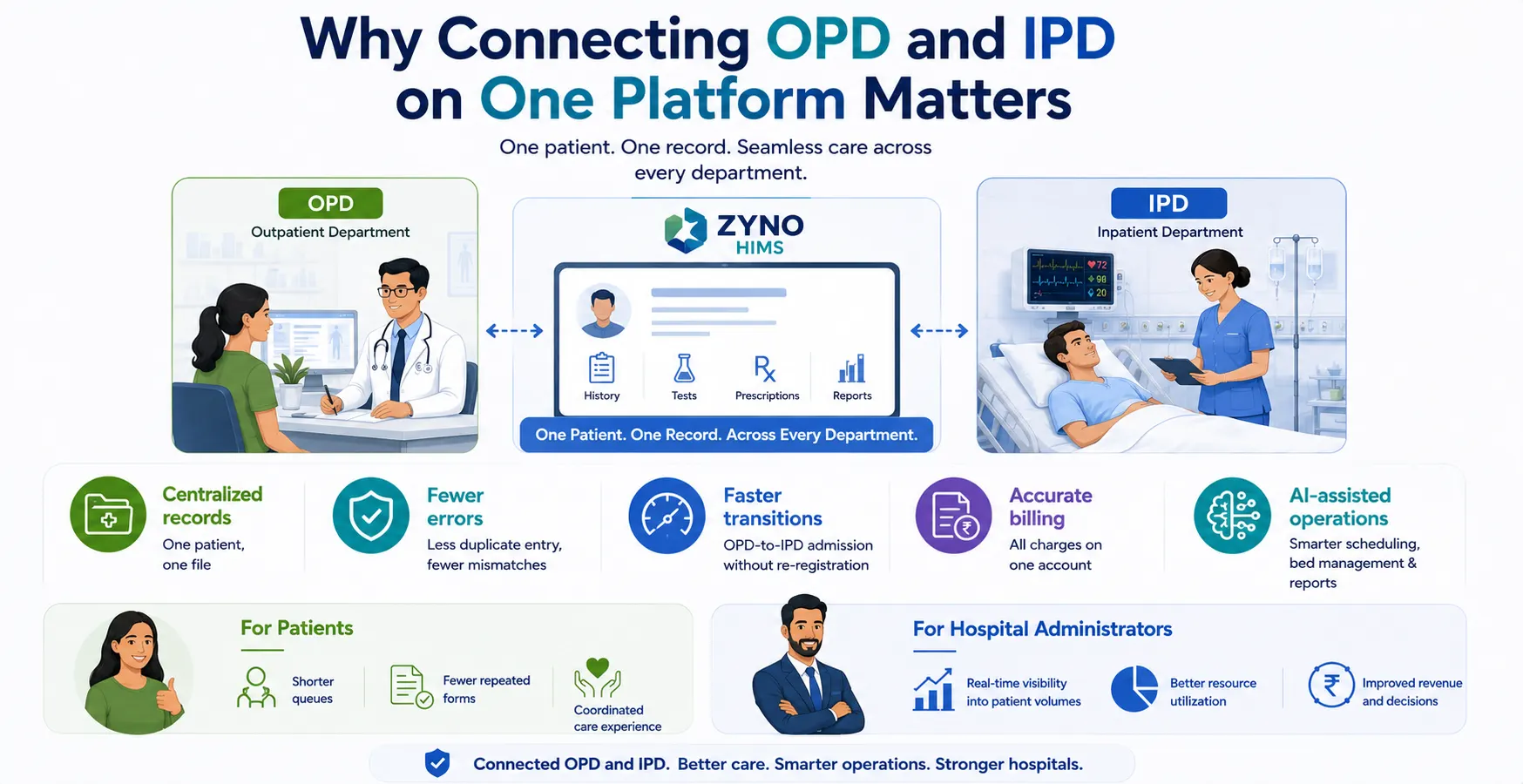
The real value shows up at the point where OPD and IPD meet. ZYNO HIMS works as an AI healthcare operating system, allowing an OPD patient’s record to move seamlessly into IPD when admission is required. Instead of starting from scratch, the same patient record carries forward including medical history, prior tests, prescriptions, and relevant clinical information helping healthcare teams save time and deliver more connected care.This kind of integration brings measurable benefits:
For patients, this translates into shorter queues, fewer repeated forms, and a visit that feels coordinated rather than disjointed. For hospital administrators, it means real visibility into patient volumes, resource utilization, and revenue the kind of data that's hard to get when OPD and IPD run on separate, disconnected tools.
OPD and IPD serve different needs, but they're two halves of the same patient journey. OPD handles the consultations, diagnostics, and short visits; IPD takes over when a patient needs admission, surgery, or continuous care. The hospitals that manage this transition best aren't necessarily the ones with the most staff they're the ones with systems that keep patient information connected from the first OPD visit through to IPD discharge.
That's the gap ZYNO HIMS is built to close: one AI-powered platform for registration, scheduling, billing, diagnostics, bed management, and discharge for both outpatient and inpatient care.
Frequently Asked Questions
OPD provides consultation and outpatient treatment without hospital admission. IPD provides admission-based care for patients needing a bed, continuous monitoring, surgery, nursing support, or extended treatment.
OPD stands for Outpatient Department.
IPD stands for Inpatient Department.
Generally, yes. OPD usually involves consultation, tests, or minor treatment, while IPD includes accommodation, nursing care, medication, procedures, and monitoring which adds up to a higher overall cost. Actual costs vary by hospital and treatment.
Generally, no. OPD patients visit for consultation, diagnosis, treatment, or follow-up and leave without formal admission.
Typically, yes. Since IPD involves formal admission, patients are assigned a bed, ward, or room based on their treatment needs.
Yes. If the treating doctor determines that a patient needs surgery, extended monitoring, or inpatient treatment, they can be admitted to IPD directly from OPD and with a connected HIMS, their existing record moves with them.
Yes. ZYNO HIMS is built specifically to connect OPD and IPD operations appointments, admissions, billing, diagnostics, pharmacy, bed management, and AI-assisted reporting on a single platform.
Can a patient move from IPD to OPD after discharge?
Yes. After discharge, patients often continue follow-up consultations, medication reviews, diagnostic tests, or routine checkups through OPD. With ZYNO HIMS, the patient’s previous admission details, reports, prescriptions, and treatment history can remain connected in one system, helping doctors access relevant information during follow-up visits.
How does ZYNO HIMS improve coordination between OPD and IPD?
ZYNO HIMS helps connect OPD and IPD workflows on a centralized platform by managing patient registration, appointments, medical records, diagnostics, pharmacy, billing, bed allocation, and discharge information. This makes it easier for hospital teams to maintain continuity when a patient moves from OPD to IPD or returns to OPD for follow-up care.
Why Cloud-Based AI HIMS is Transforming the Future of Indian Healthcare
Read More →The Complete ZYNO HIMS Guide for Modern Healthcare Management
Read More →How a Hospital Management System Improves Healthcare Operations
Read More →
Cloud vs Offline Hospital Management Systems: What Should Your Hospital Choose
Read More →What Is a Hospital Information System (HIS)? Features, Benefits & Complete Guide
Read More →How HIMS Software Improves Patient Care and Hospital Efficiency
Read More →How Is Hospital Software Transforming Patient Data Management in Modern Healthcare
Read More →
HIMS Software in Kenya: The Complete Guide for Hospitals & Clinics (2026)
Read More →
Top 10 KareXpert HIMS Alternatives & Competitors in 2026
Read More →
What is a Clinic Management System and How Does It Improve Patient Care?
Read More →
Top Challenges in Pharmacy Management and How to Overcome Them
Read More →
Top 10 Hospital Management Challenges and How ZYNO HIMS Solves Them
Read More →
Why Modern Clinics Are Switching to EMR Systems
Read More →
Top Reasons Why You Should Use Electronic Health Records System
Read More →
A Complete Guide to Choosing the Right Hospital Management Software
Read More →
ABDM Compliance Checklist: A Complete Guide for Hospitals to Achieve Digital Health Compliance
Read More →
Why Govt Hospitals Need HIMS: Improving Patient Care, Efficiency, and Digital Healthcare
Read More →
What Is Hospital Information Management Systems in Healthcare? A Complete Guide
Read More →
DocPulse vs ZYNO HIMS (2026): Why ZYNO HIMS Is the Smarter Hospital Management Choice
Read More →
MocDoc vs ZYNO HIMS: Which Hospital Management Software Is Better in 2026?
Read More →
Caresoft vs ZYNO HIMS: Complete HIMS Comparison for Hospitals
Read More →
Best PMJAY-Compliant HIMS Software in India (2026): Complete Guide for Hospitals
Read More →
Medical Report Analyzer Software: How AI Makes Medical Reports Easy to Understand
Read More →
How to Choose a Hospital Management System
Read More →
AI in HIMS: 10 Practical Ways Artificial Intelligence is Transforming Hospital Management
Read More →
Best Hospital Management Software for Private Clinics in Kenya
Read More →
Hospital Management Software in Japan: What Healthcare Providers Need in 2026
Read More →
Pharmacy Management Software for Kenyan Pharmacies: Features That Matter
Read More →
DHA and MOH Compliance for Hospital Software in the UAE
Read More →
Top 10 Hospital Management Software in India 2026: Features, Pros, Cons & Pricing
Read More →
OPD vs IPD: Difference Between OPD and IPD, Services & Complete Guide
Read More →
Pharmacy Inventory Management: Methods, Inventory Control & Best Practices
Read More →Partner with ZYNO by Elite Mindz to revolutionize how your business works. Fill out the form, and we’ll reach out with AI-powered solutions made just for you.
We use browser cookies to ensure you get the best experience on our website. Learn more
The form was submitted successfully!