Why Cloud-Based AI HIMS is Transforming the Future of Indian Healthcare
Read More →

×
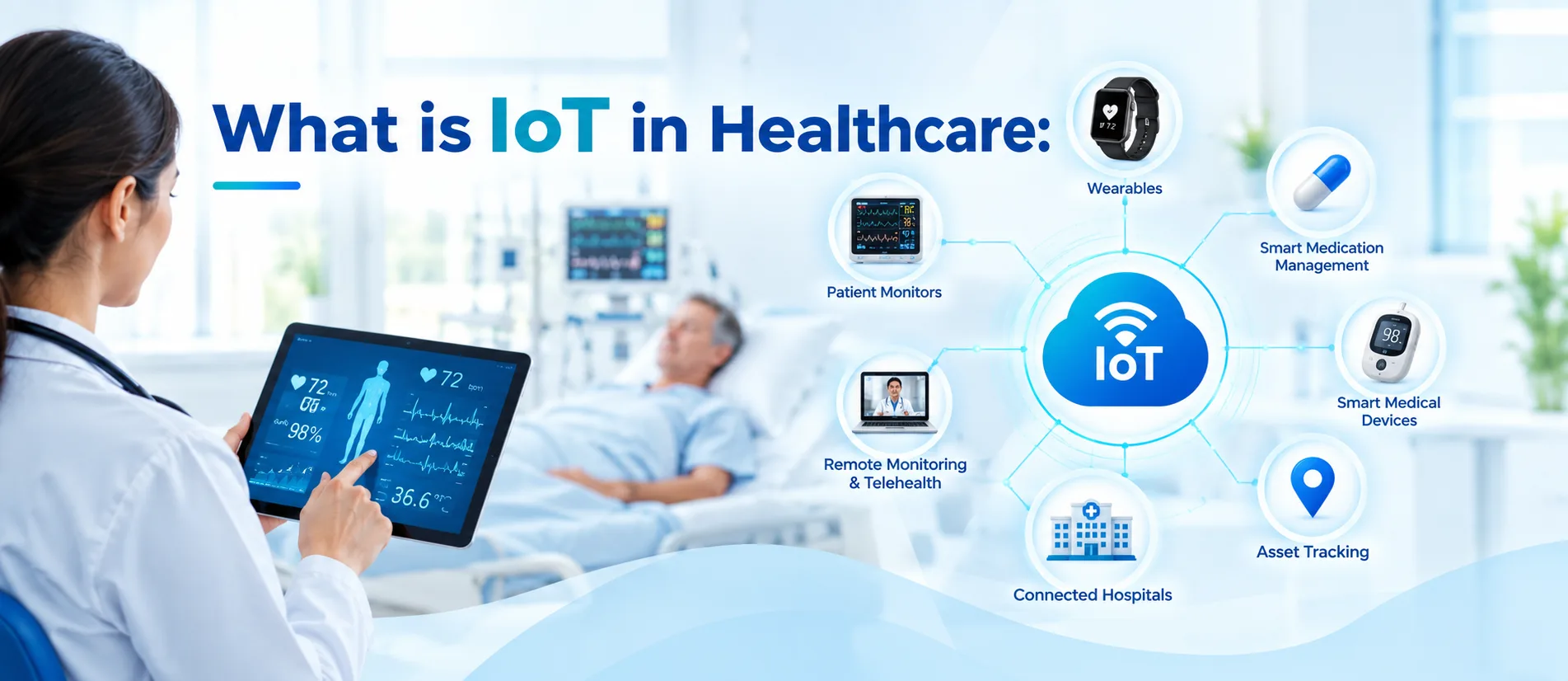
IoT in healthcare refers to connected devices, sensors, and software that collect and exchange real-time health data. Healthcare IoT applications include remote patient monitoring, smart medical devices, asset tracking, and hospital automation, helping improve patient care, operational efficiency, data accuracy, and healthcare decision-making.
Businesses using ZYNO Books cut accounting time by 70% and stay 100% ZATCA-compliant — automatically.
Not long ago, a doctor's understanding of a patient's health ended the moment the patient walked out of the clinic. No visibility between visits. No way to catch a problem before it turned into an emergency room case. Just a follow-up appointment, weeks away, and hope that nothing went wrong in between.
IoT in healthcare has closed that gap.
By connecting medical devices, wearables, hospital equipment, and software into a single data-sharing network, IoT lets physicians see what's happening to a patient in real time, not just during a visit. The result: fewer readmissions, faster interventions, and a healthcare system that reacts to problems before they escalate.
In this blog, we'll break down what IoT in healthcare actually means, how it works, its biggest applications, the software that powers it, and the benefits and challenges that come with adopting it.
Discover smarter healthcare with IoT-enabled solutions and ZYNO HIMS. Connect medical devices, enable real-time patient monitoring, streamline healthcare workflows, and improve data-driven hospital management with a modern healthcare platform.
IoT in healthcare also called the Internet of Medical Things (IoMT) refers to a network of connected medical devices, sensors, and software applications that collect, transmit, and analyze health data without needing a person to manually record it.
In simple terms: a device (a wearable, a hospital monitor, an ingestible sensor) picks up a health signal, sends it over the internet to a cloud platform, and that platform makes the data available to doctors, caregivers, or the patient instantly.
Before IoT, this kind of continuous visibility didn't exist. Monitoring a patient's blood pressure, glucose levels, or heart rhythm meant scheduled check-ins, manual logs, or a hospital stay. Now, the same data can move from a patient's wrist or bloodstream straight into a clinician's dashboard, any time of day. This enables better patient management, helping healthcare providers monitor conditions continuously, respond faster to changes, and make more informed care decisions.
This shift matters most for:

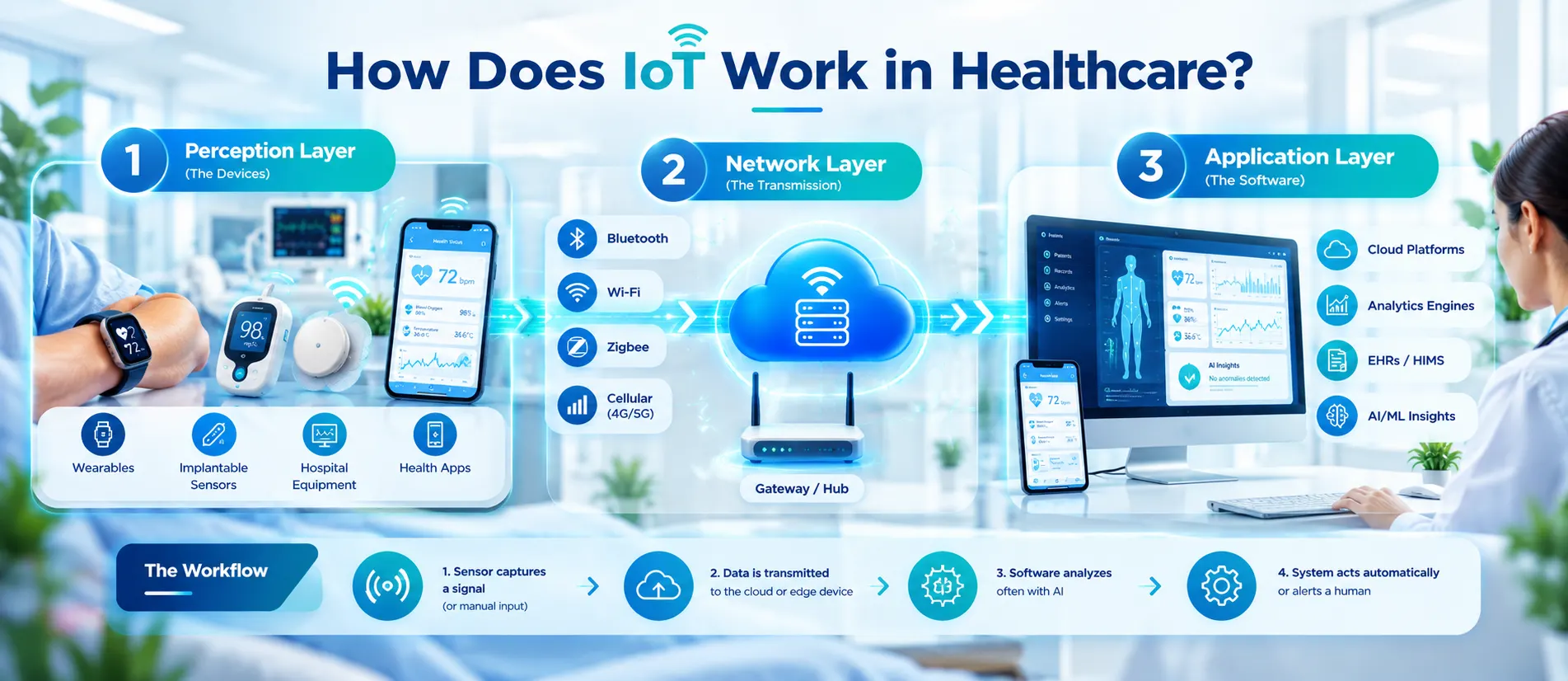
Every IoT healthcare system regardless of the specific device runs on the same basic structure:
1. Perception layer (the devices)
Wearables, implantable sensors, hospital equipment, and mobile health apps collect raw data- a heart rate, a glucose reading, a room's temperature.
2. Network layer (the transmission)
That data travels through Bluetooth, Wi-Fi, Zigbee, or cellular networks (4G/5G) to a gateway or hub, which pushes it to the cloud.
3. Application layer (the software)
Cloud platforms, analytics engines, and systems like EHRs or HIMS process the data, flag anomalies, and present it to doctors, nurses, or patients in a usable format often layered with AI/ML for predictive insights.
The workflow, boiled down:
IoT healthcare applications now touch nearly every corner of the care journey from a patient's living room to the operating theatre. Here's where it's making the biggest impact.
Remote Patient Monitoring (RPM)
Connected devices track vitals like blood pressure, SpO2, heart rate, and glucose, and stream that data to physicians in real time. This cuts down on unnecessary hospital visits and catches problems early, especially valuable for elderly patients and those managing chronic illness alone.
Wearables & Fitness Trackers
Smartwatches and fitness bands monitor activity levels, sleep, and heart rhythm continuously. For patients, this means round-the-clock awareness of their own health. For caregivers, it means an early-warning system for irregularities.
Ingestible Sensors & Smart Pills
Tiny, swallowable sensors relay data from inside the body, tracking medication adherence or internal conditions without invasive procedures. They pass naturally through the body once their job is done.
Connected Inhalers
For asthma and COPD patients, connected inhalers track usage frequency, detect patterns that precede an attack, and alert patients if they've left the device behind, reducing the risk of an unmanaged flare-up.
Smart Hospitals
Inside hospital walls, IoT sensors monitor everything from equipment performance to room temperature and hand hygiene compliance. This includes:
Robotic Surgery
IoT-connected robotic systems let surgeons perform complex, minimally invasive procedures with more precision and in some cases, remotely. This reduces surgical risk and shortens recovery time.
Telemedicine Integration
Paired with IoT devices, telemedicine platforms let physicians conduct remote exams using live vitals data instead of relying on the patient's self-report alone making virtual consultations far more clinically reliable.
Insurance & Claims Processing
Health insurers use IoT-generated data to verify claims, assess risk more accurately, personalize policies, and even reward patients for maintaining healthy habits, a win for both sides.
Devices alone don't make IoT in healthcare work. A wearable or a hospital sensor is only as useful as the software behind it, the layer that actually turns raw signals into decisions.
This is where most conversations about healthcare IoT stop short. The applications get the spotlight, but the software stack is what makes any of it clinically usable:
That last point is where most hospitals run into trouble. A connected glucose monitor or a smart bed can generate a constant stream of data, but if that data doesn't flow into the same system where a doctor already reviews a patient's history, prescriptions, and lab results, it adds noise instead of insight.
This is exactly the gap a modern Hospital Information Management System (HIMS) is built to close. ZYNO HIMS is designed to sit at the center of a hospital's digital ecosystem, pulling in data from connected devices, wearables, and monitoring systems, and presenting it alongside a patient's existing records in one unified view. Instead of clinicians toggling between a device dashboard and the EHR, ZYNO HIMS brings IoT-generated vitals, alerts, and trends directly into the same workflow doctors already use, turning scattered device data into a single, actionable patient picture.

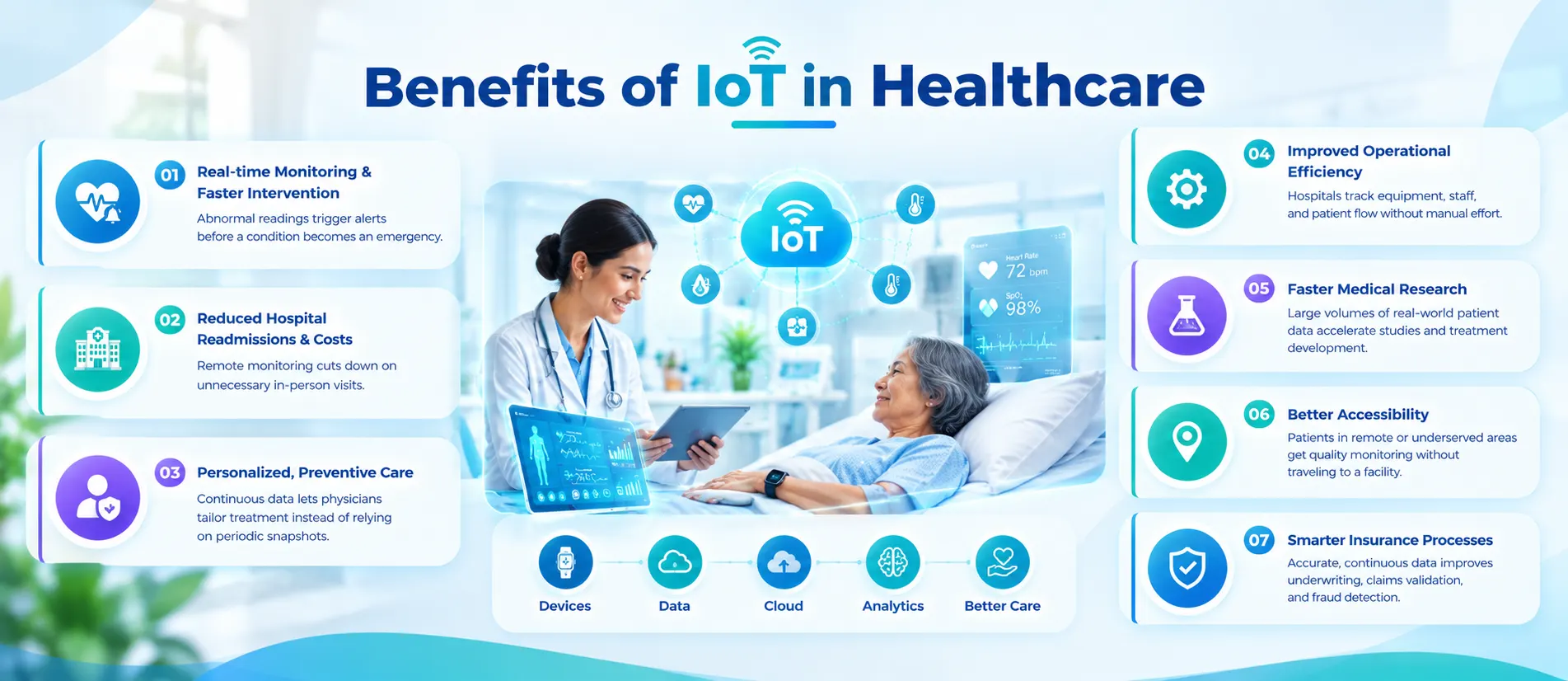
The advantages of IoT in healthcare show up at every level of the system for patients, providers, and payers alike:
For all its promise, IoT healthcare adoption isn't without friction. The most common roadblocks:
Data Security & Privacy
IoT devices transmit sensitive health data constantly, and many lack strong built-in security. That makes patient records a target stolen health data can be used for fraudulent claims or fake prescriptions. Compliance with HIPAA, GDPR, and similar regulations isn't optional.
Device & Protocol Interoperability
Different manufacturers use different communication standards. Without a common protocol, aggregating data from multiple devices into one system becomes slow and error-prone.
Data Overload & Accuracy
More connected devices mean more data but not necessarily more clarity. Sensor malfunctions, battery issues, or signal interference can introduce inaccuracies that are hard to catch without proper validation systems in place.
Cost of Implementation
Between hardware, software integration, staff training, and ongoing maintenance, IoT adoption is a real investment one that can be out of reach for smaller facilities without a phased rollout plan.
The next phase of IoT in healthcare is less about adding more devices and more about making the ones already in use smarter. Expect to see:
Connect healthcare devices, enable real-time patient monitoring, streamline clinical workflows, and manage connected healthcare operations with ZYNO HIMS.
Explore ZYNO HIMS →IoT in healthcare has moved from an emerging concept to a working part of how care gets delivered from a wearable tracking a heart rate to a hospital-wide sensor network flagging equipment failures before they happen. The applications are only half the story, though. The software that connects devices to a hospital's actual patient records is what turns real-time data into real clinical decisions.
Platforms like ZYNO HIMS are built for exactly that, bringing connected device data, patient history, and hospital operations into one system, so IoT doesn't just generate information, but usable insight. If your hospital is exploring how to make its IoT investments actually work within existing clinical workflows, book a demo with ZYNO HIMS to see how it fits into your setup.
Common examples include wearable fitness trackers, continuous glucose monitors, connected inhalers, smart beds, ingestible sensors, and RFID-based asset trackers used in hospitals.
Security depends on the device and platform. Reputable healthcare IoT solutions follow HIPAA, GDPR, and similar regulations, using encryption and authentication to protect patient data but the risk of breaches remains a real concern industry-wide.
With the right APIs and integration frameworks, IoT device data can sync directly with an EHR or HIMS, giving clinicians a unified view of both patient history and real-time device data in one dashboard.
Yes, many facilities start small, with targeted implementations like connected temperature monitors or basic RPM devices, and scale up as budgets and infrastructure allow.
They're often used interchangeably. IoMT (Internet of Medical Things) is simply the healthcare-specific application of the broader IoT concept, referring specifically to connected medical devices and systems.
Why Cloud-Based AI HIMS is Transforming the Future of Indian Healthcare
Read More →The Complete ZYNO HIMS Guide for Modern Healthcare Management
Read More →How a Hospital Management System Improves Healthcare Operations
Read More →
Cloud vs Offline Hospital Management Systems: What Should Your Hospital Choose
Read More →What Is a Hospital Information System (HIS)? Features, Benefits & Complete Guide
Read More →How HIMS Software Improves Patient Care and Hospital Efficiency
Read More →How Is Hospital Software Transforming Patient Data Management in Modern Healthcare
Read More →
HIMS Software in Kenya: The Complete Guide for Hospitals & Clinics (2026)
Read More →
Top 10 KareXpert HIMS Alternatives & Competitors in 2026
Read More →
What is a Clinic Management System and How Does It Improve Patient Care?
Read More →
Top Challenges in Pharmacy Management and How to Overcome Them
Read More →
Top 10 Hospital Management Challenges and How ZYNO HIMS Solves Them
Read More →
Why Modern Clinics Are Switching to EMR Systems
Read More →
Top Reasons Why You Should Use Electronic Health Records System
Read More →
A Complete Guide to Choosing the Right Hospital Management Software
Read More →
ABDM Compliance Checklist: A Complete Guide for Hospitals to Achieve Digital Health Compliance
Read More →
Why Govt Hospitals Need HIMS: Improving Patient Care, Efficiency, and Digital Healthcare
Read More →
What Is Hospital Information Management Systems in Healthcare? A Complete Guide
Read More →
DocPulse vs ZYNO HIMS (2026): Why ZYNO HIMS Is the Smarter Hospital Management Choice
Read More →
MocDoc vs ZYNO HIMS: Which Hospital Management Software Is Better in 2026?
Read More →
Caresoft vs ZYNO HIMS: Complete HIMS Comparison for Hospitals
Read More →
Best PMJAY-Compliant HIMS Software in India (2026): Complete Guide for Hospitals
Read More →
Medical Report Analyzer Software: How AI Makes Medical Reports Easy to Understand
Read More →
How to Choose a Hospital Management System
Read More →
AI in HIMS: 10 Practical Ways Artificial Intelligence is Transforming Hospital Management
Read More →
Best Hospital Management Software for Private Clinics in Kenya
Read More →
Hospital Management Software in Japan: What Healthcare Providers Need in 2026
Read More →
Pharmacy Management Software for Kenyan Pharmacies: Features That Matter
Read More →
DHA and MOH Compliance for Hospital Software in the UAE
Read More →
Top 10 Hospital Management Software in India 2026: Features, Pros, Cons & Pricing
Read More →
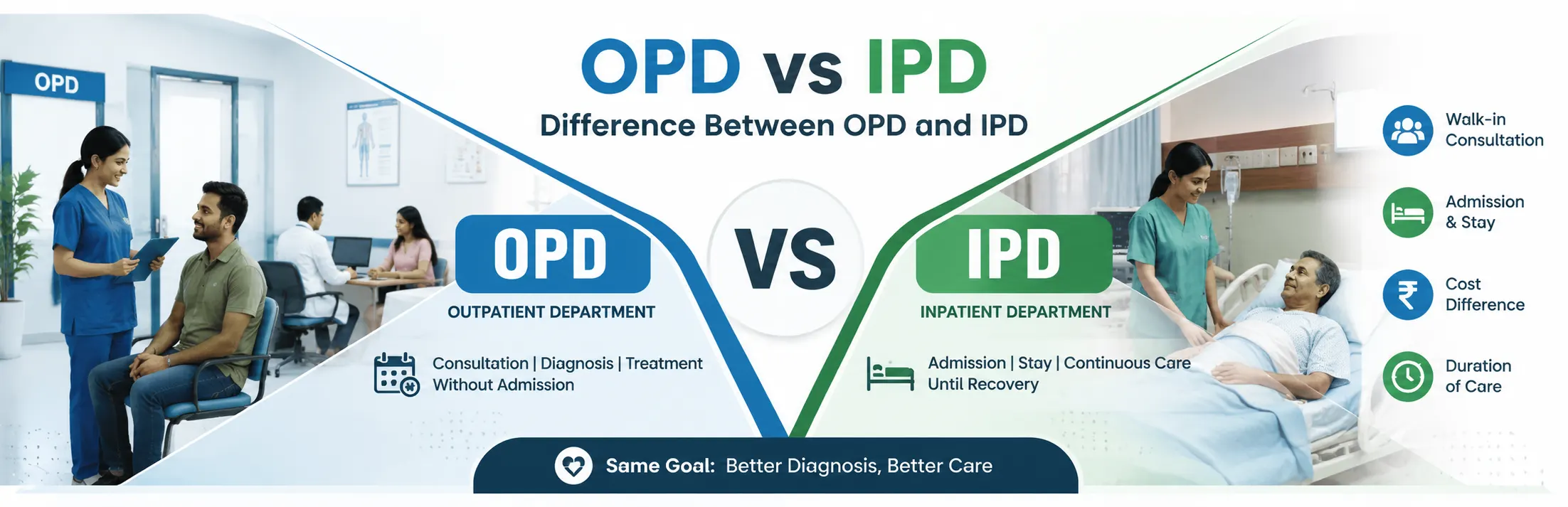
OPD vs IPD: Difference Between OPD and IPD, Services & Complete Guide
Read More →
Pharmacy Inventory Management: Methods, Inventory Control & Best Practices
Read More →
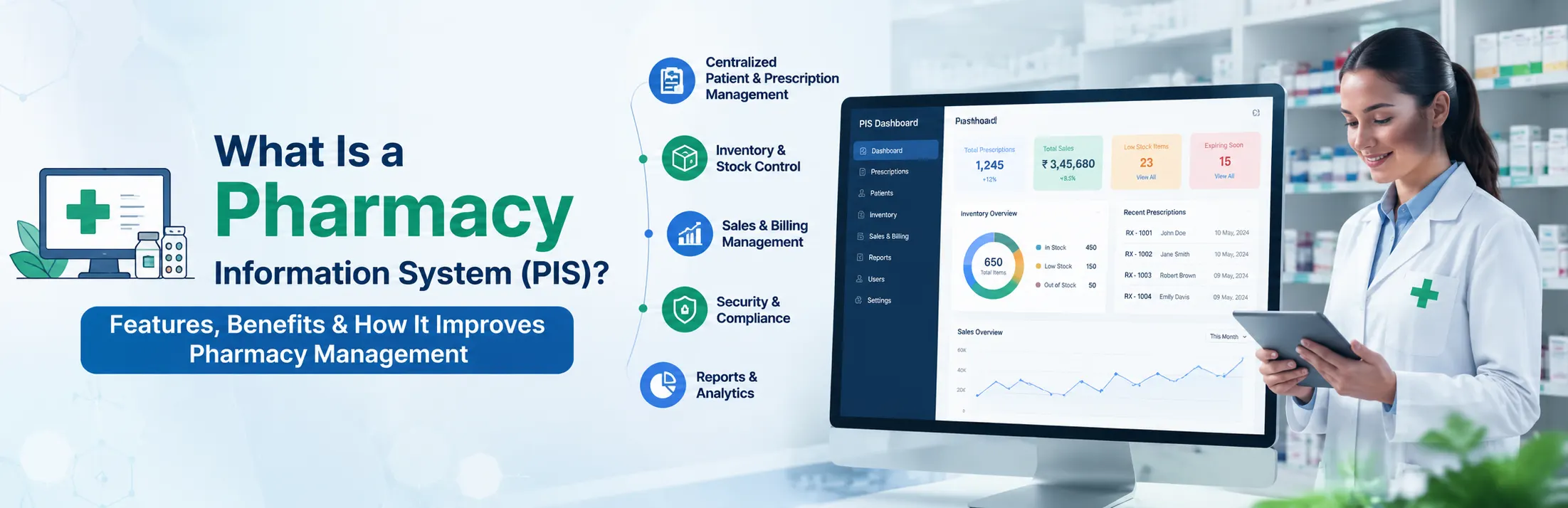
What Is a Pharmacy Information System (PIS)? Features, Benefits & How It Improves Pharmacy Management
Read More →
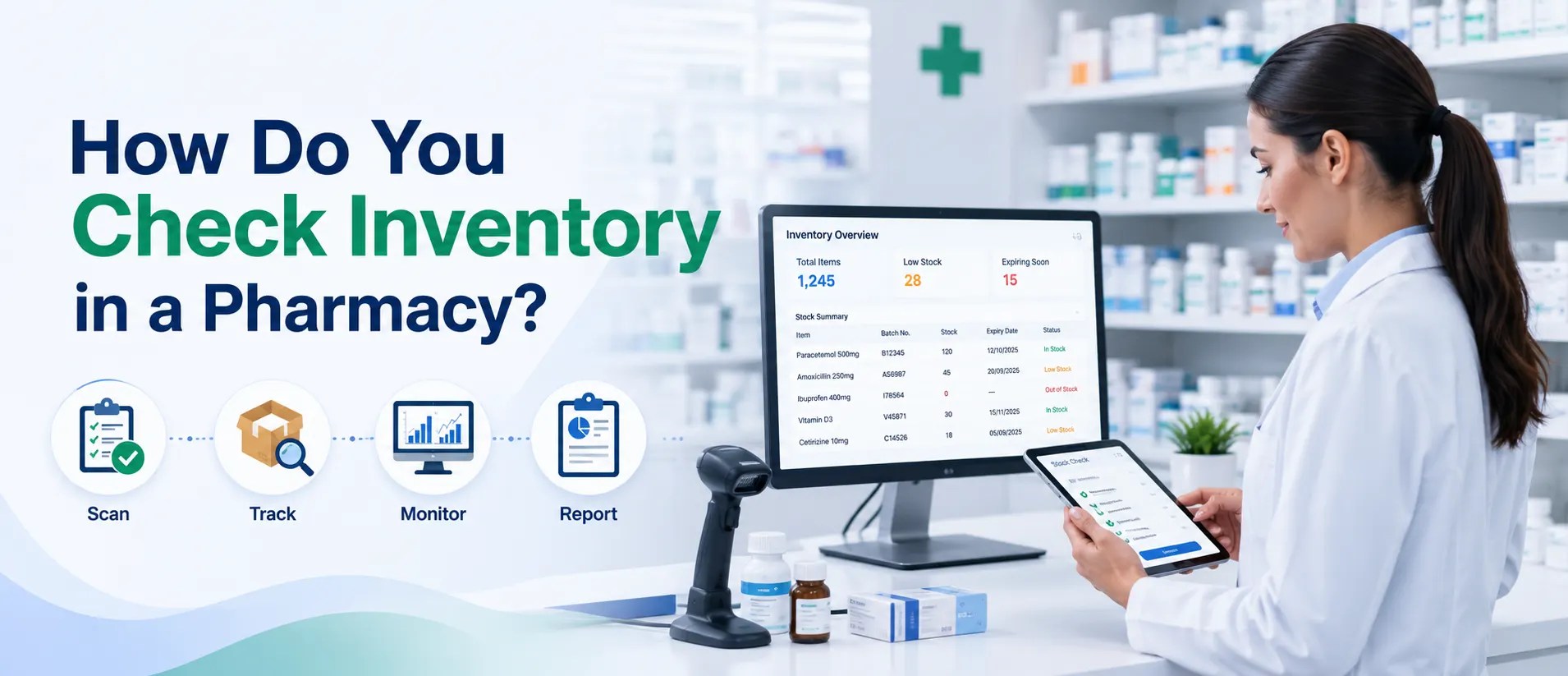
How Do You Check Inventory in a Pharmacy?
Read More →
What’s the Difference Between EHR and EMR? Key Differences, Benefits & Guide
Read More →
What is Radiology Information System? Features & Benefits
Read More →
What Is Digital Healthcare? Benefits, Examples & Future
Read More →
Healthcare Supply Chain Management Benefits
Read More →
Benefits of Patient Information Management Systems for Hospitals & Clinics
Read More →
What Is the Difference Between PACS, DICOM, RIS & CIS?
Read More →
Best Hospital Billing Software in India 2026: Top 10 Medical Billing Solutions
Read More →
Top Features of Hospital Billing Software in India
Read More →
Best Cloud-Based Hospital Inventory Management Software in 2026: Top 10 Solutions
Read More →
Which Hospital Management Software in India Is Suitable for Newly Established Hospitals?
Read More →
Medical Diagnostic Software: What It Is, How It Works & Top 5 Players in 2026
Read More →
10 Best Patient Management Software in 2026
Read More →
Hospital Management Software for Multispecialty Hospitals: A Complete Guide
Read More →
Top 10 Multi-Location Hospital Management Software in India
Read More →
Top 10 Hospital Management Software Companies in Qatar
Read More →
ZYNO HIMS: Enterprise Healthcare Management for Private Facilities
Read More →
How Hospital Staff Can Digitize Paper-Based Tabular Data into Excel Records
Read More →
Top 10 Features to Look for in a HIMS Software in Saudi Arabia & UAE
Read More →
AI-Powered HIMS: The Future of Hospital Management in the Middle East
Read More →
Types of Healthcare Software: Medical Software & Digital Health Solutions
Read More →
Telehealth vs Telemedicine: What Is the Difference Between Telehealth and Telemedicine?
Read More →
7 Best EMR Software Options for Dubai Clinics in 2026
Read More →
What is IoT in Healthcare: Application & Software in Healthcare IoT
Read More →
6 Best Hospital Management Software in UAE 2026
Read More →Partner with ZYNO by Elite Mindz to revolutionize how your business works. Fill out the form, and we’ll reach out with AI-powered solutions made just for you.
We use browser cookies to ensure you get the best experience on our website. Learn more
The form was submitted successfully!