Why Cloud-Based AI HIMS is Transforming the Future of Indian Healthcare
Read More →

×
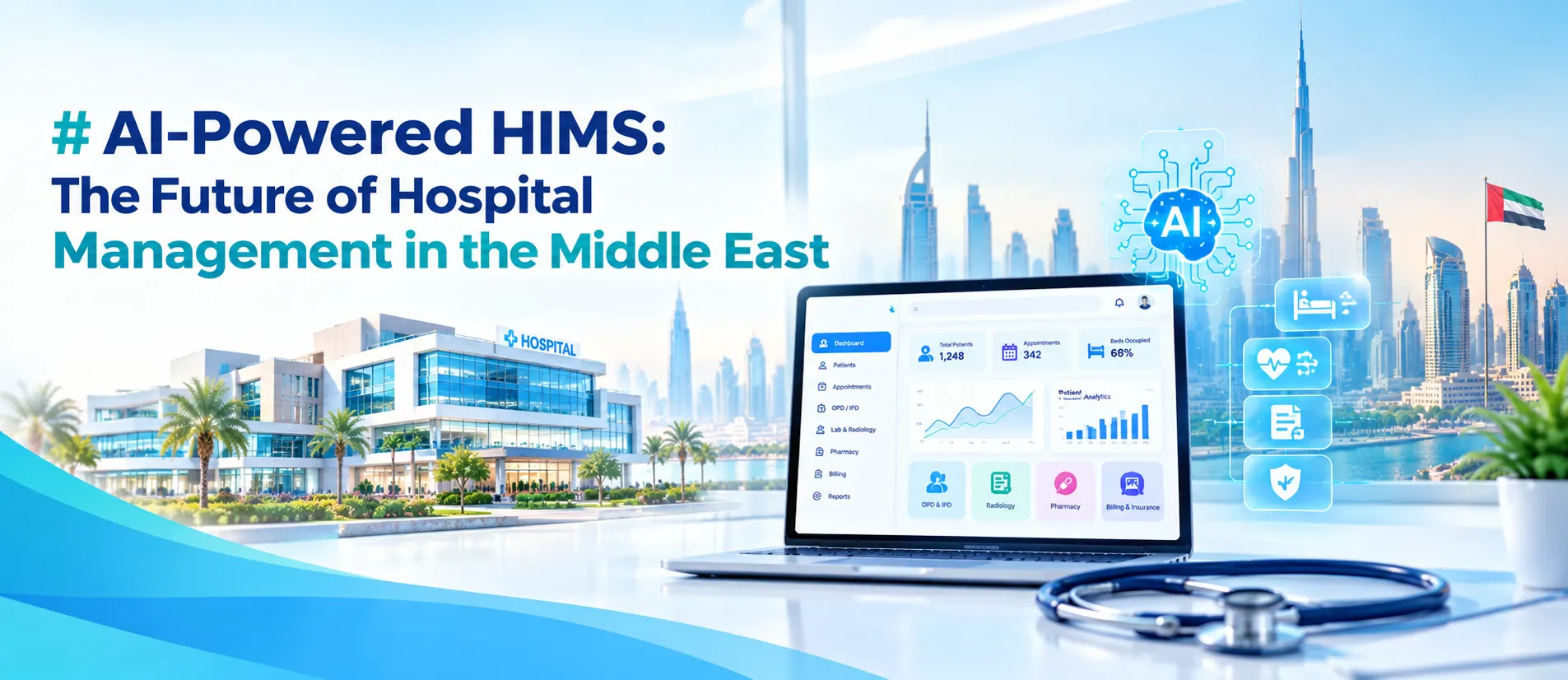
AI-powered HIMS is transforming Middle Eastern healthcare by automating operations, optimizing bed management, and enabling predictive patient care. Aligned with Saudi Vision 2030 and UAE digital health initiatives, it reduces diagnostic errors and drives seamless, data-driven hospital efficiency.
Businesses using ZYNO Books cut accounting time by 70% and stay 100% ZATCA-compliant — automatically.
Healthcare across the Middle East is undergoing rapid digital transformation. Hospitals and healthcare organizations in the UAE, Saudi Arabia, Qatar, and other regional markets are increasingly looking for smarter ways to manage growing patient volumes, multiple facilities, clinical information, and day-to-day hospital operations.
Traditional hospital management often involves scattered patient records, manual data entry, delayed reporting, limited bed visibility, and communication gaps between departments. An AI-powered Hospital Information Management System (HIMS) addresses these challenges by connecting patient records, appointments, billing, pharmacy, clinical information, and administrative workflows through one intelligent platform.
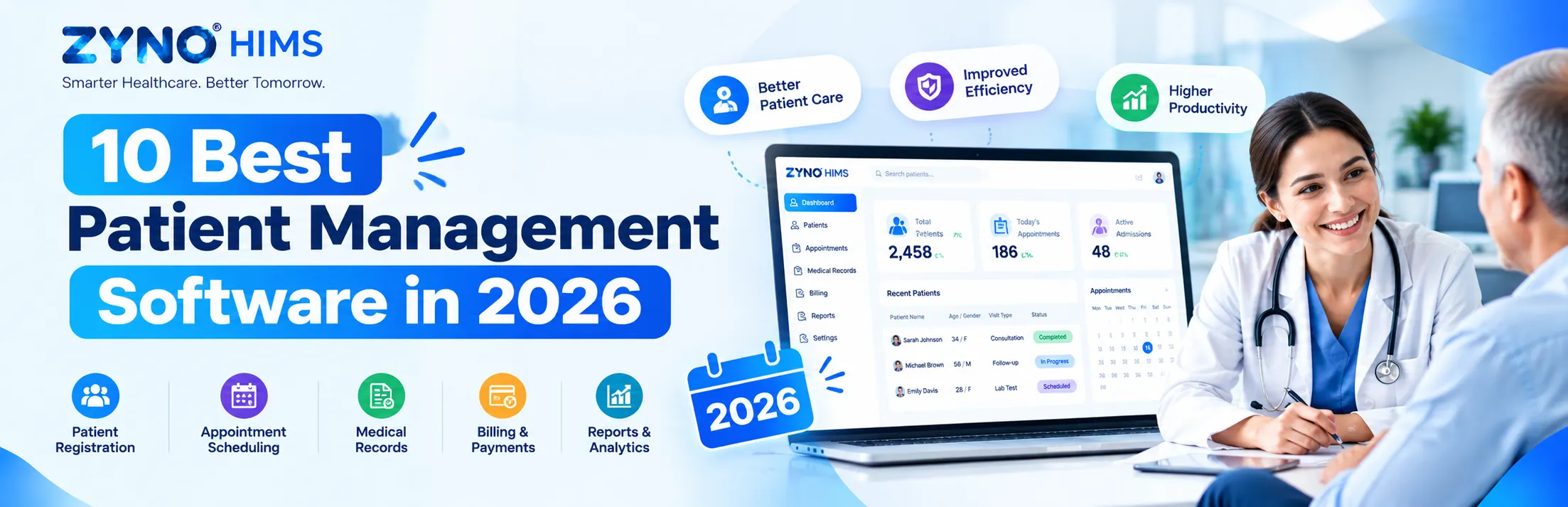
In this blog, we will explore what an AI-powered HIMS is, why hospitals in the Middle East are adopting it, its key capabilities and benefits, and what healthcare organizations should consider when selecting a modern HIMS solution.
Request a free demo of ZYNO HIMS and discover how AI-powered hospital management can streamline workflows, improve patient care, centralize healthcare data, and support smarter hospital operations across the Middle East.
A Hospital Information Management System (HIMS) acts as the digital backbone of a hospital. It helps manage patient registration, appointments, clinical records, billing, pharmacy, bed management, and administrative workflows from a centralized platform.
A traditional HIMS primarily focuses on digitizing and storing information. An AI-powered HIMS goes further by using automation and intelligent processing to help hospital teams access and manage information more efficiently.
Key capabilities can include:
In simple terms, an AI-powered HIMS moves hospital management from basic digital record-keeping toward connected, automated, and intelligent operations.
The healthcare sector in the Middle East is experiencing significant digital transformation. Hospitals are looking for technology that can help them improve operational efficiency while managing increasing amounts of healthcare data.
Some key factors driving adoption include:
Healthcare organizations are increasingly replacing manual processes with digital systems to improve data accessibility, reporting, and operational efficiency.
Growing populations, expanding healthcare infrastructure, and medical tourism can increase pressure on hospitals to deliver faster and more organized services.
Large healthcare groups often operate multiple hospitals, clinics, and specialty centers. A centralized HIMS can help maintain consistent processes and information across different locations.
Patients increasingly expect quicker registration, appointment management, billing, and access to healthcare services.
Hospitals generate large amounts of clinical, financial, and operational data. Modern systems help organize this information and make it accessible to authorized users.
Hospitals need to exchange information with laboratories, pharmacies, insurers, EHR/EMR platforms, medical devices, and other healthcare systems.
Healthcare organizations require real-time operational visibility while ensuring that sensitive patient information is protected through appropriate security controls.
These requirements are increasing demand for HIMS Software in Middle East healthcare organizations that can support connected and scalable hospital operations.

A modern AI Hospital Management System can bring multiple hospital functions together on one platform.
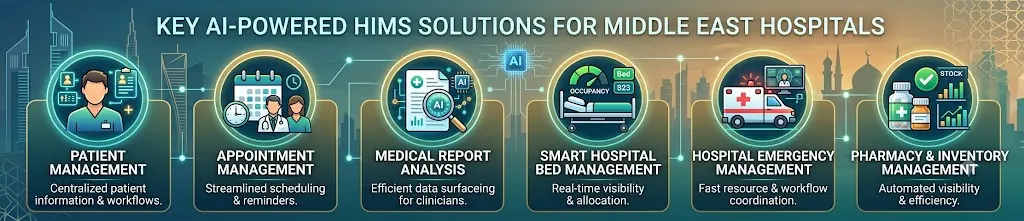
An AI-enabled patient management module can centralize registration, medical history, patient information, and related workflows. Authorized staff can search and access relevant information more quickly, supporting a smoother patient journey from registration to discharge.
Intelligent appointment management can help hospitals check doctor availability, schedule appointments, send reminders, and manage cancellations or rescheduling. This can reduce manual coordination and make appointment workflows more organized.
AI-assisted medical report processing can help surface relevant information from reports more efficiently. This can support clinicians by reducing the time required for manual information review while keeping clinical decisions with qualified healthcare professionals.
Real-time bed visibility can help hospital administrators monitor occupancy and available beds. AI-assisted allocation can support admission and discharge coordination and help teams make better use of available resources.
Emergency departments require fast access to patient, bed, specialist, and resource information. A connected HIMS can bring these elements together and help emergency teams coordinate workflows more efficiently.
Hospital pharmacies need accurate visibility into stock levels, expiry dates, procurement, and medicine availability. Automated inventory management can help reduce shortages and overstocking while supporting visibility across multiple locations.
A centralized billing module can manage patient billing, invoices, payments, insurance claims, and financial reporting. Connecting billing with patient and clinical information can help reduce repetitive data entry and improve financial visibility.
|
Hospital Challenge |
AI-Powered HIMS Solution |
|
Manual data entry |
Workflow automation |
|
Long appointment processes |
Smart scheduling |
|
Limited bed visibility |
Real-time bed tracking |
|
Scattered patient information |
Centralized records |
|
Manual report review |
AI-assisted analysis |
|
Inventory shortages |
Automated inventory monitoring |
|
Communication gaps |
Connected departmental workflows |
|
Delayed reporting |
Real-time analytics |
A modern Hospital Management System Middle East healthcare organizations can use should connect these functions rather than treating each department as a separate system.
One of the important advantages of AI-enabled hospital systems is the ability to turn large volumes of healthcare data into actionable operational information.
Centralized dashboards can provide visibility into areas such as:
Over time, organized data can also support predictive analytics and help hospitals identify patterns in patient demand and resource requirements.
For healthcare organizations looking for modern Healthcare Management Software, combining centralized data with automation and analytics can create a more connected approach to hospital operations.
Hospitals rarely operate independently. They need to exchange information with laboratories, pharmacies, insurers, medical devices, and other healthcare platforms.
A modern HIMS can integrate with:
For healthcare networks operating across multiple locations, HIMS integration can help information move between facilities and connected systems in a structured manner.
This interoperability is particularly important for organizations investing in Healthcare Software Middle East solutions, where different systems may need to work together as healthcare networks expand.
Healthcare systems handle sensitive patient and operational information, making security an important consideration when selecting an HIMS.
Organizations should evaluate features such as:
Regulatory requirements can vary between Saudi Arabia, the UAE, Qatar, and other Middle Eastern markets. Hospitals should therefore confirm how a vendor's system addresses the specific data protection and healthcare information requirements applicable to their location.
Cloud technology can provide healthcare organizations with flexible access to their hospital management platform.
A cloud-based HIMS can support:
For growing hospital groups, cloud deployment can support expansion while keeping multiple locations connected through a centralized platform.
|
Feature |
Traditional HIMS |
AI-Powered HIMS |
|
Data management |
Mostly manual |
Automated and centralized |
|
Patient search |
Basic |
AI-assisted |
|
Appointment management |
Manual |
Intelligent automation |
|
Bed management |
Periodic updates |
Real-time visibility |
|
Reports |
Static |
AI-assisted insights |
|
Analytics |
Basic |
Real-time and advanced |
|
Integration |
Limited |
API-enabled |
|
Accessibility |
Often limited |
Cloud-based |
|
Decision support |
Limited |
AI-assisted |
The key difference is that traditional systems primarily focus on storing and managing information, while AI-enabled platforms can combine data, automation, analytics, and intelligent assistance.
Implementing a modern HIMS can support hospitals in several areas:
These capabilities make Digital Hospital Management more organized by connecting departments, information, and workflows within a single digital environment.
Before selecting an HIMS, hospitals should evaluate whether the platform supports their current requirements and future growth.
Important factors include:
Hospitals should also evaluate the system through practical demonstrations and determine whether it can integrate with their existing technology ecosystem.
ZYNO HIMS by Elite Mindz brings multiple hospital management capabilities together through a connected platform designed to support modern healthcare operations.
Key capabilities include:
For hospitals evaluating an AI-powered HIMS, ZYNO HIMS provides a connected approach to patient management, hospital operations, and healthcare workflows.
Transform hospital operations with ZYNO HIMS and streamline workflows, centralize healthcare data, improve patient care, and enable smarter decision-making across the Middle East.
Explore ZYNO HIMS →The future of hospital technology is moving toward greater automation, predictive analytics, intelligent patient engagement, and stronger interoperability.
AI can increasingly support administrative workflows, data analysis, patient communication, and operational decision support. At the same time, hospitals will continue to focus on connecting laboratories, pharmacies, insurers, clinical systems, and other healthcare services.
The broader direction is moving from simply digitizing individual hospital processes toward creating connected healthcare ecosystems where information can be securely accessed and used across different workflows.
For hospitals evaluating HIMS Software in Middle East markets, choosing a platform with AI capabilities, cloud infrastructure, interoperability, security, and scalability can help establish a stronger digital foundation for future growth.
AI-powered HIMS is changing how hospitals approach digital transformation by combining centralized healthcare data, automation, analytics, interoperability, and intelligent assistance.
For healthcare organizations across the Middle East, the focus is increasingly moving beyond basic digital record-keeping toward connected hospital operations. A modern HIMS can support patient management, appointments, emergency workflows, beds, pharmacy, billing, reporting, and other essential processes through one integrated environment.
As hospitals continue to expand their digital infrastructure, technologies such as AI, cloud computing, APIs, and advanced analytics will remain important components of modern healthcare management.
Learn more about ZYNO HIMS and explore how an integrated HIMS platform can support modern hospital operations.
An AI-powered HIMS is a hospital information management platform that combines hospital data management with automation, analytics, and AI-assisted capabilities. It can support patient management, appointments, billing, pharmacy, bed management, reporting, and other hospital workflows.
AI can assist with tasks such as patient information retrieval, appointment scheduling, medical report analysis, operational analytics, and workflow automation. It is designed to support hospital teams by reducing repetitive work and providing information more efficiently.
Hospitals in the region are managing growing healthcare data, expanding facilities, multiple branches, and increasing demand for digital services. Modern HIMS platforms can help centralize information, automate workflows, improve coordination, and provide real-time operational visibility.
EMR primarily focuses on a patient's electronic medical record and clinical information. HIMS has a broader scope and can include patient management, appointments, billing, pharmacy, bed management, administration, reporting, and other hospital-wide functions.
Cloud-based HIMS can be designed with security measures such as encryption, role-based access, audit trails, backups, and controlled access. Hospitals should evaluate the vendor's specific security architecture and compliance with the regulations applicable to their country.
Yes. A centralized and cloud-based HIMS can support multi-branch operations by providing authorized users with access to shared patient, billing, operational, and reporting information according to their roles and permissions.
Modern HIMS platforms can support integrations with EHR/EMR systems, laboratory systems, pharmacy platforms, insurance systems, medical devices, and third-party applications through APIs, depending on the capabilities of the specific solution.
Hospitals should evaluate AI and automation capabilities, cloud deployment, security, interoperability, APIs, multi-branch support, analytics, mobile accessibility, customizable workflows, and integration with pharmacy, laboratory, billing, and patient management systems.
AI-powered HIMS is designed primarily to automate repetitive tasks and assist healthcare and administrative teams. It can reduce manual workload and surface relevant information, while clinical decisions and patient care remain the responsibility of qualified healthcare professionals.
AI-powered HIMS can connect hospital departments, centralize healthcare information, automate workflows, provide real-time operational visibility, and support analytics. This can help hospitals create more connected and organized digital workflows across different departments and locations.
Why Cloud-Based AI HIMS is Transforming the Future of Indian Healthcare
Read More →The Complete ZYNO HIMS Guide for Modern Healthcare Management
Read More →How a Hospital Management System Improves Healthcare Operations
Read More →
Cloud vs Offline Hospital Management Systems: What Should Your Hospital Choose
Read More →What Is a Hospital Information System (HIS)? Features, Benefits & Complete Guide
Read More →How HIMS Software Improves Patient Care and Hospital Efficiency
Read More →How Is Hospital Software Transforming Patient Data Management in Modern Healthcare
Read More →
HIMS Software in Kenya: The Complete Guide for Hospitals & Clinics (2026)
Read More →
Top 10 KareXpert HIMS Alternatives & Competitors in 2026
Read More →
What is a Clinic Management System and How Does It Improve Patient Care?
Read More →
Top Challenges in Pharmacy Management and How to Overcome Them
Read More →
Top 10 Hospital Management Challenges and How ZYNO HIMS Solves Them
Read More →
Why Modern Clinics Are Switching to EMR Systems
Read More →
Top Reasons Why You Should Use Electronic Health Records System
Read More →
A Complete Guide to Choosing the Right Hospital Management Software
Read More →
ABDM Compliance Checklist: A Complete Guide for Hospitals to Achieve Digital Health Compliance
Read More →
Why Govt Hospitals Need HIMS: Improving Patient Care, Efficiency, and Digital Healthcare
Read More →
What Is Hospital Information Management Systems in Healthcare? A Complete Guide
Read More →
DocPulse vs ZYNO HIMS (2026): Why ZYNO HIMS Is the Smarter Hospital Management Choice
Read More →
MocDoc vs ZYNO HIMS: Which Hospital Management Software Is Better in 2026?
Read More →
Caresoft vs ZYNO HIMS: Complete HIMS Comparison for Hospitals
Read More →
Best PMJAY-Compliant HIMS Software in India (2026): Complete Guide for Hospitals
Read More →
Medical Report Analyzer Software: How AI Makes Medical Reports Easy to Understand
Read More →
How to Choose a Hospital Management System
Read More →
AI in HIMS: 10 Practical Ways Artificial Intelligence is Transforming Hospital Management
Read More →
Best Hospital Management Software for Private Clinics in Kenya
Read More →
Hospital Management Software in Japan: What Healthcare Providers Need in 2026
Read More →
Pharmacy Management Software for Kenyan Pharmacies: Features That Matter
Read More →
DHA and MOH Compliance for Hospital Software in the UAE
Read More →
Top 10 Hospital Management Software in India 2026: Features, Pros, Cons & Pricing
Read More →
OPD vs IPD: Difference Between OPD and IPD, Services & Complete Guide
Read More →
Pharmacy Inventory Management: Methods, Inventory Control & Best Practices
Read More →
What Is a Pharmacy Information System (PIS)? Features, Benefits & How It Improves Pharmacy Management
Read More →
How Do You Check Inventory in a Pharmacy?
Read More →
What’s the Difference Between EHR and EMR? Key Differences, Benefits & Guide
Read More →
What is Radiology Information System? Features & Benefits
Read More →
What Is Digital Healthcare? Benefits, Examples & Future
Read More →
Healthcare Supply Chain Management Benefits
Read More →
Benefits of Patient Information Management Systems for Hospitals & Clinics
Read More →
What Is the Difference Between PACS, DICOM, RIS & CIS?
Read More →
Best Hospital Billing Software in India 2026: Top 10 Medical Billing Solutions
Read More →
Top Features of Hospital Billing Software in India
Read More →
Best Cloud-Based Hospital Inventory Management Software in 2026: Top 10 Solutions
Read More →
Which Hospital Management Software in India Is Suitable for Newly Established Hospitals?
Read More →
Medical Diagnostic Software: What It Is, How It Works & Top 5 Players in 2026
Read More →
10 Best Patient Management Software in 2026
Read More →
Hospital Management Software for Multispecialty Hospitals: A Complete Guide
Read More →
Top 10 Multi-Location Hospital Management Software in India
Read More →
Top 10 Hospital Management Software Companies in Qatar
Read More →
ZYNO HIMS: Enterprise Healthcare Management for Private Facilities
Read More →
How Hospital Staff Can Digitize Paper-Based Tabular Data into Excel Records
Read More →
Top 10 Features to Look for in a HIMS Software in Saudi Arabia & UAE
Read More →
AI-Powered HIMS: The Future of Hospital Management in the Middle East
Read More →Partner with ZYNO by Elite Mindz to revolutionize how your business works. Fill out the form, and we’ll reach out with AI-powered solutions made just for you.
We use browser cookies to ensure you get the best experience on our website. Learn more
The form was submitted successfully!