Why Cloud-Based AI HIMS is Transforming the Future of Indian Healthcare
Read More →

×
A complete, in-depth guide to pharmacy inventory management, key control techniques, common challenges, and how ZYNO HIMS pharmacy management software keeps stock, billing, and patient care connected on one platform.
Businesses using ZYNO Books cut accounting time by 70% and stay 100% ZATCA-compliant — automatically.
Every pharmacy whether it's a single retail counter or a large hospital pharmacy handling hundreds of prescriptions a day is constantly balancing two competing pressures: don't run out of stock, and don't tie up money in stock that just sits on a shelf. Both mistakes are expensive in very different ways.
Overstocking looks safe on the surface, but it quietly drains a pharmacy's working capital. Every extra strip of medicine sitting in storage is money that isn't earning anything, and if that medicine expires before it's used, the loss becomes permanent. On the other end, understocking is the mistake patients actually notice a prescribed medicine simply isn't available, the patient has to go elsewhere, and the pharmacy loses both the sale and a bit of trust.
This is the exact problem that pharmacy inventory management exists to solve. It's the discipline of knowing, at any given moment, what you have, what you're about to run out of, what's about to expire, and what needs to be reordered before any of those become a crisis. Inventory control is the more tactical half of this discipline: the day-to-day monitoring that keeps stock levels within safe limits.
Doing this manually on registers, spreadsheets, or memory works for a while, but it breaks down fast as prescription volumes grow. That's exactly why more pharmacies and hospitals are shifting to dedicated pharmacy software and a connected pharmacy management system, one that gives real-time visibility into every batch, every expiry date, and every reorder point automatically.
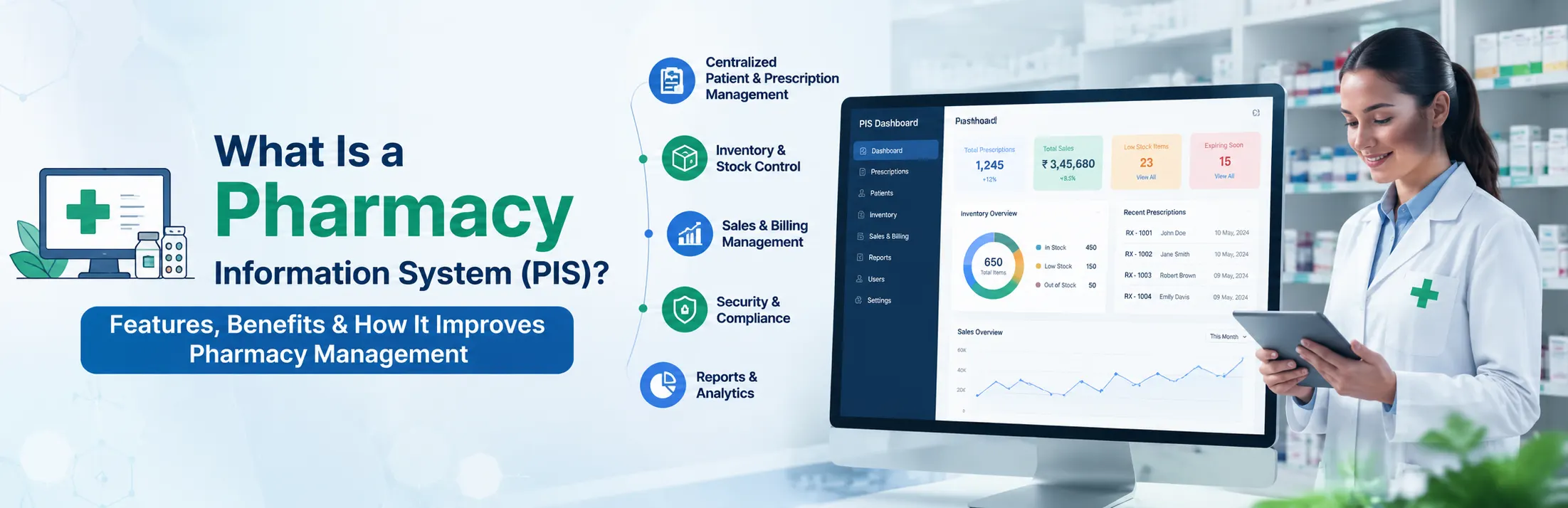
ZYNO HIMS is built specifically for this a pharmacy management software platform that ties inventory, billing, prescriptions, and patient records together instead of leaving them as separate, disconnected tools.
Explore ZYNO HIMS pharmacy management software, designed to connect pharmacy, billing, procurement, and patient workflows in one platform.
Explore ZYNO HIMSIn simple terms, pharmacy inventory management is the complete process of planning, purchasing, storing, tracking, and controlling medicines and other pharmacy supplies so that the right stock is available at the right time not too much, not too little.
It's a broad process that touches almost every part of pharmacy operations. In practice, it typically covers:
It helps to think of inventory management as the umbrella, and inventory control as one important piece under that umbrella. Inventory management is the entire lifecycle of stock, from the decision to buy it to the point it's dispensed or written off. Inventory control is narrower it's specifically about monitoring and regulating the stock that's already sitting in the pharmacy.
In practical terms, inventory control usually involves keeping a close eye on:
Good inventory management isn't just an operational nicety it directly affects patient care, cost control, and the day-to-day efficiency of the pharmacy. Here's why it matters so much in practice.
When inventory is tracked properly, a pharmacy always knows which medicines are running low well before they actually run out. This means essential medicines stay available, and patients aren't turned away or asked to come back after a fresh order arrives a situation that can be genuinely serious for anyone on ongoing medication.
Careful tracking of usage patterns means purchasing decisions are based on actual demand rather than guesswork. That keeps unnecessary stock and the capital locked up in it to a minimum, freeing up cash flow for other priorities.
Expiry tracking, especially when it's automated, gives staff enough advance warning to use, transfer, or return stock before it expires. Over time, this can meaningfully reduce the amount written off as pure waste.
Better purchasing decisions, lower wastage, and more efficient stock utilisation all add up. None of these individually feels dramatic, but together they have a real, compounding effect on margins over months and years.
At the end of the day, all of this is really about the patient experience. When the right medicine is available the moment it's prescribed, the visit feels simple and complete instead of ending with a referral to another pharmacy.
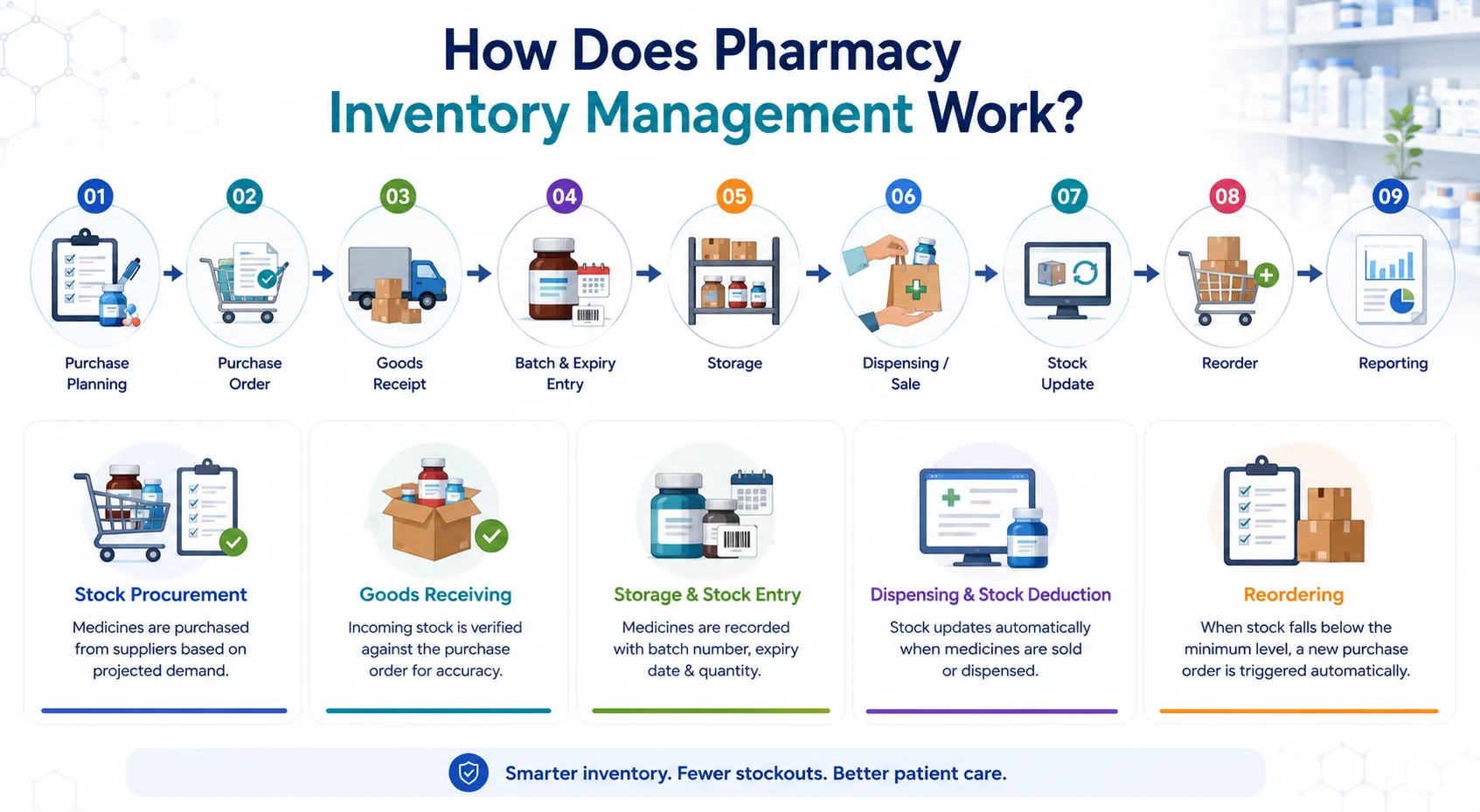
While every pharmacy has its own specific process, the underlying workflow is fairly consistent across most setups:
Purchase Planning → Purchase Order → Goods Receipt → Batch & Expiry Entry → Storage → Dispensing / Sale → Stock Update → Reorder → Reporting

This is where it all starts medicines are purchased from suppliers or vendors, guided by projected demand rather than instinct alone.
When stock arrives, the received quantity is checked carefully against the original purchase order, to catch shortages, damage, or discrepancies early.
Each medicine is recorded and stored according to its batch number, expiry date, and quantity the foundation that makes every later step (like FEFO dispensing) actually possible.
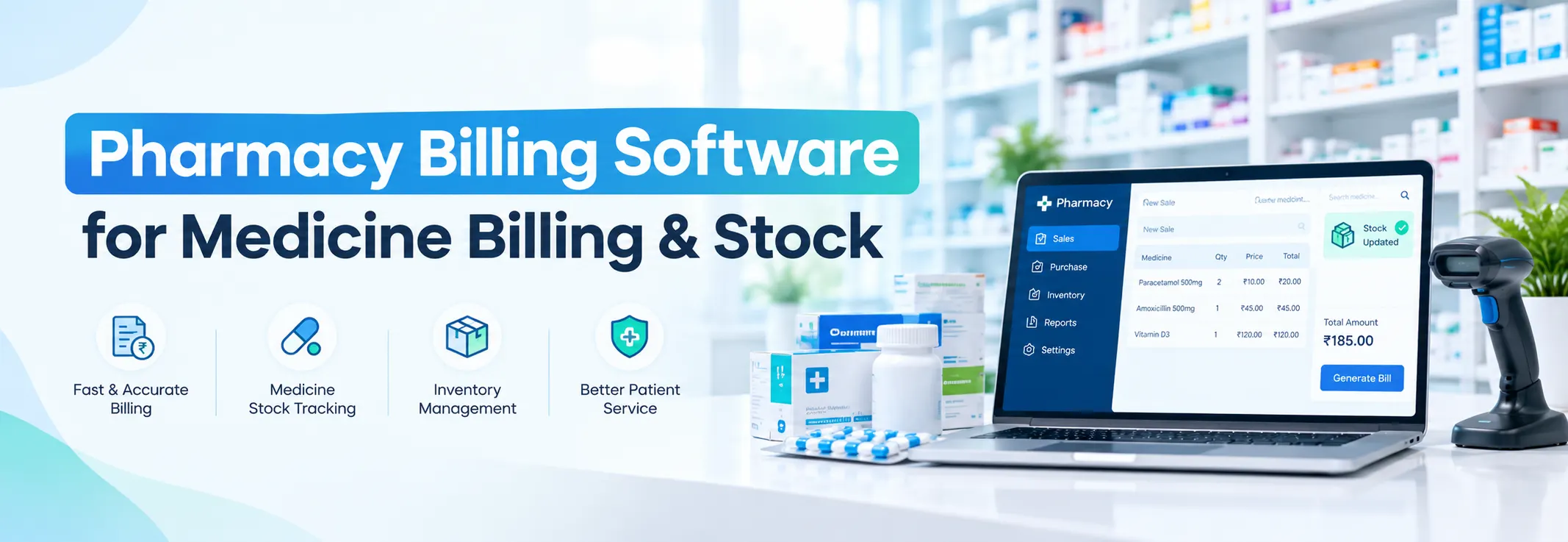
The moment a medicine is sold or dispensed, inventory should update automatically. This is one of the clearest wins of digital pharmacy software over manual registers there's no lag, and no separate step to remember.
Once stock for a particular medicine crosses its minimum threshold, a new purchase order gets triggered ideally automatically, rather than someone noticing an empty shelf.
There isn't a single 'correct' way to manage pharmacy inventory different methods suit different scales of operation.
Staff physically inspect shelves to spot items running low. It's simple and requires no technology, but it doesn't scale well the larger the pharmacy, the easier it is to miss something.
Physical inventory counts are carried out at fixed intervals weekly, monthly, or quarterly. It gives a reasonably accurate picture, but only at those specific points in time; stock levels between counts remain something of a guess.
Software continuously updates inventory in real time, as stock enters or leaves the pharmacy. This is the method underlying most modern pharmacy management systems, including ZYNO HIMS every sale, receipt, or transfer reflects instantly, with no waiting for the next count.
A combination of continuous digital tracking with periodic physical verification, catching any discrepancies between what the system says and what's actually on the shelf.
For larger pharmacies and hospital settings, the perpetual or hybrid approach tends to be far more practical than manual, visual checks alone stock volumes simply move too fast for manual methods to keep up reliably. This is exactly why more pharmacies are moving toward a dedicated pharmacy management system rather than relying on spreadsheets or paper registers.
Improve inventory visibility, reduce stock-related challenges, and streamline pharmacy, billing, procurement, and patient management with ZYNO HIMS.
Contact UsInventory is divided into categories based on value or importance typically A (high value, closely monitored), B (moderate), and C (low value, lighter oversight) so attention goes where it matters most.
Stock that arrived earlier is used or sold before newer stock, which helps prevent older items from sitting untouched indefinitely.
The medicine closest to its expiry date is dispensed first, regardless of when it arrived. In a pharmacy setting, this matters more than plain FIFO, because expiry not arrival order is what actually affects patient safety and wastage.
Every medicine gets a defined floor and ceiling quantity, so staff (or the system) know exactly when stock is getting low and when it's been over ordered.
A predefined threshold that, once crossed, automatically initiates the purchasing process removing the guesswork of 'should we order more yet?'
A buffer quantity kept on hand specifically to absorb unexpected demand spikes or supplier delays, so a single late delivery doesn't turn into a stock out.
Even with solid processes, pharmacies commonly run into a fairly consistent set of challenges:
Factors like the type of product being stocked, the overall size of the inventory, return and replacement policies, shrinkage, and unclaimed prescriptions all add extra layers of complexity layers that manual, register-based tracking struggles to handle consistently as volumes grow. This is precisely the gap that purpose-built pharmacy software is designed to close.
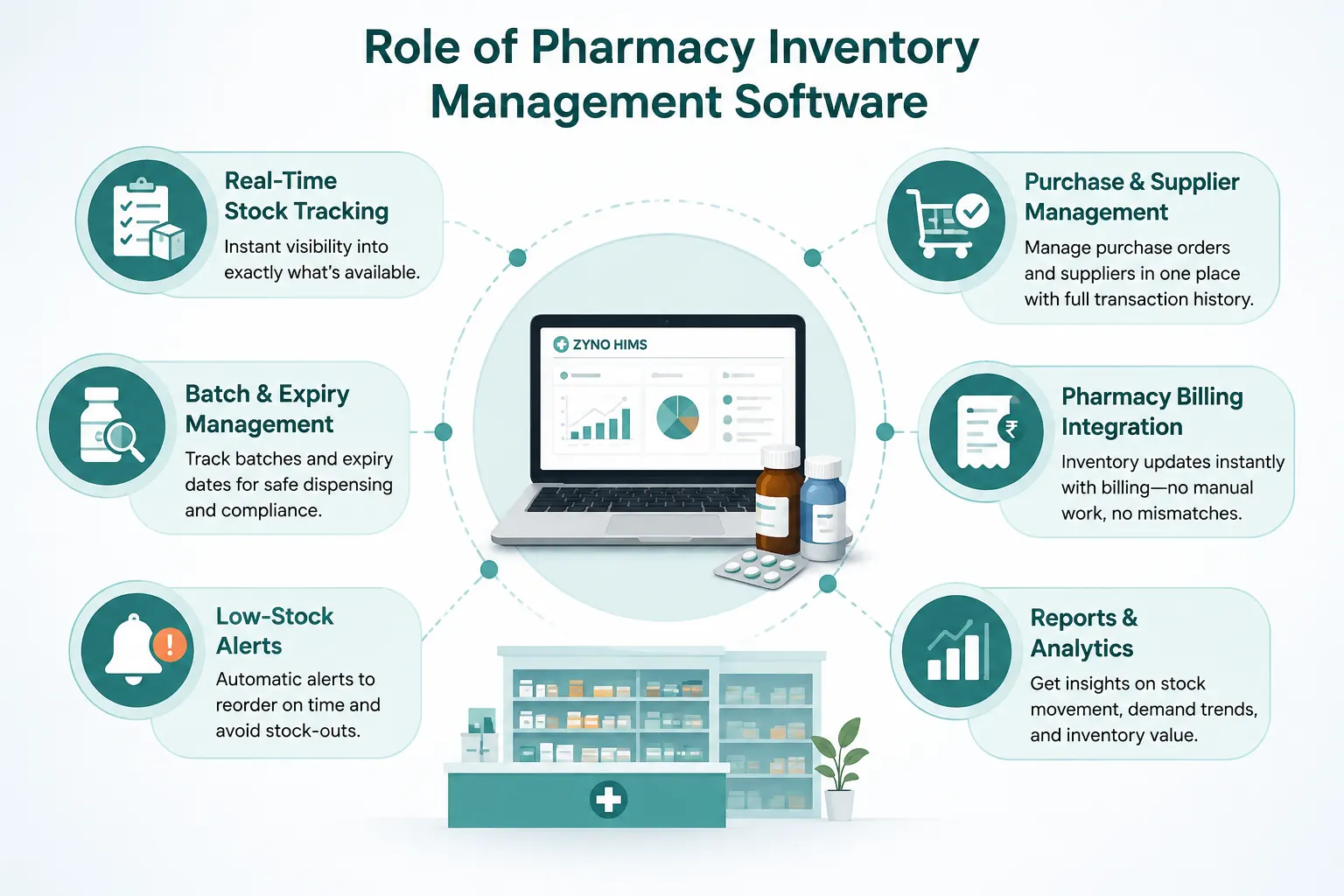
Modern pharmacy management software particularly when it's built into a broader hospital management platform centralises all of these processes on one digital system, instead of leaving them scattered across registers, spreadsheets, and someone's memory of 'what's usually in stock.

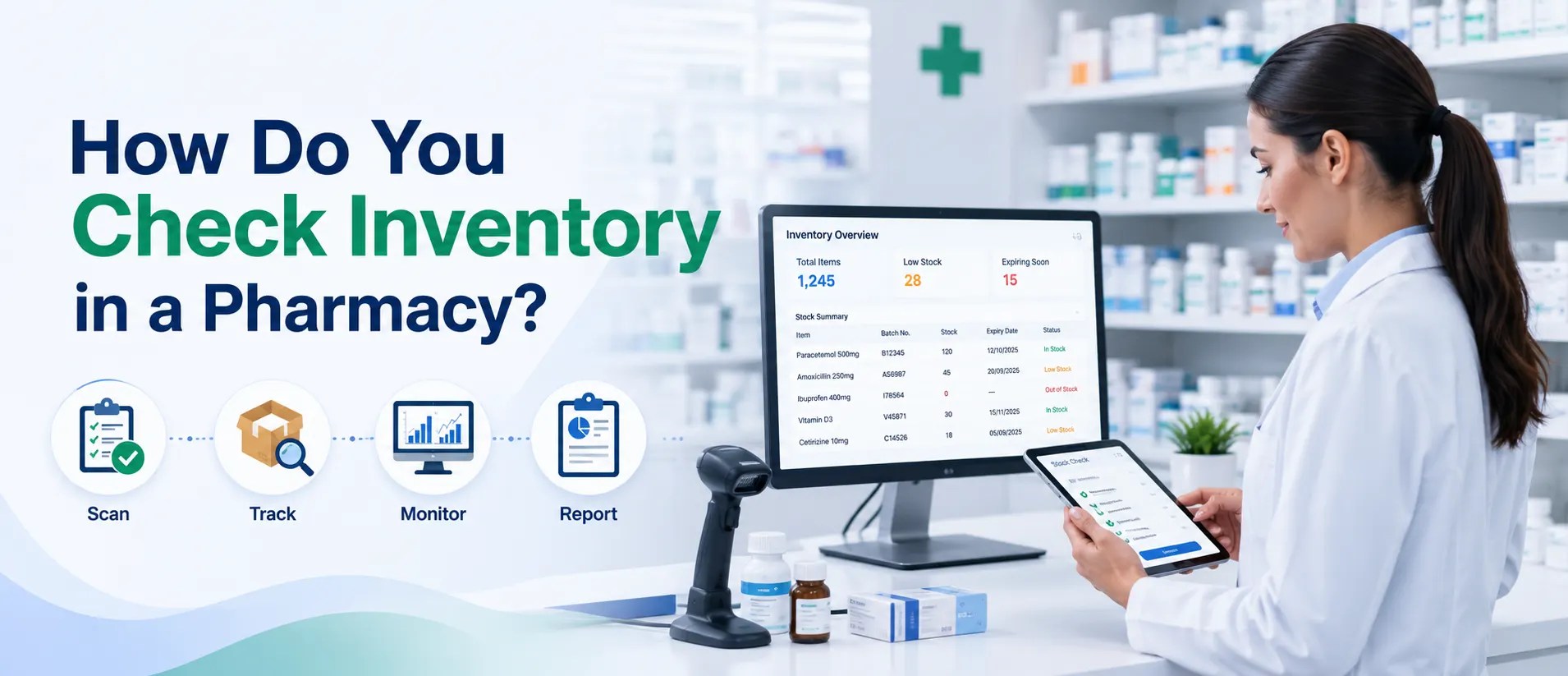
Instant, accurate visibility into exactly what's available, without needing a manual count to confirm it.
Medicine-wise batch and expiry records that are easy to search, filter, and audit critical for both FEFO dispensing and regulatory compliance.
Automatic alerts the moment stock approaches its minimum defined level, so reordering happens proactively rather than reactively.
Purchase orders and vendor transactions handled from a single place, with a clear history of who supplied what, and when.
Inventory updates the instant a sale is billed no separate manual entry, and no risk of the billing system and stock records drifting out of sync. This is one of the core strengths of ZYNO HIMS as a pharmacy management system.
Clear visibility into stock movement, fast-moving versus slow-moving products, and overall inventory value — the kind of data that makes purchasing decisions genuinely data-driven rather than habitual.
Technology-driven approaches like perpetual inventory systems, barcode scanning, and digital purchase orders are increasingly becoming the standard for any pharmacy software worth using and all of these are built into ZYNO HIMS as part of one connected pharmacy management system.
Pharmacy inventory rarely exists in isolation in a hospital setting, it's tightly connected to OPD prescriptions, IPD medicine consumption, billing, and overall patient records. ZYNO HIMS is built around exactly this kind of connected workflow, covering:
Doctor Prescription → Pharmacy Dispensing → Billing → Automatic Stock Update → Reorder Alert
As a pharmacy management system, ZYNO HIMS links OPD prescriptions, IPD medicine consumption, pharmacy stock, and billing on one platform so the moment a medicine is dispensed, both inventory and billing update together, without a separate manual step in between. You can see how the full solution works on the ZYNO HIMS Solution Pages.
Pharmacy inventory management exists for one core reason: to make sure medicines are available exactly when they're needed no more, no less. Inventory control, as the more tactical half of that process, helps reduce overstocking, prevent stock outs, and cut down on expiry-related losses before they turn into real financial and patient-care problems.
Techniques like FEFO, clearly defined reorder levels, and regular audits go a long way on their own. But as pharmacy operations scale up more suppliers, more SKUs, more prescriptions per day — manual tracking alone starts to fall short, and that's exactly where dedicated pharmacy software and a connected pharmacy management system make the real difference: centralising stock, purchasing, billing, and reporting in one place.
It's the process of planning, purchasing, storing, tracking, and controlling medicines and pharmacy supplies to keep the right stock available at the right time.
Inventory control focuses on monitoring and regulating stock that's already on hand reorder points, expiry dates, batch numbers, and stock movement.
It helps maintain medicine availability, reduces expiry-related losses, and supports better overall cost management.
Inventory management covers the complete lifecycle of stock planning, purchasing, storage, and reporting. Inventory control is a narrower part of that, focused specifically on monitoring and regulating stock levels.
FEFO stands for First Expiry, First Out dispensing the stock that will expire soonest before other stock.
FIFO stands for First In, First Out using or selling the oldest received stock first.
Pharmacy software provides real-time stock visibility, batch and expiry tracking, purchase management, billing integration, and reporting on stock movement.
Yes. A comprehensive pharmacy management system such as ZYNO HIMS can connect pharmacy inventory with prescriptions, procurement, billing, patient records, and other hospital departments.
Why Cloud-Based AI HIMS is Transforming the Future of Indian Healthcare
Read More →The Complete ZYNO HIMS Guide for Modern Healthcare Management
Read More →How a Hospital Management System Improves Healthcare Operations
Read More →
Cloud vs Offline Hospital Management Systems: What Should Your Hospital Choose
Read More →What Is a Hospital Information System (HIS)? Features, Benefits & Complete Guide
Read More →How HIMS Software Improves Patient Care and Hospital Efficiency
Read More →How Is Hospital Software Transforming Patient Data Management in Modern Healthcare
Read More →
HIMS Software in Kenya: The Complete Guide for Hospitals & Clinics (2026)
Read More →
Top 10 KareXpert HIMS Alternatives & Competitors in 2026
Read More →
What is a Clinic Management System and How Does It Improve Patient Care?
Read More →
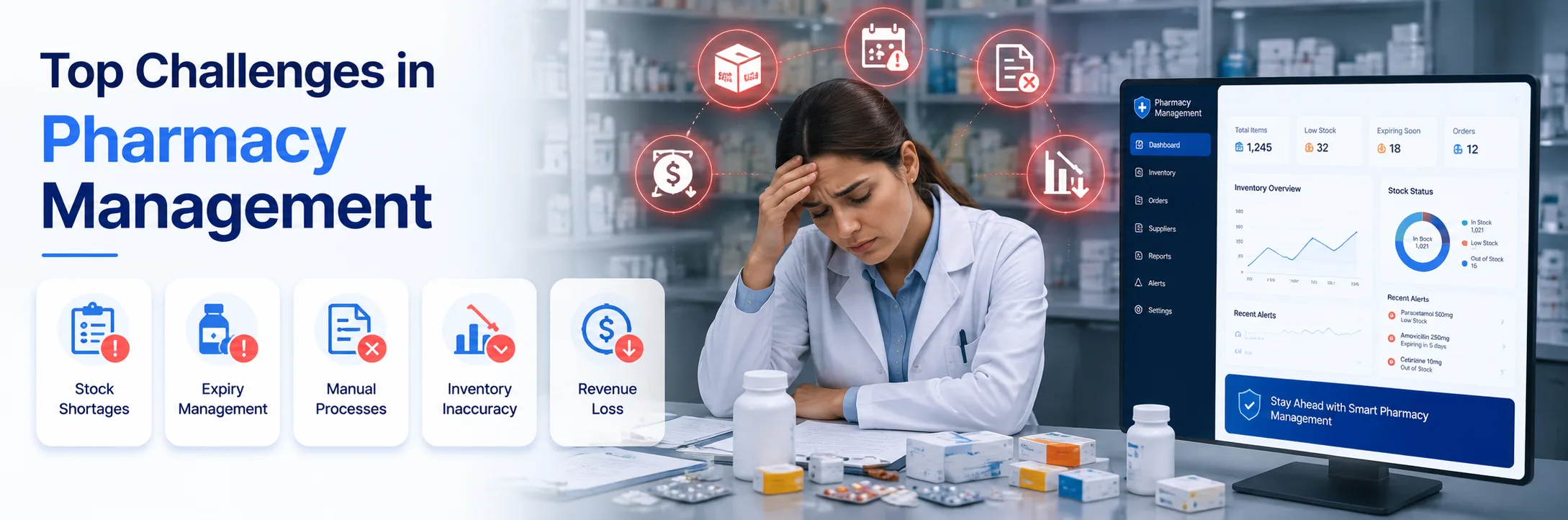
Top Challenges in Pharmacy Management and How to Overcome Them
Read More →
Top 10 Hospital Management Challenges and How ZYNO HIMS Solves Them
Read More →
Why Modern Clinics Are Switching to EMR Systems
Read More →
Top Reasons Why You Should Use Electronic Health Records System
Read More →
A Complete Guide to Choosing the Right Hospital Management Software
Read More →
ABDM Compliance Checklist: A Complete Guide for Hospitals to Achieve Digital Health Compliance
Read More →
Why Govt Hospitals Need HIMS: Improving Patient Care, Efficiency, and Digital Healthcare
Read More →
What Is Hospital Information Management Systems in Healthcare? A Complete Guide
Read More →
DocPulse vs ZYNO HIMS (2026): Why ZYNO HIMS Is the Smarter Hospital Management Choice
Read More →
MocDoc vs ZYNO HIMS: Which Hospital Management Software Is Better in 2026?
Read More →
Caresoft vs ZYNO HIMS: Complete HIMS Comparison for Hospitals
Read More →
Best PMJAY-Compliant HIMS Software in India (2026): Complete Guide for Hospitals
Read More →
Medical Report Analyzer Software: How AI Makes Medical Reports Easy to Understand
Read More →
How to Choose a Hospital Management System
Read More →
AI in HIMS: 10 Practical Ways Artificial Intelligence is Transforming Hospital Management
Read More →
Best Hospital Management Software for Private Clinics in Kenya
Read More →
Hospital Management Software in Japan: What Healthcare Providers Need in 2026
Read More →
Pharmacy Management Software for Kenyan Pharmacies: Features That Matter
Read More →
DHA and MOH Compliance for Hospital Software in the UAE
Read More →
Top 10 Hospital Management Software in India 2026: Features, Pros, Cons & Pricing
Read More →
OPD vs IPD: Difference Between OPD and IPD, Services & Complete Guide
Read More →
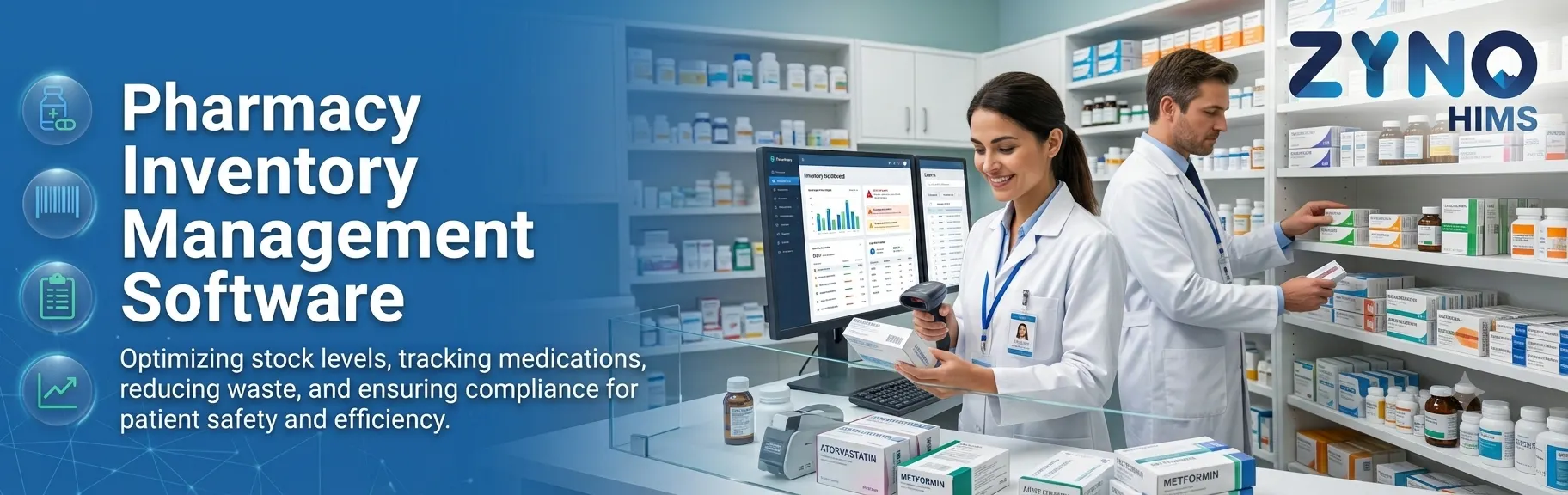
Pharmacy Inventory Management: Methods, Inventory Control & Best Practices
Read More →Partner with ZYNO by Elite Mindz to revolutionize how your business works. Fill out the form, and we’ll reach out with AI-powered solutions made just for you.
We use browser cookies to ensure you get the best experience on our website. Learn more
The form was submitted successfully!