Procurement Software Trends in 2026: What to Expect
Read More →

×
Procurement software ROI measures the financial value gained from automation. Calculate ROI by comparing total savings and benefits with software costs. Consider reduced processing time, lower procurement costs, fewer errors, and improved spend control to determine your software’s overall return on investment.
Businesses using ZYNO Books cut accounting time by 70% and stay 100% ZATCA-compliant — automatically.
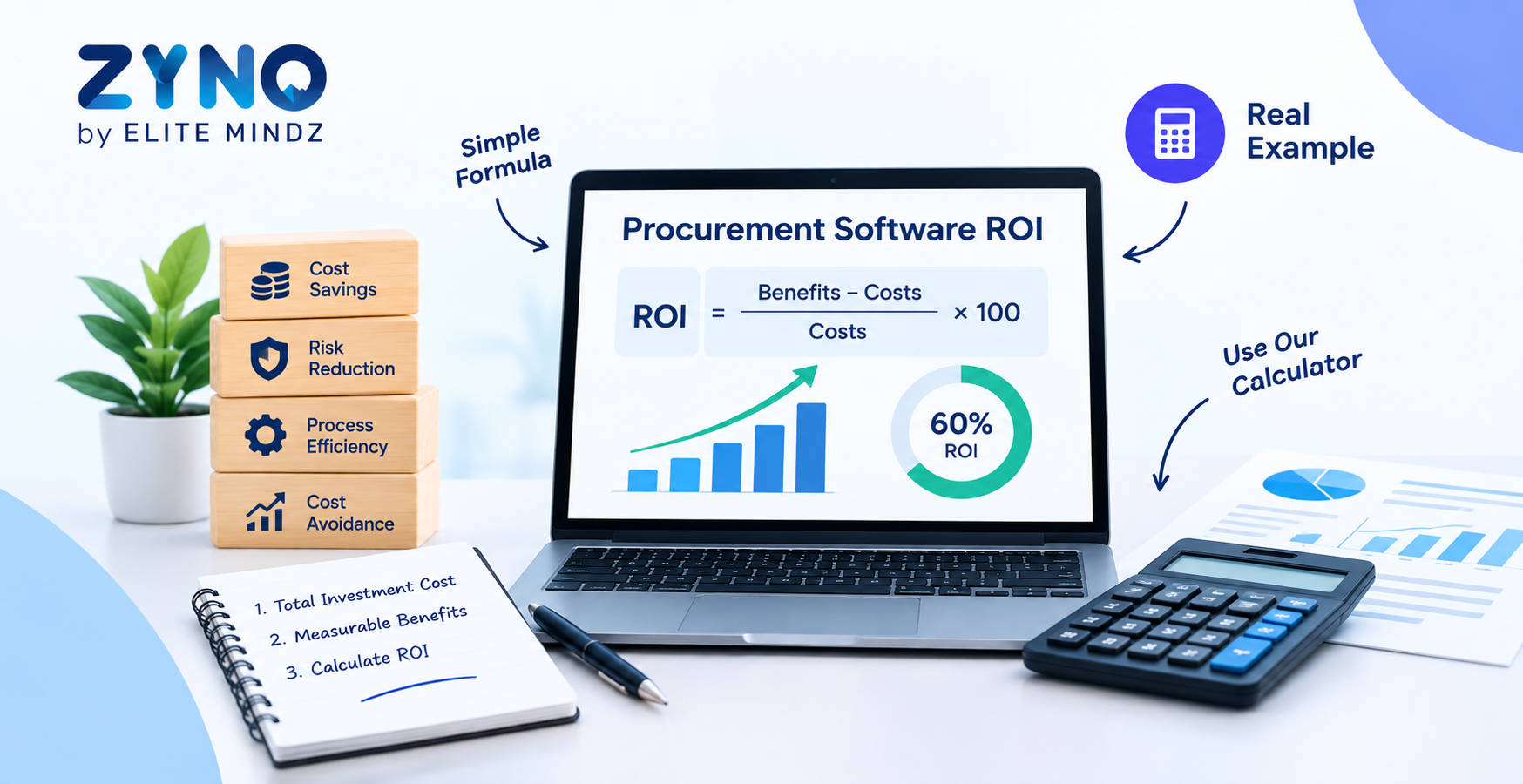
Procurement software ROI is calculated by subtracting the total investment cost from the total measurable benefits, then dividing the result by the total investment cost.
Formula:
ROI = [(Total Measurable Benefits − Total Investment Cost) ÷ Total Investment Cost] × 100
For example, if procurement software costs ₹20 lakh and generates ₹32 lakh in measurable benefits, the ROI is 60%. A realistic calculation should include software, implementation, integration, training, and relevant internal costs, while benefits should be based on measurable savings, cost avoidance, productivity gains, and other quantifiable improvements.
The formula is simple. Building a reliable ROI figure is where the real work begins.
Procurement software can affect several parts of purchasing, sourcing, supplier management, approvals, and procure-to-pay operations. Some improvements directly reduce spending. Others save employee time, reduce risk, or improve control without immediately appearing as a cash saving.
That means a credible ROI calculation should answer two questions:
What will the organization invest?
What measurable value can it reasonably expect in return?
The best way to answer those questions is to start with your current procurement operation rather than with the software vendor's claims.
Before calculating ROI, collect your current procurement data and the expected investment.
Start with metrics such as:
You do not necessarily need every metric to start. Focus on the numbers most closely connected to the problem the software is expected to solve.
For example, if your biggest issue is manual purchase processing, processing volume and employee time may matter more than supplier count.
If the main opportunity is supplier savings, addressable spend, supplier pricing, sourcing activity, and contract compliance may matter more.
Once you know where your current procurement costs and inefficiencies come from, you can build the investment side of the calculation.
Discover how ZYNO Procurement can help reduce procurement costs, automate purchasing processes, improve spend visibility, and deliver measurable ROI for your business.
Do not use only the software subscription price.
A procurement software project can involve several costs before and after go-live.
Total Investment Cost = Software Cost + Implementation + Integration + Training + Internal Resources + Other Relevant Costs
Depending on the project, consider:
Include the software cost for the period you are evaluating.
This can include:
Consider the work required to connect the platform with systems such as:
Employees need to understand how and when to use the new procurement process.
Include relevant training and change-management costs.
Procurement, finance, IT, legal, and operations employees may spend time supporting implementation.
Even if that effort does not appear as a separate vendor invoice, it can still represent an economic cost.
Now you have one side of the ROI equation: what the organization needs to invest. The next step is determining what it can realistically get back.

Procurement software benefits generally fall into four useful categories:
Keeping these categories separate makes the business case easier to defend.
Cost savings represent a measurable reduction in actual spending.
Potential sources include:
Suppose your company has ₹5 crore of addressable procurement spend and your analysis supports a 2% realized reduction.
₹5 crore × 2% = ₹10 lakh
That gives you ₹10 lakh of potential realized savings for the model.
The important point is that the 2% should come from a defensible assumption based on your own categories, supplier data, historical performance, sourcing opportunities, and realistic adoption.
Do not simply apply an arbitrary savings percentage to total procurement spend.
Cost avoidance is related to savings, but it is not the same thing.
Suppose a supplier proposes an ₹8 lakh price increase, but procurement negotiates the increase down to ₹3 lakh.
The organization has potentially avoided ₹5 lakh of additional cost.
That is valuable, but it should normally be reported separately from reducing an existing expense by ₹5 lakh.
This distinction becomes particularly important when presenting the business case to finance.
Procurement employees can spend significant amounts of time on:
If automation reduces this workload, the released capacity can have measurable economic value.
Suppose:
Estimated annual productivity value:
8 × 10 × 52 × ₹600 × 30% = ₹7,48,800
However, this does not automatically mean the company saves ₹7.49 lakh in payroll.
If the employees remain in their current roles, the more accurate description is productivity capacity released.
That distinction keeps your ROI calculation from overstating financial savings.
Procurement risks can include:
Some risks can be quantified using historical data.
Others are difficult to assign a precise monetary value to.
If the financial impact cannot be reasonably supported, it is better to identify the risk-reduction benefit separately rather than assigning an arbitrary rupee value to it.
| Benefit | Example | Financial Confidence |
|---|---|---|
| Realized savings | Lower supplier price | High |
| Cost avoidance | Avoided price increase | Medium to high |
| Processing cost reduction | Lower external processing cost | High |
| Productivity value | Employee hours released | Medium |
| Risk reduction | Lower compliance exposure | Variable |
| Strategic value | Better decision-making | Difficult to quantify |
Not every benefit has the same level of financial certainty.
This separation helps leadership understand which parts of the ROI are directly measurable and which depend on assumptions.
Once your benefits are separated and quantified, you can finally put both sides of the business case into the ROI formula.

The formula is:
ROI = [(Total Benefits − Total Investment) ÷ Total Investment] × 100
Let's put the numbers together.
Assume:
Total investment = ₹20 lakh
Now assume:
Total measurable benefits = ₹32 lakh
Therefore:
ROI = [(₹32 lakh − ₹20 lakh) ÷ ₹20 lakh] × 100
ROI = 60%
The net benefit is:
₹32 lakh − ₹20 lakh = ₹12 lakh
So, under these assumptions, the project produces a ₹12 lakh net benefit and 60% ROI.
These figures are illustrative and should not be treated as a benchmark or guaranteed procurement management software return.
| ROI Component | Example |
|---|---|
| Software | ₹10 lakh |
| Implementation | ₹3 lakh |
| Integration | ₹2 lakh |
| Training/internal resources | ₹5 lakh |
| Total investment | ₹20 lakh |
| Realized procurement savings | ₹15 lakh |
| Cost avoidance | ₹5 lakh |
| Productivity value | ₹8 lakh |
| Processing cost reduction | ₹4 lakh |
| Total benefits | ₹32 lakh |
| Net benefit | ₹12 lakh |
| ROI | 60% |
The calculation is straightforward.
The important part is whether the assumptions behind each number are realistic.
ROI tells you the return relative to the investment.
Payback period answers a different question:
How long could it take to recover the investment?
A simple calculation is:
Payback Period = Total Investment ÷ Average Monthly Benefit
For example:
₹20 lakh ÷ ₹2 lakh = 10 months
Estimated payback:
10 months
However, benefits may not reach their full level immediately.
Implementation, integration, training, user adoption, supplier onboarding, and process changes can delay benefit realization.
For that reason, a monthly benefit ramp can provide a more realistic payback model than assuming the same benefit from month one.
There is also no universal payback period that makes every procurement software investment worthwhile. The acceptable period depends on the company's financial requirements, investment alternatives, implementation risk, and expected benefits.
Simplify purchasing, control business spend, automate procurement workflows, and improve cost efficiency with ZYNO Procurement.
Ideally, look at both.
A first-year model captures:
This shows leadership what the investment could look like during the first year.
A longer model can capture:
The important rule is consistency.
Do not compare three years of benefits with only one year of costs.
Use the same period for both sides of the calculation.
A single ROI percentage can create a false sense of certainty.
Instead, build at least three scenarios.
Use cautious assumptions for:
Use assumptions supported by:
Use stronger assumptions only when there is a reasonable basis for them.
| Scenario | Investment | Benefits | ROI |
|---|---|---|---|
| Conservative | ₹20 lakh | ₹24 lakh | 20% |
| Base | ₹20 lakh | ₹32 lakh | 60% |
| Upside | ₹20 lakh | ₹40 lakh | 100% |
These numbers are only examples.
The purpose of scenario modelling is to show how sensitive the business case is when actual performance differs from expectations.
With those scenarios in place, you have a much stronger foundation for a procurement software ROI calculator.
A simple calculator needs two groups of inputs: costs and benefits.
| Input | Your Value |
|---|---|
| Annual software cost | ₹ |
| Implementation cost | ₹ |
| Integration cost | ₹ |
| Training cost | ₹ |
| Internal project cost | ₹ |
| Other relevant costs | ₹ |
| Total investment | ₹ |
| Input | Your Value |
|---|---|
| Realized procurement savings | ₹ |
| Cost avoidance | ₹ |
| Processing cost reduction | ₹ |
| Productivity value | ₹ |
| Other measurable benefits | ₹ |
| Total benefits | ₹ |
Net Benefit = Total Benefits − Total Investment
ROI % = (Net Benefit ÷ Total Investment) × 100
Payback Period = Total Investment ÷ Average Monthly Benefit
For a more reliable calculator, allow users to adjust assumptions for implementation timing, adoption, savings realization, and measurement period.
You can build the basic calculation in Excel without specialized software.
For example:
=B3-B2
=(B3-B2)/B2
Format the result as a percentage.
=B2/B6
This returns the estimated number of months required to recover the investment.
For a stronger business case, keep individual cost and benefit categories in separate rows instead of entering one combined number.
You do not need to wait until after implementation to calculate ROI.
In fact, building the model before selecting a platform can help you evaluate whether the investment makes sense.
Start with your current state.
Then estimate what part of each cost or inefficiency the proposed software can realistically address.
For example:
Current annual processing cost: ₹30 lakh
Potential addressable reduction: 20%
Potential benefit: ₹6 lakh
But ₹6 lakh should be treated as a projection, not a guaranteed saving.
Validate the assumption by asking:
This turns ROI into a software evaluation tool, rather than a number created after the purchasing decision.
When companies evaluate procurement software, they often ask:
“How much will the software cost?”
There is another question that matters just as much:
“What is our current procurement process costing us?”
Manual and fragmented procurement can create costs through:
So the comparison should be:
Current-state cost vs. future-state cost
For example:
Current annual procurement process cost: ₹40 lakh
Expected future-state operating cost: ₹28 lakh
Potential annual improvement: ₹12 lakh
The software investment can then be evaluated against that expected improvement, implementation costs, adoption, and the time required to realize the benefits.

A CFO usually needs more than a list of software features.
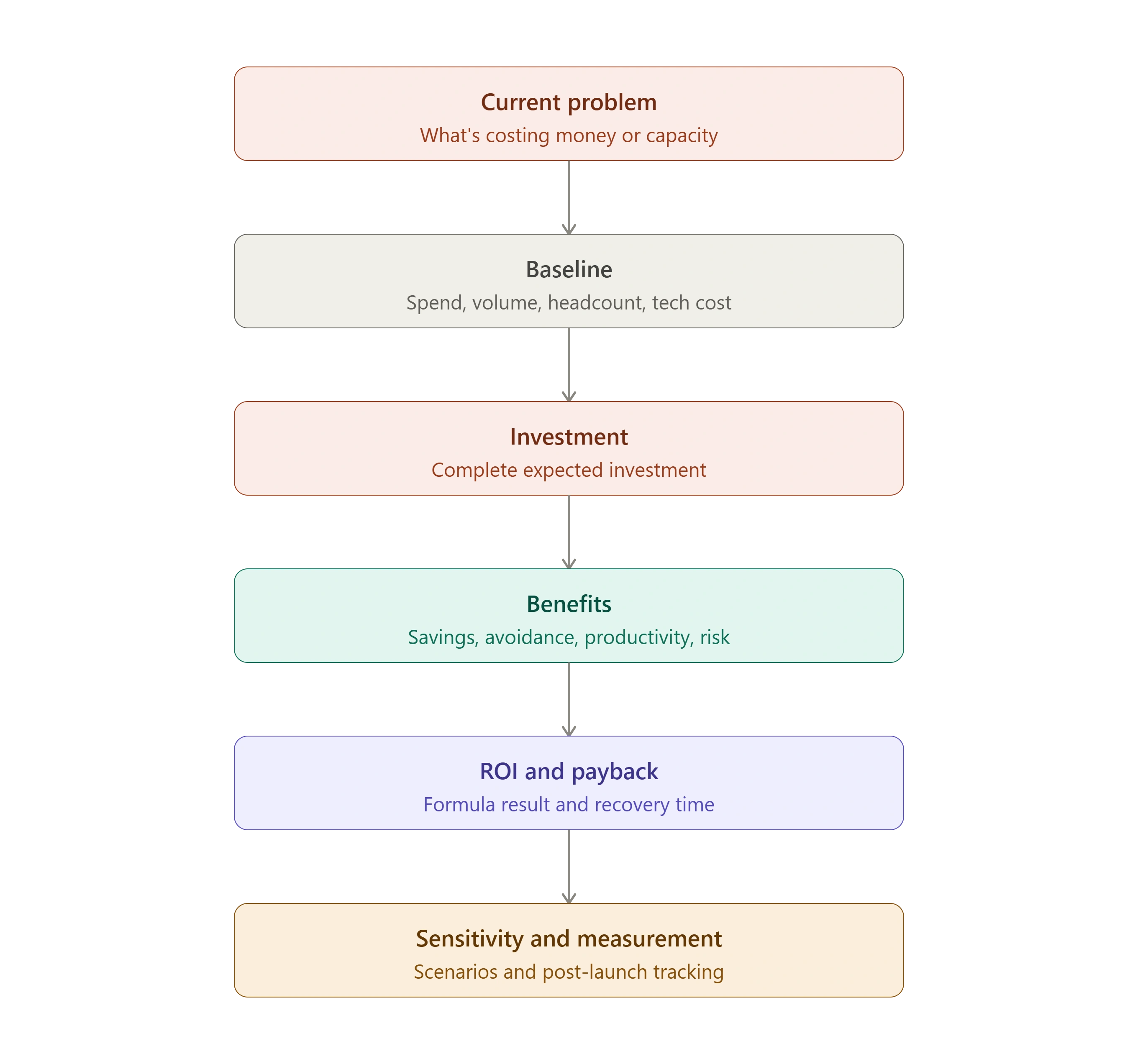
The business case should connect procurement improvements to financial outcomes.
What is costing the organization money or employee capacity today?
Show:
Show the complete expected investment.
Separate:
Show the calculation and assumptions.
Show when the investment is expected to be recovered.
Show conservative, base, and upside scenarios.
Explain how actual results will be tracked after implementation.
This gives finance a business case it can challenge, validate, and monitor rather than simply accepting a vendor-generated ROI percentage.
The ROI calculation should not end when the software goes live.
Your original baseline should become the benchmark for measuring actual performance.
The goal is to compare:
Projected ROI → Actual performance → Realized ROI
That is much more useful than calculating ROI once and never revisiting it.
Implementation, integration, training, internal resources, and other costs can materially affect the investment.
Do not assume a generic savings percentage applies to your entire procurement spend.
Use your own addressable spend and procurement data.
Employee time released by automation is valuable, but it does not automatically reduce payroll.
An opportunity identified by procurement software is not necessarily a saving that has reached the company's financial results.
If implementation takes several months, benefits should not automatically be modelled as if the platform were operating at full capacity from day one.
A platform cannot generate its expected value if employees continue using fragmented or uncontrolled purchasing processes.
The status quo has a financial cost too.
A conservative scenario helps leadership understand downside risk.
Keep investment and benefits aligned to the same period.
Compare actual performance with the original assumptions after implementation.
There is no universal ROI percentage that is automatically considered good for every procurement software investment.
A 30% ROI could be attractive in one situation and insufficient in another.
Consider:
So instead of asking whether 30% is a good ROI, ask whether the expected return justifies the investment, risk, and alternatives available to your organization.
A 2% ROI is not automatically good or bad.
You need to know:
A small positive ROI over a short period can have a very different meaning from the same percentage over several years.
Once you have calculated your own baseline, the next step is to evaluate whether a procurement platform actually addresses the costs and inefficiencies you identified.
The software should fit your business case, not the other way around.
For example:
If approval delays are consuming procurement capacity, evaluate purchase request and approval automation against your current approval time.
If supplier information is fragmented, evaluate vendor management against onboarding, compliance, and supplier-performance requirements.
If sourcing teams spend significant time managing RFPs and comparing supplier responses, evaluate sourcing and RFP workflows against that workload.
If leadership lacks visibility into uncontrolled spend, evaluate spend analytics against your current reporting and spend-control gaps.
If purchasing, approvals, invoices, and payment processes are fragmented, evaluate procure-to-pay automation against the current transaction and processing costs.
This is where ZYNO Procurement can be evaluated as part of the business case.
ZYNO Procurement brings procurement workflows across purchasing, supplier management, sourcing, and procure-to-pay into a centralized platform.
The right way to evaluate its potential ROI is to map its capabilities to measurable business problems.
If manual purchase requests and approval follow-ups are a major cost driver, evaluate purchase request automation against:
If procurement teams spend substantial time converting employee requests into structured purchase requisitions, AI-powered intake can be evaluated against:
If supplier information and compliance processes are fragmented, evaluate vendor management against:
If sourcing is a major part of your savings opportunity, evaluate RFP workflows against:
If purchasing and payment processes are fragmented, evaluate procure-to-pay software capabilities against:
If management lacks visibility into where procurement money is going, spend analytics can be evaluated against:
The objective is not to assume that every capability produces a specific percentage return.
The objective is to identify which capabilities address your measurable cost drivers and then calculate the resulting value using your own data.
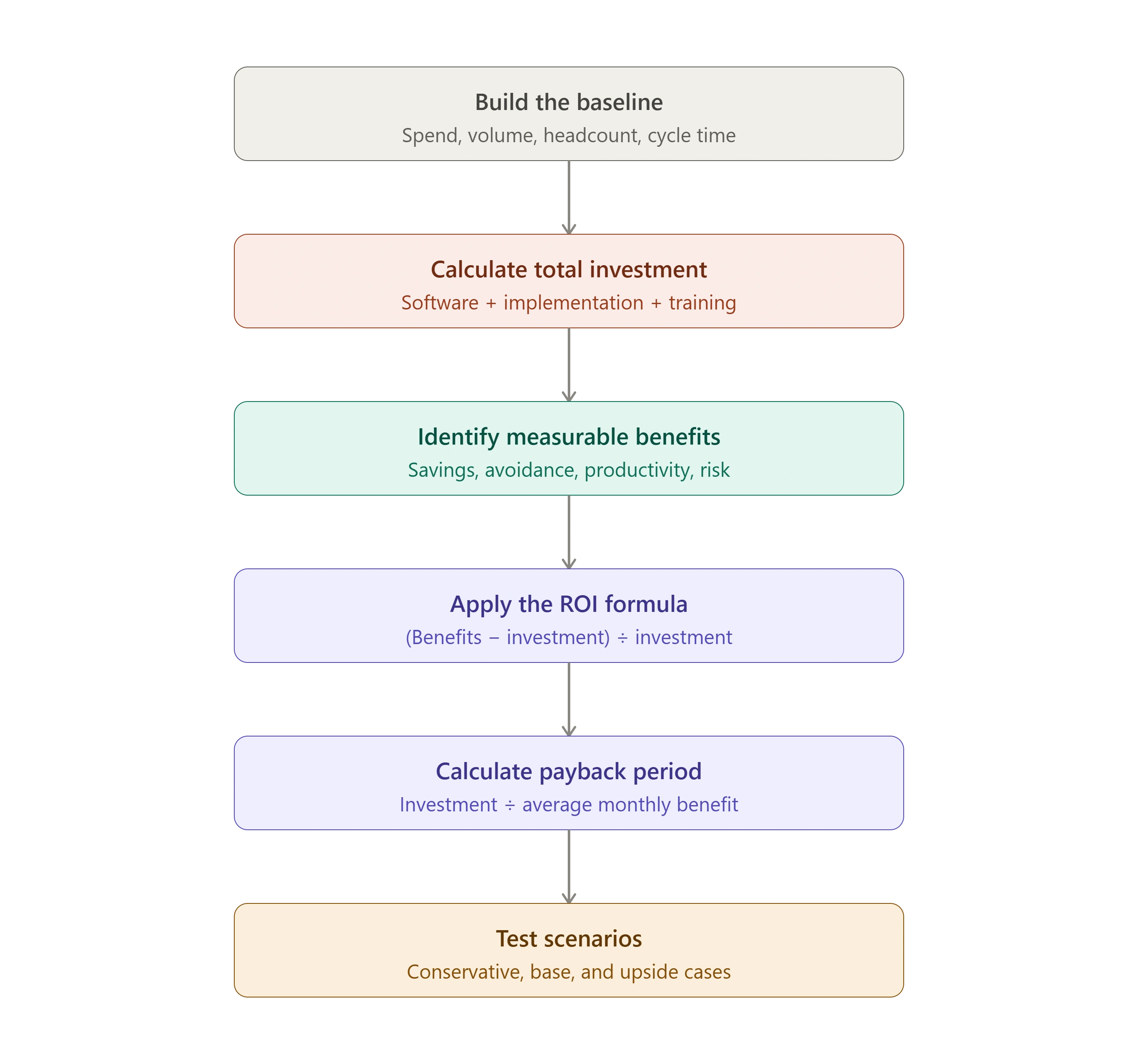
You can now bring the entire process together:
Measure your current spend, transaction volume, workforce effort, cycle times, supplier performance, and process costs.
Find out whether the largest opportunities come from savings, uncontrolled spend, manual work, approval delays, supplier management, invoice processing, compliance, or visibility.
Evaluate only the capabilities that can address those measurable problems.
Use conservative assumptions supported by your own data.
Include software, implementation, integration, training, internal resources, and other relevant costs.
Use:
ROI = [(Total Benefits − Total Investment) ÷ Total Investment] × 100
Use:
Payback Period = Total Investment ÷ Average Monthly Benefit
Model conservative, base, and upside outcomes.
Decide before implementation how you will measure realized savings, productivity, process improvements, adoption, and other benefits.
That gives procurement, finance, IT, and leadership one consistent framework for deciding whether the investment makes sense.
Use the following structure to start your own calculation.
Current annual addressable spend: ₹________
Annual purchase orders: ________
Annual purchase requests: ________
Current procurement team size: ________
Current annual procurement processing cost: ₹________
Current uncontrolled/maverick spend: ₹________
Current average procurement cycle time: ________
Software cost: ₹________
Implementation cost: ₹________
Integration cost: ₹________
Training/change management: ₹________
Internal project cost: ₹________
Other investment costs: ₹________
Total investment: ₹________
Expected realized savings: ₹________
Expected cost avoidance: ₹________
Expected processing cost reduction: ₹________
Expected productivity value: ₹________
Other measurable benefits: ₹________
Total measurable benefits: ₹________
Net Benefit = Total Benefits − Total Investment
ROI = (Net Benefit ÷ Total Investment) × 100
Payback Period = Total Investment ÷ Average Monthly Benefit
Then run the calculation under conservative, base, and upside assumptions.
From purchase requests and supplier management to spend analysis and invoice automation, ZYNO Procurement helps businesses build a more efficient and cost-effective procurement process.
Use:
ROI = [(Total Measurable Benefits − Total Investment Cost) ÷ Total Investment Cost] × 100
Include the complete investment and quantify measurable benefits using your current procurement baseline.
Include software, implementation, configuration, integration, training, internal resources, data migration, change management, and other relevant costs for the measurement period.
Consider realized procurement savings, cost avoidance, processing cost reductions, productivity value, improved compliance, reduced uncontrolled spend, supplier improvements, and measurable risk reduction.
If the investment is ₹20 lakh and measurable benefits are ₹32 lakh:
ROI = (₹32 lakh − ₹20 lakh) ÷ ₹20 lakh × 100 = 60%
The figures are illustrative. Actual ROI should use your organization's own data.
Use:
Payback Period = Total Investment ÷ Average Monthly Benefit
A ₹20 lakh investment with ₹2 lakh in average monthly benefits would have an estimated 10-month payback.
Establish your current baseline, estimate realistic benefits, calculate the complete investment cost, model different scenarios, and calculate ROI and payback before selecting the platform.
There is no single ROI percentage that applies to every organization. ROI should be evaluated alongside payback, assumptions, risk, measurement period, alternatives, and the organization's financial requirements.
Savings generally represent a measurable reduction in actual spending. Cost avoidance represents an expected additional cost that was prevented or reduced. They should generally be tracked separately.
Compare actual performance against the pre-implementation baseline. Track realized savings, cost avoidance, processing time, cycle time, uncontrolled spend, adoption, supplier performance, and the other KPIs used in the original business case.
The most useful procurement software ROI calculation is not the one with the biggest percentage.
It is the one you can explain.
Start with what procurement costs today. Identify where money, time, and control are being lost. Calculate the complete investment. Separate realized savings from cost avoidance and productivity value. Then test the result under different scenarios.
That gives you a business case based on your procurement economics, rather than a generic ROI promise.
If you're evaluating procurement automation, use the same framework to assess ZYNO Procurement against your current processes, addressable spend, operational costs, and measurable savings opportunities.
Book a ZYNO Procurement demo with Elite Mindz and discuss your procurement requirements.
Procurement Software Trends in 2026: What to Expect
Read More →
Why E-Procurement Outperforms Traditional ERP in Modern Procurement
Read More →
Top Procurement Software in India: 12 Best Options for 2026
Read More →
Best Procurement Software Companies in Kuwait (2025)
Read More →
5 Best Procurement Software in Africa for Enterprises & SMEs (2026 Guide)
Read More →
Best Procurement Software in Nigeria 2026 | Top 5 Picks
Read More →
Best Procurement Software Providers in USA (2025): How AI is Transforming the Future
Read More →
10 Best Procurement Software Providers in Thailand for Streamlined Supply Chain Management
Read More →
Top 10 Cloud-Based Procurement Solutions in Portugal for Businesses in 2025
Read More →
Top 10 Procurement Software Providers in Switzerland 2026: Streamlining Sourcing and Supplier Management
Read More →
What Makes ZYNO Procurement Different from Other Oil & Gas Procurement Software
Read More →
The Digital Transformation of Logistics Procurement in the Middle East
Read More →
A Step by Step Guide to Procurement Management Software for Modern Enterprises
Read More →
Sourcing and Procurement: What is the Difference and Why It Matters
Read More →Difference Between Procurement and Supply Chain Management
Read More →
What Is Procurement Software and Why Do Modern Businesses Need It?
Read More →
Best Procurement Management Software to Automate ERP Process
Read More →
Direct vs Indirect Procurement: Key Differences, Examples & Uses (2026)
Read More →
Smart procurement strategies for cost optimization & risk management
Read More →
What Is Procurement? Everything You Need to Know (Types, Process & SAP)
Read More →Beyond Cost-Cutting: How Procurement Drives Margin Expansion in 2026
Read More →
Direct Procurement: Process, Examples, and When to Use It
Read More →
What Are the 5 Types of E-Procurement? A Complete Guide for Businesses
Read More →
Which Procurement Management Software Is Best? Top Tools Compared for 2026
Read More →
Top 8 Coupa Alternatives to Explore in 2026
Read More →
Looking to Replace Coupa? Discover the Best Alternatives Like ZYNO Procurement
Read More →
How Does Procurement Software Work? A Complete Guide
Read More →
ZYNO Procurement vs Coupa: Best Procurement Software Comparison for Mid-Market Teams
Read More →
Best SAP ARIBA Procurement Alternatives in 2026
Read More →
ZYNO Procurement vs SAP Ariba: Which Solution Is More User-Friendly?
Read More →
AI-Powered Procurement Management Software for Fast, Connected, and Visible Workflows in Dubai
Read More →
What is Vendor Management? Complete Guide to Vendor Management Software, Systems, and Processes
Read More →
Best Procurement Management Software In Kenya
Read More →
6 SAP Ariba Alternatives for Mid-Market Businesses in 2026
Read More →
Top E-Procurement Solutions for B2B Organizations (2026)
Read More →
Quotation Format: Free Templates + Complete Guide (2026)
Read More →
Cost Control Software: Features, Benefits & Performance Guide for 2026
Read More →
Procurement Workflow: Steps, Stages, and Real Examples
Read More →
Top 10 Zycus Alternatives for Procurement Teams in 2026
Read More →
Best Precoro Alternative for Purchase Requisition and Procurement
Read More →
Top AI Procurement Tools in 2026
Read More →
Best Tools for Supplier Risk Management
Read More →
FEFO vs FIFO vs LIFO: Differences, Benefits & Which Inventory Method Is Best?
Read More →
AI Procurement Software: Features, Benefits, Use Cases & How to Choose
Read More →
Best AI Tools for Supply Chain Procurement
Read More →
Procurement Risk Management
Read More →
Still Using Excel for Procurement? Read This Before It's Too Late
Read More →
Best RFP Software in 2026: Top Tools Compared for Faster Proposal Responses
Read More →
What Is Procure-to-Pay (P2P)? A Complete Guide
Read More →
Complete Procurement Workflow Guide for Modern Businesses
Read More →
Complete Guide to E-Procurement Solutions for B2B Organizations
Read More →
Cost Control Software Comparison Guide: Features, Pricing & Benefits
Read More →
Purchase Order Tracking: How to Manage Every PO Without the Chaos
Read More →
Inventory Management: What It Is, How It Works and Why It Matters
Read More →
Top 10 Procurement Software Tools for Purchasing Automation in 2026
Read More →
Agentic AI Procurement Platforms and the Future of Strategic Sourcing
Read More →
AI Spend Analytics Software for Procurement Leaders
Read More →
From Prompt to Procurement: How AI Is Transforming Enterprise Purchasing
Read More →
ZYNO Procurement vs IBM Procure-to-Pay Automation
Read More →
ZYNO Procurement vs Infor Nexus: Which Procure-to-Pay Platform Fits Your Team?
Read More →
AI-Powered Procurement Software in 2026: Top 6 Platforms That Actually Deliver ROI
Read More →
Contract Management Software Buyer's Guide: Features, Costs & Top Picks
Read More →
Top 10 Procure to Pay Software Companies in India 2026
Read More →
10 Best Vendor Management Software in India (2026): Features, Benefits & Comparison
Read More →
How Machine Learning and AI Are Transforming Procurement: A Strategic Overview
Read More →
What Is Procurement Software for GP? Features, Benefits and Best Solutions for Businesses
Read More →
What Procurement Software Do Mid-Market Companies Use Instead of SAP Ariba or Coupa?
Read More →
Prompt-Based Procurement Software for Kenyan Businesses
Read More →
Project Management Software: A Complete Guide to Streamline Business Operations and Procurement Processes
Read More →
SAP Ariba vs ZYNO Procurement: Complete Feature Comparison (2026)
Read More →
Coupa vs SAP Ariba vs ZYNO: Which Procurement Platform Wins for Fast-Growing Teams?
Read More →
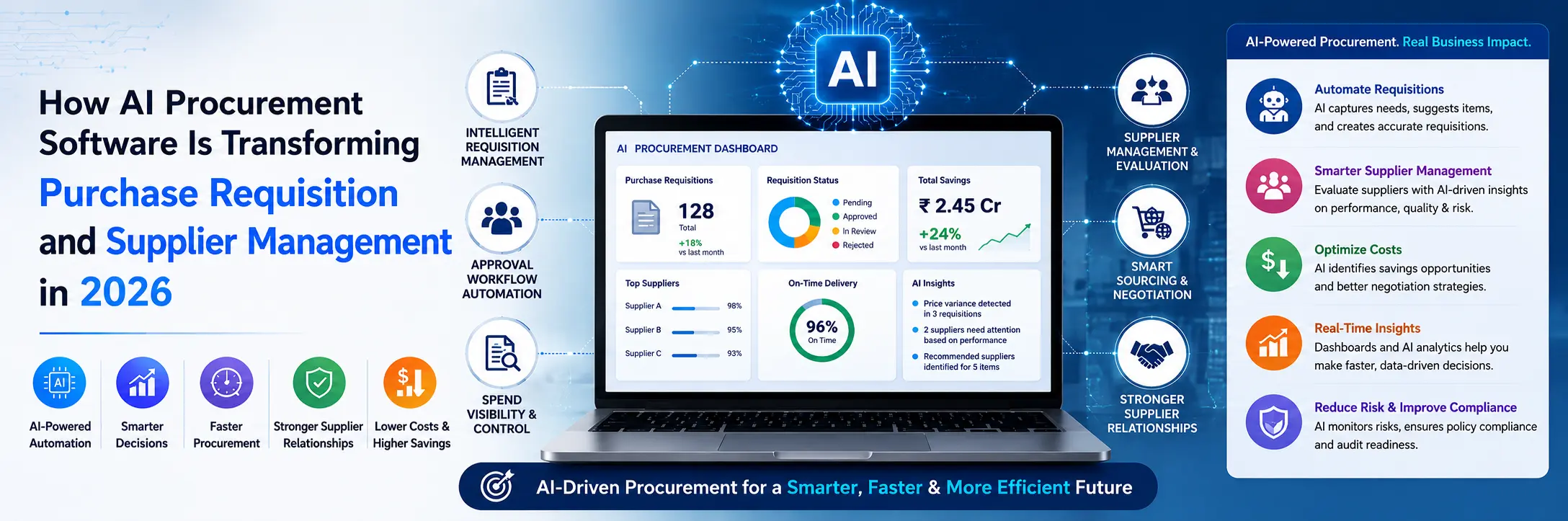
How AI Procurement Software Is Transforming Purchase Requisition and Supplier Management in 2026
Read More →
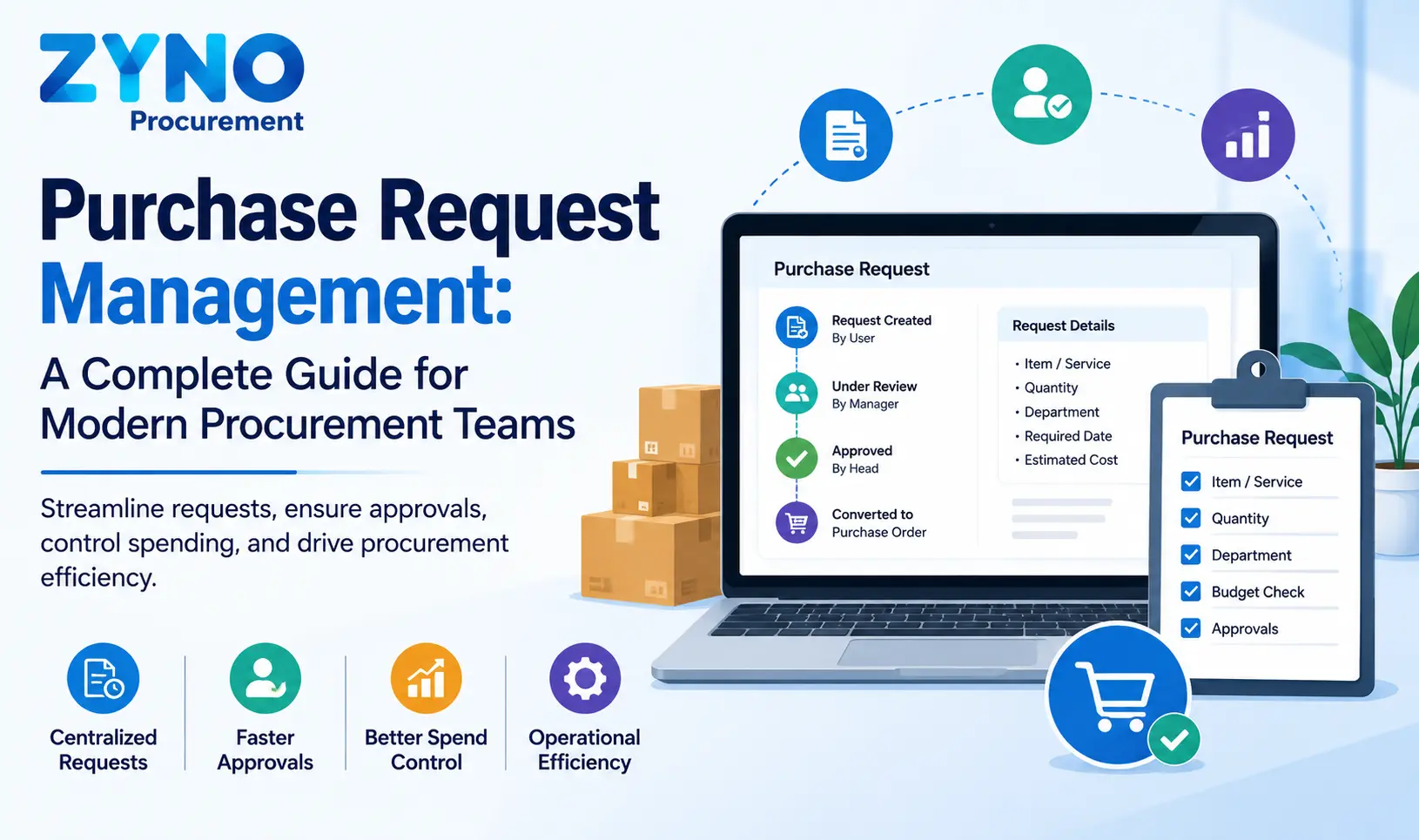
Purchase Request Management: A Complete Guide for Modern Procurement Teams
Read More →
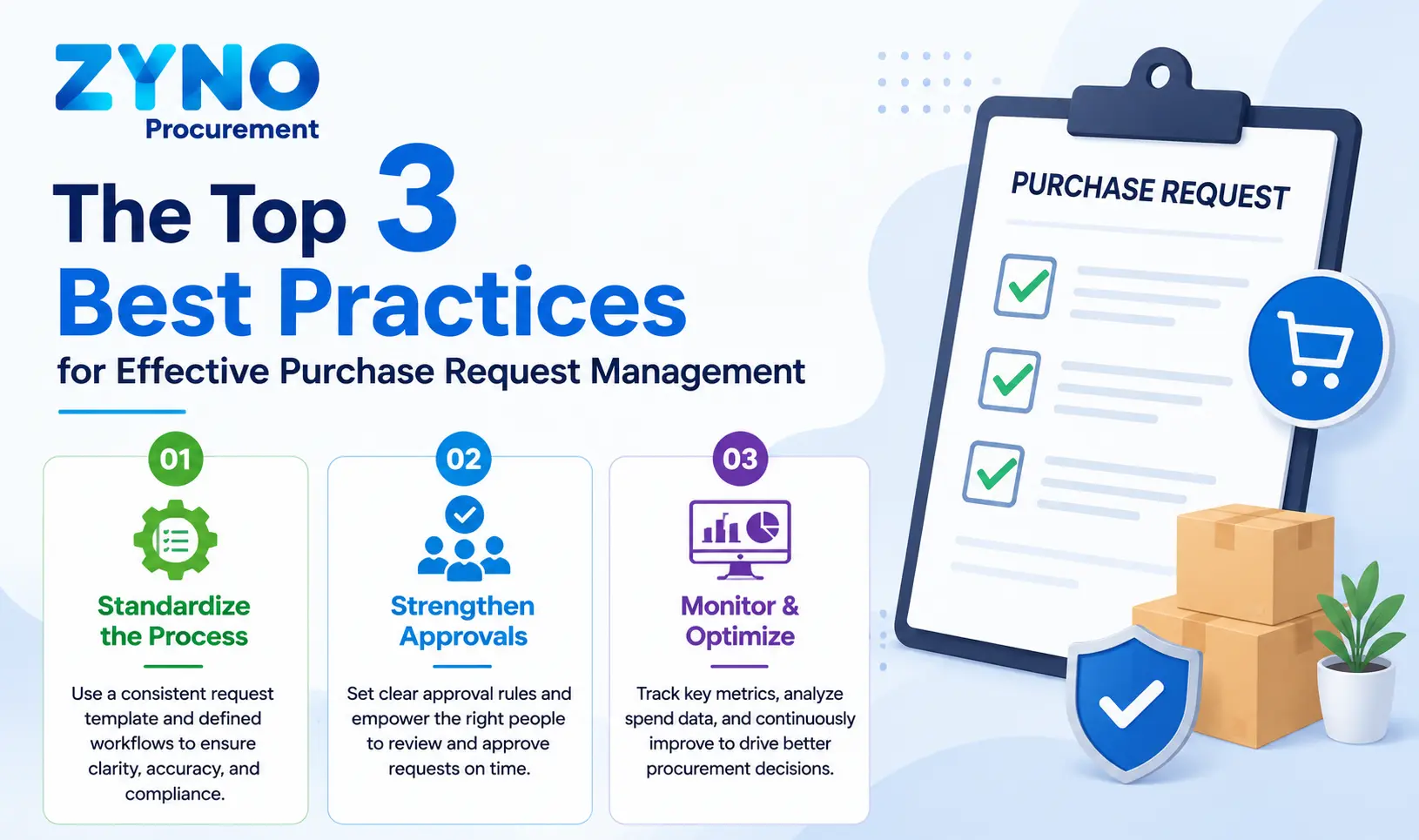
The Top 3 Best Practices for Effective Purchase Request Management
Read More →
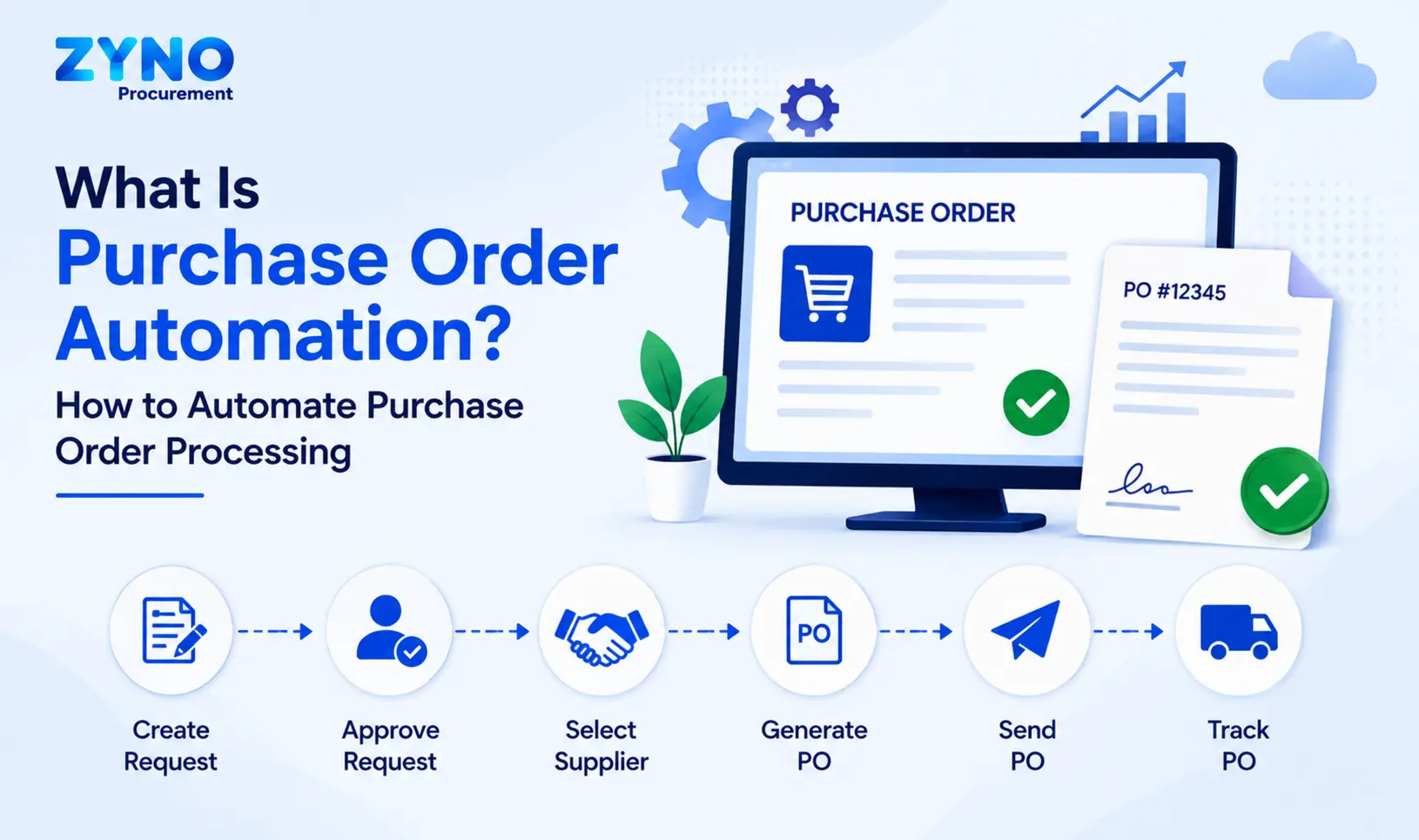
What Is Purchase Order Automation? How to Automate Purchase Order Processing
Read More →
5 Common Purchase Request Mistakes and How to Avoid Them
Read More →
What is Supplier Relationship Management in Procurement? A Complete Guide
Read More →
What is Strategic Vendor Management? A Complete Guide for Modern Procurement
Read More →
What Are Inventory Control Methods? Complete Guide to Types, Techniques, Systems, & Benefits
Read More →
Inventory Audit Checklist: Steps, Process & Best Practices
Read More →
Warehouse Inventory Management: Best Practices for 2026
Read More →
Treasury Management System (TMS): A Complete Guide for Modern Corporates
Read More →
What is Portfolio Management Services (PMS) and What Are Its Benefits?
Read More →
Generative AI Procurement Software Solution: The Future of Intelligent Procurement
Read More →
Top Contract Management Software Companies in Ethiopia: Features, Benefits & Best Procurement Solutions
Read More →
AI Procurement Software: Complete Guide to Intelligent, Generative AI & Machine Learning Procurement Solutions
Read More →
Top SAP alternatives for small, midsize, and enterprise businesses
Read More →
Best RFP Software in 2026: Top Solutions for Smarter Procurement and Proposal Management
Read More →
GST on Purchase: Complete Guide to GST on Purchases in India
Read More →
Procurement Software UAE: Complete Guide to Choosing the Best Procurement Solution
Read More →
Supply Chain Procurement: Everything You Need to Know
Read More →
Top 10 Oracle Procurement Alternatives for Businesses in 2026
Read More →
Quotation Software vs Excel: Which Is Better for Businesses in 2026?
Read More →
Contract Management Software Buyer's Guide: Features, Pricing & How to Choose
Read More →
How to Identify the Right Vendor: 10 Simple Steps
Read More →
Top 10 Automated PO Generation Tools in 2026: Best Purchase Order Software with AI Capabilities
Read More →
How to Generate a PO Automatically in SAP: Step-by-Step Guide
Read More →
What Is the Best Budget-Friendly Procurement Software With Vendor Onboarding for Indian SMEs?
Read More →
How to Generate a PO Automatically in SAP: Step-by-Step Guide
Read More →
How to Solve Invoice Mismatches: 10 Real Ways to Fix Invoice Discrepancies
Read More →
Top 10 Vendor Onboarding Tools for Businesses in 2026: Features, Process & How to Choose
Read More →
Vendor Comparison & Supplier Intelligence: How AI Helps Businesses Choose the Right Vendor
Read More →
How to Choose the Right Procurement Management Software in 2026 (Complete Buyer's Guide)
Read More →
How to Reduce Procurement Costs: 18 Practical Strategies That Actually Work
Read More →
How to Choose the Right Procurement Management Software in 2026 (Complete Buyer's Guide)
Read More →
How to Calculate Procurement Software ROI: Formula, Example & Calculator
Read More →Partner with ZYNO by Elite Mindz to revolutionize how your business works. Fill out the form, and we’ll reach out with AI-powered solutions made just for you.
We use browser cookies to ensure you get the best experience on our website. Learn more
The form was submitted successfully!