



What is ERP? A Beginner's Guide to Enterprise Resource Planning
Read More →

×
Apparel supply chain management coordinates every stage of clothing production, from design and raw material sourcing to manufacturing, warehousing, distribution, and returns. Businesses can improve efficiency by automating purchase orders, tracking inventory, monitoring suppliers, and analyzing production data. Fashion supply chain management software, such as ZYNO Manufacturing ERP, helps apparel manufacturers improve visibility, control costs, reduce delays, and make data-driven decisions.
Businesses using ZYNO Books cut accounting time by 70% and stay 100% ZATCA-compliant — automatically.
The cotton tee in your wardrobe has probably done more miles than your last vacation. The cotton may have grown in one country, been spun into yarn in another, woven or knitted and dyed in a third, stitched in a fourth, and shipped across an ocean before it reached a store shelf or your doorstep.
Every handoff in that journey is a place where something can go wrong: a late trim, a shade mismatch, a customs hold, a compliance audit, a forecast that was off by 30 percent. In apparel, supply chain problems rarely stay small. They turn into missed delivery windows, markdowns, air freight bills and unhappy buyers.
That is why apparel supply chain management (SCM) has become one of the most important capabilities for any brand, manufacturer or exporter, from a ten-person label to a global retailer.
In this guide, you will learn:
Stay till the software section. Picking the wrong system is one of the most expensive supply chain mistakes a growing apparel business can make, and the checklist there can save you months.
Simplify production planning, inventory management, purchasing, and vendor coordination with ZYNO Manufacturing ERP. Improve operational visibility and manage your manufacturing processes more efficiently.
Quick Answer
Apparel supply chain management is the coordination of every organization, activity, information flow and resource involved in moving a garment from design and raw material sourcing to final retail distribution and consumer purchase.
To manage it well:
1. What Is Apparel Supply Chain Management?
Apparel supply chain management (SCM) is the coordinated network of organizations, people, activities, information and resources involved in moving a clothing product from initial design and raw material sourcing to final retail distribution and consumer purchase.
It covers physical flow (fabric, trims, finished garments), information flow (tech packs, purchase orders, forecasts, shipment status) and financial flow (costing, payments, claims). Strong SCM aligns all three so that the right product reaches the right place, at the right time, at the right cost and quality.
2. Why Apparel Supply Chains Are Uniquely Hard
Apparel is not a simple, repeatable product. Several factors make it more complex than most industries:
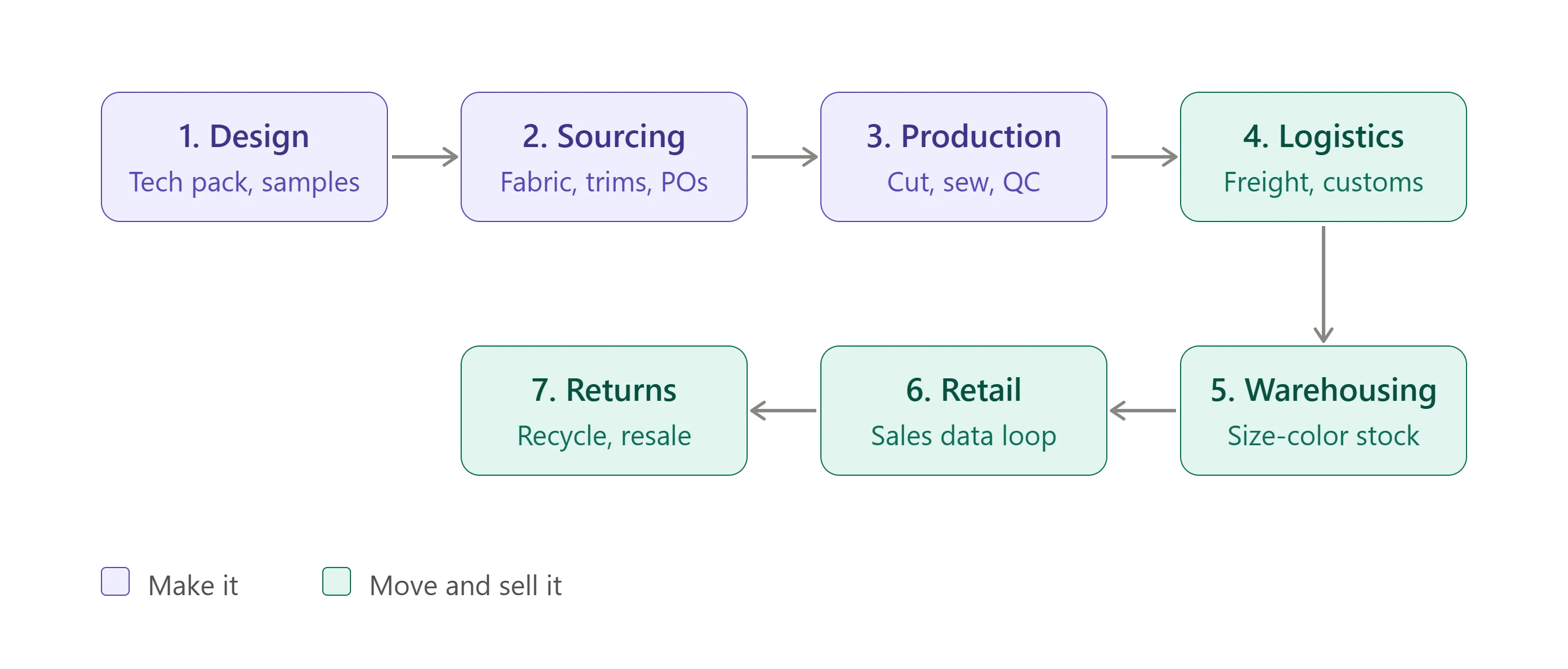
3. The 7 Key Stages of the Apparel Supply Chain

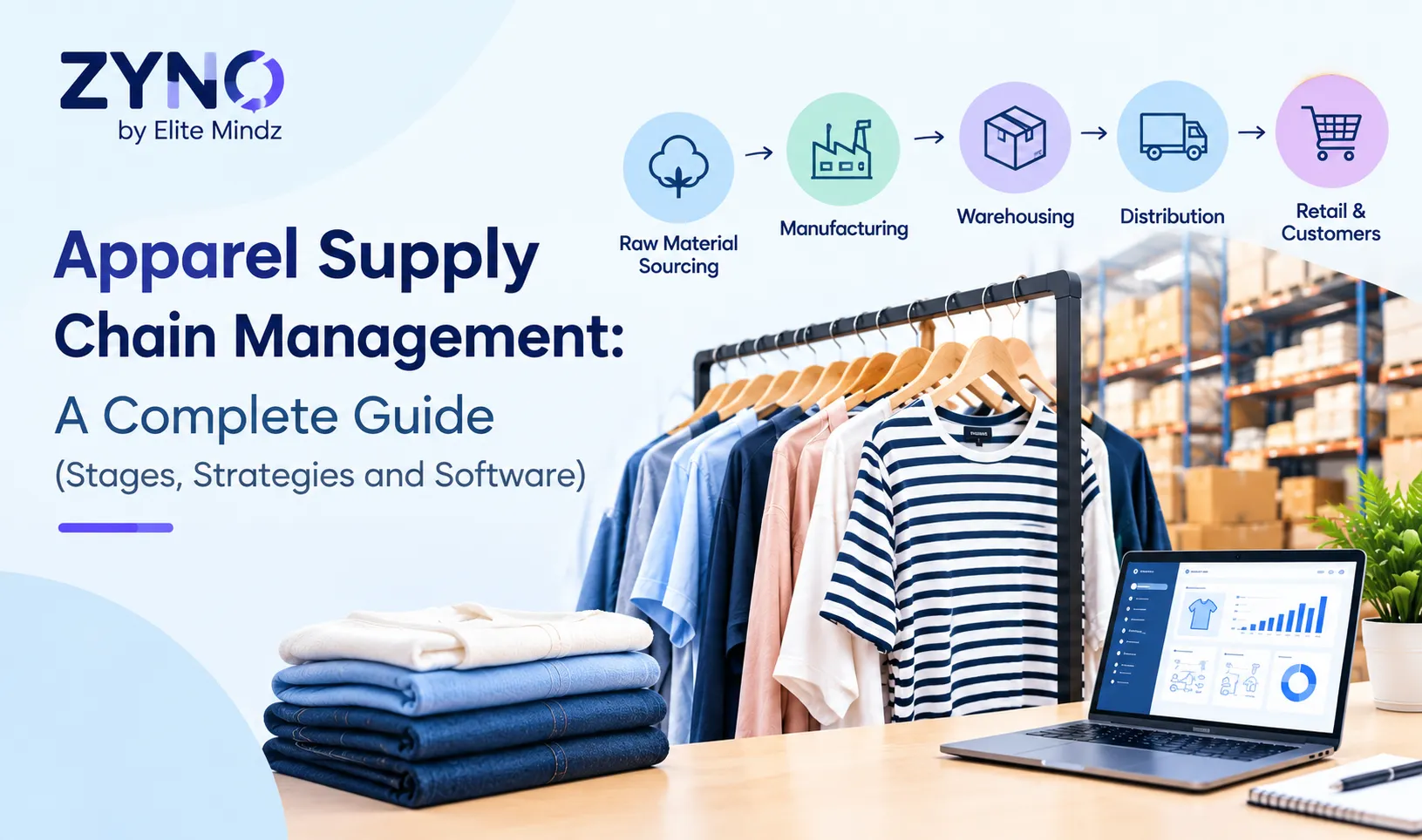
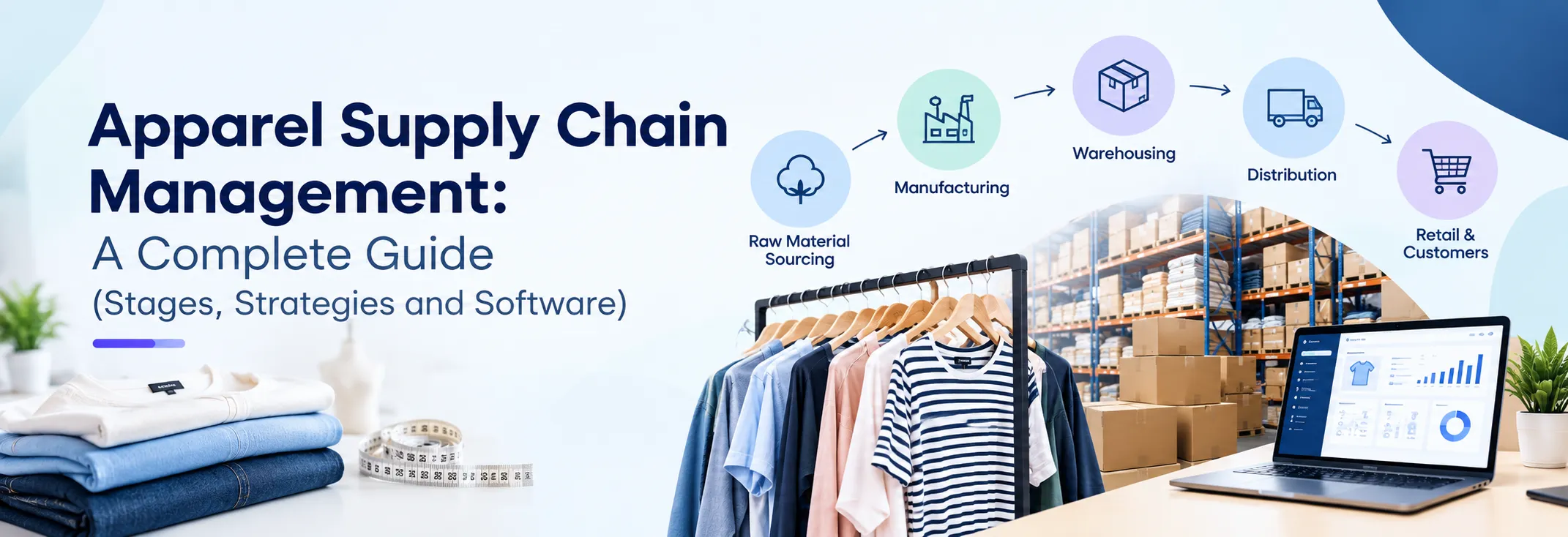
The apparel supply chain consists of seven key stages, from design and raw material sourcing to manufacturing, distribution, retail, and returns. Understanding each stage helps businesses reduce delays, control costs, improve product quality, and meet customer demand efficiently.
|
Stage |
What Happens |
Typical Risks |
|---|---|---|
|
1. Design and Product Development |

Sketching concepts, digital patterns, sampling and fitting prototypes. |
Unclear tech packs, multiple sample rounds and approval delays. |
|
2. Raw Material Sourcing |
Procuring fibers, yarns, textiles, buttons, zippers, tags and packaging. |
Late deliveries, price fluctuations and unverified suppliers. |
|
3. Manufacturing and Production |
Cutting fabric, sewing, garment assembly, inline inspections and final quality control. |
Production capacity gaps, rework and high defect rates. |
|
4. Logistics and Transportation |
Managing freight, customs and deliveries from factories to regional distribution hubs. |
Port delays, customs holds and poor shipment visibility. |
|
5. Warehousing and Distribution |
Storing, sorting and fulfilling inventory for retail stores and e-commerce orders. |
Stock-outs, overstocking and picking errors. |
|
6. Retail and Consumption |
Merchandising, marketing and selling apparel to end customers. |
Forecasting errors, excess inventory and markdowns. |
|
7. Reverse Supply Chain |
Handling customer returns, deadstock liquidation and material recycling. |
High return rates, material waste and lost product value |
Stage 1: Design and Product Development
This is where the supply chain actually begins. Decisions on fabric, trims, construction and fit lock in most of the product's cost and lead time. A complete tech pack and accurate Bill of Materials (BOM) prevent errors downstream. Digital tools for 3D design and digital prototyping reduce physical sample rounds.
Stage 2: Raw Material Sourcing
Sourcing means procuring fibers, yarns, fabrics, buttons, zippers, labels, tags and packaging. Success depends on vetted suppliers, clear purchase orders, agreed lead times and quality approvals such as lab dips and strike-offs before bulk production.
Improve production planning, inventory visibility, purchasing, and supplier coordination with ZYNO Manufacturing ERP. Simplify apparel manufacturing operations and manage your supply chain more efficiently.
Stage 3: Manufacturing and Production
Fabric is cut, sewn and assembled, with inline and final quality control. Capacity planning, line balancing, WIP (work in progress) tracking and size-color matrix control are central here.
Stage 4: Logistics and Transportation
Goods move through freight forwarders, customs and ports to distribution hubs. Visibility, documentation accuracy and customs compliance determine whether shipments arrive on time.
Stage 5: Warehousing and Distribution
Inventory is stored, sorted and fulfilled for stores or e-commerce orders. Accurate stock by size and color, plus good allocation rules, reduce both stock-outs and excess inventory.
Stage 6: Retail and Consumption
Merchandising, marketing and selling close the loop. Sales data from this stage should flow back into planning for future seasons.
Stage 7: Reverse Supply Chain
Returns, deadstock and end-of-life garments are handled through restocking, liquidation, resale or recycling. A well-run reverse chain recovers value and supports circular fashion goals.
4. Core Strategies and Concepts
Fast Fashion vs Traditional Sourcing
|
Factor |
Fast Fashion (Agile) |
Traditional Sourcing |
|---|---|---|
|
Lead Time |
Shorter lead times to respond quickly to emerging trends. |
Longer lead times with seasonal planning. |
|
Order Size |
Smaller, frequent production batches. |
Large-volume bulk production runs. |
|
Sourcing Location |
Often closer to the target market or sourced through flexible supplier networks. |
Often relies on overseas suppliers to reduce production costs. |
|
Inventory Risk |
Lower risk per batch, but requires fast production and replenishment. |
Higher risk of excess stock if demand forecasts are inaccurate. |
|
Example |
Fast-response retail models, such as Zara. |
Long-lead-time overseas sourcing with bulk orders. |
Fast, agile models compress lead times so brands can respond quickly to micro-trends, while traditional models rely on long-lead overseas bulk runs for cost efficiency. Many businesses blend both: core basics on long lead times, and trend items on faster cycles.
Lean and Agile Manufacturing
Sustainability and Transparency
Brands now track environmental impact, ethical labor practices and the use of circular or recycled fabrics. Transparency across tiers (not just your direct supplier) is becoming a baseline expectation from buyers, regulators and consumers.
Technology and AI Integration
Technology helps companies see and act faster:
5. Key Challenges and How to Solve Them
|
Challenge |
Impact |
Solution |
|---|---|---|
|
Poor Demand Forecasting |
Overstocking, stock-outs and excessive markdowns. |
Use sales data, demand forecasting and predictive planning tools. |
|
Limited Supplier Visibility |
Delivery delays, compliance issues and limited supply chain transparency. |
Implement supplier portals, supply chain tier mapping and supplier scorecards. |
|
Manual PO and BOM Handling |
Data entry errors, incorrect quantities and purchasing discrepancies. |
Automate bill of materials (BOM) and purchase order (PO) workflows through ERP or PLM software. |
|
Long Lead Times |
Missed fashion trends, delayed launches and reduced responsiveness. |
Combine agile sourcing for trend-driven products with bulk purchasing for core products. |
|
Compliance and Forced-Labor Regulations |
Shipment detention, regulatory penalties and reputational damage. |
Maintain traceability records, supplier audit reports and compliance certificates. |
|
Disconnected Systems |
Version conflicts, duplicate work and inconsistent data across departments. |
Adopt an integrated platform that connects procurement, inventory, production and order management. |
|
High Returns and Deadstock |
Lost profit margins, excess inventory and increased material waste. |
Improve reverse logistics planning and use size, fit and sales data to optimize inventory decisions. |
6. KPIs to Measure Supply Chain Performance
|
KPI |
What It Tells You |
|---|---|
|
On-Time In-Full (OTIF) |
How reliably orders arrive complete and on schedule. |
|
Order Cycle / Lead Time |
The time taken from design or order placement to delivery. |
|
Inventory Turnover |
How quickly inventory is sold and replenished. |
|
Sell-Through Rate |
The percentage of available inventory sold during a specific period. |
|
Forecast Accuracy |
How closely demand predictions match actual sales or demand. |
|
Supplier Quality Rate |
The share of supplier deliveries or production lots accepted without defects or rework. |
|
Cost per Unit (Landed Cost) |
The total cost per unit, including product cost, freight, duties and handling. |
|
Return Rate |
The percentage of sold units returned by customers. |
|
Compliance Score |
Supplier compliance with audits, certifications and applicable regulations. |
7. Fashion Supply Chain Management Software: What It Is
Fashion supply chain management software connects sourcing, design, production, inventory, logistics and compliance into a single digital platform.
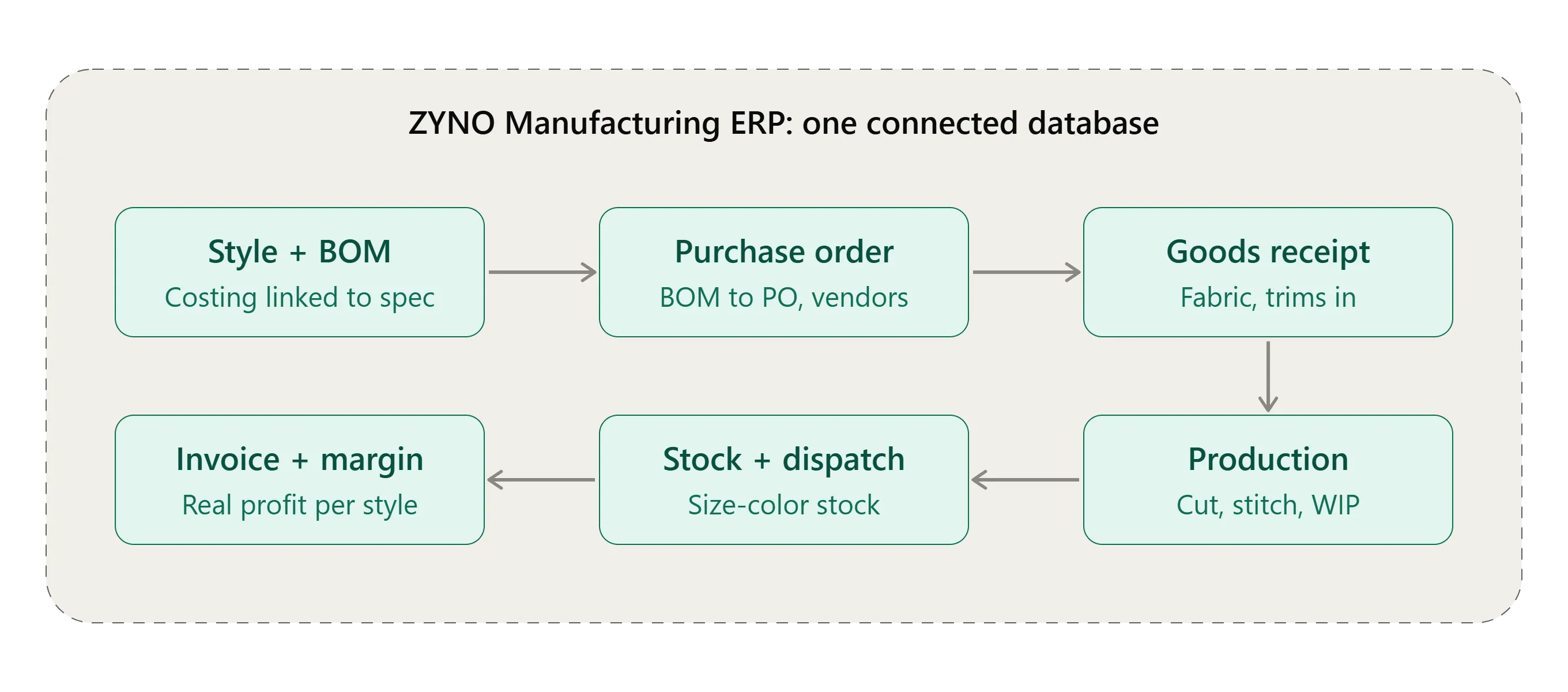
Instead of tech packs in one folder, purchase orders in email, stock in a spreadsheet and shipment updates in chat messages, a fashion SCM platform keeps everything linked. A change in the BOM updates costing and purchase orders; a delay at a supplier shows up in production planning; a shipment milestone updates delivery dates across teams.
8. Core Modules and Features
|
Module |
What It Does |
|
Product Lifecycle Management (PLM) |
Tracks design, digital sketch-to-pattern creation, material selection and tech packs |
|
Sourcing and Vendor Management |
Manages supplier onboarding, quotes, purchase order collaboration and audits |
|
Production and Inventory Tracking |
Controls multi-attribute sizing (XS to XL) and color matrices for garments and footwear |
|
Logistics and Global Trade |
Offers end-to-end tracking, customs compliance and real-time shipment visibility from factory to store |
|
ESG and Compliance |
Monitors forced labor laws, traceability standards (such as the UFLPA) and sustainability metrics |
A note on the UFLPA: the Uyghur Forced Labor Prevention Act is a United States law that restricts imports linked to forced labor. Apparel companies shipping to the US need traceable records showing where materials come from, which is why compliance modules have become a must-have rather than a nice-to-have.
9. Top Software Platforms in the Industry
|
Platform |
Focus |
Best Known For |
|
BlueCherry (by CGS) |
End-to-end ERP, PLM and Collaborative Supply Chain (CSC) tools |
Apparel and footwear brands needing an integrated suite |
|
Gravity Supply Chain |
End-to-end transparency and order management |
Predictive origin-to-destination tracking |
|
e2open |
Trading partner management, risk analysis and regulatory compliance |
Apparel and footwear supply chain networks |
|
CLO |
3D garment design and digital prototyping |
Industry standard for digital design linked to real-world production |
|
ZYNO Manufacturing ERP |
Integrated manufacturing ERP |
SMEs and apparel brands |
BlueCherry
An end-to-end platform by CGS that offers ERP, PLM and Collaborative Supply Chain (CSC) tools for apparel and footwear brands. It suits businesses that want design, sourcing, production and finance in one suite.
Gravity Supply Chain
Focuses on end-to-end transparency, order management and predictive origin-to-destination tracking. It is relevant for teams that need strong shipment and order visibility across a global network.
e2open
Use this manufacturing checklist to review production planning, inventory control, procurement, supplier coordination, and workflow efficiency. Find opportunities to improve operational control with ZYNO Manufacturing ERP.
ZYNO Manufacturing | Smarter Production, Better Control
Provides apparel and footwear solutions for trading partner management, risk analysis and regulatory compliance. It is suited to companies managing a large, multi-tier partner network.
CLO
The industry standard for 3D garment design and digital prototyping, linked to real-world production. It reduces physical sampling and speeds up design approval, and typically complements an ERP or PLM rather than replacing it.
ZYNO Manufacturing ERP: Best for SMEs and Apparel Brands
Large enterprise suites are powerful, but they can be heavy, expensive and slow to implement for a growing manufacturer or a young apparel brand. Small and mid-sized businesses usually need something different: a system that is complete enough to run the business, but simple enough to adopt quickly.
ZYNO Manufacturing ERP is designed for SMEs and apparel brands that want to bring order, costing, purchasing, production and inventory into one connected system, without the complexity of an enterprise-scale rollout.
Manage production planning, raw material inventory, purchasing, and supplier coordination with ZYNO Manufacturing ERP. Improve operational visibility, reduce manual work, and streamline your apparel manufacturing processes.
Where ZYNO Fits in the Apparel Supply Chain
|
Supply Chain Stage |
How an Integrated ERP Helps |
|
Design and Development |

Keep styles, BOMs and costing linked to approved specs |
|
Raw Material Sourcing |
Manage vendors, issue and track purchase orders, record goods receipts |
|
Manufacturing |
Plan production, track work in progress and control material consumption |
|
Warehousing |
Maintain real-time stock by size, color and location |
|
Logistics and Delivery |
Track dispatch readiness and shipment documentation |
|
Finance |
Match POs, goods receipts and invoices; monitor margins |
[Editor's note: add ZYNO-specific screenshots, verified feature list, pricing model and customer examples here for maximum credibility and conversions.]
Who ZYNO Is Best For
Quick fit guide
|
If you are... |
Consider |
|
An SME or growing apparel brand needing an all-in-one manufacturing system |
ZYNO Manufacturing ERP |
|
A brand needing a broad ERP, PLM and collaboration suite |
BlueCherry |
|
A company prioritizing global shipment and order visibility |
Gravity Supply Chain |
|
A business managing a large trading partner network with heavy compliance needs |
e2open |
|
A design team reducing physical samples |
CLO (alongside ERP/PLM) |
Implementation Roadmap
Common Mistakes to Avoid
|
Mistake |
Fix |
|
Buying software before mapping the process |
Document workflows first |
|
Choosing an enterprise suite for an SME budget |
Match the tool to your size and growth plan |
|
Ignoring tier-2 and tier-3 suppliers |
Build traceability into vendor records |
|
Treating compliance as a separate task |
Link certificates and audits to vendors and POs |
|
Poor data quality at go-live |
Clean masters before migration |
|
No ownership of the project |
Assign a clear internal owner |
|
Skipping KPI reviews |
Set monthly dashboards and review meetings |
Conclusion
That t-shirt traveling the world is a reminder of how many moving parts sit behind every garment. Apparel supply chain management is the discipline that keeps those parts aligned: seven stages, many partners, and constant pressure on cost, speed, quality and compliance.
The businesses that win are not necessarily the biggest. They are the ones that choose the right strategy for their market, build transparency into supplier relationships, and run on connected systems instead of scattered spreadsheets. Whether you evaluate enterprise platforms like BlueCherry, e2open and Gravity Supply Chain, design tools like CLO, or an SME-friendly integrated option like ZYNO Manufacturing ERP Software, the goal is the same: one clear view of your products, suppliers, stock and shipments.
Your next step: map your current supply chain on one page, mark the three handoffs where delays or errors happen most, and use the buyer checklist in Section 11 to see which platform solves those first.
Frequently Asked Questions (FAQs)
Q1. What is apparel supply chain management?
It is the coordinated network of organizations, people, activities, information and resources involved in moving a clothing product from design and raw material sourcing to final retail distribution and consumer purchase.
Q2. What are the main stages of the apparel supply chain?
The key stages are design and product development, raw material sourcing, manufacturing and production, logistics and transportation, warehousing and distribution, retail and consumption, and the reverse supply chain for returns, deadstock and recycling.
Q3. What is fashion supply chain management software?
It is a digital platform that connects sourcing, design, production, inventory, logistics and compliance, so teams work from one set of data instead of separate spreadsheets, emails and tools.
Q4. What are the core modules of fashion supply chain software?
The main modules are PLM, sourcing and vendor management, production and inventory tracking with size and color matrices, logistics and global trade, and ESG and compliance.
Q5. Which are the top fashion supply chain management software platforms?
Widely recognized options include BlueCherry, Gravity Supply Chain, e2open and CLO. For SMEs and apparel brands looking for an integrated manufacturing ERP, ZYNO Manufacturing ERP is a strong fit.
Q6. What is the best ERP for small and medium apparel businesses?
The best choice is one that handles size-color matrices, BOM and PO management, production and inventory in one system, with a fast setup and pricing suited to your size. ZYNO Manufacturing ERP is built with SMEs and apparel brands in mind.
Q7. What is the difference between fast fashion and traditional sourcing?
Fast fashion uses agile, high-speed models (like Zara's) that compress lead times to react to micro-trends. Traditional sourcing relies on long-lead overseas bulk runs planned well in advance.
Q8. What is the difference between lean and agile manufacturing?
Lean focuses on eliminating waste and optimizing cost. Agile focuses on responding quickly to volatile consumer demand. Many apparel businesses use both.
Q9. What is the UFLPA and why does it matter to apparel companies?
The Uyghur Forced Labor Prevention Act is a US law that restricts imports linked to forced labor. Apparel companies exporting to the US need traceability records to prove their supply chain is compliant.
Q10. How does AI help apparel supply chains?
AI supports predictive demand forecasting, automated quality checks and real-time inventory tracking, which help reduce overproduction, defects and markdowns.
Q11. What is the reverse supply chain in apparel?
It covers handling customer returns, liquidating deadstock and recycling materials, so businesses recover value and reduce waste.
Q12. How can small apparel brands improve supply chain visibility?
Start by centralizing vendors, purchase orders, stock and production in one ERP, track milestones with a time-and-action calendar, and review supplier performance regularly.
Q13. How long does it take to implement apparel ERP software?
It depends on the system and data readiness. Lighter, SME-focused ERPs typically go live faster than enterprise suites, especially when vendor, item and BOM data are cleaned beforehand.
Q14. Why is supplier transparency important in fashion?
Buyers, regulators and consumers expect proof of ethical, safe and sustainable production. Transparency across tiers reduces compliance risk and protects brand reputation.
What is ERP? A Beginner's Guide to Enterprise Resource Planning
Read More →
Cloud ERP vs. On-Premise vs. Hybrid: Best ERP Model for 2025
Read More →How To Customize ERP Software Without Breaking The Bank?
Read More →
The Future of Manufacturing ERP in 2026 & Beyond
Read More →Best ERP Software in India: 2026 Edition
Read More →
AI in Manufacturing ERP: The Future of Smart Factories
Read More →
How ERP Transforms Inventory Management and Reduces Costs
Read More →
Inventory Management Software Features: The Complete 2026 Buying Guide
Read More →
Top 5 Ways Asset Management Software Can Save Your Business Money
Read More →
Why Smart Businesses Are Switching to Vendor Management Systems in 2025?
Read More →
Why Manufacturing Companies Need ERP Software
Read More →
Cloud ERP vs. Traditional ERP: Which is Right for You?
Read More →
ERP for Small Business: Is It Worth the Investment?
Read More →
How to Calculate ERP ROI and Why It's Worth the Investment
Read More →
Top 10 ERP Software Companies in India 2026 Updated List (Complete Guide)
Read More →
ERP Implementation Mistakes to Avoid in 2025
Read More →
Cloud ERP vs Edge Computing: What's Right for Modern Manufacturing?
Read More →
The Future of ERP Software and the Role of Generative AI
Read More →
Digital Twin Technology & ERP: Real-Time Insights for Smarter Manufacturing
Read More →
Scalable ERP Solutions Designed for Modern Enterprises
Read More →
ERP and IoT Integration: Smart Factory Vision
Read More →Best ERP Software for Manufacturing Businesses in India
Read More →Top 10 Best Manufacturing ERP Software in India (2026)
Read More →
Best ERP Software for Manufacturing Industries in Ethiopia (2026)
Read More →
Best School ERP Software Providers in UAE (2025 Edition)
Read More →
Best School ERP Software for 2025: Guide for Educational Institutions
Read More →
Top 10 ERP Software Solutions for Nigerian Manufacturers (2025 Edition)
Read More →
Best ERP Systems for Scalable Retail and POS Integration
Read More →
Top 10 Cloud-Based Manufacturing ERP Solutions in Africa (2025 Edition)
Read More →
Top 10 Cloud-Based Manufacturing ERP in UAE
Read More →
Top 10 Cloud-Based Manufacturing ERP Software in Nigeria (2026 Edition)
Read More →
Top 10 School ERP Software Companies in Kenya (2025)
Read More →
Best School ERP Software Providers in Nigeria (2025)
Read More →
Top Cloud-Based Manufacturing ERP in Zimbabwe (2025)
Read More →
Best ERP Software in U.K
Read More →
Top 10 ERP Software Developers in the U.K. (2025)
Read More →
Best ERP Software Providers in France (2025)
Read More →
Best ERP Software Companies in Germany : A Comprehensive Guide
Read More →
Top 10 ERP Software Development Companies in Qatar
Read More →
Best ERP Providers in Germany: 10 ERP Software Options Compared
Read More →
Best ERP Software Firms in Saudi Arabia (2025)
Read More →
Best ERP Service Providers in Indonesia for SMEs and Large Enterprises
Read More →
Top 10 Cloud-Based Manufacturing ERP Systems in Egypt for Modern Factories
Read More →
Top ERP Solutions in the USA 2025: Streamline Your Business with ZYNO ERP
Read More →
Top ERP Solutions in Qatar for Businesses of All Sizes
Read More →Top Manufacturing ERP Software in India 2026 ZYNO Manufacturing ERP
Read More →How Manufacturing Companies Reduce Production Delays Using ERP Automation
Read More →Why Legal Firms Need ERP to Manage Cases, Billing & Compliance
Read More →What Is ERP And How Does It Work
Read More →
How ERP Systems Are Evolving in 2026: What Businesses Need to Know
Read More →
Best ERP Software in India: 2025 Edition
Read More →
Top 10 ERP Software Companies in Delhi NCR
Read More →
How Manufacturing ERP Software Improves Demand Forecasting
Read More →
Top 10 Best School Management Software in India
Read More →Manufacturing & Wholesale ERP in Qatar: Complete Industry Guide 2026
Read More →Cloud ERP Software in Qatar: Why Businesses Are Moving in 2026
Read More →Is ERP a Procurement Software? Key Differences, Benefits & What to Choose
Read More →What Is Production Planning and Control? Definition, Objectives & Functions
Read More →
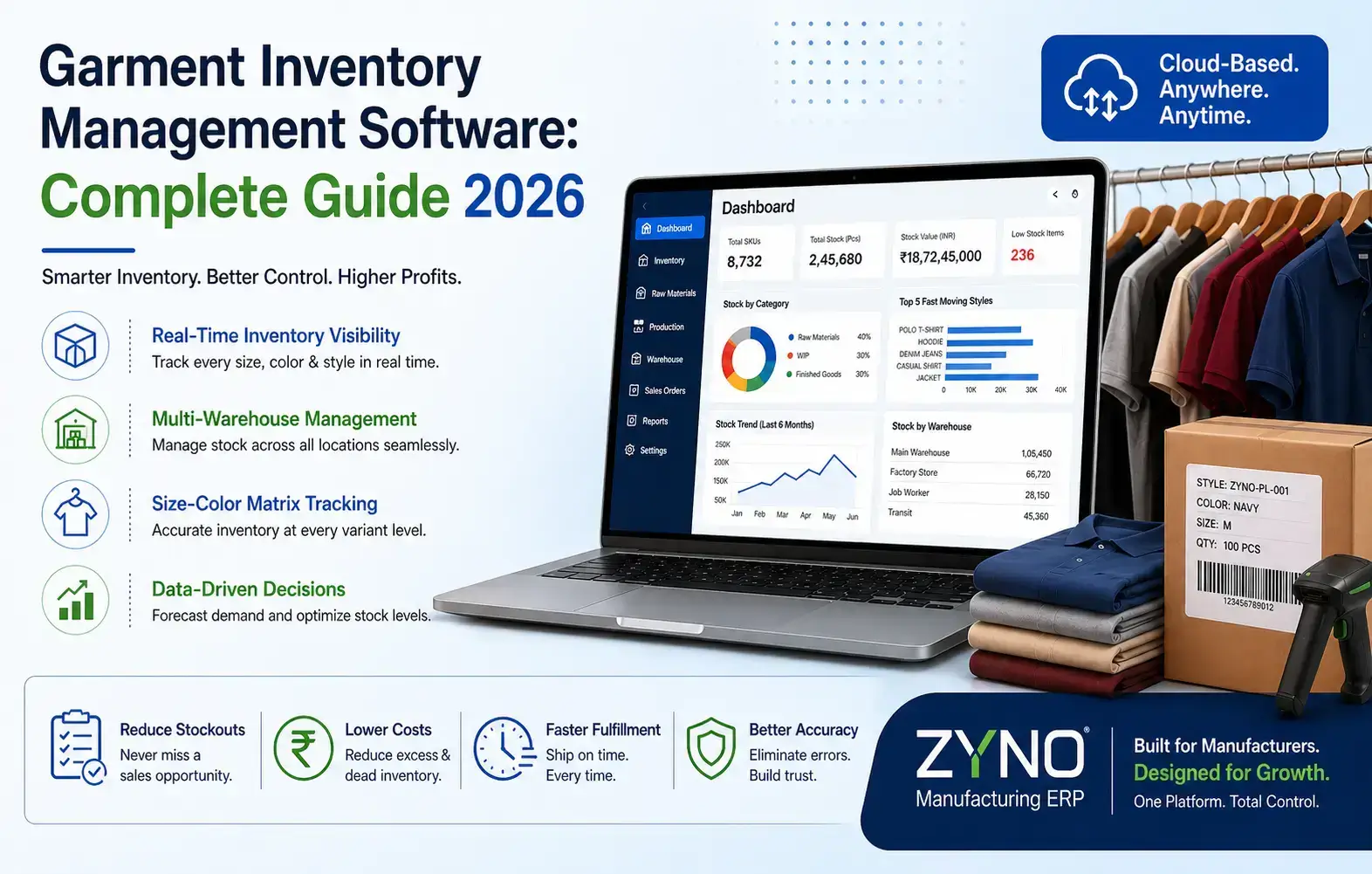
Garment Inventory Software: Features, Providers & Buying Guide (2026)
Read More →
How ERP Reduces Fabric Wastage in Garment Factories

Read More →
Why the Garment Industry Needs a Specialized ERP
Read More →
Features to Look for in Garment Manufacturing ERP Software
Read More →
Best ERP Software for Small Garment Manufacturing Business in India
Read More →
The Real Problems Holding Back Small Garment Manufacturers in India
Read More →Garment Manufacturing ERP Software in India: Best Options, Features & Complete Guide 2026
Read More →
Which ERP is Best for Manufacturers in 2026?
Read More →
Distributor & Consumer Management System: The Complete Guide for 2026
Read More →
Best Pharma ERP Software in India 2026 – Features, Compliance & Buying Guide
Read More →
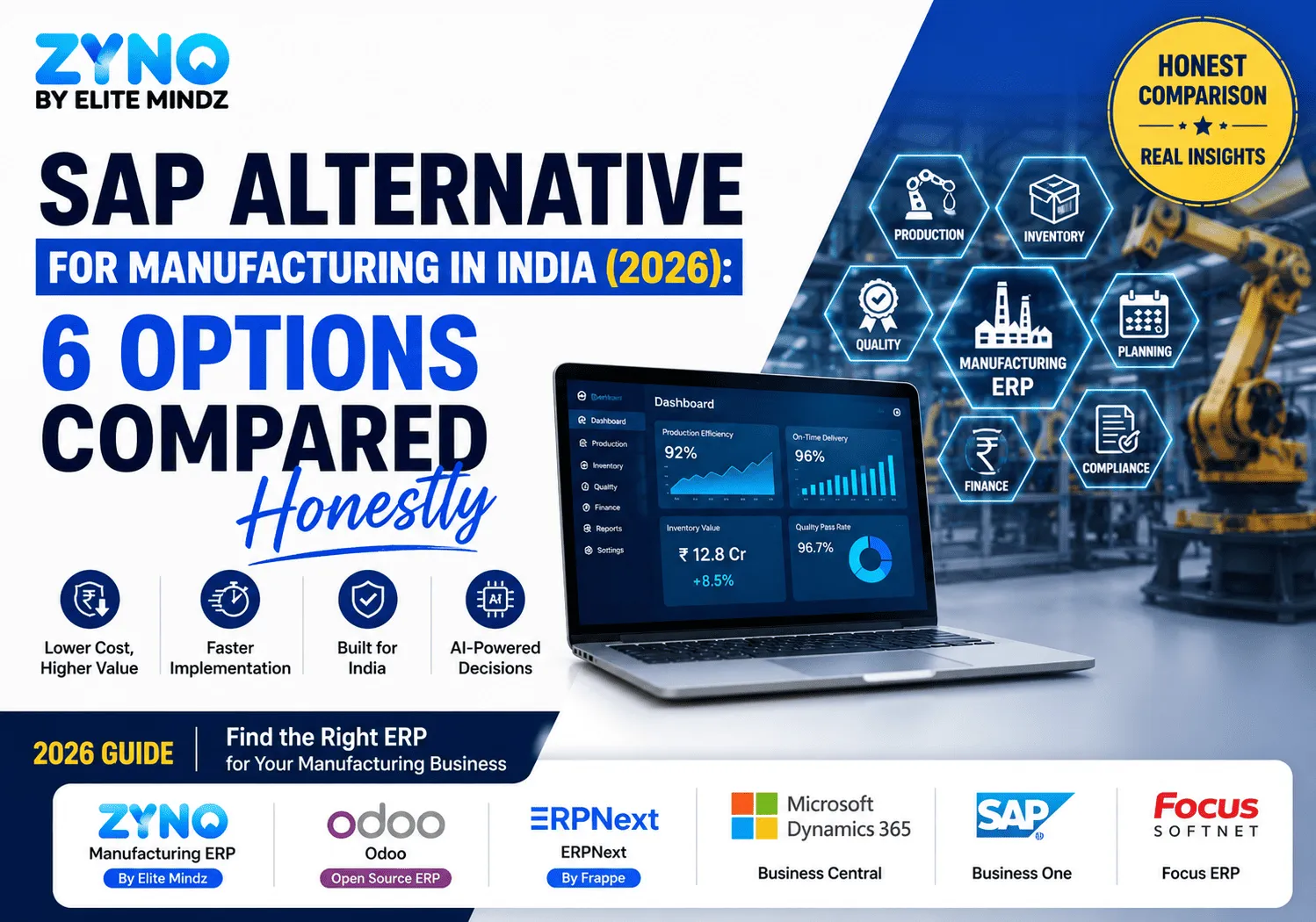
SAP Alternative for Manufacturing in India (2026): 6 Options Compared Honestly
Read More →
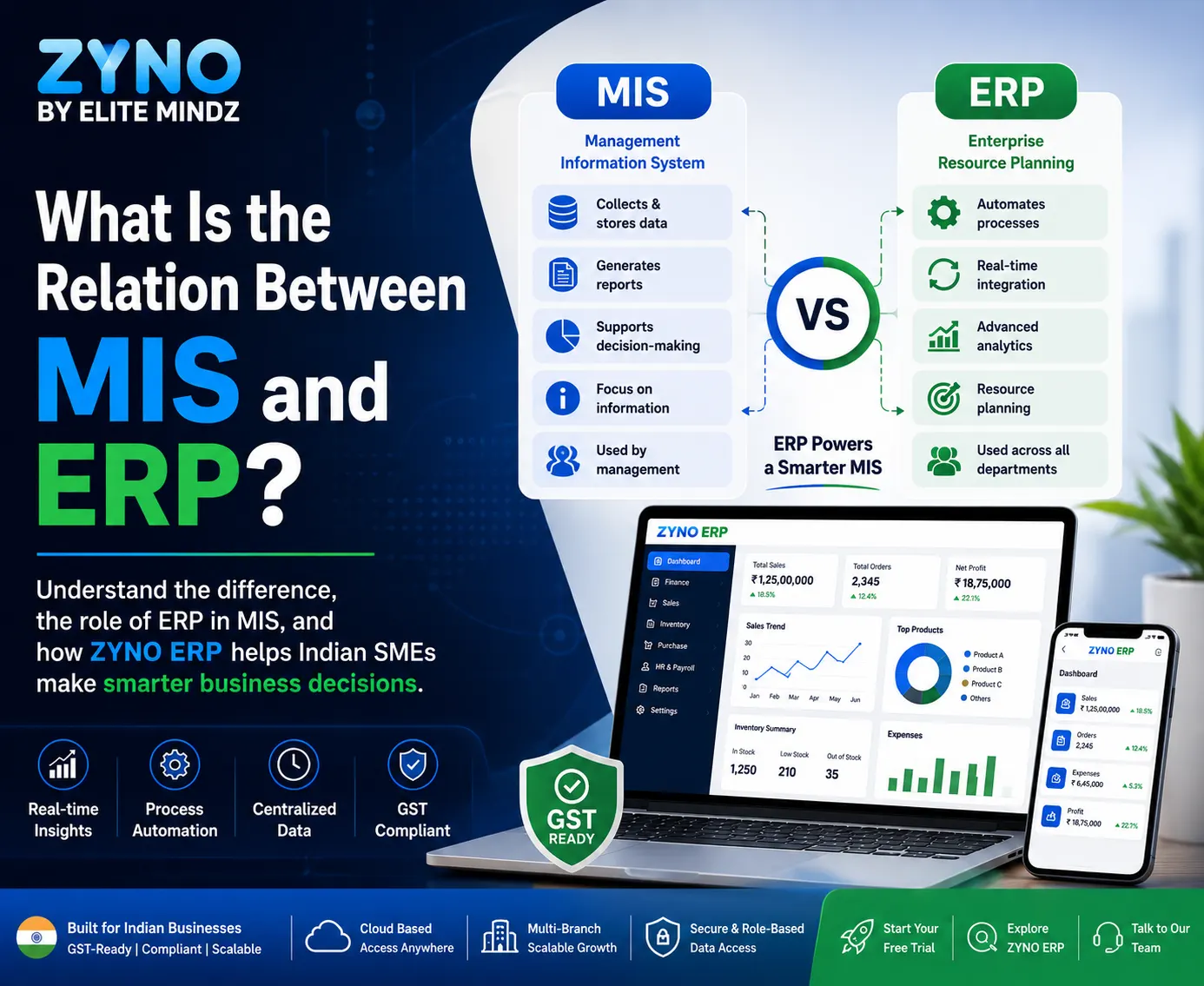
What Is the Relation Between MIS and Enterprise Resource Planning?
Read More →
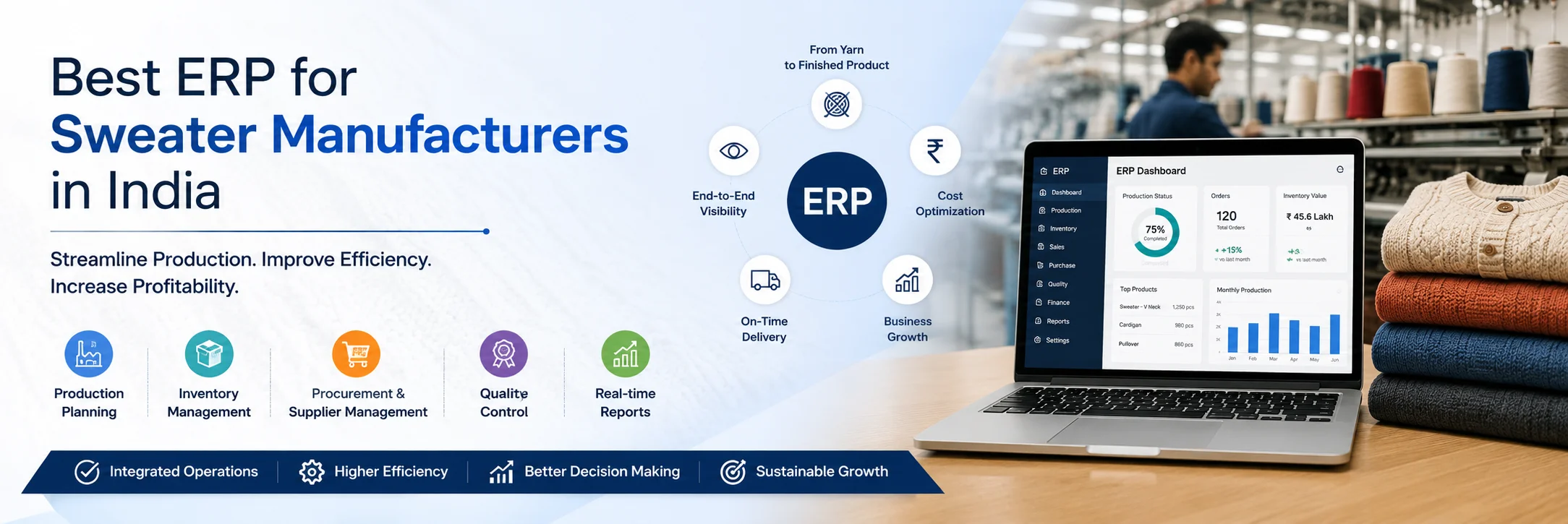
Best ERP for Sweater Manufacturers in India
Read More →
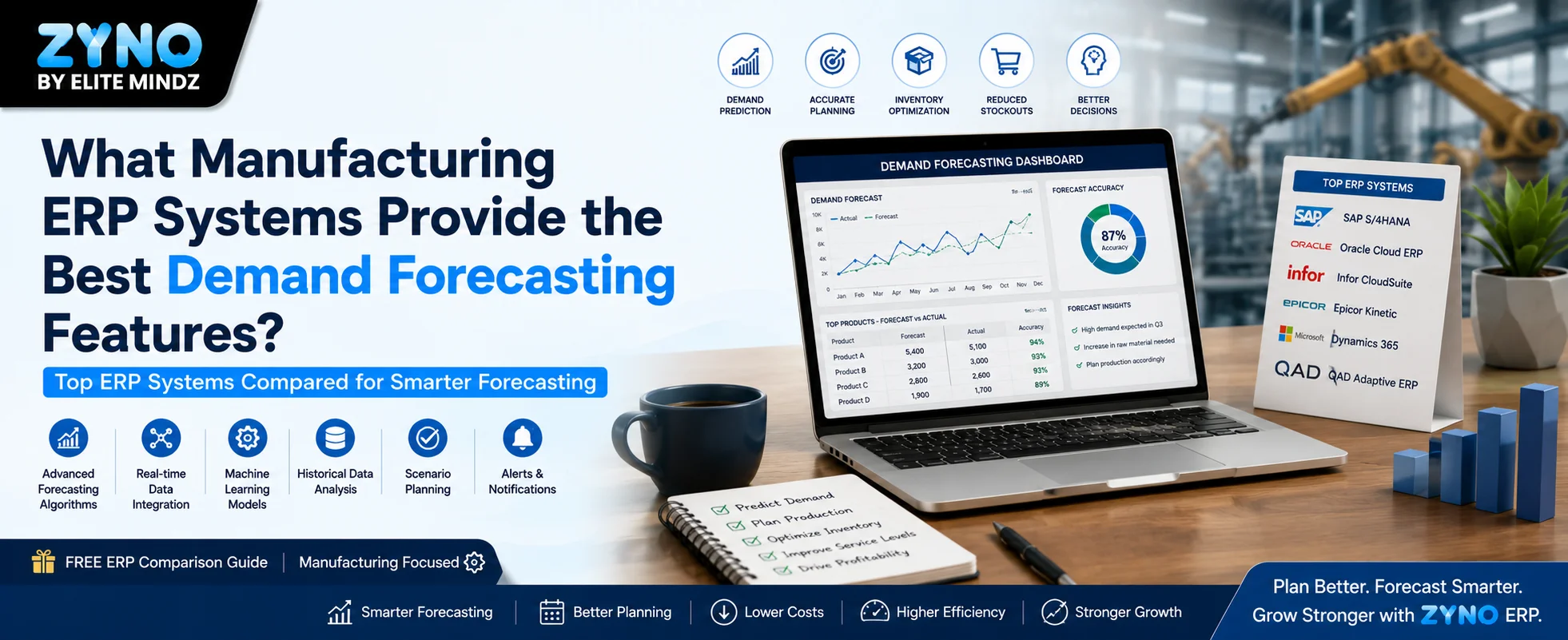
What Manufacturing ERP Systems Provide the Best Demand Forecasting Features?
Read More →
Which ERP Software Provides the Best Demand Forecasting for Manufacturers?
Read More →
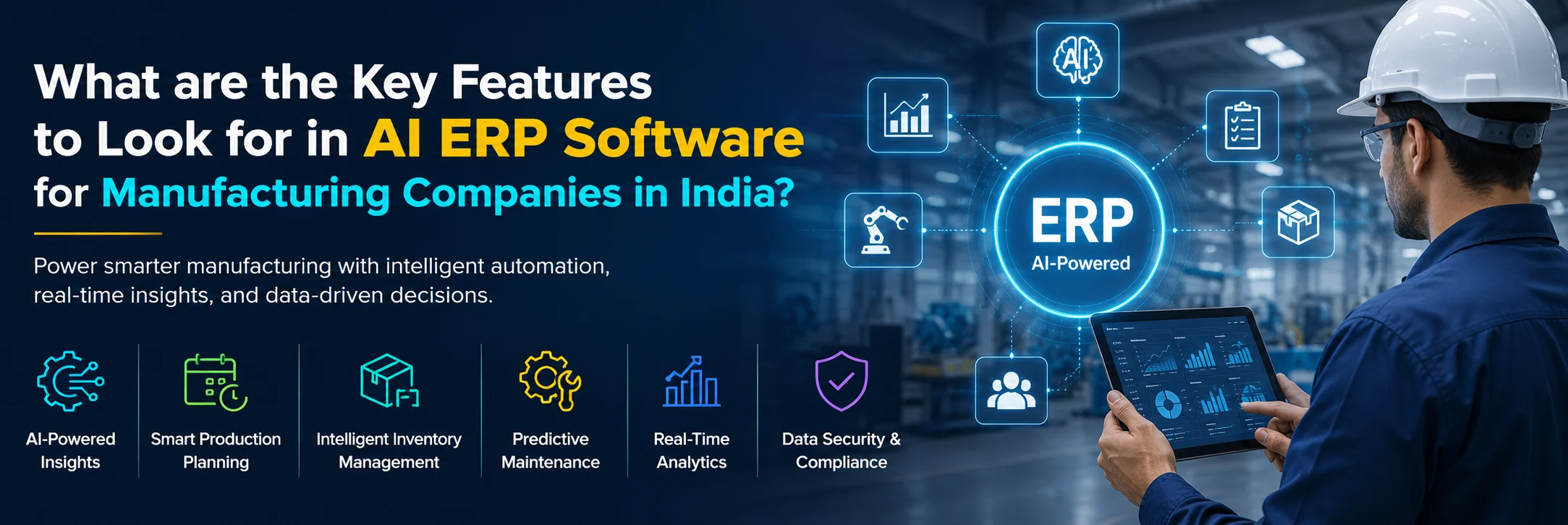
What are the key features to look for in AI ERP software for manufacturing companies in India?
Read More →
How does AI-powered ERP software improve production planning and inventory management in manufacturing?
Read More →
Which AI ERP platforms are best suited for small and mid-sized manufacturing businesses in India?
Read More →
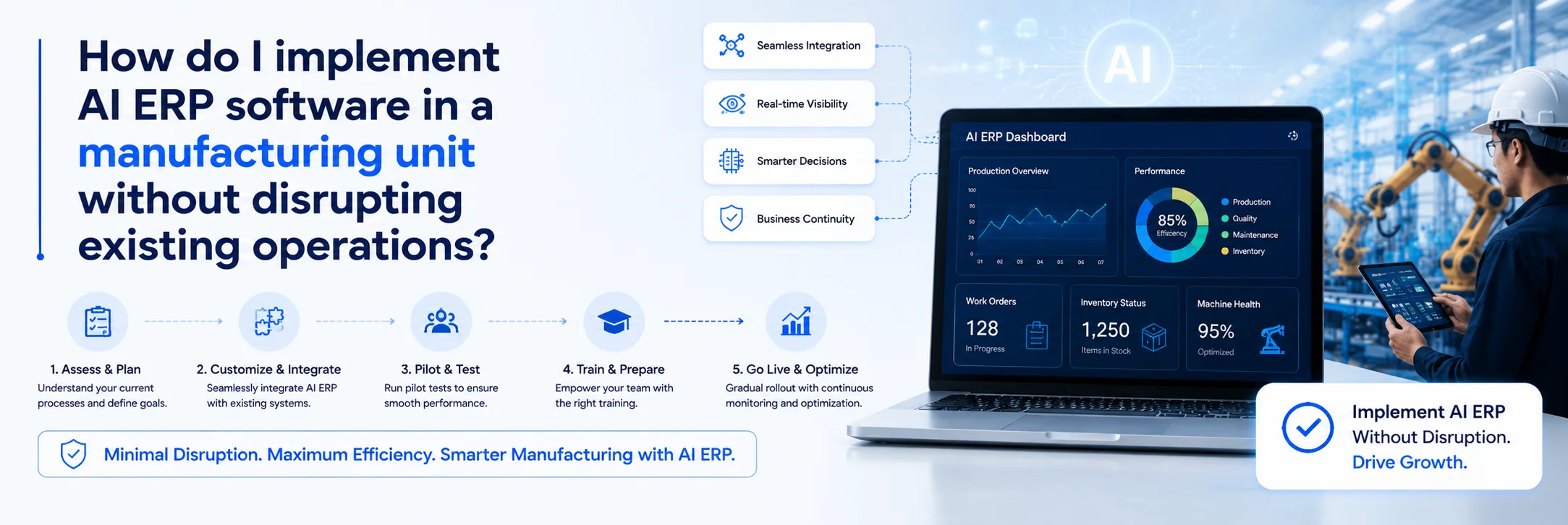
How do I implement AI ERP software in a manufacturing unit without disrupting existing operations?
Read More →
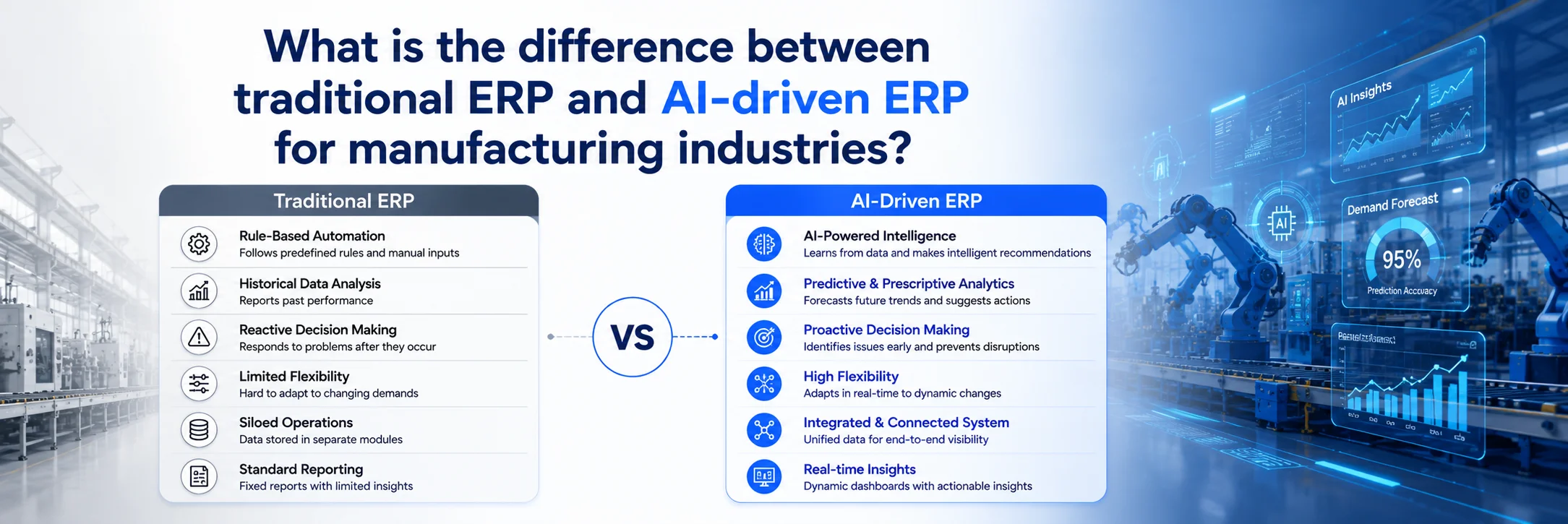
What is the difference between traditional ERP and AI-driven ERP for manufacturing industries?
Read More →
AI-Powered Smart ERP Software: The Complete Guide for Modern Enterprises
Read More →
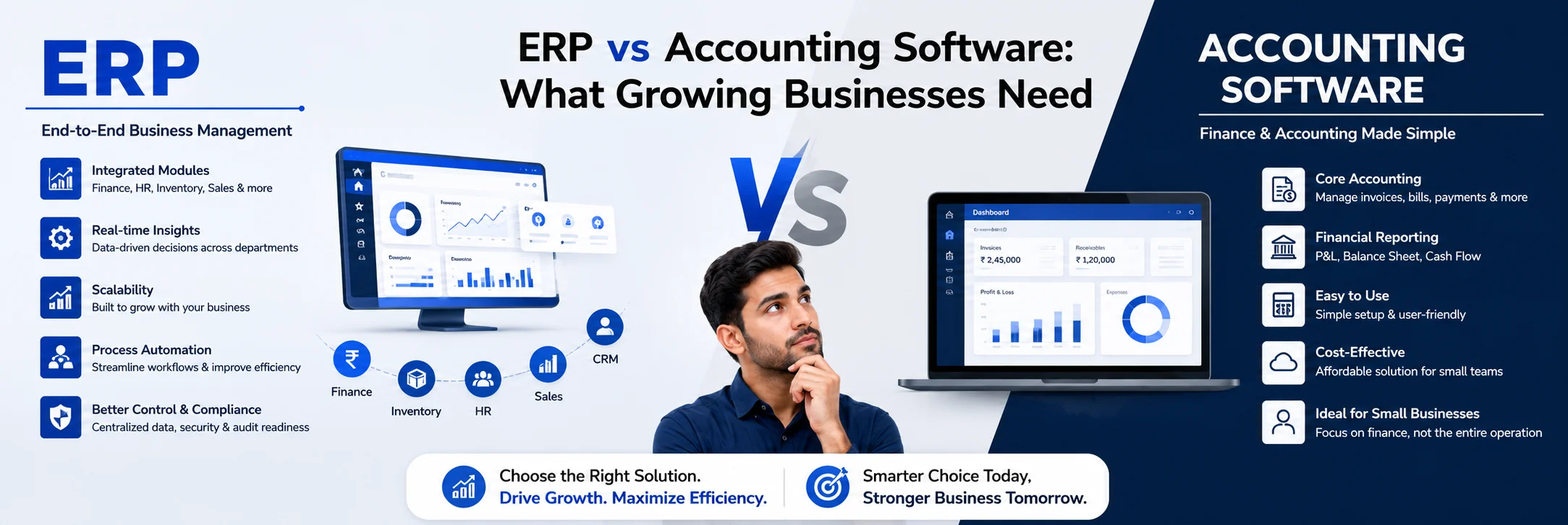
ERP vs Accounting Software: What Growing Businesses Need
Read More →
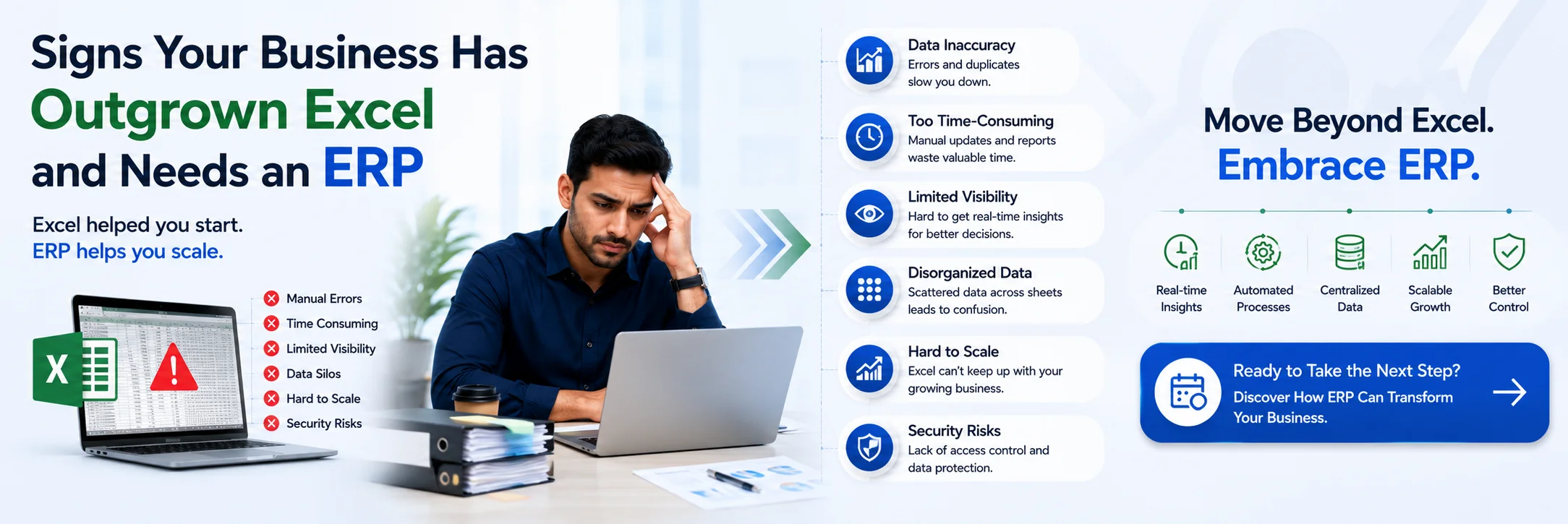
Signs Your Business Has Outgrown Excel and Needs an ERP
Read More →
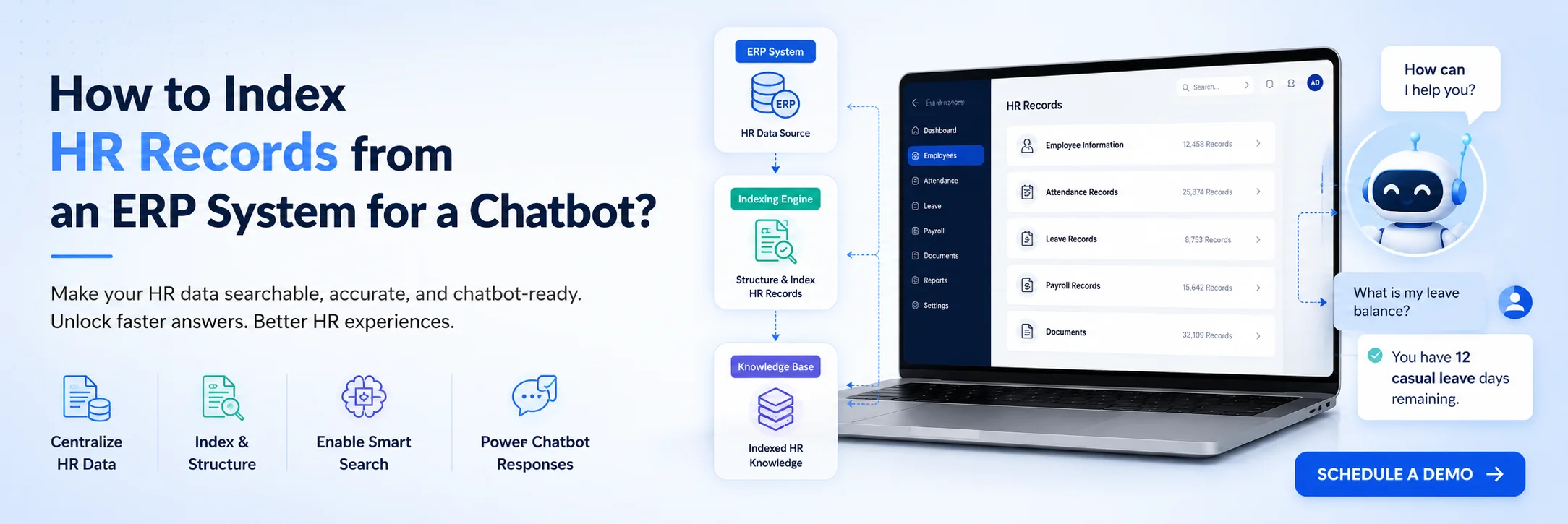
How to Index HR Records from an ERP System for a Chatbot?
Read More →
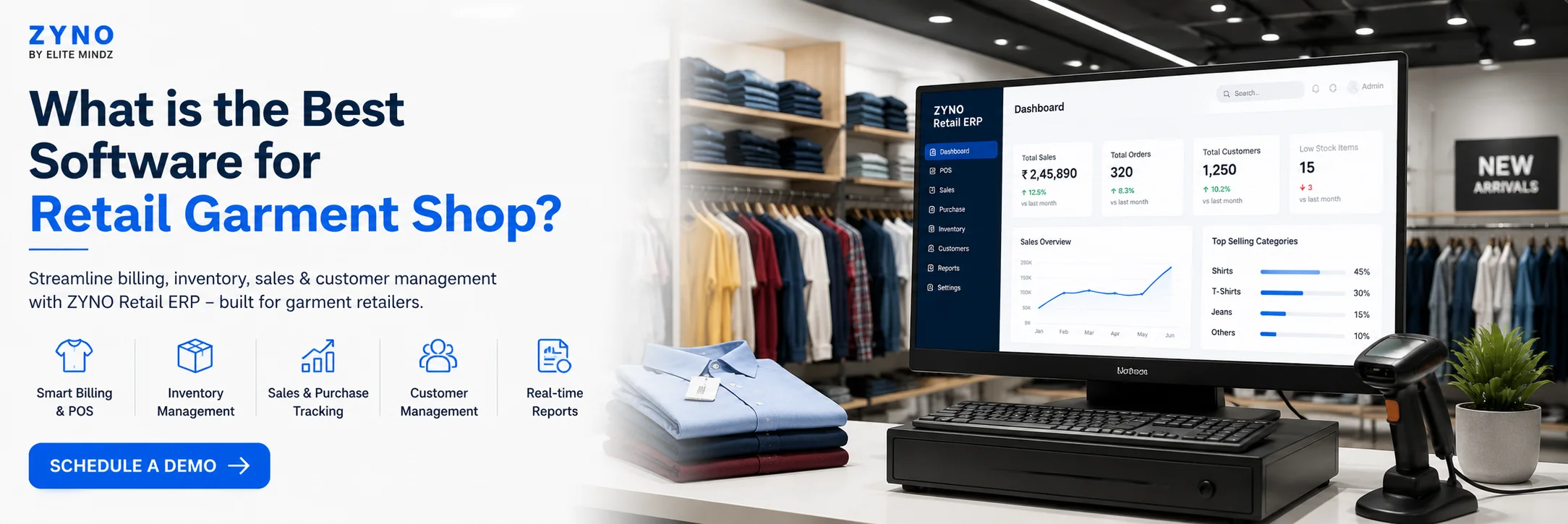
What is the Best Software for Retail Garment Shop?
Read More →
Manufacturing Software for the Textile and Garment Industry?
Read More →
Best ERP Software for Manufacturing Companies in India?
Read More →
How ERP Reduces Production Costs and Improves Profitability?
Read More →
Which ERP Software is Mostly Used in Garment Retail Shop?
Read More →
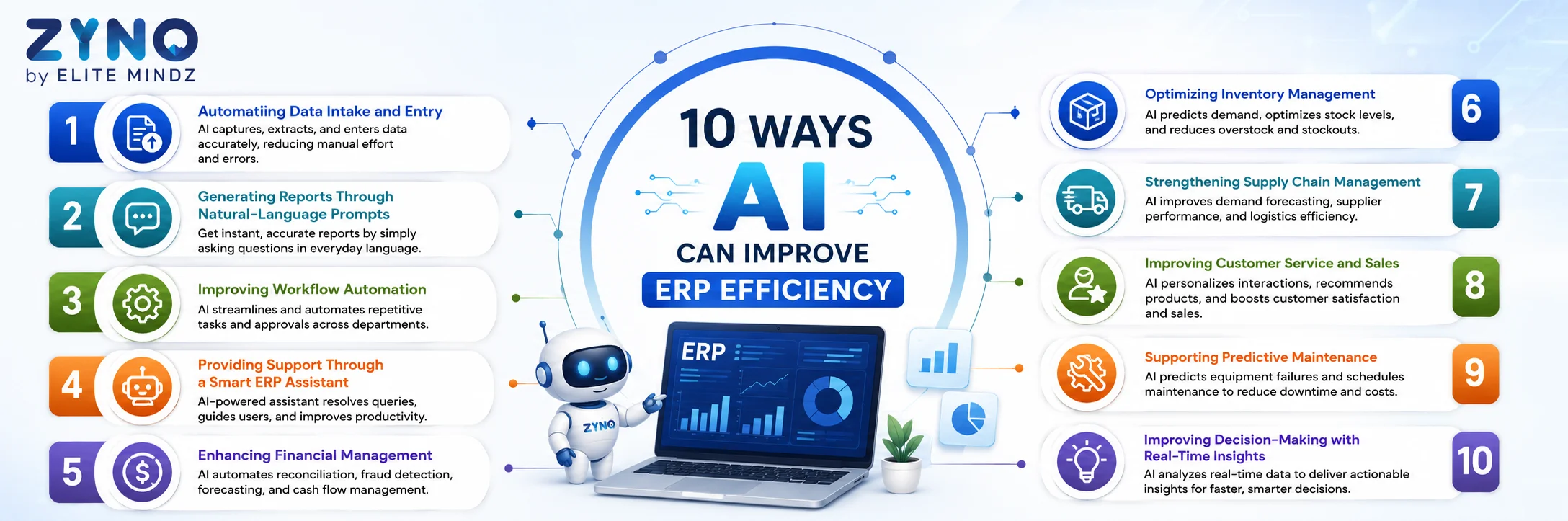
10 Ways AI Can Improve ERP Efficiency
Read More →
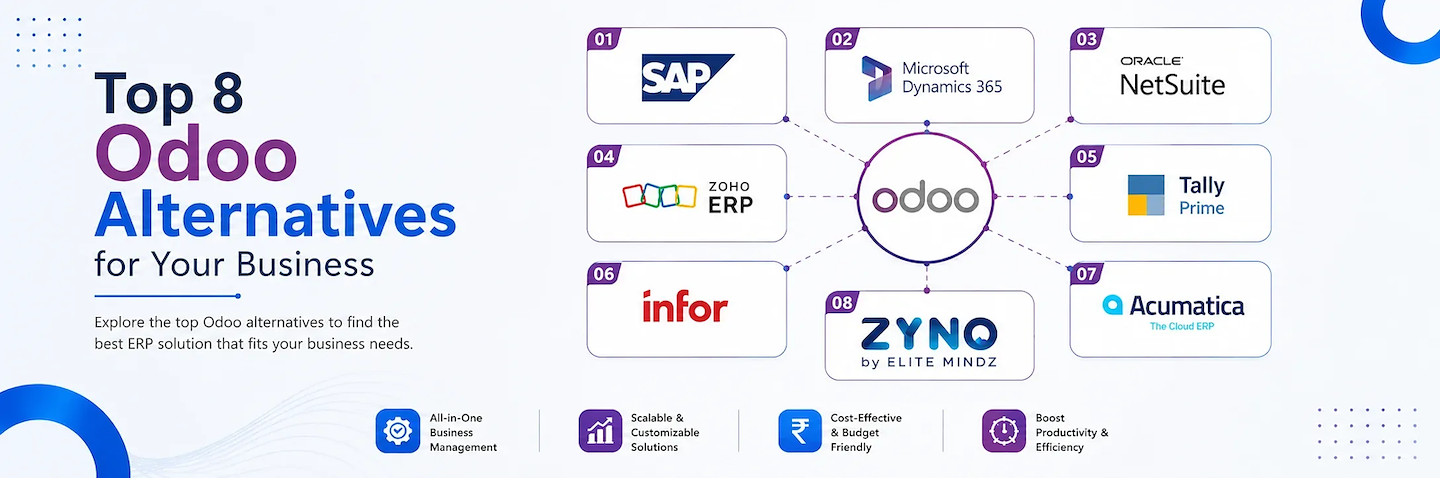
Top 8 Odoo Alternatives for Your Business
Read More →
ZYNO vs NetSuite ERP: Which Manufacturing ERP Fits Your Business Needs?
Read More →
Top ERP Software Providers in 2026: Full Comparison
Read More →
ERP Software Reviews: What Buyers Actually Say in 2026
Read More →
ERP Software for Retail Businesses: Complete Guide
Read More →
ERP Software for Healthcare: Beyond Patient Records
Read More →
ERP Software for Logistics Companies: A Complete Guide
Read More →
Best ERP Software for SaaS Companies in 2026
Read More →
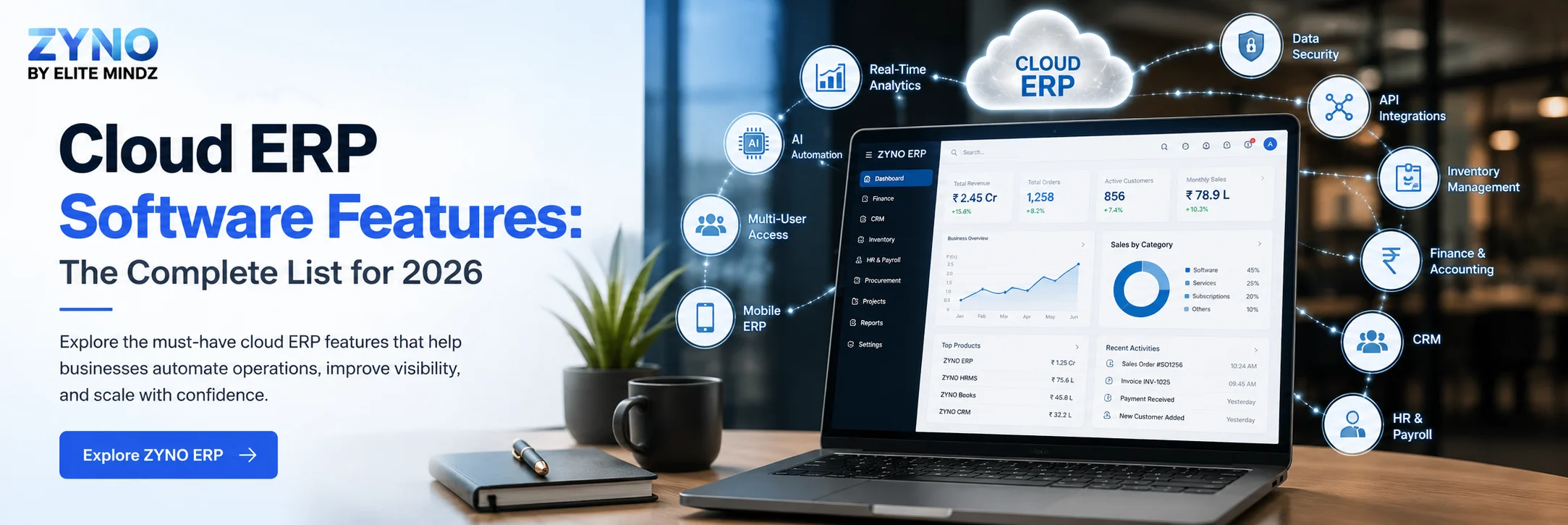
Cloud ERP Software Features: The Complete List for 2026
Read More →
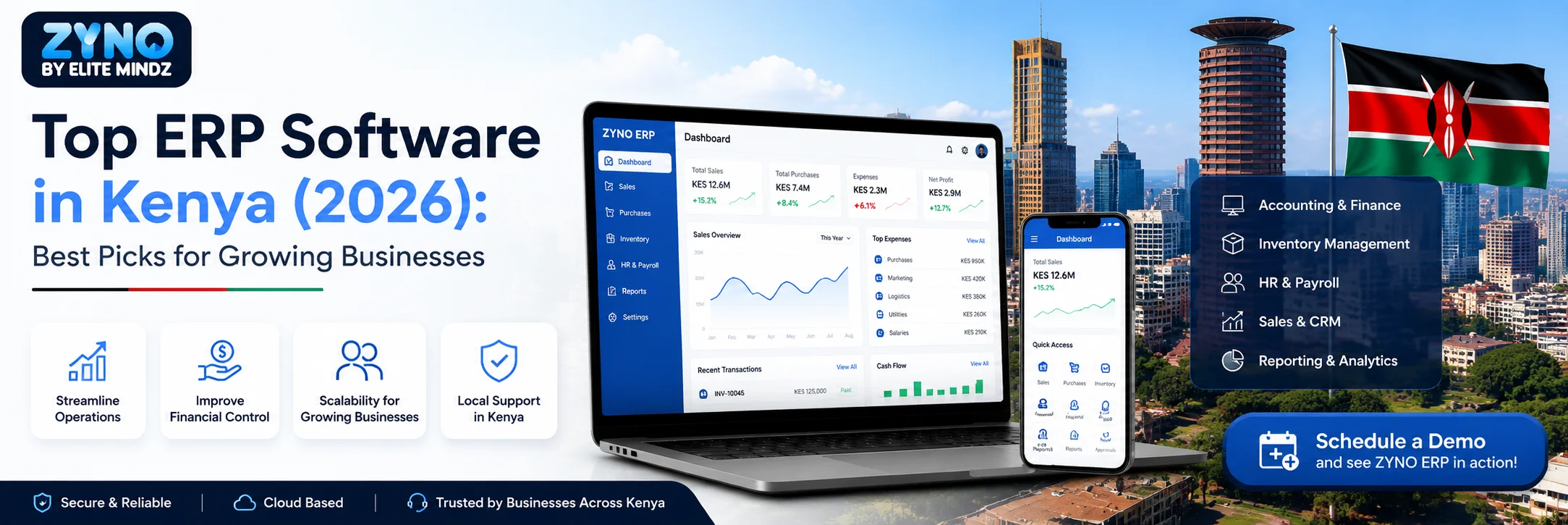
Top ERP Software in Kenya (2026): Best Picks for Growing Businesses
Read More →
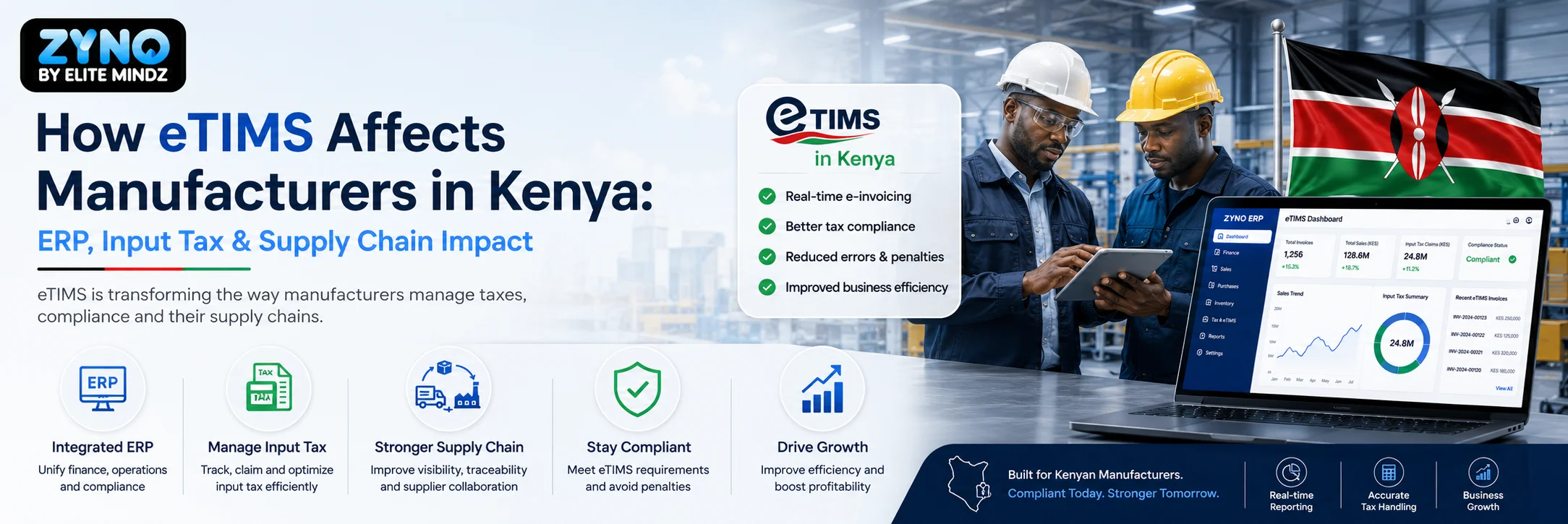
How eTIMS Affects Manufacturers in Kenya: ERP, Input Tax & Supply Chain Impact
Read More →
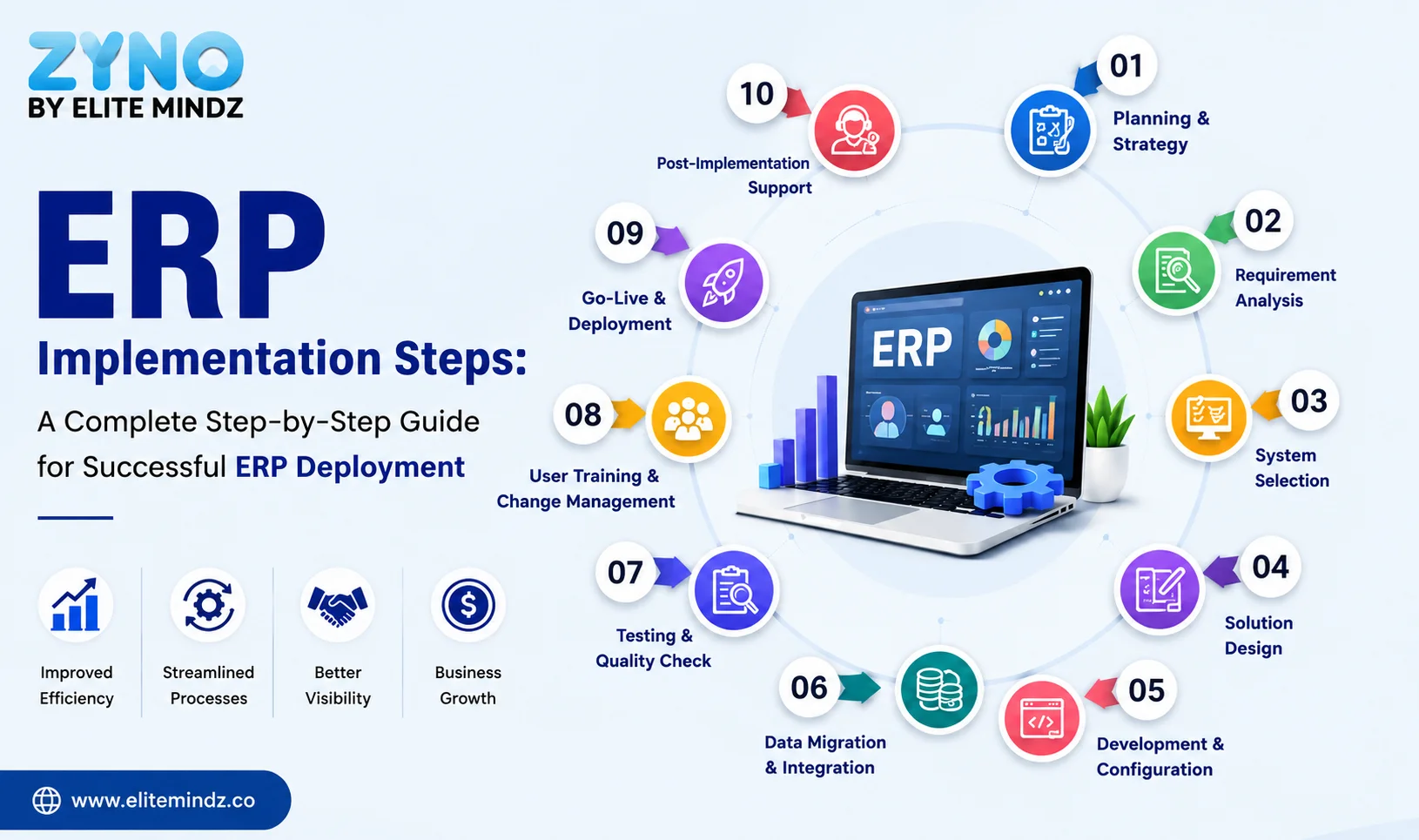
ERP Implementation Steps: A Complete Step-by-Step Guide for Successful ERP Deployment
Read More →
What Are the Steps in Production Planning and Control?
Read More →
Manufacturing Compliance in Kenya: A Complete Guide for Factory Tax Compliance & Regulatory Excellence
Read More →
ERP Migration Checklist for Manufacturing, Retail, and Service Businesses
Read More →
ERP Go-Live Checklist: Step-by-Step Guide for a Smooth System Launch
Read More →
Best ERP Software in the Middle East: What Actually Matters in 2026
Read More →
ERP Training Best Practices: Essential Tips for a Smooth ERP Implementation
Read More →
Traceability in Manufacturing: Cost Effective Solution and Complete Information
Read More →
Manufacturing ERP Software Buying Guide: Features, Checklist & Questions to Ask Before You Invest
Read More →
20 Best ERP Software in Japan (2026): Top AI-Powered & Cloud ERP Platforms Ranked
Read More →
10 Best ERP Software for Metal Manufacturing Companies: Features, Checklist & Buying Guide (2026)
Read More →How Manufacturing ERP Helps Ethiopian Factories Improve Production Planning & Cost Control
Read More →
Top 15 Business Management Software for Growing Businesses in 2026
Read More →
Why These Are the Top 15 Small Business ERP Systems for 2026
Read More →
BOM Management Software: A Complete Guide to Smarter Manufacturing
Read More →
Which Companies Build Affordable Manufacturing ERP Software in India?
Read More →
GRN Flow in SAP vs ZYNO ERP
Read More →
Which AI ERP Platform Offers the Best ROI for Retail Businesses Looking to Automate Operations in India?
Read More →
Warehouse Management System (WMS): Complete Guide
Read More →
Best WMS Software in 2026: 10 Warehouse Management Systems Compared
Read More →
Top Warehouse Management System (WMS) Pain Points and How to Solve Them
Read More →
ERP in Inventory Management: Features, Benefits & Best Practices
Read More →
Best ERP for Inventory Management : Top 10 Software Compared
Read More →
From Clicking Through Screens to Simply Asking: The New ERP Experience
Read More →
Best ERP Solutions for Textile Manufacturing and Supply Chain Control
Read More →
How Automation Software Can Help Middle East Businesses Save Time and Reduce Costs
Read More →
Top ERP Platforms for Food Processing and Manufacturing
Read More →
How to Choose the Right ERP Software for Enterprises in the UAE: Your Must-Know Points
Read More →
Top 10 ERP Solutions for Pharmaceutical Production Management
Read More →
ERP for Chemical Manufacturing: Compare the Best Solutions
Read More →
ERP for Oil and Gas: Compare the Best Solutions for 2026
Read More →
Order Management System: A Complete Buyer’s Guide
Read More →
Best Cloud Warehouse Management System for Businesses: A Complete Guide
Read More →
How Do Prompt-Based ERPs Reduce Manual Workflow Steps?
Read More →
Top 10 ERP Features Your Business Should Not Compromise On
Read More →
What Are the Best AI-Native Enterprise ERP Platforms?
Read More →
7 Best ERP Software for FMCG Manufacturers
Read More →
How to Manage Vendor, Supplier and Purchase Orders in Apparel Manufacturing
Read More →
Apparel Supply Chain Management: A Complete Guide (Stages, Strategies and Software)
Read More →Partner with ZYNO by Elite Mindz to revolutionize how your business works. Fill out the form, and we’ll reach out with AI-powered solutions made just for you.
We use browser cookies to ensure you get the best experience on our website. Learn more
The form was submitted successfully!