Procurement Software Trends in 2026: What to Expect
Read More →

×
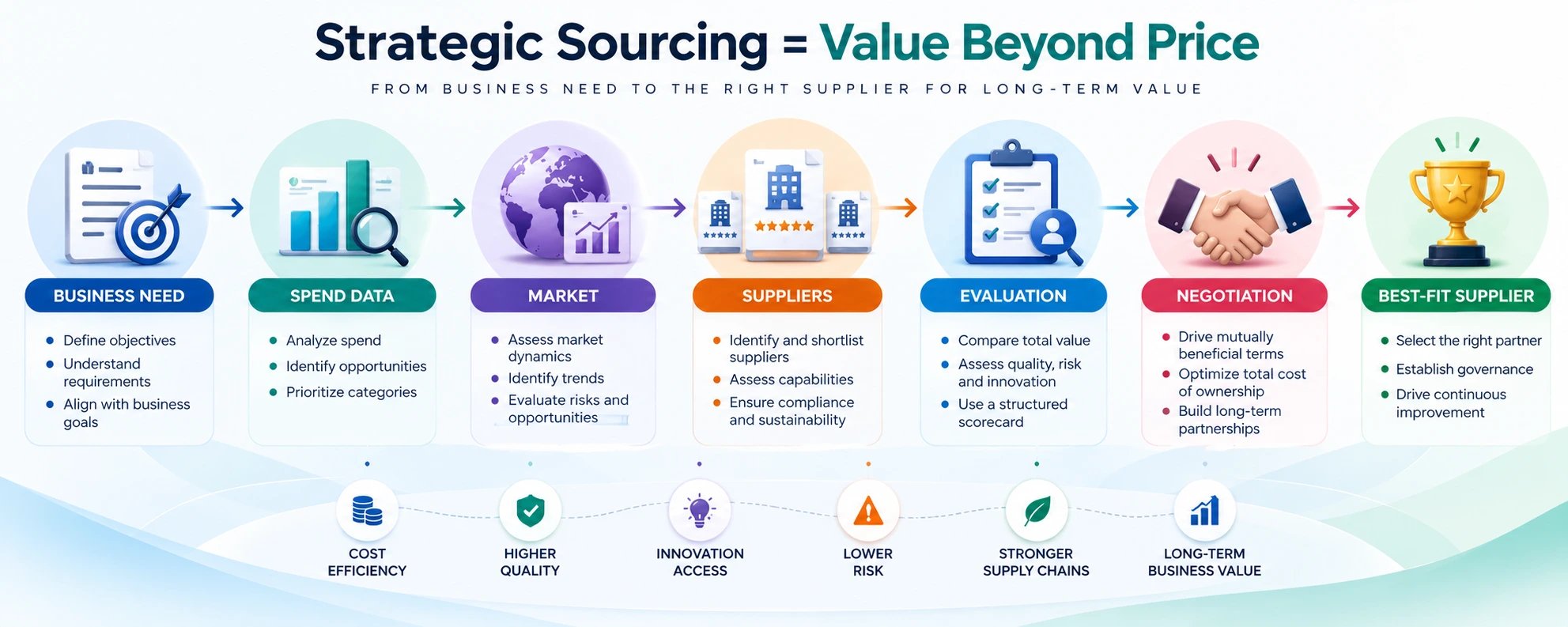
Choosing a supplier based only on the lowest quoted price can create problems later: poor quality, delivery delays, hidden costs, supply disruption or unfavorable contract terms. Strategic sourcing takes a broader view. It is a structured, data-driven approach to deciding what an organization should buy, which suppliers it should buy from, and under what commercial and operational terms, while considering cost, quality, risk, supplier capability, performance and long-term business objectives. In other words, strategic sourcing is not simply about finding a supplier. It is about finding the best overall source of value for a particular business need. A typical strategic sourcing process moves from: Business need → spend analysis → market analysis → sourcing strategy → supplier evaluation → negotiation → supplier selection → contract → performance management The exact process can vary by category, risk and business objective. A high-risk manufacturing component, for example, should not necessarily follow the same sourcing approach as office supplies. That flexibility is one of the most important characteristics of effective strategic sourcing.
Businesses using ZYNO Books cut accounting time by 70% and stay 100% ZATCA-compliant — automatically.
Strategic sourcing is a structured, data-driven procurement approach used to identify, evaluate and select suppliers based on total business value rather than price alone.
It considers factors such as:
The objective is to make sourcing decisions that improve the organization's overall outcome, rather than simply reducing the price of an individual purchase.
Strategic sourcing is generally the upstream decision-making part of procurement.
It helps answer questions such as:
Procurement then helps execute and manage the purchasing process that follows those decisions.
Strategic sourcing evaluates several dimensions simultaneously.
| Factor | What it considers |
|---|---|
| Cost | Price, discounts and commercial terms |
| Total cost of ownership | Purchase, logistics, maintenance, defects and other relevant lifecycle costs |
| Quality | Product/service quality and consistency |
| Supplier capability | Capacity, technology, expertise and resources |
| Delivery | Lead time, reliability and service levels |
| Risk | Financial, operational, geographic and supply risks |
| Compliance | Regulatory, contractual and organizational requirements |
| Sustainability | Environmental, social and responsible sourcing considerations |
| Innovation | Supplier ability to improve products, processes or services |
| Business fit | Alignment with organizational objectives |
The relative importance of these factors should change according to the category.
For example, delivery reliability may carry more weight than price for a critical production component, while price and availability might matter more for a standardized, low-risk commodity.
That is why strategic sourcing should be treated as a decision framework, not a fixed checklist.
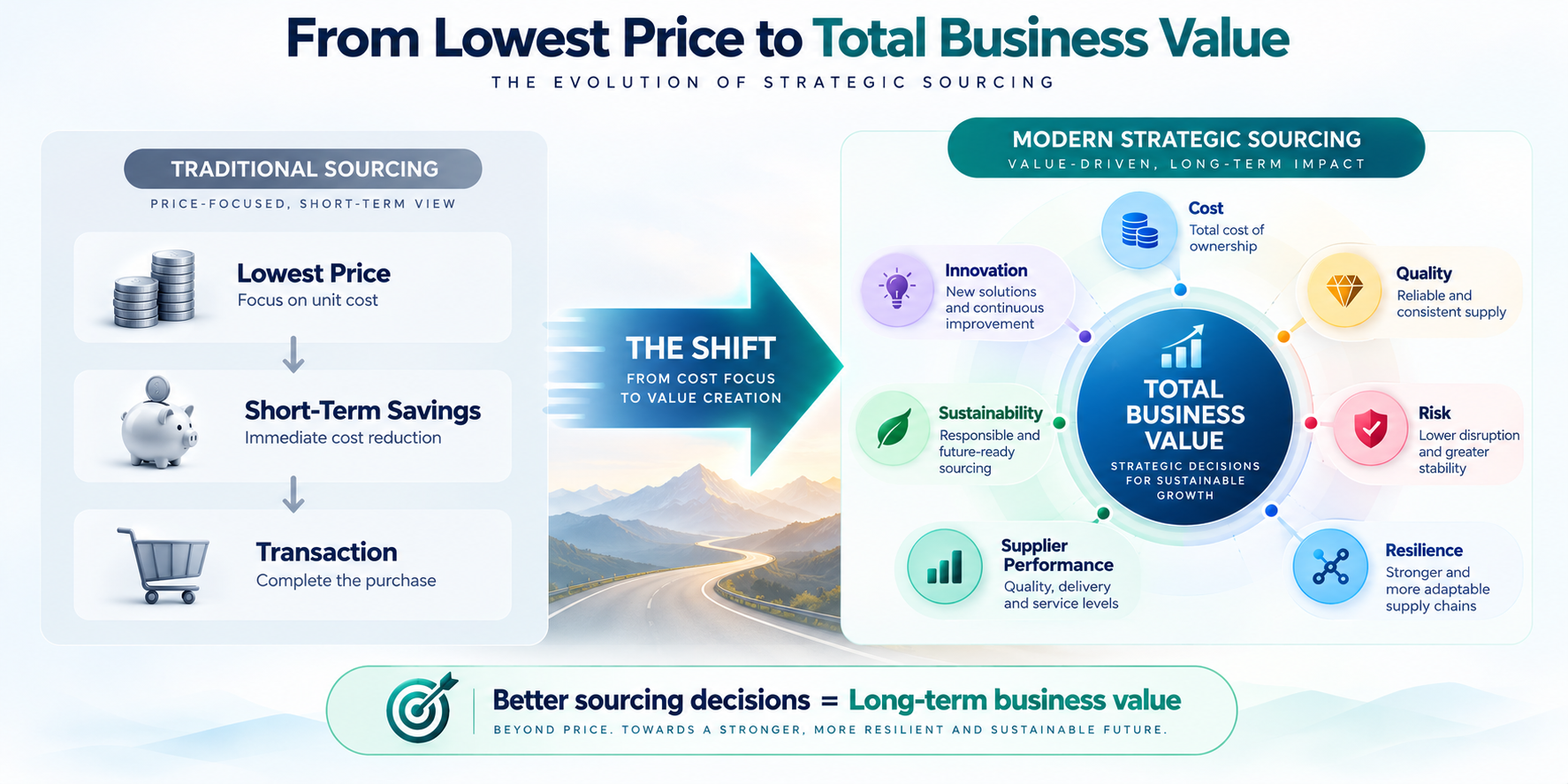
The biggest difference is what drives the decision.
Traditional or tactical sourcing is often focused on fulfilling an immediate requirement at an acceptable price.
Strategic sourcing looks further ahead.
| Strategic sourcing | Tactical sourcing |
|---|---|
| Long-term perspective | Immediate requirement |
| Total value | Primarily purchase price |
| Data-driven | Transaction-driven |
| Supplier capability | Supplier availability |
| Risk considered explicitly | Risk may receive less attention |
| TCO considered | Unit price often dominates |
| Cross-functional input | Procurement may work more independently |
| Supplier relationships | Longer-term relationship management |
| Continuous improvement | Transaction completion |
Strategic sourcing does not mean ignoring price.
Price remains important.
The difference is that price becomes one part of the decision rather than the entire decision.
Strategic sourcing and procurement are closely connected, but they are not interchangeable terms.
Strategic sourcing focuses on making informed supplier and sourcing decisions. Procurement encompasses the broader process of acquiring goods and services and executing those decisions.
A simple way to remember the distinction is:
Strategic sourcing decides how and from whom the organization should source. Procurement manages the broader acquisition and execution process.
For example:
Strategic sourcing may determine:
Procurement may then manage:
The important point
Strategic sourcing and procurement should not operate as disconnected functions.
The value created during sourcing needs to carry into contracts, purchasing, supplier management and payment.
Otherwise, negotiated savings or supplier decisions may not translate into actual business value.
Strategic sourcing matters because supplier decisions affect far more than the purchase price.
A supplier can influence:
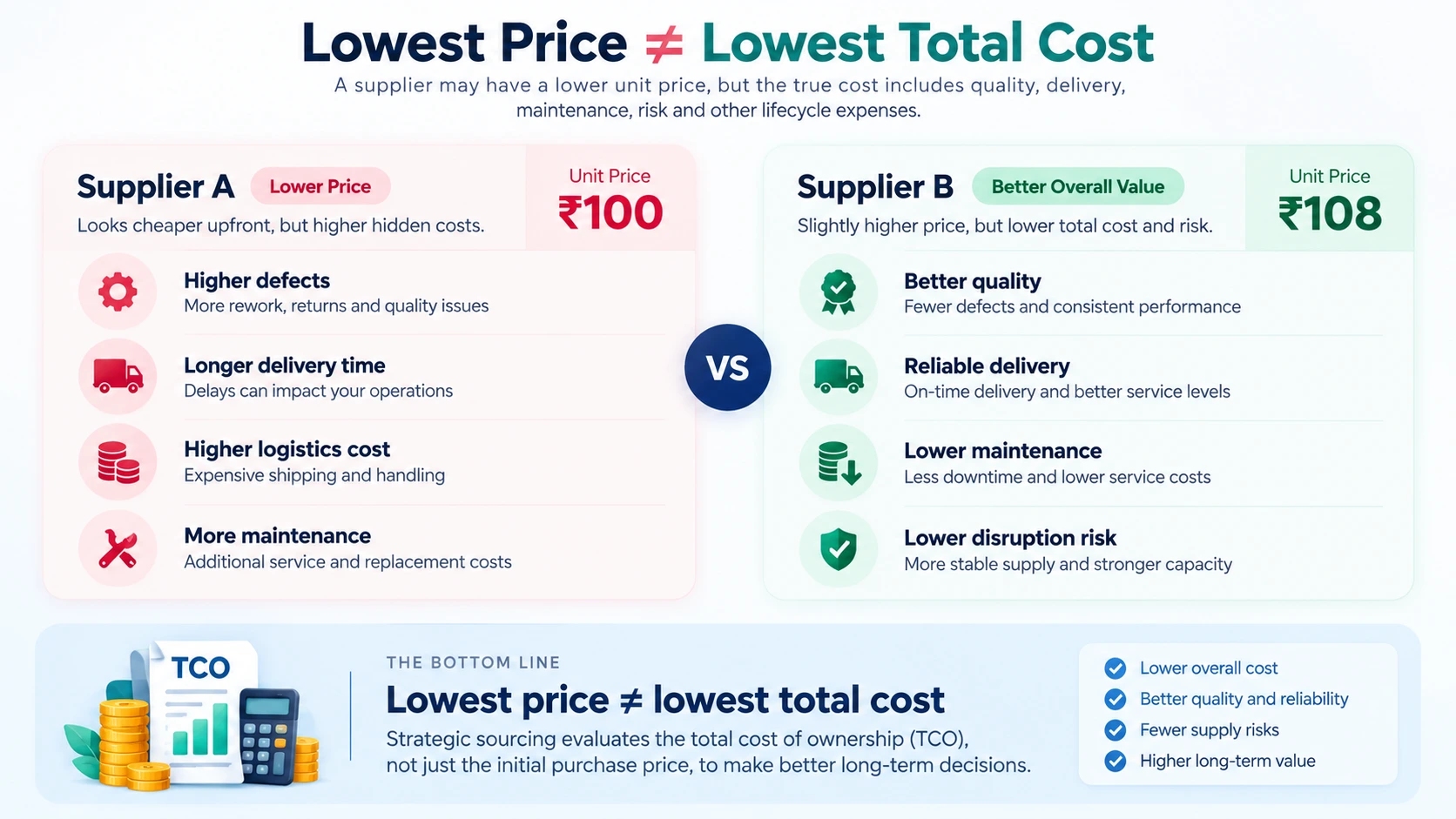
A low-cost supplier that repeatedly delivers late may ultimately cost more than a slightly more expensive supplier with reliable delivery.
Similarly, a supplier offering the lowest initial price may not have the capacity to support future growth.
Strategic sourcing brings these trade-offs into the decision.
There is no single universal strategic sourcing process that every organization must follow.
The number and sequence of activities can change based on spend category, business objectives, supplier market, risk and complexity.
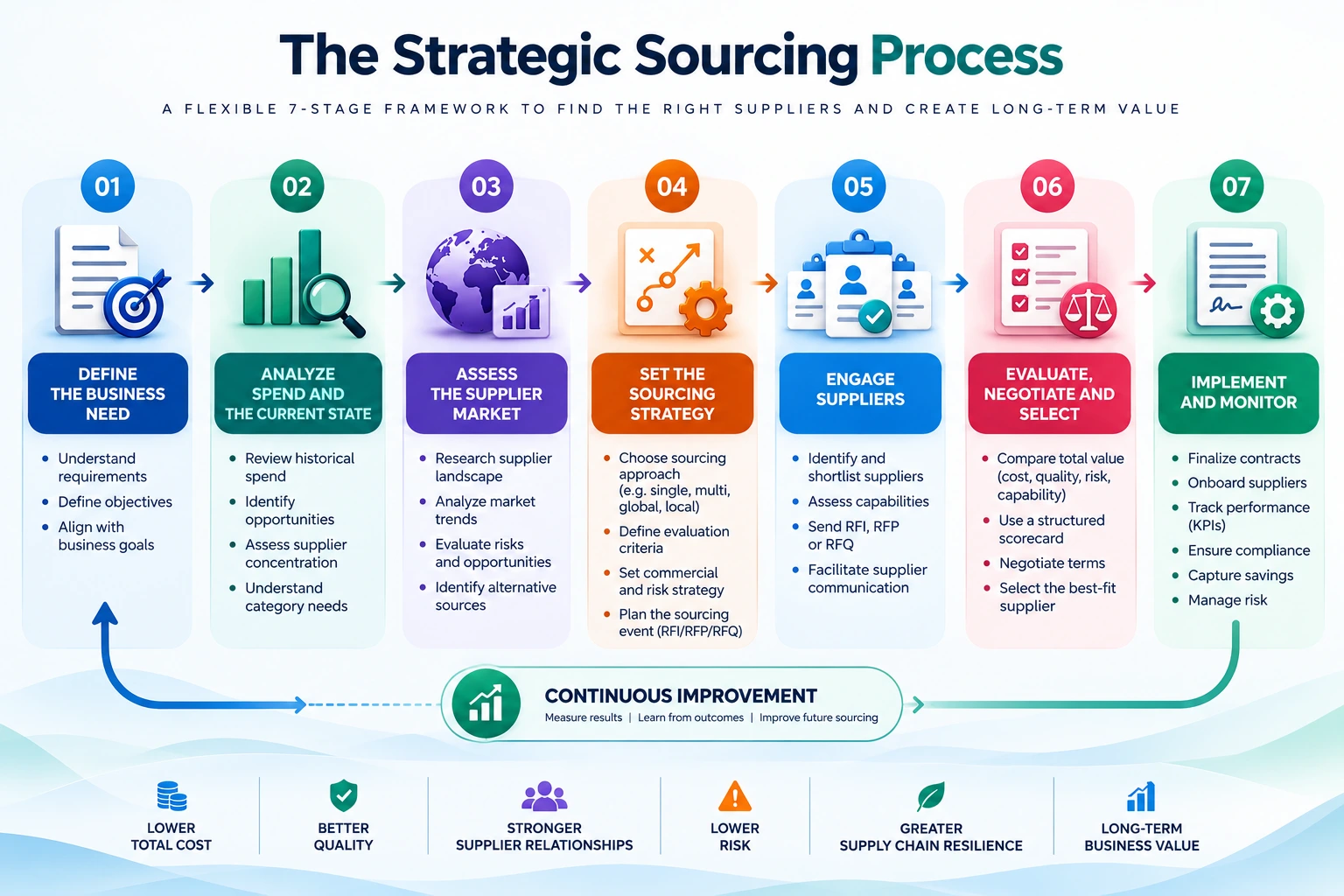
However, a typical strategic sourcing process can be organized into seven stages:

The important principle is not simply completing all seven steps.
It is knowing which activities are necessary for the sourcing decision at hand.
Strategic sourcing should begin with the business requirement, not with a supplier list.
Before approaching suppliers, the procurement team should understand:
The sourcing objective should then be defined.
For example:
A clear objective gives the rest of the sourcing process a direction.
You cannot improve a sourcing strategy without understanding the current situation.
spend analysis helps procurement teams understand:
A simple example
Suppose three business units independently purchase the same category.
Business Unit A spends ₹40 lakh.
Business Unit B spends ₹25 lakh.
Business Unit C spends ₹35 lakh.
Individually, each team may appear to have limited negotiating power.
Together, the organization has ₹1 crore of demand.
That consolidated view could change the sourcing strategy.
This is why spend visibility is often the foundation of strategic sourcing.
Once the internal requirement is understood, the next question is:
What does the external supplier market look like?
Market analysis can include:
The objective is not simply to create the longest possible supplier list.
It is to understand how much choice and negotiating leverage actually exist.
A category with hundreds of qualified suppliers may support competitive bidding.
A category with only two technically capable suppliers requires a different strategy.
Now the procurement team can determine how the requirement should be sourced.
Potential strategies include:
The right strategy depends on the category.
Example
A critical component may justify dual sourcing because business continuity matters more than achieving the lowest possible unit price.
A standardized commodity with many qualified suppliers may benefit from a competitive RFQ.
An existing strategic supplier with excellent performance may be better suited to a contract extension than a completely new sourcing event.
Strategic sourcing is therefore about choosing the right sourcing approach, not automatically running an RFP every time.
Once the sourcing strategy is established, procurement can identify suppliers that could realistically meet the requirement. Structured vendor management supports supplier information and qualification.
Potential suppliers may be assessed on:
Not every supplier needs to participate in every sourcing event.
The objective is to create a qualified supplier pool that can provide meaningful competition or strategic alternatives.
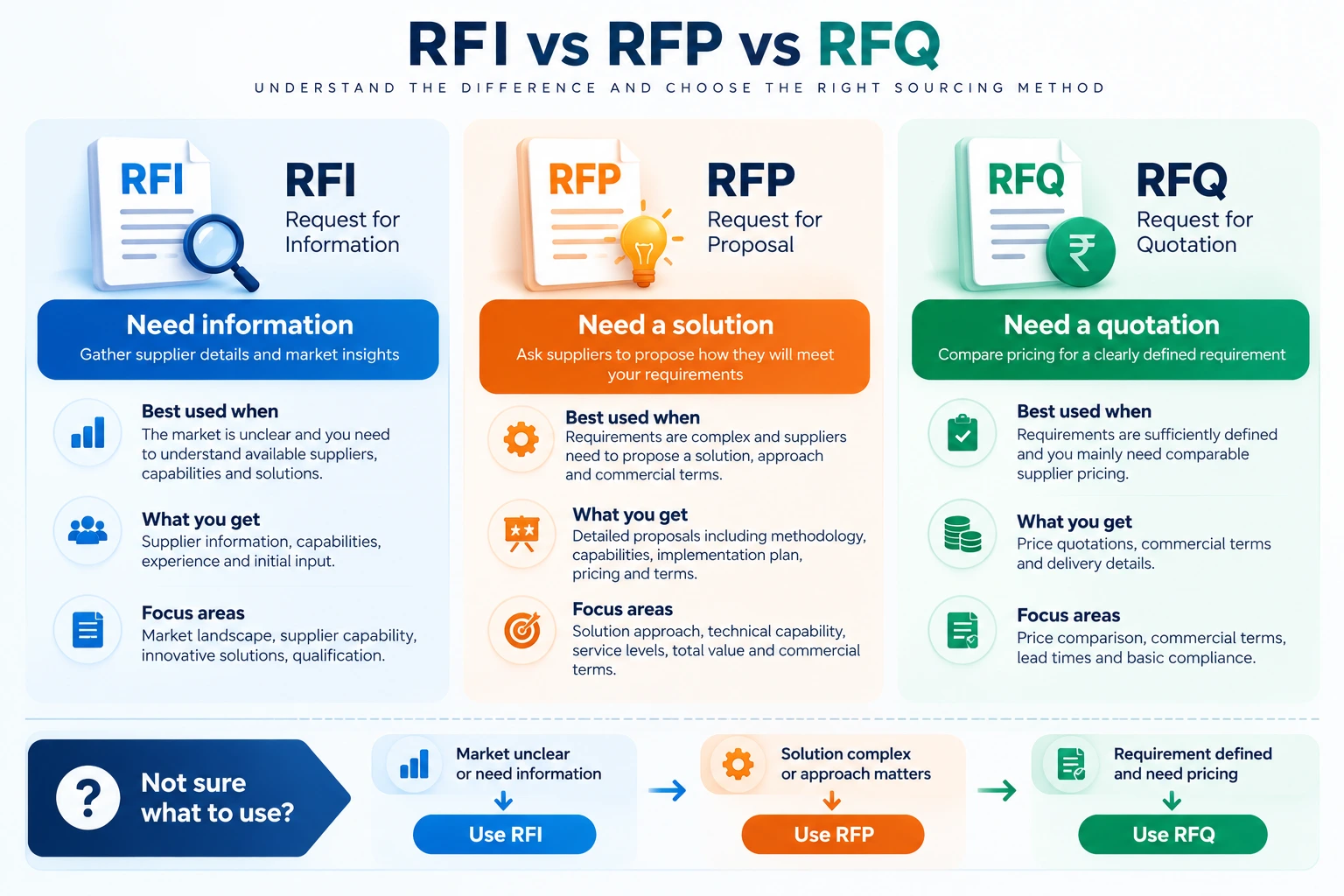
These terms are often used interchangeably, but they serve different purposes.

Use an RFI when you first need to understand:
Who can solve this problem, and how?
It is primarily an information-gathering exercise.
Use an RFP when suppliers need to explain:
Use an RFQ when the requirement is already sufficiently defined and the organization mainly needs comparable quotations. A digital quotation management workflow can help organize and compare supplier quotes.
Receiving supplier responses is not the same as making the right sourcing decision.
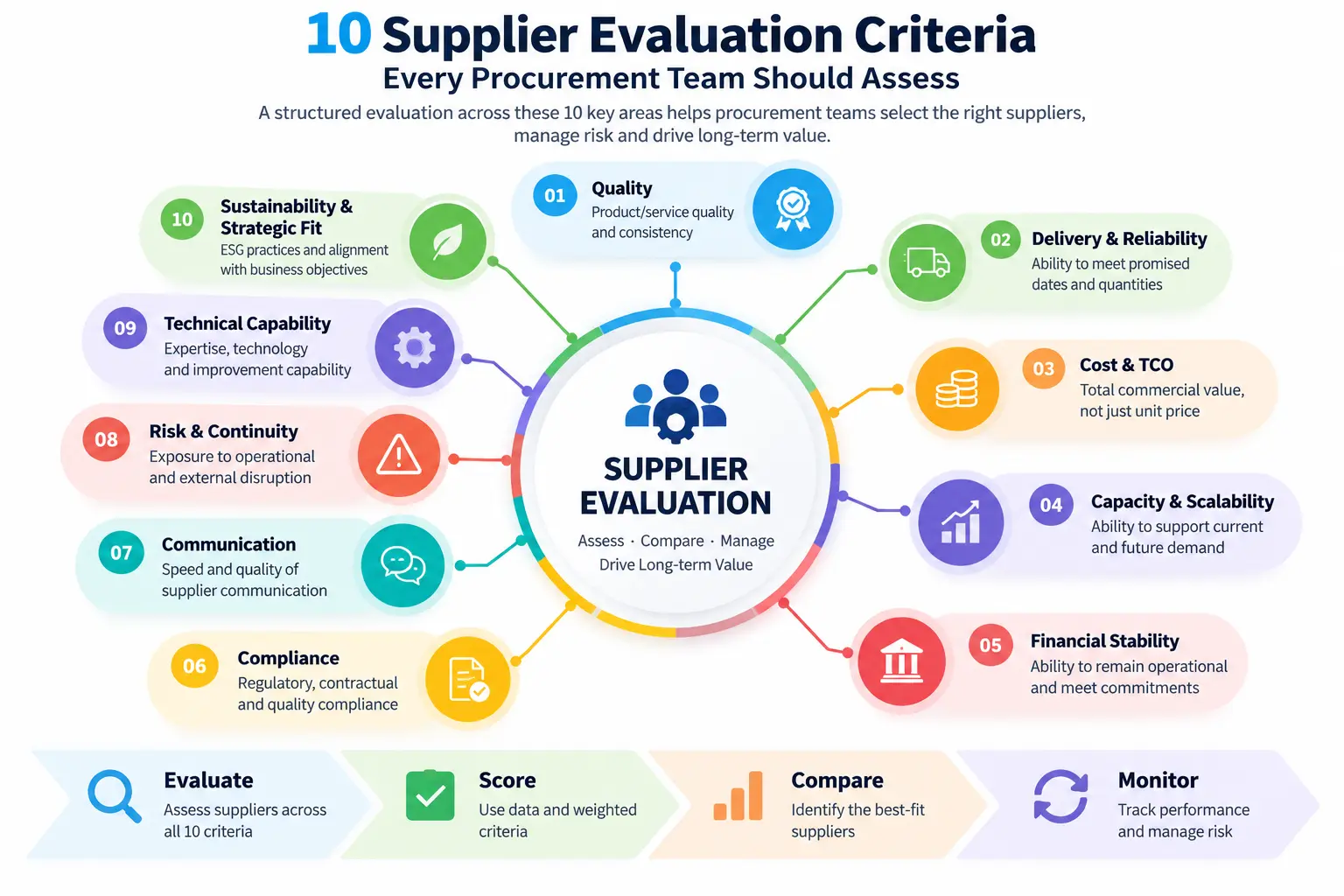
The next step is to use a consistent supplier evaluation framework.
A typical evaluation model might look like this:
| Evaluation criterion | Example weight |
|---|---|
| Total cost | 30% |
| Quality | 20% |
| Delivery capability | 15% |
| Supplier risk | 15% |
| Technical capability | 10% |
| Service | 10% |
These percentages are illustrative, not universal.
The weights should reflect the category.
For a highly regulated purchase, compliance might carry a much higher weight.
For a critical production component, supply continuity and quality may matter more.
For a standardized commodity, price may legitimately receive greater weight.
Why weighted evaluation matters
Without predefined criteria, supplier selection can become subjective.
A weighted evaluation model makes the decision more:
But scoring should not replace procurement judgment.
A supplier with a high numerical score may still present a critical risk that requires investigation.
One of the most important principles in strategic sourcing is total cost of ownership (TCO).
TCO considers the broader costs associated with acquiring and using a product or service rather than looking only at its initial purchase price.

The actual business cost could be higher.
Strategic sourcing therefore asks:
What will this supplier really cost the organization?
Not simply:
What is the quoted price?
Supplier selection is not the end of strategic sourcing.
Once a supplier is selected, the organization needs to:
Negotiate → Award → Contract → Onboard → Implement → Monitor
The negotiated terms need to become operational reality. Clear contract management helps carry agreed terms into execution.
That means ensuring:
This is where strategic sourcing connects to the broader procurement lifecycle.
A common mistake is to treat sourcing as complete once the supplier has been selected.
It isn't.
The organization should continue evaluating:
The outcome of supplier performance reviews should feed into future sourcing decisions.
That creates a continuous cycle:
Source → Contract → Buy → Measure → Learn → Improve → Source again
This is a stronger strategic model than treating each sourcing event as an isolated project.
The easiest way to understand strategic sourcing is to see how the decision changes in different categories.
A manufacturer needs a critical electronic component.
Supplier A offers the lowest price.
Supplier B costs slightly more but offers:
A strategic sourcing decision would compare the total value and risk profile, rather than automatically selecting Supplier A.
A company needs an enterprise software solution.
The cheapest subscription may not be the lowest-cost option over its lifecycle.
Procurement may need to evaluate:
This is strategic sourcing because the decision considers the broader business impact.
A company is selecting a logistics partner.
Instead of comparing only freight rates, procurement could evaluate:
The supplier with the lowest rate is not necessarily the supplier that creates the most value.
When implemented effectively, strategic sourcing can improve several areas of procurement and business performance.
strategic sourcing, competition, negotiation and TCO analysis can help organizations identify opportunities to reduce unnecessary costs.
Evaluating financial, geographic, operational and supply risks can reduce dependence on vulnerable suppliers.
Clear selection criteria and measurable performance expectations can improve quality, delivery and service.
Strategic suppliers can become long-term partners rather than simply transaction-based vendors.
Centralized spend information makes it easier to identify patterns, consolidation opportunities and areas requiring attention.
Organizations can build alternative supply options, diversify critical categories and prepare for potential disruptions.
Strategic sourcing connects purchasing decisions with objectives such as:
A good strategic sourcing strategy is not about adding more steps.
It is about making better decisions at each stage.
Don't begin with:
“Which supplier should we use?”
Begin with:
“What business outcome are we trying to achieve?”
You need to understand the current baseline before determining what improvement looks like.
Establish the criteria and weights before reviewing supplier proposals.
This reduces the risk of changing the rules after seeing the responses.
Consider relevant costs beyond the quoted unit price.
Not every requirement needs:
Use the method that fits the situation.
Procurement should not make supplier decisions in isolation.
Depending on the category, relevant stakeholders may include:
A low-cost supplier with a high probability of disruption may create more risk than value.
A sourcing decision should be tested against actual results.
Maintain a clear record of:
This improves transparency and makes future sourcing easier.
Every sourcing event should generate information that can improve the next one.
Cost savings are important, but they are not the only way to measure strategic sourcing.
A balanced measurement framework can include:
| KPI | What it measures |
|---|---|
| Realized savings | Savings actually captured after implementation |
| Cost avoidance | Costs prevented through sourcing decisions |
| Sourcing cycle time | Time required to complete sourcing events |
| Supplier quality | Quality performance against agreed standards |
| On-time delivery | Supplier delivery reliability |
| Contract compliance | Whether negotiated terms are followed |
| Supplier concentration | Dependency on individual suppliers |
| Supplier performance | Overall supplier results against agreed KPIs |
| Risk reduction | Reduction in identified supplier or supply risks |
This distinction matters.
A supplier may agree to a lower price during negotiation, but if:
the organization may not realize the expected savings.
Strategic sourcing success should therefore be measured by business results, not just negotiated numbers.
Strategic sourcing can fail even when the basic process looks correct. Related procurement challenges include poor spend visibility, incomplete supplier information and weak post-award monitoring.
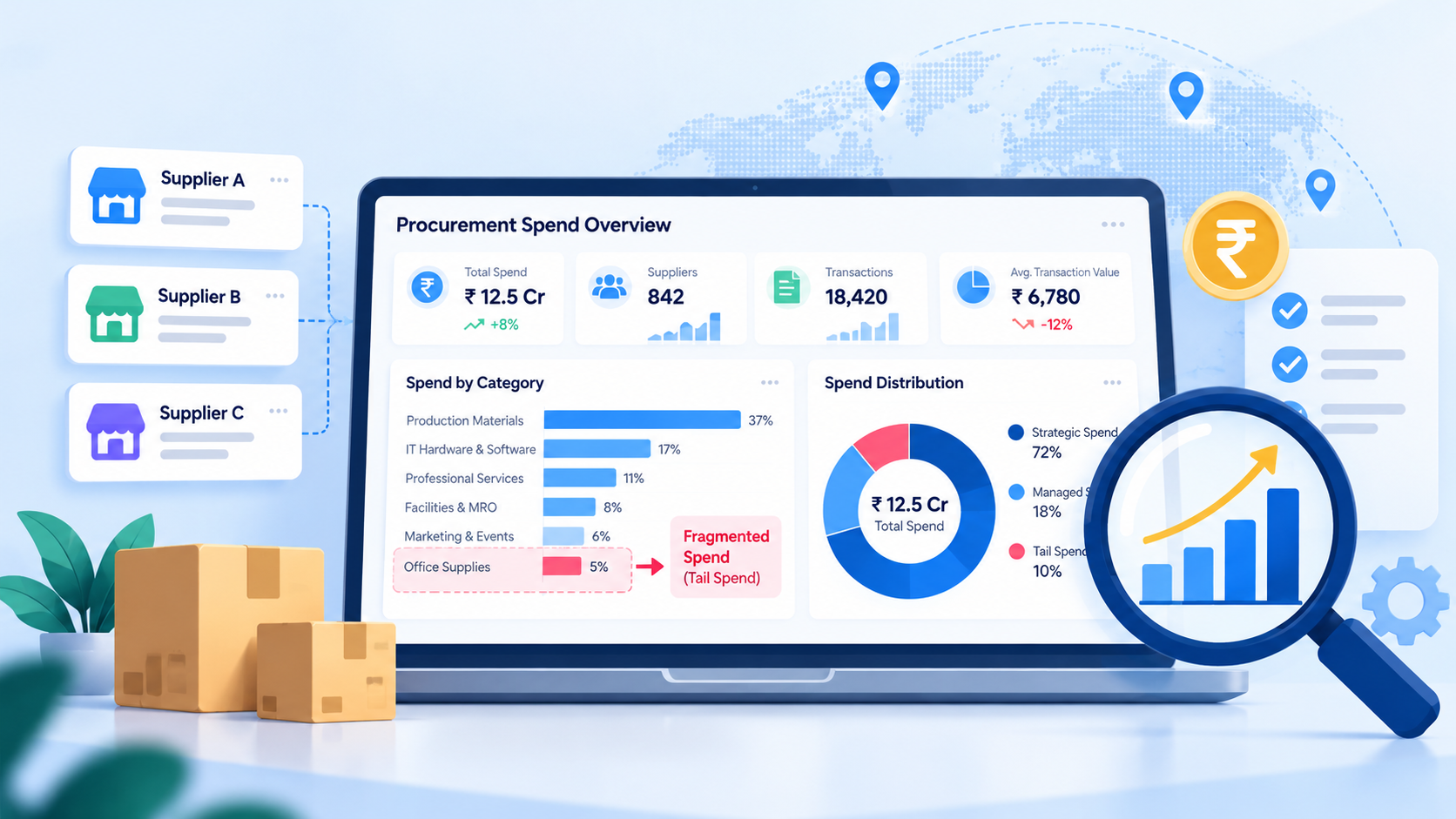
If procurement cannot see where money is going, it becomes difficult to identify opportunities.
Supplier decisions based on outdated or incomplete information increase risk.
Selecting the lowest bidder without considering TCO, quality or risk can create downstream costs.
Spreadsheets, emails and disconnected documents make supplier comparisons and approvals harder to manage.
A supplier that looks attractive to procurement may not meet operational or technical requirements.
Without performance tracking, procurement may not know whether the sourcing decision delivered the expected value.
Technology does not replace strategic sourcing judgment.
It can, however, make the process easier to manage, analyze and repeat.
Modern sourcing technology can support activities such as:
The biggest opportunity comes when these activities are connected rather than managed through isolated spreadsheets and email threads.
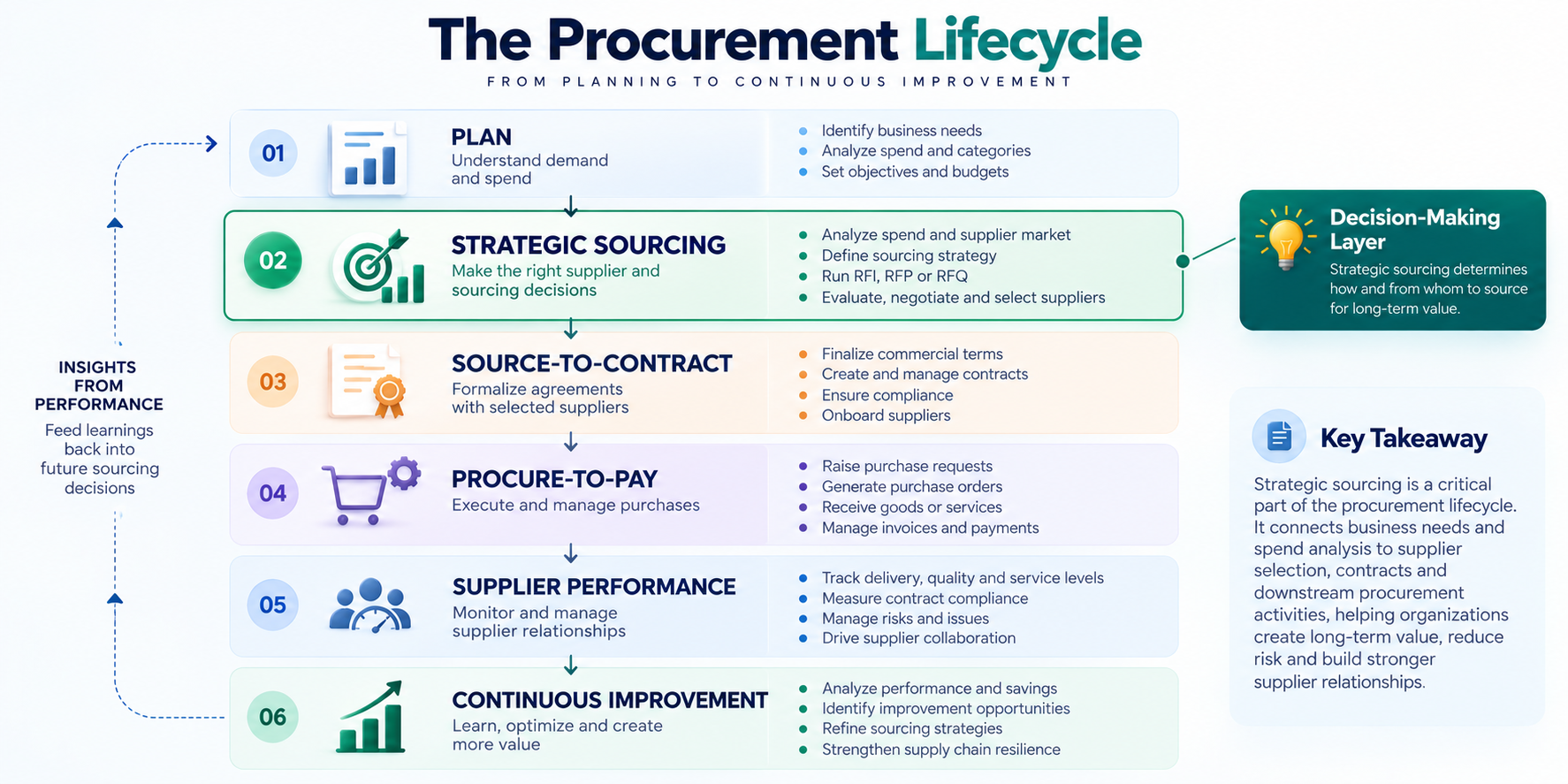
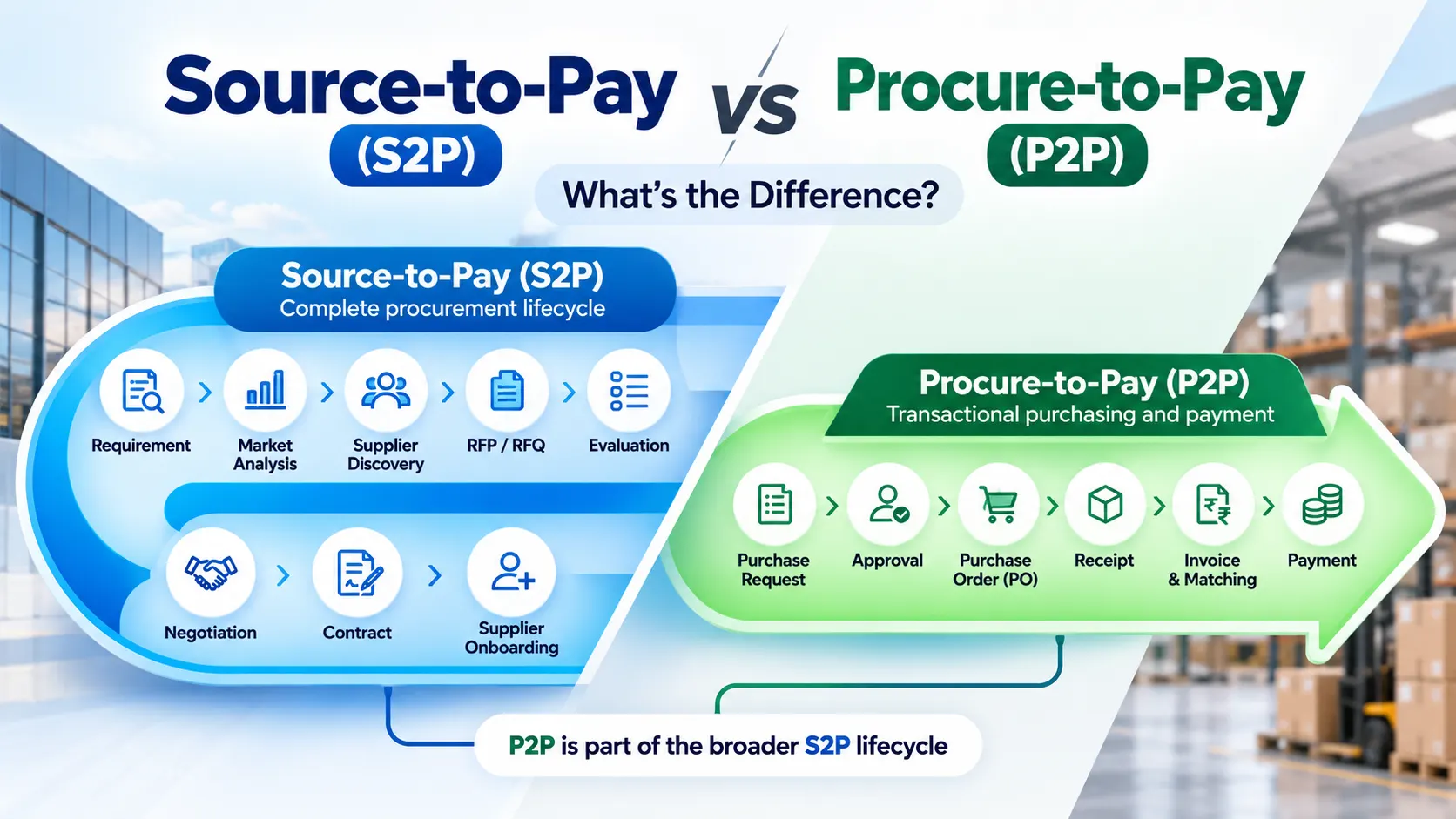
Strategic sourcing is only one part of the broader procurement lifecycle. Its downstream execution connects with the procure-to-pay process.
A simplified view looks like this:

Strategic sourcing therefore sits primarily around the source-to-contract side of procurement, while its decisions influence what happens throughout the downstream procurement lifecycle.
This connection is critical because the value negotiated during sourcing should ultimately be reflected in purchasing, contracts, supplier performance and financial outcomes.
These concepts are related but operate at different levels.
Strategic sourcing focuses on sourcing decisions and supplier selection.
source-to-pay (S2P) encompasses a broader procurement journey, typically covering activities from sourcing and contracting through purchasing, invoicing and payment.
Think of it this way:
Strategic sourcing chooses the best sourcing path and supplier.
Source-to-pay connects that decision to the broader procurement process.
This distinction helps organizations understand why sourcing technology should not operate as an isolated workflow.
Before starting a sourcing event, ask these seven questions:
If the answers are clear, the sourcing strategy becomes much easier to design.
Strategic sourcing is moving beyond the traditional objective of negotiating lower prices.
Modern procurement teams increasingly need to balance:

That means the role of procurement is increasingly about making better decisions with better information.
Technology can support this shift by bringing spend, supplier, sourcing, contract and performance information together.
But the fundamental principle remains simple:
The goal of strategic sourcing is not to find the cheapest supplier. It is to make the best sourcing decision for the business.
Strategic sourcing is a structured, data-driven approach to selecting suppliers and managing sourcing decisions based on total business value, including cost, quality, risk, supplier capability and long-term objectives.
A typical strategic sourcing process includes defining the business need, analyzing spend, researching the supplier market, developing a sourcing strategy, identifying and engaging suppliers, evaluating and negotiating offers, and implementing and monitoring supplier performance.
The exact process can vary by category and business requirements.
Strategic sourcing is the part of procurement focused on making informed sourcing and supplier decisions. It helps determine what to source, from whom, through which sourcing method and under what commercial conditions.
Strategic sourcing focuses primarily on supplier selection, sourcing strategy, evaluation and negotiation. Procurement covers the broader acquisition process, including purchasing, receiving, invoicing and payment.
Strategic sourcing takes a longer-term, value-based approach that considers factors such as TCO, risk, quality and supplier performance. Tactical sourcing generally focuses more heavily on fulfilling an immediate requirement and obtaining an acceptable price.
Key benefits include better cost management, reduced supplier risk, improved supplier performance, stronger supplier relationships, greater spend visibility, improved resilience and better alignment between procurement and business objectives.
An RFI gathers supplier and market information. An RFP asks suppliers to propose a solution to a more complex requirement. An RFQ is generally used when requirements are clearly defined and comparable quotations are required.
No. Cost is important, but strategic sourcing also considers quality, supplier capability, risk, delivery, sustainability, innovation, resilience and total cost of ownership.
Strategic sourcing can be measured using realized savings, cost avoidance, sourcing cycle time, supplier quality, on-time delivery, contract compliance, supplier concentration, supplier performance and risk reduction.
No. The appropriate sourcing method depends on the category, supplier market, business requirements and level of complexity. In some situations, an RFQ, RFI, negotiation, competitive event or incumbent contract extension may be more appropriate than a full RFP.
Strategic sourcing is not simply the process of finding a supplier at the lowest price.
It is a structured way of making better supplier and purchasing decisions by considering cost, quality, risk, capability, performance and long-term business value together.
A strong strategic sourcing process moves from:
Business need → Spend analysis → Market intelligence → Sourcing strategy → Supplier evaluation → Negotiation → Selection → Contract → Performance
The most effective organizations don't treat these stages as a rigid checklist.
They adapt the approach to the category, understand the trade-offs, use reliable data and measure whether the sourcing decision actually delivered the expected business outcome.
And that is what turns sourcing from a purchasing activity into a strategic procurement capability.
Procurement Software Trends in 2026: What to Expect
Read More →
Why E-Procurement Outperforms Traditional ERP in Modern Procurement
Read More →
Top Procurement Software in India: 12 Best Options for 2026
Read More →
Best Procurement Software Companies in Kuwait (2025)
Read More →
5 Best Procurement Software in Africa for Enterprises & SMEs (2026 Guide)
Read More →
Best Procurement Software in Nigeria 2026 | Top 5 Picks
Read More →
Best Procurement Software Providers in USA (2025): How AI is Transforming the Future
Read More →
10 Best Procurement Software Providers in Thailand for Streamlined Supply Chain Management
Read More →
Top 10 Cloud-Based Procurement Solutions in Portugal for Businesses in 2025
Read More →
Top 10 Procurement Software Providers in Switzerland 2026: Streamlining Sourcing and Supplier Management
Read More →
What Makes ZYNO Procurement Different from Other Oil & Gas Procurement Software
Read More →
The Digital Transformation of Logistics Procurement in the Middle East
Read More →
A Step by Step Guide to Procurement Management Software for Modern Enterprises
Read More →
Sourcing and Procurement: What is the Difference and Why It Matters
Read More →Difference Between Procurement and Supply Chain Management
Read More →
What Is Procurement Software and Why Do Modern Businesses Need It?
Read More →
Best Procurement Management Software to Automate ERP Process
Read More →
Direct vs Indirect Procurement: Key Differences, Examples & Uses (2026)
Read More →
Smart procurement strategies for cost optimization & risk management
Read More →
What Is Procurement? Everything You Need to Know (Types, Process & SAP)
Read More →Beyond Cost-Cutting: How Procurement Drives Margin Expansion in 2026
Read More →
Direct Procurement: Process, Examples, and When to Use It
Read More →
What Are the 5 Types of E-Procurement? A Complete Guide for Businesses
Read More →
Which Procurement Management Software Is Best? Top Tools Compared for 2026
Read More →
Top 8 Coupa Alternatives to Explore in 2026
Read More →
Looking to Replace Coupa? Discover the Best Alternatives Like ZYNO Procurement
Read More →
How Does Procurement Software Work? A Complete Guide
Read More →
ZYNO Procurement vs Coupa: Best Procurement Software Comparison for Mid-Market Teams
Read More →
Best SAP ARIBA Procurement Alternatives in 2026
Read More →
ZYNO Procurement vs SAP Ariba: Which Solution Is More User-Friendly?
Read More →
AI-Powered Procurement Management Software for Fast, Connected, and Visible Workflows in Dubai
Read More →
What is Vendor Management? Complete Guide to Vendor Management Software, Systems, and Processes
Read More →
Best Procurement Management Software In Kenya
Read More →
6 SAP Ariba Alternatives for Mid-Market Businesses in 2026
Read More →
Top E-Procurement Solutions for B2B Organizations (2026)
Read More →
Quotation Format: Free Templates + Complete Guide (2026)
Read More →
Cost Control Software: Features, Benefits & Performance Guide for 2026
Read More →
Procurement Workflow: Steps, Stages, and Real Examples
Read More →
Top 10 Zycus Alternatives for Procurement Teams in 2026
Read More →
Best Precoro Alternative for Purchase Requisition and Procurement
Read More →
Top AI Procurement Tools in 2026
Read More →
Best Tools for Supplier Risk Management
Read More →
FEFO vs FIFO vs LIFO: Differences, Benefits & Which Inventory Method Is Best?
Read More →
AI Procurement Software: Features, Benefits, Use Cases & How to Choose
Read More →
Best AI Tools for Supply Chain Procurement
Read More →
Procurement Risk Management
Read More →
Still Using Excel for Procurement? Read This Before It's Too Late
Read More →
Best RFP Software in 2026: Top Tools Compared for Faster Proposal Responses
Read More →
What Is Procure-to-Pay (P2P)? A Complete Guide
Read More →
Complete Procurement Workflow Guide for Modern Businesses
Read More →
Complete Guide to E-Procurement Solutions for B2B Organizations
Read More →
Cost Control Software Comparison Guide: Features, Pricing & Benefits
Read More →
Purchase Order Tracking: How to Manage Every PO Without the Chaos
Read More →
Inventory Management: What It Is, How It Works and Why It Matters
Read More →
Top 10 Procurement Software Tools for Purchasing Automation in 2026
Read More →
Agentic AI Procurement Platforms and the Future of Strategic Sourcing
Read More →
AI Spend Analytics Software for Procurement Leaders
Read More →
From Prompt to Procurement: How AI Is Transforming Enterprise Purchasing
Read More →
ZYNO Procurement vs IBM Procure-to-Pay Automation
Read More →
ZYNO Procurement vs Infor Nexus: Which Procure-to-Pay Platform Fits Your Team?
Read More →
AI-Powered Procurement Software in 2026: Top 6 Platforms That Actually Deliver ROI
Read More →
Contract Management Software Buyer's Guide: Features, Costs & Top Picks
Read More →
Top 10 Procure to Pay Software Companies in India 2026
Read More →
10 Best Vendor Management Software in India (2026): Features, Benefits & Comparison
Read More →
How Machine Learning and AI Are Transforming Procurement: A Strategic Overview
Read More →
What Is Procurement Software for GP? Features, Benefits and Best Solutions for Businesses
Read More →
What Procurement Software Do Mid-Market Companies Use Instead of SAP Ariba or Coupa?
Read More →
Prompt-Based Procurement Software for Kenyan Businesses
Read More →
Project Management Software: A Complete Guide to Streamline Business Operations and Procurement Processes
Read More →
SAP Ariba vs ZYNO Procurement: Complete Feature Comparison (2026)
Read More →
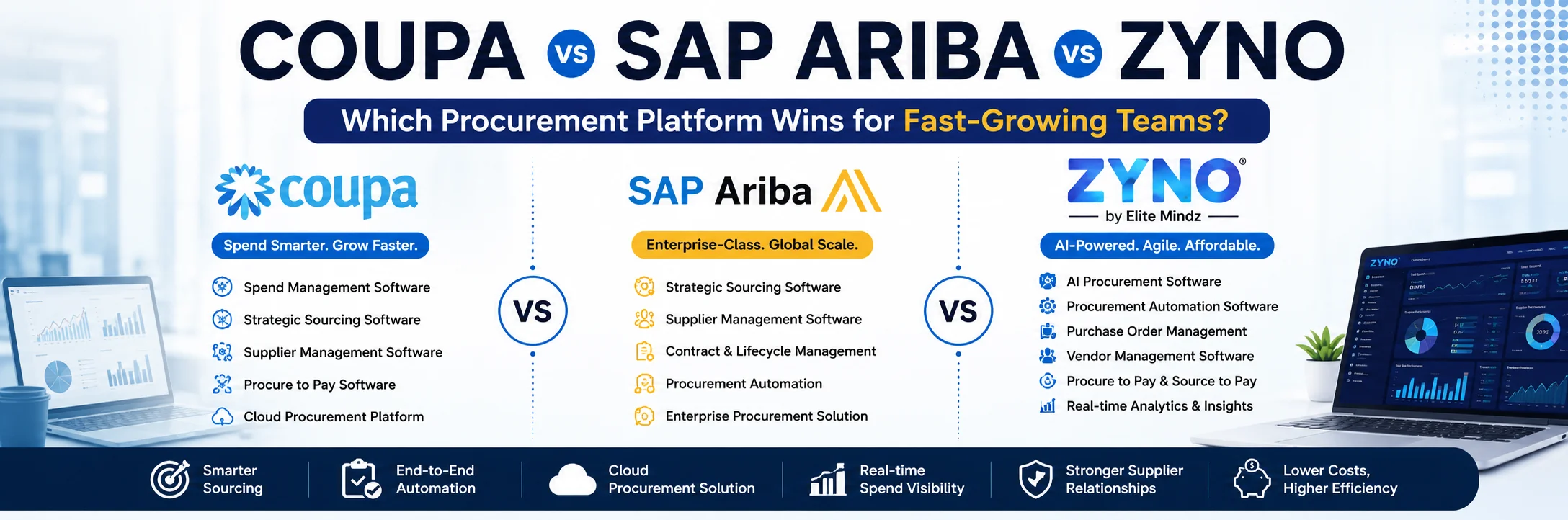
Coupa vs SAP Ariba vs ZYNO: Which Procurement Platform Wins for Fast-Growing Teams?
Read More →
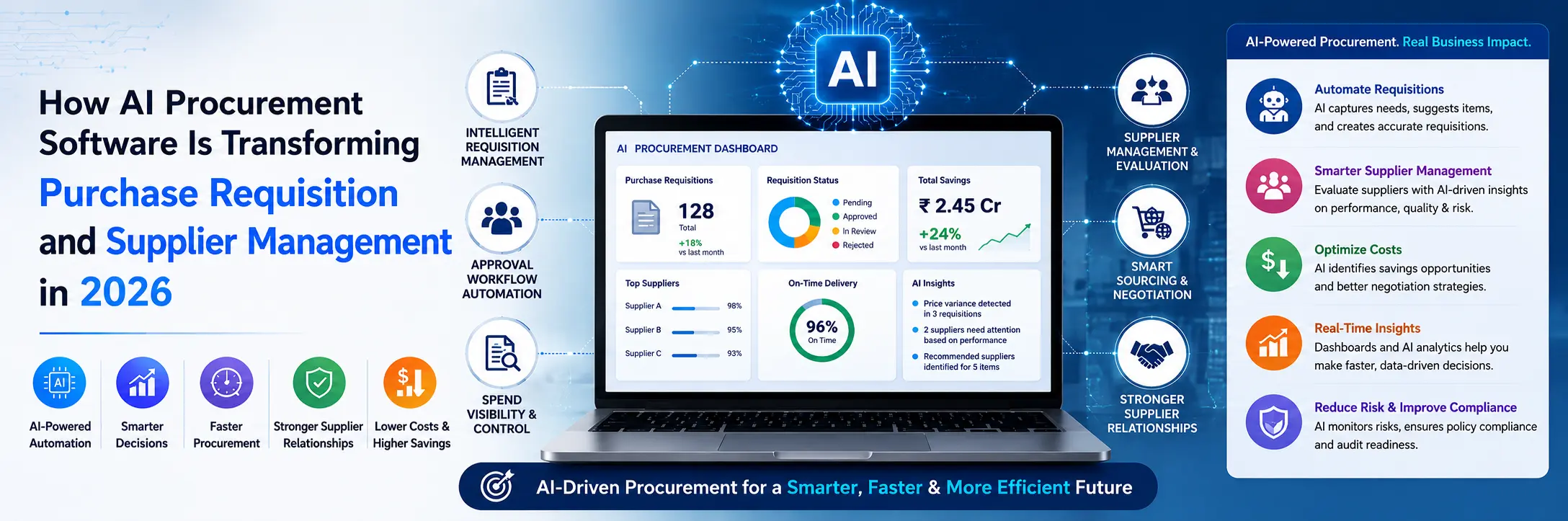
How AI Procurement Software Is Transforming Purchase Requisition and Supplier Management in 2026
Read More →
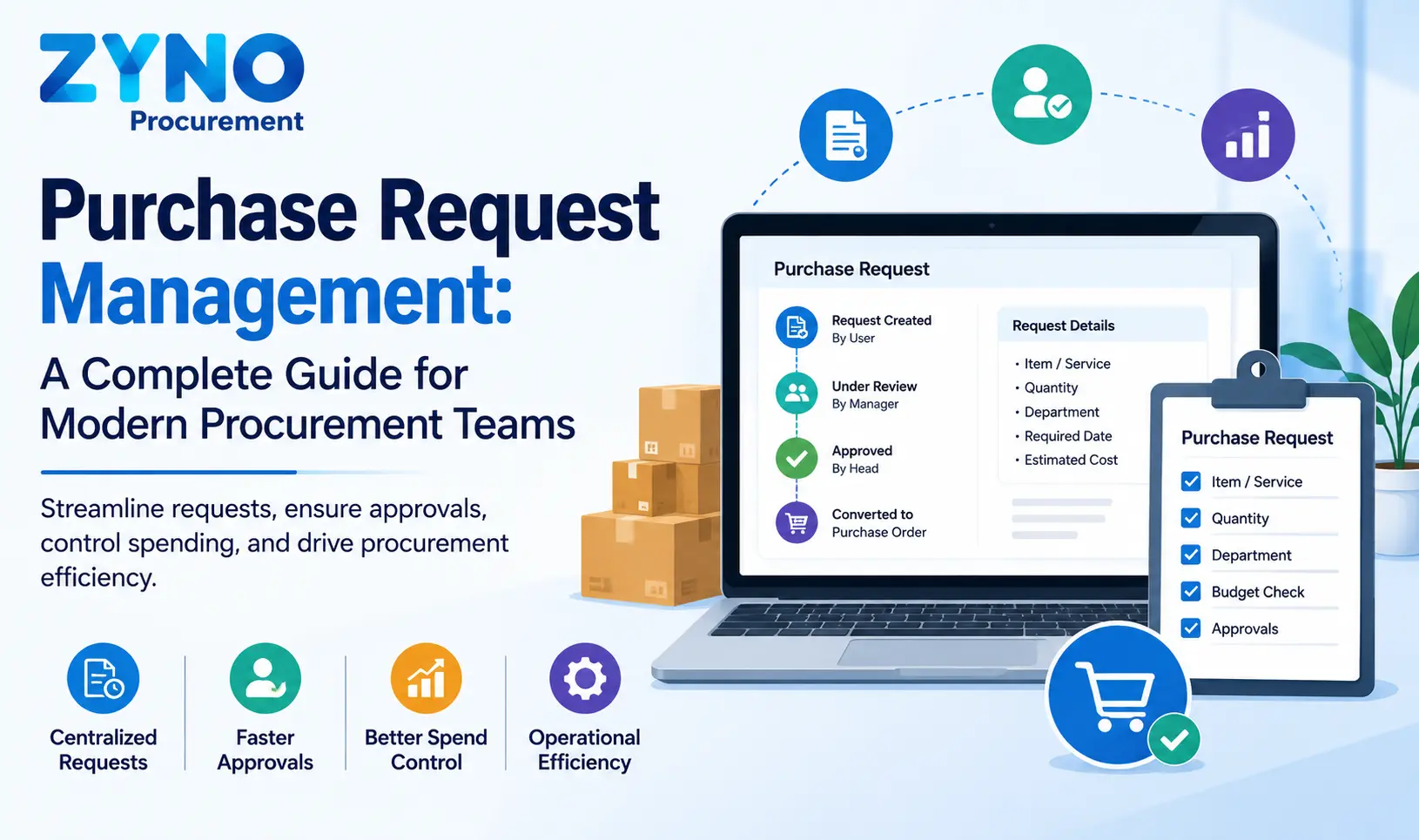
Purchase Request Management: A Complete Guide for Modern Procurement Teams
Read More →
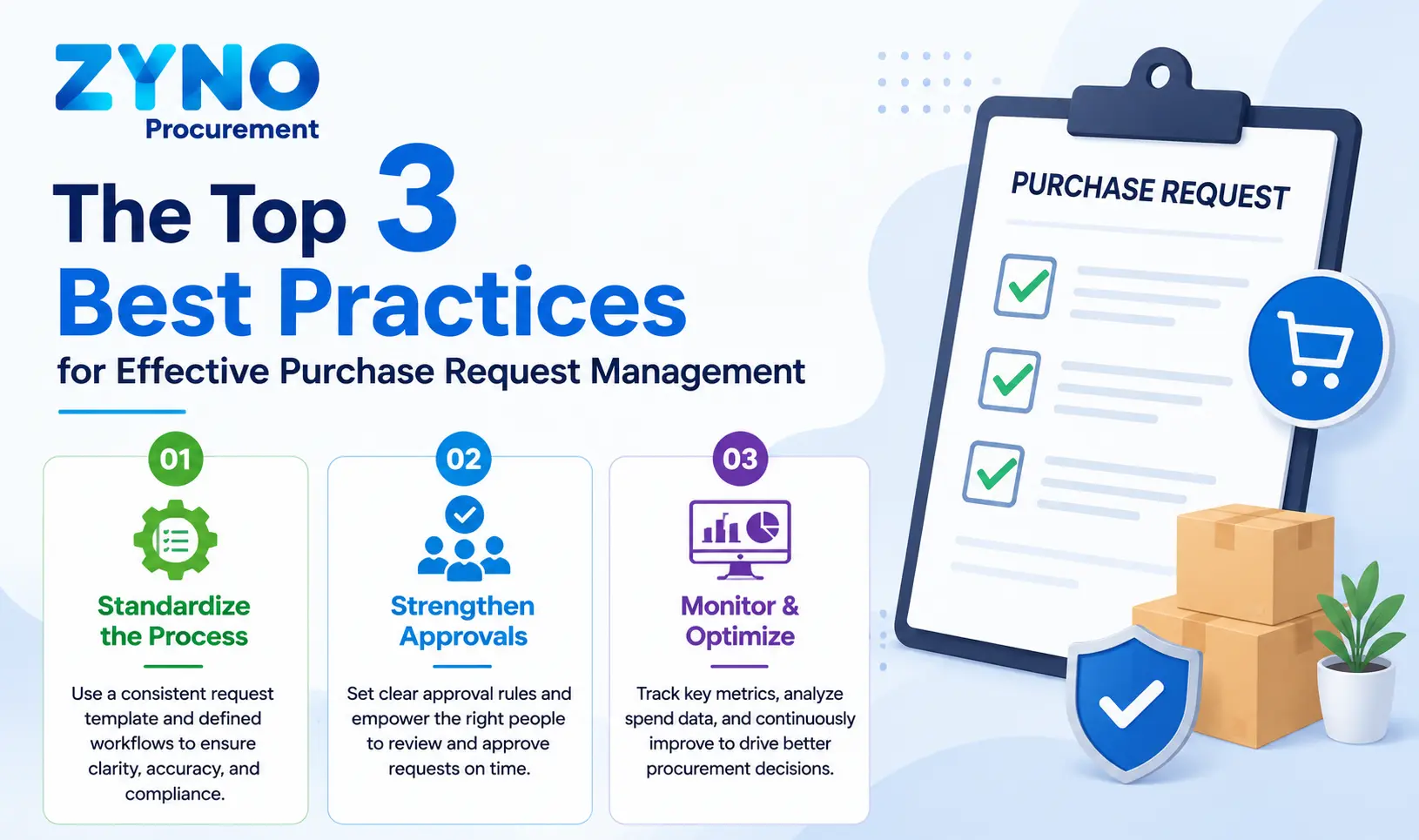
The Top 3 Best Practices for Effective Purchase Request Management
Read More →
What Is Purchase Order Automation? How to Automate Purchase Order Processing
Read More →
5 Common Purchase Request Mistakes and How to Avoid Them
Read More →
What is Supplier Relationship Management in Procurement? A Complete Guide
Read More →
What is Strategic Vendor Management? A Complete Guide for Modern Procurement
Read More →
What Are Inventory Control Methods? Complete Guide to Types, Techniques, Systems, & Benefits
Read More →
Inventory Audit Checklist: Steps, Process & Best Practices
Read More →
Warehouse Inventory Management: Best Practices for 2026
Read More →
Treasury Management System (TMS): A Complete Guide for Modern Corporates
Read More →
What is Portfolio Management Services (PMS) and What Are Its Benefits?
Read More →
Generative AI Procurement Software Solution: The Future of Intelligent Procurement
Read More →
Top Contract Management Software Companies in Ethiopia: Features, Benefits & Best Procurement Solutions
Read More →
AI Procurement Software: Complete Guide to Intelligent, Generative AI & Machine Learning Procurement Solutions
Read More →
Top SAP alternatives for small, midsize, and enterprise businesses
Read More →
Best RFP Software in 2026: Top Solutions for Smarter Procurement and Proposal Management
Read More →
GST on Purchase: Complete Guide to GST on Purchases in India
Read More →
Procurement Software UAE: Complete Guide to Choosing the Best Procurement Solution
Read More →
Supply Chain Procurement: Everything You Need to Know
Read More →
Top 10 Oracle Procurement Alternatives for Businesses in 2026
Read More →
Quotation Software vs Excel: Which Is Better for Businesses in 2026?
Read More →
Contract Management Software Buyer's Guide: Features, Pricing & How to Choose
Read More →
How to Identify the Right Vendor: 10 Simple Steps
Read More →
Top 10 Automated PO Generation Tools in 2026: Best Purchase Order Software with AI Capabilities
Read More →
How to Generate a PO Automatically in SAP: Step-by-Step Guide
Read More →
What Is the Best Budget-Friendly Procurement Software With Vendor Onboarding for Indian SMEs?
Read More →
How to Generate a PO Automatically in SAP: Step-by-Step Guide
Read More →
How to Solve Invoice Mismatches: 10 Real Ways to Fix Invoice Discrepancies
Read More →
Top 10 Vendor Onboarding Tools for Businesses in 2026: Features, Process & How to Choose
Read More →
Vendor Comparison & Supplier Intelligence: How AI Helps Businesses Choose the Right Vendor
Read More →
How to Choose the Right Procurement Management Software in 2026 (Complete Buyer's Guide)
Read More →
How to Reduce Procurement Costs: 18 Practical Strategies That Actually Work
Read More →
How to Choose the Right Procurement Management Software in 2026 (Complete Buyer's Guide)
Read More →
How to Calculate Procurement Software ROI: Formula, Example & Calculator
Read More →
Procurement Software Evaluation Checklist: 35 Criteria for Choosing the Right Platform
Read More →
How Businesses Can Improve Vendor Performance and Manage Supplier Risk
Read More →
Procure-to-Pay Process: Steps, Challenges & How to Automate It
Read More →
Purchase Requisition vs Purchase Order: What’s the Difference?
Read More →
10 Source-to-Pay Software Platforms to Consider in 2026
Read More →
Supplier Management Software Buying Guide: How to Choose the Right Platform
Read More →
Procurement Automation Guide: How It Works, What to Automate & How to Implement It
Read More →
Procurement Software Features: 12 Must-Have Capabilities to Look For
Read More →
Best E-Procurement Software in 2026: Top Electronic Procurement Systems for Modern Businesses
Read More →
AI in Vendor Management: Complete Guide to Automated Supplier Scoring and Supply Chain Risk Analysis
Read More →
Procurement Software vs ERP: What's the Difference and Which Do You Need?
Read More →
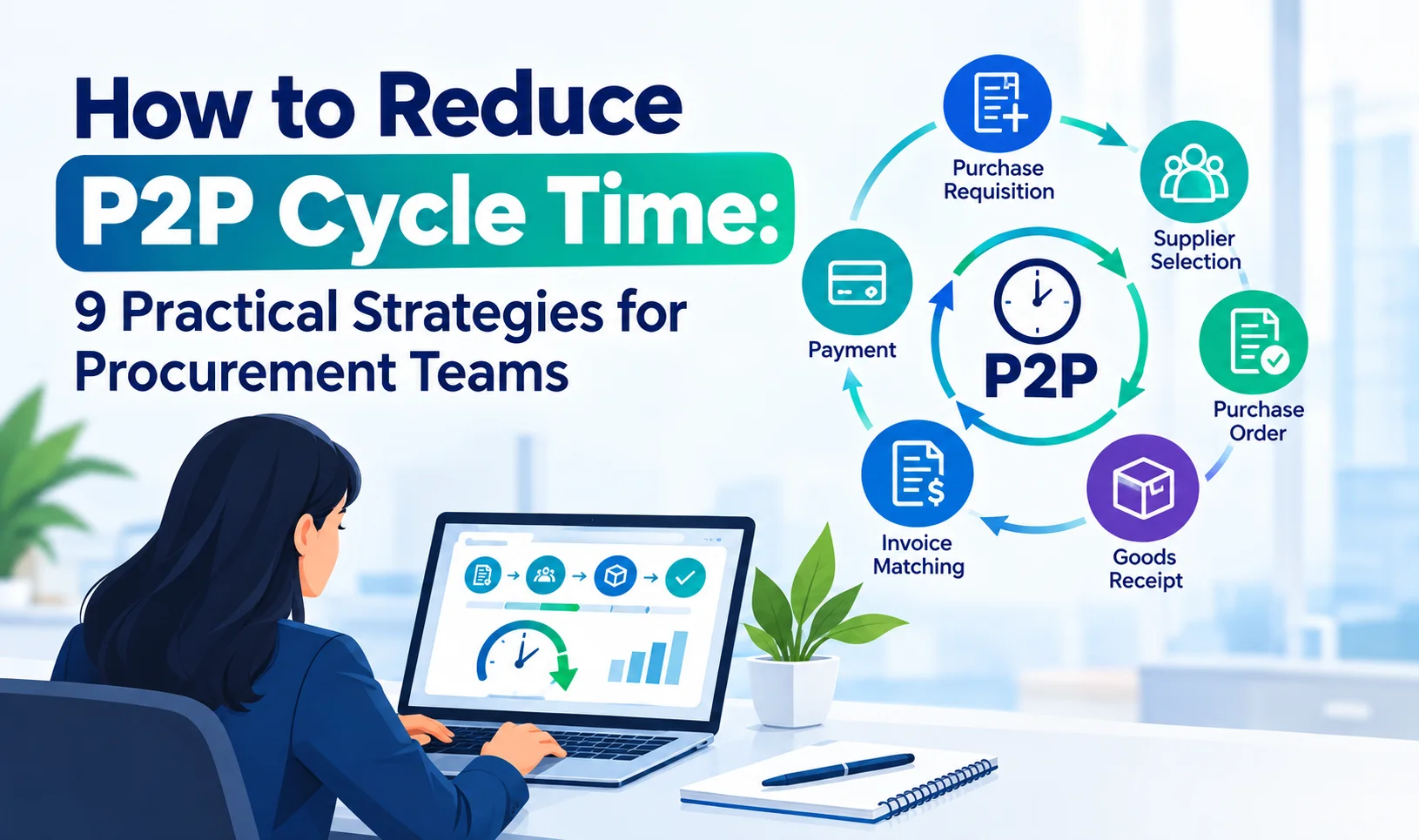
How to Reduce P2P Cycle Time: 9 Practical Strategies for Procurement Teams
Read More →
Procurement Software for Oil & Gas Companies in UAE and Saudi Arabia
Read More →
10 Vendor Onboarding Best Practices Every Business Should Follow (2026)
Read More →
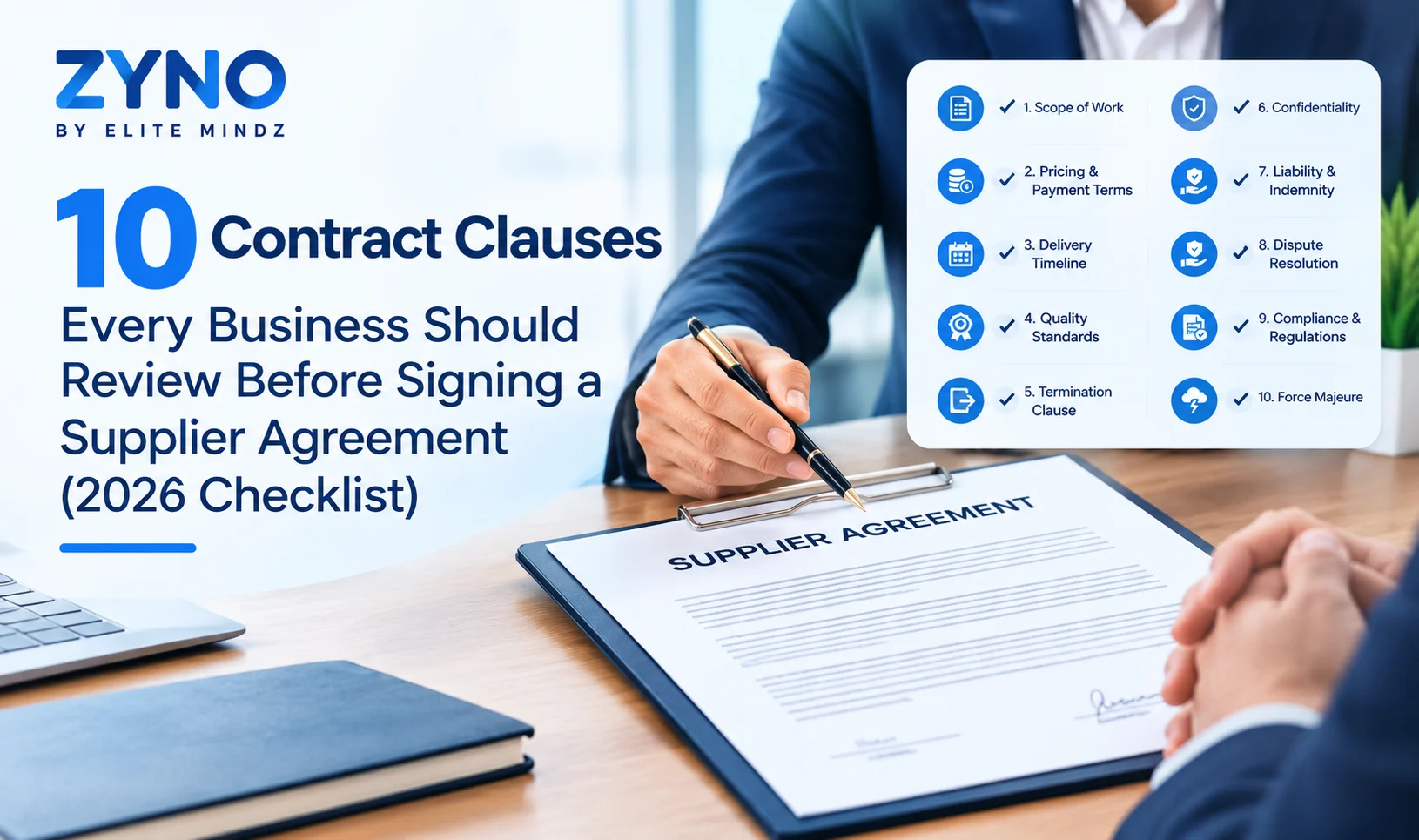
10 Contract Clauses Every Business Should Review Before Signing a Supplier Agreement (2026 Checklist)
Read More →
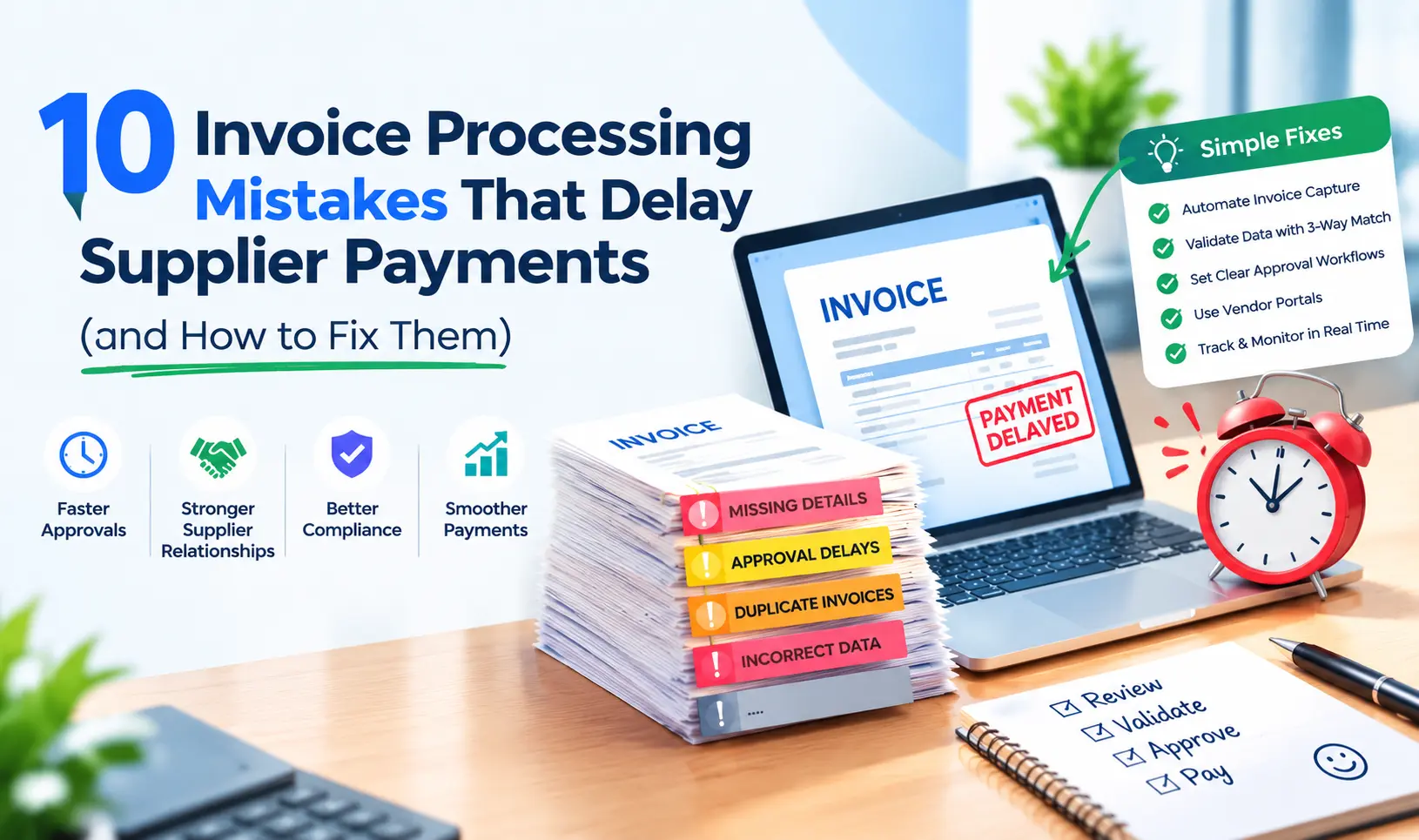
10 Invoice Processing Mistakes That Delay Supplier Payments (and How to Fix Them)
Read More →Source-to-Pay vs Procure-to-Pay: Key Differences, Processes & Software Guide
Read More →
Procurement Challenges: 15 Common Problems & How to Solve Them
Read More →
Supplier Evaluation Criteria: 10 Factors Every Procurement Team Should Assess
Read More →
What Is Strategic Sourcing? Process, Benefits & Best Practices
Read More →
Tail Spend Analysis: How to Identify, Measure and Optimize Fragmented Spend
Read More →Partner with ZYNO by Elite Mindz to revolutionize how your business works. Fill out the form, and we’ll reach out with AI-powered solutions made just for you.
We use browser cookies to ensure you get the best experience on our website. Learn more
The form was submitted successfully!